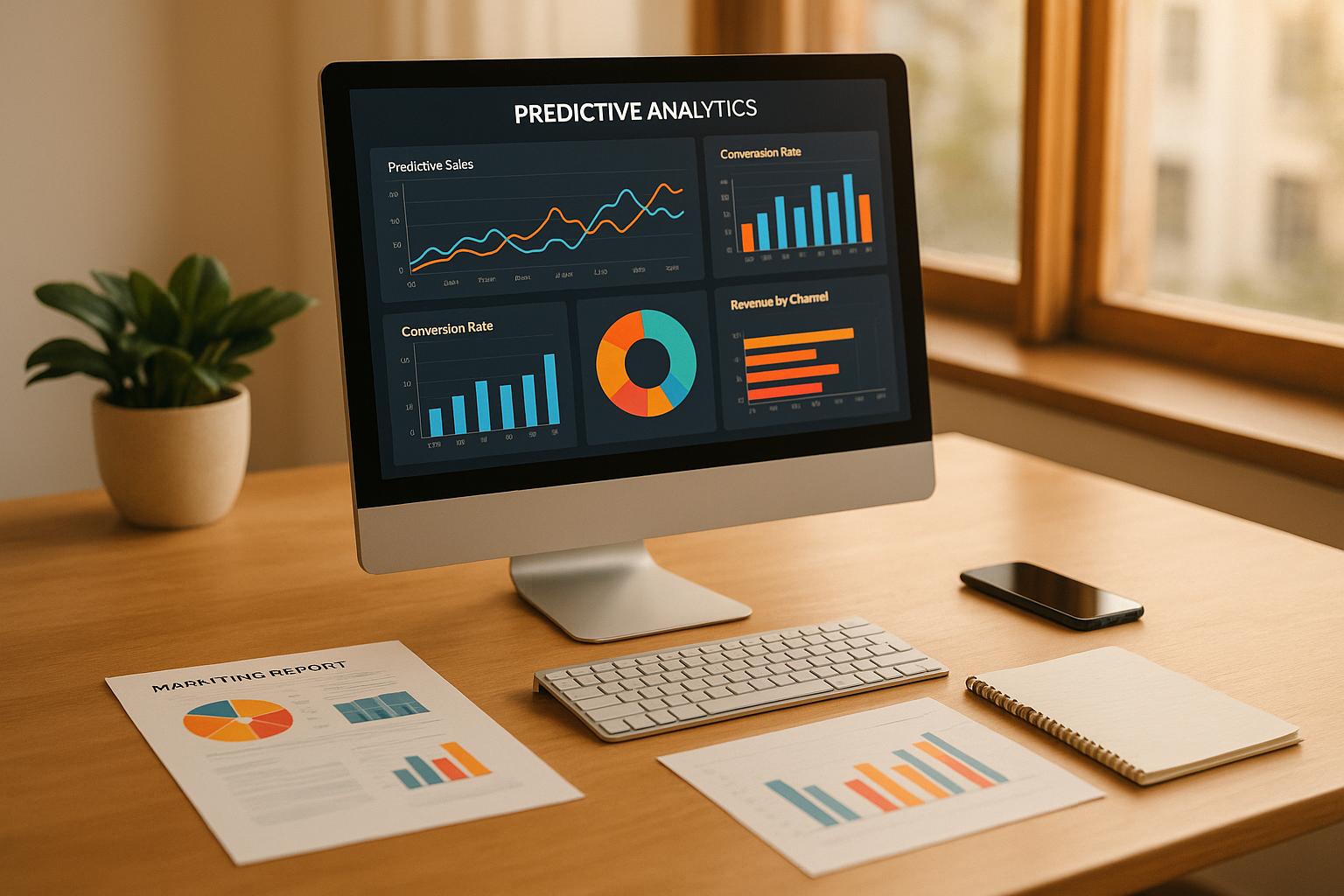

Marketing is no longer about guessing what works. Using predictive analytics in marketing turns your data into actionable insights. By analyzing historical and real-time data, predictive tools help businesses anticipate customer behavior, optimize campaigns, and improve ROI faster than ever. Here’s what you need to know:
Key Use Cases:
- Lead Scoring: Focus on leads most likely to convert.
- Churn Prediction: Spot at-risk customers early and retain them.
- Customer Lifetime Value (CLV): Identify high-value customers and prioritize them.
- Dynamic Pricing: Adjust prices in real-time to boost revenue.
- Personalized Content: Deliver tailored recommendations to keep users engaged.
- Ad Spend Optimization: Spend smarter with predictive audience targeting.
- Sales Forecasting: Get accurate, data-driven sales projections.
- Product Recommendations: Suggest items customers are most likely to buy.
- Sentiment-Based Campaigns: Align marketing with real-time customer emotions.
- Predictive SEO: Plan content ahead of trends for better search visibility.
Why It Matters:
Predictive analytics in marketing is all about faster, smarter decisions. For example, companies like Uber and Amazon use these tools to adjust pricing and recommend products in real-time, driving higher engagement and revenue. Platforms like Salesforce Einstein and H2O.ai make this tech accessible, even for non-data scientists.
Quick Takeaway:
If you’re not using predictive analytics in marketing, you’re leaving money on the table. Start small – focus on a single use case like lead scoring or churn prediction – and scale as you see results. The data you already have can transform your marketing strategy.
Harnessing Predictive Analytics: Enhancing Marketing Strategies with Data-Driven Insights
What Is Predictive Analytics in Marketing?
Predictive analytics in marketing involves leveraging historical and real-time data, processed through machine learning, to anticipate customer behaviors, market trends, and campaign outcomes. Instead of relying on guesswork, marketers can now make informed adjustments to their strategies based on what customers are likely to do next. This foundational concept sets the stage for diving into specific applications later in this discussion.
The process follows a structured workflow, turning raw data into actionable insights. It begins with gathering information from sources like CRM systems, web analytics, social media, email campaigns, and transaction data. These inputs are fed into machine learning models that identify patterns, predict outcomes, and guide strategic decisions. The results? Smarter ad budget allocation, personalized content delivery, and well-timed campaigns.
Data sources such as CRM platforms, web analytics tools, email systems, social media, and POS systems all play a role in shaping the accuracy of these predictions. The more comprehensive and diverse the data, the sharper the insights.
Unlike traditional analytics – which focus on reporting past events – predictive analytics goes a step further, offering a glimpse into future possibilities. By processing massive datasets in real time, it empowers marketers to adopt proactive, customer-first strategies.
"Together, they enable agents that go beyond language – able to forecast, reason, optimize, and take action." – H2O.ai [1]
Machine learning is at the heart of this approach, continually improving the accuracy of predictions by learning from both successful and unsuccessful campaigns. This dynamic refinement allows marketers to allocate resources more effectively, prioritizing high-value customers while addressing potential churn through targeted retention efforts. By evolving from basic statistical methods to advanced models, predictive analytics ensures forecasts are consistently fine-tuned for better results. As we move forward, we’ll explore real-world examples that highlight the impact of this powerful tool.
1. Lead Scoring and Prioritization
Business Objective Addressed
Sales teams often struggle to manage a flood of leads, each with different levels of buying intent. Relying solely on basic demographics or engagement metrics doesn’t provide the clarity needed to identify which leads are most likely to convert. Improving how leads are assessed not only enhances sales efficiency but also drives higher conversion rates.
Application of Predictive Analytics
Predictive lead scoring leverages machine learning to dig into data like website activity, email interactions, and behavioral patterns. It assigns a conversion score to each prospect, helping sales teams focus their efforts on high-intent leads. With real-time rankings, follow-ups become more strategic, aligning marketing and sales efforts seamlessly. This approach not only improves immediate outcomes but also lays the groundwork for further advancements in targeted marketing strategies.
2. Customer Churn Prediction
Business Objective Addressed
Customer churn prediction, much like lead scoring, uses data-driven insights to sharpen marketing efforts. With the rising costs of acquiring new customers, holding on to current ones has become a crucial focus for businesses. However, many companies struggle to spot customers who might cancel subscriptions, reduce their spending, or switch to competitors until it’s too late. Reactive approaches to churn often result in lost revenue and wasted marketing budgets. A forward-thinking strategy, on the other hand, allows businesses to pinpoint at-risk customers early. This enables them to roll out targeted retention campaigns, better allocate resources, and maintain stronger, long-term customer relationships. Predictive models play a key role in making this proactive approach possible.
Application of Predictive Analytics in Marketing
Predictive churn models analyze historical customer data to uncover patterns that suggest potential churn. These models assess various factors – like how often a customer makes purchases, their engagement levels, interactions with support teams, and payment habits – to assign a churn probability score. By pulling data from multiple sources such as transaction records, website activity, and customer service logs, machine learning algorithms can detect early warning signs of churn. Real-time scoring capabilities further enhance this process, enabling businesses to launch immediate, automated retention efforts.
3. Customer Lifetime Value Forecasting
Business Objective Addressed
Building on the insights from lead scoring and churn prediction, Customer Lifetime Value (CLV) forecasting sharpens marketing strategies by measuring the potential long-term value of each customer. Treating all customers the same often results in wasted budgets and missed opportunities. Predictive CLV forecasting replaces this guesswork with data-driven precision, pinpointing which relationships are worth the investment. Without this clarity, businesses risk overspending on low-value customers while neglecting those who could drive higher returns.
Application of Predictive Analytics in Marketing
Predictive CLV models combine historical transactions, behavioral trends, and demographic data to create detailed customer profiles. These profiles help identify patterns – such as specific product preferences or engagement timing – that signal higher lifetime value. The forecasting process pulls data from multiple sources, including purchase history, website activity, email interactions, social media engagement, and customer service records. It also accounts for external influences like economic shifts and seasonal trends. With real-time updates, CLV predictions stay relevant, enabling marketing teams to adapt their strategies as new information emerges. This approach ensures marketing efforts are fine-tuned and aligned with long-term value potential, paving the way for more effective campaigns.
4. Dynamic Pricing Models
Business Objective Addressed
Static pricing often leaves money on the table during high-demand periods and fails to attract price-sensitive customers when demand drops. Dynamic pricing models tackle these challenges by adjusting prices in real-time, responding to market conditions, competitor actions, and customer behavior. This approach helps businesses optimize revenue, balance supply and demand, minimize inefficiencies, and offer pricing that aligns with market realities. Without predictive analytics, businesses tend to react too slowly to market changes, losing valuable opportunities to fine-tune their pricing strategies.
Application of Predictive Analytics in Marketing
Predictive analytics in marketing takes dynamic pricing to a whole new level by turning it into a forward-thinking strategy. By analyzing diverse data sources – such as historical sales patterns, competitor pricing, seasonal trends, customer behaviors, and external influences like weather or economic changes – predictive models forecast the best prices for various customer segments over time. These models continuously improve as they process real-time data, identifying patterns in price elasticity, determining the perfect timing for discounts, and even anticipating how competitors might respond. Real-time data integration ensures that pricing decisions are always aligned with current market conditions, creating a feedback loop that sharpens future strategies.
Real-World Example Demonstrating Impact
The benefits of dynamic pricing powered by predictive analytics are clear in industry leaders’ success stories. Uber’s surge pricing model is a standout example. During peak demand – whether it’s a holiday rush or extreme weather – Uber’s algorithm evaluates rider demand, driver availability, and historical data to adjust fares dynamically. For instance, during a winter storm in New York City, surge pricing raised rates significantly, ensuring enough drivers were available to meet the spike in demand. This system has enabled Uber to handle millions of trips daily worldwide, reducing wait times for riders while boosting earnings for drivers.
Amazon also exemplifies the power of dynamic pricing. Its system continuously adjusts prices across its massive product catalog by analyzing competitor pricing, inventory levels, and customer behavior in real time. These adjustments help Amazon enhance sales, improve customer satisfaction, and drive revenue growth. Both Uber and Amazon demonstrate how predictive analytics can transform dynamic pricing into a powerful tool for achieving business goals.
5. Personalized Content Recommendations
Business Objective Addressed
In today’s world of endless online options, generic content just doesn’t cut it. Customers expect content that feels tailored to their interests and needs – something that speaks directly to them. Without this level of personalization, businesses risk losing engagement, seeing higher bounce rates, and missing chances to nurture leads through the sales funnel. A one-size-fits-all approach can waste marketing budgets by targeting less interested audiences, while the right customers may never see content that truly resonates. The challenge lies in delivering the right content to the right person at the right moment. Personalized recommendations address this gap, aligning with other predictive strategies to create a seamless customer journey.
Application of Predictive Analytics in Marketing
Predictive analytics transforms content recommendations into smart, data-driven actions. By analyzing a variety of data – such as browsing history, past interactions, purchase behavior, demographics, and engagement patterns – it builds detailed profiles for each customer. Machine learning then steps in to identify patterns, pinpointing what types of content similar users have found engaging. The result? Accurate predictions about which articles, videos, or resources will resonate with each individual.
What makes this approach even more powerful is its ability to adapt. These predictive models learn and improve with every interaction. Whether it’s tracking time spent on a page, clicks, shares, or conversions, the system refines its recommendations based on real-time behavior. It doesn’t stop there – advanced algorithms can even predict the best time to deliver content. For instance, educational materials might perform better in the morning, while promotional offers could see higher engagement in the evening. This dynamic approach ensures that prospects are guided through the buyer’s journey with content that feels relevant and timely.
Real-time data processing takes personalization a step further. If a customer’s interests shift – say they start exploring a new product category – the system quickly adjusts its recommendations. This agility ensures that content remains aligned with the customer’s evolving preferences, keeping the experience both engaging and effective.
6. Ad Spend Optimization
Business Objective Addressed
Marketing budgets are always under scrutiny, and spending them wisely is no small task. Many businesses find themselves overspending due to poor audience targeting, launching campaigns at the wrong time, or failing to optimize their bids. Without a clear understanding of which channels, audiences, or creative choices yield the best return on advertising spend (ROAS), marketing teams often fall back on guesswork or outdated insights.
The complexity grows when campaigns span multiple platforms. A campaign might thrive on one platform but struggle on another, or certain demographics may engage more with video ads than static images. Traditional methods, like manually adjusting bids or using broad audience targets, often lead to wasted impressions and missed opportunities. This makes it crucial to adopt smarter, data-driven strategies to get the most out of every ad dollar.
Application of Predictive Analytics
Predictive analytics in marketing can take ad spend optimization to the next level by analyzing historical campaign data, audience behavior, and market trends to predict which strategies will yield the best results. One key feature is real-time bid optimization. Using machine learning, these systems assess bidding environments, audience relevance, and conversion likelihood to dynamically adjust bids. This ensures that ad dollars are spent on high-value prospects with the greatest potential to convert.
Additionally, predictive models fine-tune audience segmentation by diving into past performance data to identify demographics most likely to convert. They also help allocate budgets more effectively across platforms by evaluating where funds will have the biggest impact. This data-driven approach eliminates much of the guesswork, allowing businesses to focus on what works.
Real-World Example Demonstrating Impact
Leading digital advertisers have embraced predictive analytics to transform their campaigns. These systems continuously learn from past performance, enabling marketers to adapt quickly to shifts in consumer behavior and competitive dynamics. The result? Campaigns that are more efficient and deliver a stronger ROAS, proving the value of smarter, real-time decision-making in advertising.
sbb-itb-e8c8399
7. Sales Forecasting
Business Objective Addressed
Sales teams are constantly under pressure to hit their targets, but traditional forecasting methods often fall short of providing accurate guidance. Many businesses still rely on intuition, historical averages, or basic trend projections to predict future sales. These outdated practices can lead to serious missteps: overestimating sales might leave you with surplus inventory and unnecessary hires, while underestimating can result in missed opportunities and unfulfilled customer demand. On top of that, manually updating spreadsheets eats up valuable time that could be spent engaging with customers. This is where real-time, data-driven forecasting steps in to address these challenges.
Application of Predictive Analytics
Predictive analytics takes sales forecasting to the next level by leveraging historical data to identify patterns that might otherwise go unnoticed. By analyzing variables like deal specifics, customer behavior, and market trends, these models deliver forecasts that are far more accurate than simple trend lines. What sets predictive analytics apart is its ability to pull from a variety of data sources and continuously refine forecasts in real time as new information emerges. This dynamic approach empowers sales managers to quickly identify deals that need immediate attention and allocate resources more strategically across their teams.
Real-World Example Demonstrating Impact
Salesforce’s Einstein AI platform offers a compelling example of predictive sales forecasting in action. A leading software company significantly reduced its forecast errors by using Einstein AI. The platform not only simplified the forecasting process – freeing up time for strategic activities like coaching the sales team – but also helped prioritize deals with higher chances of closing. The result? More consistent revenue streams and a noticeable boost in overall sales performance.
8. Product Recommendation Engines
Business Objective Addressed
E-commerce businesses face the challenge of presenting the right product to the right customer at the right time. With extensive catalogs, it can be difficult to ensure customers find products that align with their preferences. Without tailored recommendations, businesses risk losing revenue, seeing lower conversion rates, and missing opportunities for cross-selling. On the other hand, a well-designed recommendation system helps customers quickly discover items they’re more likely to purchase, boosting satisfaction and driving sales. This personalized approach aligns with broader predictive strategies aimed at enhancing customer engagement throughout their journey.
Application of Predictive Analytics in Marketing
Product recommendation engines rely on predictive analytics to deliver a seamless and tailored shopping experience. By analyzing data like customer behavior, purchase history, browsing patterns, product attributes, seasonal trends, price sensitivity, and brand preferences, these systems predict what a customer might buy next. They use filtering techniques – such as collaborative filtering and content-based filtering – to match customer behavior with product features. Over time, these engines learn from every interaction, fine-tuning their suggestions to become more accurate and relevant.
Real-World Example Demonstrating Impact
Major players like Amazon and Netflix showcase the power of predictive analytics in their recommendation systems. Amazon’s engine constantly evaluates customer interactions, refining its models to offer highly personalized product suggestions, which boosts customer engagement and sales. Similarly, Netflix uses predictive techniques to recommend shows and movies, enhancing user satisfaction and retention. These examples highlight how targeted recommendations not only make product discovery easier but also improve overall business performance. By increasing sales and streamlining marketing efforts, these systems contribute to better ROI measurement and stronger customer relationships.
9. Sentiment-Based Campaign Design
Business Objective Addressed
Marketing teams often face challenges with timing and messaging when rolling out campaigns. Traditional approaches often overlook real-time customer sentiment, which can lead to poorly timed messages that miss the mark – or worse, alienate the audience. Misjudging sentiment can result in wasted ad spend, tone-deaf content that harms brand reputation, or missed chances to ride waves of positive public emotion. Sentiment-based campaign design addresses these issues by aligning marketing messages with real-time customer emotions and attitudes.
Application of Predictive Analytics
The use of predictive analytics in marketing can transform sentiment analysis from a backward-looking tool into a forward-thinking strategy. By continuously tracking social media activity, customer reviews, news stories, forum chatter, and search trends, the system identifies emotional patterns. It also factors in seasonal changes, competitor movements, economic shifts, and broader events that influence customer sentiment. Machine learning algorithms then forecast emotional trends and refine messaging strategies accordingly.
For instance, the system might detect growing dissatisfaction with a competitor’s service issues, signaling an opportunity for acquisition-focused campaigns. Alternatively, it could spot rising enthusiasm around an industry trend, prompting marketers to release content that rides this positive wave.
With these insights, marketing teams can adjust their timing, tone, and messaging before campaigns go live. Instead of guessing how customers might react, they can anticipate emotional responses and fine-tune their approach for maximum impact.
Real-World Example Demonstrating Impact
Consider the early months of the COVID-19 pandemic in 2020, a time when many brands struggled to strike the right tone. Companies using sentiment-driven predictive analytics, however, were better equipped to adapt. By analyzing sentiment data, these brands noticed a shift in public conversations – from anxiety and fear in March 2020 to more hopeful, forward-looking discussions by May 2020 as people adjusted to new routines.
Armed with this insight, businesses pivoted their campaigns. Instead of continuing with fear-based safety messaging, they embraced themes of resilience, community support, and optimism. This shift allowed them to maintain customer engagement during a time when many brands saw their campaigns falter due to mismatched messaging.
The predictive aspect was especially useful in identifying the best timing for different types of campaigns. Brands launched community-focused, supportive messages during high-anxiety periods and shifted to product-centric content when sentiment data indicated that audiences were ready for more traditional marketing. This approach not only kept customers engaged but also demonstrated the value of aligning campaigns with real-time emotional trends.
10. Predictive SEO and Demand Forecasting
Business Objective Addressed
While traditional SEO relies on analyzing past data and making reactive changes, predictive SEO takes a forward-looking approach. It focuses on forecasting upcoming search trends, allowing marketers to prepare content that aligns with future demand rather than just reacting to what has already happened. Without these predictive insights, businesses often lose the chance to rank for trending keywords before the competition catches on, reducing their organic visibility and traffic potential.
Application of Predictive Analytics
Predictive SEO leverages advanced models to analyze patterns in search volumes, seasonal shifts, competitor strategies, and emerging topics. By tapping into data from search engines, social media discussions, news trends, and industry reports, these systems identify early signals of rising demand. Machine learning algorithms then determine the best timing for content creation and resource allocation, giving marketers an edge by capturing search traffic before a trend reaches its peak.
Although predictive analytics is widely recognized for its success in areas like fraud detection and operational efficiency, its use in SEO remains relatively untested. Current research provides limited evidence on how effectively these techniques can forecast search behavior or customer demand. To explore this potential, businesses should start with small-scale pilot projects to evaluate how well these models perform in anticipating trends and improving organic search outcomes.
This emerging approach highlights the growing role of predictive analytics in reshaping marketing strategies, offering a forward-thinking complement to traditional methods already in use.
How Predictive Analytics Changes ROI Measurement
For years, traditional marketing ROI measurement has struggled with slow insights and incomplete data. Marketers often have to wait weeks or even months after a campaign ends to analyze results, relying on basic metrics like cost per acquisition or return on ad spend. While these metrics provide some value, they fail to capture the full complexity of the customer journey, often overlooking which specific touchpoints truly drive conversions.
Predictive analytics in marketing is reshaping this process by linking marketing actions to business outcomes in real-time. With predictive models, marketers can forecast campaign performance and evaluate the impact of their efforts as they happen, allowing for faster and more informed decision-making.
Speed makes all the difference. Traditional methods require weeks to measure campaign success, but predictive analytics can deliver insights within days – or even hours. For example, IDT, a telecommunications company, cut their campaign measurement time from several weeks to just 2-3 days by adopting predictive analytics. This shift enabled them to refine campaigns while they were still active, rather than waiting until it was too late to make adjustments[2].
Accuracy is another game-changer. Basic single-touch attribution models often misattribute success to the wrong activities, leading to poor budget allocation. Predictive analytics, on the other hand, evaluates multiple touchpoints across the entire customer journey, assigning value based on each touchpoint’s actual contribution to conversions.
Amazon provides a compelling example of this in action. Using predictive models within their recommendation engine, they didn’t just track immediate sales – they measured the incremental lift in conversions and the long-term value of customers influenced by recommendations. Over a 36-month period, the percentage of orders impacted by their predictive intelligence rose from 11.47% to 34.71%, tying their predictive efforts directly to increased sales outcomes[3].
Proactive measurement beats reactive analysis. Traditional ROI methods focus on what happened after a campaign ends. Predictive analytics flips the script, showing what’s likely to happen, so marketers can make mid-campaign adjustments to maximize returns.
| Aspect | Traditional ROI Measurement | Predictive Analytics ROI Measurement |
|---|---|---|
| Data Source | Historical, often siloed | Real-time, integrated from multiple sources |
| Measurement Speed | Weeks to months post-campaign | Real-time or within 2-3 days |
| Attribution Accuracy | Single-touch, basic models | Multi-touch, full journey analysis |
| Optimization Timing | Post-campaign | During campaign execution |
| Insight Depth | Broad averages | Segment-level predictions and uplift |
The financial benefits of predictive analytics are clear. Take Aydinli, a major retailer operating across Asia, the Middle East, and Europe. In 2022, they adopted Acquia’s machine learning models for predictive customer segmentation. This allowed them to move beyond basic demographic targeting and identify customers most likely to make repeat purchases. The result? An additional $50,000 in revenue per campaign and an ROI exceeding 3,500%[2].
Granular insights set predictive analytics apart. Instead of relying on broad campaign averages, predictive models provide detailed ROI metrics at the individual customer or micro-segment level. This level of detail helps marketers pinpoint which elements of a campaign drive success and which audiences respond best.
The actionable insights from predictive analytics enable continuous optimization. For instance, IDT used predictive measurement to achieve a 50% increase in customers purchasing new services and a 17% boost in customer lifetime value. These outcomes were tracked and optimized in real-time, rather than being discovered months after the fact[2].
Salesforce’s benchmark data underscores this point, showing that sessions influenced by predictive intelligence see an average conversion rate lift of 22.66%[3]. Predictive analytics doesn’t just change how ROI is measured – it actively improves ROI by enabling precise targeting and personalization.
Beyond individual campaigns, predictive analytics also enhances strategic planning. These models can forecast the long-term value of different marketing investments, allowing teams to allocate budgets based on future outcomes rather than past performance. By adopting this forward-looking approach, marketing teams can ensure their resources are directed toward activities with the greatest potential for sustainable growth. This integration of predictive insights into strategic decision-making creates a powerful feedback loop, driving smarter investments and stronger results.
Predictive Marketing Tools and Platforms
Selecting the right predictive marketing platform can be a game changer for your analytics strategy. The market offers a variety of options, from robust enterprise-grade AI platforms to tools tailored for specific marketing needs. Each platform has its own strengths and requirements, which can significantly impact how effectively your team executes predictive campaigns. Here’s a closer look at some of the leading platforms designed to deliver predictive insights.
Google Vertex AI is a powerful machine learning platform that integrates seamlessly with the Google ecosystem. It handles large datasets and creates custom predictive models for tasks like forecasting customer lifetime value and predicting demand. Its AutoML feature allows marketing teams to develop advanced models without requiring deep technical expertise. Plus, its integration with tools like Google Analytics and Google Ads enables real-time campaign optimization, making it a strong choice for large-scale marketing efforts.
H2O.ai offers advanced predictive analytics through its h2oGPTe platform, which combines generative and predictive AI. Impressively, it achieved 75% accuracy on the General AI Assistant (GAIA) test, setting a high standard in deep learning research [1]. Companies like AT&T have seen tangible results, such as a 2X ROI in free cash flow within just a year of using h2oGPTe. The platform also supports seamless integration with tools like Google Drive, SharePoint, Slack, and Teams via APIs, making it adaptable to existing workflows [1].
HubSpot AI brings predictive analytics into the realm of marketing automation, making it especially useful for B2B companies focused on lead generation. The platform uses predictive lead scoring to identify prospects most likely to convert and employs machine learning to personalize email campaigns and website interactions, streamlining the customer experience.
Salesforce Einstein integrates predictive analytics across the entire customer journey through its CRM. It offers features like predictive audience segmentation, automated campaign optimization, and intelligent content recommendations. By connecting marketing activities directly to sales outcomes, Einstein ensures that every customer interaction is data-driven and impactful.
For businesses seeking both advanced tools and strategic guidance, Data-Mania‘s Fractional CMO services provide a unique solution. Led by Lillian Pierson, an experienced marketing leader specializing in data and AI consulting, this service focuses on helping technology companies – like AI startups and cybersecurity firms – implement predictive marketing strategies. Unlike traditional software platforms, Data-Mania offers hands-on leadership and go-to-market execution, making it ideal for companies with marketing budgets exceeding $1 million annually.
| Platform | Best For | Key Strengths | Implementation Complexity |
|---|---|---|---|
| Google Vertex AI | Large-scale data processing and Google integration | AutoML, real-time optimization, scalability | Medium to High |
| H2O.ai | Enterprises needing secure custom models | 75% GAIA accuracy, proven ROI, flexible deployment [1] | High |
| HubSpot AI | B2B lead generation and automation | Predictive lead scoring, integrated CRM | Low to Medium |
| Salesforce Einstein | End-to-end customer journey analytics | CRM-based predictions, automated segmentation | Medium |
| Data-Mania Fractional CMO | B2B tech companies seeking strategic support | Industry expertise, hands-on leadership | Low (guided) |
These platforms have already delivered measurable results for organizations. For example, the National Institutes of Health implemented H2O.ai’s h2oGPTe in a secure, air-gapped environment to create a 24/7 business assistant for 8,000 federal employees. This highlights the platform’s ability to meet complex security and operational demands [1].
The right choice ultimately depends on your organization’s technical expertise, budget, and specific marketing goals. Platforms like Google Vertex AI and H2O.ai cater to organizations with robust technical teams and extensive datasets, while HubSpot AI and Salesforce Einstein are better suited for those prioritizing ease of use and quick deployment. For companies seeking tailored, strategic guidance, Data-Mania’s Fractional CMO services provide a hands-on approach to predictive marketing.
To ensure success, consider starting with a pilot program. This allows you to test a platform’s capabilities for your unique needs while building internal expertise in predictive marketing – helping you drive better outcomes through data-driven strategies.
Implementation Challenges and Ethics
Predictive analytics can be a game-changer for marketing teams, but putting it into action isn’t without its hurdles. From technical roadblocks to ethical dilemmas, the journey to effective implementation requires careful planning. By anticipating these challenges, teams can equip themselves to tackle them head-on. Among the most pressing issues are data quality, system integration, skills shortages, and ethical concerns.
Data quality issues are a foundational barrier. Incomplete, inconsistent, or siloed data can lead to unreliable predictions and misguided marketing strategies. Many organizations struggle with fragmented data systems. Take IDT, for example. Their customer data was scattered across different silos, which hindered campaign personalization. By collaborating with Optimove to unify their data sources and apply predictive models, a major telecommunications company significantly improved its performance metrics [2].
Integration challenges also loom large. Predictive analytics tools must seamlessly connect with existing marketing platforms, CRM systems, and data warehouses, often requiring extensive IT resources and coordination across departments. This complexity can slow implementation. Leveraging middleware solutions, selecting tools with robust integration capabilities, and involving IT teams early in the process can smooth the path. Strong integration frameworks not only speed up deployment but also ensure systems communicate effectively, reducing friction down the line.
Skill gaps pose another obstacle. Predictive analytics demands expertise in data science and machine learning – skills that many marketing teams lack. Organizations can address this by investing in training, hiring specialized talent, or partnering with external experts. For instance, companies like Aydinli have seen improved campaign ROI by using integrated, high-quality data for customer segmentation, often with help from specialized vendors [2].
On the ethical front, data privacy concerns are increasingly critical. Predictive analytics relies on large volumes of personal and behavioral data, which raises questions about compliance with regulations such as GDPR and the California Consumer Privacy Act (CCPA). One well-known example is Target’s ability to predict a customer’s pregnancy, which highlighted the potential for misuse. Regulations like CCPA demand transparency, robust consent systems, and data minimization. Marketers need to communicate clearly about how data is used and ensure that consumers have control over their personal information. Balancing these responsibilities with the benefits of predictive analytics is essential for building trust.
Algorithmic bias is another ethical challenge. When training data reflects historical biases or lacks diversity, predictive models can produce unfair or discriminatory outcomes. This can result in certain groups being excluded from campaigns or perpetuate harmful stereotypes. To address this, teams should use diverse datasets, regularly test models for fairness, and involve cross-functional teams to validate results for demographic equity.
Responsible data use is the cornerstone of ethical predictive analytics. While these tools offer immense personalization potential, marketers must avoid crossing the line into manipulation or privacy infringement. This is especially relevant as the digital world shifts away from cookies, with 81% of marketers emphasizing the importance of predictive tools for personalization [4].
| Challenge Type | Common Issues | Practical Solutions |
|---|---|---|
| Data Quality | Incomplete data, inconsistent formats, data silos | Regular audits, strong data governance, unified systems |
| Integration | Multiple systems, complex workflows | Middleware tools, early IT involvement, streamlined platforms |
| Skills | Lack of expertise in data science and analytics | Training programs, hiring specialists, external collaborations |
| Privacy | Compliance with regulations, consent management | Transparent policies, robust consent systems, regular privacy audits |
| Bias | Unfair outcomes, lack of diversity in data | Representative datasets, fairness testing, cross-functional oversight |
Successful implementation demands collaboration across departments, including marketing, IT, data science, legal, and compliance. Regular cross-team meetings and shared accountability can help address challenges efficiently and create a culture of responsibility.
To measure both performance and ethical impact, marketing teams should track metrics like model accuracy, conversion rates, ROI, and customer satisfaction. For ethical oversight, monitoring privacy incident rates, opt-out percentages, and demographic fairness in targeting can provide critical insights.
With the predictive analytics market valued at $10.2 billion and growing [4], organizations that prioritize data governance, collaboration, and ethical practices are best positioned to harness its potential while maintaining customer trust and meeting regulatory requirements.
Next Steps for Marketing Teams
Predictive analytics takes the uncertainty out of decision-making by leveraging data to drive strategies that improve conversion rates, reduce acquisition costs, and enhance customer lifetime value. As previously discussed, targeted predictive models can lead to measurable business gains.
To succeed, a thoughtful and structured approach is essential. Begin with a thorough data audit. Understand the data you currently have, where it’s stored, and its quality. Reliable predictions depend on accurate and unified data, so pinpoint your most dependable sources and address any quality issues right away.
Start with a pilot project that has a clear, measurable goal. Focus on a specific challenge – such as lead scoring or churn prediction – that addresses a major pain point. Early wins from these projects can provide actionable insights and serve as a foundation for scaling your efforts.
Encourage collaboration across teams like marketing, IT, data science, and compliance from the outset. Predictive analytics thrives on teamwork. Set up regular check-ins and shared success metrics to keep everyone aligned throughout the process. Once your teams are working together effectively, ensure they have the tools they need to succeed.
Equip your team with the right tools and training. Platforms like Google Vertex AI, H2O.ai, HubSpot AI, or Salesforce Einstein can enable predictive analytics, but they’re only as effective as the people using them. Consider hiring data scientists, offering training for current staff, or working with external experts to guide your initial steps.
Establish ethical guidelines for data use. Develop clear policies around data privacy, algorithmic fairness, and responsible usage. Taking a proactive stance not only helps you avoid compliance issues but also builds trust with your customers.
Track both performance and model impact. Monitor traditional metrics like conversion rates and ROI alongside predictive metrics such as model accuracy and confidence levels. This dual focus ensures you’re not only achieving campaign goals but also improving the performance of your predictive models over time.
For marketing teams looking to push the boundaries further, exploring Growth Forecasting with Hierarchical Models can open doors to understanding customer behavior across different segments and timeframes. These advanced techniques complement the foundational strategies outlined here.
As the predictive analytics landscape continues to grow, early adopters have a chance to gain a competitive edge. By following these steps, your team can build on the examples discussed earlier and scale predictive analytics for long-term success.
FAQs
How can a business choose the best predictive analytics use case to start with?
To pinpoint the right predictive analytics use case for your business, begin by examining your most urgent challenges or objectives. For instance, if retaining customers is a major issue, focusing on churn prediction could be a great first step. On the other hand, if boosting revenue is your priority, you might explore customer lifetime value forecasting or dynamic pricing strategies.
Equally crucial is assessing the quality of your data. Opt for a use case where you already have a solid foundation of reliable and sufficient data to create accurate models. Starting with a single, focused use case not only helps you measure its impact but also provides an opportunity to fine-tune your approach before tackling more advanced applications.
What ethical factors should businesses consider when using predictive analytics in marketing?
When applying predictive analytics in marketing, businesses need to navigate several ethical considerations thoughtfully:
- Data privacy and security: It’s crucial to handle customer data responsibly. This means collecting, storing, and using information in strict alignment with privacy laws and industry regulations. Failing to do so can erode trust and lead to significant legal consequences.
- Bias in data and models: Algorithms and datasets can unintentionally reflect biases, which might result in unfair or discriminatory outcomes. Regularly auditing data and models can help identify and address these issues before they cause harm.
- Transparency and accountability: Customers and internal teams deserve to understand how predictive models operate. Providing clear explanations and maintaining accountability ensures greater trust and confidence in the technology.
Focusing on these ethical aspects allows businesses to not only use predictive analytics responsibly but also strengthen trust with their customers and stakeholders.
How are tools like Google Vertex AI and H2O.ai used differently in marketing strategies?
Predictive analytics tools like Google Vertex AI and H2O.ai both bring a lot to the table, but they serve different purposes depending on your marketing strategy. If your business operates within Google’s ecosystem and needs scalability, Google Vertex AI is a strong contender. It integrates effortlessly with Google Cloud, offering features like machine learning model development, workflow automation, and large-scale data analysis. These capabilities can enhance your marketing by optimizing campaigns, predicting customer behavior, and sharpening ad targeting.
On the flip side, H2O.ai stands out for its open-source approach and intuitive interface, making it approachable for teams without deep AI expertise. Its focus on making AI accessible includes pre-built models for tasks such as customer segmentation, churn prediction, and personalized marketing. For businesses seeking flexibility and budget-friendly options, H2O.ai is a compelling choice.
The best fit ultimately depends on your company’s size, technical capabilities, and specific marketing objectives.
Related Blog Posts
- AI Agents in Marketing: The Secret to Driving 10x Engagement & Conversions
- 5 Ways AI Can Optimize Marketing ROI for your Tech Startup
- Real-Time Analytics for Marketing Decision Support
- AI Growth Marketing: Forecasting Use Cases