

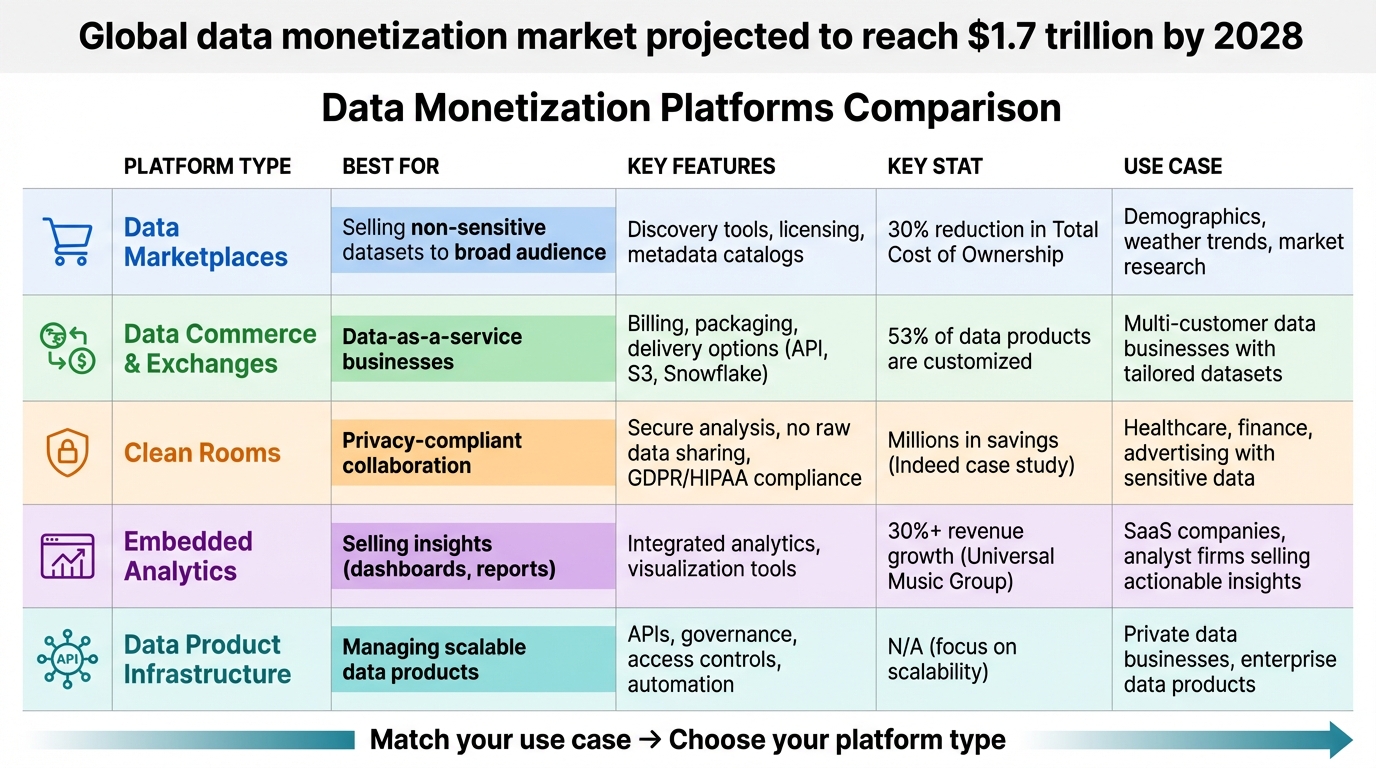
Here’s the deal: Data monetization platforms are tools that help businesses turn raw data into income. They come in five main types, each designed for specific needs like selling data, securing privacy, or delivering insights. Choosing the right one depends on your goals – whether you’re selling raw datasets, sharing sensitive information, or offering analytics.
Key Takeaways
- Types of Platforms:
- Marketplaces: Great for selling non-sensitive datasets to a broad audience.
- Commerce Platforms: Handle transactions, billing, and delivery for tailored data products.
- Clean Rooms: Enable secure data collaboration without exposing raw data.
- Embedded Analytics: Sell insights like dashboards instead of raw data.
- Infrastructure Platforms: Manage APIs, governance, and scalable data products.
- Choosing a Platform:
- Match your needs: Selling raw data? Go for a marketplace. Need privacy? Choose clean rooms.
- Look for features like compliance, integration with tools like Snowflake, and user-friendly licensing.
- Common Mistakes:
- Skipping buyer research.
- Poor data documentation.
- Ignoring privacy regulations like GDPR or HIPAA.
Quick Comparison
| Platform Type | Best For | Key Features |
|---|---|---|
| Marketplaces | Selling non-sensitive datasets | Discovery tools, licensing, metadata |
| Commerce | Data-as-a-service businesses | Billing, packaging, delivery options |
| Clean Rooms | Privacy-compliant collaboration | Secure analysis, no raw data sharing |
| Embedded Analytics | Selling insights (dashboards, reports) | Integrated analytics, visualization |
| Infrastructure | Managing scalable data products | APIs, governance, access controls |
Why it matters: The global data monetization market is projected to hit $1.7 trillion by 2028. Picking the right platform could be the difference between staying ahead or falling behind.
5 Types of Data Monetization Platforms Comparison Guide
Data Monetisation: How to turn data into revenue | On-Demand Webinar – Biztory
5 Types of Data Monetization Platforms
Not all data monetization platforms are created equal. Each serves a specific purpose, and choosing the wrong one can derail your strategy before it even begins. Here’s a breakdown of the main types of platforms and when they make the most sense to use.
Data Marketplaces
Think of data marketplaces as online shops where suppliers showcase datasets and buyers can browse, compare, and purchase through self-service tools [3]. These platforms focus on making data easy to find, offering features like search filters, metadata catalogs, and preview options.
Marketplaces go beyond just listing datasets – they handle licensing, pricing, and usage tracking [2]. Companies using these platforms often see up to a 30% reduction in Total Cost of Ownership, as they avoid buying duplicate data [2]. Many operate on a revenue-share model, taking a commission only when a sale is completed [4].
These platforms are ideal for selling non-sensitive, aggregated datasets such as demographics, weather trends, or market research to a broad audience.
Data Commerce and Exchanges
Data commerce platforms focus on the operational side of selling data. They handle packaging, delivery, billing, and contract management, acting like a “Shopify for data” [1][4]. Providers can list their products across multiple marketplaces, manage leads, and automate invoicing for usage-based or subscription pricing.
Roughly 53% of data products created on these platforms are customized to meet specific buyer needs [1]. This flexibility is key when customers require tailored datasets. These platforms also integrate with CRM systems and support various delivery methods, like API access, S3 buckets, or Snowflake shares [1][4].
A commerce platform is a great choice for data-as-a-service businesses that need to streamline transactions and manage contracts, renewals, and billing efficiently.
Clean Rooms and Secure Collaboration
Clean rooms provide a secure space where multiple parties can analyze combined datasets without exposing raw data [1][5]. These are essential for privacy-first collaboration, particularly when working with sensitive information like PII, healthcare, or financial data.
In 2024, Indeed used Snowflake Data Clean Rooms to centralize its data lake and collaborate with partners, leading to faster campaign execution and millions in savings [5]. Similarly, Merkle used clean rooms to consolidate client data securely while maintaining compliance [5].
“Data is the lifeblood of the modern business because of the extreme value it represents at all stages of commerce.” – Snowflake [5]
Clean rooms are essential when privacy regulations like GDPR or HIPAA prevent traditional data sharing. They’re particularly valuable in industries like healthcare, finance, and advertising, where joint analysis with partners is critical but raw data can’t be shared.
Embedded Analytics and Insights Monetization
Embedded analytics platforms let you sell access to dashboards, reports, and visualizations directly within your application [5][4]. Instead of selling raw data, you’re selling the insights – trends, metrics, and interpretations your customers need.
For instance, AltHub converts unstructured data into “analytics-ready” products for hedge funds, providing charts and data attributes tailored to fund managers [4]. This approach appeals to buyers who prioritize actionable insights over raw numbers.
This model works best for businesses that focus on interpreting data rather than providing raw datasets. Examples include analyst firms, SaaS companies offering premium reporting, or any organization that monetizes insights through tools like Tableau or Power BI [5][7].
Data Product Infrastructure
Data product infrastructure platforms serve as the backbone for creating and scaling data offerings. They provide governance, APIs, access controls, and automation tools to manage data products [9][1]. These platforms enable seamless delivery to systems like Snowflake, S3, or Azure, while managing permissions and pricing tiers.
These platforms are ideal for companies building private data businesses or managing multiple data products with varying access levels and delivery schedules. Whether you’re packaging data for internal teams or selling to enterprise clients, this infrastructure simplifies the complexity behind the scenes.
| Platform Type | Primary Focus | Best For |
|---|---|---|
| Data Marketplaces | Discovery & transactions | Broad external sales of non-sensitive data |
| Data Commerce | Packaging & billing | Multi-customer data-as-a-service businesses |
| Clean Rooms | Privacy & compliance | Regulated industries handling sensitive data |
| Embedded Analytics | Insights & visualization | Selling analysis rather than raw data |
| Data Infrastructure | Governance & APIs | Building scalable, managed data products |
Choosing the right platform is essential for aligning your technical capabilities with your business goals. Each type plays a distinct role in turning data into a revenue-generating asset.
How to Choose the Right Platform
Picking the right data monetization platform starts with understanding your specific needs. What are you selling? Who’s buying? And what regulations must you follow? These questions set the foundation for your decision.
Match Your Use Case to Platform Type
First, clarify what you’re offering. Are you selling raw or aggregated datasets – like demographics, weather patterns, or market research? If so, a data marketplace or commerce platform is ideal. These platforms streamline discovery, licensing, and transactions for external buyers.
If your focus is on selling actionable insights rather than raw data, an embedded analytics platform might be a better fit. For instance, Universal Music Group’s integrated analytics tool boosted e-commerce revenue by over 30% [8].
For businesses dealing with strict regulations like GDPR or HIPAA, clean rooms are essential. These platforms let you securely collaborate on sensitive datasets without exposing raw personally identifiable information (PII). Similarly, if you’re managing multiple data products with varying access levels – whether for internal teams or enterprise clients – data product infrastructure is key. It provides governance, APIs, and automation to manage access and distribution effectively.
“Start with Use Cases, Not Tech: Begin by identifying specific business use cases and potential buyers rather than building technical infrastructure first.” – Harvard Business Review [8]
Once your use case is clear, the next step is to evaluate platforms based on critical factors.
What to Evaluate Before Choosing
With your use case in mind, focus on these essential considerations:
- Compliance requirements: Does the platform meet regulations like GDPR, CCPA, or industry-specific rules such as HIPAA? Look for features like policy enforcement, data residency controls, consent management, and detailed audit trails.
- Integration capabilities: The platform should integrate seamlessly with your existing tech stack. Check for native connectors to tools like Snowflake, Databricks, or AWS, and ensure it supports your preferred delivery methods – whether via APIs, cloud sharing, or secure clean rooms.
- Transaction management: If you’re running a data-as-a-service model, evaluate how the platform handles licensing, billing, and usage tracking. Some platforms offer revenue-share models, charging a commission on completed sales, while others use subscription-based or pay-per-use pricing.
- User experience: Intuitive interfaces, robust data discovery tools, and instant previews encourage adoption among both technical and business users. For example, FordDirect developed a customer-journey platform that combined dealer website data with CRM and external sources. This allowed dealers to better segment customers, resulting in a 40% increase in sales and a 22% drop in cost per lead [8].
Platform Selection Decision Tree
Use this framework to align your platform choice with your use case:
- Selling raw or aggregated datasets to external buyers? A data marketplace or commerce platform is your best bet for discovery, pricing, and transactions at scale.
- Selling insights, dashboards, or analytics? Choose an embedded analytics platform when buyers value actionable insights over raw data.
- Dealing with regulations like GDPR or HIPAA? Opt for a clean room to enable privacy-compliant collaboration without exposing raw PII.
- Managing internal data products or building a private data business? Use data product infrastructure for governance, APIs, and scalable access controls.
Organizations leveraging governed data marketplaces have reported up to a 30% reduction in Total Cost of Ownership through improved data reuse [2]. By aligning your platform choice with your monetization goals, technical setup, and compliance needs, you’ll be better positioned to succeed.
Platform Evaluation Rubric
A scoring rubric can help you systematically evaluate platform options, aligning their features with your monetization goals. This approach ensures you focus on what truly matters, avoiding distractions from unnecessary extras or overlooking critical gaps.
6 Criteria to Score
To quantify each platform’s capabilities, rate them on a scale of 1 to 5 across these six key dimensions:
Compliance & Governance
This measures how well a platform supports regulatory requirements and ensures data accuracy. Does it comply with standards like GDPR, HIPAA, or PCI DSS? Look for features such as data anonymization, encryption, access controls, and audit trails. Be cautious of platforms with unclear security documentation or vague custodian agreements. Compliance is a common hurdle – only 1 in 12 companies fully monetize their data, often due to regulatory concerns [13].
Packaging
Evaluate the platform’s ability to create custom data products and provide clear documentation. Can you version datasets, define schemas, and offer samples for buyers to preview? Platforms with rigid data formats that limit iteration can stifle monetization [1][4]. Poor packaging remains a major obstacle to buyer adoption.
Distribution
Consider the technical delivery options available. A robust platform should offer multiple methods, such as APIs, cloud-to-cloud sharing (e.g., Snowflake, AWS S3), and native connectors for BI and ML tools. Platforms relying heavily on manual delivery often struggle to scale [1][4].
Monetization Mechanics
This dimension looks at pricing flexibility, billing integration, and contract automation. Can the platform manage subscription models, usage-based pricing, or tiered structures? Seamless integration with your existing CRM and invoicing systems is critical [1][4]. Watch out for platforms with opaque fee structures, as they can complicate revenue management [10][12].
Buyer Experience
Assess self-service capabilities and discovery tools. Features like intuitive search, instant data previews, and clear documentation are essential. If buyers need to rely on support tickets for every minor change, adoption rates will likely drop [11][1]. A strong buyer experience can also cut costs by up to 30% [2].
Measurement
Examine the platform’s analytics and reporting tools. Real-time usage tracking, anomaly detection, and detailed metrics (e.g., CPM, RPM, conversion rates) are crucial for optimization. Delayed or insufficient reporting can make it harder to detect revenue loss [11][12]. For instance, using AI-managed price floors has been shown to boost pageview CPM by an average of 20% [12].
Sample Scoring Matrix
Here’s how you can assign weighted scores based on your company’s stage and priorities:
| Criterion | Weight (Early Stage) | Weight (Enterprise) | Critical Questions |
|---|---|---|---|
| Compliance | 15% | 30% | Does it meet GDPR/HIPAA? Is data anonymized? Are audit trails available? |
| Packaging | 20% | 15% | Can I create samples and prototypes? Is versioning supported? |
| Distribution | 25% | 20% | Does it support API, Snowflake, or S3 delivery? Are integrations native? |
| Monetization | 20% | 20% | Are pricing models flexible? Is billing automated? Are fees transparent? |
| Buyer Experience | 10% | 10% | Is there a self-service portal? Can buyers preview data instantly? |
| Measurement | 10% | 5% | Is reporting real-time? Are anomaly alerts available? |
For early-stage companies, distribution and packaging should take precedence to get products to market quickly. Enterprises, on the other hand, need to prioritize compliance due to heightened regulatory risks and reputational stakes. Industry-specific needs may also shift these weights – for instance, healthcare and financial services may require compliance to account for 40% or more of the total score.
When scoring, be honest about any shortcomings. If a platform scores 3 or below in a category weighted at 20% or higher, it warrants careful reconsideration. Publishers who focus solely on revenue share percentages while ignoring broader capabilities risk losing 15% to 30% of potential ad revenue [11].
Finally, test self-service features like pausing partners or adjusting price floors to ensure they don’t require support tickets. Also, confirm that data is portable – you should be able to export it via CSV or API, avoiding lock-in to proprietary dashboards [11].
This matrix provides a structured framework for narrowing down your platform choices before diving into specific vendor options.
sbb-itb-e8c8399
Platform Examples by Category
Here’s a look at how various platforms cater to distinct monetization needs, using real-world examples to highlight their strengths and trade-offs.
Marketplace and Commerce Platforms
Monda simplifies the process for data providers by offering no-code integrations with major marketplaces, SEO-friendly storefronts, and a centralized CRM for managing leads across multiple channels [1]. It’s a great option for those looking to distribute data widely without heavy technical work. However, users need to handle listing optimization manually, and payments are usually processed outside the platform [1].
ThinkData Works focuses on secure data distribution and discovery. It includes features like automated data cleansing, enrichment, and freshness monitoring, along with access to a lead pool of large enterprises [1]. While its capabilities are robust, the platform comes with high subscription costs and challenges when integrating with older IT systems.
“When data is easier to distribute, it’s easier to monetize” [1].
Revelate serves regulated industries by providing a secure hub for transactions with strong data governance. It supports multiple formats, including CSV and API, and prioritizes encryption and anonymization [1]. That said, it lacks marketing tools and does not handle in-platform transactions [1].
AWS Data Exchange stands out for its scalability and seamless integration with the AWS ecosystem, making it a solid choice for organizations already using AWS [2].
These platforms showcase diverse ways to approach data monetization, with strengths in discovery, pricing, and managing transactions at scale.
Collaboration and Privacy Platforms
Snowflake Data Clean Rooms enable secure data collaboration by allowing parties to combine datasets without exposing personally identifiable information [5]. For example, in 2024, Indeed used Snowflake to centralize its data lake architecture, speeding up marketing campaigns and saving millions of dollars [5]. It’s a leading solution for privacy-focused data sharing.
LiveRamp operates a secure private marketplace for audience data exchange and monetization, making it especially useful for advertising and media companies. It helps activate data for targeted campaigns while ensuring compliance with privacy regulations [9].
Harbr allows organizations to create private marketplaces with automated distribution across multiple cloud environments [1]. Over half (53%) of Harbr’s data products are tailored for specific use cases. While it offers high flexibility, setting it up requires significant technical expertise, and its primary focus leans more toward collaboration than monetization [1].
These platforms are designed for secure data sharing, particularly in industries with strict regulations.
Analytics and Data Product Platforms
GoodData empowers SaaS companies to monetize insights by selling dashboard access directly within their applications [6]. This approach is ideal for businesses offering insights-as-a-service.
AltHub specializes in transforming raw data into tickerized charts and analytics-ready products for hedge funds [4]. Its niche focus makes it a valuable tool for financial services firms looking for ready-to-use investment data.
FordDirect combines dealer and external data into an analytics tool that has boosted dealer sales by 40% and reduced lead costs by 22% [8].
ADP leverages payroll data to create a compensation benchmark product, helping businesses set competitive salaries [8].
These platforms highlight how selling actionable insights, rather than raw data, can deliver targeted value to specific buyer groups.
Common Mistakes to Avoid
Steering clear of these mistakes can make all the difference in ensuring your data monetization efforts lead to meaningful, long-term results.
Skipping Buyer and Use Case Definition
Jumping into data monetization without first identifying who needs your data and why is a costly misstep. It’s essential to pinpoint the specific business use cases where your data provides measurable value [5]. Who benefits from this data? What problems does it solve? How will it be applied? Without clear answers to these questions, your efforts lack direction.
“Selling raw data is often the lowest form of value realization and mostly leads to short term subscribers.” – AWS Cloud Adoption Framework [6]
Instead of offering raw data, aim for composite insights or data-enhanced products. These deliver greater value and help establish lasting customer relationships [6]. Overlooking this step can also complicate the way you package and ensure compliance for your data, as explained below.
Poor Data Packaging and Documentation
If your data isn’t well-documented or quality-checked, it undermines buyer confidence and can derail your monetization goals [5][4]. Even if the information itself has potential, incomplete or inconsistent packaging will make buyers hesitant to invest.
To avoid this, ensure your data includes:
- Comprehensive documentation: Provide clear metadata, usage guidelines, and quality details.
- Quality assurance (QA): Validate the data’s accuracy and completeness before making it available [2][14].
- Service Level Agreements (SLAs): Define metrics like update frequency and issue-resolution protocols [2].
Offering previews or samples can also reassure buyers by allowing them to verify the schema and quality firsthand [2]. Notably, organizations using data marketplaces have reported up to a 30% reduction in Total Cost of Ownership due to improved data reuse [2].
Equally important is maintaining strict adherence to privacy laws and compliance standards.
Ignoring Privacy and Compliance
Regulations like GDPR, CCPA, and HIPAA aren’t just guidelines – they’re mandatory [5][4]. Failing to comply can result in hefty fines and irreparable damage to your reputation.
“Failure to comply with data privacy rules can lead to stiff penalties and loss of reputation – even if the failure is accidental.” – Snowflake [5]
Noncompliance doesn’t just pose legal risks; it also leaves your organization vulnerable strategically [6]. To build trust and ensure compliance, document data provenance meticulously [2]. Establish robust governance and privacy protocols as a cornerstone of your monetization strategy [5][2]. These measures not only protect your organization but also make your data more appealing to buyers.
Next Steps for Data Monetization
To make the most of your data monetization efforts, start by securing executive sponsorship and bringing key stakeholders on board across business, IT, and governance teams. High-level support ensures your initiative gets the resources and collaboration necessary to move forward effectively. These initial steps lay the groundwork for a thorough evaluation of your data environment.
Take a close look at your data landscape to identify inefficiencies like duplicate purchases or unnecessary data sharing. For example, check for “data leaks”, where multiple departments might be buying the same external datasets or sharing data with third parties without clear advantages. Tackling these issues early can provide quick wins, delivering immediate benefits while building momentum for more ambitious projects.
Before launching any initiatives, establish a solid governance framework to address data quality, access, and compliance. Once this is in place, categorize opportunities into areas like internal efficiency improvements, cost reductions, or direct sales. This categorization helps you focus on the most impactful starting points. With governance and priorities set, the next step is to test your approach.
A pilot program is a practical way to validate and fine-tune your strategy. Universal Music Group offers a compelling example: in 2021, they introduced the FAME tool, which combined data from social media, e-commerce, and CRM systems to deliver valuable fan insights to partners. This initiative drove over 30% revenue growth in their e-commerce channels [8]. A successful pilot can serve as a springboard for scaling your efforts.
Finally, define clear success metrics, including baselines for revenue growth, cost savings, time-to-insight, and user adoption. With the global data monetization market expected to hit $1.7 trillion by 2028 [1], organizations that follow these structured steps are well-positioned to unlock substantial value from their data assets.
FAQs
How can I choose the right data monetization platform for my business?
Choosing a data monetization platform starts with clarifying what you aim to monetize. If your focus is on selling raw or aggregated datasets, explore options like a data marketplace or a data commerce platform. For delivering insights through dashboards or API-driven solutions, consider platforms built for embedded analytics or data product infrastructure. If secure collaboration or adherence to privacy regulations is a priority, a clean-room platform is the way to go. For improving internal decision-making, look for governance-focused data product layers.
Once you’ve narrowed down the type of platform you need, evaluate potential solutions using these six key criteria:
- Compliance & governance: Does the platform offer robust tools for managing data privacy, consent, and audits?
- Packaging: Are documentation, schema standards, and versioning well-supported?
- Distribution: How well does it handle API integrations, cloud compatibility, and data-sharing capabilities?
- Monetization mechanics: Evaluate pricing models, billing systems, and contract management features.
- Buyer experience: Is it easy for users to discover, onboard, and get support?
- Measurement: Look for analytics, renewal tracking, and usage reporting tools.
By scoring platforms against these criteria and aligning them with your business goals, you can confidently choose a solution that not only meets your needs but also optimizes revenue potential while staying compliant.
What privacy factors should you consider when using data monetization platforms?
Privacy is a cornerstone of any initiative involving data monetization. Modern platforms must establish secure environments, such as clean rooms, that enable data analysis and collaboration while safeguarding sensitive details like personally identifiable information (PII). These spaces operate with stringent access controls, encrypt data both in transit and at rest, and maintain detailed audit logs to comply with regulations like GDPR and CCPA.
Equally important are strong governance and compliance tools. Features like consent management, data lineage tracking, and audit trails ensure that data usage aligns with legal requirements. Many platforms go a step further by embedding PII-masking and usage policies directly into their workflows. This approach allows data providers to share information securely while staying within the bounds of privacy laws. By implementing these safeguards, platforms protect both data owners and buyers, building trust and minimizing legal risks in the data monetization ecosystem.
What mistakes should you avoid when starting data monetization?
When venturing into data monetization, it’s crucial to validate the demand and potential use cases for your data before assuming it holds value. Take the time to ensure your data is well-prepared and presented – this means having proper documentation, clear schemas, and thorough quality checks in place. Skipping this step can make your data less appealing to buyers and harder to work with.
Equally important is addressing privacy, legal, and compliance requirements right from the start. Overlooking these areas can expose you to serious risks, both legal and reputational, so they should always be a top priority.
On the internal front, be mindful of potential hurdles like resistance to change or misalignment on goals within your team. Recognize that data monetization isn’t a quick, one-off effort – it’s a long-term commitment. A sustainable strategy requires careful planning and a clear vision, rather than rushing to market without laying the groundwork.