AI search visibility tools are now essential for brands navigating the shift to AI-driven search. These tools help you track and improve how your brand appears in AI-generated responses on platforms like ChatGPT, Perplexity, and Google AI Overviews. With 13.1% of U.S. desktop queries now relying on AI-generated answers, your brand’s visibility in these spaces can directly impact your reach and revenue.
The shortlist below splits by what you are actually buying for:
- Agencies: Tools like Profound and Peec AI offer advanced features such as multi-client dashboards, white-label reporting, and data for client pitches.
- In-House Teams: Look for tools such as Semrush AI Visibility Toolkit or Ahrefs Brand Radar that combine monitoring with insights like content gap analysis and sentiment tracking.
- Early-Stage Startups: Affordable options like Otterly AI or AI Peekaboo provide simple, low-cost solutions to start tracking your AI visibility.
Key takeaway: The right tool depends on your team size, budget, and goals. Agencies need scalable solutions; in-house teams benefit from deeper analytics, while startups should focus on cost-effective basics.
I’m Lillian Pierson, a fractional CMO and licensed Professional Engineer who’s spent 20 years driving growth for B2B tech companies, and I’ve written 12 books with Wiley on data and AI. Use the comparisons below to answer one question: whether a tool’s output would change a decision you are about to make, or just give you another dashboard to check.
Quick Comparison
| Tool | Best For | Key Features |
|---|---|---|
| Profound | Agencies | Tracks 10 AI engines, sentiment analysis, SOC 2 compliance |
| Otterly AI | Startups | GEO Audit tool, 15 prompts, 6 AI platforms |
| Peec AI | Agencies/Startups | Credit-based pricing, multilingual tracking, actionable recommendations |
| Semrush AI Toolkit | In-House Teams | Integrated with SEO tools, 261M prompt database |
| Ahrefs Brand Radar | In-House Teams | Unlimited domains, research-focused, tracks 6 AI platforms |
| SE Ranking AI Visible | Agencies | "No cited" feature, unlimited users, tracks 5 AI platforms |
| AI Peekaboo | Startups | Real-user data scraping, AI Visibility Score, tracks 5 AI platforms |
| Nightwatch | Mixed Use | Combines SEO rank tracking with AI visibility, automation tools |
Each tool has strengths depending on your workflow, so match your choice to your priorities. Each tool below earns its place with a particular buyer, and the detail is what separates them for you.
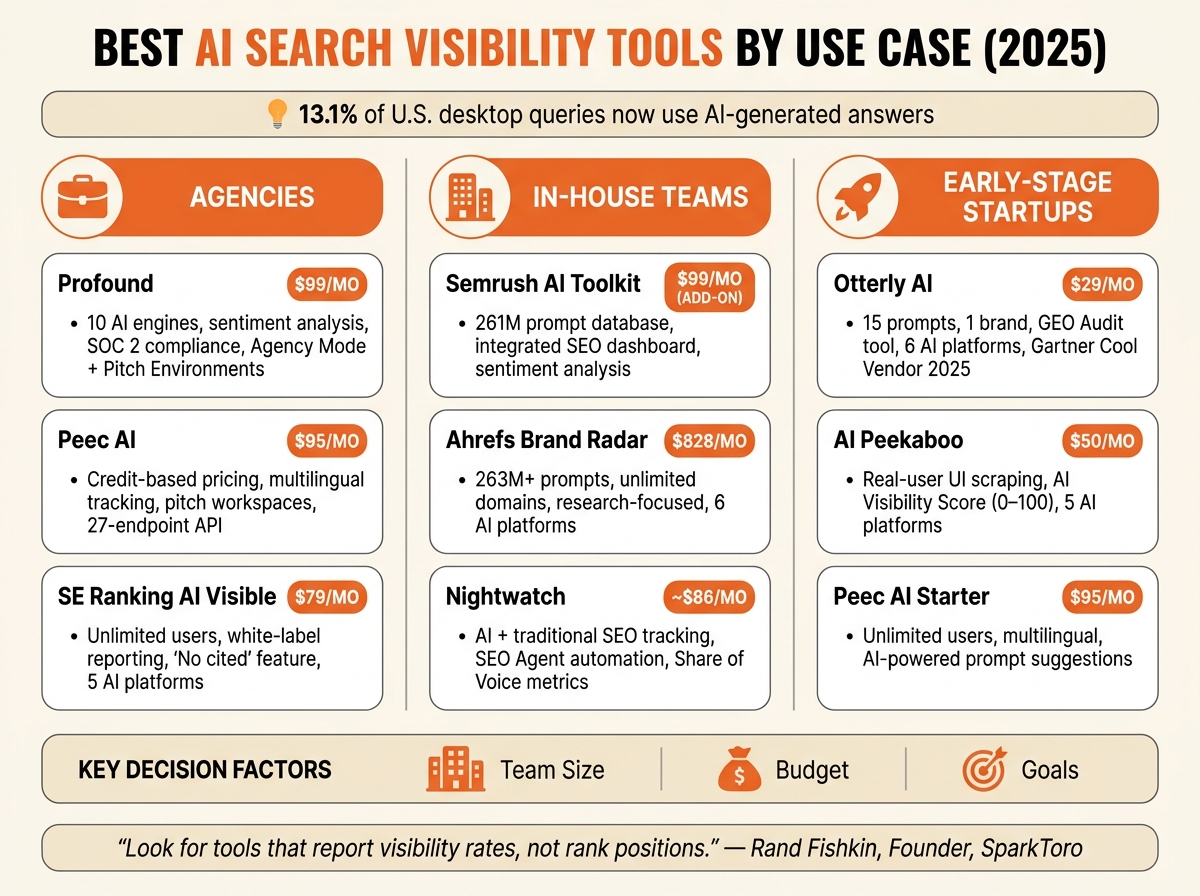
Best AI Search Visibility Tools by Use Case (2025)
AI Search Visibility Tools You Should Be Using in 2026
1. Profound
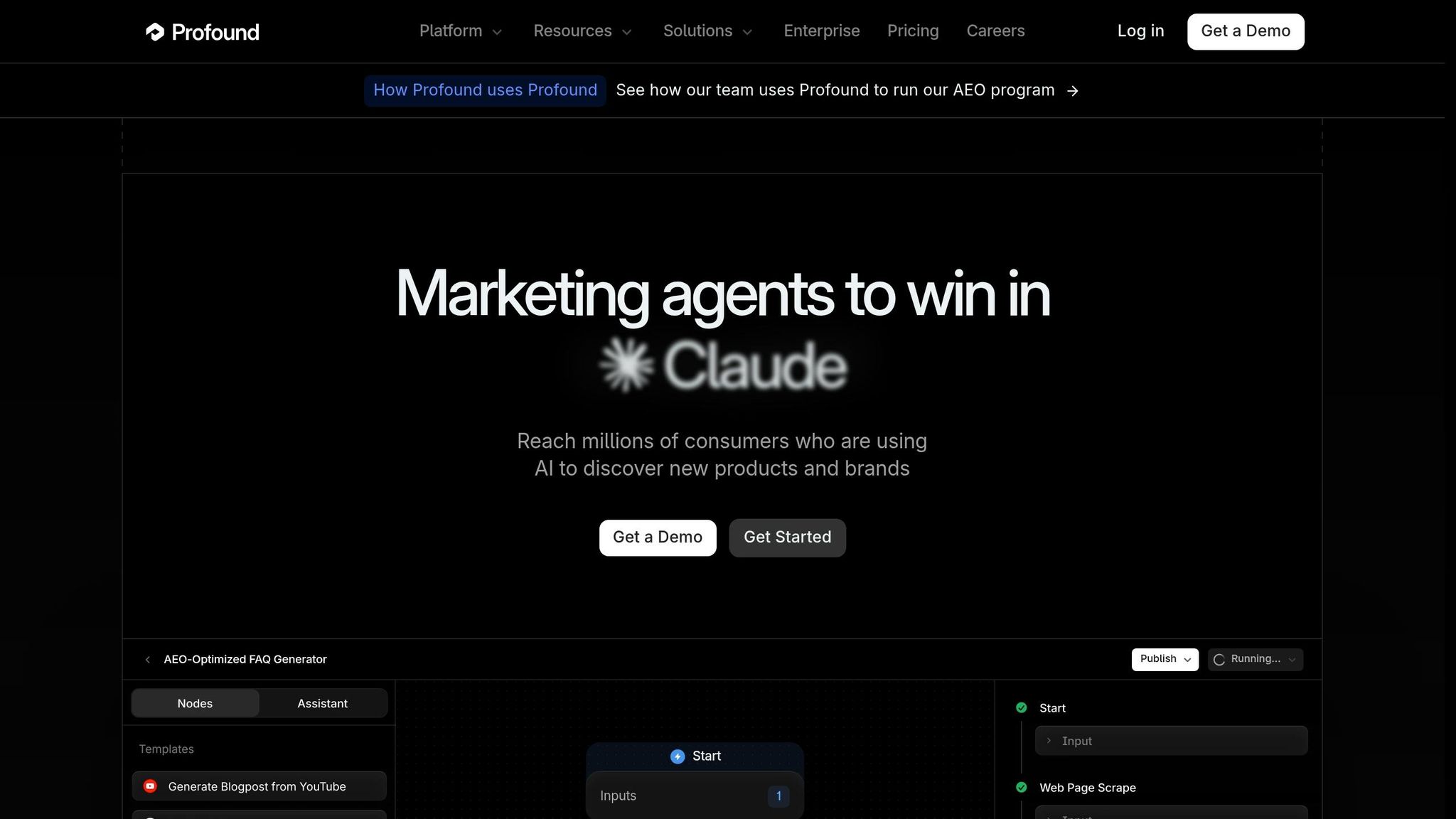
Profound is a standalone AI visibility platform that tracks 10 major AI engines, including ChatGPT, Perplexity, Google AI Overviews, Google AI Mode, Gemini, Microsoft Copilot, Meta AI, Grok, DeepSeek, and Claude. It provides a detailed view of how your brand appears across AI-driven search results. Implementing strategies to improve brand visibility is essential for maintaining this presence.
What sets Profound apart is its ability to go beyond simple tracking. It offers sentiment analysis, citation sources, share of voice, and prompt-level search volumes, giving you insights not just into whether your brand shows up, but how it’s being portrayed and which prompts bring it into the conversation. Its Agent Analytics tool takes things a step further by identifying which AI crawlers (like GPTBot or ClaudeBot) are visiting your site and what content they’re engaging with. This level of detail helps you fine-tune your strategy with precision.
"Profound helps us see where clients show up in AI search and how their narratives are framed, providing the clarity to elevate visibility and safeguard reputation in real time." Michael Brito, Global Head of Analytics, Zeno Group [2]
Pricing: Profound publishes a free trial and quote-based enterprise pricing rather than fixed public tiers, so getting a real number for your prompt volume and engine coverage means a sales conversation [1][5].
Who it’s for: Profound is ideal for agencies and enterprise-level in-house teams. The Agency Mode offers a centralized dashboard for managing multiple client accounts, along with "Pitch Environments", a feature that allows you to analyze a prospect’s AI visibility during a sales meeting. For industries with strict compliance needs, Profound also meets SOC 2 Type II and HIPAA standards [4]. Its depth may be more than an early-stage startup needs, but the free trial lets you test ChatGPT visibility monitoring before you commit to anything.
2. Otterly AI
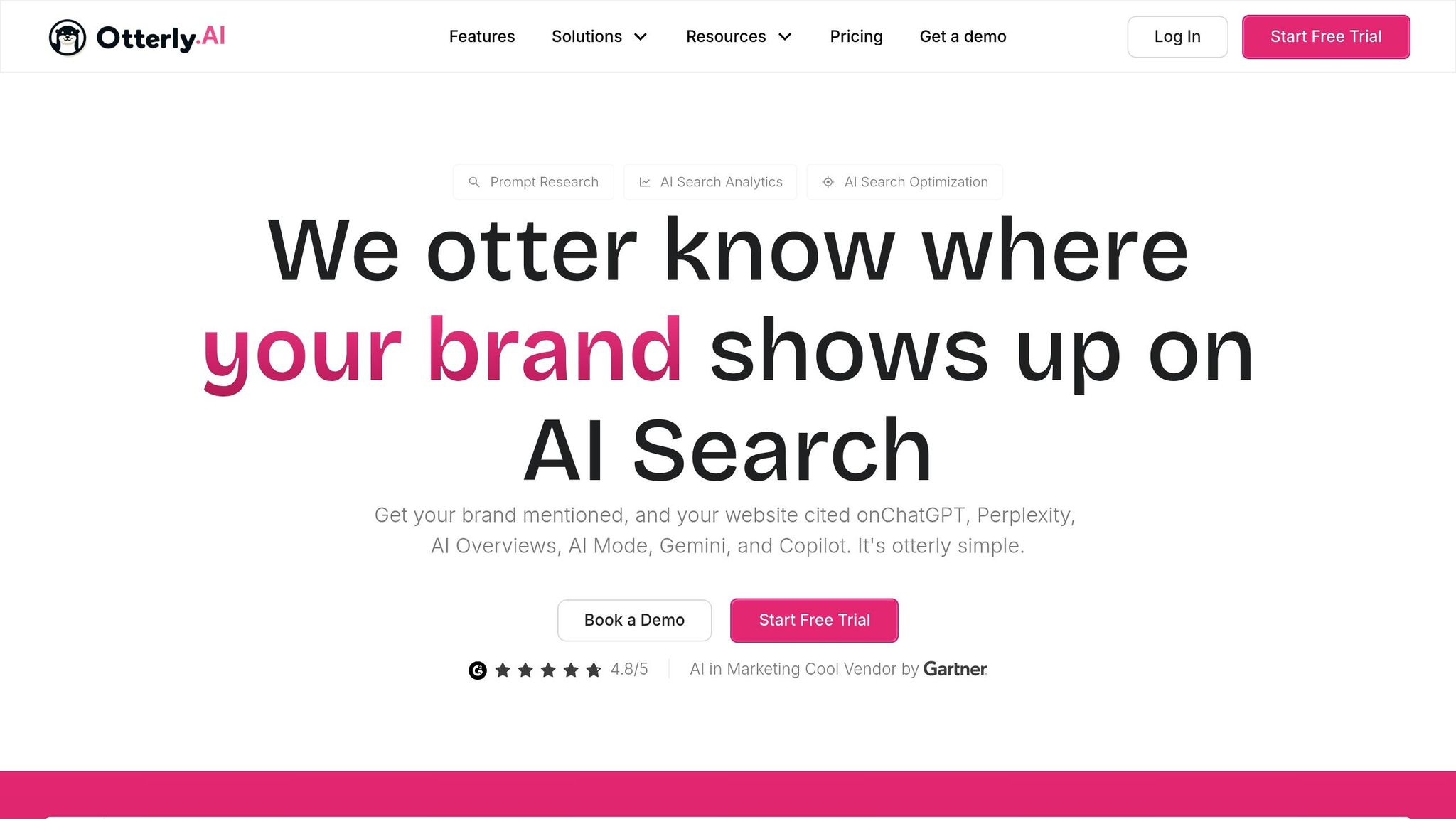
Otterly AI provides an easy way to dive into the world of AI visibility tracking, and its entry tier is among the cheapest on this list. The Lite plan offers 15 prompts and one brand, making it a solid option for teams looking to establish basic tracking. It monitors six major AI platforms, including ChatGPT, Perplexity, Google AI Overviews, Google AI Mode, Gemini, and Microsoft Copilot. This makes it a flexible choice for agencies, in-house teams, and startups.
Which of Otterly AI’s three tiers you need comes down to how many prompts and brands you track, and you can add prompts on top of any of them. Lite covers a single brand on a small prompt allowance, the middle tier adds the GEO Audit tool and multi-brand tracking, and the top tier adds workspace management and the largest prompt volume. Check Otterly AI’s own pricing page for current numbers before you budget.
Otterly AI has earned recognition as a Gartner Cool Vendor in 2025 and carries a "High Performer" badge on G2 in Answer Engine Optimization [7][8]. One standout feature is the GEO Audit tool, which evaluates over 25 on-page factors to identify citation blockers, such as missing schema or thin content. For in-house SEO teams, this feature helps pinpoint structural weaknesses that might be preventing AI engines from citing their brand.
"The best first step for teams new to AI visibility tracking. You’ll likely outgrow it within six months if you’re serious about the category, but the low price makes it a near-zero-risk starting point." Cintra [6]
Agencies can take advantage of Pro-tier features like workspace management, multi-client dashboards, and a native Looker Studio connector for white-label reporting. However, agencies managing a large client roster might find the prompt limits and lack of advanced multi-client automation restrictive compared to platforms designed for enterprise needs. If you are early-stage, Lite is enough to start with, and you can move up once your prompt list outgrows it.
3. Peec AI
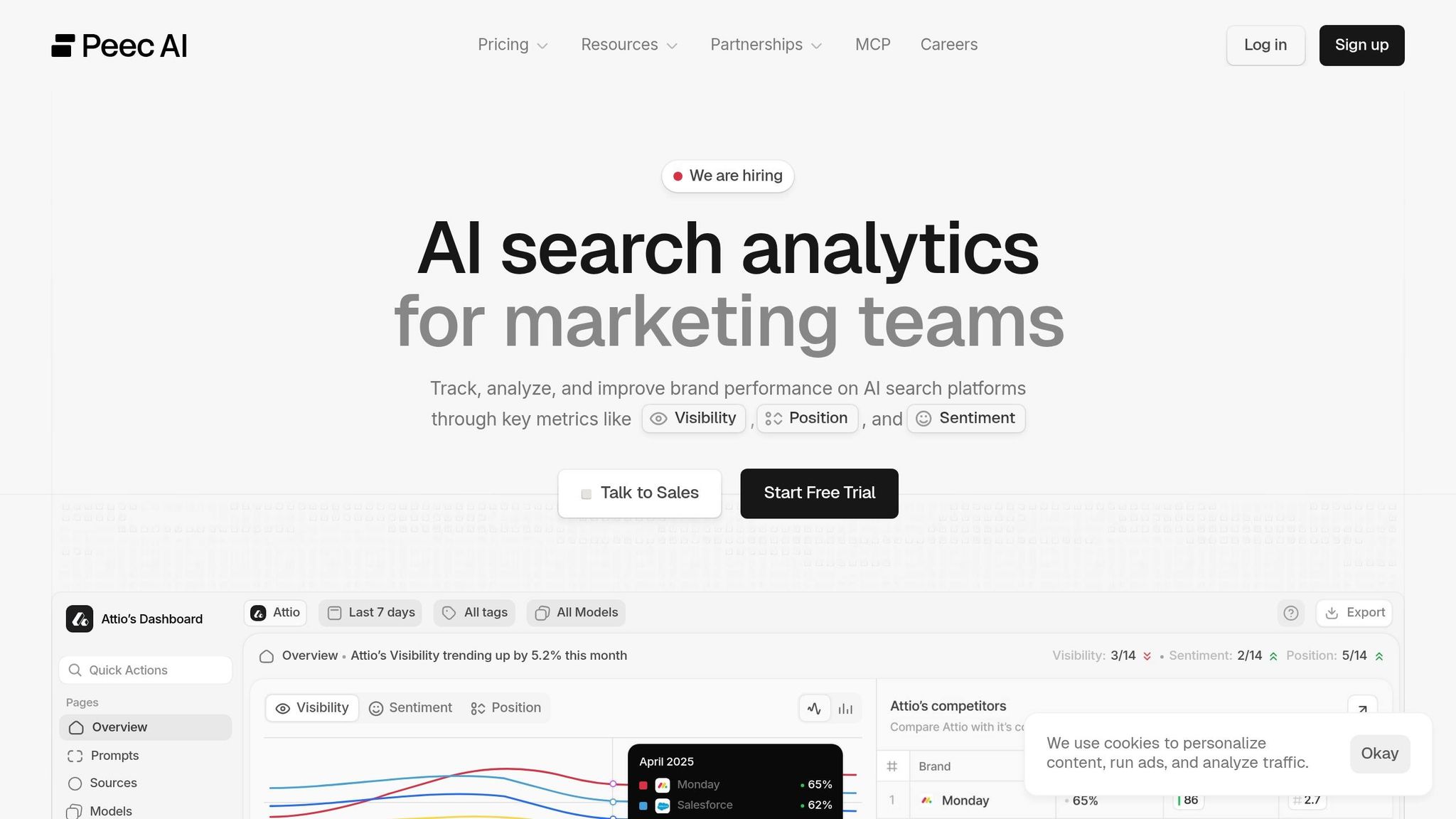
Peec AI helps brands monitor their presence across major language models like ChatGPT, Perplexity, Google AI Overviews, Google AI Mode, Microsoft Copilot, Gemini, and Grok. Enterprise users also gain access to platforms like Claude Sonnet 4 and GPT-5 Search [10][12]. By early 2026, the platform has onboarded over 1,300 brands and earned the trust of more than 2,000 marketing teams [9][11].
The platform operates on a credit-based system: 1 credit equals 1 prompt tracked per model per day, and unused credits roll over to the next month [10]. You get one project and a limited prompt allowance across three language models on the entry plan, and the agency tiers scale project count and daily capacity from there [12].
This flexible pricing and features make Peec AI a strong choice for both startups and agencies at various growth stages.
One of its standout features is the Actions module, which takes monitoring data and turns it into actionable recommendations for content creation, source targeting, and addressing citation gaps. For agencies, the platform also offers "pitch workspaces", which are dedicated environments where teams can generate visibility data to support sales pitches for prospective clients [10]. Additionally, Peec AI integrates seamlessly with tools like Looker Studio and provides a 27-endpoint API, enabling detailed white-label reporting without the need for custom development [11][12].
"Peec allows us to pinpoint the exact types of content that are surfaced in specific LLMs. With that visibility, we’ve been able to prioritize our content strategy and drive a 5x year-over-year increase in traffic and demo requests from LLMs." Jon Gitlin, SEO Strategist [9]
For early-stage startups, the Starter plan includes unlimited user access and AI-powered prompt suggestions, making it easier to identify key customer queries [9][12]. Watch your engine count, though: every AI engine you add beyond the three in the base plan costs you more. Teams planning to track five or more models should factor this into their budgets before committing.
4. Semrush AI Visibility Toolkit
If your team already relies on Semrush for SEO, the AI Visibility Toolkit makes it easy to extend those efforts into AI-driven search. It tracks brand visibility across platforms like ChatGPT, Google AI Overviews (AI Mode), Gemini, and Perplexity, offering a streamlined way to monitor your presence in these emerging spaces [15].
The AI Toolkit is an add-on to a Semrush subscription rather than a standalone product, so budget for both layers. It includes tracking for one domain, 300 daily AI analysis queries, and access to an extensive prompt research database with over 261 million LLM prompts worldwide, of which 126 million of which are specific to the U.S. and 58.4 million tailored to ChatGPT [15]. For teams needing more capacity, Semrush bundles the toolkit into its Semrush One plans.
Beyond tracking, the toolkit includes an AI Search Site Audit that flags issues like missing schema or crawler restrictions, which could prevent AI models from accessing your content. It also offers brand sentiment analysis, helping you understand whether AI platforms describe your brand in positive, neutral, or negative terms [14].
However, the toolkit isn’t perfect. One limitation is its reliance on fixed prompt sets, which might not fully capture the unique language of niche or highly specialized brands [13]. As one analyst noted:
"For teams already paying for Semrush, the AI Toolkit is a reasonable add-on. As a standalone GEO solution, it’s not deep enough." Surferstack [13]
This makes the toolkit more suitable for teams already invested in Semrush, particularly those looking to consolidate AI and traditional SEO data. Agencies can also use features like "My Reports" to create white-label dashboards combining AI visibility with standard rankings, though the lack of custom prompt flexibility and limited AI traffic attribution could pose challenges [13]. For startups, the figure that matters is the combined cost, because the add-on cannot be bought without a base Semrush subscription underneath it [3].
5. Ahrefs Brand Radar
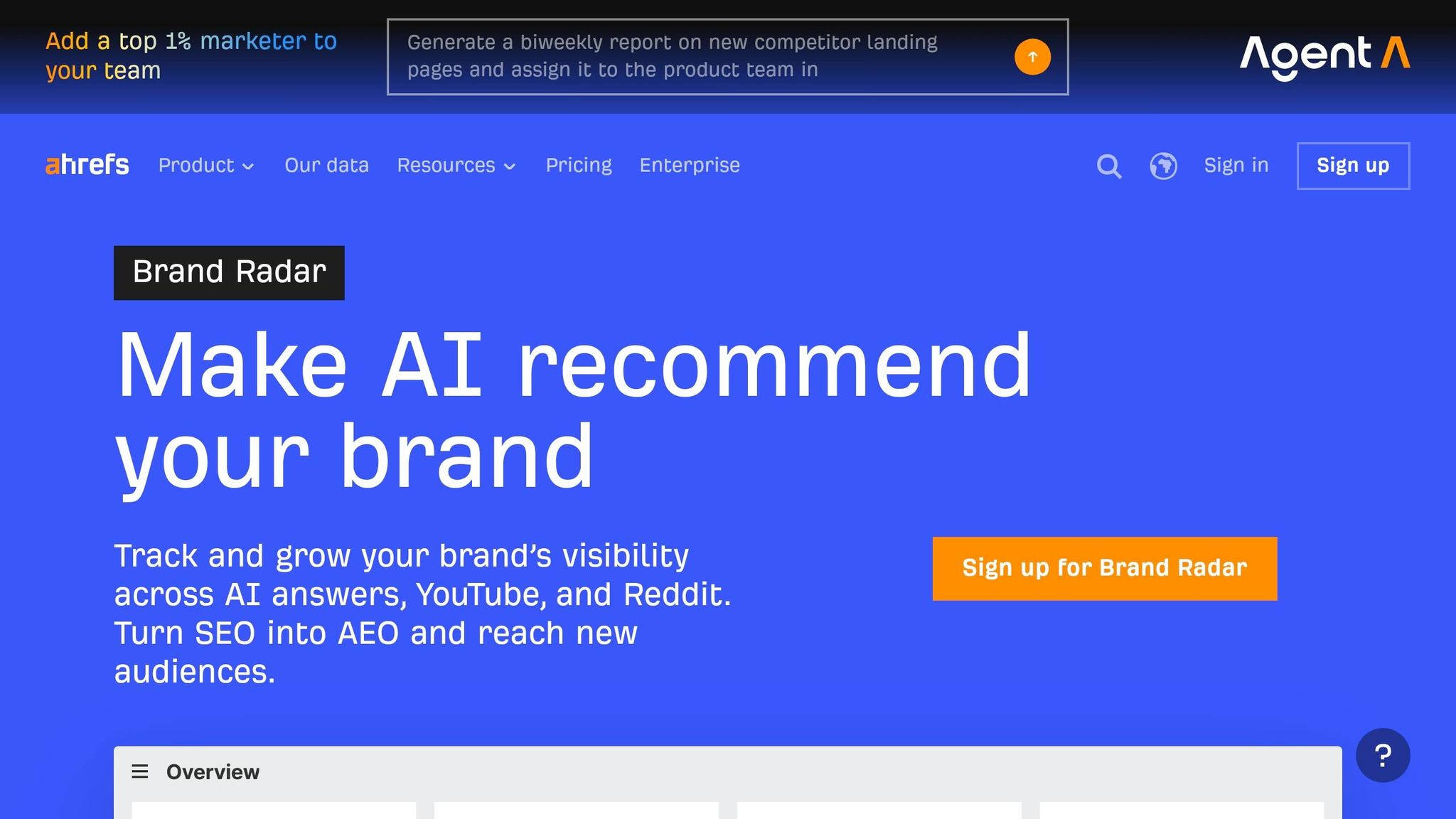
Ahrefs Brand Radar keeps tabs on your brand across six major AI platforms: ChatGPT, Perplexity, Gemini, Microsoft Copilot, Google AI Overviews, and Google AI Mode. It also includes Grok and monitors YouTube, Reddit, and TikTok, with the latter currently available for free in beta [16][18].
What sets Brand Radar apart is how it gathers its data. Instead of relying on synthetic queries, it taps into a massive database of over 263 million monthly search-backed "People Also Ask" prompts [19][17]. As Ahrefs CMO Tim Soulo explains:
"Most AI visibility tools are dashboards. Brand Radar is a research engine." [21]
The tool also offers unlimited domain tracking without any per-brand limits, making it an attractive option for agencies. Pricing depends on what you already pay Ahrefs: custom prompt tracking is bundled into the paid Ahrefs plans, while the wider AI Visibility Index is sold separately, so confirm current terms against your existing plan [22].
Brand Radar fits these buyer types differently, depending on what you already run:
| Buyer Type | Fit | Key Reason |
|---|---|---|
| Agency | Moderate | Unlimited domains are useful, but the total cost can be restrictive at scale. |
| In-House Team | Strong | Perfect for teams already using Ahrefs who need comprehensive brand monitoring. |
| Early-Stage Startup | Varies | Worth it mainly if you already pay for Ahrefs; confirm current pricing before committing. |
While Brand Radar excels at tracking brand presence and competitor mentions, it doesn’t offer content recommendations or automated fixes [19][20]. For in-house teams already invested in Ahrefs, this tool is a logical extension for monitoring AI search. However, early-stage startups operating on tight budgets may struggle to justify the expense. If you’re looking for a research-heavy approach to AI search insights, Brand Radar delivers, but it comes with a premium price tag.
6. SE Ranking AI Visibility
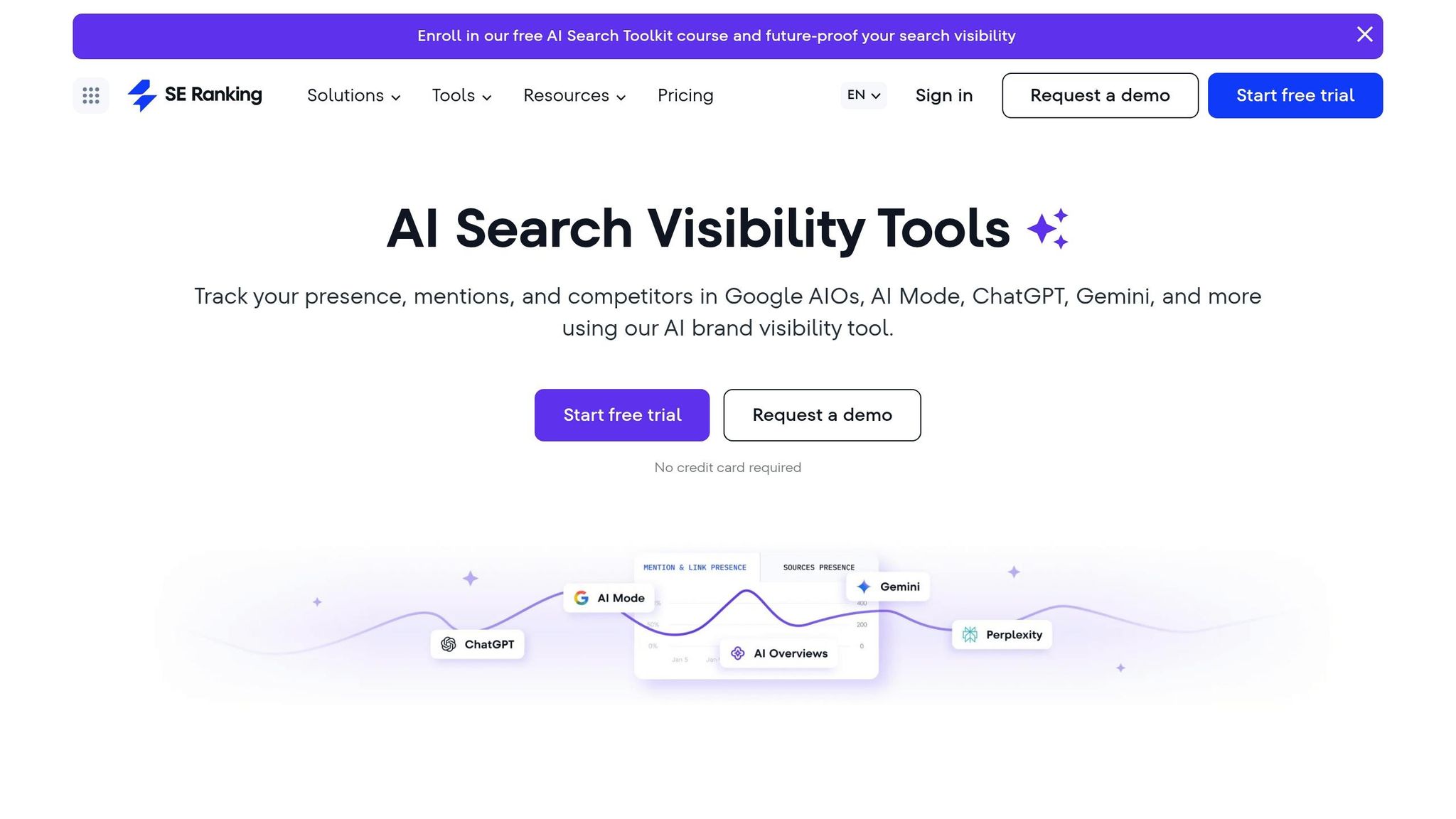
SE Ranking’s SE Visible is a dedicated tool for tracking brand visibility across five key platforms: ChatGPT, Perplexity, Gemini, Google AI Overviews, and Google AI Mode. Notably, it doesn’t cover platforms like Claude, Grok, or Copilot.
SE Visible is sold as its own subscription, separate from SE Ranking, and the tiers scale by brand count and prompt allowance. The detail worth knowing is that every tier lets you invite unlimited users (SE Visible pricing).
One standout feature is the "No cited" view, which highlights prompts where competitors are mentioned but your brand is absent. As Rankability notes:
"The ‘No cited’ feature, which shows where competitors are mentioned but your brand isn’t, has been described as ‘gold for content ideas.’" [23]
Treat SE Visible as your monitoring layer. It tells you where you stand, and it will not write or rework your content for you. It doesn’t include content gap analysis or AI writing capabilities. However, it offers great value for different types of users:
- Agencies: Unlimited seats and white-label reporting make it ideal for managing multiple clients.
- In-house teams: Its cost-efficiency mirrors traditional rank tracking workflows.
- Startups: While it’s a strong monitoring tool, they might eventually pair it with an optimization platform for deeper insights.
7. AI Peekaboo
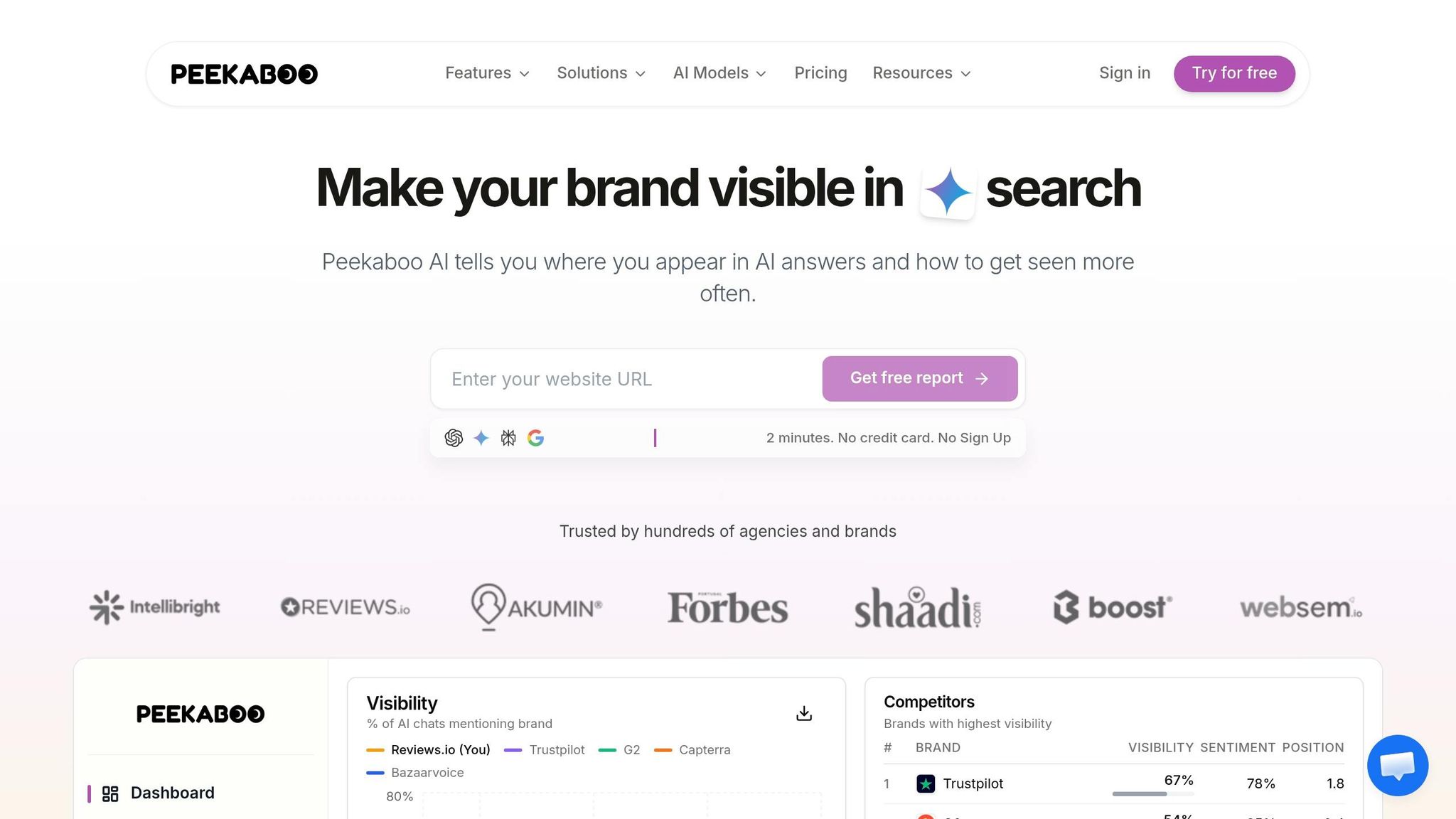
AI Peekaboo offers a fresh spin on tracking brand visibility by focusing on five AI platforms: Google AI Overviews, Google AI Mode, ChatGPT, Perplexity, and Gemini [25][27]. What makes it stand out is its approach to data collection. What you get is scraped straight from the platforms’ own interfaces rather than pulled through their APIs. This ensures that the results reflect what a real user would experience [25].
The tool calculates an AI Visibility Score (ranging from 0 to 100) by analyzing factors like how often a brand is mentioned, the quality of citations, and overall brand prominence. It also tracks the external sources feeding into AI responses, such as Reddit discussions, Wikipedia pages, GitHub repositories, and YouTube videos. This insight is invaluable for shaping off-site content strategies [25].
Pricing and Plans
Peekaboo prices by calculator rather than fixed tiers: you set the number of brands, the prompts per brand, how many AI models to include and how often to refresh, and the price moves with those choices. White-label and share-link features cost extra, and agencies managing many brands are quoted directly.
Features to Note
One standout feature is the Search Console AI Chat, which lets users query Google Search Console data in plain language. This bridges the gap between organic search performance and AI visibility trends [25]. Swanand Pisat, Digital Marketing Manager, shared:
"We knew LLMs were driving traffic, but we had no visibility into where we appeared. Peekaboo gave us clear insight into our mentions, our gaps, and opportunities." [26]
Which of its features matter to you depends on whether you run a single brand or report on a dozen. Agencies can take advantage of a multi-client dashboard, white-label reporting, and unlimited team seats. Meanwhile, startups and in-house teams will appreciate the affordable entry-level pricing and the ability to track citations for better content distribution planning.
However, it’s important to note that AI Peekaboo is strictly a monitoring tool. While it excels at identifying visibility gaps, it doesn’t include features like content generation or crawler log analysis to address those gaps [25]. Even so, if you want current data and a clear next step rather than a deep archive, it will serve you.
8. Nightwatch
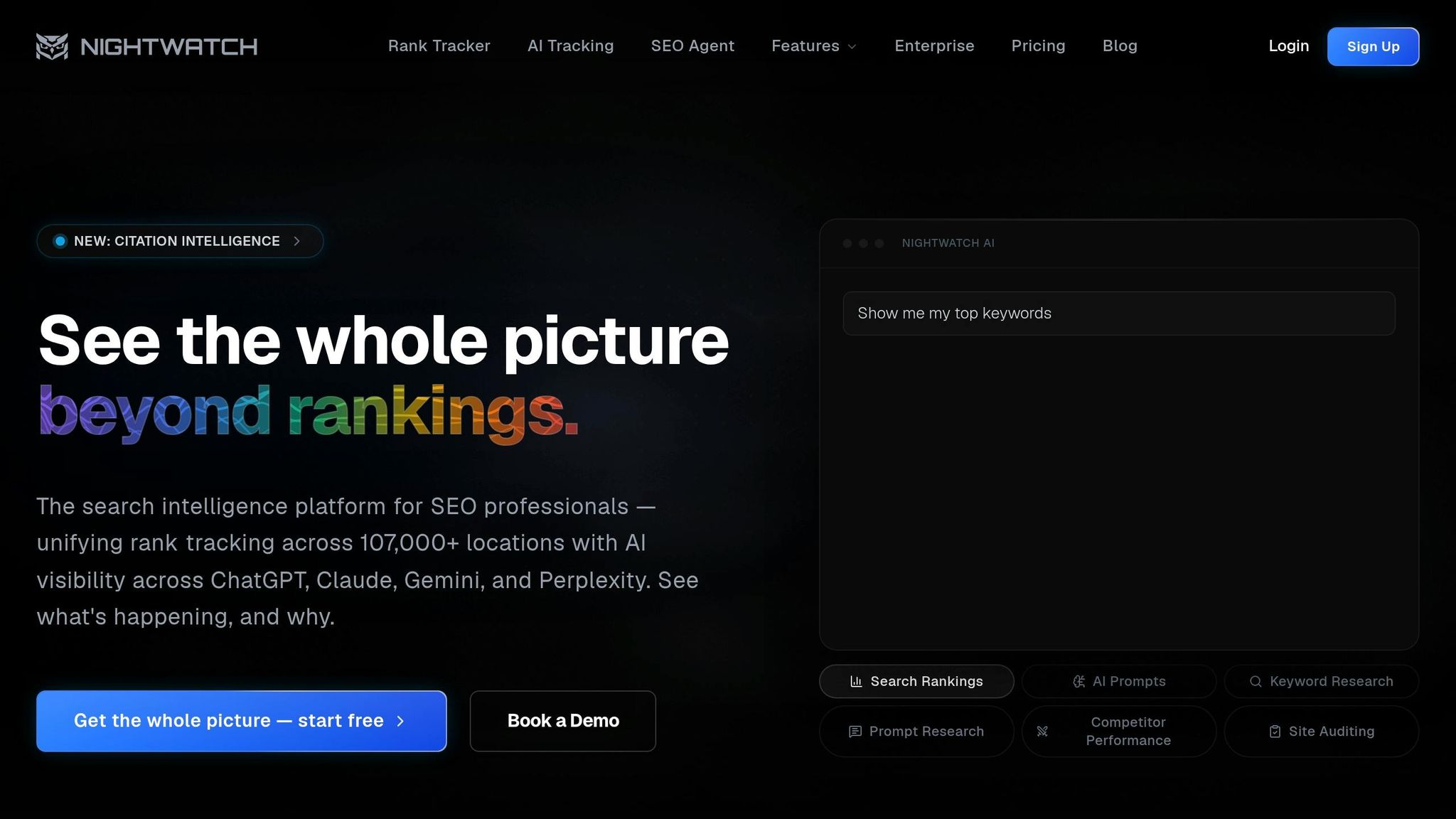
Nightwatch merges traditional rank tracking with AI-powered visibility monitoring, creating a unified tool for SEO professionals. It supports six traditional engines: Google, Bing, YouTube, Yahoo, DuckDuckGo, and Google Places, alongside key AI platforms like ChatGPT, Claude, Gemini, and Perplexity. Additionally, it tracks Google AI Overviews and AI Mode, providing a comprehensive view of both legacy SEO data and emerging AI trends [29][31]. If you already pay for classic rank tracking, this saves you running a second tool alongside it.
The platform measures a variety of metrics, including AI Visibility Score from 0 to 100, Share of Voice, Sentiment, Generative Rankings, and Citation Intelligence, which references specific pages [30][32]. It also features an integrated SEO Agent that automates tasks like ranking drop alerts and generating content briefs [29][31]. Henrik Russell, an SEO Specialist, praised the tool:
"Nightwatch has an impressive set of features, super competitive pricing, great API, and the best rank tracking accuracy in the industry." [30]
Pricing and Plans
Note that you will be billed in euros, and the cheapest rate is annual rather than monthly. The Starter plan covers 500 keywords, 50 AI prompts and up to 5 websites, with higher tiers scaling keyword and prompt volume [28][33].
Who Benefits Most?
Nightwatch’s combined tracking appeals to both agencies and in-house teams. Agencies can leverage unlimited user seats and a robust API, while in-house teams benefit from automation features like the SEO Agent and native Looker Studio integration. If you are early-stage, the Starter tier gives you enough keyword and prompt coverage to begin without over-committing. However, while AI tracking is a valuable addition, its core strength still lies in traditional rank tracking [28][32].
9. Amadora.ai
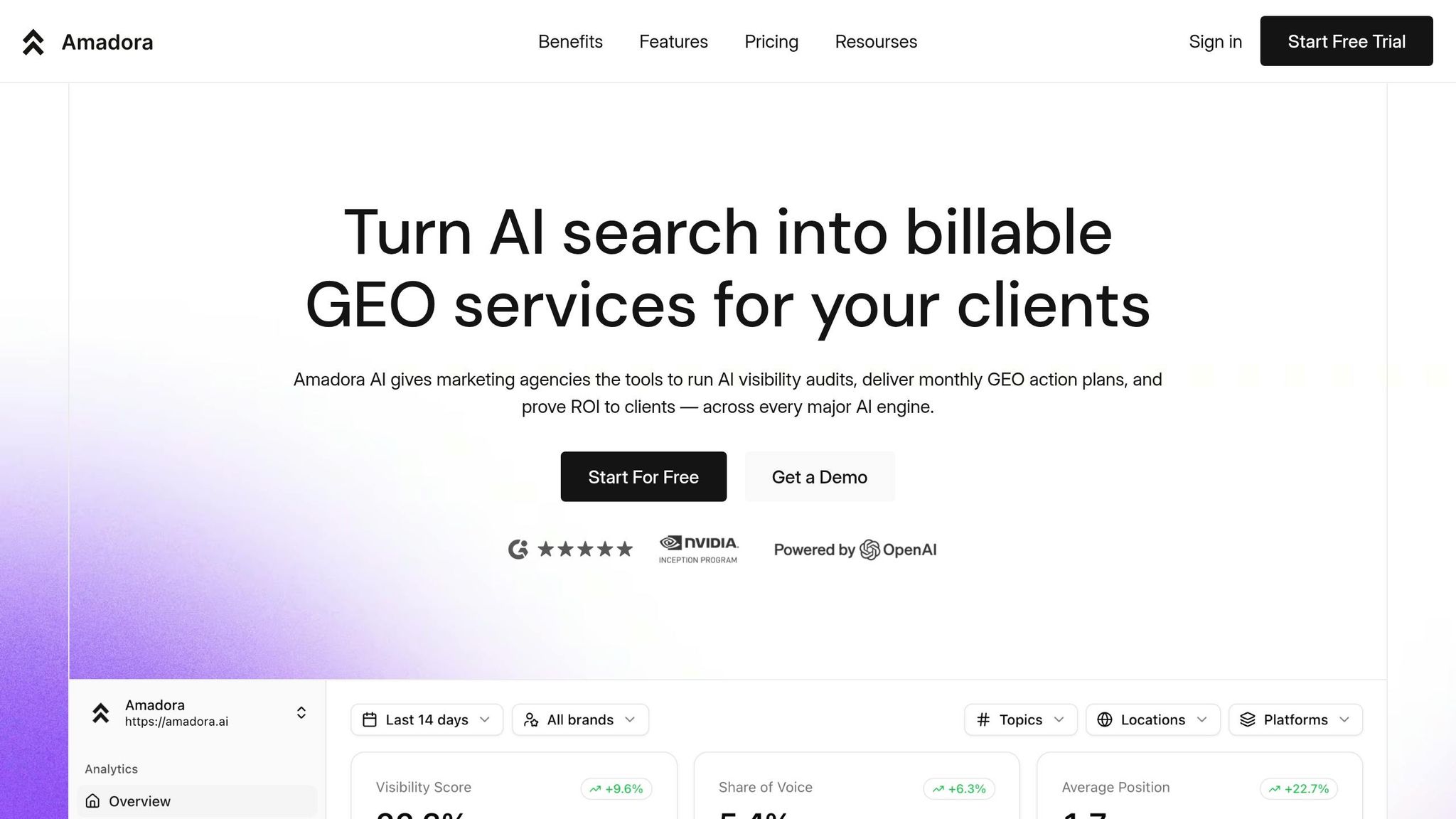
Amadora.ai takes an agency-first approach, offering a clear snapshot of your brand’s presence across emerging AI search engines. It tracks performance on platforms like ChatGPT, Perplexity, and Gemini, giving SEO agencies a quick way to see how their clients are featured in AI-driven search results.
The platform’s streamlined interface ensures that busy teams can access essential insights without the hassle of navigating overly complicated dashboards. It covers the basics of AI search visibility without much setup. Understanding how to rank in AI search results is the next logical step for teams using these insights.
Pricing and Plans
Amadora.ai is built for agencies, so it suits you if you report across a roster of client brands rather than one. Amadora.ai publishes its own plan pricing, so check their site for the current figures before you budget.
Who Benefits Most?
This platform is ideal for SEO agencies managing multiple client brands. Its agency-focused design provides an efficient overview of AI visibility, making it a strong choice for teams that need to track performance across various AI search engines. For those seeking more detailed reporting or advanced analytics, this tool serves as a practical starting point, though other platforms might offer additional features for deeper insights.
Pros and Cons by Buyer Type
Your workflow decides this more than any feature list: whether you are juggling client accounts, going deep on a single brand, or trying to register in AI answers at all. The table below highlights how each tool stacks up for these buyer types, outlining strengths and potential drawbacks.
| Tool | Agencies | In-House Teams | Early-Stage Startups |
|---|---|---|---|
| Profound | Strong fit. Advanced analytics; SOC 2 compliance for enterprise-level security | Strong fit. Exceptional data depth with compatibility for over 10 AI models | Poor fit. Quote-based enterprise pricing may be more than small teams need |
| Otterly AI | Strong fit. Budget-friendly multi-prompt tracking and simple client reporting | Limited. Provides monitoring but lacks optimization features | Strong fit. Affordable entry point with SEO-to-prompt conversion tools |
| Peec AI | Limited. Optimization tools could be stronger | Strong fit. Unlimited user access; supports 115+ languages with daily updates | Strong fit. User-friendly interface with effective multilingual tracking |
| Semrush AI Visibility Toolkit | Limited. Fixed prompts and per-domain pricing limit scalability | Strong fit. Integrated SEO/AI dashboard tailored for Semrush users | Poor fit. Per-domain pricing on top of a Semrush subscription may deter lean budgets |
| Ahrefs Brand Radar | Limited. Focused on research, lacking direct optimization features | Strong fit. Extensive prompt database (240M+), ideal for research-heavy workflows | Limited. Cost depends on your existing Ahrefs plan; check current terms |
| SE Ranking AI Visibility | Strong fit. Unlimited users and detailed evidence logs for client transparency | Strong fit. Great for multi-brand organizations with unlimited seats | Limited. Does not track certain models like Claude or Grok |
Some tools focus heavily on visibility reporting without offering actionable insights. For in-house teams, it’s crucial to choose tools that go beyond identifying low visibility. Look for features like crawler log access, content gap analysis, and traffic attribution to drive meaningful improvements.
This breakdown should help you match the tool to your specific needs as you move toward the final analysis.
Conclusion
When selecting a tool, consider your user type and how you plan to use the data. For agencies managing multiple clients, features like multi-client workspaces and white-label reporting are essential. Peec AI and Profound excel in these areas, with Peec AI’s unlimited seat model offering predictable costs as your team grows. In-house teams, on the other hand, should focus on tools that go beyond basic dashboards. Look for features like content gap analysis, crawler log access, and revenue attribution tools to drive meaningful insights. If you’re an early-stage startup, it’s smart to start lean, and Otterly AI’s entry plan is a cheap way to build a foundation while you keep expenses down.
Before committing to a paid plan, take a moment to assess your current standing. Run 10 to 15 high-intent queries manually in tools like ChatGPT or Perplexity. This quick audit gives you a baseline, so you can tell whether a tool is actually improving your outcomes once you pay for it. This step is key for aligning your strategy and budget.
Also, don’t overlook seat limits. A cheaper plan with a single user seat can cost you more than a dearer one with unlimited seats once your team grows. Paying for visibility data without a clear process for acting on it can also lead to wasted resources. Always calculate the true cost based on your team size and needs.
"Any tool that sells you ‘AI rankings’ is measuring noise. Look for tools that report visibility rates, not rank positions." Rand Fishkin, Founder, SparkToro [1]
FAQs
How do I choose the right tool for my team type?
Start by mapping out your workflow and pinpointing what your team truly needs. If you’re part of an in-house team, look for tools that excel in content workflows, offer revenue attribution, and provide detailed visibility data. On the other hand, agencies juggling multiple clients should prioritize tools designed for multi-client management, white-label reporting, and seat-based access. Choosing tools that don’t fit your workflow can lead to wasted time, money, and opportunities. Stay focused on what aligns with your specific processes.
Which metrics matter most for AI search visibility?
Key metrics for AI search visibility in 2026 focus on brand mentions, citations, and references within AI-powered tools like ChatGPT and Google AI Overviews. To strengthen your presence, performing a content gap analysis and evaluating citation coverage are essential steps to uncover opportunities for growth. On top of that, tracking traffic attribution and source data bridges the gap between visibility efforts and measurable business results, offering clear insights to fine-tune your brand’s appearance in AI-generated content.
How can I improve AI citations after tracking gaps?
To strengthen AI citations, start by analyzing where your brand is being referenced, or overlooked. Dive into a thorough citation analysis to understand who is citing you, the sources they rely on, and the situations that lead to those citations. Leverage tools that provide detailed insights, such as source URLs and the context of mentions, to pinpoint citation gaps. From there, develop focused content or outreach strategies to address these gaps. Incorporating workflows for content gap analysis and optimization can also play a big role in bridging these citation voids effectively.