Last updated: September 23, 2026. My own trailing-three-month report covered 1,563 grounding queries and 190,776 query-level citations, which is exactly the visibility the tools below exist to measure. Full numbers are in my Semrush AI Search Health audit.
Your buyers now search inside ChatGPT and Perplexity as much as Google, so ranking on page one is only part of the job in 2026. The tools below help you see whether AI answers mention your brand, and they show you how to earn more of those mentions. I’ve been landing 5-figure clients from AI search since 2025, so this list reflects what I’ve watched actually move the needle.
Key takeaways for 2026:
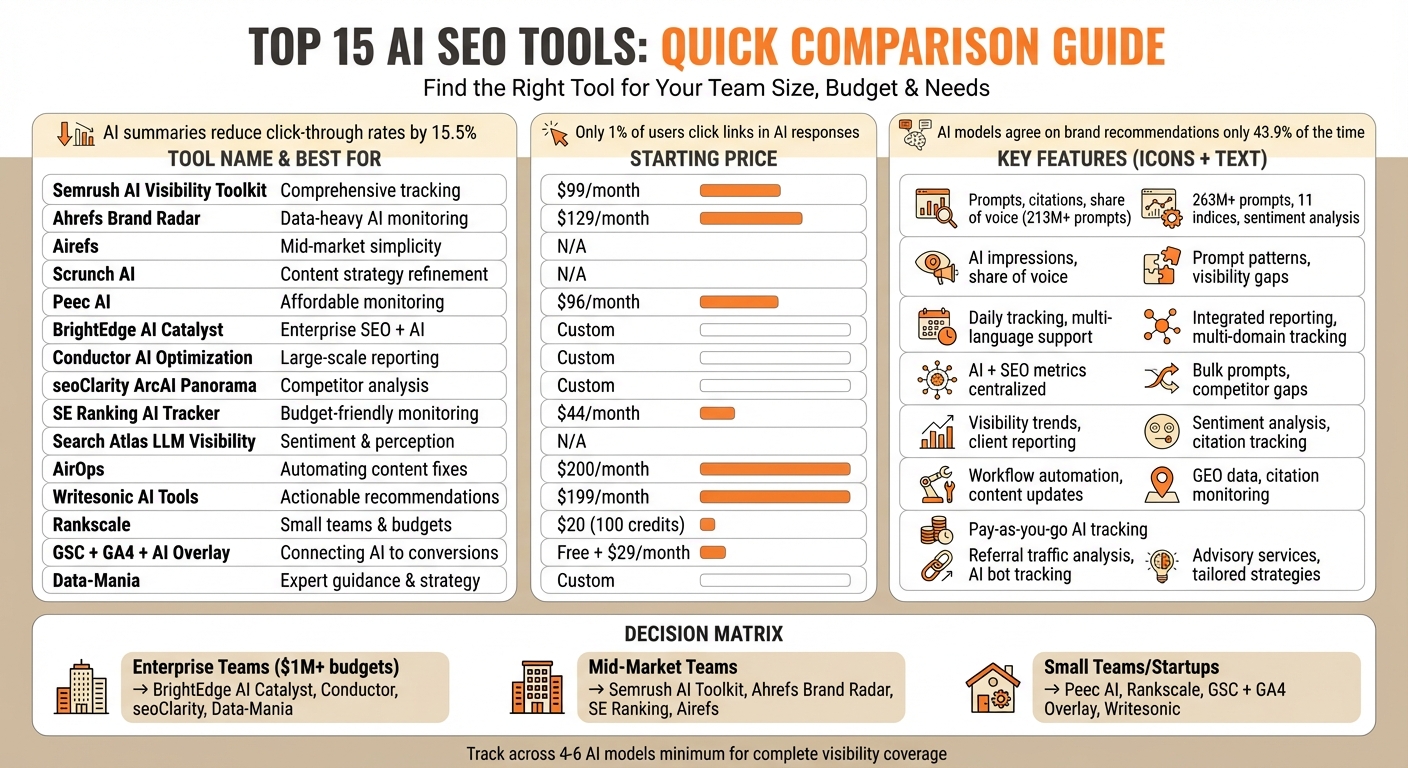
- AI-driven search is reshaping visibility. Click-through rates drop 15.5% when AI summaries appear, and only 1% of users click links in these responses.
- Metrics have changed. To succeed, you need to track prompts, citations, share of voice, AI bot crawlability, and how AI platforms perceive your brand.
- Tools are evolving. From Semrush’s AI Visibility Toolkit to BrightEdge AI Catalyst, the best tools now focus on helping you monitor and improve how AI models reference your content.
Here’s a quick rundown of the top tools:
- Semrush AI Visibility Toolkit: Tracks prompts, citations, and share of voice across 140+ countries.
- Ahrefs Brand Radar: Monitors 263M+ prompts and AI mentions across 11 indices.
- Airefs: Focused on share of voice and AI impressions for mid-market teams.
- Scrunch AI: Helps refine content strategy by analyzing AI response patterns.
- Peec AI: Affordable monitoring for smaller teams, with daily prompt tracking.
- BrightEdge AI Catalyst: Enterprise-focused, integrating AI metrics with SEO data.
- Conductor AI Visibility Optimization: Centralizes AI and SEO reporting for large brands.
- seoClarity ArcAI Panorama: Bulk prompt research and competitor gap analysis.
- SE Ranking AI Visibility Tracker: Budget-friendly and integrates with existing SEO workflows.
- Search Atlas LLM Visibility: Tracks brand perception and sentiment across AI models.
- AirOps: Automates content fixes based on AI visibility insights.
- Writesonic GEO / AI Visibility Tools: Combines citation monitoring with actionable fixes.
- Rankscale: Pay-as-you-go tracking for AI mentions and citations.
- Google Search Console + GA4 + AI Visibility Overlay: Connects AI visibility to traffic and conversions.
I’ve picked and chosen from this exact set of tools to get client brands cited in ChatGPT and Perplexity for the high-intent questions their buyers ask, and I’ve been doing it since 2025.
Use a list like the one that follows in a specific order. Start by measuring where you stand, because measuring is the only way to improve a number. Pick one tool to show you which AI answers already mention you and which ones mention a competitor instead. Then use the rest of these tools to close that gap, one buying question at a time. Visibility in AI search is an engineering problem, and these tools are how you work it:
| Tool | Best For | Starting Price | Key Features |
|---|---|---|---|
| Semrush AI Toolkit | Comprehensive tracking | $99/month | Prompts, citations, share of voice |
| Ahrefs Brand Radar | Data-heavy AI monitoring | $129/month | Tracks 263M+ prompts, sentiment analysis |
| Airefs | Simplicity for mid-market teams | N/A | AI impressions, share of voice |
| Scrunch AI | Content strategy refinement | N/A | Prompt patterns, visibility gaps |
| Peec AI | Affordable monitoring | $96/month | Daily tracking, multi-language support |
| BrightEdge AI Catalyst | Enterprise-level SEO + AI | Custom | Integrated reporting, multi-domain tracking |
| Conductor AI Optimization | Large-scale reporting | Custom | AI and SEO metrics centralized |
| seoClarity ArcAI Panorama | Competitor analysis | Custom | Bulk prompts, share of voice |
| SE Ranking AI Tracker | Budget-friendly AI monitoring | $44/month | Visibility trends, client reporting |
| Search Atlas LLM Visibility | Sentiment and perception | N/A | Sentiment analysis, citation tracking |
| AirOps | Automating content fixes | $200/month | Workflow automation, content updates |
| Writesonic AI Tools | Actionable recommendations | $199/month | GEO data, citation monitoring |
| Rankscale | Small teams and budgets | $20 (100 credits) | Pay-as-you-go AI tracking |
| GSC + GA4 + AI Overlay | Connecting AI to conversions | Free + $29/month | Referral traffic analysis, AI bot tracking |
Whether you’re a small team or a global brand, there’s a tool here to help you stay visible in the AI-driven search world.
AI SEO Tools Comparison: Features, Pricing, and Best Use Cases
1. Semrush AI Visibility Toolkit
The Semrush AI Visibility Toolkit brings together essential metrics like prompt tracking, citation monitoring, share of voice, technical crawlability, and brand monitoring into a single platform. This all-in-one solution is ideal for teams looking to streamline their tools. It tracks visibility across platforms such as ChatGPT, Perplexity, Google AI Overviews, and Gemini, covering over 140 countries and supporting 17 languages [6]. Built around Lillian Pierson’s framework, this toolkit demonstrates how integrated AI SEO tools can deliver insights that drive action.
Prompt Tracking
This feature treats AI prompts similarly to traditional keywords, enabling users to research high-volume AI topics, evaluate difficulty, and discover overlooked opportunities [6]. The toolkit allows monitoring of 50–200 high-volume prompts with automated alerts. Enterprise users gain access to an extensive database of over 213 million LLM prompts [6].
Citation Monitoring
The toolkit pinpoints which of your website’s pages are cited by AI platforms like ChatGPT and Google AI Overviews [6]. By updating these cited pages, you can refine your brand narrative and fill visibility gaps. Additionally, it integrates with Semrush’s "AI PR Toolkit" to actively boost the number of AI citations for your brand [6].
Share of Voice
This feature benchmarks your brand’s visibility across LLMs and traditional metrics [5][7]. It evaluates brand sentiment and performance relative to competitors, offering strategic recommendations to enhance your brand visibility in AI search engines [6]. In a comparative analysis conducted in 2026, the toolkit scored 90/100, securing second place among AI SEO tools [5].
AI Bot Crawlability
The "AI Site Audit" feature identifies technical barriers that may prevent LLM bots from crawling your content effectively [6]. It offers solutions to improve accessibility for AI agents, a critical factor given that 88.1% of AI Overview queries are informational, requiring precise answers [9].
Entity/Brand Monitoring
Semrush tracks public sentiment around your brand and compares it to competitors, offering recommendations to adjust your website messaging based on AI-driven sentiment analysis [6]. It also monitors brand mentions and benchmarks performance to uncover gaps in topics and sources [6].
Actionability
The toolkit is designed to quickly highlight actionable insights, such as high-priority topics, untapped prompt opportunities, and marketing strategies based on LLM data [6]. These insights can be directly applied to update content and improve site performance for better AI visibility. Pricing starts at $99/month for the standalone toolkit, while Semrush One plans range from $199/month for 50 tracked prompts to $549/month for 200 prompts, including share of voice tracking and API access [6].
2. Ahrefs Brand Radar
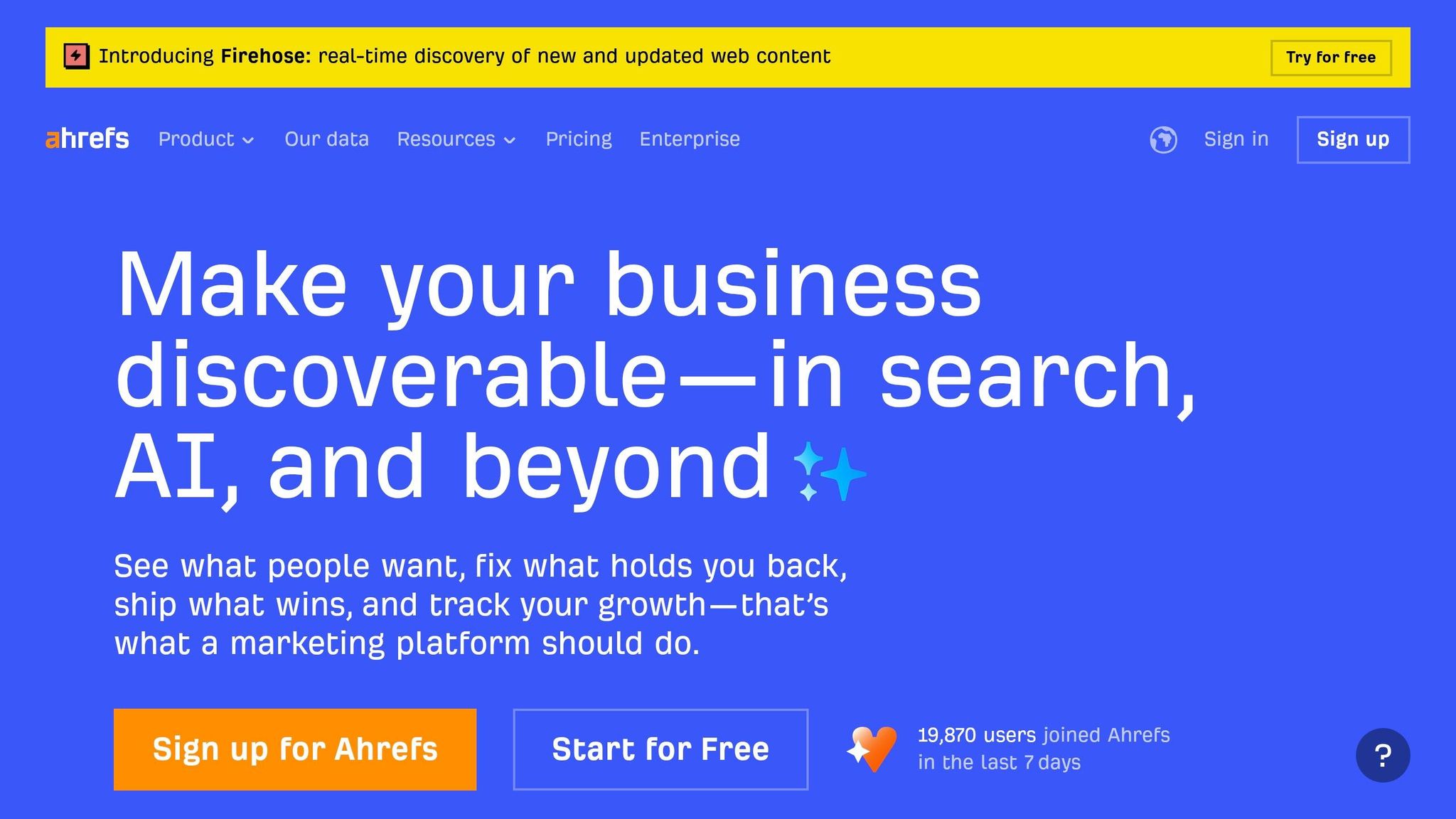
Ahrefs Brand Radar is a standout tool in the AI SEO space, known for its extensive data infrastructure and ability to monitor across multiple platforms. With a database tracking over 263 million monthly prompts and monitoring brand visibility across 11 indices, including ChatGPT, Perplexity, Gemini, Copilot, Google AI Overviews, and social platforms like YouTube, Reddit, and TikTok, it offers a thorough view of the AI search landscape [3]. In a 2026 evaluation, Brand Radar earned a score of 88/100 for its strong data capabilities and infrastructure [5]. Let’s dive into the features that make Brand Radar a key player in boosting visibility in AI search algorithms.
Prompt Tracking
Brand Radar excels in tracking real conversations through thousands of prompts, with the flexibility to support custom prompts for niche tracking [3]. This feature helps uncover "unknown unknowns", or visibility opportunities that might otherwise go unnoticed. This is a critical step for brands learning how to show up in AI search results quickly.
"It shows you your AI visibility across tons of prompts and responses that you wouldn’t have thought to monitor (your unknown, unknowns)," says Louise Linehan, Content Marketer, Ahrefs [3]
Citation Monitoring
The Domains report goes beyond tracking brand mentions by distinguishing between simple references and formal citations that include links. This allows users to see which websites AI platforms rely on when discussing their brand, making it easier to focus PR and backlink efforts on high-authority domains [3].
Share of Voice
Brand Radar also measures the share of AI mentions, offering insights into brand ownership of specific topics and tracking performance over time. It provides response excerpts with highlighted mentions of your brand, enabling sentiment analysis and reputation management. For instance, in March 2026, the tool revealed that AI Overview visibility for key topics had doubled [3].
Entity/Brand Monitoring
The Competitor Gap Analysis feature identifies AI responses that mention competitors while omitting your brand, spotlighting opportunities where your presence is missing. Additionally, the tool tracks co-mentions of your brand alongside industry-specific topics, helping clarify how AI models perceive your brand’s authority [3].
Actionability
Brand Radar integrates seamlessly with Ahrefs Web Analytics, categorizing AI referral traffic (e.g., from ChatGPT and Perplexity) as a distinct channel. This enables users to pinpoint which types of content are driving actual clicks. By linking visibility metrics to referral traffic, the tool provides a clear picture of the business impact of AI mentions, aligning with Lillian Pierson’s framework for actionable AI SEO insights. Pricing starts at $129/month ($108/month with annual billing) for the Lite Plan, while individual AI indices are available at $199/month each or $699/month for full access [3].
3. Airefs (AIRefs)
Airefs simplifies AI search visibility tracking for mid-market teams by focusing on core metrics like AI search impressions, visits, and share of voice across major LLMs. It avoids the complexity of enterprise-level platforms, offering a straightforward way for marketers to see where their brand appears in AI-generated content. While it doesn’t provide the extensive data infrastructure of larger tools, Airefs excels at delivering focused insights into share of voice, entity mapping, and actionable analytics.
Share of Voice
Airefs measures share of voice by tracking how often your brand is mentioned across the generative AI landscape. This allows teams to compare brand visibility with competitors and evaluate their market positioning in an AI-driven search environment.
Entity/Brand Monitoring
The tool aligns with frameworks designed to track semantic relationships between your brand and related entities in AI knowledge graphs[3]. It evaluates brand rankings in both grounded AI responses (search-based) and ungrounded responses (internal model knowledge), ensuring your brand is accurately represented across various AI-generated outputs[3].
Actionability
By analyzing brand-to-entity connections, Airefs highlights how AI models associate your brand with specific topics, products, or industry concepts[3]. This helps content teams pinpoint gaps where competitors are linked to key terms, but your brand is not. Metrics like AI search impressions and visits provide direct insights into how improved AI visibility translates to user engagement, aligning with Lillian Pierson’s framework for actionable AI insights.
4. Scrunch AI
Scrunch AI offers detailed tracking tools like prompt tracking, citation monitoring, and share-of-voice analysis to provide a clear picture of your brand’s visibility in AI-generated content. Instead of just identifying where your brand shows up in AI responses, it helps uncover the patterns behind these mentions. This makes it a valuable tool for teams looking to refine their content strategy and strengthen their competitive positioning by learning how to rank in AI search results. Built on core features like prompt tracking, citation monitoring, and share-of-voice analysis, Scrunch AI turns data into actionable insights for marketers, aligning with Lillian Pierson’s metrics for strategic content planning.
Prompt Tracking
Scrunch AI dives into how specific query patterns influence your brand’s visibility across AI platforms. It identifies which queries boost or hinder mentions of your brand, helping prioritize content adjustments. This analysis also supports a deeper understanding of sources and competitors, tying seamlessly into its citation monitoring feature.
Citation Monitoring
The platform categorizes sources, whether first-party, competitor, or third-party, to showcase which content assets are driving AI citations. This insight highlights strengths in your content while also pinpointing areas where you can enhance authority and secure more citations.
Share of Voice
Scrunch AI examines how your brand stacks up against competitors in AI search results. By identifying gaps where your brand is underrepresented, it provides benchmarks for your AI visibility and uncovers opportunities to improve your presence in areas dominated by competitors.
Actionability
By combining data from prompt tracking, citation monitoring, and share-of-voice analysis, Scrunch AI equips teams with clear strategies to enhance their AI visibility. This comprehensive approach ensures marketers can make precise adjustments to close visibility gaps and improve their competitive edge.
5. Peec AI
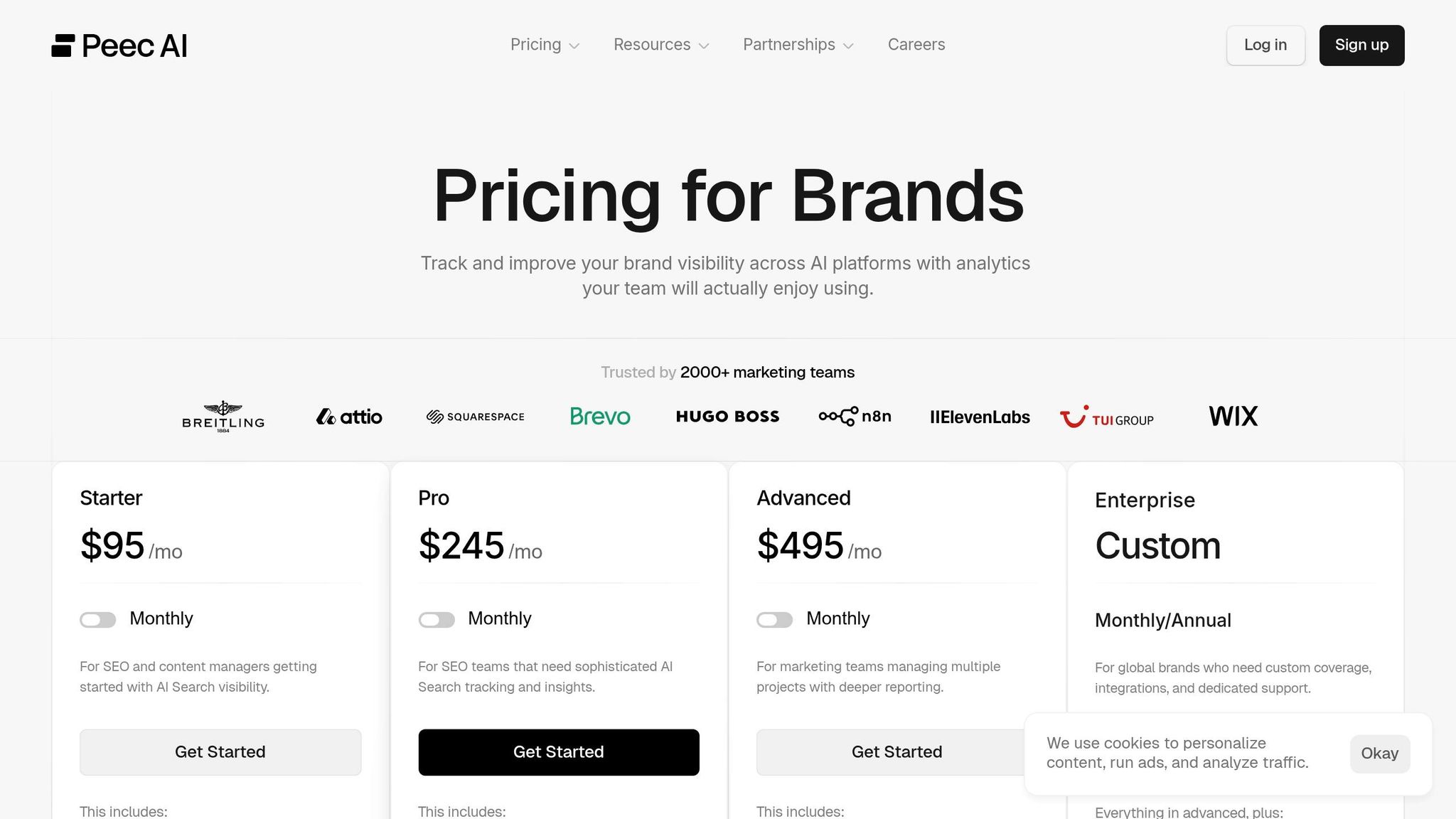
Peec AI focuses on AI search analytics, offering tools like daily prompt tracking, model-level filtering, and competitor benchmarking. Designed for marketers who need consistent monitoring, it tracks visibility across key engines like ChatGPT, Perplexity, and Google AI Overviews. Users can also extend tracking to niche models like DeepSeek, Llama, Claude, and Grok with subscription plans starting at €89/month ($96/month) [14]. In a December 2025 analysis, Peec AI scored 3.2/5 [12], reflecting its strength as a monitoring tool rather than one aimed at deep technical optimization. Its evaluation aligns with Lillian Pierson’s framework, focusing on practical monitoring over in-depth technical features. Below is an overview of its core functionalities.
Prompt Tracking
Peec AI enables users to track custom prompts daily, across various regions and languages. Businesses can create a tailored prompt library to monitor specific queries over time. Popularity is measured on a 1–5 scale, helping users gauge the relevance of their queries [13].
Citation Monitoring
The platform highlights specific publications and web sources that contribute to AI mentions. Its "Source Targeting Guidance" helps users prioritize PR and content placement efforts. However, as Jeffrey Kranz from Overthink Group pointed out:
"Peec is a tool designed for monitoring, not for action"
This means users must manually interpret the data to develop actionable strategies [12].
Share of Voice
Peec AI provides visibility scores and tracks mention frequency across multiple AI engines. Users can monitor up to five competitors simultaneously, helping identify areas where visibility may be lacking. However, it doesn’t offer built-in recommendations for addressing these gaps.
Entity/Brand Monitoring
The platform tracks brand mentions and sentiment across six AI models: ChatGPT, Perplexity, Gemini, Llama, Claude, and DeepSeek. Automated alerts notify users of significant visibility changes. Additionally, its "Pitch Workspaces" make it easy to share reports with clients. Maddy Osman from The Blogsmith noted:
"The data included with each prompt is generous: daily tracking, unlimited countries, and all models included with your plan"
This highlights its strength in supporting multi-language and multi-region tracking [14].
Actionability
Peec AI does not include technical AI crawler analytics or content generation tools. Features like crawler logs or bot activity tracking are absent. While it does offer a Looker Studio connector for custom dashboards, users will need supplementary tools to turn insights into actionable changes. As Nick Lafferty observed:
"Peec AI shines on price and benchmarking"
This makes it a practical choice for smaller teams working within tight budgets [15].
6. BrightEdge AI Catalyst
BrightEdge AI Catalyst is tailored for enterprise teams needing an integrated approach to AI search visibility and traditional SEO. It combines generative AI visibility metrics with standard SEO and content performance data, creating a unified view of search performance. Drawing inspiration from Lillian Pierson’s framework, it merges AI SEO metrics with conventional insights to provide a more complete picture. The platform tracks content performance across major AI systems like Google AI Overviews, ChatGPT, Perplexity, and Gemini, making it a robust tool for enterprise configurations. Pricing is customized, scaling with the size of the organization, the number of domains, data volume, and specific feature needs. This enterprise-oriented design sets BrightEdge AI Catalyst apart from simpler tools mentioned earlier.
Prompt Tracking
For enterprises managing multiple domains, BrightEdge offers prompt tracking by integrating AI metrics with existing SEO workflows. This allows large organizations to monitor their content’s performance across major AI engines while maintaining centralized governance. Its scalability and detailed reporting make it ideal for multi-team environments managing numerous domains simultaneously.
Citation Monitoring
BrightEdge tracks how often brand content is cited in AI-generated responses, with a particular emphasis on Google AI Overviews. The platform provides AI-driven recommendations to help secure more answer slots in large language model (LLM) responses. Unlike tools focused solely on raw data or prompt-level experimentation, BrightEdge embeds AI tracking into existing SEO workflows. This integrated approach lets teams cross-reference AI mentions with traditional keyword rankings and site health metrics within a single dashboard.
Share of Voice
The platform enables competitive benchmarking on an enterprise scale, helping organizations measure their AI visibility against competitors. It also tracks citation frequency in Google AI Overviews, offering insights to refine strategies. With its detailed reporting capabilities, BrightEdge supports governance needs for large organizations handling complex SEO operations and extensive data volumes.
Actionability
BrightEdge delivers insights designed to improve visibility in AI-generated summaries and answers. Enterprises can consolidate traditional SEO data with emerging AI visibility metrics, making it easier to justify budgets and maintain operational continuity. However, its focus on enterprise-level needs means it’s best suited for organizations with complex requirements, rather than smaller teams looking for lightweight monitoring tools.
7. Conductor AI Visibility Optimization
Conductor AI Visibility Optimization is designed for large brands navigating the intricacies of both traditional and AI-driven search landscapes. By centralizing AI reporting across prompts, domains, and search engines, it offers a streamlined dashboard that connects AI visibility metrics with established SEO benchmarks. This approach makes it easier for teams to monitor brand performance at scale while ensuring consistent oversight across diverse content properties. It aligns well with Lillian Pierson’s framework, providing actionable insights for brands operating across multiple platforms.
Prompt Tracking
Conductor keeps tabs on brand visibility by running extensive queries through key language models like ChatGPT, Perplexity, and Google AI Overviews. This allows you to see which prompts lead to brand mentions and identify the specific content assets driving those mentions. For large organizations managing multiple domains, this feature simplifies the otherwise complex task of prompt tracking.
Citation Monitoring
The platform goes further by tracking which source URLs AI models cite when generating answers. This highlights which content assets are earning AI citations. Additionally, it incorporates sentiment analysis to flag and address inaccuracies or hallucinations in AI-generated content. This dual focus on source tracking and sentiment ensures brands maintain accurate representation in AI responses.
Share of Voice
Conductor also benchmarks your brand’s AI presence against competitors. By analyzing citation frequency and brand mentions across various language models, it provides insights into how your visibility stacks up. For enterprises managing multiple product lines or regional markets, this feature helps simplify governance and refine strategic planning.
Turning Insights into Strategies
Conductor tracks performance and turns data into actionable strategies. The platform offers AI-driven recommendations to enhance content visibility in AI-generated summaries. By integrating AI metrics with traditional SEO data, it helps refine content strategies to perform well on both legacy search engines and emerging AI platforms. This integrated approach ensures cross-functional teams stay aligned on shared visibility objectives.
8. seoClarity ArcAI Panorama
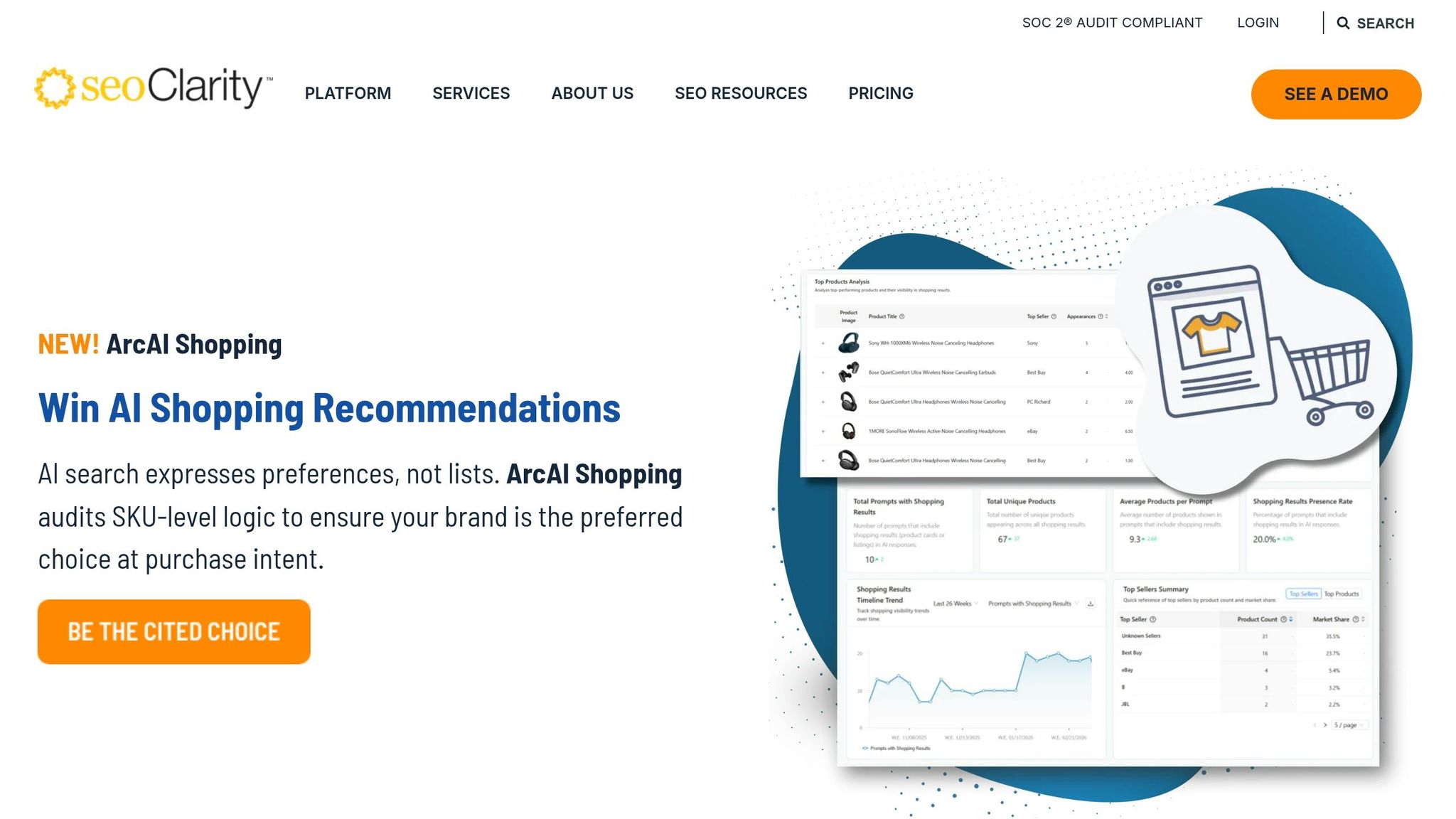
seoClarity ArcAI Panorama provides enterprise teams with tools for bulk prompt research and competitor gap analysis, simplifying content management in complex enterprise settings while adhering to enterprise-grade AI visibility standards. Let’s explore how its key features, prompt tracking, share of voice, and actionability, support targeted content strategies.
Prompt Tracking
ArcAI Panorama enables bulk prompt queries across leading language models like ChatGPT, Perplexity, and Google AI Overviews. This allows you to evaluate content visibility and identify areas where improvements or new opportunities exist.
Share of Voice
The platform goes a step further by benchmarking your brand’s visibility against competitors. By analyzing mention patterns across major AI search engines, it highlights where competitors are outperforming. This information helps teams focus on areas that need attention, whether through strategic updates or creating new content assets.
Actionability
ArcAI Panorama turns insights into practical steps. By identifying specific content assets that need optimization, it ensures visibility data directly informs SEO strategies. The platform bridges AI visibility metrics with traditional SEO workflows, helping teams shift from diagnosing visibility gaps to executing focused content strategies.
9. SE Ranking AI Visibility Tracker
For mid-market teams, the SE Ranking AI Visibility Tracker provides a budget-friendly option for monitoring AI search activity at just $44 per month. It covers platforms like ChatGPT, Gemini, Perplexity, Claude, Copilot, and Google AI Overviews [1][5]. With a score of 78/100 in a 2026 evaluation of AI visibility tools, it’s a practical choice for teams already familiar with SE Ranking’s SEO tools [5]. Built around Lillian Pierson’s framework, this tool focuses on tracking prompts, brand mentions, and delivering actionable insights. Let’s take a closer look at its main features.
Prompt Tracking
This feature monitors brand mentions and URL citations across major AI engines. It also provides evidence logs and screenshots, which are especially useful for reporting to clients and stakeholders [2]. The Pro plan, priced at $119 per month, supports up to 2,000 keywords, while the Business plan, at $259 per month, expands coverage to 5,000 keywords, including Gemini [7].
Share of Voice
SE Ranking includes competitive benchmarking through its Brand Visibility Index. This feature uses simple trend lines to show how your brand’s visibility changes over time compared to competitors [5]. While it effectively tracks brand mentions and positioning across various AI models, the trend analysis remains fairly basic [2][7].
Actionability
The tool integrates AI visibility data directly into existing SEO workflows, placing AI presence data alongside keyword rankings and site audits [1][5]. However, it lacks automated content generation features or AI crawler logs, meaning users must handle optimization manually [2][8]. For those already using SE Ranking, this integration streamlines processes and provides foundational data, making it easier to justify AI search monitoring before committing to higher-cost enterprise tools [5].
10. Search Atlas LLM Visibility
Search Atlas LLM Visibility offers tools for tracking brand presence, sentiment, and share-of-voice metrics across multiple large language models (LLMs). While pricing details remain private, the platform aligns with 2026 standards, monitoring activity across 4–6 AI models, or up to 10 for leading options like ChatGPT, Perplexity, Claude, and Gemini. This makes it a strong choice for teams focused on brand perception rather than deep technical audits. Using Lillian Pierson’s evaluation framework, it supports features like prompt tracking, citation monitoring, and sentiment analysis, providing a solid foundation for AI SEO strategies.
Share of Voice
The platform specializes in comparing brand visibility across different LLMs. It measures share of voice by analyzing how often your brand is mentioned or cited compared to competitors on specific prompts and topics [7]. This data helps teams understand where they are gaining or losing influence in AI-generated content. Additionally, it enables answer gap analysis by identifying prompts where competitors have a stronger presence, offering insights to refine strategy.
Entity/Brand Monitoring
Beyond visibility metrics, Search Atlas delves into how your brand is perceived. It categorizes AI-generated responses as positive, neutral, or negative, offering a clearer picture of your brand’s reputation [7]. This goes beyond simply counting mentions. It reveals whether AI platforms frame your brand in a favorable light. These insights are invaluable for shaping content strategies and mitigating potential reputation risks.
Citation Monitoring
Search Atlas doesn’t just track mentions; it identifies the exact source URLs that influence AI-generated narratives. Unlike basic mention tracking, this approach highlights whether AI models are referencing your owned content or external sources [4]. By mapping the sources that shape AI responses, Search Atlas provides a deeper understanding of how your brand’s narrative is being driven. This data helps teams determine whether their content strategy is effectively influencing AI platforms or if adjustments are needed.
11. AirOps
AirOps is all about action. It’s not just another tool for tracking rankings or citation counts. It’s built for teams that want to take visibility insights and turn them into tangible results. By integrating with top language models like GPT-4, Claude, Gemini, and Perplexity, AirOps automates tasks like research, audits, and large-scale content creation, all without requiring any coding skills [11]. This focus on execution sets it apart in the crowded AI SEO tools market.
To complement its execution-driven approach, AirOps also offers customizable workflows to refine your monitoring capabilities.
Prompt Tracking and Brand Monitoring
AirOps allows you to create tailored "LLM Brand Audit" workflows. These workflows analyze high-intent AI queries and pull real-time data to identify content gaps. Its "Brand Kit" feature takes things a step further by generating brand guidelines directly from your website URL. This ensures that AI-generated content aligns with your brand’s unique voice, maintaining consistency across all outputs [11].
Turning Insights Into Action
What makes AirOps stand out is its ability to transform insights into immediate fixes. The "Grids" feature automates key SEO tasks, such as refreshing and repurposing outdated content, adding internal links, and creating content briefs based on live SEO data. These features are designed to address both traditional SEO needs and the evolving demands of AI-driven search [11][13]. Pricing starts at $200 per month for the Solo plan (which includes ChatGPT insights) and goes up to $2,000 per month for the Pro plan, which offers broader coverage of language models [13].
"We love how easy AirOps is. No coding, no API juggling or maintaining a tool stack. It’s just one intuitive platform with seamless integrations for tools like SEMrush, ChatGPT and Perplexity, plus out-of-the-box solutions for SEO tasks," says Marco Schlauri, Founder, Digital Leverage [11]
Trade-Offs in Visibility Data
While AirOps shines in automating content execution, it does come with limitations. Its citation tracking is fairly basic and doesn’t include detailed data like prompt volumes, comprehensive crawler logs, or in-depth sentiment analysis [13]. Additionally, there’s a bit of a learning curve. Setting up workflows and Grids takes time before you can fully realize its potential. If your main focus is robust visibility monitoring, other tools might provide more detailed analytics. However, for teams managing extensive content libraries and looking to automate fixes to boost AI discoverability, AirOps offers solutions where many other tools fall short.
12. Writesonic GEO / AI Visibility Tools
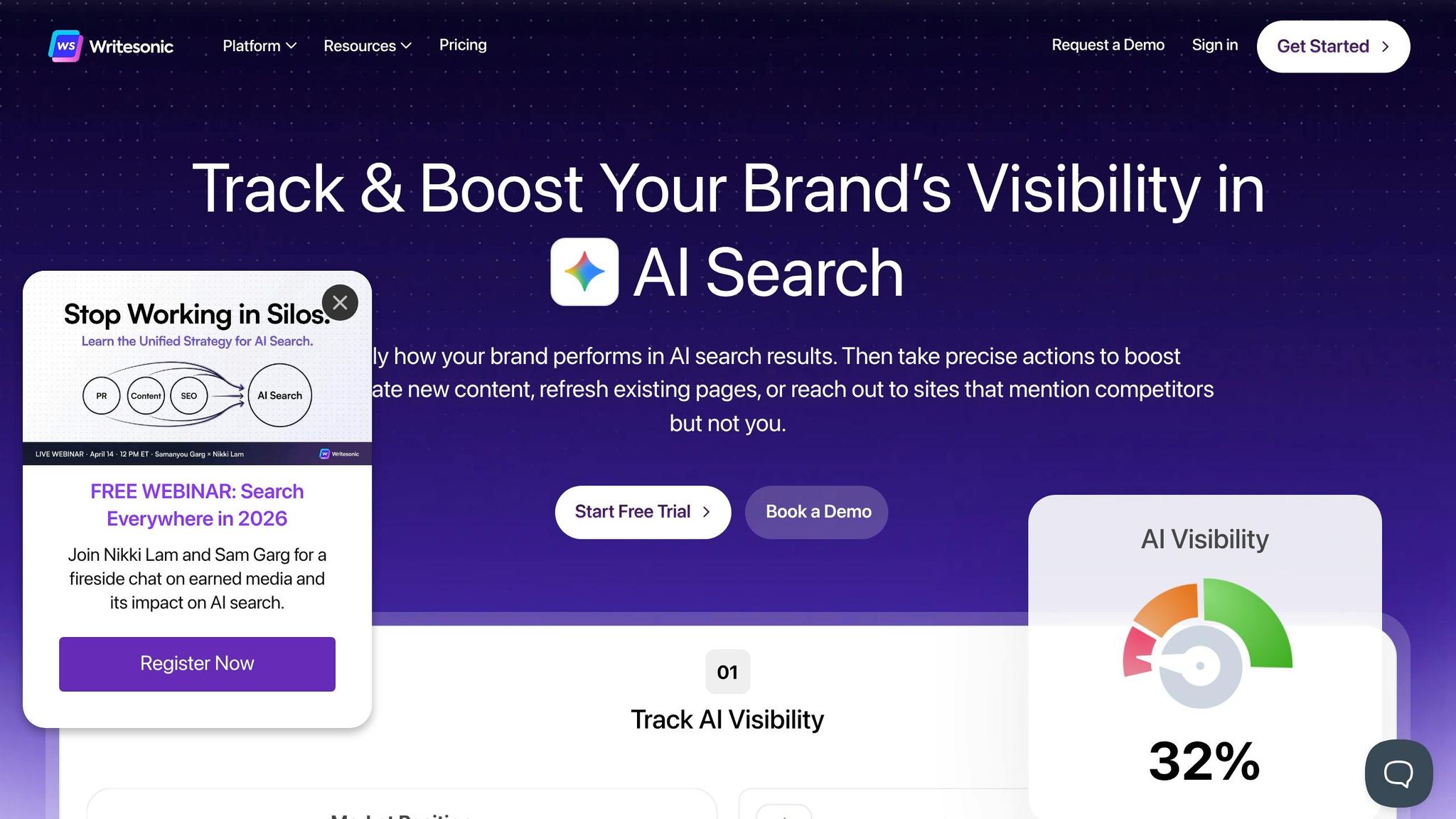
Writesonic stands out by combining GEO data with its Chatsonic AI to monitor your brand’s AI search visibility and address technical issues in real time [11]. This system aligns with Lillian Pierson’s framework, tying insights directly to actionable content improvements. By integrating data from Google Search Console, Semrush, and Ahrefs, the platform delivers page-specific recommendations through its Chatsonic AI agent [11].
Prompt Tracking and Brand Monitoring
For $199/month (Professional plan) or $399/month (Advanced plan), Writesonic provides features like brand tracking, GEO data integration, and a Brand Kit to ensure consistency in AI-generated mentions [11]. Users can test prompts across various LLMs, including GPT-4o, Claude, Gemini, and Flux 1.1, to understand how their brand is represented. The Brand Kit allows uploading brand guidelines or content samples, ensuring the AI stays aligned with your brand identity [11].
Citation Monitoring and Practical Recommendations
Writesonic enhances credibility with citation monitoring and fact-checking features built into its AI Article Writer. This ensures content is grounded in reliable sources. Additionally, Chatsonic pinpoints technical issues, such as missing alt text or overlooked keywords, which can impact how AI bots interpret and cite your site. By leveraging your site data, it provides clear, actionable recommendations.
"LLMs like ChatGPT provide generic advice that doesn’t consider what’s already on the page. But Chatsonic identified real areas for improvement and concrete suggestions. It felt like collaborating with another SEO expert on the team!" says Evelina Milenova, SEO and Growth Manager, Opinion Stage [11]
Balancing Features and Limitations
While Writesonic excels at turning insights into quick actions, it does have limitations in areas like granular prompt data and detailed crawler log analysis [11]. The Professional plan supports up to 100 articles per month and 40 site audits (covering 1,200 pages), while the Advanced plan scales to 200 articles and 60 audits (covering 2,500 pages) [11]. However, if your workflow requires deeper analytics, such as detailed prompt data or extensive crawler logs, you might find other tools more suitable. Writesonic is ideal for teams focused on actionable recommendations and efficient execution rather than exhaustive tracking metrics [11].
13. Rankscale
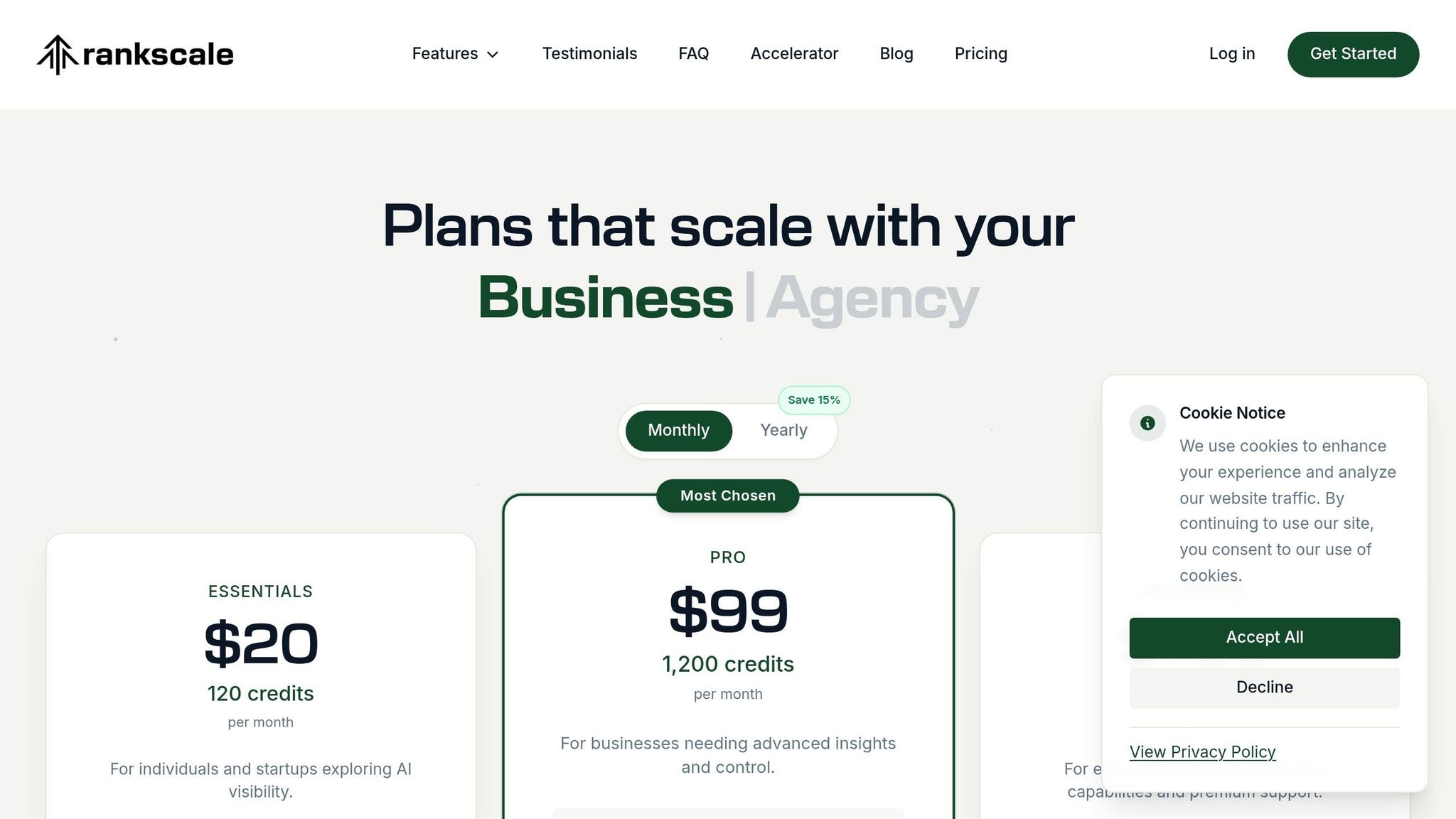
Rankscale uses a straightforward, credit-based pay-as-you-go pricing model that starts at $20 for 100 credits, making it a practical option for smaller teams needing occasional audits [11]. The platform specializes in monitoring brand visibility across various AI engines, including ChatGPT, Perplexity, Google AI Overviews, Gemini, Claude, and DeepSeek [11]. By leveraging an evaluation framework inspired by earlier strategies, Rankscale delivers detailed, localized insights at a budget-friendly price. It aligns with Lillian Pierson’s framework by focusing on prompt tracking, citation monitoring, and share-of-voice analysis.
Prompt Tracking and Citation Monitoring
Rankscale allows users to input specific keywords or prompts and choose from a variety of AI engines, offering tracking on both local (city-level) and national scales [11]. It provides visual verification, showing actual AI responses to confirm brand mentions and flag any hallucinated or incorrect information [11]. Additionally, the platform tracks which website pages are being cited, along with the frequency and placement of these citations [2].
Share of Voice and Entity Monitoring
Instead of limiting insights to traditional search engine results, Rankscale evaluates your brand’s presence within AI-generated responses. It measures how often your brand appears across different AI engines and analyzes the sentiment of the generated content to ensure accurate portrayal [3]. The platform also assigns an "AI readiness score", which reflects how effectively AI bots can index your site [3].
Actionability and Limitations
Rankscale excels at identifying where your brand is gaining or losing visibility, offering a focused ranking tool rather than a comprehensive solution. It does not include features like crawler logs or content creation, so if diagnosing AI bot crawlability issues is critical, pairing Rankscale with a technical SEO tool like Screaming Frog is recommended [2]. This platform is ideal for teams looking for an affordable, entry-level way to reverse-engineer successful content strategies by pinpointing which URLs are earning citations [2].
14. Google Search Console + GA4 + AI Visibility Overlay
Google Search Console (GSC) and Google Analytics 4 (GA4) are essential tools for most marketing teams, but they fall short when it comes to tracking visibility in AI-driven search environments. GSC can identify queries that trigger AI-generated overviews on Google but doesn’t track activity within platforms like ChatGPT, Perplexity, or Claude [10]. Meanwhile, GA4 can filter referral traffic from AI chatbots (e.g., "chatgpt.com" or "perplexity.ai") but misses interactions where no clicks occur, leaving gaps in understanding user behavior [8]. This is where an AI visibility overlay steps in. Tools like Promptwatch, Profound, or Semrush monitor brand mentions and citations across large language models (LLMs), filling in these gaps [8].
By combining overlay data with GSC and GA4, you can link improvements in visibility to actual conversions. For instance, if your overlay reports a 60% citation rate on key category prompts, a benchmark for market leaders, you can use GA4 to analyze whether that visibility results in referral traffic or assisted conversions. Tools like Promptwatch, which tracks over 880 million citations, can also integrate with GSC to highlight which pages perform well across both traditional and AI-driven search [8]. The sections below explore how to use overlay data for better query tracking, crawlability insights, and conversion analysis.
Prompt Tracking and Citation Monitoring
In today’s AI-driven search landscape, relying solely on traditional visibility metrics doesn’t cut it. GSC can help identify high-volume queries that lead to AI-generated overviews, and you can use an AI visibility overlay to see how ChatGPT and Perplexity handle similar intents [10]. Overlays excel at capturing natural language prompts that traditional tools often miss [2]. By comparing the "Cited Pages" report in your overlay with GSC’s "Top Pages" report, you can measure whether LLM citations contribute to an increase in Google impressions. This is especially important since there can be up to a 25% discrepancy between what LLMs return via API and what users actually see [16].
AI Bot Crawlability and Share of Voice
While GSC provides limited data on Googlebot activity, AI visibility overlays can offer detailed analytics on bot behavior. These tools track when bots like GPTBot, PerplexityBot, or ClaudeBot visit your site, which pages they access, and any errors encountered [1]. Additionally, overlays allow you to measure how frequently your brand is mentioned compared to competitors. GA4 can then determine whether a higher share of voice translates into increased referral traffic. If AI bots aren’t crawling your pages, your content is unlikely to be cited, even if it performs well in traditional search. Combining these datasets gives you a more complete picture, connecting your site’s technical health to business outcomes.
Actionability and Limitations
This integrated approach is ideal for teams looking to tie AI visibility directly to measurable results like traffic, pipeline growth, and revenue [6]. Overlays can identify where your brand is being overlooked, while GSC ensures your site’s technical setup (sitemaps, canonicals, indexing) is sound, and GA4 tracks whether visibility gains lead to conversions. However, full integration often requires API access or server log analysis, which can pose challenges for smaller teams [2]. Costs for AI visibility overlays range from $29/month for basic features to $579/month for advanced capabilities, while GSC and GA4 remain free [5].
Data-Mania
Data-Mania offers strategic advisory services focused on AI SEO, rather than functioning as a standalone monitoring tool. Founded by Lillian Pierson, a recognized leader in marketing and data consulting, the company caters to technology businesses such as AI startups, analytics platforms, SaaS companies, and data consultancies. Through Fractional CMO services and growth marketing consulting, Data-Mania specializes in creating evaluation frameworks to help teams choose the right AI SEO tools and transform visibility insights into measurable business results. This combination of strategic planning and implementation sets Data-Mania apart from traditional monitoring solutions.
Prompt Tracking and Citation Monitoring
Data-Mania employs a standardized framework to run real-world queries across various large language models (LLMs) like ChatGPT, Gemini, Claude, and Perplexity. This process distinguishes between citation tracking, pinpointing source URLs, and mention tracking, which highlights unverified brand mentions [17][19]. This distinction is critical because AI platforms rely on a "consensus signal", which involves checking multiple independent sources, such as Reddit, YouTube, industry publications, and brand websites, before citing a brand [18]. Data-Mania helps clients identify which content assets are earning citations versus mentions and develops strategies to boost their authority as a source.
Share of Voice and AI Bot Crawlability
The advisory framework goes beyond mention tracking to assess overall visibility and technical accessibility. It measures share of voice by tracking a brand’s ownership of specific topics on a global scale and benchmarking this against competitors [3]. For AI bot crawlability, Data-Mania assists teams in monitoring AI crawler logs (e.g., GPTBot, PerplexityBot, ClaudeBot) to understand which pages bots access, what errors they encounter, and whether robots.txt or other technical barriers are preventing citation-worthy content from being indexed [2]. These insights help prioritize technical fixes that improve the chances of a brand’s content appearing in AI-generated responses.
Actionability
What sets Data-Mania apart is its focus on turning visibility insights into actionable strategies. Instead of merely reporting metrics like citation rates, the company provides tailored content recommendations, technical fixes, and traffic attribution strategies [2][6]. For companies with marketing budgets exceeding $1M annually, Fractional CMO services deliver comprehensive support, including strategy development, KPI reporting, and team leadership to convert AI visibility into revenue growth. For smaller teams or those with tighter budgets, Data-Mania offers Power Hour consultations, intensive, 60-minute sessions designed to tackle immediate challenges with actionable plans. This model is ideal for teams seeking expert guidance on selecting and implementing tools, rather than relying on a pre-built monitoring dashboard.
Strengths and Weaknesses
This section builds on the detailed tool reviews by comparing their key strengths and weaknesses, helping you make a more informed purchase decision. The table below evaluates 15 tools based on the most critical criteria for AI search visibility: prompt tracking, citation monitoring, share of voice analysis, AI bot crawlability, and actionable insights.
Recent studies show that AI models agree on a top brand recommendation only 43.9% of the time. This underscores the importance of tracking at least 4–6 models to get a complete picture [19]. Citation tracking, pinpointing the specific URLs referenced by AI platforms, can provide substantial benefits, such as driving referral traffic and establishing content authority [19].
It’s also important to distinguish between tools that focus solely on monitoring and those that offer optimization features. For example, tools like Peec AI, SE Ranking, and Airefs mainly provide visibility into your current standing without suggesting how to address gaps. On the other hand, platforms like Semrush and BrightEdge go a step further by offering actionable recommendations, while Data-Mania takes it even further by crafting tailored content strategies based on insights.
For technical crawlability, advanced tools can provide AI crawler logs, showing when bots like GPTBot, averaging 60.5 pages per session [19], visit your site and which pages they access. These logs are invaluable for diagnosing why some content fails to appear in AI-generated answers. Below is a detailed comparison of the tools to help you identify the best fit for your needs.
| Tool | Key Strengths | Key Weaknesses |
|---|---|---|
| Semrush AI Visibility Toolkit | Combines SEO and AI workflows; offers actionable recommendations; tracks over 213M+ prompts globally [6] | AI features are add-ons; lacks the depth of specialized tools; limited model coverage [19][6] |
| Ahrefs Brand Radar | Large database (263M+ prompts); tracks 11 indices including YouTube and Reddit; robust data infrastructure [3] | Advanced features require premium plans; AI capabilities are still developing; additional costs for extra indices [3][5] |
| Airefs (AIRefs) | Lightweight and focused on AI impressions, visits, and share of voice across LLMs | Limited to monitoring; lacks tools for content generation or gap analysis |
| Scrunch AI | Tracks AI visibility and bot activity; integrates site-audit workflows; rated 4.7/5 on G2 [9] | Primarily monitoring-focused; lacks built-in content optimization tools |
| Peec AI | Supports multiple languages; tracks daily prompts; offers model-level filtering [6][3] | No optimization tools; strictly a monitoring platform [6][3] |
| BrightEdge AI Catalyst | Enterprise-level governance and reporting; integrates AI visibility into broader SEO platforms [20] | Expensive; custom pricing; requires analysts for data interpretation [20] |
| Conductor AI Visibility Optimization | Comprehensive reporting across prompts, domains, and engines; scales for enterprise needs | Custom pricing; better suited for large organizations |
| seoClarity ArcAI Panorama | Bulk prompt research; competitor analysis; enterprise segmentation | Requires technical expertise; lacks content optimization features |
| SE Ranking AI Visibility Tracker | Simplified monitoring; rated 4.8/5 on G2 from 1,401 reviews [9]; mid-market pricing | Monitoring-only; lacks advanced crawlability audits |
| Search Atlas LLM Visibility | Tracks brands across LLMs; includes sentiment analysis and share-of-voice metrics | Limited actionable insights; no content generation tools |
| AirOps | Bridges visibility insights with content execution; designed for content-driven teams | Weaker in technical auditing compared to specialized tools |
| Writesonic GEO / AI Visibility tools | Tracks AI visibility with guided recommendations; enables quick content publishing; rated 4.7/5 on G2 from 5,901 reviews [9] | Limited technical analysis for LLMs; basic monitoring features [6] |
| Rankscale | Affordable option for tracking AI answer visibility and competitor analysis | Monitoring-only; lacks depth in model coverage and technical features |
| Google Search Console + GA4 + AI visibility overlay | Free first-party data; connects AI discovery with branded search, direct traffic, and conversions [20] | Requires manual setup; limited to Google AI tracking; no cross-LLM capabilities |
| Data-Mania | Offers strategic advisory services; evaluates tools rigorously; turns insights into measurable results; provides Fractional CMO services for teams with $1M+ budgets | Not a standalone monitoring tool; requires engagement for advisory services; higher investment for full support |
This comparison highlights the strengths and limitations of each tool to help you align your choice with your specific goals and resources. Whether you need monitoring, optimization, or a hybrid approach, there’s a tool tailored for your needs.
Conclusion
Picking the right AI SEO tool boils down to three main considerations: the size of your team, your budget, and whether you’re looking for simple monitoring or a complete optimization solution. Interestingly, AI models only agree on top brand recommendations 43.9% of the time [19]. This makes it crucial to track visibility across multiple platforms like ChatGPT, Perplexity, Claude, and Gemini. With these factors in mind, teams can choose tools that align with their specific needs.
For enterprise teams managing multiple brands or global operations, tools with features like API access, single sign-on, and governed workflows are key. Options like BrightEdge or the Semrush AI Visibility Toolkit provide executive-level reporting and support multi-region management.
Content-focused teams benefit from platforms that turn insights into actionable content changes. AirOps and Conductor are great for linking visibility data with execution, while Promptwatch stands out by offering multi-model tracking (covering over 10 models) alongside built-in content generation.
Mid-market teams should prioritize tools that connect AI visibility to measurable traffic and revenue. Solutions like the Semrush AI Visibility Toolkit and SE Ranking deliver strong ROI tracking without the complexity of enterprise-level platforms.
For larger organizations seeking expert guidance, Data-Mania’s Fractional CMO services offer a customized approach. They help transform technical tasks, such as citation tracking, technical crawlability, or share-of-voice analysis, into actionable strategies for prompt tracking, entity monitoring, and visibility across multiple AI platforms.
FAQs
What is an AI SEO tool?
An AI SEO tool is a type of software built to help brands and marketers boost their presence in AI-generated answers on platforms like ChatGPT, Perplexity, and Google AI. These tools go beyond traditional SEO by monitoring brand mentions, citations, and share of voice within AI responses. They also analyze prompts and identify content gaps, giving marketers the insights they need to refine strategies for success in AI-driven search landscapes.
What should I track for AI search visibility?
To measure AI search visibility, keep an eye on metrics such as how frequently your brand shows up in AI-generated answers from large language models (LLMs). Pay attention to whether your brand is cited in responses and assess your share of voice against competitors. It’s also important to evaluate your brand’s placement in AI-generated summaries and analyze the prompts that bring your brand into focus. These observations can reveal content gaps and offer opportunities to boost your visibility on AI platforms.
How do I choose the right AI SEO tools stack?
To build an effective AI SEO tools stack, start by identifying your specific goals and ensuring the tools you choose go beyond just tracking metrics. They should help you take action. Look for features like prompt tracking, citation monitoring, share of voice analysis, and technical crawlability for AI bots. Prioritize platforms that translate data into actionable steps, whether that’s creating content or optimizing your site. Finally, align the tools with your team’s needs, budget, and skill set to get the best results.
Related Blog Posts
- AI Brand Visibility: How To Optimize Your Brand’s Visibility in AI Search
- AI Search Analytics: The Metrics + Dashboard You Need to Track LLM Visibility
- AI Search Visibility Tools & Metrics: What to Buy (and the Metrics That Actually Matter)
- 20 Best AI Search Visibility Tools (2026): Free & Paid, Ranked