
I compared 20 AI visibility platforms across AI engine coverage, citation tracking, prompt intelligence, optimization recommendations, reporting, and price, so you can pick one this afternoon instead of demoing six of them.
Last updated: September 23, 2026. My Bing page-level report logged 318,850 AI citations across 160 URLs over the trailing three months, and the median cited page earned just 32. Seeing that spread is what the tools below are for. The full read is in my Semrush AI Search Health audit.
Evaluated from vendor documentation, published pricing, and independent third-party reviews rather than hands-on testing of all 20. The Semrush link is an affiliate link and it did not affect the ranking. Full methodology.
Best overall: Semrush AI Visibility Tracking
Semrush takes the top spot because it’s the only platform here that pairs the widest engine coverage with a serious prompt research database and a site audit that catches the technical blockers keeping you out of AI answers. If you already pay for Semrush, the add-on is $99 a month.
- Starting price$99/mo add-on
- AI engines8 tracked
- Free trial7 days
- Prompt database213M+ prompts
Three capabilities that decided it: citation and sentiment tracking with daily prompt updates, a prompt database you can filter by volume and intent, and an AI Site Audit that flags blocked LLM crawlers before you write another word. See why ↓
01Best AI search visibility tools by use case
Most of you don’t need to evaluate all 20. Find your situation in the left column, then jump straight to that review.
| Use case | Winner | Why it wins |
|---|---|---|
| Best overall | Semrush AI Visibility Tracking | 8 engines, a 213 million prompt database, and a working site audit, starting at $99 a month. |
| Best for enterprise | Profound AI | 10+ engines, API and SSO access, and server-level tracking of how models crawl your content. |
| Best for agencies | Rankability | Multi-client AI citation gaps and content optimization inside one SEO platform. |
| Best budget paid option | Otterly.AI | $29 a month buys 6 engines, a 25-point GEO audit, and unlimited team members. |
| Best free option | Mangools AI Search Grader | A free account unlocks all 8 models plus a market-share-weighted 0 to 100 score. |
| Best for SEO plus AI visibility | SE Ranking AI Search Toolkit | The “No cited” report turns competitor citations into your next content brief. |
| Best for content execution | Writesonic | Spot the gap and publish the fix in the same session through WordPress or Cloudflare. |
| Best for multi-location brands | Birdeye | Cleans up the reviews and listings that AI systems read for local and service answers. |
Every winner above comes from the detailed reviews further down, and each one links to the evidence behind the pick.
02Compare all 20 AI visibility tools
This is the decision table. Filter it to your budget or your situation, then read the two or three reviews that survive. The detailed capability marks live on each review card below.
| Tool | Best for | Starting price | AI engines | Free plan or trial |
|---|---|---|---|---|
| 1Semrush | SEO teams and agencies already running Semrush | $99/mo add-on | 8 engines | 7-day free trial |
| 2Profound | Enterprise teams with analysts in-house | $99/mo | 10+ engines | No free plan |
| 3Otterly.AI | Agencies and small marketing teams | $29/mo | 6 engines | No free plan |
| 4Peec AI | B2B SaaS teams who want share of voice, fast | $103/mo | 3 engines | No free plan |
| 5Scrunch AI | Teams that need the fix, not just the diagnosis | $100/mo | 6 engines | No free plan |
| 6ZipTie | Teams that need screenshot proof of what AI showed | $69/mo | 3 engines | 14-day free trial |
| 7SE Ranking | SEO teams running both traditional and AI search | $189/mo | 5 engines | No free plan |
| 8Writesonic | Teams that want tracking and content production together | $99/mo | 5 engines | No free plan |
| 9Knowatoa | Agencies tracking brand attributes, not just mentions | $59/mo | 7 engines | Free plan (10 questions, ChatGPT) |
| 10Morningscore | SEO teams adding AI tracking without a second dashboard | $69/mo | 2 engines | 14-day free trial |
| 11Ahrefs Brand Radar | Ahrefs subscribers adding AI data to authority research | $199/mo | 6 engines | No free plan |
| 12Rankability | Agencies handling AI visibility and SEO in one platform | $149/mo | 4 engines | No free plan |
| 13Similarweb | Enterprise teams pairing AI visibility with market intelligence | $99/mo | 6 engines | 7-day free trial |
| 14BrightEdge | Large organizations with governance and compliance needs | Custom | 4 engines | No free plan |
| 15Mangools | A free multi-model baseline before you spend anything | Free | 8 models | Free (all 8 models on a free account) |
| 16Gauge | A first look at where you stand against competitors | Custom | 3 engines | No free plan |
| 17Visby AI | Startups that want basic mention tracking, cheaply | Custom | 3 engines | No free plan |
| 18Goodie | Brands where Microsoft Bing Copilot drives real traffic | Custom | 1 engine | No free plan |
| 19Birdeye | Multi-location businesses managing reputation signals | Custom | Indirect | No free plan |
| 20Adamigo | A 60-second free snapshot and nothing more | Free | Not documented | Free |
No tools match that filter. Pick another one above.
Scroll the table sideways on a phone. The tool column stays put. Every price is the published entry price at the time of this update, and the tier that price actually buys you is spelled out inside each review.
03How I ranked the tools
You should be able to see why #1 sits above #2, so I’ll walk you through the whole logic.
I didn’t score these numerically, and I want to be direct about why. Producing a 9.4 out of 10 would imply a precision that desk research can’t support. What I did instead was evaluate every platform against six criteria and mark each one Strong, Partial, or Not offered based on what the vendor documents and what independent reviewers confirm. Those marks appear on every review card below.
The six criteria
- AI engine coverageHow many AI engines the tool tracks, and whether the wider coverage sits behind an enterprise tier.
- Citation intelligenceWhether it separates bare mentions from clickable citations, names the source URLs, and reads sentiment.
- Prompt discoveryWhether it finds the questions your buyers ask and shows you where competitors get named instead of you.
- Optimization recommendationsWhether it tells you what to fix, or only what’s wrong.
- Reporting and team fitUpdate cadence, seat limits, exports, white-labeling, and whether a non-specialist can read the dashboard.
- Price transparency and valueWhether pricing is published, what the entry tier really includes, and what you get for the money.
How the criteria break ties
The criteria are not equally weighted, and the order matters. Engine coverage and citation intelligence come first, because a tool that can’t see the engines your buyers use, or can’t tell a bare mention from a clickable citation, is measuring the wrong thing no matter how good the interface is.
Prompt discovery and optimization recommendations come next, because those two decide whether you leave the dashboard with a task list or with a feeling. Reporting and value break the remaining ties.
Semrush ranks above Profound on exactly that logic. Both are Strong on coverage and citations. Semrush publishes a real entry price that gets you four engines, and Profound’s $99 tier tracks ChatGPT alone, so multi-engine coverage there actually starts at $399. Profound goes deeper once you’re inside it, and that depth is why it wins the enterprise slot rather than the overall one.
On the tools ranked 16 through 20: Gauge, Visby, Goodie, Birdeye, and Adamigo sit at the bottom because each one covers a narrow slice of the job. That isn’t a quality judgment. Birdeye is excellent at reputation management and doesn’t track AI citations at all, and Goodie goes deep on one engine on purpose. They rank low as general AI visibility platforms and rank high for the specific person who needs exactly what they do.
04The 20 best AI search visibility tools, ranked
Every review opens with a summary card you can read in about 15 seconds. The full analysis sits behind the “read the full analysis” toggle underneath it, so you only open the detail for the tools that made your shortlist.
Rank #1 Semrush AI Visibility Tracking
Best for: SEO teams and agencies already running Semrush
Semrush wins the top spot because it’s the only platform on this list that pairs the widest engine coverage with a 213 million prompt research database and a working site audit, and it starts at $99 a month as an add-on to a subscription most SEO teams already pay for.
- AI engine coverage: Strong
- Citation intelligence: Strong
- Prompt discovery: Strong
- Optimization recommendations: Strong
- Reporting and team fit: Strong
- Price transparency and value: Strong
At a glance
- Starting price$99/mo add-on
- Free plan or trial7-day free trial
- AI enginesChatGPT, Google AI Overviews, Perplexity, Gemini, Claude, Microsoft Copilot, Grok, DeepSeek
- Citation trackingCited URLs, mention frequency, and sentiment, with weekly updates and daily prompt tracking
- Prompt trackingPrompt Research across 213M+ prompts, filterable by volume, difficulty, and intent
- RecommendationsAI Site Audit for blocked crawlers, plus schema and URL-slug recommendations
- Primary userIn-house SEO teams and agencies
- What the price note meansor $199/mo via One Starter (50 prompts)
Best things about it
- Broadest engine coverage on this list, spanning 8 platforms across 140+ countries and 17 languages
- A prompt database of 213 million queries, including 90 million US prompts and 29 million ChatGPT-specific ones
- The AI Site Audit catches the boring blockers that keep you invisible, like a robots.txt file that shuts out LLM crawlers
Limitations
- The add-on only makes financial sense when you already pay for Semrush
- The full multi-engine picture sits behind the enterprise AIO tier, which is custom-priced
Choose this ifYou already run Semrush and you want AI citations sitting in the same dashboard as your rankings.
Skip this ifYou don’t have a Semrush subscription and you only care about one AI engine.
Read the full analysis of Semrush
Engine coverage
Semrush tracks your brand across ChatGPT, Google AI Overviews, Perplexity, Gemini, Claude, Microsoft Copilot, Grok, and DeepSeek. The Visibility Toolkit covers the four core engines, which are ChatGPT, Perplexity, Gemini, and Google AI Overviews. The enterprise AIO tier opens up the rest and adds real-time competitor benchmarking.
Coverage spans 140+ countries and 17 languages, so this is one of the few options here that holds up if you sell outside a single English-speaking market.
Citation and mention tracking
You get the cited URLs, how often your brand shows up, and whether the sentiment around it reads positive, neutral, or negative. Updates land weekly, and prompt tracking runs daily, so a visibility drop surfaces fast enough that you can act on it in the same week.
Prompt and opportunity discovery
Prompt Research taps a database of more than 213 million prompts, including 90 million US-based queries and 29 million that are specific to ChatGPT. You can filter by search volume, difficulty, and intent to isolate the questions that are worth winning. 88.1% of those queries are informational, which tells you where to aim your content.
Optimization recommendations
The AI Site Audit flags configuration problems that quietly keep you out of AI answers, like blocked LLM crawlers in your robots.txt or a missing llms.txt file. The content optimizer suggests schema types such as Organization, Article, and BreadcrumbList, and it recommends URL slugs in the 17 to 40 character range.
Sentiment analysis then points you at the narratives that need work.
Pricing
Semrush runs a 7-day free trial. After that, the AI Visibility Toolkit starts at $99 a month as an add-on, or $199 a month through the Semrush One Starter plan with 50 tracked prompts. Pro+ runs $299 a month and Advanced runs $549 a month, which adds API access and more tracked prompts. Enterprise AIO pricing is custom.
Primary source for this entry: www.semrush.com
Rank #2 Profound AI
Best for: Enterprise teams with analysts in-house
Profound goes deeper than anything else here, tracking how large language models crawl and reuse your content at the server level, and that depth is exactly why it’s the wrong buy for a team without an analyst to interpret it.
- AI engine coverage: Strong
- Citation intelligence: Strong
- Prompt discovery: Strong
- Optimization recommendations: Strong
- Reporting and team fit: Strong
- Price transparency and value: Partial
At a glance
- Starting price$99/mo
- Free plan or trialNo free plan
- AI enginesChatGPT, Perplexity, Google AI Overviews, Gemini, Claude, Microsoft Copilot, Grok, Meta AI, DeepSeek
- Citation trackingDaily mentions, citation frequency, sentiment, plus server-level crawler tracking and historical replay
- Prompt trackingConversion Explorer surfaces hidden prompt themes and simulates buyer journeys
- RecommendationsSix optimized articles a month on Growth, plus CSV, JSON, and API export
- Primary userEnterprise analysts and BI teams
- What the price note meansStarter tracks ChatGPT only; Growth is $399/mo
Best things about it
- Agent Analytics tracks which pages AI crawlers hit and how models reuse your content at the server level
- Historical replay lets you review past data instead of only watching the present
- It connects to Akamai, AWS, Cloudflare, GA4, and Vercel, so the data reaches the rest of your stack
Limitations
- The $99 Starter plan tracks ChatGPT and nothing else, so real multi-engine coverage begins at $399 a month
- Reading the raw data and building the reports takes technical skill you have to already have on staff
Choose this ifYou have an analyst or a BI team who will build custom reports off raw AI visibility data.
Skip this ifYou’re a mid-market team without in-house analysts, because the interpretation work lands on you.
Read the full analysis of Profound
Engine coverage
Coverage is tiered, and the tiers matter more here than anywhere else on this list:
- Starter ($99/month): tracks ChatGPT only.
- Growth ($399/month): adds Perplexity and Google AI Overviews.
- Enterprise (custom): expands to more than 10 platforms, including Gemini, Claude, Microsoft Copilot, Grok, and DeepSeek.
Enterprise users also get product visibility monitoring inside the ChatGPT Shopping ecosystem.
Citation and mention tracking
Profound delivers daily updates on brand mentions, citation frequency, and sentiment through Agent Analytics. The feature identifies the specific pages that AI crawlers reference, and it tracks how large language models reuse your site content at the server level. A historical replay feature lets you go back through past data for trend analysis.
“Profound is designed for analyst-driven teams that need high-frequency monitoring and prefer building their own reports.”
Margarita Loktionova, Semrush
Prompt and opportunity discovery
Conversion Explorer analyzes brand perception across large numbers of prompts and surfaces the prompt themes you’d otherwise never see. It pulls topic suggestions straight from your website to pinpoint high-value audience questions. Profound also simulates buyer journeys, so you can see how AI models walk a prospect through the stages of your funnel.
Optimization recommendations
Growth subscribers get six optimized articles generated per month. The platform integrates with Akamai, AWS, Cloudflare, GA4, and Vercel, which enables faster indexing and flexible export through CSV, JSON, or the API.
Pricing
| Plan | Price | Engines | Prompts | Key features |
|---|---|---|---|---|
| Starter | $99/mo | ChatGPT only | 50 | All-time history |
| Growth | $399/mo | ChatGPT, Perplexity, AI Overviews | 100 | CSV/JSON exports, 6 articles/mo |
| Enterprise | Custom | 10+ engines | Custom | API access, SSO/SAML, ChatGPT Shopping |
Profound raised a $35 million Series B led by Kleiner Perkins and Sequoia in 2024, which is a reasonable signal that the platform will still exist next year.
Primary source for this entry: www.rankability.com
Rank #3 Otterly.AI
Best for: Agencies and small marketing teams
Otterly gives you six engines, a 25-point technical audit, and unlimited team members for $29 a month, which makes it the cheapest honest entry point into AI visibility tracking that I can point you at.
- AI engine coverage: Strong
- Citation intelligence: Strong
- Prompt discovery: Strong
- Optimization recommendations: Strong
- Reporting and team fit: Partial
- Price transparency and value: Strong
At a glance
- Starting price$29/mo
- Free plan or trialNo free plan
- AI enginesChatGPT, Google AI Overviews, Perplexity, Google AI Mode, Gemini, Microsoft Copilot
- Citation trackingSeparates brand mentions from link citations, with share of voice against competitors
- Prompt trackingConverts SEO keywords into the natural-language questions people actually ask
- RecommendationsDeep GEO Audit across 25+ technical and content elements
- Primary userAgencies, freelancers, and small in-house teams
- What the price note meansLite plan, 15 tracked prompts
Best things about it
- Unlimited team members on every plan, including the $29 Lite tier, which is unusual at this price
- The Deep GEO Audit checks 25+ elements including schema markup, robots.txt, page speed, and llms.txt
- White-label reporting on the Premium plan, which is what makes it work for client delivery
Limitations
- Data refreshes weekly rather than daily, so it won’t suit teams that need to watch a launch in real time
- Some users find the interface busy because the data spreads across a lot of separate charts
Choose this ifYou’re an agency or a small team that wants real multi-engine coverage without a four-figure commitment.
Skip this ifYou need daily data refreshes, because Otterly updates weekly.
Read the full analysis of Otterly.AI
Engine coverage
Otterly tracks six major platforms: ChatGPT, Google AI Overviews, Perplexity, Google AI Mode, Gemini, and Microsoft Copilot. It uses API-based web scraping through Firecrawl.dev to see how each engine retrieves and presents data.
The citation behavior across those engines varies more than most people realize. Perplexity cites its sources 97% of the time, Google AI Overviews 34%, and ChatGPT only 16%. If you’re chasing clickable citations rather than bare mentions, that spread should shape where you spend your effort.
Citation and mention tracking
Otterly separates brand mentions from link citations, so you get a clear read on your share of voice against competitors. It also tracks how your brand is positioned inside the answer, not just whether it appeared.
“The citation and prompt tracking has been perfect for our SME clients, and the dashboards help to provide actionable content and PR strategies we can implement with clients.”
Michael Farr, Founder, MFF Marketing
Otterly reports that brands using the platform show up three times more often in “best of” AI responses, and that 95% of users get measurable insights inside their first month.
Prompt and opportunity discovery
Otterly turns your SEO keywords into natural language queries. It takes something like “project management software” and converts it into “What is the best project management tool for remote teams?”, which is far closer to how people actually talk to a chatbot.
Optimization recommendations
The Deep GEO Audit evaluates more than 25 technical and content elements, including schema markup, page structure, multilingual content, robots.txt configuration, and page speed. It also checks your llms.txt setup so AI crawlers can find you.
Pricing
| Plan | Price | Tracked prompts | Key features |
|---|---|---|---|
| Lite | $29/mo | 15 | Core 4 engines, GEO Audit, unlimited team members |
| Standard | $189/mo | 100 | All features, weekly data refresh |
| Premium | $489/mo | 400 | Enterprise monitoring, white-label reporting |
Otterly is used by more than 20,000 marketing professionals worldwide.
Primary source for this entry: otterly.ai
Rank #4 Peec AI
Best for: B2B SaaS teams who want share of voice, fast
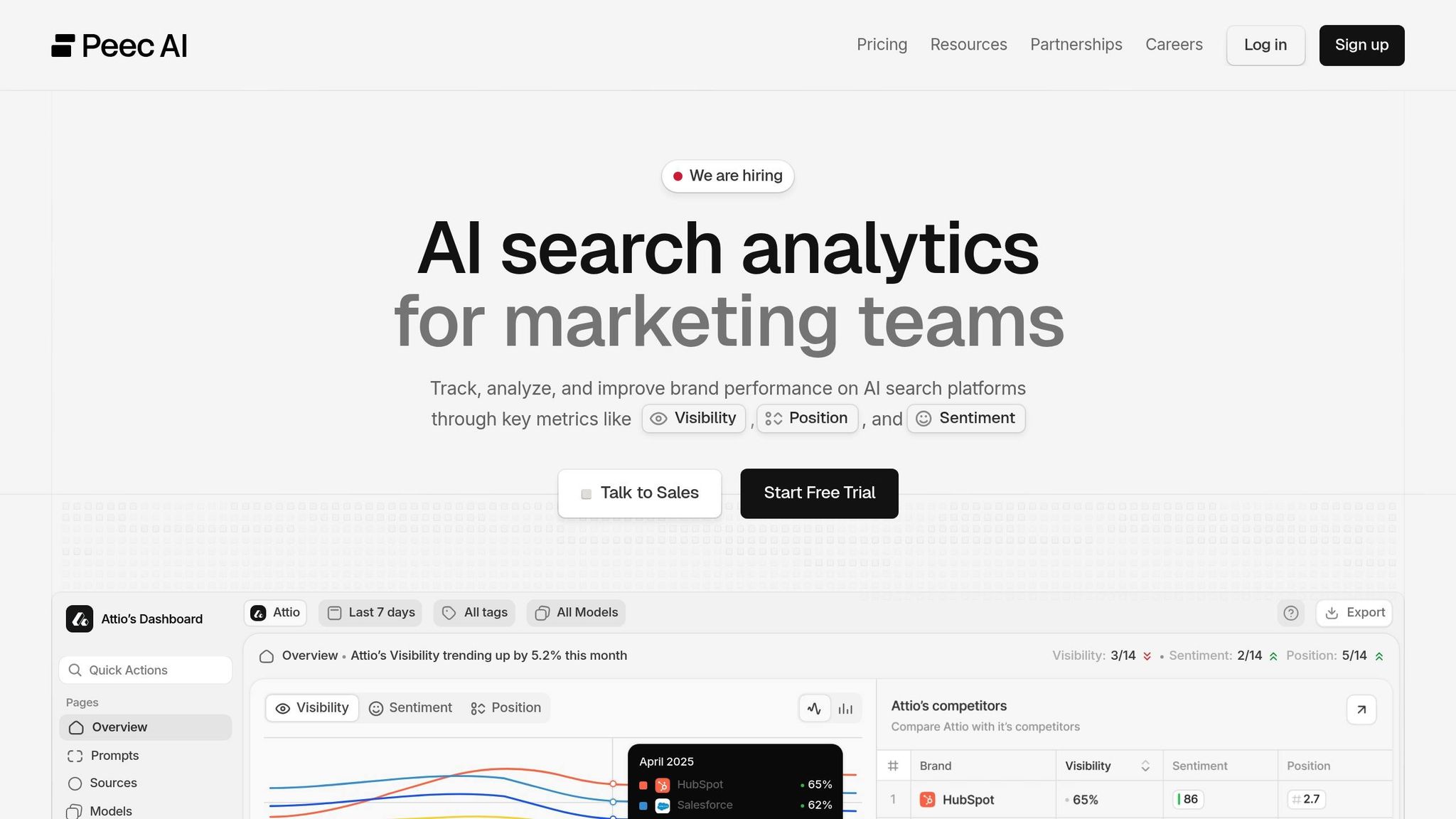
Peec is the cleanest dashboard on this list and the fastest to set up, and it deliberately leaves technical SEO alone, so you’ll need a second tool if schema and indexation are part of the problem.
- AI engine coverage: Partial
- Citation intelligence: Strong
- Prompt discovery: Strong
- Optimization recommendations: Partial
- Reporting and team fit: Strong
- Price transparency and value: Partial
At a glance
- Starting price$103/mo
- Free plan or trialNo free plan
- AI enginesChatGPT, Perplexity, Google AI Overviews (Gemini, Claude, AI Mode, DeepSeek, Grok on Enterprise)
- Citation trackingMentions separated from citations with source URLs, sentiment, and share of voice
- Prompt trackingAuto-generated prompt suggestions plus Prompt Association Mapping
- RecommendationsStrategic visibility insights and alerts, no built-in technical audit
- Primary userB2B SaaS marketing teams and agencies
- What the price note meansStarter, 25 prompts, ~2,250 AI answers a month
Best things about it
- Unlimited seats on every tier, which keeps the cost flat as your team grows
- Prompt Association Mapping shows you which questions AI engines tie most closely to your brand
- A Looker Studio connector and Pitch Workspaces make client and stakeholder reporting straightforward
Limitations
- No built-in technical audit, so schema, page structure, and indexation issues stay invisible here
- The Starter plan covers three engines, and the wider coverage sits on Enterprise at $580+ a month
Choose this ifYou want share of voice and sentiment in a dashboard your CEO can read without a walkthrough.
Skip this ifYour visibility problem is technical, because Peec won’t diagnose schema or indexation for you.
Read the full analysis of Peec AI
Engine coverage
The Starter and Pro plans cover ChatGPT, Perplexity, and Google AI Overviews. Enterprise users can extend into Gemini, Claude, Google AI Mode, DeepSeek, and Grok for an additional cost. Smaller teams can start on the essential engines and scale up as the budget allows.
Citation and mention tracking
Peec separates mentions from citations by giving you the source URLs, tracks sentiment, and compares your share of voice against your competitors. The platform analyzes between 2,250 and more than 27,000 AI responses per month depending on your tier.
Prompt and opportunity discovery
Peec generates prompt suggestions from your website content and your industry. Prompt Association Mapping then highlights the questions that AI engines most closely link to your brand. Real-time alerts fire when your visibility shifts suddenly, which earns its keep during a product launch or a campaign.
Optimization recommendations
Peec leans strategic rather than technical. You get visibility insights and alerts, and the technical SEO work stays with you. The Looker Studio connector lets you build custom dashboards, and Pitch Workspaces exist for sharing competitive visibility reports with clients or execs.
Pricing
| Plan | Price | Prompts | AI answers analyzed | Key features |
|---|---|---|---|---|
| Starter | $103/mo | 25 | ~2,250/mo | ChatGPT, Perplexity, AI Overviews; daily updates |
| Pro | $230/mo | 100 | ~9,000/mo | Adds Slack support |
| Enterprise | $580+/mo | 300+ | 27,000+/mo | Dedicated account manager, SSO, extended engines |
Peec has raised $1.9 million to date.
Primary source for this entry: visible.seranking.com
Rank #5 Scrunch AI
Best for: Teams that need the fix, not just the diagnosis
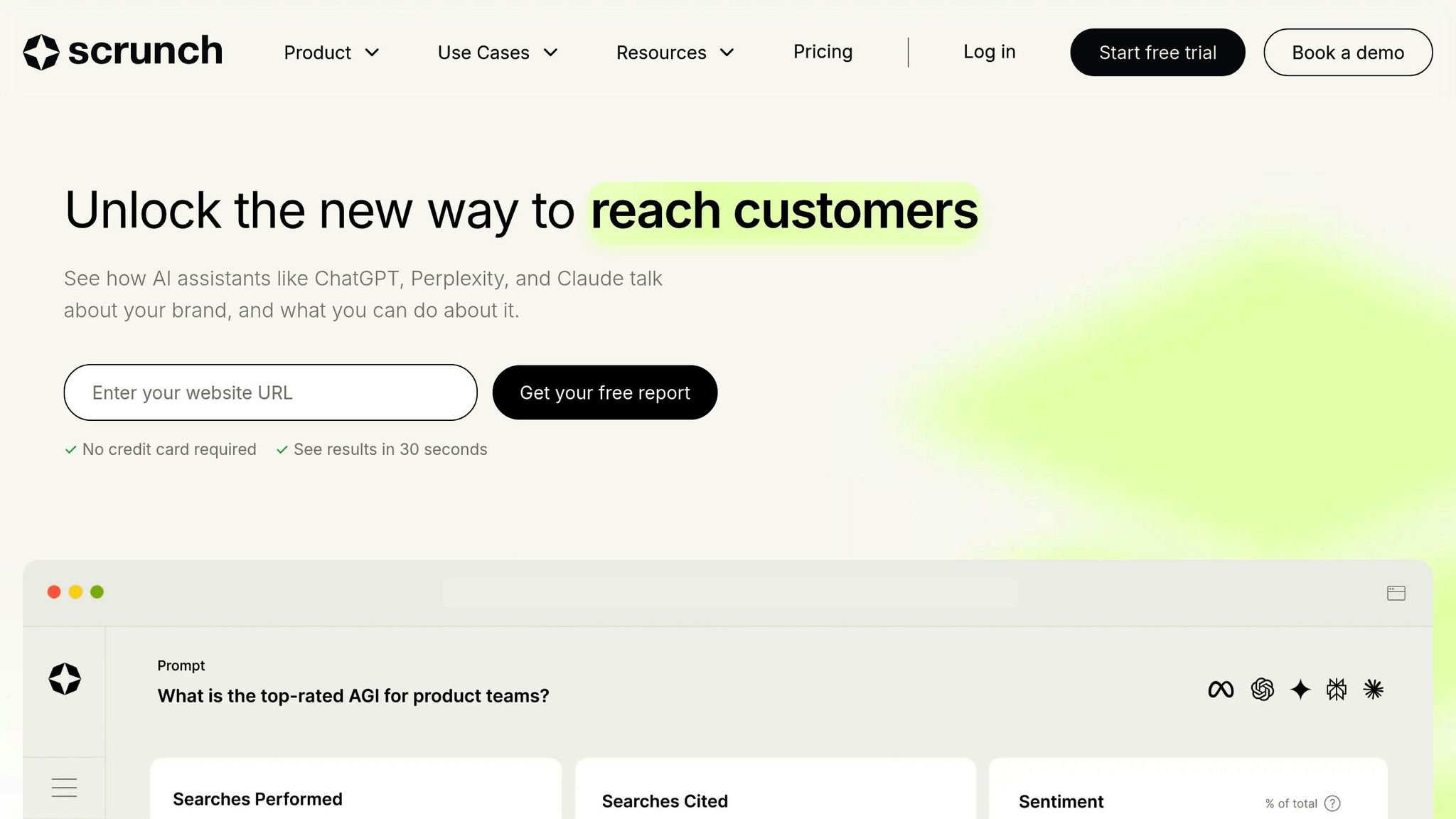
Scrunch is the strongest option here for actually changing your outcome rather than measuring it, because the Agent Experience Platform serves AI crawlers a clean version of your site without asking your engineers for anything.
- AI engine coverage: Strong
- Citation intelligence: Strong
- Prompt discovery: Strong
- Optimization recommendations: Strong
- Reporting and team fit: Partial
- Price transparency and value: Partial
At a glance
- Starting price$100/mo
- Free plan or trialNo free plan
- AI enginesChatGPT, Gemini, Perplexity, Meta AI (Llama), Claude, plus Google AI Overviews in beta
- Citation trackingPresence and Position metrics, plus a map of which sources feed the answer
- Prompt tracking1,000 auto-tracked industry prompts and a Missed Content Opportunity report
- RecommendationsPer-URL content quality audit plus a CDN-level bot-friendly site layer
- Primary userMarketing teams with a technical site problem
- What the price note meansExplorer covers ChatGPT only; custom prompts start at $300/mo
Best things about it
- The Agent Experience Platform builds a lightweight, crawler-friendly version of your site at the CDN level, which solves the JavaScript problem for single-page applications without engineering time
- Position tracking tells you whether you’re the first recommendation or the tenth bullet, and those are not the same result
- The competitive presence dashboard lists the exact prompts where competitors are cited and you aren’t
Limitations
- The $100 Explorer plan covers ChatGPT alone, and all eight engines require the $500 Growth plan
- Custom prompt tracking starts on the $300 Starter plan, and each engine consumes a credit per prompt
Choose this ifYour site is JavaScript-heavy and you suspect AI crawlers can’t read it properly.
Skip this ifYour budget stops below $300 a month, because custom prompt tracking begins there.
Read the full analysis of Scrunch AI
Engine coverage
Scrunch tracks ChatGPT, Gemini, Perplexity, Meta AI (Llama), and Claude, with beta support for Google AI Overviews. The Explorer plan at $100 a month covers ChatGPT only. All eight engines require the Growth plan at $500 a month or the Enterprise tier.
Citation and mention tracking
Scrunch maps the supply chain of information, showing whether an AI answer pulls from your website, your competitors, or third-party sources like news outlets. It tracks two metrics that are worth separating:
- Presence: whether your brand gets mentioned at all.
- Position: how prominently it appears, because a mention buried as the tenth bullet point is close to invisible.
“Scrunch AI showed us exactly what AI was seeing, and what we were missing. It was like flipping on a light switch. Within weeks, we went from invisible to cited right alongside the biggest players in the space.”
Danilo Vaccalluzzo, Digital Marketing Manager
Prompt and opportunity discovery
Scrunch analyzes your brand, suggests prompts, and automatically tracks 1,000 industry-specific prompts. The Starter plan at $300 a month includes 350 custom prompts, and one credit gets consumed per engine per prompt, so tracking a single prompt across five engines costs five credits.
The Missed Content Opportunity feature flags the places where AI found no relevant content from your brand and tells you what to do about it, whether that means updating an FAQ or adding a case study.
Optimization recommendations
The site audit tool evaluates individual URLs for content quality and hands you a checklist covering headings, content gaps, and semantic relevance.
The Agent Experience Platform is the piece worth paying attention to. It creates a lightweight, bot-friendly version of your site at the CDN level, which sidesteps the JavaScript-heavy layouts that block AI crawlers. If you’re running a single-page application, that solves a real problem without pulling an engineer off your roadmap.
Scrunch also integrates with Google Analytics to track visits from crawlers like GPTBot, and its competitive presence dashboard shows the prompts where competitors get cited and you don’t.
Who’s using it
Scrunch supports more than 500 companies, including Lenovo, Crunchbase, and Penn State University.
Primary source for this entry: getmint.ai
Rank #6 ZipTie
Best for: Teams that need screenshot proof of what AI showed
ZipTie reads the user-facing results instead of the API, which is why it surfaces up to 17 times more AI Overviews than a standard SEO tool, and the full response screenshots make it the easiest tool here to prove a point to a skeptical stakeholder.
- AI engine coverage: Partial
- Citation intelligence: Strong
- Prompt discovery: Strong
- Optimization recommendations: Strong
- Reporting and team fit: Strong
- Price transparency and value: Strong
At a glance
- Starting price$69/mo
- Free plan or trial14-day free trial
- AI enginesGoogle AI Overviews, ChatGPT, Perplexity
- Citation trackingBrand mentions separated from citations, with full response screenshots per query
- Prompt trackingAI Prompt Generation Assistant from URLs, Search Console, or custom lists
- RecommendationsContent Optimization module that models the structure of cited content
- Primary userIn-house marketers and lean agencies
- What the price note means500 checks, unlimited seats
Best things about it
- Tracking user-facing results rather than the API uncovers up to 17 times more AI Overviews than standard SEO tools
- Full response screenshots for every query, which settles arguments about what an AI engine actually said
- The AI Success Score ranks queries by mention frequency, citation presence, and sentiment so you know what to work on first
Limitations
- Coverage stops at three engines, so Gemini, Claude, and Copilot go untracked
- It doesn’t handle traditional SEO metrics like backlink analysis or organic keyword rankings
Choose this ifYou need documented evidence of your AI visibility, and a 14-day trial to prove the case internally.
Skip this ifYou want one platform for both traditional SEO and AI visibility, because ZipTie only does the second half.
Read the full analysis of ZipTie
Engine coverage
ZipTie tracks Google AI Overviews, ChatGPT, and Perplexity. It doesn’t limit itself to API data. Instead it tracks user-facing results to capture what a real customer sees, including live citations and sentiment trends. That method uncovers up to 17 times more AI Overviews than standard SEO tools, across 14+ countries including the US, UK, Canada, Australia, India, and Brazil.
Citation and mention tracking
ZipTie separates Brand Mentions, where you’re referenced without a link, from Citations, which are clickable references to your site. For every query it captures a full response screenshot and tracks the cited domains, so you can watch mention frequency and sentiment shift over time.
“ZipTie has become my go-to tool to monitor my sites, clients, and competitors’ inclusion in AI Overviews, effectively assess the impact over traffic, and identify the best way to optimize for them.”
Lily Ray, SEO Expert
Prompt and opportunity discovery
The AI Prompt Generation Assistant converts traditional SEO keywords into conversational prompts. You can generate them from URLs, a Google Search Console integration, or your own custom lists. The platform then calculates an AI Success Score for each query, factoring in mention frequency, citation presence, and sentiment, which gives you a priority order.
Optimization recommendations
The Content Optimization module analyzes the structural and semantic patterns in content that already gets cited. If competitors’ cited pages consistently use comparison tables, ZipTie tells you to add a pricing matrix or a comparison table of your own.
Pricing
ZipTie starts at $69 a month for 500 checks with unlimited seats, and there’s a 14-day free trial.
Primary source for this entry: ziptie.dev
Rank #7 SE Ranking AI Search Toolkit
Best for: SEO teams running both traditional and AI search
SE Ranking’s “No cited” report is the single most useful screen on this list for a team with a content calendar, because it hands you the exact prompts where your competitors get named and you don’t.
- AI engine coverage: Strong
- Citation intelligence: Strong
- Prompt discovery: Strong
- Optimization recommendations: Strong
- Reporting and team fit: Strong
- Price transparency and value: Partial
At a glance
- Starting price$189/mo
- Free plan or trialNo free plan
- AI enginesChatGPT, Google AI Overviews, Google AI Mode, Perplexity, Gemini
- Citation trackingAll brand mentions plus the source URLs driving them, with weekly sentiment scores
- Prompt trackingSuggested prompts, localized topic suggestions, and the AIO Research Tool
- RecommendationsWebsite Audit for AI indexing blockers, aligned with traditional SEO fixes
- Primary userSEO teams and multi-brand marketers
- What the price note meansSE Visible, 450 prompts, 5 brands
Best things about it
- The “No cited” report isolates prompts where competitors appear and your brand is absent, which is a content brief you don’t have to write
- It processes over 100 million AI answers a month and captures cached snapshots of the real interface
- Unlimited users and daily prompt updates on every plan
Limitations
- The entry plan at $189 a month is priced for teams managing several brands, not for a single site
- Updates run daily at most, so it won’t suit anyone who needs faster than that
Choose this ifYou already do traditional SEO and you want AI visibility running on the same content calendar.
Skip this ifYou manage one brand and one engine, because the pricing assumes you’re managing several.
Read the full analysis of SE Ranking
Engine coverage
SE Ranking’s AI Search Toolkit monitors brand mentions across ChatGPT, Google AI Overviews, Google AI Mode, Perplexity, and Gemini. It processes over 100 million AI answers each month to track how brands surface in conversational search.
Citation and mention tracking
The toolkit identifies every brand mention and pinpoints the source URLs driving your visibility. Its “No cited” report highlights the prompts where competitors get mentioned and your brand doesn’t, and weekly sentiment scores let you watch perception shift over time.
Prompt and opportunity discovery
SE Ranking generates suggested prompts from your site’s content and offers localized topic suggestions that match native-language search behavior. The AIO Research Tool lets you filter by keyword group to find the niches where you can realistically win.
The platform also captures cached snapshots of AI results through real-time interface scraping, so you can verify exactly how your brand appeared, which is especially useful for watching Google’s AI Mode.
Optimization recommendations
SE Ranking lines its recommendations up with traditional SEO work rather than treating AI visibility as a separate discipline.
“GEO does not replace SEO. It builds on it.”
Eric Waterschoot, AI and SEO Strategist, SE Ranking
The Website Audit tool identifies technical issues that block AI indexing. Two findings from SE Ranking’s research are worth building into your plan: sites with over 32,000 referring domains are 3.5 times more likely to be cited by ChatGPT than sites with fewer than 200, and ChatGPT tends to favor articles over 2,900 words while AI Mode prefers content over 2,300 words.
Pricing
SE Visible plans start at $189 a month for 450 prompts across 5 brands, then $355 a month for 1,000 prompts across 10 brands, and $519 a month for 1,500 prompts across 15 brands. All plans include unlimited users and daily prompt updates.
Primary source for this entry: visible.seranking.com
Rank #8 Writesonic
Best for: Teams that want tracking and content production together
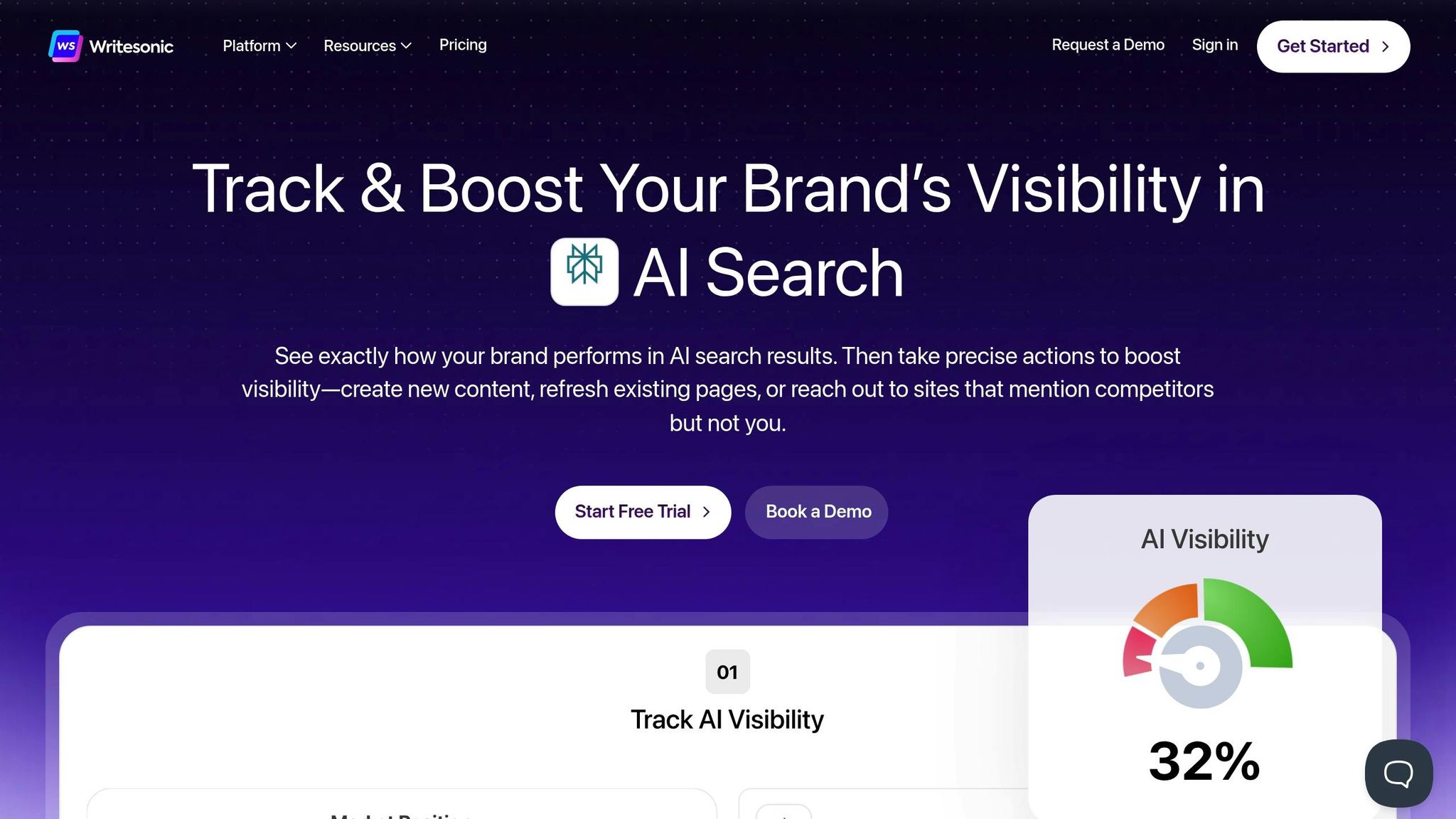
Writesonic is the only tool here that lets you spot a gap and fix the page in the same session, because its editor writes directly into WordPress or Cloudflare.
- AI engine coverage: Strong
- Citation intelligence: Strong
- Prompt discovery: Strong
- Optimization recommendations: Strong
- Reporting and team fit: Partial
- Price transparency and value: Partial
At a glance
- Starting price$99/mo
- Free plan or trialNo free plan
- AI enginesChatGPT, Google AI Overviews, Claude, Gemini, Perplexity
- Citation trackingMentions, citation frequency, and sentiment, plus an AI Visitors crawler dashboard
- Prompt trackingContent Strategy Planner and Prompt & UI Scraping for gap analysis
- RecommendationsAction Center with a prioritized audit and in-platform fixes
- Primary userContent teams and ecommerce brands
- What the price note meansGEO tracking; $499/mo for full sentiment and unlimited content
Best things about it
- The Action Center prioritizes the audit for you, flagging missing schema and crawler blockers in order of impact
- WordPress and Cloudflare integrations let you publish the fix from inside the tool
- The AI Visitors dashboard shows which of your pages crawlers hit most, so you optimize the right ones
Limitations
- Full sentiment monitoring and unlimited content generation jump the price to $499 a month
- The value depends on you wanting the content-generation side, which not every team does
Choose this ifYour bottleneck is publishing the fix, not finding it.
Skip this ifYou already have a content team and only need the measurement layer.
Read the full analysis of Writesonic
Engine coverage
Writesonic tracks ChatGPT, Google AI Overviews, Claude, Gemini, and Perplexity.
Citation and mention tracking
You get brand mentions, citation frequency, and the sentiment behind them across every major platform. Writesonic’s own testing found that Grammarly appeared in 85% of AI-generated answers, with 77% of those carrying positive sentiment. The AI Visitors dashboard highlights your most frequently crawled pages so you can put your optimization effort where the crawlers already are.
Prompt and opportunity discovery
The Content Strategy Planner benchmarks your site against competitors and pinpoints where your brand is missing from AI responses. Prompt & UI Scraping surfaces the AI-generated content that exposes those visibility gaps.
Optimization recommendations
The Action Center gives you a prioritized AI audit that flags issues like missing schema or crawler blockers. When you connect WordPress or Cloudflare, you can push the fix directly through the built-in editor instead of handing a ticket to someone else.
Pricing
Pricing starts at $99 a month for GEO tracking. Full sentiment monitoring and unlimited content generation move you to the $499 a month tier.
Primary source for this entry: visible.seranking.com
Rank #9 Knowatoa AI
Best for: Agencies tracking brand attributes, not just mentions
Knowatoa tracks whether AI describes your product accurately, not only whether it names you, and that distinction matters the moment a model starts telling prospects your product does something it doesn’t.
- AI engine coverage: Strong
- Citation intelligence: Strong
- Prompt discovery: Strong
- Optimization recommendations: Strong
- Reporting and team fit: Partial
- Price transparency and value: Strong
At a glance
- Starting price$59/mo
- Free plan or trialFree plan (10 questions, ChatGPT)
- AI enginesChatGPT, Claude, Perplexity, Gemini, Google AI Overviews, Meta AI, Google AI Mode
- Citation trackingTracks the third-party sources AI trusts most, plus sentiment and feature-level omissions
- Prompt trackingQuestion-based tracking across product names, leadership, and features
- RecommendationsThe BISCUIT Framework, with steps for content, PR, and entity clarity
- Primary userAgencies and in-house brand teams
- What the price note meansStarter, 30 questions; Agency runs $749/mo
Best things about it
- It tracks specific brand attributes like product names, leadership, and standout features rather than only website mentions
- It identifies which third-party sources the models trust most, which turns into a public relations target list
- A free plan with 10 questions and a 7-day trial let you validate the fit before you pay
Limitations
- It won’t replace your SEO tools, because backlinks and keyword rankings sit outside its scope
- The Agency tier at $749 a month is a real step up from the $59 entry point
Choose this ifAI is describing your product inaccurately and you need to see exactly where that starts.
Skip this ifYou want one platform covering backlinks, rankings, and AI visibility together.
Read the full analysis of Knowatoa
Engine coverage
Knowatoa monitors seven platforms: ChatGPT, Claude, Perplexity, Gemini, Google AI Overviews, Meta AI, and Google AI Mode. It processes up to 21,700 responses monthly, supports multiple languages and regions, and had already run 4,961 AI search audits by early 2026.
Citation and mention tracking
Knowatoa focuses on specific brand attributes, including product names, leadership details, and standout features, rather than tracking website mentions alone. It identifies which third-party sources AI platforms trust most, monitors sentiment, and pinpoints the moments when a specific feature gets mentioned or left out. That last part earns its keep when a model misrepresents your product.
“Knowatoa revealed insights that completely changed how I think about brand, website, and content distribution. It’s not just a tool, it’s a smarter way to approach visibility.”
Craig Hewitt, CEO, Castos
Optimization recommendations
The BISCUIT Framework analyzes how large language models prioritize and recommend companies, then gives you clear steps: update this content, refine that public relations angle, clarify these entity details.
Pricing
The free plan includes 10 questions with ChatGPT access. Paid plans run from $59 a month for 30 questions on Starter up to $749 a month for 1,500 questions on Agency. There’s a 7-day free trial.
Primary source for this entry: knowatoa.com
Rank #10 Morningscore
Best for: SEO teams adding AI tracking without a second dashboard
Morningscore’s “Zero” ranking reframes the metric that actually matters now: if you rank fifth organically but you’re the top-cited source in the AI Overview, that’s your real position, and Morningscore is the tool that will tell you so.
- AI engine coverage: Partial
- Citation intelligence: Strong
- Prompt discovery: Partial
- Optimization recommendations: Strong
- Reporting and team fit: Strong
- Price transparency and value: Strong
At a glance
- Starting price$69/mo
- Free plan or trial14-day free trial
- AI enginesGoogle AI Overviews and ChatGPT, including ChatGPT Search
- Citation trackingIdentifies the exact URLs Google's AI cites and tracks mention frequency
- Prompt trackingFlags which keywords trigger an AI Overview, with cached answers and volume data
- RecommendationsThe Missions System turns findings into ordered SEO tasks
- Primary userSEO teams and small agencies
- What the price note means14-day free trial, no credit card
Best things about it
- The GEO Score gives you one AI visibility index that sits beside your normal rankings
- Daily updates across 167 countries at $69 a month
- The Missions System converts insight into a task list instead of leaving you with a chart
Limitations
- Coverage stops at Google AI Overviews and ChatGPT, so Perplexity, Gemini, and Claude go untracked
- No advanced prompt testing or competitor sentiment analysis
Choose this ifYour audience lives on Google and ChatGPT, and you want AI tracking inside an SEO tool you’ll actually open.
Skip this ifPerplexity, Gemini, or Claude matter to your audience, because Morningscore doesn’t cover them.
Read the full analysis of Morningscore
Engine coverage
Morningscore focuses on Google AI Overviews and ChatGPT, including ChatGPT Search. It tracks whether your target keywords generate an AI summary and confirms whether your site is cited as a source. Daily updates cover 167 countries.
Citation and mention tracking
The platform identifies which specific URLs Google’s AI highlights and monitors how often your brand comes up. Its “Zero” ranking system is the feature that changes how you read your own data.
“You might be rank #5 organically, but cited #1 in the AI Overview. That is the new top spot. We track it.”
Morningscore
Morningscore’s data shows that 75% of websites cited in AI Overviews already rank within the top 12 of traditional Google results, so your existing SEO work is doing more for you here than you might realize.
Prompt and opportunity discovery
Morningscore pinpoints the keywords that trigger AI Overviews and evaluates search intent using cached AI answers and search volume data. With roughly 47% of searches now triggering an AI Overview, knowing which of your keywords are in that 47% is where the work starts.
Optimization recommendations
The Missions System hands you detailed SEO tasks that lift both traditional rankings and AI visibility.
“AI Searches, whether it’s AI Overviews, ChatGPT, Perplexity, etc., looks for the clearest and most direct answer.”
Morningscore
The practical advice that follows is simple: use plain paragraphs and bulleted lists, and you can win a citation even against sites that outrank you.
Pricing
Plans start at $69 a month, with a 14-day free trial that doesn’t ask for a credit card.
Primary source for this entry: morningscore.io
Rank #11 Ahrefs Brand Radar
Best for: Ahrefs subscribers adding AI data to authority research
Brand Radar’s 271 million monthly queries make it the best trend instrument here, and its monthly update cycle makes it the wrong instrument for anything you need to act on this week.
- AI engine coverage: Strong
- Citation intelligence: Strong
- Prompt discovery: Partial
- Optimization recommendations: Not offered
- Reporting and team fit: Strong
- Price transparency and value: Partial
At a glance
- Starting price$199/mo
- Free plan or trialNo free plan
- AI enginesChatGPT, Perplexity, Gemini, Google AI Overviews, Google AI Mode, Microsoft Copilot
- Citation trackingSource domains and URLs cited, wired into Ahrefs' backlink and authority metrics
- Prompt trackingCustom prompt tracking sold in check packages from $50/mo
- RecommendationsNo dedicated recommendation engine
- Primary userSEO teams already inside Ahrefs
- What the price note meansper index; $699/mo for all platforms
Best things about it
- It covers about 271 million queries a month across six platforms, which is a genuinely large sample
- AI citation data sits inside Site Explorer next to your backlink and authority metrics
- Custom prompt tracking scales cleanly at $50, $100, or $250 a month depending on volume
Limitations
- Updates roll out monthly, which makes it a trend tool rather than a monitoring tool
- Ahrefs CMO Tim Soulo has acknowledged the interface still needs work
Choose this ifYou live in Ahrefs and you want AI citation trends beside your authority data.
Skip this ifYou need to know what changed this week, because monthly updates won’t tell you.
Read the full analysis of Ahrefs Brand Radar
Engine coverage
Brand Radar covers about 271 million queries each month across six major AI platforms: ChatGPT, Perplexity, Gemini, Google AI Overviews, Google AI Mode, and Microsoft Copilot. Updates roll out monthly, which gives you a broad view of the trend rather than a live feed.
Citation and mention tracking
Brand Radar identifies the source domains and URLs that AI models cite when they mention your brand, and it plugs that straight into Ahrefs’ existing backlink and authority metrics.
Custom prompt tracking comes in tiered packages:
- $50 a month for 2,500 checks
- $100 a month for 7,000 checks
- $250 a month for 25,000 checks
Pricing
Brand Radar costs $199 a month per index, or $699 a month for access to all platforms. Tim Soulo, Ahrefs’ CMO, has publicly acknowledged that the interface has room to improve, which is a fair caveat to hear from the vendor itself.
Primary source for this entry: www.loamly.ai
Rank #12 Rankability
Best for: Agencies handling AI visibility and SEO in one platform
Rankability folds AI citation gaps into the SEO platform an agency already uses for content optimization, which removes a tab from the workflow, and its update cadence is still catching up to the specialist tools.
- AI engine coverage: Partial
- Citation intelligence: Strong
- Prompt discovery: Strong
- Optimization recommendations: Strong
- Reporting and team fit: Strong
- Price transparency and value: Partial
At a glance
- Starting price$149/mo
- Free plan or trialNo free plan
- AI enginesChatGPT, Gemini, Perplexity, Google AI Overviews
- Citation trackingBenchmarks your citations against competitors and flags where you're missing
- Prompt trackingBranded and commercial prompt testing, with IBM Watson and Google NLP for topics
- RecommendationsContent Optimizer with in-platform copy and entity fixes
- Primary userAgencies managing multiple clients
- What the price note meansbilled annually; AI Analyzer sits on higher agency tiers
Best things about it
- Citation gap analysis and content optimization live in the same platform, so nothing moves to a spreadsheet
- It tests branded and commercial prompts separately, which are two different visibility problems
- IBM Watson and Google NLP surface topic and keyword opportunities you’d otherwise miss
Limitations
- The update cadence was still evolving as of early 2026, so real-time tracking isn’t its strength
- AI Analyzer access typically requires the higher agency tiers, so confirm seat and prompt limits with sales
Choose this ifYou run an agency and you want AI citation gaps sitting next to the content optimizer you already use.
Skip this ifYou need real-time updates or coverage of niche AI engines.
Read the full analysis of Rankability
Engine coverage
The AI Analyzer tracks brand mentions across ChatGPT, Gemini, Perplexity, and Google AI Overviews. It tests both branded and commercial prompts, which gives you a fuller read than branded tracking alone.
Citation and mention tracking
Rankability benchmarks where your pages appear in AI responses and compares your citations against your competitors’, so you can see which competitor is winning which prompt.
Prompt and opportunity discovery
Using IBM Watson and Google NLP, Rankability surfaces overlooked topics and keyword opportunities. Prompt-level testing shows you the specific queries that bring up your brand.
Optimization recommendations
The built-in Content Optimizer gives you clear steps to refine copy, strengthen entity details, and close the visibility gaps, and all of it happens inside the platform.
“Spot citations across ChatGPT, Perplexity, and Google AI Overviews, then fix gaps right inside the same platform.”
Rankability
Pricing
Plans start at $149 a month billed annually. AI Analyzer access typically comes with the higher agency tiers, so contact their sales team for the specifics on seat and prompt limits.
Primary source for this entry: www.rankability.com
Rank #13 Similarweb
Best for: Enterprise teams pairing AI visibility with market intelligence
Similarweb’s Influence Score tells you which third-party domains the models actually trust in your category, which turns a visibility problem into a specific public relations target list.
- AI engine coverage: Strong
- Citation intelligence: Strong
- Prompt discovery: Strong
- Optimization recommendations: Partial
- Reporting and team fit: Strong
- Price transparency and value: Partial
At a glance
- Starting price$99/mo
- Free plan or trial7-day free trial
- AI enginesChatGPT, Google AI Overviews, Perplexity, Gemini, Claude, Grok
- Citation trackingCitation Analysis with an Influence Score for every cited source
- Prompt trackingPrompt Analysis showing where competitors get cited instead of you
- RecommendationsSentiment analysis and structured data guidance, no dedicated fix engine
- Primary userEnterprise marketing and competitive intelligence teams
- What the price note meansGen AI Intelligence; Pro packages from $125/mo
Best things about it
- The Influence Score ranks cited sources by how often models reference them, which prioritizes your outreach for you
- AI visibility sits next to referral traffic and standard web analytics, so you can connect mentions to sessions
- Coverage spans six engines including Claude and Grok, which most tools here skip
Limitations
- The wider platform is more than you need if AI visibility tracking is the only job
- There’s no dedicated recommendation engine, so the fixes stay your responsibility
Choose this ifYou want AI citations, referral traffic, and competitive intelligence in one place.
Skip this ifAI visibility tracking is your only requirement, because you’d be paying for the rest of the platform.
Read the full analysis of Similarweb
Engine coverage
Similarweb covers ChatGPT, Google AI Overviews, Perplexity, Gemini, Claude, and Grok. Its GenAI Intelligence module reports your rank in AI search results and tracks the referral traffic those engines send you.
Citation and mention tracking
The Citation Analysis tool identifies which domains and URLs AI engines cite when answering questions in your category, and it assigns each source an Influence Score based on how often it gets referenced.
In November 2025, Limor Barenholtz, Similarweb’s Director of SEO, analyzed OpenAI-related citations and found that for “AI Research” topics the most-cited sources were arxiv.org, medium.com, and en.wikipedia.org. A single Wikipedia article on “Word embedding” carried an influence score of 0.48% and appeared across three separate prompts.
“Citations are the new SEO battleground… securing citations beneath AI-generated answers represents one of the few remaining pathways for website visibility.”
Limor Barenholtz, Director of SEO, Similarweb
Prompt and opportunity discovery
Prompt Analysis reveals the questions users ask and where competitors get cited instead of you. A January 2026 study found that Lululemon appeared in 32.77% of AI answers overall but was largely absent from “sustainability” prompts, which is exactly the kind of category-level blind spot that costs a brand real pipeline.
Optimization recommendations
Sentiment analysis evaluates whether AI mentions read positive, neutral, or negative. The citation data highlights high-influence third-party domains, including niche review sites and industry forums, which is where your public relations and link-building effort should go. Similarweb also supports technical work with structured data and llms.txt files.
Pricing
The Gen AI Intelligence package starts at $99 a month, and Pro packages begin at $125 a month. A 7-day free trial is available.
Primary source for this entry: www.similarweb.com
Rank #14 BrightEdge
Best for: Large organizations with governance and compliance needs
BrightEdge is built for the organization where AI visibility reporting has to satisfy several teams and a compliance workflow at once, and the custom pricing tells you plainly whether you’re the customer.
- AI engine coverage: Partial
- Citation intelligence: Strong
- Prompt discovery: Strong
- Optimization recommendations: Strong
- Reporting and team fit: Strong
- Price transparency and value: Partial
At a glance
- Starting priceCustom
- Free plan or trialNo free plan
- AI enginesGoogle AI Overviews, ChatGPT, Perplexity, Gemini
- Citation trackingCitation frequency and context, with page-level drivers and competitor comparison
- Prompt trackingCompetitive reporting that surfaces the topics you haven't covered
- RecommendationsSemantic gap and topical cluster recommendations aligned to E-E-A-T
- Primary userEnterprise SEO and content teams
- What the price note meanspriced on org size, domains, and data volume
Best things about it
- AI visibility and traditional search rankings share one dashboard, which suits multi-team reporting
- Enterprise competitive benchmarking across multiple domains and brands
- Recommendations map to E-E-A-T principles, which is the framework enterprise content teams already work to
Limitations
- Custom enterprise pricing means a sales cycle before you know the number
- Small teams will find the platform heavier than the problem requires
Choose this ifYou’re managing several domains across several teams with a compliance workflow attached.
Skip this ifYou’re a startup that wants straightforward AI visibility tracking.
Read the full analysis of BrightEdge
Engine coverage
BrightEdge monitors how your content performs in Google AI Overviews, ChatGPT, Perplexity, and Gemini, and it identifies when your brand gets cited in AI-generated summaries. Enterprise teams see AI visibility beside traditional search rankings in a single dashboard.
Citation and mention tracking
The platform tracks how often your brand is cited and the context around those mentions across engines. It also shows which pages drive the mentions and how often competitors get named instead of you. The enterprise competitive benchmarking suits organizations managing multiple domains or brands.
Prompt and opportunity discovery
BrightEdge’s competitive reporting pinpoints the topics and questions your brand hasn’t addressed yet, and benchmarks your citation frequency against competitors to give you a content roadmap. All of it sits in the same interface your team already uses for keyword research and content planning.
Optimization recommendations
Recommendations target semantic gaps and strengthen topical clusters. They align with E-E-A-T principles, which stands for Experience, Expertise, Authoritativeness, and Trustworthiness, and those signals correlate with a higher citation likelihood across AI systems.
Pricing
BrightEdge uses custom enterprise pricing based on your organization’s size, the number of tracked domains, your data volume, and the features you need. You negotiate directly with their sales team.
Primary source for this entry: www.brightedge.com
Rank #15 Mangools AI Search Grader
Best for: A free multi-model baseline before you spend anything
Mangools is the best free starting point on this list because a free account unlocks all 8 models and gives you a weighted 0 to 100 score, and it stops short of the source URLs you’ll eventually need.
- AI engine coverage: Strong
- Citation intelligence: Partial
- Prompt discovery: Partial
- Optimization recommendations: Partial
- Reporting and team fit: Partial
- Price transparency and value: Strong
At a glance
- Starting priceFree
- Free plan or trialFree (all 8 models on a free account)
- AI enginesChatGPT (GPT-4o-mini), Perplexity Sonar, DeepSeek V3, Claude 3.5 Haiku, Grok 3 Mini, Gemini 2.5 Flash Lite Preview, Mistral Small 3.2 24B, Llama 4 Scout
- Citation trackingVisibility percentage and average ranking, but no source URLs on the free tier
- Prompt trackingCustom prompts generated for your brand and niche, with the top 20 competitors per prompt
- RecommendationsCompetitor comparison rather than a fix list
- Primary userMarketers running a first baseline audit
- What the price note meansAI Search Watcher from $37.70/mo billed annually
Best things about it
- A free account unlocks all 8 models, which is more coverage than several paid tools on this list
- The AI Search Score blends visibility and ranking, weighted by each model’s market share
- It shows the top 20 competitors per prompt, so you learn who’s winning your category for free
Limitations
- The free version doesn’t track source URLs or give you the full conversational context
- Ongoing tracking means moving to AI Search Watcher at $37.70 a month billed annually
Choose this ifYou haven’t measured anything yet and you want a real baseline before you commit budget.
Skip this ifYou need the cited URLs, because the free tier reports mentions and rankings only.
Read the full analysis of Mangools
Engine coverage
Mangools evaluates your brand across 8 AI models: ChatGPT (GPT-4o-mini), Perplexity Sonar, DeepSeek V3, Claude 3.5 Haiku, Grok 3 Mini, Gemini 2.5 Flash Lite Preview, Mistral Small 3.2 24B, and Meta’s Llama 4 Scout. The version you get without signing in covers 3 models, and a free account unlocks all 8 with a limited number of searches.
Citation and mention tracking
The tool tracks Visibility, which is the percentage of prompts where your brand appears in the top 20 results, and calculates an Average Ranking position. It combines both into an AI Search Score from 0 to 100, weighted by each model’s market share.
The free version doesn’t track specific source URLs or give you the full conversational context, so treat it as a baseline instrument rather than an ongoing monitor.
Optimization recommendations
Mangools generates custom prompts for your brand and niche and shows you which queries produce mentions. It also lists the top 20 competitors for each prompt, which tells you where your content is falling short. For ongoing tracking, AI Search Watcher gives you weekly updates from $37.70 a month billed annually for up to 500 prompts.
One finding from Mangools’ research is worth building into your editorial calendar: content cited in AI results tends to be 25.7% newer than content ranking in traditional Google search.
Primary source for this entry: mangools.com
Rank #16 Gauge
Best for: A first look at where you stand against competitors
Gauge does monitoring and competitor benchmarking cleanly and stops there, so it’s a reasonable first instrument and never the only one you’ll need.
- AI engine coverage: Partial
- Citation intelligence: Partial
- Prompt discovery: Not offered
- Optimization recommendations: Not offered
- Reporting and team fit: Partial
- Price transparency and value: Partial
At a glance
- Starting priceCustom
- Free plan or trialNo free plan
- AI enginesChatGPT, Perplexity, Google AI Overviews
- Citation trackingTracks visibility and compares it against competitors
- Prompt trackingNot offered
- RecommendationsNot offered
- Primary userTeams new to AI search visibility
- What the price note meanscontact for pricing
Best things about it
- Simple monitoring that doesn’t ask you to learn a technical discipline first
- Competitor benchmarking is built in, so you get context rather than a bare number
Limitations
- No technical fixes, no schema analysis, and no content recommendations
- You’ll need to pair it with a second platform to act on anything it shows you
Choose this ifYou want to see where you stand before you invest in an optimization platform.
Skip this ifYou need the tool to tell you what to do next, because Gauge only tells you where you are.
Read the full analysis of Gauge
Monitoring and benchmarking
Gauge tracks your brand’s visibility in AI search results and compares it against your competitors. It doesn’t go further than that. There are no tools for technical fixes, schema analysis, or content improvement, and the product doesn’t pretend otherwise.
Who it’s not for
If you want actionable recommendations or technical tooling, Gauge alone won’t get you there. You’d pair it with a platform that handles the optimization side.
Primary source for this entry: www.withgauge.com
Rank #17 Visby AI
Best for: Startups that want basic mention tracking, cheaply
Visby covers three engines and reports mention frequency, which is enough to establish whether you have a problem and not enough to solve it.
- AI engine coverage: Partial
- Citation intelligence: Partial
- Prompt discovery: Not offered
- Optimization recommendations: Not offered
- Reporting and team fit: Partial
- Price transparency and value: Partial
At a glance
- Starting priceCustom
- Free plan or trialNo free plan
- AI enginesChatGPT, Google AI Overviews, Perplexity
- Citation trackingBasic mention frequency across AI-generated responses
- Prompt trackingNot documented
- RecommendationsNot documented
- Primary userStartups and small teams
- What the price note meanspositioned for startups and small teams
Best things about it
- Covers the three engines that matter most for a first read on your visibility
- Deliberately simple, which suits a team that’s establishing a baseline rather than running a program
Limitations
- Mention frequency is close to the whole feature set
- No documented prompt discovery or optimization recommendations
Choose this ifYou want to know whether AI engines mention you at all, before you build a case for real budget.
Skip this ifYou’re past the baseline stage and need citation sources or a fix list.
Read the full analysis of Visby AI
Engine coverage
Visby AI, which also goes by Visibility.ai, monitors brand mentions across ChatGPT, Google AI Overviews, and Perplexity.
Citation and mention tracking
You get basic data on how frequently your brand is mentioned inside AI-generated responses. It’s a straightforward way to see whether you show up, and it’s designed for teams who are building a first understanding of their AI presence before they consider a heavier platform.
Primary source for this entry: www.therankmasters.com
Rank #18 Goodie
Best for: Brands where Microsoft Bing Copilot drives real traffic
Goodie optimizes for Microsoft Bing Copilot Search specifically, which makes it the right call for the small number of companies where Bing is a serious channel and the wrong call for everyone else.
- AI engine coverage: Not offered
- Citation intelligence: Partial
- Prompt discovery: Not offered
- Optimization recommendations: Strong
- Reporting and team fit: Partial
- Price transparency and value: Partial
At a glance
- Starting priceCustom
- Free plan or trialNo free plan
- AI enginesMicrosoft Bing Copilot Search
- Citation trackingFocused on Copilot representation rather than cross-engine citation tracking
- Prompt trackingNot offered
- RecommendationsSemantic gap fixes across structured data, entity accuracy, and technical setup
- Primary userBrands with meaningful Bing traffic
- What the price note meanspriced on organization size and requirements
Best things about it
- Deep focus on one engine instead of thin coverage across many
- Recommendations target semantic gaps, structured data, and entity accuracy, which carry over to other engines
Limitations
- Coverage is effectively one engine, so ChatGPT, Perplexity, and Claude go untracked
- Custom pricing with no published entry point
Choose this ifMicrosoft Bing Copilot Search is central to how your customers find you.
Skip this ifBing is a minor share of your traffic, because you’d be buying depth in the wrong place.
Read the full analysis of Goodie
Engine coverage
Goodie concentrates on Microsoft Bing Copilot Search. Its methods line up with general Generative Engine Optimization practice, including brand authority, accurate representation, and making it easy for AI systems to recommend you, so the work may lift your visibility on platforms like Google AI Overviews as a side effect.
Optimization recommendations
Goodie targets semantic gaps, which are the places where AI systems lack accurate information about your brand, products, or expertise. It works through structured data, entity accuracy, and technical optimization so AI systems can understand and surface you correctly.
Pricing
Goodie prices on organization size and requirements, so you’ll need to contact them directly.
Rank #19 Birdeye
Best for: Multi-location businesses managing reputation signals
Birdeye doesn’t track AI citations at all, and it earns a place here because reviews, ratings, and listing accuracy are inputs that AI systems weigh heavily for local and service queries.
- AI engine coverage: Not offered
- Citation intelligence: Not offered
- Prompt discovery: Not offered
- Optimization recommendations: Partial
- Reporting and team fit: Partial
- Price transparency and value: Partial
At a glance
- Starting priceCustom
- Free plan or trialNo free plan
- AI enginesNo direct AI engine tracking; manages the reputation signals AI systems read
- Citation trackingNot offered
- Prompt trackingNot offered
- RecommendationsReview monitoring, sentiment trends, and listing consistency alerts
- Primary userFranchises, dealerships, clinics, and multi-location brands
- What the price note meansavailable on request
Best things about it
- Keeps reviews, ratings, and business listings consistent, which is what AI systems read for local and service queries
- Built for franchise networks, dental practices, auto dealerships, and restaurants, where location count is the hard part
Limitations
- No AI citation tracking, no prompt discovery, and no AI engine reporting
- It’s a foundation for AI visibility rather than a measurement of it
Choose this ifYou run many locations and your reputation data is inconsistent across them.
Skip this ifYou want to measure AI citations, because Birdeye doesn’t do that.
Read the full analysis of Birdeye
Engine coverage
Birdeye doesn’t track AI-specific citations from ChatGPT, Google AI Overviews, or Perplexity. What it does is manage the reputation signals that many AI systems factor into local and service-related answers, which are reviews and business listings.
Optimization recommendations
Birdeye monitors customer reviews, identifies sentiment trends, alerts you to new reviews, and helps you correct inconsistencies in your business information across locations. Getting that data clean is a real prerequisite for local AI visibility, even though it isn’t a measurement of it.
Pricing
Custom pricing, available on request.
Rank #20 Adamigo AI Search Grader
Best for: A 60-second free snapshot and nothing more
Adamigo’s core product is a Meta ads assistant, and the AI Search Grader is a side feature, so treat it as a free second opinion rather than a tool you’d build a program on.
- AI engine coverage: Not offered
- Citation intelligence: Not offered
- Prompt discovery: Not offered
- Optimization recommendations: Partial
- Reporting and team fit: Not offered
- Price transparency and value: Partial
At a glance
- Starting priceFree
- Free plan or trialFree
- AI enginesNot documented; typically ChatGPT, Perplexity, and Google AI Overviews
- Citation trackingNot offered
- Prompt trackingNot offered
- RecommendationsLimited, and oriented toward Meta ad campaigns rather than AI search
- Primary userAnyone wanting a fast free check
- What the price note meansgrader is a secondary feature of a Meta ads platform
Best things about it
- Free, and fast enough to run alongside Mangools for a second data point
- No commitment involved in finding out whether you show up at all
Limitations
- Engine coverage isn’t documented, so you’ll want to confirm it before you rely on it
- The platform is built for Meta ad account analysis, and AI search visibility is a secondary feature
Choose this ifYou want a free second opinion to sanity-check what another free tool told you.
Skip this ifYou need citation analysis or continuous monitoring across engines.
Read the full analysis of Adamigo
Engine coverage
Public information on Adamigo AI Search Grader’s engine coverage is thin. Tools in this category generally cover ChatGPT, Perplexity, and Google AI Overviews, and I’d confirm the current list directly with Adamigo before you build anything on it.
Optimization recommendations
Adamigo is best known for daily recommendations on Meta ad campaigns, where it highlights what to improve, why, and what the likely impact is. It may offer similar suggestions for content or entity optimization, though its focus on AI search visibility is not as developed. Given the limited scope, use it for quick checks and not as your primary tracker.
Primary source for this entry: www.adamigo.ai
05How to choose an AI search visibility tool
Five decisions get you to the right platform. Work through them in this order, because the first one eliminates the most options.
1Start with engine coverage, and match it to your buyers
Some tools only watch ChatGPT. Others cover Perplexity, Google AI Overviews, Gemini, Claude, Microsoft Copilot, Grok, and Meta AI. If your audience is technical, prioritize strong Perplexity and Claude tracking. If you sell to a general consumer audience, Google AI Overviews and ChatGPT coverage matter more.
Watch the tier, not the headline. Several platforms here advertise 10 engines and deliver one on the entry plan.
2Confirm it separates mentions from citations
A mention is when an AI answer references your brand. A citation includes a clickable link back to your site. Citations drive traffic, and mentions build awareness, and a tool that reports them as one number will make your progress look better than it is.
The stronger platforms go further and name the specific domains the models rely on, whether that’s Reddit, Wikipedia, or a niche industry blog, which turns your visibility problem into an outreach target list.
3Check the prompt limits before the feature list
Prompt discovery is how you find the questions your buyers actually ask. Profound uses Conversion Explorer to surface hidden prompt themes, and Semrush opens a database of more than 213 million prompts.
Entry plans cap the number of prompts you can track, sometimes at 15 or 25. Price the plan you’d actually need, not the one on the pricing page header.
4Decide whether you need a diagnosis or just a measurement
Scrunch addresses specific content problems like weak headings and thin semantic coverage. Otterly’s Deep GEO Audit checks 25+ technical and content elements. Larger sites benefit from structural diagnosis, which catches problems like expertise locked inside PDFs that crawlers can’t read, or entity conflicts where different pages describe your company differently.
“Measurement without diagnosis leaves you unable to prioritise action.”
Stefan Finch, Founder, Graph Digital
5Ask whether it will survive a budget review
Most tools in this category track mentions and citations. Only a few connect AI mentions to actual website traffic and revenue.
“Most AI search visibility tools are monitoring layers… If you need to defend spend, you need visibility plus AI traffic detection and attribution.”
Marco Di Cesare, Founder, Loamly
If you’ll have to justify this line item in six months, choose something that integrates with GA4 and gives you revenue attribution. That’s the same discipline behind AI-powered ROI forecasting, and it’s what turns a dashboard into a budget defense.
Two companion pieces are worth reading before you commit: the AI search analytics metrics and dashboard for tracking LLM visibility covers what to measure, and the best attribution and pipeline analytics tools for 2026 covers how to connect it to revenue. If you need the reporting layer itself, my KPI scorecard and pipeline tracker is built for exactly this.
06What AI search visibility is, and why it matters in 2026
AI search visibility is how often your brand appears in AI-generated answers. When someone asks ChatGPT, Perplexity, or Google AI Overviews “What’s the best CRM for healthcare teams?” or “Which email platform has the best deliverability?”, your AI search visibility decides whether you get named, cited, or skipped entirely.
That shifts what you’re optimizing for. Traditional search optimization has always been about ranking positions and clicks. AI search optimization is about mentions, citations, and contextual trust.
“AI search is built around supplying information that can be extracted, trusted, and reused without a click ever happening.”
Mike King, CEO, iPullRank
If you want the tactical version of what King is describing, I broke it down in 5 cutting-edge techniques for boosting visibility in AI search algorithms.
Two frameworks have emerged to handle this. Generative Engine Optimization (GEO) structures your content so AI systems can understand and cite it, with an emphasis on clear organization, factual accuracy, and semantic depth. Answer Engine Optimization (AEO) focuses on crafting authoritative answers the models will recognize and include. Both aim at the same outcome, which is earning your brand a place in the conversation.
I walk through both frameworks in detail in how to rank in AI search results with GEO and AEO.
The numbers that should concern you
- 89% of B2B buyers now use generative AI tools during vendor research.
- 50% of B2B software buyers start their journey with an AI chatbot instead of Google.
- With AI Overviews in play, organic click-through rates have dropped by roughly 70%, and only 1% of users click a link.
- 60% of searches now end without a click, because the answer arrives directly.
- Websites make it into only 25% of AI responses, even when they rank well on Google.
- AI-driven traffic converts at 4.4 times the rate of traditional organic search.
If you want the underlying numbers for your own category, I keep a running set of AI search visibility benchmarks for B2B SaaS, covering citation rates and share of voice. For Google specifically, work through the Google AI Overviews checklist.
“The lost pipeline is invisible in your CRM. Buyers who exclude you don’t call to explain why.”
Stefan Finch, Founder, Graph Digital
That last quote is the one I’d underline. You will not see this problem in your pipeline reporting. You’ll see it as a quarter that came in soft for reasons nobody can name, which is why I recommend a roadmap for showing up in AI search results before the gap widens.
07How to use these tools to improve your AI search visibility
Buying the tool is the easy part. Here’s the sequence I run with clients, and it expands on the 5 steps to optimize for AI search ranking that I published earlier this year.
Run a baseline audit
Start with the AI engines your audience actually uses, which for most B2B companies means ChatGPT, Perplexity, Gemini, and Google AI Overviews. Select 25 to 50 high-intent prompts, mixing branded and generic queries.
Otterly and Peec both do this well. You’re looking for where your brand gets mentioned, which URLs get cited, and how often competitors appear instead of you. Pay attention to sentiment too, because an inaccurate mention is its own problem. If you want the full method, I wrote up how to run an AI search visibility gap audit as a standalone process with a template. I also spent six months testing these platforms directly and wrote up what actually worked.
Find the gaps where competitors get cited and you don’t
Focus on the queries flagged “No cited” where competitors appear. Then use a tool with an action center, like Rankability or SE Ranking, to identify the sources the engines trust most.
Perplexity pulls 46.7% of its top sources from Reddit. If your brand has no presence on Reddit, you’re missing a large share of Perplexity’s answers, and no amount of on-site optimization will fix that.
Restructure your content for machine readability
Add FAQs, bulleted lists, tables, and JSON-LD structured data such as FAQPage and Product schema. Keep your key pages scannable by adding a 150 to 300 word summary at the top. Implement llms.txt and semantic slugs while you’re in there.
Morningscore’s guidance holds up across engines: plain paragraphs and bulleted lists win citations, even against pages that outrank you. There’s more detail in my write-up on how to show up in AI search, and in my guide to optimizing your brand’s visibility in AI search.
Tie citations to revenue, then run the loop every 7 to 14 days
Track citation changes weekly and connect them to revenue metrics. Set up attribution in GA4 so you can measure whether AI mentions produce sessions and conversions. Re-run your audit every 7 to 14 days, because AI results shift faster than search rankings do.
“The brands that review the data and act fast, not the ones with the priciest dashboard, will own tomorrow’s AI search results.”
Rankability
Three mistakes worth avoiding
- Tracking low-value prompts. Stick to queries with real commercial intent, because a prompt nobody types is a metric nobody needs.
- Ignoring where the citations come from. If Reddit or a niche review site dominates your category, your effort belongs in public relations and outreach, not in another blog post.
- Treating this like traditional SEO. Conversational intent and factual accuracy carry far more weight here than keyword placement does.
08Frequently asked questions
How can I make my brand more visible in AI-generated search results?
Start by monitoring how ChatGPT, Google AI Overviews, and Perplexity currently reference and cite you, because traditional SEO metrics won’t show you any of it. Use a tool from this list that tracks mentions, citations, and sentiment separately.
Then work on the content itself. Clear structure, factual accuracy, consistent entity details, and schema markup all help AI systems interpret and trust your brand. Generative Engine Optimization adds the longer game, which is building authority signals and closing the topical gaps where competitors get cited instead of you.
What’s the difference between traditional SEO and AI search optimization?
Traditional SEO improves your position on a search engine results page through keywords, backlinks, and technical work, and the goal is a click.
AI search optimization gets your content accurately cited or referenced inside an AI-generated answer, which means the content has to be clear, factual, and structured so a model can interpret and recommend it. The goal is a mention you may never get a click from.
You need both. As SE Ranking’s Eric Waterschoot puts it, GEO doesn’t replace SEO, it builds on it, and Morningscore’s data backs that up: 75% of sites cited in AI Overviews already rank in the top 12 organically.
What are the best affordable AI search visibility tools for small businesses?
Start free with Mangools AI Search Grader, where a free account unlocks all 8 models and gives you a weighted score. Run Adamigo alongside it for a second data point.
When you’re ready to pay, Otterly.AI at $29 a month is the cheapest honest entry point, and it includes six engines, a 25-point GEO audit, and unlimited team members. Knowatoa at $59 a month and Morningscore and ZipTie at $69 a month are the next tier up.
If you already pay for Semrush, the $99 a month add-on is better value than any standalone tool at that price.
Which AI visibility tools are actually free?
Three on this list have a real free option. Mangools AI Search Grader gives you all 8 models on a free account with limited searches. Adamigo AI Search Grader is free. Knowatoa offers a free plan with 10 questions on ChatGPT.
Semrush, ZipTie, Morningscore, Similarweb, and Knowatoa also run free trials, which is a different thing and still useful when you’re building an internal case.
Do I need a dedicated AI visibility tool if I already pay for an SEO platform?
Often not, and that’s the cheapest answer available to you. Semrush, Ahrefs, SE Ranking, Morningscore, and Rankability all sell AI visibility as an addition to a platform you may already have, which means one login and one invoice.
You’d move to a specialist tool when you need engine coverage those platforms don’t offer, faster than monthly updates, or the server-level crawler data that Profound and Scrunch provide.
09The bottom line
By 2027, AI-driven search is expected to account for 28% of global search traffic, and 60% of US adults already use AI to find information. Gartner forecasts a 30% drop in traditional search volume. If your brand doesn’t show up in ChatGPT, Perplexity, or Google AI Overviews, you become invisible to a segment that’s growing every quarter.
Pick one tool from the table above and run a baseline audit this week. Choose 25 to 50 high-intent prompts, see where you land against your competitors, and find the queries where they get cited and you don’t.
AI search traffic converts at 4.4 times the rate of traditional organic search, so the arithmetic here is friendlier than most channels you’re considering right now.
Related reading
- How to Run an AI Search Visibility Gap Audit (Standalone Method + Template)
- AI Search Visibility Tools & Metrics: What to Buy (and the Metrics That Actually Matter)
- Best AI Search Visibility Tools by Use Case: Agency, In-House Team & Early-Stage Startup
- AI Search Referral Traffic Benchmarks 2026