
AI search is already sending B2B traffic, and the top three patterns are clear: ChatGPT leads on share, Claude leads on conversion, and Perplexity leads on revenue per visitor. From this 30-day benchmark across 500+ B2B SaaS sites, AI-referred visits converted at 14.2%, compared with 2.8% from Google organic.
If I were briefing a founding team on this, I’d keep it simple:
- ChatGPT drove 62.6% of trackable AI referrals
- Claude drove 18.5% and had the top conversion rate at 16.8%
- Gemini drove 10.6% but converted at 3.0%
- Perplexity sent fewer visits, but hit $1.42 revenue per visitor
- A lot of AI traffic is still misclassified, with 73% of ChatGPT-referred sessions ending up in GA4 Direct
It might surprise you to hear that the biggest issue here isn’t traffic volume. It’s measurement. Using the right AI search visibility tools is essential for capturing these metrics. If your GA4 setup misses AI-driven referrals, your team can undercount pipeline from AI by 2x to 3x.
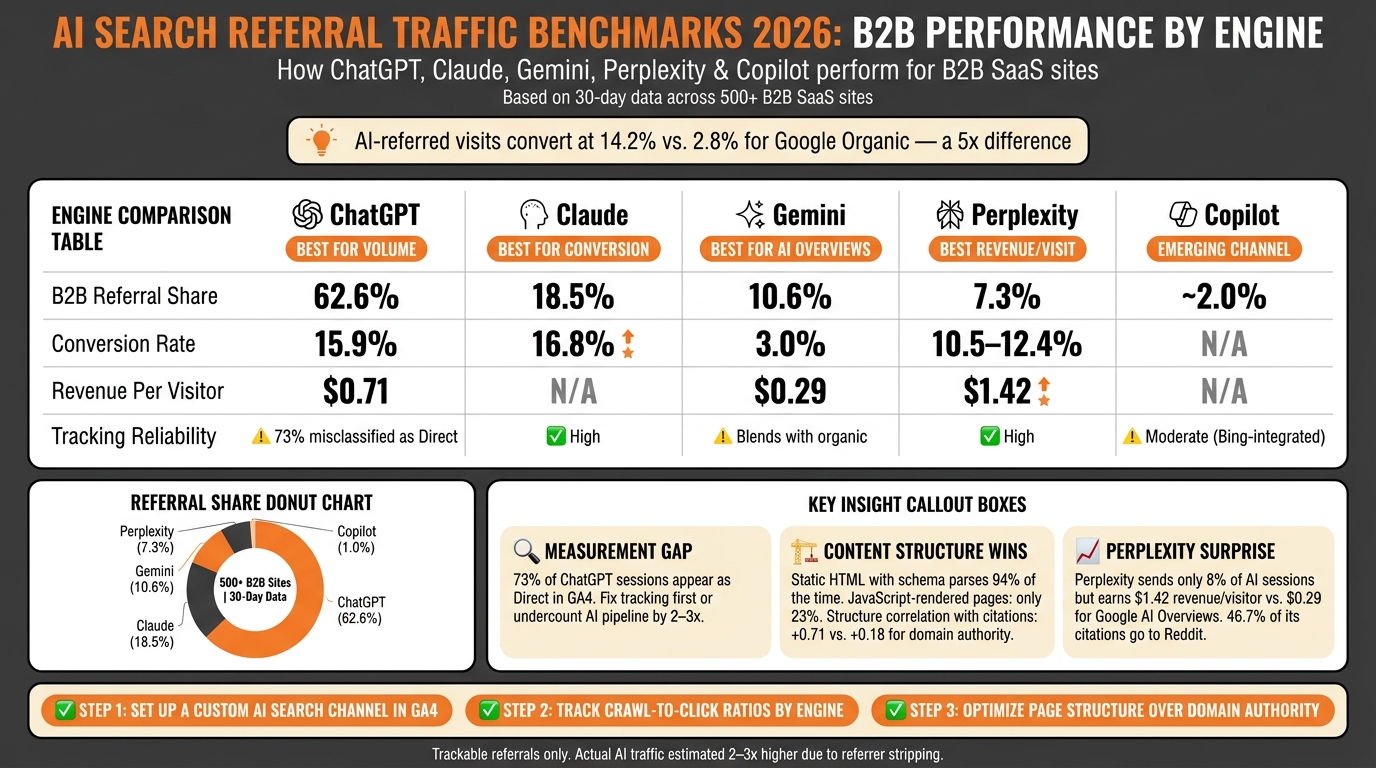
AI Search Engines: B2B Referral Traffic Benchmarks 2026
Quick Comparison
| Engine | Referral Share | Conversion Rate | Revenue Per Visitor | What Stands Out |
|---|---|---|---|---|
| ChatGPT | 62.6% | 15.9% | $0.71 | Highest volume, undercounted in GA4 |
| Claude | 18.5% | 16.8% | N/A | Best conversion rate |
| Gemini | 10.6% | 3.0% | $0.29 | Harder to isolate from Google traffic |
| Perplexity | 7.3% | 10.5% to 12.4% | $1.42 | Best monetization per visit |
| Copilot | 1.0% to ~2.0% | N/A | N/A | Messier attribution through Bing |
In other words, I’d treat AI search as a measurable early-stage acquisition channel, then do two things first:
- set up a custom AI Search channel in GA4
- track crawl-to-click ratios by engine
However, traffic quality also depends on page structure. The article shows that static HTML with schema parsed 94% of the time, while JavaScript-rendered pages parsed only 23%. It also shows that product pages, FAQ markup, and tightly structured pages have a much better shot at earning citations and clicks.
If you want the short version, this benchmark says your team should fix tracking first, then learn how to show up in AI search by tuning content structure.
Overall AI referral traffic share: Which engines sent the most B2B visits
30-day ranking: ChatGPT, Claude, Gemini, Copilot, and Perplexity by referral share
Trackable referrals are heavily concentrated in two engines. Here’s the 30-day split for referral share, conversion rate benchmarks, and revenue per visitor [3][1].
| AI Engine | B2B Referral Share | Conversion Rate | Revenue Per Visitor |
|---|---|---|---|
| ChatGPT | 62.6% | 15.9% | $0.71 |
| Claude | 18.5% | 16.8% | N/A |
| Gemini | 10.6% | 3.0% | $0.29 |
| Perplexity | 7.3% | 10.5% | $1.42 |
| Copilot | 1.0% | N/A | N/A |
By share alone, ChatGPT and Claude drive more than 80% of trackable B2B AI referrals [3]. The rest of the tracked share is split across Gemini, Perplexity, and Copilot.
Claude stands out here. Its referral share jumped from 1.4% to 18.5% in just eight months [3].
There’s one catch. These numbers reflect trackable referrals only, so ChatGPT’s actual share is likely higher.
Referral share tells you who has reach. Crawl-to-click tells you who turns that reach into traffic. In other words, this section shows audience distribution, and the next section looks at which engines convert visibility into clicks.
What the aggregate data says about AI search as a B2B traffic channel
AI search still makes up a small slice of total traffic, but growth is happening fast. More importantly for B2B teams, AI-referred visitors convert at 14.2% on average, versus 2.8% for Google organic [3].
That gap matters more than raw session volume. If you’re on a lean team, you care less about vanity traffic and more about who shows up ready to act.
Most trackable referrals come from ChatGPT and Claude. That’s why the next section drills into ChatGPT, Claude, and Gemini through the lens of click efficiency.
Engine breakdowns: ChatGPT, Claude, and Gemini referral traffic compared
ChatGPT referral traffic for B2B: sessions, landing pages, and click efficiency
ChatGPT sends the most trackable B2B referrals, although GA4 still undercounts them. Raw volume only tells part of the story. Referral efficiency gives you a better read on what matters.
Product pages make up 45.9% of ChatGPT-cited content [3]. In other words, if you want more referral traffic from ChatGPT, start there. Following a proven roadmap for AI search visibility can help accelerate these results. Clean, crawlable product pages tend to win, and the gap is big: static HTML with schema parses 94% of the time, while JavaScript-rendered pages parse only 23% of the time [3].
There’s another catch. Fewer than 1 in 5 brands mentioned in AI answers get cited with a clickable link [7]. That’s where the engine-level differences start to matter, because Claude and Gemini handle this very differently.
Claude vs. Gemini: referral share and crawl-to-click performance
| Metric | Claude | Gemini |
|---|---|---|
| B2B Referral Share | 18.5% [3] | 10.6% [3] |
| Conversion Rate | 16.8% [3] | 3.0% [3] |
| Crawl-to-Click Pattern | Lower volume, stronger clicks [4] | Hard to isolate from organic traffic [4] |
Claude sends fewer sessions than ChatGPT, but the traffic it sends converts at 16.8%, which is the highest of any engine in this dataset [3]. That lines up with how Claude tends to surface deep, expert-led content. The people who click through are often further along and closer to a decision.
Gemini’s 3.0% conversion rate stands out for the opposite reason [3]. However, its tie-in with Google’s broader AI surfaces means that traffic often blends into organic [4]. That makes performance harder to isolate. Pages with FAQPage markup are also 3.2x more likely to show up in Google AI Overviews [3].
AI clicks usually come from users who are already closer to a decision.
Copilot and Perplexity make up the smaller but still measurable long tail.
Copilot and Perplexity: What the remaining engines contribute
Referral volume and click quality for Copilot and Perplexity
Copilot and Perplexity together drive about 10% of measurable B2B AI referrals, but Perplexity pulls a lot more weight per click. If you’re trying to figure out which smaller engines send qualified traffic, this is where things get interesting.
Perplexity punches above its weight. It holds about 7.3% of B2B AI referral share [3] and sends only 8% of total AI sessions [1]. However, its revenue per visitor reaches $1.42, compared with just $0.29 for Google AI Overviews [1]. Its conversion rate lands between 10.5% and 12.4% [3][5]. So yes, Perplexity sends fewer visits than ChatGPT, but those visits convert and monetize better.
Copilot matters less for raw traffic and more for tracking accuracy. Its referral share sits at roughly 2% of sessions [1], and conversion data isn’t cleanly available because its traffic often splits between copilot.microsoft.com and Bing referrers [4].
| Metric | Perplexity | Copilot |
|---|---|---|
| B2B Referral Share | 7.3% [3] | ~2.0% [1] |
| Conversion Rate | 10.5%–12.4% [3][5] | Not specified |
| Citations per Response | 4–8 [2] | 3–6 [2] |
| Tracking Reliability | High – consistent referrer [4] | Moderate – Bing-integrated [4] |
| Primary Ranking Signals | Structure, diversity, verification [2] | Domain authority, multimedia, Bing SEO [2] |
One detail stands out here. Perplexity cites Reddit in 46.7% of responses and listicles in 30.0% [3]. Standard B2B product pages barely show up, with only 0.4% of Perplexity citations going to them [3][7]. In other words, owned product pages alone often won’t get you much visibility in this engine.
That puts measurement accuracy right next to traffic volume in terms of importance.
What these patterns mean for AI search visibility tracking in 2026
Perplexity is the easiest one to track because it consistently passes perplexity.ai. Copilot is messier because traffic often shows up through Bing referrals, so both should sit inside a custom GA4 channel rule.
For Copilot, Microsoft launched a Bing Webmaster Tools AI Performance dashboard in February 2026 [6]. It shows the search phrases Copilot uses to find citations, so it’s worth checking weekly [8].
Reported AI traffic is likely 2-3x higher than what analytics shows, due to referrer stripping in mobile apps and private browsing sessions [5][6]. For B2B teams, the challenge here is simple: count these sessions correctly before you decide where to put time and budget.
Conclusion: What B2B teams should do with these AI traffic benchmarks
These benchmarks make one thing clear: AI search is already driving measurable B2B traffic. However, most teams still miss part of it in their analytics. When many ChatGPT visits show up as Direct, your team ends up making calls from partial data. That puts reporting setup first and content volume second.
The split between engines matters too. ChatGPT leads on volume, Claude leads on conversion, and Perplexity leads on revenue per visitor [1][3][5]. In other words, each engine has its own behavior, its own reporting quirks, and its own content preferences. Treating them as the same will blur what’s working.
Once your reporting is in place, the next step is content structure. Measure AI traffic directly in GA4. Set up a custom "AI Search" channel group in GA4 with an AI referrer regex, so this traffic stops vanishing into Direct and Unassigned. Then track crawl-to-click by engine. That shows you which platforms turn visibility into visits, and which ones just send bots to look around. Without that setup, you can’t report AI traffic the right way.
On the content side, structure matters more than domain authority for AI citation rates. The correlation is +0.71 for structural optimization versus +0.18 for domain authority [3]. That’s a big gap. Pages with strong structure, high quotation density, statistics, and FAQ schema are more likely to earn citations, and those choices can lift visibility by up to 41% [8].
Use these numbers as a starting point, not a one-size-fits-all target. Your own first-party 30-day data is the baseline that counts. Crawl-to-click ratios, landing page mix, and audience intent will shift the results across industries and company sizes. Run your own 30-day baseline, compare engine by engine, and then go after the gaps that show up first.
FAQs
How should I set up GA4 to track AI referrals correctly?
In GA4, set up a custom channel group because AI traffic often lands in Direct or Referral when GA4 classifies it.
Head to Admin → Data Display → Channel Groups and add a channel such as AI Search or AI Referral. Then use a regex that matches the main AI platforms you want to track.
This part matters: place your new channel above the default Referral channel, because GA4 checks rules in order. If you leave it below Referral, GA4 will sort that traffic there first.
However, this only works for visits that pass a referrer. Some AI traffic still won’t send that data, so part of it will continue to show up as Direct.
Which page types are most likely to earn AI citations and clicks?
Pages that pack clear structure and specific data have the best shot at earning AI citations and clicks. It might surprise you to hear that the page type matters quite a bit, too. Product pages get cited most by ChatGPT, while listicles do best on Perplexity and Google’s AI surfaces.
The pages that tend to win usually make the answer easy to find. That means answer-first H2s, structured pricing tiers, technical documentation, and schema like FAQ, HowTo, and Product. In other words, if an AI system can scan the page and pull a clean answer fast, you’re in a much better spot.
There’s also a very practical angle here. Head-to-head competitor comparison sections can increase citation rates by 38%. For a technical founder, that’s a strong signal. If buyers already compare options, your page should help them do it with direct facts, side-by-side detail, and clear tradeoffs.
How can I measure crawl-to-click by engine on my site?
Measure crawl-to-click by splitting bot activity from human traffic. GA4 only tracks sessions that start with a click and referrer data, so it can’t show total crawl volume.
Use server logs to spot AI crawlers like GPTBot or OAI-Searchbot. Then track click-throughs in GA4 with an AI Assistant channel or a custom channel group. Compare those clicks with Search Console’s AI impression report to see the gap between visibility and engagement.
Related Blog Posts
- AI Visibility: 5 Steps to Optimize for AI Search Ranking in 2026
- 7 Powerful Strategies That Improve Brand Visibility in AI Search Engines (with Examples)
- 12 Best GEO Experts in 2026: Don’t Hire a Rebranded SEO Consultant Until You Read This
- AI Search Visibility Benchmarks 2026: Citation Rates & Share of Voice for B2B SaaS