AI visibility is the new SEO for B2B brands. If you’re not showing up in AI-driven search results on tools like ChatGPT or Perplexity, you’re not just losing rankings. You’re losing the entire conversation. For lean teams, three platforms, Scrunch, Otterly, and Limy, offer solutions to track and improve your brand’s presence in AI search.
I’m Lillian Pierson, a fractional CMO and licensed Professional Engineer. I measure my own AI search visibility across 160 URLs, which came to 318,850 citations at last count, per Bing’s AI Performance report. That measurement problem is what these three tools are competing to solve, and they solve different parts of it.
The breakdown:
- Scrunch: Best for mid-market teams needing advanced tools. Tracks 9 AI engines, integrates with GA4, and offers real-time bot crawl logs. Plans start at $250/month.
- Otterly: Ideal for small teams prioritizing accuracy and compliance. Monitors 6 AI engines, offers GEO audits, and starts at just $29/month.
- Limy: Tailored for startups linking AI visibility to revenue. Tracks sentiment and provides optimization actions. Pricing starts at $449/month.
Quick Comparison
| Feature | Scrunch | Otterly | Limy |
|---|---|---|---|
| Setup Time | ~30 seconds | ~8 minutes | Not disclosed |
| AI Engines Tracked | 9 | 6 | 3+ |
| Entry Price | $250/month | $29/month | $449/month |
| Key Strength | Advanced tracking tools | Compliance focus | Revenue attribution |
Which one’s for you?
- Scrunch: Growing teams needing deep insights and technical tools.
- Otterly: Small teams focused on compliance and quick setup.
- Limy: Startups justifying ROI with revenue-linked visibility.
Pick the tool that fits your goals, budget, and growth stage.
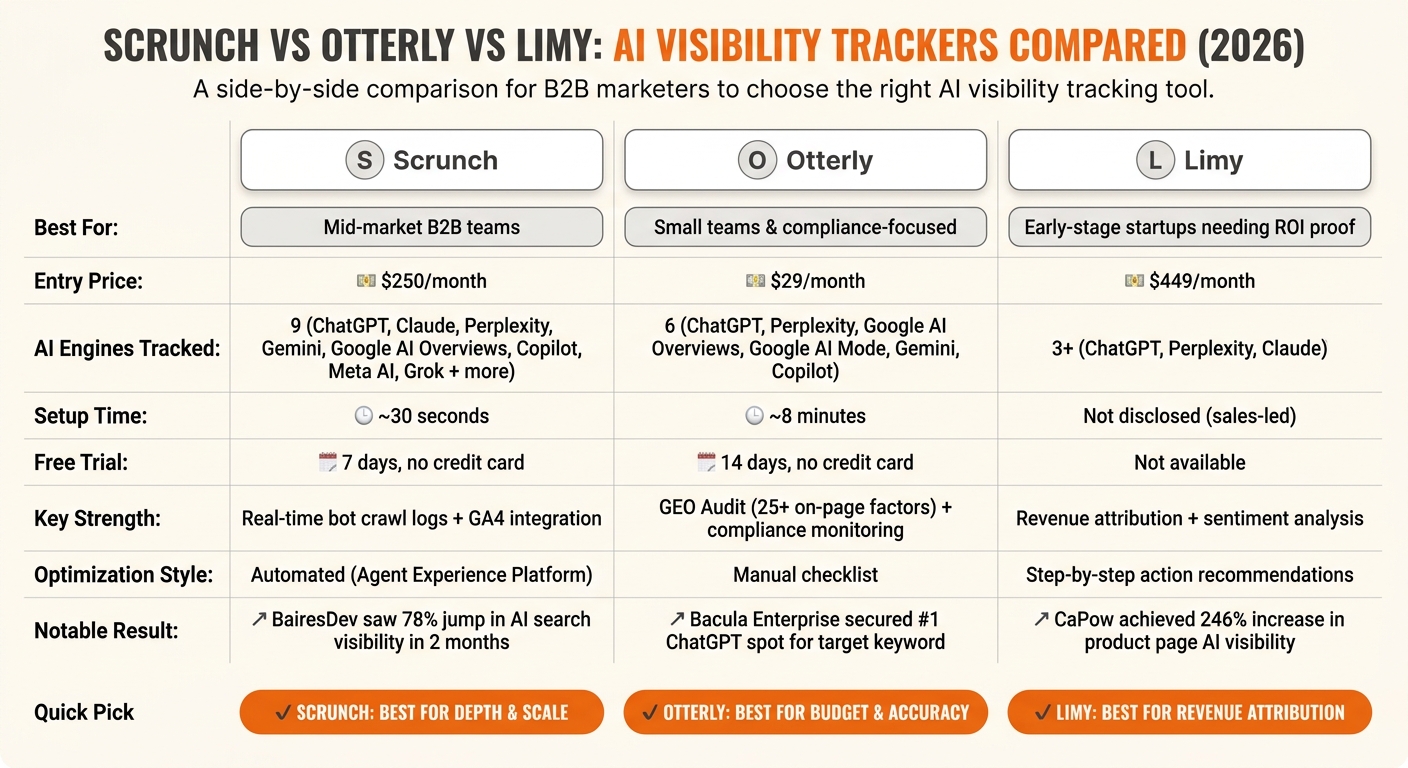
Scrunch vs Otterly vs Limy: AI Visibility Tracker Comparison 2026
Scrunch: Built for Growing Mid-Market B2B Teams
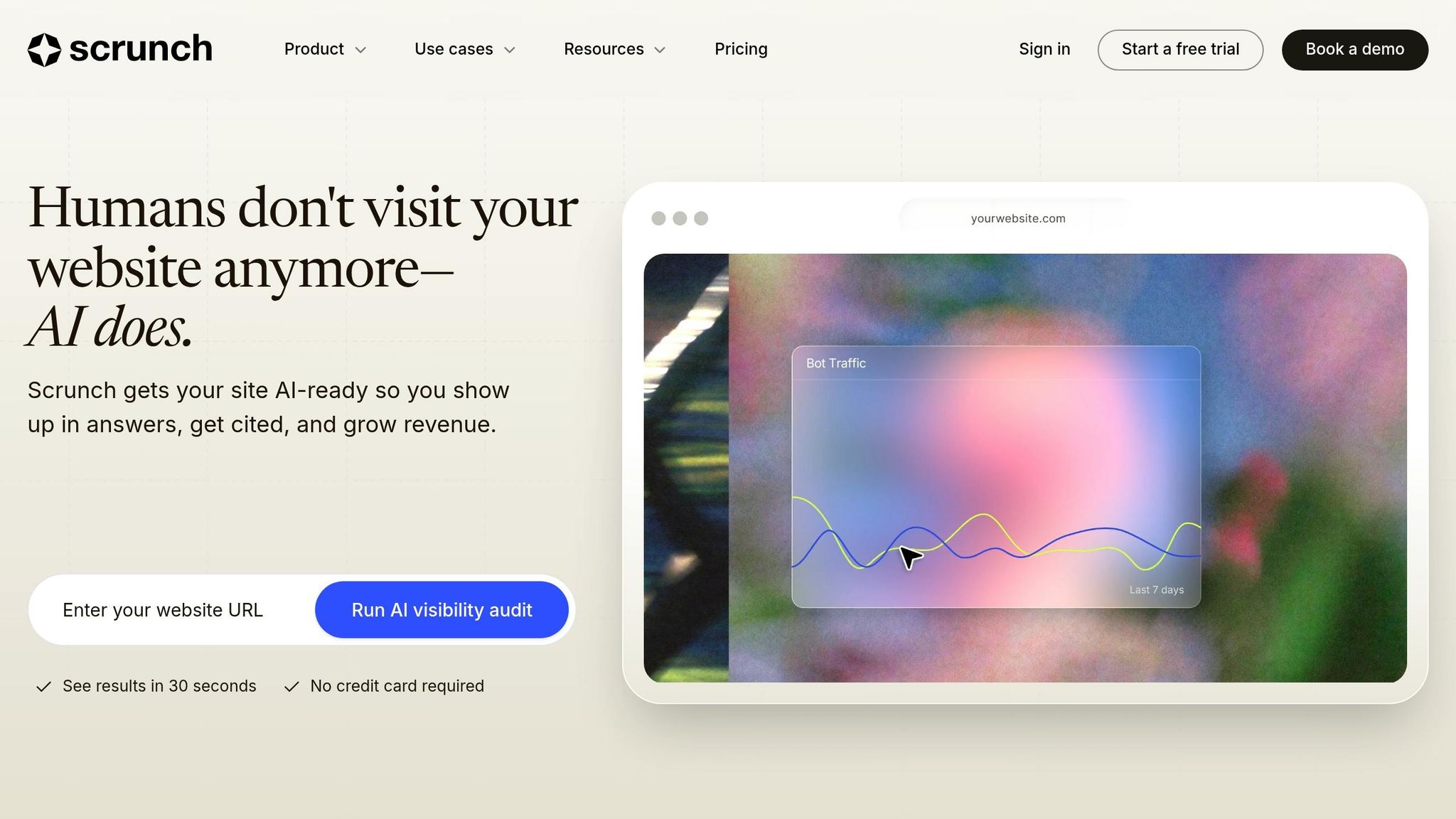
Scrunch is designed for mid-market B2B teams that need more than just basic tracking but don’t want the overwhelming complexity of enterprise solutions. Over 500 companies, including Lenovo, ADP, and Akamai, rely on Scrunch, showing it’s tailored for organizations with substantial infrastructure needs rather than individual marketers experimenting on a smaller scale [6].
Core Features and Use Cases
Scrunch’s Agent Experience Platform (AXP) optimizes your website for AI by creating a streamlined, AI-friendly version. It removes JavaScript and delivers clean HTML/Markdown through Akamai, Cloudflare, and Vercel, ensuring better parsing by large language model (LLM) crawlers [6].
In addition to AXP, Scrunch monitors brand visibility across nine major AI engines, including ChatGPT, Claude, Perplexity, Gemini, Google AI Overviews, Microsoft Copilot, Meta AI, and Grok [6]. Its real-time bot crawl tracking provides detailed insights into when AI crawlers visit your site, what pages they access, and any errors they encounter [3]. This feature helps identify gaps where your content may not be cited.
Companies like Tinybird and BairesDev have seen impressive results with Scrunch. Tinybird reported a 370% increase in web traffic from LLMs and tripled its share of voice for key non-branded prompts in just three months [6]. Similarly, BairesDev experienced a 78% jump in AI search visibility within two months, transforming from virtually invisible to a top-cited brand [6].
"Scrunch helped us unlock visibility, refine our content, and turn AI search into a core part of our acquisition strategy," says Emmett Fear, Growth Lead, Runpod [6]
These features make Scrunch a tool that not only delivers powerful insights but also simplifies the process of using them.
Setup Process and Daily Usability
Scrunch complements its strong feature set with a guided onboarding process that helps teams get started quickly. During setup, the platform automatically generates competitors, personas, and topic suggestions, allowing many users to start collecting data within a single day [6]. Its integration with Google Analytics 4 (GA4) connects AI visibility data to actual referral traffic, making it easier for teams to link insights to revenue [6]. This user-friendly approach aligns with the needs of lean teams by simplifying setup, providing broad query coverage, and offering effective alerting and reporting tools.
The platform’s interface focuses on prompt-level tracking, enabling filtering by persona, funnel stage, and topic. Standard prompts refresh every three days, while newer prompts (less than 14 days old) update daily. For time-sensitive needs, users can trigger instant data collection [1]. However, the Insights section is still in beta and may require manual analysis [8].
Pricing and What You Get for the Cost
Scrunch offers pricing plans that scale with your team’s needs:
| Plan | Monthly Cost | Key Features |
|---|---|---|
| Core / Starter | $250–$300/mo | 125–350 prompts, 4 LLMs, 5 site audits/month |
| Growth | $417–$500/mo | 700 prompts, 5 personas, expanded site audits |
| Enterprise | Custom | Unlimited prompts, 9 LLMs, SSO, dedicated account team |
Each tracked prompt across multiple AI engines uses additional credits [10], so teams monitoring several LLMs should plan their budget accordingly.
Starting at $250 per month, the Core plan provides a solid entry point for growing teams that need deeper insights than basic tracking can offer. Features like GA4 integration, which ties AI visibility to revenue, add an extra layer of value by supporting ROI-focused reporting. Scrunch has earned a 4.7/5 rating on G2 [6], with users highlighting its detailed monitoring and persona-based filtering. However, one limitation is that while Scrunch identifies content gaps, it doesn’t generate the content to fill them, meaning teams will need a separate workflow to act on these insights [9][11].
Otterly: Compliance-Focused Tracking for Small Teams
Otterly stands out as a budget-friendly, compliance-driven solution tailored for smaller teams. While Scrunch emphasizes optimization and content delivery, Otterly zeroes in on monitoring accuracy and catching factual errors early. With over 20,000 marketing professionals relying on it and recognition as a Gartner Cool Vendor in 2025 [6], Otterly has become a go-to for small B2B teams seeking precise, diagnostic-level insights. These insights are critical for teams looking to optimize AI brand visibility across emerging search engines.
Key Features and What Makes Otterly Different
One of Otterly’s most notable tools is its GEO (Generative Engine Optimization) Audit, which examines over 25 on-page factors such as technical crawlability, structured data, content depth, and E-E-A-T signals. This audit helps pinpoint why a brand isn’t appearing in AI-generated content, offering insights that go beyond simply identifying whether your brand is mentioned [4][5].
"Otterly’s GEO audits analyze 25+ on-page factors that influence AI model perception. Most tools tell you whether you’re mentioned. Otterly tells you why you’re not," says Alexandre Rastello, CEO of Mentionable [1]
In addition to diagnostics, Otterly monitors brand mentions across six major AI platforms: ChatGPT, Perplexity, Google AI Overviews, Google AI Mode, Gemini, and Microsoft Copilot [13][15]. Each mention is classified as positive, neutral, or negative, making it especially helpful for compliance-sensitive teams. If an AI platform misrepresents your product or includes disclaimers, Otterly flags these issues for further investigation [12].
The platform also tracks URL citations weekly across AI search engines, logging position changes over time. This feature helps teams quickly identify outdated or missing references that could harm brand credibility [12].
For example, Bacula Enterprise, a specialized B2B tech company, used Otterly to secure the top spot in ChatGPT results for "best HPC backup software." By focusing on optimizing for AI search ranking through structured content and prompt-led strategies, they dominated this highly specific but valuable search result [12][14].
Otterly pairs this robust feature set with an easy setup process, making it accessible even for non-technical users.
How Simple Is Otterly to Set Up?
Otterly’s setup process is quick and intuitive, involving just four steps to identify niches, search prompts, and competitors based on your URL or SEO keywords [15][16]. Most teams can start monitoring within an hour [13][17].
"As a Content Strategist, generative search was a major blind spot for our team. With Otterly, that fear disappeared almost immediately. The time-to-value was amazing; I was monitoring our first set of brand and product-specific triggers within one hour," says Alex B, Content Strategist [17][18]
For teams preparing board-level reports, a practical tip is to manually validate Otterly’s data using incognito mode and a VPN. This method helps avoid "Memory RAG", a personalization bias that can skew AI results compared to what a neutral buyer might see [13].
Otterly’s Pricing for Smaller Budgets
Otterly’s pricing is designed with smaller teams in mind. Its Lite plan starts at just $29/month, making it about 8.6 times cheaper than Scrunch’s entry-level tier [4][5]. For marketing teams, the Standard plan at $189/month provides access to 100 prompts and unlimited workspaces [13][15].
| Plan | Monthly Cost | Prompts | Best For |
|---|---|---|---|
| Lite | $29/month | 15 | Basic brand query testing |
| Standard | $189/month | 100 | Marketing teams, full platform access |
| Premium | $489/month | 400 | Larger orgs, 10,000 AEO URL audits/month |
| Enterprise | Custom | Unlimited | SSO, quarterly GEO Health Checks |
Additional tracking for Gemini and Google AI Mode is available as a paid add-on, with costs ranging from $9 to $149/month depending on the plan [1]. A 14-day free trial is also available, no credit card required [12][13].
It’s worth noting that while Otterly excels in diagnostics, users will need a separate workflow to address any issues identified.
Limy: Low-Cost Tracking for Early-Stage Startups
For startups on a tight budget but looking for effective AI tracking, Limy offers a fresh perspective. Launched in 2025, Limy was designed for a world where AI agents make purchasing decisions for humans. Positioned as a B2A (Business-to-Agent) platform, its goal is twofold: to ensure your brand is visible to AI models by using strategies to improve brand visibility in AI search engines and to help you understand how those models perceive and recommend your brand [19]. Limy rounds out our trio of AI visibility trackers as the most streamlined option for startups.
Features and Supported Platforms
Limy monitors brand mentions and rankings on platforms like ChatGPT, Perplexity, and Claude [19]. But it doesn’t stop at basic tracking. It offers prompt-level analytics, showing which queries trigger your brand, how your ranking shifts over time, and how mentions vary by category. Additionally, it tracks sentiment and narrative framing, helping you determine if AI models position your brand as high-end or budget-friendly [19].
One of its standout tools is Limy Analytics, which connects AI visibility to real-world user behavior, conversions, and revenue. This feature, launched in December 2025, allows companies like the travel brand Alta to directly link AI mentions to actions like visits to pricing pages or product comparisons. For startups needing to justify their spend to investors, this kind of revenue attribution for B2B is invaluable [19]. Despite its advanced capabilities, Limy is built for ease of use, making it a great fit for lean teams.
Setup and Reporting for Teams with Limited Bandwidth
Getting started with Limy is simple. It uses a lightweight tracking pixel, installed via Google Tag Manager (GTM), so there’s no need for developer support. Once the pixel is live, Limy automatically identifies AI crawlers and populates its dashboard. With no ongoing maintenance required, it’s perfect for small marketing teams of just one or two people [20].
"Limy helps companies understand how AI models perceive their brand, which pages AI bots visit, and how their information is being used to answer user prompts across AI search engines," says Limy.ai [20]
For teams without SEO experts, Limy goes a step further by offering actionable optimization steps. Instead of leaving users to interpret raw data, it provides clear instructions on improving visibility [19].
Limy’s Pricing and Fit for Small Teams
While Limy is marketed as a budget-friendly option, its pricing reflects its robust feature set. The Basic plan starts at $449/month, which includes 200 prompts, coverage for 2 regions and 2 languages, 1 domain, and 8 optimization recommendations per month [19]. However, there’s no free trial available [19]. Compared to its competitors, this plan costs about 80% more than Scrunch’s entry-level tier and is 15 times the price of Otterly’s Lite plan [19]. That said, features like revenue attribution and prescriptive recommendations make it ideal for startups with some budget to spare and a need to demonstrate ROI.
| Plan | Monthly Cost | Prompts | Key Inclusions |
|---|---|---|---|
| Basic | $449/month | 200 | 2 regions, 2 languages, 1 domain, 8 optimization actions/month |
| Enterprise | Custom | Unlimited | Multiple domains, dedicated onboarding |
For example, the robotics energy company CaPow used Limy to track and enhance its AI presence, leading to a 246% increase in visibility for individual product pages in AI search results [19].
Next, we’ll dive into a comparison of setup time, query coverage, and alerting features across all three platforms.
Scrunch vs Otterly vs Limy: Side-by-Side Comparison
Let’s break down how Scrunch, Otterly, and Limy stack up in terms of setup, query coverage, alerting, reporting, and cost.
Setup Time and Query Coverage
The setup process is where these platforms start to diverge. Scrunch leads the pack with an impressively fast initial report, delivered in about 30 seconds, and it doesn’t require a credit card [3]. Otterly isn’t far behind, as detailed by Shripad Deshmukh of LLMClicks.ai:
"Creating my account and setting up tracking [on Otterly] took 8 minutes. You enter your brand name, select LLMs to monitor, and start getting reports." [21]
Limy, however, relies on a sales-led onboarding process with unclear trial terms, which can slow down the time to first insights [3].
| Scrunch | Otterly | Limy | |
|---|---|---|---|
| Setup Time | ~30 seconds (free report) | ~8 minutes | Not disclosed (sales-led) |
| Free Trial | 7 days, no credit card | 14 days | Not specified |
| AI Models Tracked | 9 (incl. Grok, Meta AI) | 6 (some as paid add-ons) | 3+ |
| Entry-Level Prompts | 350 | 15 | 200 |
Alerting, Reporting, and Monthly Cost
Scrunch stands out with its real-time AI bot crawl logs, giving teams the ability to see when ChatGPT or Perplexity bots visit their site and whether they encounter indexing issues [3][5]. It also connects to GA4, linking AI visibility to referral traffic [1]. Otterly offers polished dashboards and Looker Studio connectors, but its focus is more on monitoring rather than technical diagnostics [2][5]. Limy emphasizes sentiment analysis and revenue attribution using its own tracking system, though its methods aren’t fully transparent [3][4].
When it comes to pricing, Otterly is the most affordable at $29/month. Scrunch starts at $250/month (billed annually), while Limy begins at $449/month [3][4][5].
| Scrunch | Otterly | Limy | |
|---|---|---|---|
| Entry Price | $250/mo (annual) | $29/mo | $449/mo |
| Real-Time Crawl Logs | Yes | No | No |
| GA4 Integration | Yes | No | No (internal attribution) |
| Sentiment Analysis | Enterprise only | No | Yes |
| Optimization Style | Automated (AXP) | Manual checklist | Step-by-step actions |
Strengths and Trade-Offs for Lean Teams
Each platform caters to different needs. Scrunch provides the most robust technical tools, including bot crawl logs, persona-based tracking, and its Agent Experience Platform (AXP), which serves AI-optimized site versions directly to bots. However, this level of depth comes with higher costs and a more intricate setup [3][6]. For teams serious about using AI search as a growth strategy, Scrunch is an excellent choice.
Otterly is the easiest to get started with. Its GEO Audit tool reviews over 25 on-page factors to flag citation blockers, and the 14-day free trial offers a low-risk way to test the waters [4]. That said, it doesn’t provide the technical insights needed to understand why AI bots might not index your content, and its lower-tier plans come with strict prompt limits.
Limy offers more advanced features than Otterly, particularly in revenue attribution and sentiment tracking. However, it’s pricier and harder to evaluate without going through its sales process. For startups needing to showcase ROI to stakeholders, Limy’s attribution tools can justify the investment. That said, it’s less ideal for teams seeking simple monitoring solutions.
Which Tool Should Your Team Use?
Choosing the right tracker depends on your team’s growth stage, budget, and specific needs. A quick guide to help you decide:
Best for Scaling Mid-Market Teams: Scrunch
If your team has moved past the startup phase and relies heavily on AI search for growth, Scrunch is an excellent choice. It stands out for its simple setup, broad query coverage, and integration with GA4 for traffic attribution. Scrunch supports over seven AI engines, including Grok and Claude, making it a versatile option [3]. At $250/month (billed annually), it’s a strategic investment for teams prioritizing AI visibility. However, if compliance and quick implementation are more critical, you might want to explore Otterly.
Best for Startups Needing Stringent Citation Accuracy: Otterly
For startups focused on ensuring their brand appears accurately in AI-generated answers, Otterly is a smart pick. Its GEO Audit tool evaluates over 25 on-page factors to identify citation issues across six major AI engines, including Google AI Overviews and Microsoft Copilot [17]. With a starting price of $29/month and a 14-day free trial, Otterly offers a cost-effective way for lean teams, especially in regulated industries, to maintain brand accuracy and credibility.
Best for Early-Stage Startups on a Tight Budget: Limy
If you’re just starting out and need to link AI visibility directly to revenue, Limy has you covered. It offers features like sentiment analysis, revenue attribution, and actionable optimization steps, making it ideal for teams without dedicated analysts [4]. Priced at $449/month, Limy provides deep reporting and optimization tools. That said, early-stage startups might find Otterly’s lower-cost entry point a better fit until they can justify the higher investment with proven ROI.
For more support, check out our fractional CMO and growth marketing services at Data-Mania. We’ll help turn your visibility insights into actionable strategies.
Conclusion: Picking the Right AI Visibility Tracker for Your Team
Finding the right tool comes down to your team’s current needs, budget, and goals. Throughout this article, we’ve explored key factors like ease of setup, query coverage, alerting, and reporting. For solo marketers or small teams just starting out, Otterly is a budget-friendly choice at $29 per month, offering a simple way to establish AI visibility. If you’re part of a growing mid-market team needing more technical features, Scrunch delivers advanced tools like real-time bot crawl logs, GA4 integration, and compatibility with over seven LLMs for $250 per month. For teams focused on connecting AI visibility to revenue and justifying the investment to leadership, Limy at $449 per month is the go-to option.
Both Scrunch and Otterly provide free trials, so you can test the waters before committing. If you’re unsure where to begin, starting with Otterly can help you identify gaps in your AI visibility strategy. From there, you can decide if Scrunch’s advanced optimization tools are worth the upgrade.
Early adopters of these tools are already seeing measurable improvements in AI-driven visibility.
"Waiting for perfect data means missing the opportunity to shape how AI platforms talk about your brand right now, and that’s a risk no forward-thinking marketer can afford to take," says Maddy Osman, Founder, The Blogsmith [7]
Need help turning visibility insights into growth? Check out Data-Mania for fractional CMO vs. growth marketing services tailored to B2B tech teams.
FAQs
How do I choose prompts to track?
To select the right prompts, zero in on keywords, questions, or topics that resonate with your brand or industry. Think about the core questions your audience might ask, whether they’re about your products, services, or specific industry jargon. Keep an eye on AI visibility trends to identify which prompts are gaining traction, and prioritize those that align with your business objectives. It’s also important to revisit and refresh your prompt choices regularly to stay relevant and ensure your brand remains prominent in AI-generated responses.
How can I prove AI visibility drives revenue?
To demonstrate how AI visibility contributes to revenue, tie increased visibility in AI-driven searches directly to tangible results like lead generation, conversions, or sales. Keep an eye on metrics such as brand mentions, citations, and sentiment across various AI platforms. By consistently tracking your AI presence, refining content for better AI recognition, and connecting visibility to measurable outcomes like engagement or sales, you can create a solid, data-backed argument that AI visibility plays a role in driving revenue growth.
What should I fix first if AI tools misquote my product?
To improve how AI systems reference your product, begin by refining the accuracy and structure of your content. Make sure that essential details are clear, relevant, and easy to understand. This ensures AI can cite your information correctly and reduces the risk of misrepresentation.
Leverage tools designed for content gap analysis and optimization recommendations to pinpoint areas where your content might be lacking or unclear. These tools can help you address visibility issues that may be affecting how your product is perceived or cited.
Keep in mind, simply monitoring for errors won’t solve problems like misquotations. Instead, focus on proactive content optimization to minimize inaccuracies in how AI systems interpret and present your product information.
Related Blog Posts
- AI Search Visibility Tools & Metrics: What to Buy (and the Metrics That Actually Matter)
- 20 Best AI Search Visibility Tools (2026): Free & Paid, Ranked
- Top 15 AI SEO Tools for Improving Visibility in ChatGPT, Perplexity, and Google
- Profound vs BrightEdge vs Scrunch: AI Search Visibility Platforms Compared (2026)