Last updated: September 23, 2026. Citations concentrate hard. My top four pages carried 64.3% of every citation this site earned over the trailing three months, out of 318,850 across 160 URLs in Bing’s AI Performance report. Working out which pages those are is the job of the platforms below, and I show the full breakdown in my Semrush AI Search Health audit.
My comparisons of the AI search visibility platforms get cited across ChatGPT, Claude, and Gemini, so I’ll give you a straight read on Profound, BrightEdge, and Scrunch below. These tools all promise to show you how visible your brand is in AI answers, and each one measures it in a different way. I’ll walk you through what each does well, where it falls short, and which one fits your stage.
Key Takeaways:
- Profound: Best for enterprise teams needing raw data, API integrations, and custom dashboards. Tracks over 10 AI models and offers SOC 2 compliance. Pricing starts at $99/month.
- BrightEdge: Ideal for large organizations already using its SEO platform. Combines AI and SEO tracking but focuses mainly on Google AI Overviews. Custom pricing starts at $25,000/year.
- Scrunch: Mid-market option for teams optimizing content for AI bots. Covers 9 AI engines and offers persona-based tracking. Pricing starts at $250/month.
Quick Comparison:
| Feature | Profound | BrightEdge | Scrunch |
|---|---|---|---|
| Best For | Enterprise BI teams | Large SEO-focused teams | Mid-market growth teams |
| AI Model Coverage | 10+ (e.g., ChatGPT, Claude) | Limited (Google AI, ChatGPT) | 9 (e.g., ChatGPT, Claude) |
| Starting Price | $99/month | $25,000/year | $250/month |
| Setup Time | 2–4 weeks | Long (custom onboarding) | 1–2 weeks |
| Unique Feature | Raw data & API access | SEO + AI integration | Optimized content delivery |
Each platform has strengths depending on your goals. Profound is for data-heavy enterprises, BrightEdge integrates AI with SEO workflows, and Scrunch offers a cost-effective solution for mid-market teams. The right choice depends on your team’s structure, budget, and focus.
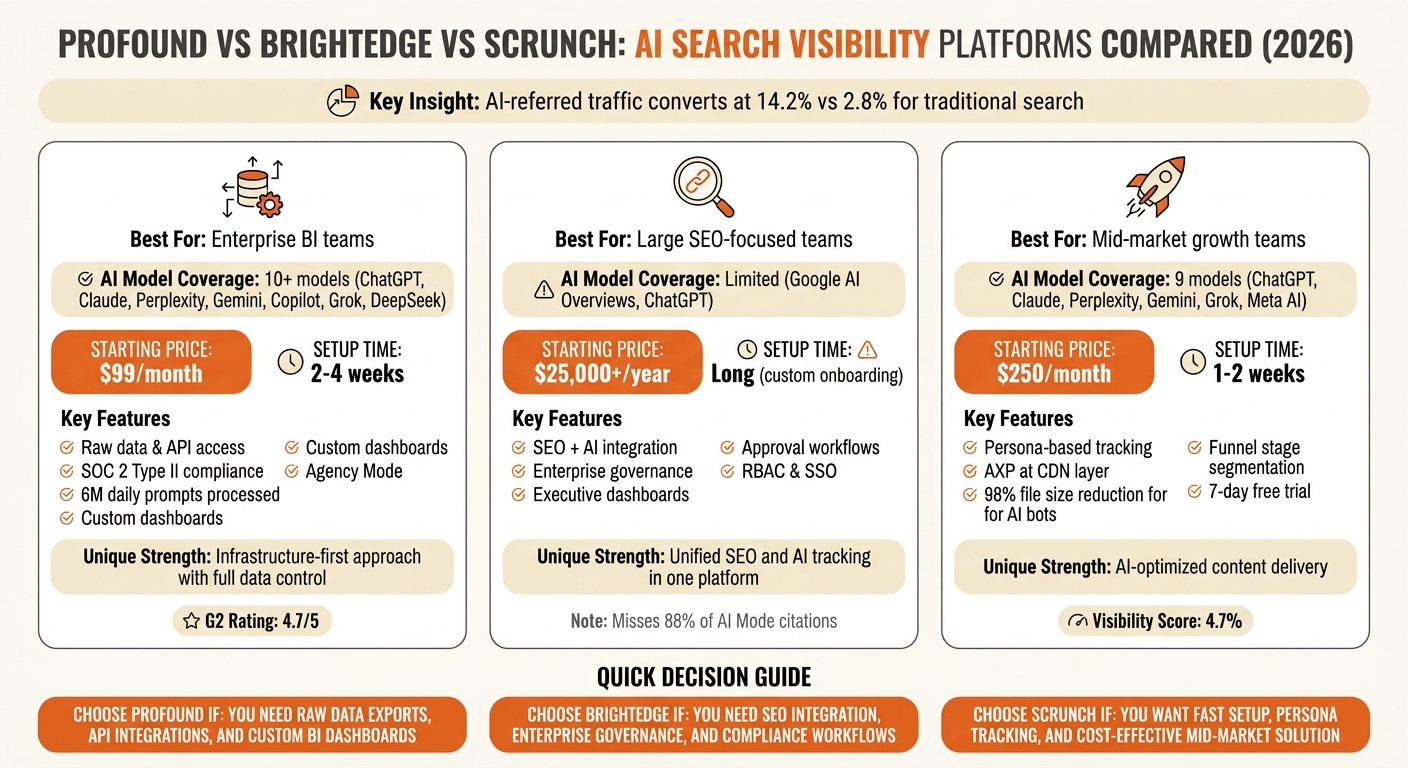
Profound vs BrightEdge vs Scrunch: AI Search Visibility Platform Comparison 2026
My AI search visibility comparisons are cited more than 50,000 times across AI answers, and I’ve been landing 5-figure clients from AI search since 2025, so this comes from work I do every week.
I’d have you get clear on one thing before you buy any of these. The tool that fits you depends on who is using it and why. An agency that’s tracking dozens of client brands needs different coverage than an in-house team watching one. An early-stage startup mostly needs to know whether it shows up at all yet. Pick the tool that answers the question you actually have right now, and you’ll get far more out of it than the one with the longest feature list.
AI Search Visibility Tools You Should Be Using in 2026
Profound: Enterprise Brand Intelligence Platform
Profound is a monitoring platform designed for enterprise teams that need in-depth analytics and control over their infrastructure. It tracks over 10 models, including ChatGPT, Perplexity, Claude, Gemini, Copilot, Grok, and DeepSeek [7], and processes more than 15 million prompts daily to analyze brand mentions and sentiment [12]. By providing raw data, Profound enables analyst teams to create custom reports and integrate AI visibility metrics directly into existing BI tools.
What makes Profound stand out is its infrastructure-first approach. The platform offers full API access and raw data exports, making it easy for BI teams to connect AI visibility metrics to tools like Tableau or Looker [3]. It also meets enterprise-grade standards with SOC 2 Type II certification and SSO support (SAML, OIDC) [13], which are critical for Fortune 100 companies. For instance, One Identity, a cybersecurity firm, boosted its AI search visibility by 30% in just one quarter and doubled its share of non-branded mentions using Profound [12].
Core Features and Functions
Profound excels in tracking unlinked citations and performing advanced sentiment analysis. It identifies brand mentions even when no direct link is provided and categorizes them as positive, negative, or neutral. It also interprets specific brand positioning, such as whether AI models describe your business as “best for enterprise” or “most affordable” [10]. The platform includes Agent Analytics, which monitors how AI agents interact with your brand [3], and it earned a score of 92/100 in the 2026 Answer Engine Optimization framework, the highest among evaluated platforms [14].
Other key features include:
- Prompt difficulty scoring to assess how AI models handle complex queries
- Share-of-voice measurement to track your brand’s visibility compared to competitors
- Agency Mode, which simplifies managing multiple client accounts [14]
However, Profound focuses purely on monitoring. It does not generate content to fill visibility gaps, meaning teams need separate tools for content creation [1].
"Profound is the strongest pure-monitoring alternative for enterprise, with granular keyword/entity control and executive dashboards." according to the AI Search Tools Guide [1]
These features make it a robust option for enterprise teams looking for scalable integration.
Setup Timeline and Cost Structure
Setting up Profound typically takes between 2 to 4 weeks, depending on the complexity of the brand hierarchy and integration needs [14]. The platform offers tiered pricing:
- Starter Plan: $99/month, covering ChatGPT monitoring only
- Growth Plan: $399/month, including ChatGPT, Perplexity, and Google AI Overviews
- Enterprise Plan: Starting at $1,500/month for full access to all supported models, API features, and dedicated support [3]
Enterprise accounts also come with a dedicated AI search strategist and priority support via Slack or email [13]. The platform integrates seamlessly with major CDNs like Cloudflare, Akamai, Amazon CloudFront, and Fastly, ensuring secure data handling [13]. Profound’s $35 million Series B funding in August 2025, led by Sequoia Capital, underscores its commitment to scaling enterprise infrastructure [12].
Best-Fit Customer Profile
Profound is tailored for large B2B SaaS enterprises with dedicated analyst teams that report AI visibility metrics to leadership but already use separate tools for content creation [1]. It’s especially suitable for organizations requiring SOC 2 compliance, SSO integration, and raw data export capabilities for custom dashboards. Agencies managing multiple client accounts will also benefit from features like Agency Mode and advanced brand configuration tools [7].
That said, smaller teams or companies without in-house analysts might find the platform’s focus on raw data and infrastructure too complex. If your organization needs built-in content generation or a more action-oriented workflow, another solution might be a better fit.
BrightEdge: SEO Platform with AI Search Tracking
BrightEdge takes a unique approach by folding AI tracking into its well-established SEO workflows. Instead of treating AI search tracking as a standalone feature, it builds on its existing SEO framework, offering users a unified view of both traditional search and AI-generated response visibility. The AI Catalyst feature blends AI tracking with BrightEdge’s traditional SERP monitoring, allowing teams to manage both data types within a single platform. This approach minimizes the need for multiple tools, though it may come at the cost of more specialized AI tracking capabilities [1][4].
The platform primarily focuses on Google AI Overviews (formerly SGE) rather than casting a wide net across various large language models. AI Catalyst integrates seamlessly with BrightEdge’s core tools like ContentIQ for site audits, Data Cube for keyword research, and Share of Voice reporting. This integration appeals to Fortune 500 marketing teams managing large-scale organic search operations [5].
Core Features and Functions
BrightEdge shines in areas like executive reporting and workflow integration. It offers automated alerts and executive dashboards that simplify the process of communicating AI search performance to leadership. Additionally, its enterprise-grade API allows businesses to incorporate AI visibility metrics into their existing reporting systems [1][5].
However, the platform has limitations when it comes to AI-specific features. For instance, it lacks tools like AI crawler logs, tracking for platforms such as Reddit or YouTube, and built-in content generation. BrightEdge also uses a fixed prompt methodology in some areas, which restricts its ability to capture the full range of AI model responses. Furthermore, it does not include an "action loop" feature to directly link gap analysis with content creation [4].
Setup Timeline and Cost Structure
BrightEdge’s setup process aligns with its integrated feature set, designed for enterprise use. The platform operates on a custom pricing model, with annual contracts starting at $25,000 or more. Pricing is not publicly disclosed, and onboarding requires a sales conversation. There’s no free trial. You must schedule a demo for evaluation. Access to AI features often depends on existing SEO contracts, meaning users must commit to the full platform to unlock these capabilities [7].
This high entry cost and setup complexity make BrightEdge less ideal for smaller teams or those lacking an existing vendor relationship. The platform is built for large-scale operations, capable of managing thousands of keywords and supporting complex technical SEO needs for Fortune 500 companies [4].
Best-Fit Customer Profile
BrightEdge is tailored to large enterprises already using its SEO platform and looking to integrate AI visibility into their existing workflows. It’s particularly effective for organizations managing large, multi-stakeholder websites with 50,000+ pages that require features like robust security, single sign-on, and role-based access controls. Companies prioritizing unified reporting over detailed AI tracking will find this platform a good fit.
On the other hand, smaller teams or businesses seeking a dedicated AI visibility tool may find BrightEdge too costly and complex. Additionally, organizations needing deeper insights into multiple AI models might need to supplement BrightEdge with other tools.
Next, we’ll explore how Scrunch addresses AI visibility for mid-market organizations.
Scrunch: Mid-Market AI Visibility Tool
Scrunch is designed for mid-market teams looking for an affordable way to track how to rank in AI search results and how agents represent their brands during B2B buying processes. Covering nine major AI engines, including ChatGPT, Perplexity, Claude, Gemini, Grok, and Meta AI, it offers broad large language model (LLM) coverage [2][16].
One of its standout features is its AXP capability, which serves AI-optimized content directly to crawlers at the CDN layer. This reduces page file size for AI bots by up to 98%, for instance, shrinking a page from 263,220 bytes to just 4,578 bytes. The result is content that’s easier for AI models to process [17]. However, some experts warn that delivering different content to bots versus humans could resemble "cloaking", which might pose risks to traditional SEO rankings [15].
Core Features and Functions
Scrunch is built for teams with mature content libraries, offering tools like citation tracking, competitive analysis, and content audits. It also provides persona-based tracking that differentiates between buyer roles (e.g., CTO vs. Developer) and segments funnel stages into Awareness, Consideration, and Decision phases [17]. Additionally, its AI Search Trends feature analyzes over 1,500 curated topics to identify content gaps and optimization opportunities.
The platform is particularly effective for companies with JavaScript-heavy sites or slow render times that can hinder AI bot crawling. By delivering streamlined page versions to AI agents, Scrunch addresses these challenges head-on. It’s already used by over 500 organizations, including names like Lenovo, Skims, Penn State, and Crunchbase [2].
That said, Scrunch does have some gaps. It lacks built-in AI content generation tools, AI crawler logs, and tracking for platforms like Reddit or YouTube, features some competitors include [17][18].
"Scrunch fits teams that need operational monitoring, persona-level segmentation, and technical delivery optimization for existing content."
- Shubha D., Co-founder, RankSaver [17]
While its features emphasize operational efficiency, Scrunch’s benchmark performance highlights its mid-market focus. In a September 2025 visibility study, it ranked #23 with a 4.7% visibility score, far below enterprise platforms like Profound, which scored 47.1% [2][15]. This suggests Scrunch is better suited for teams prioritizing cost savings over maximum visibility.
Setup Timeline and Cost Structure
Scrunch offers a quick setup process with transparent pricing and a 7-day free trial. Its Starter Plan costs $250 per month (billed annually) and includes 350 custom prompts across three AI models. The Growth Plan costs $500 per month with monthly billing or $417 per month when billed annually, covering 700 custom prompts across nine platforms [16]. Additional seats are available for $25 per month [17].
Compared to enterprise platforms like Profound, which start at $1,000–$3,000 per month, Scrunch’s entry costs are 4–10 times lower [2]. At the Growth tier, Scrunch costs about $62.50 per monitored engine, roughly half the $133 per engine cost of enterprise competitors [2]. Setup typically takes 1–2 weeks, much faster than the longer onboarding times of enterprise solutions [2].
Despite its mid-market focus, Scrunch doesn’t skimp on security, offering SOC 2 Type II compliance, SSO, and RBAC [11][9].
Best-Fit Customer Profile
Scrunch is ideal for mid-market B2B SaaS firms with established content libraries that want to optimize pages for AI agents. It’s especially effective for demand generation and growth teams needing persona-based tracking and funnel-stage segmentation. Companies facing technical challenges with AI bot crawling will also benefit from Scrunch’s streamlined page delivery [17].
Agencies can take advantage of its flexible seat pricing and multi-client monitoring, while content teams will appreciate its topic-focused analysis at a lower price point [2][6]. On the flip side, teams requiring built-in content generation, detailed AI crawler logs, or tracking for platforms like Reddit and YouTube may need supplemental tools. For organizations seeking maximum AI visibility, Scrunch’s 4.7% benchmark score might fall short, and the potential SEO risks of its AXP approach should be carefully considered [15].
Next, we’ll dive into a side-by-side comparison of all three platforms to see how they stack up for B2B SaaS teams.
Platform Comparison: Profound vs BrightEdge vs Scrunch
Evaluation Criteria Breakdown
This section dives into a direct comparison of three platforms, Profound, BrightEdge, and Scrunch, focusing on metrics that matter most to B2B SaaS teams.
Each platform takes a distinct approach to AI search visibility. Profound processes an impressive 6 million daily prompts across more than 10 AI engines, analyzing over 400 million conversations. It stands out by offering raw data and API access, enabling teams to create custom dashboards [9]. BrightEdge, on the other hand, integrates AI citation tracking into SEO workflows but misses 88% of AI Mode citations due to its reliance on SERP data [9]. Scrunch finds middle ground by focusing on visibility tracking and delivering optimized content directly to AI crawlers at the CDN layer.
When it comes to citation tracking, Profound captures both unlinked and implied brand mentions that traditional crawlers often overlook [19]. It uses autonomous agents to identify the prompts responsible for generating citations [16]. Scrunch emphasizes error detection to ensure accurate brand representation in AI models [20], while also segmenting visibility by buyer persona (e.g., CTOs versus Developers) and funnel stage [21]. BrightEdge prioritizes governance and board-level reporting, but its SERP-dependent method results in significant gaps in conversational AI citation coverage [9].
"Profound excels at infrastructure-level control with APIs and raw data access, making it ideal for analyst-driven BI teams building custom reporting." according to Toolsolved [3]
The platforms also differ in terms of implementation timelines and pricing. Scrunch offers the fastest setup at 1–2 weeks, with pricing starting at $250/month. Profound requires 2–4 weeks for implementation, with plans starting at $99/month for the Starter package and scaling to custom pricing for enterprise needs. BrightEdge, however, involves a lengthy onboarding process and annual contracts that range from $30,000 to over $150,000 [9] [16].
This comparison highlights the unique strengths of each platform, helping you determine which one aligns best with your goals.
Side-by-Side Comparison Table
| Feature | Profound | BrightEdge | Scrunch |
|---|---|---|---|
| Target Market | Enterprise / Fortune 500 | Large Enterprise SEO Teams | Mid-market to Enterprise |
| LLM Coverage | 10+ (e.g., ChatGPT, Perplexity) | Major platforms (Google AIO, ChatGPT) | 4–9 (e.g., ChatGPT, Claude) |
| Citation Depth | Unlinked & implied mentions; Citation Authority Scoring | Integrated with SEO data (SERP-dependent) | Persona & funnel segmentation; error detection |
| Unique Capability | Autonomous AI Agents (content drafting, gap analysis) | Governance & approval workflows | Agent Experience Platform (AXP) at CDN layer |
| Setup Time | 2–4 weeks | Long (annual contracts/onboarding) | 1–2 weeks |
| Starting Price | $99/mo (Starter), $399/mo (Growth) | Custom ($30,000–$150,000+/year) | $250/mo (Core), $417–$500/mo (Growth) |
| Security | SOC 2 Type II, HIPAA | SOC 2 Type II, RBAC | SOC 2 Type II, RBAC, SSO |
| Best For | BI teams needing raw data and APIs | Organizations requiring SEO integration and governance | Demand gen teams needing persona-based tracking |
| Content Tools | AI Agents for content generation | Optimization of existing content | Recommendations only (no built-in generation) |
| G2 Rating | 4.7/5 (Winter 2026 AEO Leader) [9] | Not specified | Not specified |
Selection Guide: Matching Platform to Your Organization
Platform Match by Organization Type
For startups and small teams, entry-level plans offer a quick way to establish visibility without the hassle of enterprise-level procurement. Profound’s Starter tier, priced at $99/month, focuses on ChatGPT-only tracking, while Scrunch’s Core plan at $250/month provides a broader range of visibility benchmarks to get started efficiently[8].
Mid-market companies often need a balance between cost and insight. Scrunch’s tiered pricing, ranging from $300 to $1,000/month, delivers deeper analytics without requiring the long-term commitments associated with enterprise plans[8].
At the enterprise level, organizations typically divide their needs based on team structure. Profound caters to analyst-driven teams that require raw data exports and API integrations for custom dashboards. On the other hand, BrightEdge is ideal for enterprises needing robust governance, approval workflows, and integrated SEO tools[3].
For security-focused industries like fintech or healthcare, compliance is non-negotiable. Profound offers SOC 2 Type II and HIPAA certifications, while BrightEdge provides enterprise-grade governance with role-based access controls and SSO support, ensuring data security and streamlined access management[17].
Agencies juggling multiple clients benefit from tools designed for scalability. Profound’s multi-workspace management feature and Scrunch’s flexible seat pricing, $25 per additional seat, make it easier to handle segmented reporting and client-specific needs[17].
These tailored options help organizations align their platform choice with their specific operational and budgetary demands.
Selection Factors to Consider
Budget limitations play a crucial role in platform decisions. Teams working with less than $500/month can explore entry-level plans like Profound’s Starter tier or Scrunch’s Core plan. For mid-market budgets ($500–$2,000/month), higher-tier offerings like Scrunch’s Growth or Pro plans and Profound’s Growth plan at $1,499/month provide more advanced features. Enterprise-level organizations typically negotiate custom pricing with platforms like BrightEdge to meet their extensive needs[3].
Team expertise is another important factor. Profound’s raw data export capabilities are ideal for teams with dedicated analysts to create custom reports. BrightEdge, however, requires coordination across multiple functions, such as SEO, content, and compliance. Scrunch, with its simpler setup, is better suited for teams looking to minimize technical complexity[8].
Content capabilities can reveal potential challenges. While these platforms excel at identifying visibility gaps, they don’t come with built-in content creation tools. Without dedicated writers, teams may struggle to act on the insights provided. Before committing to a platform, run a baseline scan of key revenue-generating pages, like pricing or comparison pages, to estimate the content workload required[1][10][22].
"AI search visibility is now a revenue problem. Your buyers aren’t just Googling, they’re asking ChatGPT, Perplexity, and Google’s AI experiences to shortlist vendors," says Waqas Arshad, CEO, The Rank Masters[8]
Conclusion
When selecting a platform, think about whether your team prioritizes detailed monitoring, enterprise-level governance, or technical content optimization. Profound focuses on infrastructure-level monitoring, offering raw data access and APIs, perfect for analyst-driven teams integrating AI visibility into their existing BI tools. BrightEdge, on the other hand, caters to large organizations with its enterprise governance features, approval workflows, and compliance-focused reporting, alongside traditional SEO capabilities. Meanwhile, Scrunch’s Agent Experience Platform (AXP) delivers a technical edge by optimizing content delivery at the CDN layer, making it a strong choice for mid-market brands managing JavaScript-heavy websites [23].
Your decision should also factor in budget and team structure. For smaller teams or those with limited resources, entry-level plans like Profound’s Starter plan or Scrunch’s Core plan provide a cost-effective starting point. Mid-market organizations can unlock more advanced analytics by opting for higher-tier plans, while enterprise-level companies often negotiate custom pricing with BrightEdge [9].
One critical point to keep in mind: monitoring alone won’t drive results. While all three platforms highlight areas where your brand lacks visibility in AI systems, none of them will automatically generate the content needed to address those gaps. As Arup Chatterjee, Editor, aptly noted:
"The monitoring data sits in dashboards while the citation gap stays open" [9].
Before committing to a platform, ensure your team is ready to act on the insights provided. Without execution, you’re just paying for data that won’t translate into revenue.
Match your choice to your team’s strengths and operational needs. Profound suits teams with BI analysts who can work with raw data exports. BrightEdge requires collaboration across SEO, content, and compliance teams, while Scrunch offers quick technical wins without the need for heavy custom integrations. Choose the tool that fits your current capabilities and tackles your most pressing challenges.
FAQs
How do I prove AI search visibility is driving pipeline and revenue?
To show how AI search visibility impacts your pipeline and revenue, tie your brand’s presence in AI-generated answers to results you can measure. Focus on tracking key indicators like share of voice, brand mentions, and positioning within AI responses. Then, link these to funnel metrics such as inquiries and conversions.
Dig into high-intent AI queries and evaluate how prominently your brand is cited in responses. Use attribution models to connect your AI visibility directly to pipeline stages and the resulting revenue. This approach helps bridge the gap between AI-driven visibility and tangible business outcomes.
Which metrics matter most for AI visibility: citations, share of voice, or sentiment?
When it comes to AI visibility, two metrics stand out: share of voice and citations. These are far more impactful than sentiment.
Share of voice measures how frequently your brand is mentioned across AI-driven platforms like ChatGPT or Perplexity. The more you’re mentioned, the more visible you become in these AI search engines. Meanwhile, citations play a crucial role in ensuring your brand is included in AI-generated outputs. They not only boost your reach but also strengthen your reputation.
While sentiment might seem important, it takes a backseat here. The primary goal is increasing mentions and securing a prominent place in AI-generated results.
What’s the safest way to optimize pages for AI crawlers without hurting SEO?
To make your pages appealing to AI crawlers without sacrificing SEO, prioritize authoritative, well-crafted content that AI models are inclined to reference. Simultaneously, stick to solid technical SEO practices to retain visibility in traditional search engines. This dual strategy ensures your content performs well for both AI systems and standard search engines.
Related Blog Posts
- AI Brand Visibility: How To Optimize Your Brand’s Visibility in AI Search
- AI Search Visibility Tools & Metrics: What to Buy (and the Metrics That Actually Matter)
- 20 Best AI Search Visibility Tools (2026): Free & Paid, Ranked
- Top 15 AI SEO Tools for Improving Visibility in ChatGPT, Perplexity, and Google