


If you’re concerned about GDPR compliance and data privacy, switching from Google Analytics to a more privacy-focused platform might be essential. Google Analytics has faced criticism for non-compliance with GDPR, particularly around data transfers and user consent. Luckily, there are several alternatives that prioritize compliance while offering actionable insights.
Here’s a quick overview of 10 GDPR-compliant analytics tools tailored for businesses of all sizes:
- Matomo: Open-source with full data ownership, offering both cloud and self-hosted options.
- Jetpack Stats: Lightweight analytics for WordPress users with automatic IP anonymization.
- Slimstat Analytics: Self-hosted WordPress plugin with customizable data retention.
- Fathom Analytics: Cookie-free, privacy-first design with EU-based servers.
- Plausible Analytics: Lightweight, open-source, and fully hosted in the EU.
- PostHog: Event-based tracking with flexible hosting options, including self-hosting.
- Simple Analytics: No cookies or personal data collection, hosted in the EU.
- Umami: Open-source and self-hosted for full control over data.
- GoatCounter: Cookieless tracking with affordable pricing and self-hosting options.
- Open Web Analytics: Fully self-hosted and customizable for advanced needs.
These platforms ensure compliance by anonymizing data, avoiding cookies, and prioritizing user consent. Whether you need basic metrics or advanced features, there’s a solution to fit your needs.
Quick Comparison
| Platform | Hosting Options | GDPR Features | Best For |
|---|---|---|---|
| Matomo | Cloud/Self-hosted | Full data ownership, consent tools | Enterprises needing detailed data |
| Jetpack Stats | Cloud | Auto IP anonymization | WordPress users |
| Slimstat | Self-hosted | Data retention controls | WordPress with technical setup |
| Fathom | Cloud/Self-hosted | No cookies, EU servers | Small to medium businesses |
| Plausible | Cloud/Self-hosted | Lightweight, EU-hosted | Privacy-conscious businesses |
| PostHog | Cloud/Self-hosted | Event tracking, flexible hosting | Product teams |
| Simple Analytics | Cloud | No personal data collection | Businesses needing simplicity |
| Umami | Self-hosted | Lightweight, no cookies | Developers, small businesses |
| GoatCounter | Cloud/Self-hosted | Cookieless tracking | Small websites, personal projects |
| Open Web Analytics | Self-hosted | Fully customizable | Advanced customization needs |
Each tool offers unique features to help you stay compliant while gaining insights into your audience. Choose based on your business size, technical capabilities, and privacy requirements.
The top GDPR-compliant analytics tools
GDPR Compliance Requirements for Analytics Tools
Analytics tools that comply with GDPR must meet strict legal and technical standards that go far beyond basic privacy policies. For B2B tech companies, understanding these requirements is key to choosing platforms that protect user data while offering meaningful insights to drive growth.
At the heart of GDPR compliance is data sovereignty. This principle dictates that data is subject to the laws of the country where it is collected, stored, or processed. Importantly, GDPR applies based on the location of the individual whose data is being collected. For example, if an analytics tool gathers data from an EU resident, GDPR rules apply no matter where the servers are located.
For analytics platforms, this has made data sovereignty a top priority. By 2025, many companies are shifting to European-based infrastructures to avoid issues like extraterritorial access under laws such as the CLOUD Act. This trend highlights the growing focus on cloud-neutral, auditable, and geographically distributed AI infrastructure [3].
User consent management is another cornerstone of GDPR compliance. Tools must provide detailed, user-friendly mechanisms for obtaining consent, allowing users to opt in or out and clearly understand how their data will be processed.
Additionally, data anonymization and pseudonymization are critical. These methods ensure that personally identifiable information (PII) is either removed or masked while maintaining the usability of the data. For instance, platforms often anonymize IP addresses, user agents, and other identifiers to prevent tracking individuals across sessions.
To safeguard user data, strict policies on third-party sharing are essential. These policies ensure that data remains secure and is not shared beyond what is necessary.
Transparent privacy policies and clear data processing agreements provide the legal backbone for compliance. These documents should detail data retention periods, processing purposes, user rights, and breach notification procedures. With regulations expected to become even stricter over the next few years, this level of clarity is increasingly important [3].
The stakes for compliance are high. Violating GDPR can result in steep penalties – up to 4% of a company’s annual global revenue or $24 million, whichever is greater [1][2]. Beyond avoiding fines, compliance helps build customer trust. When users feel confident that their data is handled responsibly, they are more likely to engage, improving both data quality and customer acquisition.
GDPR also requires careful management of sensitive telemetry, such as IP addresses and user activities [4]. Analyzing these details is crucial for mitigating risks.
Modern analytics platforms address these challenges with advanced technical frameworks. By adopting privacy-by-design principles, minimizing data collection, and offering robust audit trails, these tools create a strong foundation for long-term growth. They not only protect user privacy but also align with business goals.
With this understanding of GDPR requirements, let’s look at how modern analytics platforms incorporate privacy-by-design while still delivering actionable insights.
1. Matomo
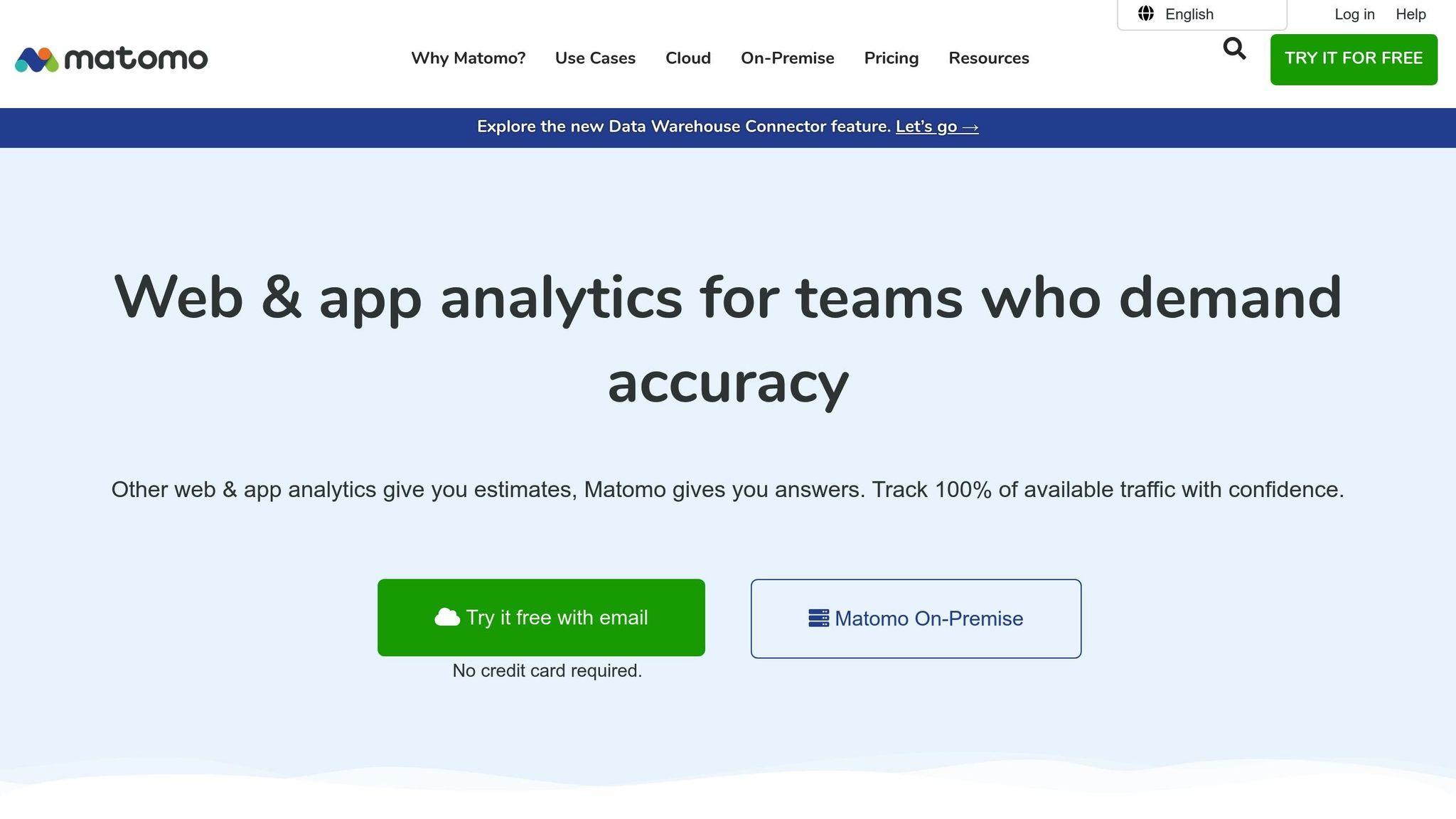
Matomo is one of the longest-standing analytics platforms focused on privacy, offering a solution that ensures complete data ownership alongside detailed insights. This open-source platform has become a go-to choice for organizations prioritizing GDPR compliance. A notable example is the European Commission, which selected Matomo for its Europa Analytics platform due to its ability to guarantee full control over data.
GDPR Compliance Features
Matomo integrates privacy-centric features right into its design. These include tools for obtaining user consent, opt-out tracking options, and mechanisms to support the "right to be forgotten." Additionally, it automatically anonymizes IP addresses and allows for precise control over data collection, aligning with GDPR’s data minimization principles.
Hosting Options
Matomo provides two hosting models to address concerns about data sovereignty:
- Matomo Cloud: All data is stored in Europe, specifically on AWS servers located in Germany, with backups in Ireland. This ensures no data is transferred to the US.
- Matomo On-Premise: This self-hosted option gives organizations full control over where their data is stored. By keeping the data on their own servers, website owners become the data controllers, while Matomo does not act as a processor or controller. The platform also supports seamless migration between cloud and on-premise setups, allowing flexibility as compliance needs evolve [6].
Privacy-Centric Data Practices
Unlike many traditional analytics tools, Matomo strictly avoids sharing data with third parties. This means all collected data stays with the website owner, removing concerns about external advertising networks or third-party sales.
For Matomo Cloud, InnoCraft Limited (based in New Zealand) acts as the data processor under a Data Processing Agreement (DPA). Data transfers to New Zealand comply with GDPR thanks to an adequacy decision [6]. Meanwhile, organizations using the on-premise version maintain total control as the sole data controllers.
"With Matomo Cloud your data is stored in Europe and no data is transferred to the US. On the other hand, with Matomo On-Premise, the data is stored in your country of choice." [5]
How Matomo Supports B2B Marketing Strategies
Matomo’s features are well-suited for B2B marketing analytics while maintaining strict privacy compliance. The platform provides tools to track conversion funnels, goal completions, and user journeys – essential for understanding the customer acquisition process in B2B settings.
Custom dimensions and variables allow businesses to monitor specific metrics, such as lead scoring, account-based marketing performance, and multi-touch attribution, which are crucial for long sales cycles. Additionally, its API access facilitates integration with CRM systems and marketing automation tools commonly used in B2B environments.
Mikke Schiren, a Customer Solutions Developer, shared insights into their decision to use Matomo:
"Collecting data from one’s visitors is very useful, and it is possible to do so despite the GDPR, including via Matomo, the solution we have chosen. It incorporates the right to be forgotten – meaning a user wants a website to delete all the data it has collected about him or her – and the ability to choose not to be tracked at all when visiting a site. That is why we have chosen Matomo. High security, high flexibility, and we know exactly who is looking at the data collected." [5]
The European Commission’s adoption of Matomo further underscores its capabilities:
"Europa Analytics is based on Matomo which is the leading open-source analytics platform that provides relevant and reliable insights into user behaviour. The data and information collected by Matomo is 100% owned and controlled by the European Commission. This guarantees compliance with strict privacy regulations and laws." [5]
For B2B tech companies navigating complex compliance requirements while striving for growth, Matomo offers the analytical tools needed to make informed decisions – without the regulatory risks tied to traditional analytics platforms.
Next, learn about another analytics solution tailored for GDPR compliance and B2B marketing needs.
2. Jetpack Stats
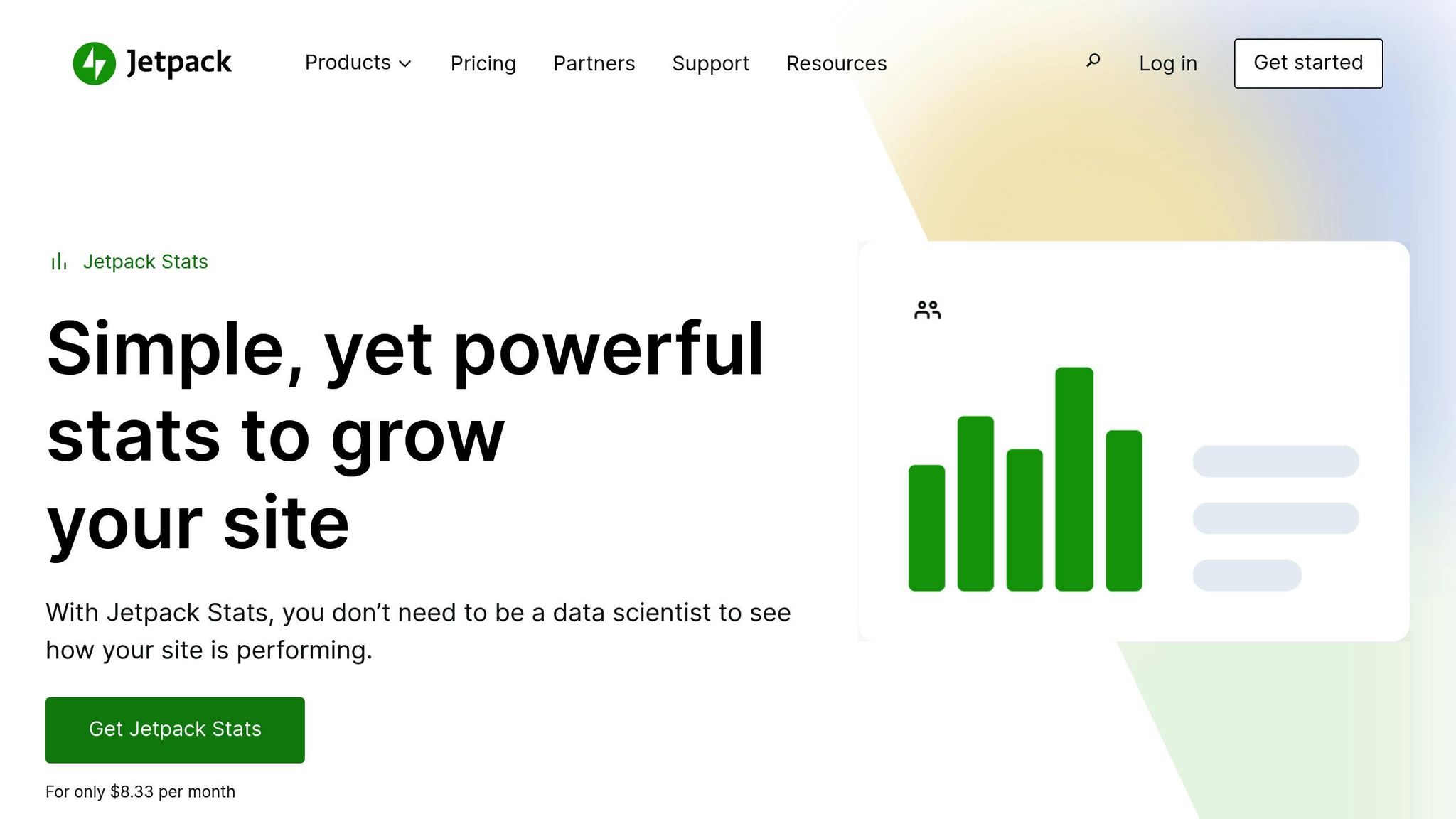
Jetpack Stats provides WordPress users with straightforward visitor insights while prioritizing privacy and adhering to GDPR guidelines. Created by Automattic – the team behind WordPress.com – it integrates seamlessly with WordPress sites, offering analytics without the usual technical headaches of traditional tracking tools. Its design focuses on delivering valuable data while respecting user privacy.
GDPR Compliance Mechanisms
Jetpack Stats is built with privacy in mind. To align with GDPR requirements, the tool automatically anonymizes visitor IP addresses by removing the final segment. This ensures that individual identification is impossible while still allowing for location-based insights useful for marketing purposes. By doing so, it eliminates the need for complex consent processes while providing actionable data.
Additionally, Jetpack Stats honors Do Not Track browser settings by default, respecting users’ privacy preferences without requiring any manual setup. For those seeking even stricter data collection limits, website owners can enable enhanced privacy settings that further reduce the scope of collected information.
Data Collection and Privacy Practices
Jetpack Stats takes a minimalist approach to data collection, focusing on essential metrics like page views, referrers, and basic visitor details. Unlike more comprehensive analytics platforms, it avoids using tracking cookies and relies on server-side analytics, which lowers privacy risks significantly.
All data collected by Jetpack Stats is stored on servers in the United States. To ensure GDPR compliance, Automattic uses Standard Contractual Clauses (SCCs) for secure data transfers. This simplified data model minimizes privacy concerns compared to more elaborate tracking systems.
Suitability for B2B Tech Growth and Marketing Strategies
For B2B tech companies looking for basic website analytics without the complexities of advanced tracking systems, Jetpack Stats offers just enough insights to optimize content marketing and analyze traffic sources. It effectively tracks referral data, helping businesses pinpoint which channels bring the most qualified leads to their sites.
The platform is particularly useful for monitoring blog performance and content engagement, making it ideal for companies that rely on content marketing to attract potential clients. Businesses can easily identify their best-performing articles, track social media-driven traffic, and analyze search engine referrals – all without needing a complicated setup.
However, Jetpack Stats is designed for simplicity, which means it may not meet the needs of companies requiring in-depth customer journey tracking or CRM integration. For businesses focused on ease of use and privacy over advanced analytics, it’s a practical solution for basic B2B content marketing efforts.
3. Slimstat Analytics
Slimstat Analytics is a self-hosted WordPress plugin that gives website owners full control over their analytics data while ensuring compliance with GDPR regulations. Unlike cloud-based tools, Slimstat processes all visitor data directly on your server, keeping everything local and under your control.
GDPR Compliance Features
Slimstat Analytics is designed with privacy in mind, offering several tools to meet GDPR requirements. For example, it anonymizes IP addresses by removing the last octet, allowing you to track geographic trends without compromising user privacy.
The plugin integrates seamlessly with popular WordPress consent management tools, enabling it to respect visitors’ cookie preferences. If a user opts out of analytics tracking, Slimstat automatically disables tracking for that session. It also includes a data retention scheduler to automatically delete old visitor data after a set period, aligning with GDPR’s principles of data minimization.
For businesses that need even stricter controls, Slimstat allows you to disable specific tracking features, such as user agent or referrer data collection. This flexibility makes it a strong choice for organizations with rigorous privacy policies.
Hosting and Data Ownership
Slimstat’s self-hosted design ensures all visitor data stays on your server, avoiding the complexities of international data transfers that often come with cloud-based solutions. By hosting your WordPress site on EU-based servers, you can further simplify GDPR compliance without relying on additional legal frameworks like Standard Contractual Clauses.
This self-hosted approach also means you retain full ownership and control over your analytics data, with no third-party processors involved. This setup is particularly appealing to B2B tech companies that prioritize strict data governance or operate in highly regulated industries.
Privacy-Focused Data Collection
Slimstat Analytics uses cookieless tracking by default, relying on server-side analytics to monitor visitor behavior. This eliminates the need for persistent browser identifiers, reducing privacy concerns while still delivering valuable insights into site performance and user engagement.
The plugin gathers key metrics like page views, session duration, traffic sources, and basic device information without building detailed user profiles. All data processing happens locally on your server, ensuring no external sharing of sensitive information. Slimstat also honors Do Not Track browser settings and lets you exclude specific IP addresses or user roles from being tracked.
Ideal for B2B Tech Companies
For B2B tech businesses focused on content marketing and lead generation, Slimstat Analytics provides actionable insights into how content performs and engages audiences – all while maintaining privacy standards. It excels at tracking conversion funnels, helping teams identify which blog posts or landing pages drive the most qualified leads.
Real-time reporting keeps marketing teams informed about trending content, allowing them to adapt strategies quickly based on visitor behavior. The plugin’s referrer tracking also helps measure the success of various marketing channels, whether through social media, email campaigns, or other efforts.
Note: Since Slimstat is a self-hosted solution, businesses will need WordPress development expertise for setup and customization. For those prioritizing data privacy and ownership over convenience, Slimstat offers a powerful, privacy-compliant analytics platform tailored to their needs.
4. Fathom Analytics
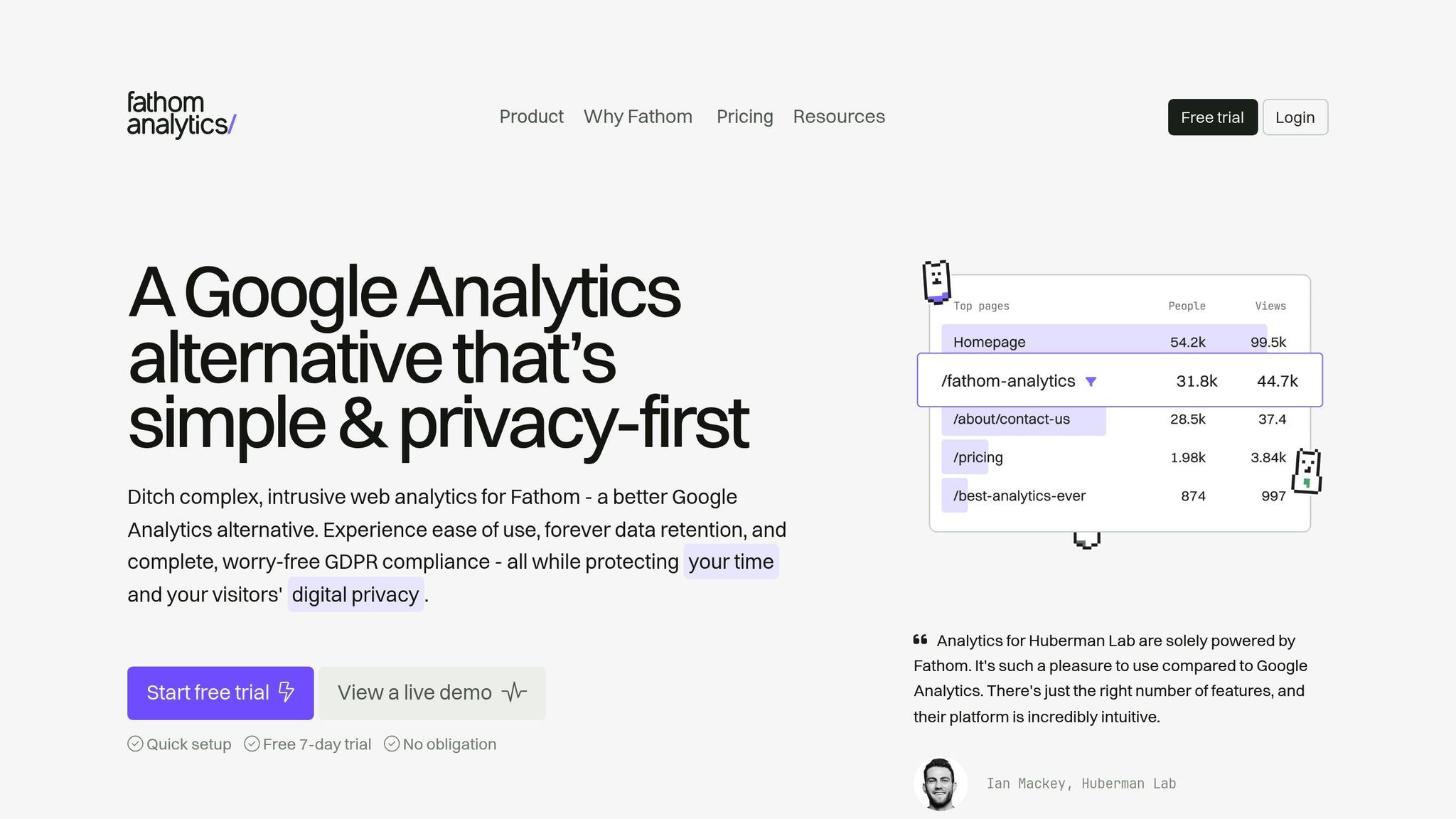
Fathom Analytics is a cloud-based tool designed with privacy at its core. By automatically anonymizing visitor data, it enables businesses to monitor website performance without relying on cookie consent banners. This "privacy-first" approach simplifies compliance with GDPR regulations since no personally identifiable information is collected or stored.
Fathom sidesteps many of the common GDPR hurdles by avoiding cookies altogether. Instead of tracking individual user behavior, it focuses on providing aggregated website performance data. Organizations can also customize data retention periods, making it easier to align with strict internal data policies. These features make Fathom a practical choice for businesses looking for a simple and privacy-conscious analytics platform.
Hosting Options
Fathom offers two hosting options tailored to different needs. Its cloud service operates on secure infrastructure that adheres to GDPR requirements. For businesses that prefer complete control over their data, there’s the self-hosted option known as Fathom Lite, which allows the platform to run on private servers.
Data Collection and Privacy Practices
Fathom uses a non-cookie-based tracking system to collect essential metrics like page views, referrer details, and basic device information. This system avoids persistent browser identifiers, and all visitor IP addresses are hashed and anonymized before processing, ensuring that individual users remain unidentifiable. Additionally, Fathom does not share collected data with third parties, helping businesses build trust with their audience.
Suitability for B2B Tech Growth and Marketing Strategies
With its privacy-focused design, Fathom Analytics is particularly useful for B2B marketing efforts. For tech companies leveraging content marketing and lead generation, the platform delivers clear and actionable insights. Its real-time reporting helps marketing teams monitor campaign performance instantly, while referrer tracking highlights the most effective traffic sources. Built-in goal tracking further supports lead generation by measuring conversions and optimizing strategies.
That said, Fathom’s streamlined approach may not suit organizations that require advanced features like custom event tracking, as it prioritizes simplicity and privacy over extensive functionality.
5. Plausible Analytics
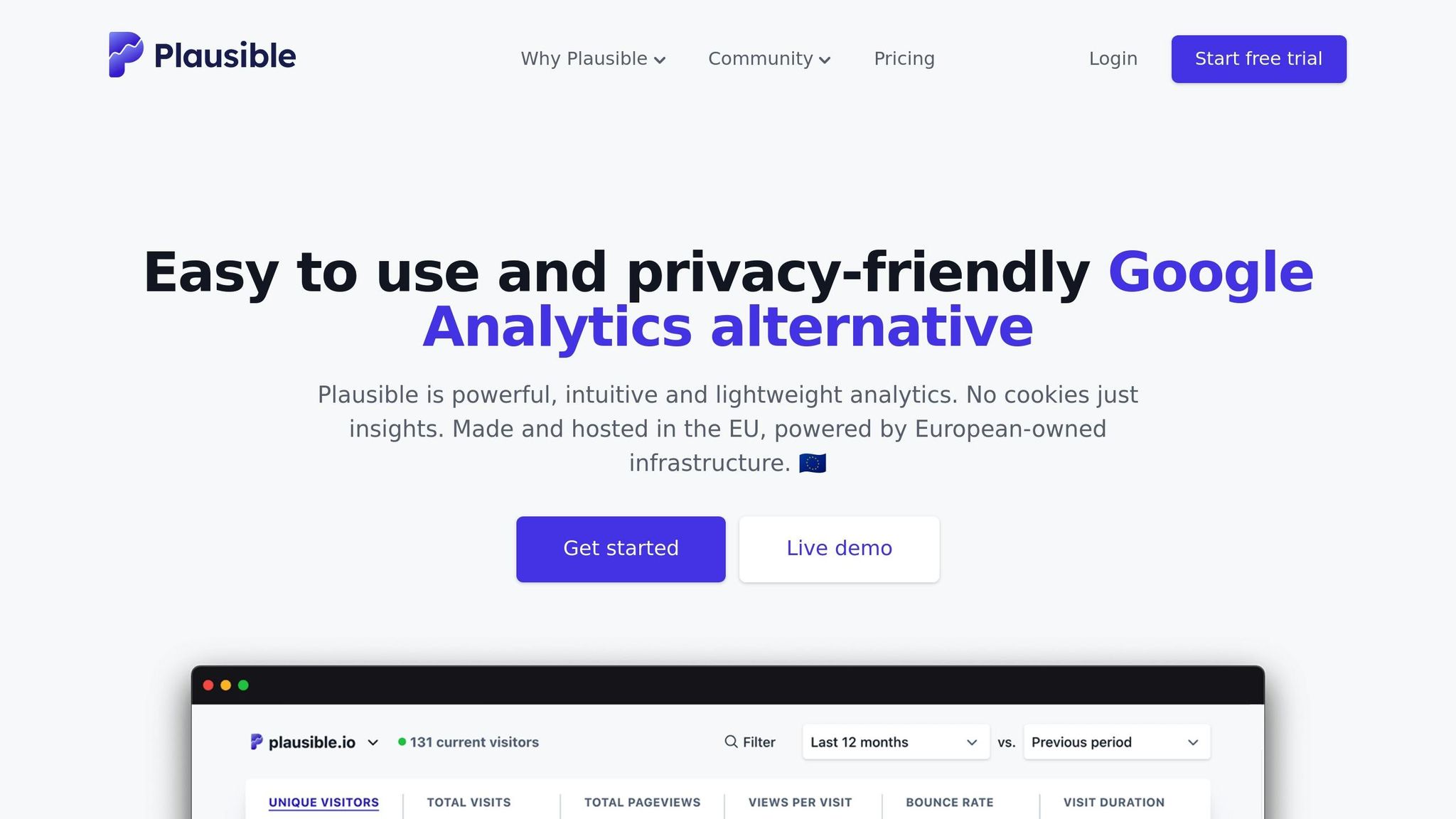
Plausible Analytics, developed in Estonia, is a platform designed with privacy as its core focus. It operates under the strict data protection laws of the European Union, making it a reliable choice for businesses prioritizing data privacy.
Hosting Options
Plausible offers two hosting choices:
- Managed Cloud Service: Visitor data is processed exclusively on EU-owned infrastructure located in Germany.
- Self-Hosted Community Edition: This option gives users full control, allowing them to host data on EU-based servers.
Plausible emphasizes its commitment to privacy with the following statement:
"All visitor data is exclusively processed on EU-owned cloud infrastructure. We keep your site data on a secure, encrypted and green energy powered server in Germany. This ensures that your site data is protected by the strict European Union data privacy laws and ensures compliance with GDPR. Your website data never leaves the EU." – Plausible Analytics [7]
Data Collection and Privacy Practices
The platform collects only essential metrics, ensuring that all data remains within EU borders. To achieve this, Plausible relies on two EU-based subcontractors: BunnyWay d.o.o. in Slovenia for content delivery and Hetzner Online GmbH in Germany for server hosting. This setup guarantees that data is securely stored within the EU.
Suitability for B2B Tech Growth
Plausible’s strong privacy framework makes it a great choice for B2B technology companies. Its simple, privacy-focused design aligns seamlessly with EU regulations, enabling businesses to deploy data-driven marketing and customer acquisition strategies without compromising compliance.
6. PostHog
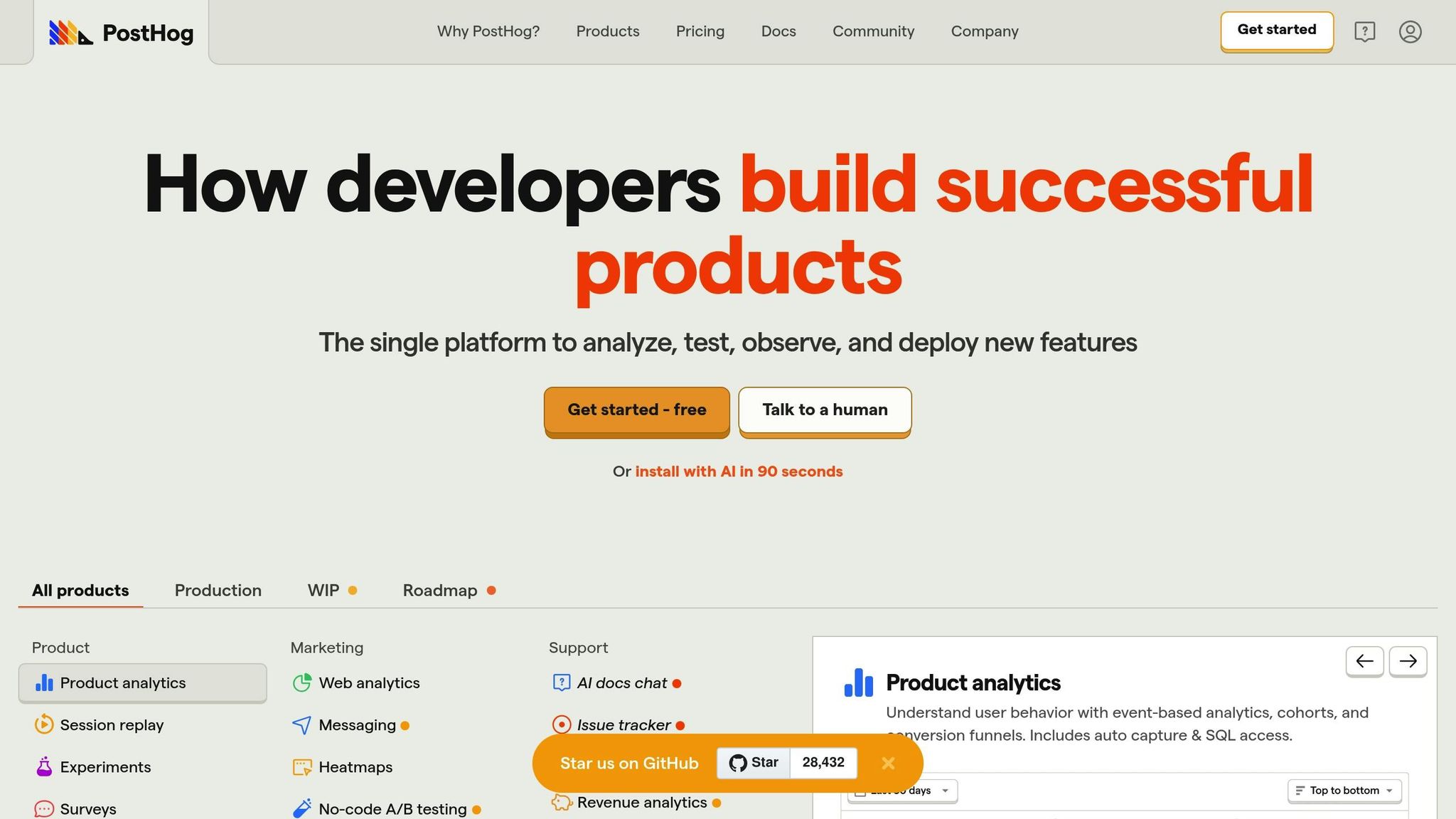
PostHog is an analytics platform designed with a strong focus on privacy. It offers flexible deployment options to meet GDPR requirements while providing detailed user insights.
Hosting Options
PostHog provides three hosting solutions to suit varying privacy and compliance needs:
- PostHog Cloud EU: Hosted on servers in Frankfurt, Germany, this option ensures that user data stays within EU jurisdiction, making it ideal for organizations prioritizing GDPR compliance [8].
- PostHog Cloud US: Located in Virginia, USA, this service is tailored for U.S.-based markets. For companies collecting data from EU users on this platform, adopting data anonymization practices is advised to maintain compliance [8].
- Self-hosting: This option empowers organizations to deploy PostHog on their own servers or private cloud infrastructure, granting complete control over where and how data is processed [8].
These hosting choices offer flexibility while supporting stringent GDPR standards.
GDPR Compliance and Data Practices
For businesses needing robust GDPR compliance, the PostHog Cloud EU option is highly recommended as it keeps data within the EU. When using the US cloud, anonymizing EU user data can help mitigate privacy risks [8]. The self-hosting option provides organizations with full control over data storage and processing, which can significantly bolster privacy measures [8].
Ideal for B2B Tech Companies
PostHog’s privacy-focused approach and versatile deployment options make it a valuable tool for B2B technology companies. By delivering actionable user insights, it helps businesses refine their marketing and customer acquisition strategies. Its compliance-friendly design is particularly beneficial for companies navigating regulated industries or targeting European markets [8].
sbb-itb-e8c8399
7. Simple Analytics
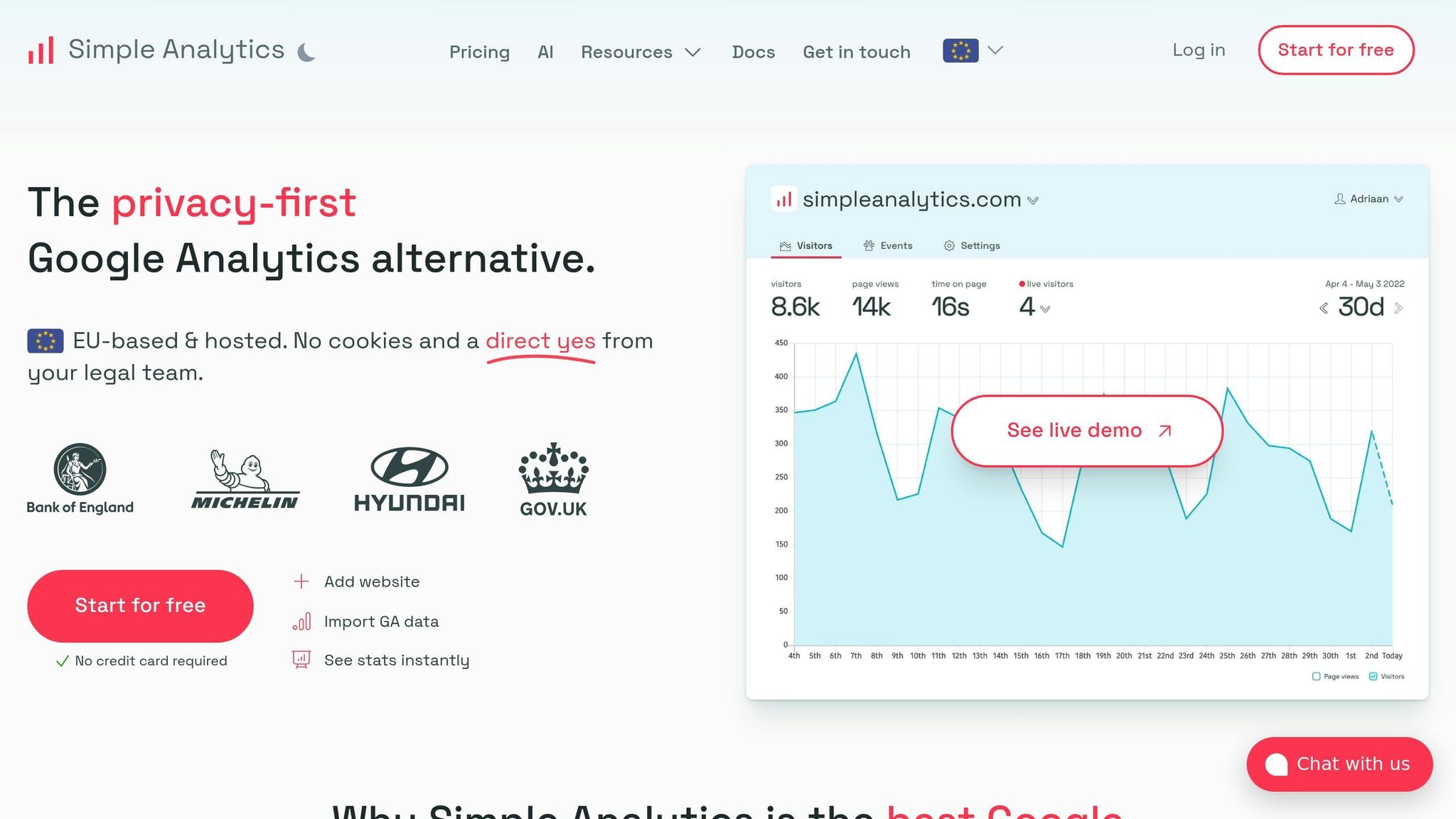
Simple Analytics is a privacy-focused analytics platform designed to comply with GDPR right out of the box. Unlike many traditional tools that require extensive setup to meet privacy standards, Simple Analytics ensures full compliance from the moment it’s implemented [9][10].
How Simple Analytics Handles GDPR Compliance
Simple Analytics takes a straightforward approach to privacy. By avoiding the collection of personal data entirely, it eliminates the need for cookie banners, consent management systems, or complicated data processing agreements. This design not only reduces administrative headaches but also significantly lowers the risk of data breaches, as no individual information is stored. The platform is fully aligned with GDPR, PECR, and CCPA regulations by default [9][10].
Privacy-Friendly Data Collection
The platform’s data collection methods are as simple as its name suggests. Using cookieless tracking, it gathers only aggregated, non-personal data, ensuring website performance insights without compromising user privacy. Since no data is shared with third parties, this approach keeps the user experience clean and free from unnecessary complexity [9][10].
Hosting Within the EU
To further support its privacy-first mission, Simple Analytics hosts all its data exclusively within the European Union. This ensures that data processing remains under EU jurisdiction, avoiding the legal and logistical challenges associated with international data transfers [9][10].
Ideal for B2B Tech Companies
Simple Analytics is particularly well-suited for B2B tech businesses. It combines privacy-by-design with practical tools for marketing and growth. Trusted by organizations like government agencies, Michelin, and Hyundai, the platform offers features such as an AI-powered analytics chat, goal tracking, and event exploration. These tools help marketing teams uncover actionable insights and make a seamless switch from Google Analytics [9][10].
8. Umami
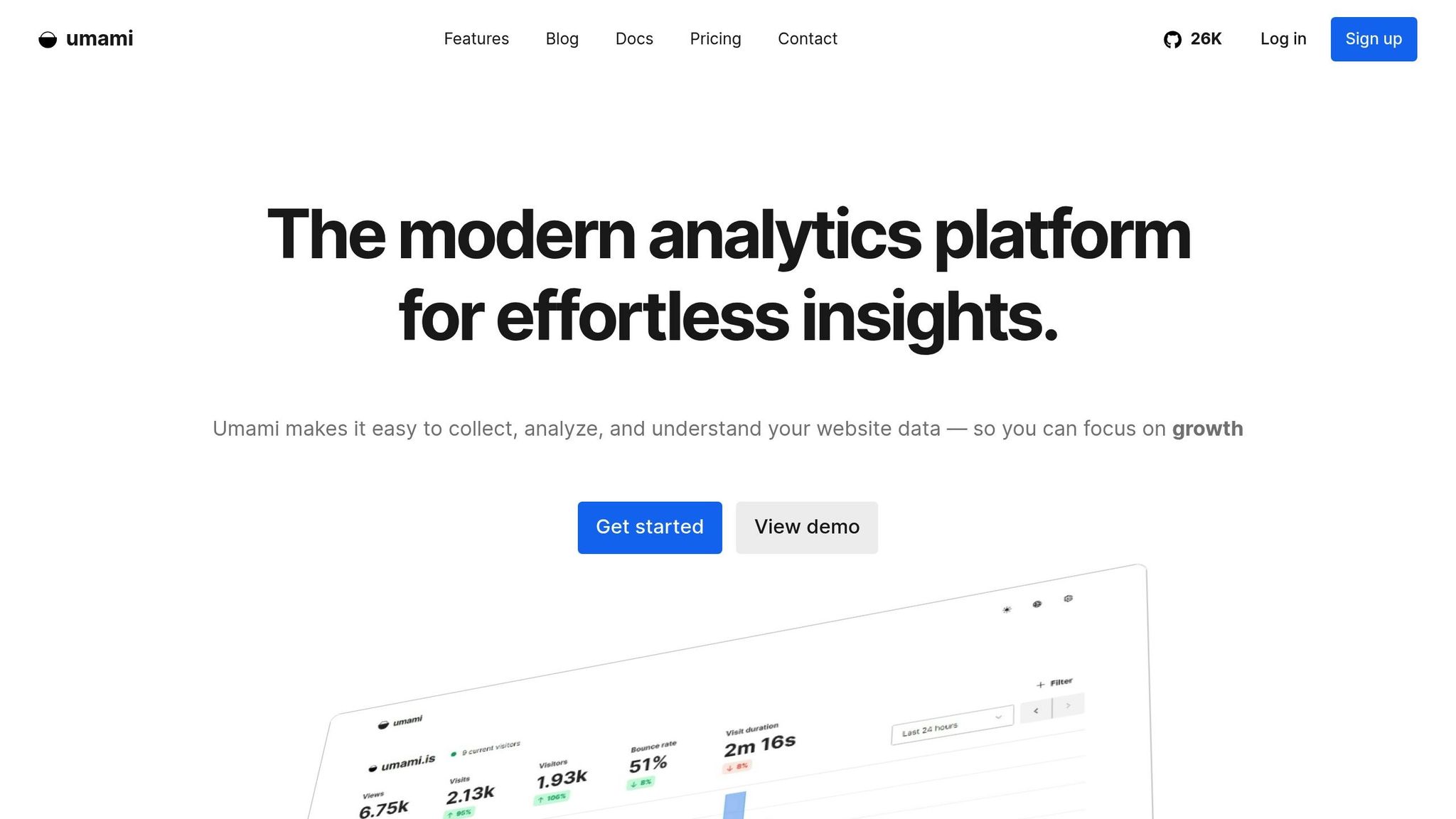
Umami is an open-source analytics platform designed with privacy at its core. It offers a self-hosted solution that aligns with GDPR requirements, giving businesses full control over their data. This approach ensures companies can manage data collection and storage without relying on external platforms, reinforcing both privacy and autonomy.
GDPR Compliance Features
Built on a privacy-first philosophy, Umami minimizes data collection by design. It avoids gathering personally identifiable information, which not only protects user privacy but also simplifies compliance with GDPR regulations. By reducing the need for complex consent management systems, Umami can help businesses save time and resources.
Hosting Flexibility
Umami’s self-hosted model lets businesses decide where and how their data is stored. For those who prefer managed hosting, there are trusted third-party providers that maintain high standards of data protection, ensuring flexibility without compromising security.
Lightweight Data Collection
Umami operates without cookies, using a lightweight tracking script to collect essential metrics like page views, referrers, and device information. This streamlined approach minimizes performance impact, leading to faster page load times and a smoother user experience.
Ideal for B2B Tech Marketing
Umami goes beyond basic analytics by supporting custom event tracking. Marketers can monitor key interactions such as form submissions and file downloads, providing valuable insights into user behavior. Its real-time dashboard allows businesses to assess campaign performance and website traffic instantly, enabling quick adjustments to strategies. Additionally, the platform’s multi-website management feature makes it easy to track multiple domains while keeping data streams separate for detailed analysis. These capabilities make Umami a powerful ally for B2B tech companies looking to refine their marketing strategies and drive growth.
9. GoatCounter
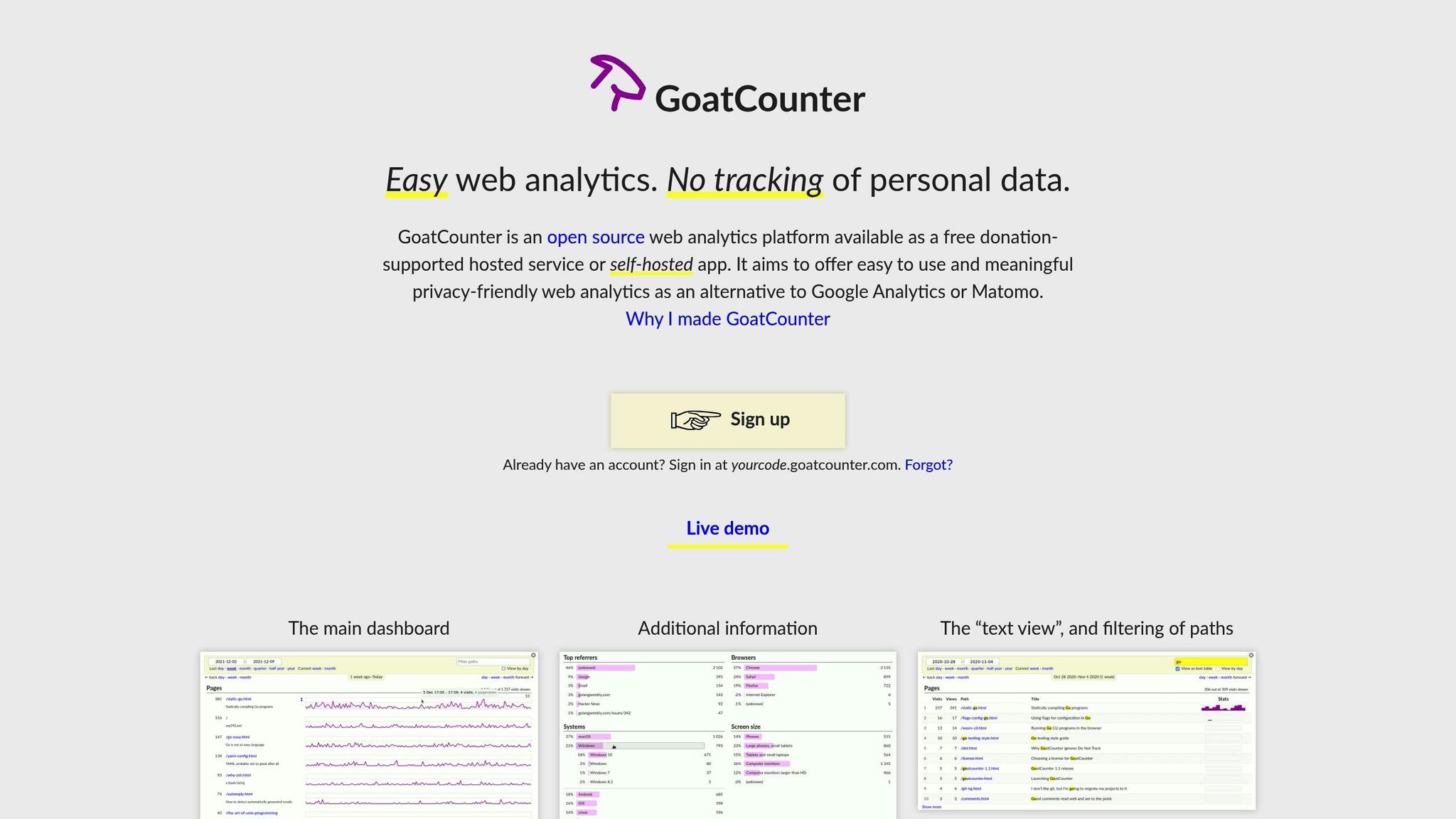
GoatCounter is an open-source analytics platform designed with privacy in mind. It provides essential business insights while ensuring compliance with GDPR regulations. Lightweight and efficient, it processes over 1 million pageviews daily through its hosted service, supporting thousands of websites worldwide, including a strong presence in the United States and Europe.
GDPR Compliance Features
GoatCounter’s cookieless tracking is a key feature that ensures GDPR compliance. By avoiding cookies and personal data collection, it eliminates the need for cookie consent banners. The platform also anonymizes IP addresses automatically and refrains from gathering any personally identifiable information. This privacy-centered approach allows businesses to analyze website performance without the hassle of complex consent systems or data protection worries.
Hosting Options
Users can opt for EU-based cloud hosting or choose to self-host the platform for complete control over their analytics data. For organizations with strict compliance requirements, on-premises deployment ensures that all data remains securely within their own infrastructure. As an open-source tool licensed under AGPLv3, GoatCounter offers full transparency, allowing users to audit and verify its codebase.
Data Collection and Privacy Policies
GoatCounter enforces a strict policy against third-party data sharing. It does not sell, share, or transfer analytics data, ensuring that all collected information stays under the control of the site owner. Its lightweight tracking script gathers only basic performance metrics, minimizing resource usage while aligning with increasing regulatory demands in both the EU and the United States.
Ideal for B2B Tech Growth and Marketing
GoatCounter is particularly well-suited for B2B tech companies aiming to showcase their commitment to privacy. This can be a strong advantage when working with privacy-conscious clients or industries with stringent regulations. The platform provides essential analytics for tasks like tracking campaign performance and analyzing website traffic. While it focuses on delivering core metrics rather than advanced segmentation, its straightforward design is perfect for growing B2B tech businesses that value simplicity in data interpretation.
Pricing starts at $5 per month for up to 100,000 pageviews, making it an affordable alternative to many enterprise analytics tools. Additionally, the free self-hosting option is an excellent choice for organizations with technical expertise, offering unlimited use without licensing fees while retaining complete control over their data. Up next, we’ll explore another GDPR-compliant solution tailored to support B2B tech growth.
10. Open Web Analytics
Open Web Analytics is a self-hosted, open-source web analytics tool built using PHP and MySQL. This gives organizations the ability to manage their analytics data in-house, offering greater control over data handling and compliance configurations, including those related to GDPR.
While specific details about its GDPR-focused features – like privacy tools, data retention settings, or consent management – aren’t extensively documented, users can adjust its settings to align with compliance requirements. Additionally, its open-source framework allows technical teams to modify and tailor the platform for specific reporting needs or to integrate it seamlessly with other systems.
Feature Comparison Table
Here’s a quick reference to help you evaluate GDPR-compliant analytics platforms. This table highlights key features like hosting options, pricing, and ideal use cases, making it easier to compare platforms side by side.
| Platform | Key GDPR Features | Hosting Type | Pricing | Best For |
|---|---|---|---|---|
| Matomo | Cookie-less tracking, data anonymization, consent management, EU data centers | Self-hosted or Cloud | Free for self-hosted / Subscription-based for Cloud | Large enterprises needing detailed analytics |
| Jetpack Stats | Minimal data collection, no personal data storage, automatic anonymization | Cloud (WordPress.com) | Free with optional premium upgrade | WordPress site owners looking for simplicity |
| Slimstat Analytics | IP anonymization, data retention controls, cookie-less mode | Self-hosted | Free basic plan with an option to upgrade | WordPress users needing detailed visitor insights |
| Fathom Analytics | No cookies, privacy-first design, data anonymization, EU servers | Cloud | Subscription-based pricing | Small to medium businesses focused on privacy |
| Plausible Analytics | Cookie-less tracking, open source, lightweight script, EU hosting | Cloud or Self-hosted | Subscription for Cloud / Free for self-hosted | Privacy-conscious businesses needing lightweight tools |
| PostHog | Event-based tracking, data anonymization, self-hosting options, consent tools | Cloud or Self-hosted | Free tier with event-based pricing | Product teams analyzing user behavior |
| Simple Analytics | No cookies, minimal data collection, privacy dashboard, EU servers | Cloud | Subscription-based pricing | Businesses seeking straightforward analytics |
| Umami | Cookie-less, open source, data anonymization, lightweight | Self-hosted or Cloud | Free for self-hosted / Subscription-based for Cloud | Developers and small businesses wanting control |
| GoatCounter | No personal data collection, open source, privacy-focused | Cloud or Self-hosted | Free for personal use / Commercial plans available | Personal projects and small websites |
| Open Web Analytics | Self-hosted control, customizable privacy settings, data ownership | Self-hosted | Free | Organizations needing technical customization |
Choosing the Right Solution
Self-hosted platforms like Matomo, Umami, and Open Web Analytics offer complete control over your data but often require technical expertise for setup and maintenance. On the other hand, cloud-hosted services such as Fathom Analytics and Simple Analytics handle updates and infrastructure, giving you a hassle-free experience while maintaining GDPR compliance with privacy-first designs.
For WordPress users, Jetpack Stats is a simple option for content-driven sites, while Slimstat Analytics provides more detailed insights for those seeking a deeper understanding of visitor behavior.
Platforms like Matomo include advanced consent management tools, while Plausible Analytics and Fathom Analytics simplify GDPR compliance by eliminating the need for traditional consent banners altogether. Whether you’re a developer, small business owner, or part of a larger enterprise, there’s a solution tailored to your needs.
How to Select the Right Analytics Platform
Picking the right analytics platform comes down to understanding your business needs and technical capabilities. Each decision point builds on the last, helping you zero in on the platform that fits your specific requirements.
Start by considering the size of your business. If you’re a small business or startup, lightweight tools like Fathom Analytics or Simple Analytics can be a great fit. They offer straightforward pricing and are easy to set up, requiring little to no technical expertise.
For mid-sized companies, the complexity of your operations plays a bigger role. You’ll likely need platforms with more advanced features and customization options. Matomo, for example, offers a wide range of features with flexible hosting options, while PostHog is ideal for teams focusing on detailed user behavior analysis and event tracking.
Next, think about data residency and integration. If your business runs on WordPress, tools like Jetpack Stats or Slimstat Analytics might align better with your existing setup. Companies using modern development stacks may find PostHog appealing due to its developer-friendly API, while Fathom Analytics and Plausible Analytics are excellent for seamless integration across various environments.
Your reporting needs also matter. For marketing teams that focus on traffic sources and conversion tracking, Matomo provides a rich reporting suite. On the other hand, if simplicity is your priority, platforms like GoatCounter or Simple Analytics may be more suitable.
Budget is another key factor, but it’s not just about subscription costs. Self-hosted platforms like Umami or Open Web Analytics come with added responsibilities, such as server maintenance, security updates, and the need for technical expertise. Managed solutions, by contrast, handle infrastructure for you, allowing your team to focus entirely on data analysis.
Scalability is crucial, too. Your platform should be able to handle growth without significant cost hikes or performance issues. Tools like Matomo and PostHog are built to scale flexibly, while simpler options like GoatCounter are better suited for businesses with steady, moderate traffic.
Finally, take advantage of trial periods. Most platforms offer testing opportunities, giving you the chance to evaluate reporting quality, ease of use, and how well the platform integrates with your workflows. These trials can uncover potential compatibility issues that feature lists might not reveal. And by ensuring the platform aligns with GDPR standards, you’ll not only stay compliant but also set the stage for strategic growth.
FAQs
What’s the difference between cloud-hosted and self-hosted analytics tools when it comes to GDPR compliance?
Self-hosted analytics tools give you more control over your data, which can make it easier to comply with GDPR regulations. By keeping data on your own servers, you can ensure it stays within the boundaries of data sovereignty laws, avoid over-reliance on third-party providers, and reduce the chances of unauthorized access or data transfers.
In contrast, cloud-hosted solutions depend on external providers to handle data storage and processing. While many cloud providers claim to offer GDPR-compliant services, challenges can arise – like ensuring data remains in approved locations and properly managing access controls. For businesses that prioritize privacy and maintaining tight control over their data, self-hosted solutions often provide a more secure and reliable path forward.
How do GDPR-compliant analytics tools protect user privacy through consent and data anonymization?
GDPR-Compliant Analytics Tools: How They Protect User Privacy
GDPR-compliant analytics tools put user privacy front and center by making sure people give clear and explicit consent before any data is collected. This is usually done through easy-to-understand consent banners or settings, giving users a transparent view of how their information will be used.
To add another layer of protection, these tools rely on data anonymization methods like masking or hashing IP addresses and removing any personally identifiable information (PII). These steps ensure that the data collected can’t be linked back to specific individuals, staying in line with GDPR’s strict privacy and security requirements.
Why is data sovereignty essential for GDPR compliance, and how do these analytics tools help address it?
Data sovereignty plays a key role in meeting GDPR requirements, as it ensures personal data is governed by the laws of the country where it’s collected. This not only helps businesses adhere to local data protection laws but also reduces legal risks and strengthens customer trust.
To support this, GDPR-compliant analytics tools include data localization features. These allow businesses to store data in designated regions and process it according to local regulations. Such practices safeguard privacy, provide better control over sensitive data, and align with GDPR standards.