

Think your SaaS pricing model is future-proof? It might surprise you that 2026 is forcing startups to rethink everything. AI is automating entire workflows, making seat-based pricing models outdated.
I’m Lillian Pierson, a fractional CMO and licensed Professional Engineer who runs go-to-market for B2B SaaS and AI startups. Changing the revenue model is the riskiest thing I get asked to help with, and the most common reason a founder calls me.
- Seat-based pricing is shrinking fast: It dropped from 21% to 15% of SaaS revenue in just one year.
- Investors want predictable revenue: Hybrid and usage-based models are becoming the norm, with 43% of SaaS companies already making the switch.
- The risks are real: Customer churn, revenue dips, and billing errors can derail transitions if not handled carefully.
The good news? Shifting your revenue model doesn’t have to break your business, if you do it right. This guide covers when to pivot, how to execute the change, and the metrics you need to watch.
How to Know When It’s Time to Change Revenue Models
Founders often wait until boardroom discussions about NRR or customer churn make it clear that something needs to change. But the real challenge is spotting the signs early, before they become an emergency.
Assessing the Health of Your Current Revenue Model
Start with cohort-level NRR. If your seat-based model consistently falls below 110%, it’s time to rethink your strategy. Companies like Snowflake and Twilio, which lead in usage-based pricing, have hit NRR levels of 155%–158% [5]. Another key metric is your expansion revenue ratio, the portion of revenue coming from existing customers without active sales input. Healthy usage-based models typically land between 20% and 30% [1].
Also, pay attention to operational friction. If more than 2% of your transactions result in support tickets or invoice disputes, it’s a red flag. This often points to a poorly defined billing unit, which can confuse customers and create bigger issues as you scale [1][6].
Beyond metrics, behavioral patterns can also indicate when it’s time to change.
Trigger Signals by Revenue Model Type
The signs that a shift is needed depend on your current model:
- Seats to Usage: Watch out for "ghost seats", licenses customers pay for but no longer use as workflows become automated. These don’t show up as churn right away but often lead to future problems. Companies sticking exclusively to seat-based models face churn rates 2.3 times higher than those using hybrid or outcome-based pricing [4].
"If your pricing is tied to seats, your revenue shrinks the more value you deliver. That’s not a temporary headwind. That’s a structurally inverted incentive.", Falk Gottlob, Founder, Falkster.AI [2]
- Usage to Outcome-Based: Be cautious when customers reach usage limits without seeing proportional business benefits. If power users churn or frequently ask for custom pricing, it’s a sign that your value metric isn’t aligned with their needs. HubSpot’s 2026 move to outcome-based pricing for its Breeze AI agents, charging $0.50 per resolved conversation and $1 per qualified lead, was designed to better match costs with ROI for SMBs [2][9].
- Freemium to Paid: A stalled free-to-paid conversion rate is a clear signal. If free users drain resources without converting, your freemium model shifts from a growth driver to a cost burden. Tracking your usage-to-revenue conversion rate, the percentage of metered activity that turns into billed revenue, can help you spot this issue [1].
Once you’ve identified these signals, the next step is understanding how they affect different customer groups.
Mapping Impact Across Customer Segments
Not all customer segments will react the same way to a revenue model change. To prioritize effectively, segment your ARR based on two factors:
- Seat Dependency: How much of the contract relies on headcount.
- AI Exposure: How easily the customer’s workflows can be automated.
Customers with high seat dependency and high AI exposure are the most vulnerable and should be prioritized for early outreach. How to approach different segments:
| Customer Segment | Migration Approach | Primary Concern |
|---|---|---|
| Enterprise | Bespoke conversations led by CPO/CRO | Budget certainty and committed-use discounts |
| Mid-Market | Structured email campaigns and webinars | Achieving clear ROI on key use cases |
| SMB | Pure self-service with deadline-driven migration | Keeping upfront costs low and billing transparent |
| High-Risk Annual Contract | Honor legacy pricing until renewal; offer transition credits | Preventing bill shock and ensuring stability |
A well-executed migration typically results in 60–70% of customers paying within 15% of their current spend [1]. If your projections show a wider gap, with many customers facing significant increases, consider extended grandfathering or phasing the rollout more gradually.
"The transition is not theoretical and it is not fatal to the existing revenue base. It is executable. The question is not whether to make this transition but whether to make it on your own terms or wait until the renewal cycle forces it.", Bill McDermott, CEO, ServiceNow [4]
ServiceNow’s April 2026 earnings call highlights this point: 50% of its new business now comes from non-seat-based pricing, while renewal rates remain at 97%. This serves as a strong example of how to manage a segment-aware, well-timed transition.
How to Plan and Execute a Revenue Model Transition
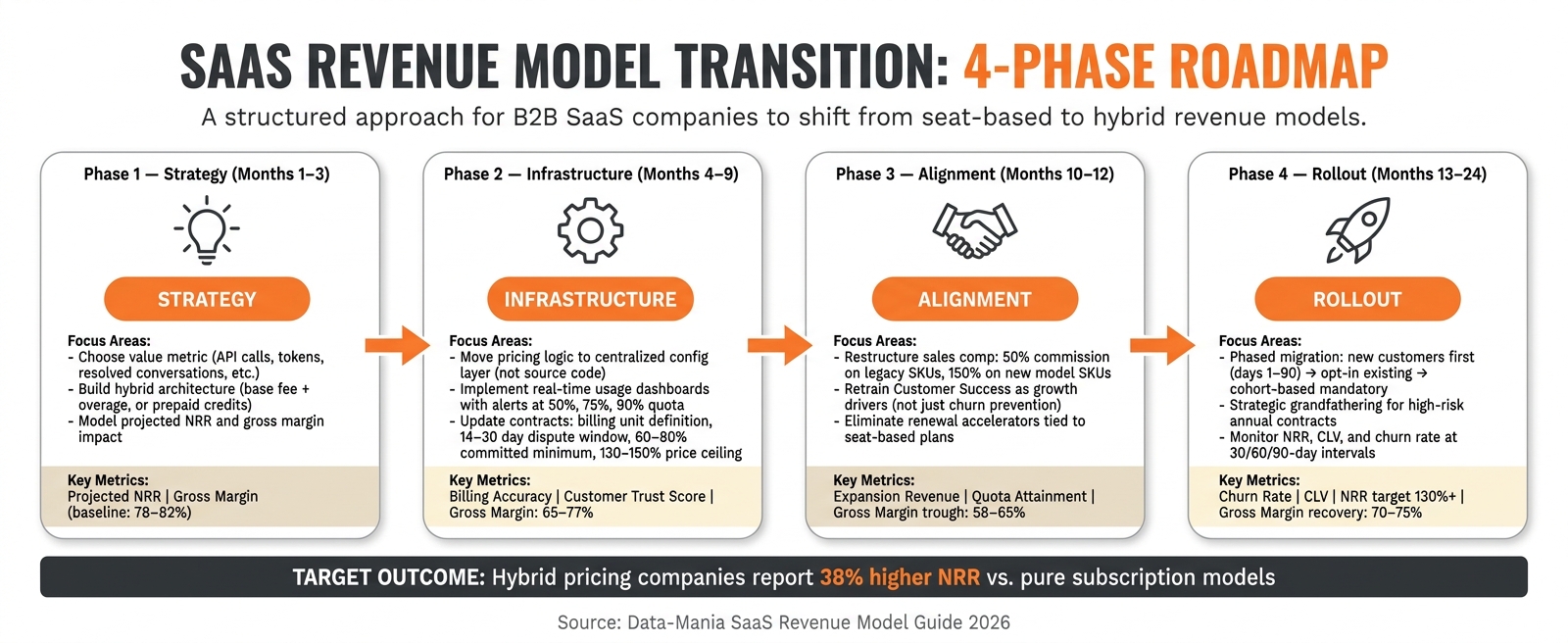
SaaS Revenue Model Transition: 4-Phase Roadmap for 2026
Once you’ve determined it’s time to pivot your revenue model, the next step is executing the shift with precision. This ensures you maintain your revenue while navigating the change.
Designing the New Revenue Model
The cornerstone of any new revenue model is selecting the right value metric, the unit your customers will pay for. This metric should align with the value your customers derive from your product, not your internal costs. Examples include API calls, tokens processed, documents generated, or resolved conversations. These metrics grow naturally as customers benefit more from your offering.
"Your value metric is a one-way door. Once you train customers to think about your product in terms of a specific metric, changing it later is expensive in trust and operational disruption.", Aanchal Parmar, Product Marketing Manager, Flexprice [1]
A hybrid architecture is often the safest way to transition. This could include a base plan with overage charges, a minimum commitment with a true-up mechanism, or prepaid credits with a drawdown structure. These approaches provide a revenue baseline while allowing you to capture growth as usage increases. Be prepared for a temporary dip in gross margins, from around 80% to 58–65%, during the first 10 to 18 months as volumes stabilize [11][2]. Anticipating this drop will help you manage expectations with stakeholders.
Updating Billing Systems and Contracts
Once the new model is defined, your billing infrastructure needs to support it. A common misstep is embedding pricing logic directly into source code, making adjustments cumbersome. Instead, move pricing into a centralized configuration layer, enabling your team to iterate without engineering bottlenecks.
"Pricing should live in config, not code. Defined once, inherited everywhere, from the pricing page to the billing system to the feature gate in your code.", Paweł Huryn, Author, The Product Compass [12]
For instance, Automox, an IT management platform, reduced the time needed to launch new pricing tiers by 75% after migrating to a decoupled pricing system. This shift also freed up two engineers who had been focused on maintaining pricing logic [12]. On the contracts side, ensure your updated templates include these five critical terms:
- A clear definition of the unit being billed
- A 14–30 day dispute resolution window
- An arbitration mechanism
- A committed minimum (typically 60–80% of forecasted volume)
- A price ceiling, usually set at 130–150% of projected usage, to protect customers from unexpected costs [11][2]
Aligning Sales, Customer Success, and Compensation Plans
Your sales team won’t naturally prioritize the new model unless their compensation reflects it. Implement compensation asymmetry: pay 50% of the usual commission for legacy products and 150% for the new model. This shift ensures the new model gets the attention it needs.
"The comp asymmetry is the lever that prevents the legacy product from quietly winning the next eighteen months.", Falk Gottlob, Product Executive, Falkster [2]
Customer Success (CS) teams also need to adapt. In a usage-based model, CS evolves from a churn-prevention role to a growth driver, where increased usage directly translates to higher revenue [1]. Train your CS team to monitor usage data and identify expansion opportunities. Eliminate renewal accelerators tied to legacy seat-based plans, as they incentivize reps to keep customers on the old model.
| Metric | Old (Subscription) Model | New (Usage/Hybrid) Model |
|---|---|---|
| Primary Reward | Upfront contract value (ACV) | Customer growth and adoption |
| Legacy SKU Comp | 100% of historical commission | 50% of historical commission |
| Successor SKU Comp | N/A | 150% of equivalent ACV |
| Accelerators | Renewal-based | Migration and expansion-based |
| Sales Behavior | "Close and move on" | "Close and ensure success/usage" |
With these internal adjustments in place, the focus shifts to rolling out the changes to your customers.
Communicating the Change to Customers
A phased rollout is essential: start with new customers for the first 60–90 days, followed by opt-in migrations for existing users, and finally move to cohort-based mandatory migrations [1][7]. This approach allows you to gather real billing data before impacting your core revenue base.
When communicating the change, focus on the benefits to customers. Phrases like "Pay only for what you use" resonate better than "We’re moving off seats." Provide a real-time usage dashboard with automated alerts at 50%, 75%, and 90% of their quota to ensure transparency. This helps prevent bill shock, which is a leading cause of involuntary churn during transitions [1][7]. Tailor your messaging based on account size: enterprise customers may need one-on-one discussions about committed-use discounts, while SMBs benefit from a simple calculator to estimate their new costs.
How to Test the New Model Before Full Rollout
Testing a new pricing model before rolling it out fully is essential to gather actionable data and make informed decisions. This phase acts as a bridge between planning and a smoother, lower-risk implementation.
Defining Test Cohorts and Hypotheses
A step-by-step approach works best: start with shadow billing, then move to new signups, opt-in existing customers, and finally segmented cohort waves. This method captures real-world data without exposing your entire customer base to potential risks.
"New customers give you a clean signal on whether usage-based pricing affects conversion, early retention, and initial usage behavior.", Ayush Parchure, Flexprice [13]
For outcome-based pricing, Falk Gottlob of Falkster.AI advises starting with one strategic account that has a "bounded, frequent, and measurable" workflow, like support resolutions or booked sales meetings. This account can act as both a pilot and a key reference point [2]. When transitioning existing customers, focus on those currently overpaying under fixed plans. They’re more likely to see the new model as a positive change.
Every hypothesis you test should be precise and falsifiable. For example, instead of saying, "the new model will improve revenue", aim for something like: "Switching new signups to hybrid pricing will increase MRR by more than 35% within 90 days while keeping trial-to-paid conversion drops under 8%." Define these thresholds upfront, before launching the test [15].
Once your test cohorts and hypotheses are clear, the next step is running parallel tests that simulate the new billing model.
Running Parallel Pricing Tests
Shadow billing is the safest starting point. Over 2–3 billing cycles, continue charging customers under the current model while simulating invoices based on the new pricing structure. This reveals potential issues, like customers whose usage might cause unexpected spikes in bills or cases where the new metric doesn’t align well with their workflow [13].
For a seats-to-usage transition, test a hybrid model combining a base fee with usage overages. This secures a revenue floor while allowing you to track expansion. For usage-to-outcome pricing, benchmarks like Intercom’s $0.99 per successful customer resolution for its Fin AI agent provide a clear example of how outcome-based models can work when outcomes are discrete and measurable [2]. For freemium-to-paid transitions, experiment with paywall placements, limiting tests to new signups and keeping all other factors constant to isolate the impact of pricing changes [15].
"The mistake is announcing publicly first; that means strategic accounts find out from a blog post and you lose 20% of them.", Falk Gottlob, Founder, Falkster.AI [2]
These pilots help refine metrics and ensure your approach is ready for broader application.
Tools and Metrics for Monitoring Tests
Effective monitoring combines two key data layers: product analytics (tools like Mixpanel, Amplitude, or PostHog) to track user behavior and activation, and billing data (platforms like Stripe, Chargebee, or Paddle) to connect usage patterns to revenue outcomes.
"If you cannot trace a charge back to a specific event for a specific customer, you don’t have billing-grade data.", Ayush Parchure, Flexprice [13]
The metrics you track will vary depending on the pricing model transition:
| Metric Category | Old Model (Subscription/Seat) | New Model (Usage/Outcome/Hybrid) |
|---|---|---|
| Primary Growth Metric | New Bookings / ACV | Net Revenue Retention (NRR) |
| Expansion Driver | Seat/License Upsells | Usage Intensity / Outcome Volume |
| Guardrail Metric | Feature Adoption | Billing Disputes & Support Tickets |
| Customer Success KPI | Churn Prevention | Usage Growth & Value Realization |
Set structured review intervals to evaluate progress. At Day 30, confirm that all data collection systems are working properly, with no gaps in recorded usage events. By Day 60, look for changes in user behavior, such as shifts in usage intensity or increases in billing-related support tickets. At Day 90, assess key financial metrics like NRR trends, LTV changes, and account-level gross margins [13].
Deciding When to Roll Out the New Model
Allow at least 90 days to gather meaningful pricing data. For enterprise customers, you may need to extend this to a full quarter [13]. Use a simple three-tier framework to evaluate results:
- Green light: NRR is higher than with the old model, usage grows month-over-month, and churn remains stable or decreases.
- Yellow light: Usage grows, but revenue stays flat, suggesting the pricing may need adjustment.
- Red light: Churn rises above historical levels, or customers start limiting their usage to manage costs [13].
If you hit a yellow light, tweak pricing (e.g., adjust unit rates or tier structures) and re-test. A red light means revisiting your value metric or communication strategy. Once you achieve a green light, roll out the new model in the same phased approach used during testing: start with new customers, then opt-in renewals, and finally segmented cohort waves based on account size [2][10].
The insights gained from this process help ensure a well-informed and controlled transition to the new pricing model.
Common Mistakes During Revenue Model Transitions and How to Fix Them
Revenue model transitions often stumble at operational hurdles rather than strategic missteps. Identifying these common breakdown points for specific model shifts can save you time, money, and customer trust.
Failure Modes by Model Pair
Seats to usage transitions frequently result in what’s known as "bill shock." Customers accustomed to a fixed monthly rate suddenly face variable invoices, and even minor increases can feel overwhelming if they’re not prepared. The solution? Implement real-time usage dashboards and spend alerts before introducing variable billing. As Aanchal Parmar, Product Marketing Manager at Flexprice, explains:
"If customers can’t see what they’re being charged for, they don’t trust the bill. If they don’t trust the bill, they churn." [1]
Another issue is migration drift, where accounts technically move to the new model but fail to actively engage with it. They may look fine in your billing system but are at high risk of churning when renewals come up. Proactive outreach by your customer success team is crucial to keeping these accounts engaged.
Usage to outcome-based transitions often falter because of disagreements over unit definitions. For example, what exactly counts as a "resolved ticket" or a "completed task"? Without clear definitions, small design issues can snowball into massive operational headaches. One SaaS company with $40M ARR faced 600 disputes during a legacy tier sunset, a staggering 12 times more than their 50-dispute projection [6]. To prevent this, stress-test your billable unit at 10× your expected dispute volume and establish a clear dispute resolution process (typically 14–30 days) before issuing the first invoice.
Freemium to paid transitions can spark backlash from free users, especially if features suddenly move behind a paywall. This can lead to negative press or poor app reviews, which hurt your conversion rates. To mitigate this, test paywalls with new users first, allowing you to gather conversion data without alienating your existing base.
A universal challenge across transitions is sales compensation mutiny. Sales teams tied to legacy subscription commissions may deprioritize the new model unless you adjust their incentives. To ensure alignment, reduce commissions on legacy SKUs to 50% and increase them by 150% for the new model [2]. This compensation gap encourages the shift without leaving room for hesitation.
Addressing these operational pitfalls requires aligning your financial models and go-to-market strategies.
Adjusting Financial Planning and Go-to-Market Strategy
Once operational fixes are in place, refining your financial and market approaches becomes the next priority. A key mistake here is treating variable revenue as if it were fixed ARR. While seat-based ARR is predictable, usage revenue is inherently variable. Mismanaging this distinction can lead to forecasting errors that erode board confidence.
You need to prepare your CFO and board for a gross margin trough. Misaligned revenue forecasts and CAC models can worsen transition risks. The table below outlines the typical progression of gross margins during a revenue model shift:
| Transition Phase | Gross Margin Range | What’s Happening |
|---|---|---|
| Baseline (Months 1–3) | 78–82% | Internal alignment; unit economics modeling |
| Trough Start (Months 4–9) | 65–77% | New customers on hybrid; inference costs land |
| Trough Bottom (Months 10–12) | 58–65% | Mid-market migration; highest CS/dispute load |
| Recovery (Months 13–18) | 62–72% | Volume scales; inference costs amortize |
| New Normal (Months 19–24) | 70–75% | Outcome revenue dominates; NRR typically 130%+ |
"The CFO not being bought in to the trough is the single highest predictor of failed pricing migration.", Falk Gottlob, Founder, Falkster.AI [2]
On the go-to-market side, your CAC model also needs recalibration. Usage-based models often show slower initial ACV but deliver higher NRR over time. For instance, public SaaS companies using consumption models like Snowflake and Datadog frequently report NRR above 120%, compared to 100–105% for seat-based models [3]. Build your new lifetime value (LTV) model before you start migrating customers to avoid surprises later.
Lastly, include monthly minimum commitments in every new contract during the transition. This ensures a stable monthly revenue floor while still allowing for variable usage-based growth. It also provides your CFO with a more reliable foundation for financial forecasting as the new model matures [3].
Conclusion: What It Takes to Change Revenue Models Without Breaking the Business
Shifting your revenue model is a high-stakes decision for founders and CFOs, but it’s far from impossible. As this guide illustrates, treating the change as an operational project rather than a simple pricing tweak can make all the difference.
Companies that navigate this transition successfully rely on strategies like shadow billing and strategic grandfathering to maintain value, restructure sales compensation early to avoid internal resistance, and monitor key metrics like NRR and Customer Lifetime Value (CLV) to measure success. For example, firms using hybrid pricing models report 38% higher NRR compared to those with pure subscription models [14]. This underscores how much impact the right revenue model can have. To help you visualize the process, A breakdown of the key phases and metrics to prioritize during the transition:
| Transition Phase | Focus Areas | Key Metrics to Monitor |
|---|---|---|
| Phase 1: Strategy | Choosing value metrics & building revenue models | Projected NRR, Gross Margin |
| Phase 2: Infrastructure | Ensuring metering, dashboards, and billing accuracy | Billing Accuracy, Customer Trust |
| Phase 3: Alignment | Adjusting sales compensation & retraining customer success teams | Expansion Revenue, Quota Attainment |
| Phase 4: Rollout | Implementing grandfathering and phased migrations | Churn Rate, CLV |
Beyond the technical and contractual adjustments, aligning your entire organization is essential. As Jeff Ignacio from RevOps Impact explains, "Usage-based pricing isn’t just a pricing model. It’s an entirely new operating system for your revenue organization." [8] This requires your go-to-market strategies, customer success processes, and financial planning to evolve together.
If alignment feels overwhelming, bringing in specialized marketing leadership can help. My fractional CMO engagements are built for exactly these moments. I work with B2B SaaS and AI startups on refining the go-to-market motion, building messaging around a new value metric, and protecting retention while the change is happening. Founder Lillian Pierson combines technical expertise with marketing savvy, offering a rare ability to unite product, sales, and customer success teams during revenue model transformations.
FAQs
How do I pick the right usage metric?
When selecting a usage metric, pick one that reflects the value your customers get from your product. It should grow as the customer’s value increases, be simple to grasp, and easy to measure. Good examples include API calls, sessions, or tasks completed. Make sure the metric is simple enough for customers to estimate their costs. Finally, test it with customer feedback to ensure it aligns with their needs and expectations.
How do I prevent bill shock during migration?
To help customers transition smoothly to a usage-based pricing model and avoid unexpected charges, prioritize clarity and open communication. Offer tools like real-time usage dashboards so users can track their consumption easily. Set up spending alerts at critical milestones, think 50%, 75%, and 90% of their budget, to keep them informed. Shadow billing is another great way to demonstrate how costs align with actual usage before fully rolling out the new model. Additionally, explain how this pricing approach benefits them by reflecting their actual needs, and consider adding safeguards like spending caps to build trust and reduce any anxiety about overspending.
What minimum commitments should I include in contracts?
To maintain revenue stability while addressing customer concerns, it’s essential to include a minimum commitment of 60-80% of the projected usage. This ensures a steady income stream. At the same time, implementing a price ceiling, set between 130-150% of the forecasted volume, safeguards customers from unexpectedly high costs.
Clarity in billing terms is equally important. Define unit definitions, the length of dispute windows, and the process for arbitration mechanisms upfront. This minimizes the chance of billing disputes and keeps both parties on the same page. Together, these measures create a billing structure that’s fair, predictable, and balanced for both customer needs and your operational requirements.