


Here’s the problem: Startups often stall between $500K and $2M ARR when their founder-led growth strategies stop working. The usual fixes – hiring a generalist marketer or outsourcing to an agency – don’t solve the real issue: there’s no repeatable system to drive consistent revenue.
The better solution? A Fractional CMO who uses GTM Engineering to build scalable, automated systems for growth. Instead of running random campaigns, they create a structured revenue engine that aligns marketing, sales, and data for predictable results.
What You’ll Learn:
- What a Fractional CMO does: They’re part-time executives focused on building systems, not just giving advice or running ads.
- Why GTM Engineering works: It treats marketing like a product – built for efficiency, iteration, and measurable outcomes.
- How they deliver results fast: A 30-60-90 day plan to diagnose issues, build systems, and scale growth.
- When NOT to hire one: If your product isn’t ready, or your team can’t handle weekly execution.
Key takeaway: If your startup needs predictable growth without the cost of a full-time CMO, a Fractional CMO with GTM Engineering expertise might be the answer. They’ll focus on metrics like pipeline velocity, CAC payback, and conversion rates – not vanity metrics like clicks or impressions.
Your Tech Startup Needs A Fractional CMO To Thrive (Here’s Why)
What a Fractional CMO Does for Startups
Fractional CMO vs Consultant vs Agency: Key Differences for Startups
Part‐Time Leadership Without Full‐Time Cost
A Fractional CMO offers top-tier marketing leadership without the hefty price tag of a full-time hire, which typically ranges from $250,000 to $350,000 or more per year [2]. Instead, businesses can expect to pay between $6,000 and $15,000 per month – roughly 30–50% of that full-time cost – while still benefiting from the same strategic expertise and operational oversight [2].
Unlike full-time CMOs, who often require 3–4 months to fully onboard, a Fractional CMO can hit the ground running in just 1–2 weeks. This quick integration allows them to immediately tackle inefficiencies, manage internal teams, work with external vendors, and provide CEOs with clear updates on revenue metrics [2][5].
For instance, in 2025, Rebound B2B deployed a Fractional CMO alongside a specialized team for a venture-backed RWD/RWE software startup. Within just 90 days, they established messaging frameworks, implemented lead management systems, and built analytics dashboards. These efforts not only enhanced lead quality but also improved pipeline transparency, setting the company up for its next funding milestone [2].
“A fractional CMO is a two-way door… you can afford to dramatically shorten the upfront evaluation process and get them working for you faster.” – Prasid, Founder, The Growth CMO [10]
How a Fractional CMO Differs from Consultants and Agencies
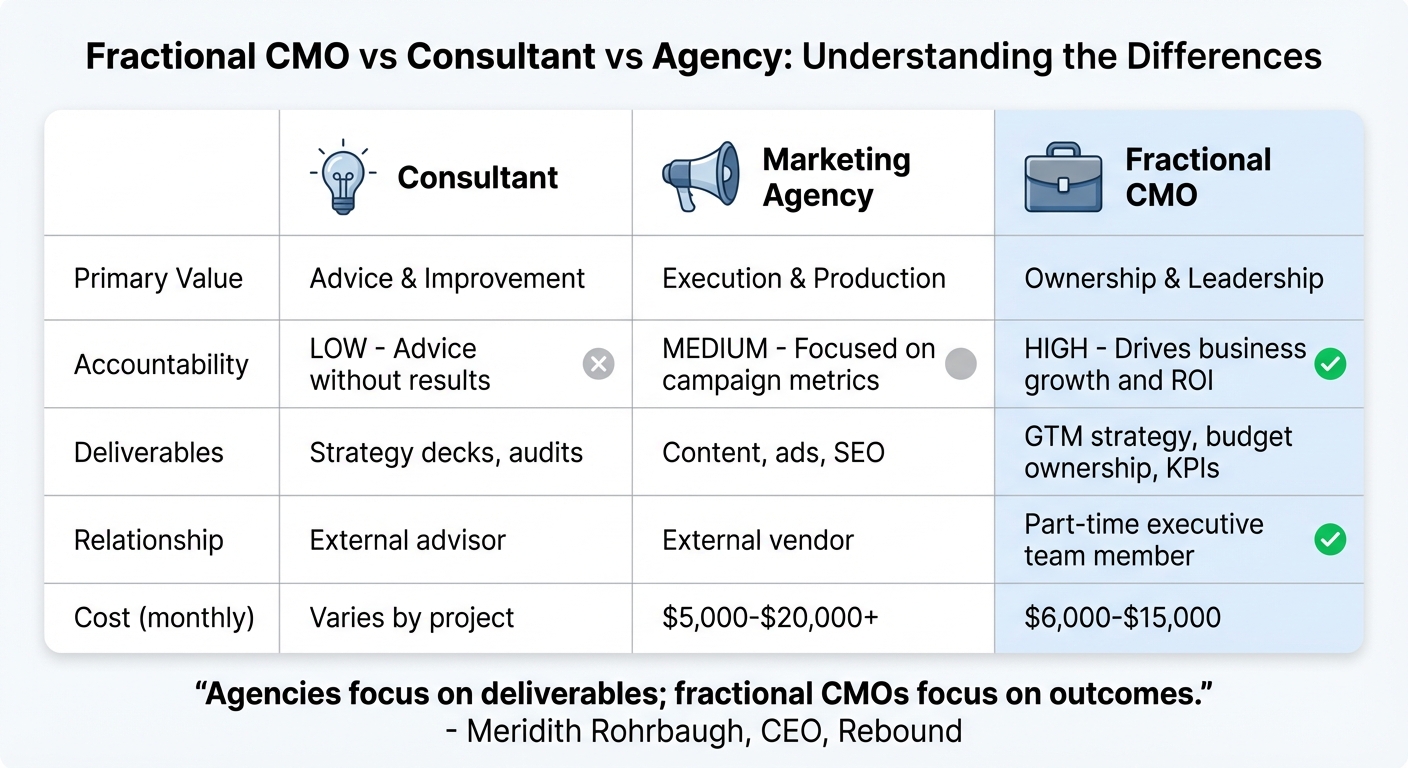
Consultants offer guidance, and agencies handle specific tasks like running ad campaigns or creating content. A Fractional CMO, however, takes charge of the entire marketing function, holding responsibility for overall business growth – not just individual campaign metrics [5].
Here’s a quick comparison to highlight these distinctions:
| Feature | Consultant | Marketing Agency | Fractional CMO |
|---|---|---|---|
| Primary Value | Advice & Improvement [6] | Execution & Production [6] | Ownership & Leadership [6] |
| Accountability | Low; advice without results [5] | Medium; focused on campaign metrics [6] | High; drives business growth and ROI [5] |
| Deliverables | Strategy decks, audits [6] | Content, ads, SEO [6] | GTM strategy, budget ownership, KPIs [5] |
| Relationship | External advisor [5] | External vendor [8] | Part-time executive team member [8] |
This level of accountability is what enables Fractional CMOs to build repeatable go-to-market (GTM) systems that adapt to startups’ growth stages. Their role extends beyond strategy to making real-world changes within teams.
Take Coding Dojo, for example. Fractional CMO Prasid reviewed their social media strategy and found that organic posts were yielding zero engagement. By redirecting the Social Media Manager’s efforts toward managing paid influencers, the company began generating sales meetings at a lower cost compared to previous paid search and social campaigns [10].
“Agencies focus on deliverables; fractional CMOs focus on outcomes.” – Meridith Rohrbaugh, Founder and CEO, Rebound [2]
GTM Engineering: Building Revenue Systems, Not Running Campaigns
Startups often rely on scattered efforts – webinars, ads, LinkedIn posts – hoping something will click. GTM Engineering flips the script. It’s about designing, connecting, and automating a cohesive revenue system, bridging the gap between big-picture strategy and day-to-day execution [4]. Think of it as building a product that consistently generates revenue, rather than managing isolated marketing campaigns.
Traditional campaigns focus on metrics like clicks and impressions. GTM Engineering, however, zeroes in on revenue-driving metrics.
“A GTM Engineer isn’t writing code. They’re engineering the sales and marketing engine that drives revenue.” – Leadle [4]
This approach treats GTM as a technical product. For instance, Clay’s team operates in two-week sprints with version control and release notes. In October 2025, they automated the creation of customer handoff decks by pulling data from Snowflake for credit consumption, Gong for call recordings, and Salesforce for account details. This data was formatted into Google Slide decks, ready for kickoff calls [3]. This isn’t campaign management – it’s building revenue infrastructure.
The GTM System: From ICP to Revenue
This engineered approach integrates every step of revenue generation into a seamless system. The GTM system connects five stages: ICP definition → offer design → distribution channels → pipeline management → revenue generation. Each stage informs the next, creating a feedback loop for continuous improvement.
It all starts with defining your Ideal Customer Profile (ICP). Instead of relying on static buyer personas, use signal-based prospecting – track hiring trends, funding announcements, and tech usage to identify real-time opportunities [4]. For example, if your product targets Series A SaaS companies, the system flags funding events or new VP of Sales hires.
Next, your offer and messaging must directly address your ICP’s challenges. Then comes distribution, which moves beyond broad, generic outreach. Modern GTM systems use precision-based infrastructure to turn signals into automated actions [4]. For instance, when a target company hires a new CMO, the system enriches the data, scores the lead, routes it, and triggers a personalized outreach sequence.
Pipeline management is where many startups lose potential revenue. Leads contacted within five minutes are up to nine times more likely to convert than those reached later [4]. A well-designed GTM system automates lead routing and real-time enrichment, often improving conversion rates by 10–15% [4]. Finally, revenue generation isn’t just about closing deals – it’s about analyzing what’s working and feeding that data back into the system to refine every stage.
| Feature | Traditional Marketing Campaigns | GTM Engineering (Systems) |
|---|---|---|
| Focus | One-off creative/outreach bursts | Repeatable, automated revenue loops |
| Execution | Manual list building and follow-ups | Automated triggers and orchestration |
| Measurement | Campaign-specific ROI/Clicks | Pipeline velocity and system health |
| Structure | Siloed (Marketing vs. Sales) | Unified data ecosystem (Revenue Stack) |
| Scalability | Requires more headcount for growth | Scales through automation and workflows |
Why Repeatable Systems Outperform One-Off Campaigns
One-off campaigns deliver inconsistent, short-term results. You run a webinar, gain 50 leads, and then spend weeks manually following up – meanwhile, your pipeline stalls. Systems, on the other hand, generate predictable revenue with repeatable processes that run whether or not you’re in the office [2].
Startups that adopt GTM systems early often experience a 15–20% increase in pipeline velocity [4]. These systems handle repetitive tasks like lead enrichment, scoring, routing, and follow-ups, freeing your team to focus on meaningful conversations instead of cleaning CSV files. Sales reps typically lose 8–12 hours a week to manual data tasks – automated systems give that time back [4].
The true advantage emerges as you scale. A campaign-driven model demands more people to sustain growth, while a systems-driven approach scales through automation and workflows. By creating a unified system, you eliminate inefficiencies, predict pipeline outcomes with confidence, and onboard new team members faster because the infrastructure is already in place. As James Clear puts it: “You don’t rise to the level of your goals. You fall to the level of your systems” [1].
“GTM Engineering works at Clay because we treat it like engineering. Clear ownership, sprint-based delivery, version control, release notes.” – Everett Berry, Head of GTM Engineering, Clay [3]
What You Get: Strategy, Systems, and Execution
Leveraging the principles of GTM Engineering, a Fractional CMO offers a blend of strategy, systems, and execution to build a revenue engine you can count on. This isn’t just advisory work – it’s hands-on leadership that delivers tangible results.
Strategy: ICP, Positioning, and Channel Focus
The Fractional CMO starts by sharpening your Ideal Customer Profile (ICP) through signal-based prospecting. They create tailored messaging and positioning frameworks, translating your product’s features into clear value propositions for each target segment. From there, they develop a 6–12 month GTM roadmap that lays out channel priorities, budget distribution, and a data-driven revenue model to define growth targets [4][7][2][10].
This roadmap answers critical questions: Should you focus on outbound or inbound? Is a product-led growth (PLG) approach better, or should you lean into a sales-led model? For example, a Series A SaaS startup might identify high-value prospects by tracking companies that recently hired a VP of Sales or secured funding.
This strategic groundwork sets the stage for building reliable systems that make revenue growth predictable.
Systems: Tracking, Dashboards, and Conversion Optimization
Once the strategy is in place, the next step is creating systems that turn plans into measurable outcomes. This involves setting up CRM platforms, marketing automation tools, and analytics dashboards to give you full visibility into your pipeline [7][2]. The Fractional CMO ensures seamless data flow across systems – like your CRM, sequencers, and enrichment tools – eliminating duplicate or conflicting integrations that can lead to blind spots [4].
Lead management systems are built in phases:
- Phase 1 focuses on quick wins such as automated lead routing, real-time data enrichment (e.g., company size, tech stack), and scoring models [4].
- Phase 2 introduces channel orchestration, including inbound nurture sequences and outbound cadences.
- Phase 3 incorporates advanced signals like job changes, product usage triggers, and account-based marketing workflows [4].
Another key deliverable is a “Golden List” – a dynamic, high-priority target account list complete with updated contact details and strategic outreach insights [3]. This isn’t just a static spreadsheet but a system that evolves as market signals shift. Implementing these systems often boosts funnel efficiency by 20-40% within 3 to 6 months [2].
With these systems in place, execution becomes a matter of structured, disciplined teamwork.
Execution: Weekly Cadence and Cross-Team Coordination
Execution is where the Fractional CMO steps into the trenches, embedding themselves into your daily operations. They lead weekly reviews and coordinate efforts across marketing, sales, and product teams [2]. Unlike consultants who hand over a deck and vanish, fractional CMOs use a sprint-based approach: two-week cycles where tasks are prioritized, bundled into releases, and delivered with detailed release notes [3].
“GTM Engineering works… because we treat it like engineering. Clear ownership, sprint-based delivery, version control, release notes.” – Everett Berry, Head of GTM Engineering, Clay [3]
The Fractional CMO also mentors your team, working closely with both in-house staff and external agencies while transferring knowledge to ensure your team can eventually manage the system independently [8][7]. They run structured experiments – testing ICPs, tweaking messaging, and refining channel strategies – to shift from guesswork to data-driven marketing [4][1]. Every two weeks, they provide updates on progress, including new sequences, dashboard enhancements, and other optimizations, keeping everyone aligned on GTM progress [3].
For instance, in 2025, a venture-backed life sciences SaaS startup partnered with a Fractional CMO through Rebound. Within just 90 days, they rolled out messaging frameworks, automated lead management, and built pipeline dashboards. The result? Better lead quality, clearer pipeline visibility, and a stronger position for their next funding round [2].
The 30-60-90 Day Implementation Plan
A Fractional CMO follows a structured three-phase approach to build a scalable revenue system. Each phase builds on the last, creating a clear progression toward an efficient and self-sustaining system.
Days 0-30: Diagnose, Set Baselines, and Address Critical Gaps
The first 30 days focus on identifying problem areas and establishing measurable benchmarks. During this period, the Fractional CMO conducts a thorough funnel audit to map lead entry points, pinpoint drop-offs, and evaluate deal closure times. They also assess your martech stack, removing redundant tools and automating manual workflows to streamline operations [7].
One priority is improving speed-to-lead. If inbound leads aren’t reaching a sales rep within two hours, the process is restructured immediately. Research shows that leads contacted within five minutes are nine times more likely to convert [4]. By the end of the first month, you’ll have key tools in place, including a GTM scorecard tracking metrics like MQL-to-SQL conversion rates and lead-to-close rates. Additional deliverables include a SWOT analysis, a refined Ideal Customer Profile (ICP), and a roadmap for experimentation [7].
Days 31-60: Build a Core Growth Loop
In the second phase, the focus shifts to execution. The Fractional CMO selects one channel and conversion pathway to create scalable, repeatable systems. This includes CRM upgrades, automated lead scoring based on ICP fit and intent signals, and a messaging framework that defines your brand voice, key differentiators, and value propositions for different audience segments. These changes aim to improve funnel efficiency by 20–40% [7][5][4][2].
The lead management process is further refined with real-time data enrichment tools like Clay or Apollo, along with instant lead routing rules [4][2]. Analytics dashboards are introduced to provide real-time tracking and ensure the team has full visibility into performance.
Days 61-90: Scale and Transition Ownership
The final phase focuses on scaling the proven growth loop and transitioning ownership of the system. This includes expanding workflows to track product usage, job changes, or intent signals that trigger sales actions [3][4]. Automated tools, such as auto-generated QBR decks or handoff slides pulling data from your CRM and call transcripts, are implemented to streamline reporting. Performance dashboards are also fully operational, offering complete pipeline visibility.
The Fractional CMO documents all processes and provides hands-on training for your team, ensuring they can manage the system independently moving forward [7][2]. This phased approach culminates in a robust GTM scorecard to track ongoing success.
| Phase | Focus | Key Deliverables |
|---|---|---|
| Days 0-30 | Diagnosis & Strategy | SWOT Analysis, ICP Refinement, GTM Scorecard, Roadmap |
| Days 31-60 | Systems & Messaging | CRM Setup, Messaging Framework, Real-Time Analytics |
| Days 61-90 | Scale & Execution | Signal-Based Workflows, Training, Automated Reporting |
sbb-itb-e8c8399
How to Measure Success: The GTM Scorecard
A GTM scorecard bridges the gap between strategy and daily execution by directly linking activities to their impact on revenue. It tracks the entire journey – from capturing leads to enriching them, handing them off to sales, and ultimately converting them [4][7]. This comprehensive view connects high-level planning with on-the-ground actions, making it a valuable tool for weekly operational reviews.
Primary Metrics: Pipeline Coverage, CAC, and Conversion Rates
These metrics provide a clear picture of your revenue engine’s performance. The pipeline coverage ratio ensures you have enough leads to meet revenue goals, typically aiming for 3x to 4x coverage depending on your market segment [4][2]. The CAC payback period measures how effectively you’re using funds to grow, with a benchmark of less than 12 months [4][2]. Conversion rates help identify weak points in the funnel, while deal velocity tracks how quickly leads move through the sales process [4][2]. Additionally, win rates reveal how well your positioning and offers align with your ideal customer profile (ICP).
When GTM strategies align effectively, startups often cut 15–30% of wasted marketing spend by reallocating resources to better-performing initiatives [2]. Implementing tasks like automated lead scoring and real-time enrichment can boost conversion rates by 10–15% [4].
Leading Indicators of System Health
Leading indicators provide an early look at system performance before revenue outcomes are visible. For example, aim for each rep to have 10+ qualified conversations weekly to forecast pipeline growth [4]. A demo booking rate of 15–20% signals that your messaging resonates with your ICP [4]. Meanwhile, product activation metrics track how quickly users find value in your product and identify patterns that suggest readiness for expansion [3][4].
One critical indicator is speed-to-lead – contacting leads within five minutes significantly increases conversion chances [4]. Maintaining a data enrichment rate above 95% reduces manual tasks, freeing up more time for selling [4]. Startups that adopt early GTM engineering functions often experience 15–20% faster pipeline velocity [4].
Sample Scorecard for Weekly Reviews
Top-performing teams use scorecards in weekly reviews to tackle tough questions about scaling demand and speeding up deal closures [11]. Instead of relying on slides, begin meetings directly from the dashboard to build consistent habits and ensure the scorecard serves as a practical “control system” [11].
| Metric Category | Specific Metric | Target Range | Why It Matters |
|---|---|---|---|
| Primary (Lagging) | Pipeline Coverage Ratio | 3x – 4x | Ensures enough volume to meet revenue goals |
| Primary (Lagging) | CAC Payback Period | < 12 Months | Tracks how efficiently capital is spent |
| Early Warning (Leading) | Qualified Conversations | 10+ per week/rep | Predicts future pipeline growth |
| Early Warning (Leading) | Demo Booking Rate | 15% – 20% | Shows if messaging resonates with the ICP |
| System Health | Lead Response Time | < 5 Minutes | Boosts conversion probability |
| System Health | Data Enrichment Rate | > 95% | Reduces manual work, increasing selling time |
“What doesn’t get measured can’t get improved. This is why it’s really important to capture the complete health of your GTM system across different metrics and understand how they are connected.” – Maja Voje, GTM Strategist [11]
Use pre-operational metrics to identify potential issues early [11]. For instance, monitor delays like waiting for approvals to uncover bottlenecks in your system [11]. Treat the scorecard as a living tool – regularly adjust metrics and targets based on the insights gained from your reviews [12].
When a Fractional CMO Is the Wrong Choice
A Fractional CMO can be a powerful addition to your team – but only if your startup is ready for what they bring to the table. If your operations or product development aren’t up to speed, hiring one could waste both time and money. Knowing when not to hire a Fractional CMO is just as important as knowing when to bring one on board.
Product Isn’t Ready or Team Can’t Execute
If your startup hasn’t nailed down product-market fit, a Fractional CMO isn’t the solution. For companies in the $0–$500k ARR range, founder-led sales are far more effective than external marketing leadership [9].
“No one but you (founder) can be the CRO and AE at this stage [$0–$500k ARR]. The founder is the best and only person who can close those first sales.” – Jess Schultz, Founder & CEO, Amplify Group [9]
Similarly, if your team struggles to release product updates or act on customer feedback, even the best marketing strategy will fall flat. A Fractional CMO builds systems that depend on your team’s ability to adapt and improve based on data. Without execution, those systems are just ideas on paper [2].
This highlights a critical point: your internal operations must be solid before you can scale effectively with external marketing leadership.
Seeking Content Creation Instead of Revenue Systems
If your main priority is creating blog posts or social media content, a Fractional CMO isn’t the right hire. Their role is to build scalable systems, not churn out LinkedIn posts [5]. They focus on metrics like pipeline coverage, conversion rates, and CAC payback – not engagement numbers.
When content production is your biggest gap, you’re better off hiring a content strategist or agency. Fractional CMOs excel at identifying funnel problems, aligning sales and marketing, and creating repeatable revenue systems. Asking them to handle tactical content tasks misuses their expertise and leaves the bigger revenue-building opportunities untapped.
No Bandwidth for Weekly Execution
Even with the right product and a solid strategy, execution is where the magic happens – and your team needs to show up for it.
The GTM Engineering approach relies on consistent weekly participation from your team [1]. This means reviewing dashboards, iterating on systems, and acting on data regularly. Without this commitment, even the best systems will stall.
If your team is stretched too thin to handle weekly sprints or system updates, a Fractional CMO won’t be able to implement their strategies effectively. This disconnect often leads to frustration on both sides. A strategy that isn’t executed is a wasted investment, no matter how strong it looks on paper [4].
Before bringing on a Fractional CMO, make sure your team has the capacity to engage in weekly cycles, review data, and continuously refine systems. Without this alignment, even a cost-effective Fractional CMO won’t deliver the results you’re hoping for.
To fully benefit from a GTM-engineered revenue system, your product, content needs, and team capacity must all align.
Frequently Asked Questions
Below are answers to some common questions that expand on the ideas discussed earlier.
What does a Fractional CMO do for a startup?
A Fractional CMO steps in part-time to design and operate your revenue engine. They join your leadership team to provide executive-level guidance on go-to-market (GTM) strategies, oversee budgets, and manage internal or external teams. Their goal? To align marketing and sales efforts under a single, cohesive revenue plan, replacing scattered marketing activities with structured, repeatable systems [2][5][6].
Their responsibilities cover three key areas:
- Strategy: This includes refining your Ideal Customer Profile (ICP), establishing positioning, and prioritizing marketing channels.
- System Building: They handle infrastructure setup, like tracking tools, automation, and lead management systems.
- Execution Management: Using weekly sprints, they coordinate teams and ensure priorities stay on track.
Instead of focusing on one-off campaigns, a Fractional CMO lays the groundwork for scalable systems, such as automated lead routing, dashboard tracking, and optimizing conversion paths.
What’s the difference between a Fractional CMO and an agency?
The key difference lies in ownership and accountability. A Fractional CMO takes charge of your revenue strategy and leads your team, while an agency focuses on executing specific tasks without strategic oversight [2][6].
Agencies are typically hired to deliver specific outputs, like ad campaigns or content production. In contrast, a Fractional CMO builds and manages the long-term systems and strategies needed for company growth. They make decisions about your GTM tech stack, ensure alignment between sales and marketing, and are responsible for broader metrics like pipeline health and conversion rates – not just campaign results.
If you’re looking for someone to oversee your entire revenue function without hiring a full-time executive, a Fractional CMO is the better option. For specialized work in a single area, an agency is the right fit.
What is GTM Engineering?
GTM Engineering applies the principles of product engineering to GTM operations. Instead of treating marketing as a series of creative projects, it views it as a technical system that requires consistent, iterative improvement [3][4].
This approach often includes working in two-week sprints and automating tasks like lead routing and signal-based prospecting [3][4].
“RevOps defines the ‘rules of the game,’ while GTM Engineers ‘build the playing field and make sure the game runs without interruption.'” – CandyboxCRM [4]
How much does a Fractional CMO cost?
The cost of a Fractional CMO depends on factors like time commitment, your company’s stage, and the scope of their role. On average, rates fall between $5,000 and $20,000 per month [6][9].
Here’s a breakdown of typical pricing:
| Engagement Level | Monthly Hours | Typical Cost | Ideal For |
|---|---|---|---|
| Light Advisory | 5–10 hours | $2,000–$4,000 | Early-stage audits and occasional guidance |
| Core Fractional | 20–50 hours | $6,000–$15,000 | Strategy, leadership, and system setup |
| High-Involvement | 80–120+ hours | $15,000–$25,000+ | Major initiatives like market expansion or product launches |
Costs are influenced by several factors, including your industry (technical fields like healthtech often command higher rates) and whether the role focuses solely on strategy or includes execution oversight. These fees typically represent 30–50% of what a full-time CMO would cost, with the average full-time CMO earning around $32,500 per month when benefits are included [2][6][9].
Conclusion
Startups thrive on systems, not sporadic efforts. A Fractional CMO who uses GTM Engineering principles can turn scattered marketing experiments into a reliable and scalable revenue system. This involves approaching your GTM stack with the same discipline you bring to product development: think version control, sprint-based delivery, and consistent iteration [3]. The payoff? Tangible results like better marketing ROI, faster pipeline velocity, and hours saved from manual work [6][4].
“You don’t rise to the level of your goals. You fall to the level of your systems.” – Sangram Vajre, GTM Partners [1]
By automating processes like lead routing and data enrichment, GTM Engineering eliminates the chaos of manual tasks [3][4]. This automation doesn’t just save time – it allows your team to focus on what truly matters: high-value customer interactions.
If your team spends more time patching funnel leaks than refining product-market fit, or if SDRs are losing over 20% of their time to manual data entry, it’s time to consider a Fractional CMO who applies GTM Engineering [4]. This approach typically costs just 30–50% of a full-time executive’s salary while delivering the strategic expertise and technical precision needed to turn disjointed marketing efforts into a cohesive revenue engine [2].
This kind of system isn’t just a tool – it’s the foundation for scalable growth that lasts.
FAQs
What makes GTM Engineering different from traditional marketing strategies?
GTM Engineering treats go-to-market strategies as a structured, repeatable process rather than a collection of isolated campaigns. This approach centers on building a measurable system that ties together every step of the revenue journey – ideal customer profile (ICP), offer, distribution, pipeline, and revenue – while developing the tools, dashboards, and automation needed to refine and scale it, much like a software product.
Traditional marketing, on the other hand, often leans on one-off campaigns or creative efforts, placing less focus on data-driven workflows and ongoing improvement. By emphasizing instrumentation, iteration, and scalability, GTM Engineering allows for rapid testing and sustained growth. In contrast, traditional methods may lack the structured framework needed for consistent performance and optimization over time.
What are the key metrics for evaluating a Fractional CMO’s success?
The effectiveness of a fractional CMO is gauged by tracking essential metrics like pipeline coverage, CAC (Customer Acquisition Cost) payback targets, conversion rates, sales velocity, and win rates. Additionally, leading indicators such as qualified conversations per week, demo rates, and activation rates offer valuable insights into how well the overall system is performing.
By focusing on these metrics, startups can ensure their go-to-market strategies are driving consistent growth, operating efficiently, and delivering tangible outcomes.
When is hiring a Fractional CMO not the right choice for a startup?
Hiring a Fractional CMO might not be the right fit if your startup isn’t quite prepared for growth on a larger scale. These professionals excel at creating systems that drive sustainable revenue, but if your immediate needs are focused on managing social media or running isolated campaigns, this role may not match what you’re looking for.
It’s also important to assess your team’s bandwidth. If you’re unable to maintain a consistent weekly rhythm or implement the strategies and recommendations provided, you may not see the full benefit of bringing in a Fractional CMO. Before taking this step, ensure your startup is ready to embrace a structured and results-oriented approach.
Related Blog Posts
- Best Fractional CMOs for Tech Startups: 6 Strategic Leaders Driving 100x Growth (2025)
- Top 10 GTM Engineering Consultants for 2026 & How To Choose the Right One For Your Startup
- The AI GTM Engineer: The Missing Role Behind Scalable B2B Growth
- Fractional CMO vs GTM Engineer vs Agency: What Startups Actually Need