
If you sell AI into the enterprise in 2026, your deal can stall for 4 to 8 extra weeks unless you show proof across five areas: evals, production visibility, governance, data handling, and deployment. I’d treat this as a sales system, not a security side task.
Here’s the short version I’d give any founding team:
- SOC 2 gets you into review, not through it
- Buyers want evidence they can inspect, not policy claims
- Missing proof can kill deals, and the article cites 50% of competitive evaluations ending in disqualification for missing or unverifiable security credentials
- A $250,000 deal delayed by five weeks can cost more than $11,500 in delayed revenue
- By August 2, 2026, the EU AI Act hit full enforcement for high-risk systems, so buyer scrutiny is higher
In other words, your enterprise-readiness stack needs five parts:
- Evaluation proof
Show test results, bias checks, hallucination rates, source trace for data, and buyer-ready artifacts like model cards and an AI bill of materials. - Production visibility
Keep timestamped logs for prompts, outputs, tool calls, and policy actions. Buyers also want audit trails, tenant separation, encryption, and access controls. - Governance docs
Have clear answers ready for model inventory, human review, prompt injection, retention, incident response, and whether customer data trains models. - Deployment controls
Match your architecture claims to actual data flow. If prompts still leave the customer boundary, buyers will spot it. Region pinning matters, especially for EU deals. - A trust pack for sales
Put the whole file in one place with owners and last-updated dates, then share the right slice at discovery, pilot, security review, and procurement.
The challenge here is simple: enterprise buyers approve risk before they approve product. So if I were building the sales motion, I’d lead with a tight trust pack that answers security, legal, and procurement before the questionnaire even lands.
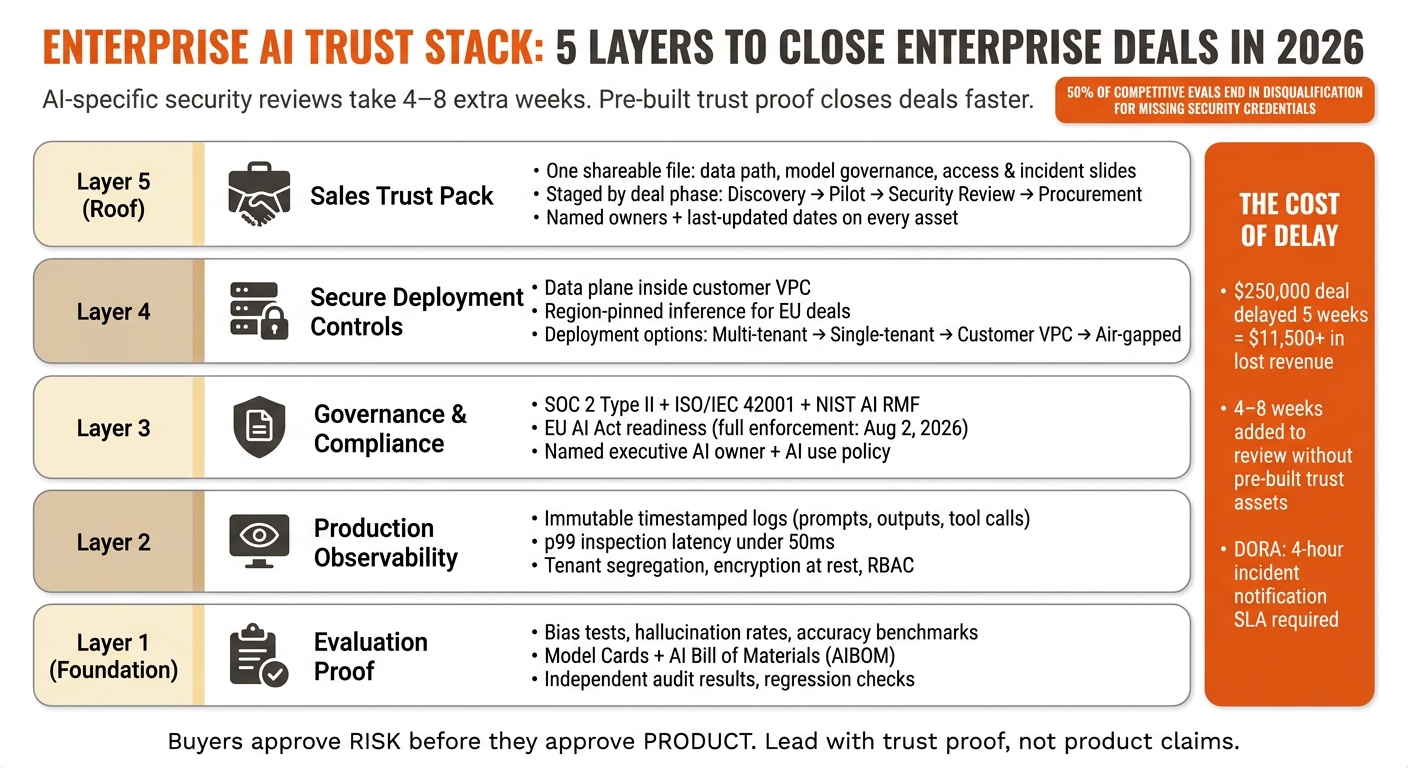
Enterprise AI Deal Readiness: 5-Layer Trust Stack for Closing B2B Deals in 2026
Inside the Startup Saving Enterprises from AI’s Most Dangerous Mistake – Opsin
1. Evaluation and proof: show measurable reliability before the pilot expands
Proof comes first. Before a pilot grows, buyers want evidence they can inspect on their own, without your team there to explain every slide. In other words, you need an evidence pack they can read before they ask for a live trial.
Buyers usually look for independent test results, bias checks, measured hallucination rates, and continuous monitoring. The SEC fined Delphia and Global Predictions for unsubstantiated AI claims, so every claim in your deck needs a source file [7].
Build the minimum evaluation package buyers can review
Think of the evaluation package as a buyer-ready evidence file. Each piece should answer a question that will come up in security or legal review.
| Evaluation Component | Minimum Evidence Required |
|---|---|
| Datasets | Source trace, signed licenses, consent records for user-generated content, and an AI Bill of Materials (AIBOM) |
| Test Cases | Bias tests, accuracy benchmarks, robustness testing, prompt injection, data poisoning, model inversion, hallucination and factual accuracy checks, regression checks |
| Production metrics | MMLU, TruthfulQA, p99 latency, drift detection, confidence scores |
| Buyer-facing artifacts | Model Cards, SOC 2 Type II (AI-specific), independent bias audit, incident register |
The goal is simple: make it easy for a security reviewer to verify risk without booking a follow-up call.
Run the same evaluation twice, one week apart, and show that the results hold steady. Document how your system handles uncertainty. A model that says "I don’t know" is often seen as safer than one that guesses with confidence [10].
For Tier 1 use cases, especially customer-facing flows or systems tied to regulated decisions, buyers may ask for quarterly reassessment of performance and bias [6]. The good news is that proof gets stronger when one person owns the risk record and keeps it current.
Package the core proof artifacts into one shareable document so security can review everything without another meeting [9].
Gentrace, Kolena, and Airtrain.ai fit here when they help you package repeatable tests and exportable reports.
Once the proof layer is in place, the next question is whether production monitoring can sustain that trust.
2. Observability and monitoring: prove ongoing control after deployment
Production control is the mechanism here. Passing eval gets you in. Proving control after deployment keeps you in. At that point, the buyer’s question shifts from “Did it work?” to “Can you prove it still works?”
Enterprise security teams want proof they can inspect live behavior. They don’t want comforting language. If your answer is, “we log everything for 30 days for debugging,” you sound like you built debug logging, not enterprise monitoring. With regulated buyers, that answer dies fast.
The minimum observability evidence that reduces enterprise risk
Buyers draw a hard line between monitoring and observability.
| Dimension | Monitoring | Observability |
|---|---|---|
| Focus | System health, aggregate performance | Why a decision was made and what data it used |
| Key signals | Uptime, latency, error rates | Traces, tool calls, retrieved context, agent handoffs |
| Primary audience | DevOps, SRE teams | Legal, compliance, security officers |
| Key artifact | Dashboard with trend lines | Searchable audit trail of specific interactions |
In other words, monitoring tells you the system is up. Observability shows what happened, why it happened, and who can inspect it later.
Enterprise buyers expect immutable, timestamped logs for prompts, outputs, tool calls, and policy actions. They also expect tenant segregation, encryption at rest, and role-based access controls [5][8]. That’s the baseline for proving control when someone from security, legal, or compliance asks for a specific record.
For inline deployments, speed matters more than many teams expect. Buyers want p99 inspection latency under 50 ms. Once you go above 100 ms, users start routing around the system. Once you cross 300 ms, the setup becomes unworkable [3].
Incident response is another place where buyers look for hard proof. They want a documented kill switch: one control-plane action that can cancel in-flight tool calls and deactivate a specific agent without taking down the full system [3][8]. You should spell out how long that action takes. You should also line up your notification SLAs with the rules buyers already live under. DORA requires a 4-hour initial notification for critical incidents [5].
The good news is that this gets much easier to defend when your production traces map back to the same test criteria you used during evaluation. That lets buyers check drift, toxicity, hallucinations, and agent handoffs in one place. Or put another way, they can follow a single audit trail across logs, traces, policy events, and incident response records instead of piecing the story together from scattered dashboards and screenshots [5][3][11].
Once that trail is in place, buyers move to governance and deployment controls.
3. Governance, compliance, and secure deployment: answer the questionnaire before it arrives
Security review for AI deals has changed. Buyers now ask pointed questions about governance, data handling, and deployment, so you want those answers ready before procurement sends the form over.
SOC 2 gets you in the room. It does not close the deal on its own. What keeps things moving is clear alignment with ISO/IEC 42001 and the NIST AI RMF, with EU AI Act readiness showing up more often, even in U.S. deals [4][2]. Procurement teams also lean on AI-CAIQ and SIG AI as standard review templates [3][2]. On top of that, they expect named executive ownership, a written AI use policy, and a full map of the AI supply chain, including model providers, inference hosting, and vector database vendors [4][5].
Map governance requirements to real procurement questions
The mechanism here is simple: turn governance into prewritten procurement answers. Every category below lines up with questions buyers already ask.
| Governance Category | Procurement Question | Required Artifact |
|---|---|---|
| Executive Ownership | Who is responsible for AI risk and policy? | AI Use Policy with a named executive owner [4] |
| Model Inventory | Which foundation models underpin the service? | AI Bill of Materials (AIBOM); version-pinned model cards [5][14] |
| Training Data | Is customer data used for model training? | Data Processing Addendum with explicit "no-training" clauses [4][5] |
| Subprocessor Visibility | Which AI vendors are in the supply chain? | Subprocessor list including foundation model, inference hosting, and vector database providers [4][5] |
| Prompt Injection | How do you defend against adversarial attacks? | OWASP LLM Top 10 eval results; runtime detection logs [5][12] |
| Human Oversight | How are autonomous agent actions governed? | Documentation of human-in-the-loop checkpoints [5][10] |
| Incident Response | What is your notification timeline for AI incidents? | AI Incident Runbook with SLA tiers (e.g., 4-hour initial) [5][14] |
| Retention & Deletion | Can we require zero-retention for prompts? | Configurable retention tables and deletion certificates [5][11] |
| Auditability | Can we audit a specific decision independently? | Signed execution receipts and portable proof packs [13][14] |
One thing stalls deals all the time: your training-data answer has to match the contract language [5][2]. If the questionnaire says, "we don’t train on your data", but the DPA stays vague, security teams will catch it. And when they do, the deal slows down fast.
After that, buyers usually move to the next layer: where the data lives and who can touch it.
How Credal AI, Lenzo, and deployment architecture build buyer trust
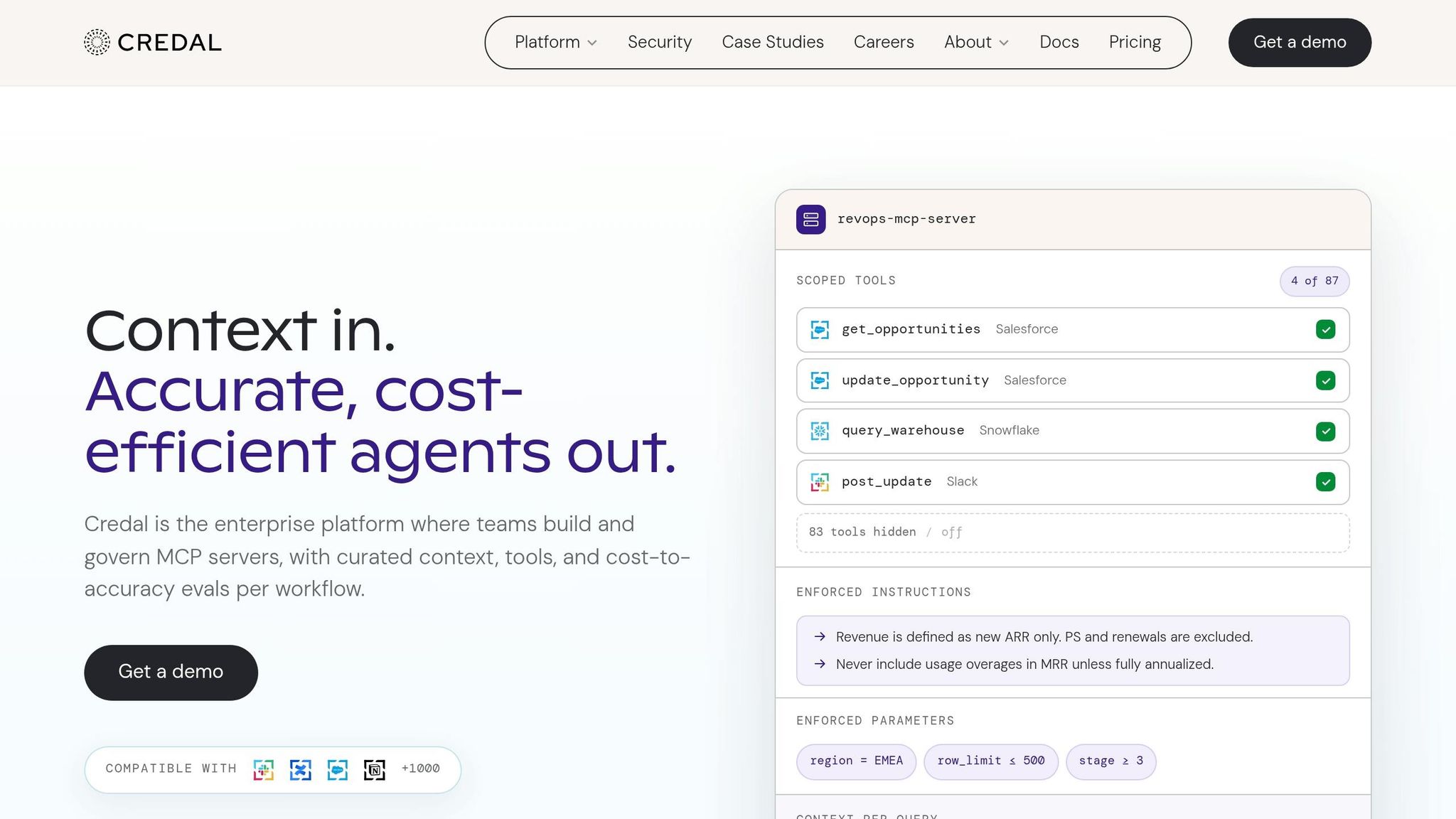
The cleanest setup is to keep the data plane inside the customer’s VPC and limit the control plane to metadata, RBAC, and configuration. That split matters more than many teams expect.
"If the vendor’s ‘VPC deployment’ still ships prompts to a vendor-managed log aggregator, that’s a SaaS deployment in a different wrapper." – TrueFoundry [14]
In other words, deployment language has to match data flow in practice, not just on the diagram. These controls help legal and security teams move faster because they turn architecture into proof. For EU buyers, "routing to whichever region has capacity" is a red flag. They want data flow diagrams that show region-pinned inference [2].
| Deployment Option | Isolation Level | Operational Overhead | Data Residency Fit | Typical Buyer Type |
|---|---|---|---|---|
| Multi-tenant SaaS | Low (Logical) | Low | Vendor-defined | Startups, SMBs, non-regulated units [12][14] |
| Single-tenant SaaS | Medium | Medium | Region-specific | Mid-market, some enterprise units [5][14] |
| Customer VPC | High (Network) | High | Customer-defined | Fortune 1000, Healthcare, FinServ [14] |
| Air-gapped / on-prem | Maximum (Physical) | Very High | Local only | Government, Defense, Critical Infra [14] |
Once this is documented, sales has something concrete to hand over during review: an evidence pack that answers the buyer’s risk questions with policy, architecture, and contract-ready language.
4. Turn the stack into a sales asset: close enterprise deals with readiness proof
Enterprise deals move when a buyer can check the whole stack in one place. The sales asset here is simple: turn your proof into one buyer-ready file that sales can use in every deal.
Build an AI security and trust pack for every enterprise opportunity
The trust pack should live in a single link or PDF. It should answer procurement before they ask. This is an evidence file, not a pitch deck.
At a minimum, it should cover four questions: where data lives, what the model does with it, who sees the outputs, and what happens during a failure [1].
Each item also needs a named owner and a last updated date. Without that, security teams can treat the file as stale [15].
Use the same pack across the deal cycle, but share only what fits the stage. That keeps the process clean and gives buyers what they need without dumping everything on them at once.
- Discovery: share three slides: a data-path slide, a model-governance slide, and an access-and-incident slide [1].
- Pilot kickoff: add the evaluation summary and monitoring overview.
- Security review: release the full trust pack, including the AI-BOM, pre-filled AI-CAIQ responses, and governance policy excerpts [2][4].
- Procurement: provide the data policy summary, AI usage statement, and AI safety playbook for hallucinations, bias, and leakage [15].
| Buyer Concern | Trust Pack Asset | Key Evidence |
|---|---|---|
| Accuracy | Evaluation Summary | Benchmark results, hallucination rates, bias outcomes |
| Safety | AI Usage Statement | Guardrail configs, prompt-injection resistance, refusal taxonomy |
| Governance | AI-BOM / Model Inventory | Model versions, providers, training data provenance |
| Security | Pre-filled AI-CAIQ / SIG AI | Answers to 80+ standard AI security addendum questions [2] |
| Ongoing Control | Monitoring Dashboard Link | Drift detection, error rates, unsafe output filtering |
| Legal/Procurement | Data Policy Summary | Retention periods, residency, PII redaction methods |
| Executive Buy-in | Proof of Results | Measured deployment outcomes |
How I position enterprise-readiness assets inside AI-native GTM at Data-Mania
The mechanism is a gap review. I use it to spot missing trust, proof, and security assets before procurement finds the holes.
Then I bake those assets into the default enterprise sales motion. In other words, the team shares one trust pack early instead of scrambling after a security request. That move can cut review time and show enterprise buyers that the company planned for approval from day one.
Conclusion: The enterprise-readiness stack founders need in 2026
Enterprise AI deals often slow down for a simple reason: buyers can’t verify that the system is safe, governed, and under control. Model quality matters, of course. However, one missing layer in the stack can still block the deal.
That is why the trust pack needs to sit inside the sales motion, not just with security. AI-specific security reviews in 2026 take 4 to 8 weeks longer than standard SaaS reviews [2]. When you pre-package trust assets, security teams can verify risk faster, review cycles get shorter, and the back-and-forth drops. Buyers approve risk before they approve capability, so lead with trust proof before product claims.
The stack described here gives buyers what they need to move forward: evaluation evidence, runtime monitoring, governance, secure deployment, and a pre-built trust pack. Build it once, keep it current, and use it as a core sales asset. Make it part of every enterprise deal from day one.
In 2026, enterprise AI readiness is the difference between a strong pilot and a closed deal.
FAQs
What should founders build first to pass AI security review faster?
Treat trust as an upstream architecture discipline from day one. Put it into the system design early, then let marketing reflect what the system already does.
Start with the build itself:
- Create a documented end-to-end data path
- List every third party, encryption status, and data retention policy
- Publish a Trust Center with SOC 2 reports, ISO 42001 statements, AI-BOM, and monitoring evidence
Your architecture needs to back every claim in public. That matters most for tenant isolation and whether models train on customer inputs, because those are the first places technical buyers will look.
How is AI observability different from normal SaaS monitoring?
Normal SaaS monitoring tracks the system layer: database access, server latency, and network traffic. AI observability tracks the model layer, where behavior can shift in ways that feel less like software bugs and more like judgment errors. That includes hallucinations, bias, prompt injection, and model drift.
For enterprise buyers, that difference matters fast. They want proof at the interaction level, not just a green uptime dashboard. That means per-interaction audit logs, output performance metrics, and continuous monitoring for quality, safety, policy enforcement, and adversarial robustness.
Which deployment model do enterprise buyers usually require?
Enterprise buyers care less about a single deployment model and more about whether the architecture fits their security and governance rules.
In practice, they usually evaluate three setup options: self-hosted, hosted by a third-party inference provider, or hosted by the original model provider. For top-tier customers, the bar is often higher. They tend to want dedicated deployments and region-pinned inference instead of shared inference or capacity-based routing.
Related Blog Posts
- How to Choose AI Marketing Operations Software: A Buyer’s Framework (Workflows, Permissions, Security, Reporting)
- The AI-Native Founder’s Build-to-Sell Stack: Tools to Ship and Sell an AI Product (2026)
- AI-Native GTM for Vertical AI Startups: Positioning & ABM Playbook (2026)
- Human Oversight in Your AI GTM Automation: When to Keep a Human in the Loop (2026)