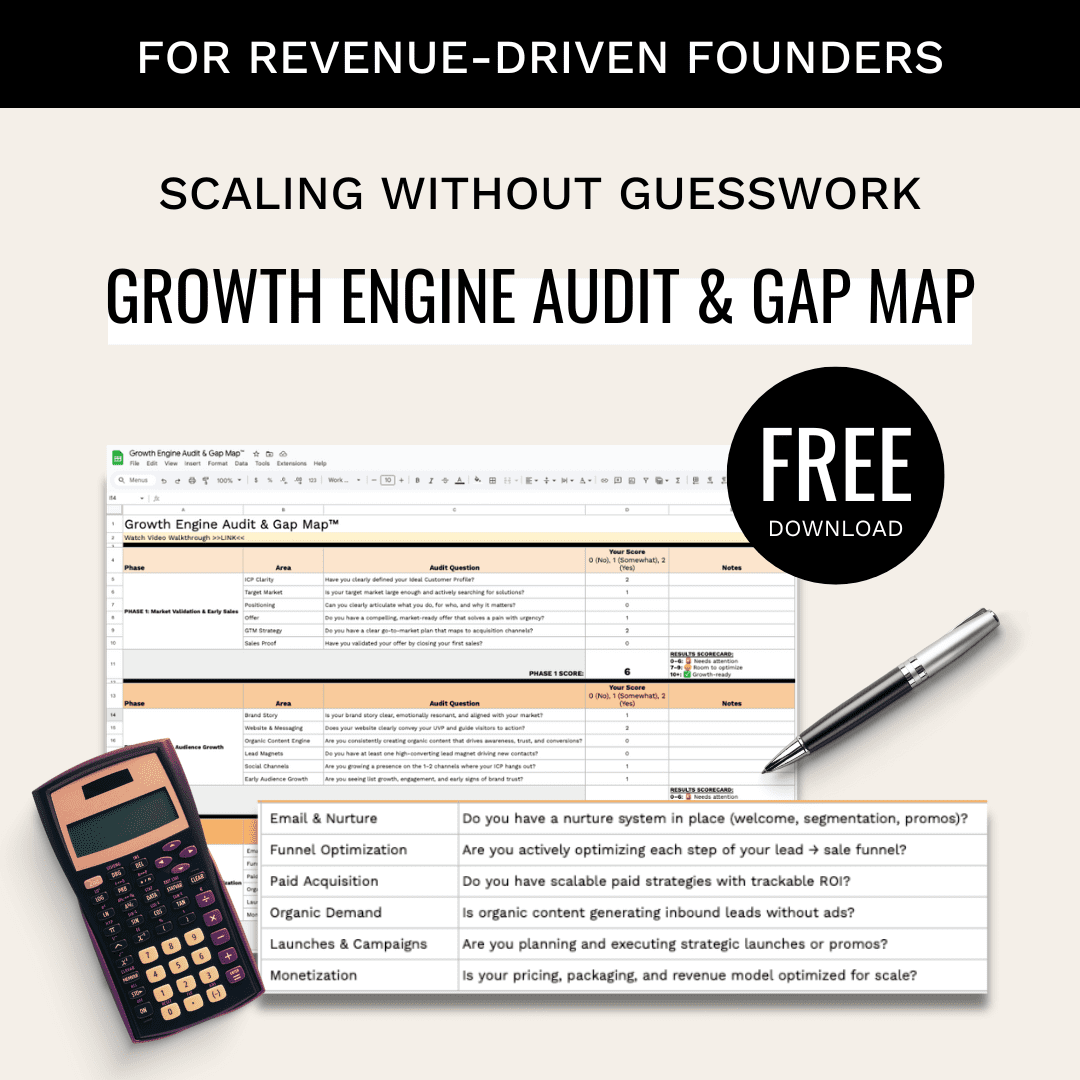

Founder-led sales works right up until it doesn’t. Once you hit product-market fit, the manual outreach and the pipeline that depends on you start capping how fast you can grow. What you need next is a repeatable, marketing-driven revenue engine that runs without you in every deal.
That shift is exactly what a go-to-market consultant is for. Most B2B buyers now research and shortlist vendors long before they ever talk to sales, so your positioning, your content, and your pipeline systems have to do the selling early. Below are the 7 best GTM consultants for tech startups in 2026, what each one is best at, and how to match one to your stage.
Here’s a quick rundown of the 7 best GTM consultants for tech startups in 2026:
- Data-Mania: Fractional CMO services for AI, SaaS, and analytics startups. Known for hands-on execution and scalable growth systems. Pricing: $5,000–$20,000/month.
- Oak Tech: Tailored RevOps strategies for B2B tech companies. Ideal for Series A+ startups needing data-driven GTM plans.
- GrowthMentor: Affordable mentorship model with unlimited access to 750+ experts. Flat rate: $99/month.
- Bain & Company: Full-service GTM transformations for established startups ($200M+ revenue).
- Altman Solon: TMT sector specialists with AI-driven GTM accelerators. Focused on SaaS, fiber, and digital infrastructure.
- GrowthRocks: Growth hacking for B2B SaaS and marketplaces. Emphasizes organic and inbound strategies.
- Toptal: On-demand freelance GTM consultants. Flexible pricing: $60–$150/hour.
Quick Comparison:
| Consultant | Best For | Pricing | Key Services |
|---|---|---|---|
| Data-Mania | AI, SaaS startups (early-stage) | $5,000–$20,000/month | Fractional CMO, GTM engineering |
| Oak Tech | B2B tech (Series A+) | Custom | RevOps, pipeline audits, vertical markets |
| GrowthMentor | Early-stage, bootstrapped | $99/month | Unlimited mentorship sessions |
| Bain & Company | Series C+, $200M+ revenue | Custom | Full GTM transformations, benchmarks |
| Altman Solon | TMT sector | Custom | AI-driven GTM, test-and-learn frameworks |
| GrowthRocks | B2B SaaS, marketplaces | Custom | Growth hacking, organic strategies |
| Toptal | Flexible, short-term needs | $60–$150/hour | Freelance GTM consultants |
The best consultant depends on your stage, budget, and urgency. Need fast execution? Choose Data-Mania or GrowthRocks. Tight budget? GrowthMentor is perfect. Scaling a complex SaaS? Bain or Altman Solon can help. Pick the one that aligns with your goals and get results faster.
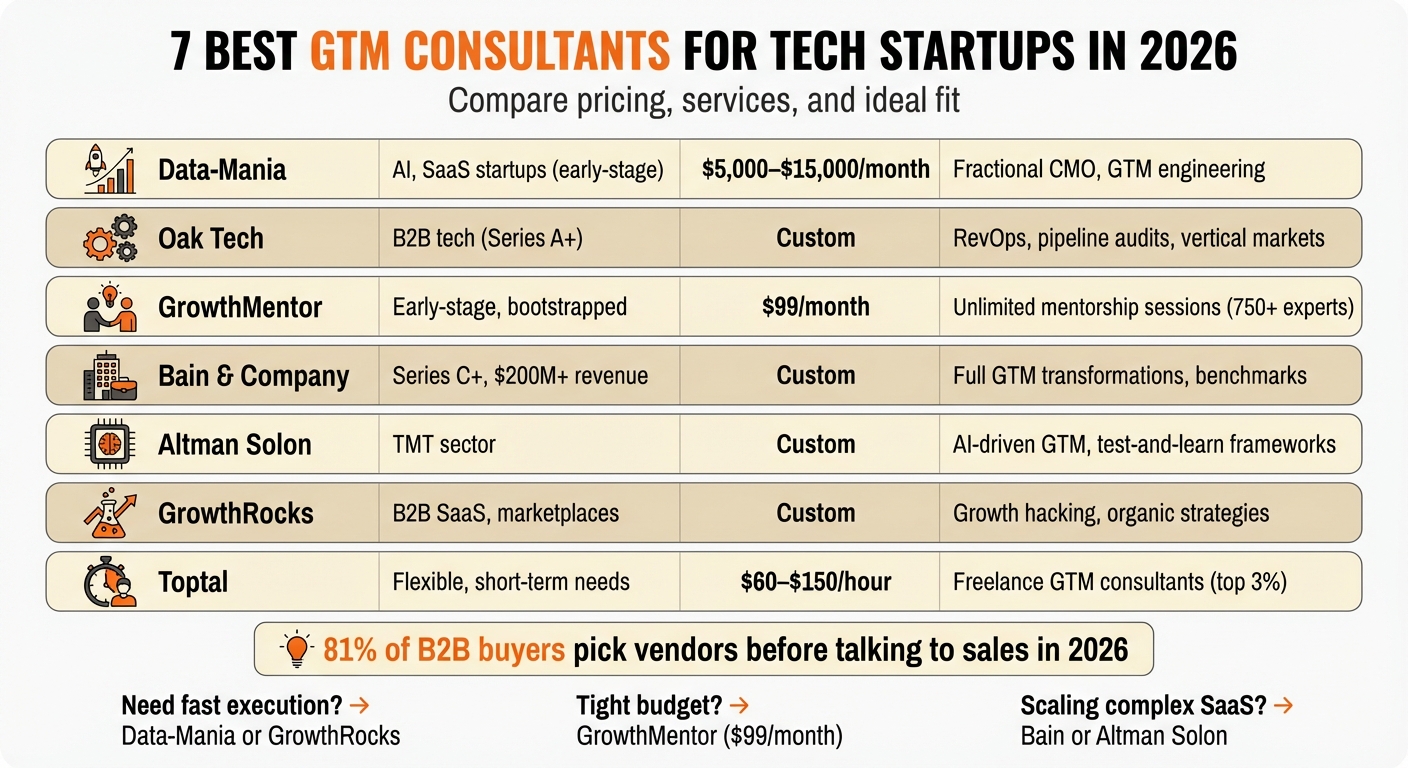
Comparison of 7 Best Go-To-Market Consultants for Tech Startups 2026
Go-To-Market Strategy Framework That Works in 2026
1. Data-Mania: Fractional CMO and GTM Engineering for Tech Startups
I built Data-Mania to give technical startups senior marketing leadership and the GTM engineering to back it, without the full-time CMO salary that now runs well into the $300,000s. That is my firm, and instead of handing you a strategy deck and walking away, I build the AI-driven growth systems that turn your technical strengths into repeatable revenue, and I stay hands-on while we build them. The technical fluency behind that comes from being a licensed Professional Engineer turned fractional CMO.
Services and Features
My work follows three moves: find the gaps, own the leadership while we fix them, and build systems that keep scaling after I step out. In practice that covers GTM strategy (ICP, positioning, messaging, and channel selection), team mentoring, KPI ownership across CAC, payback, activation, and retention, and demand generation. For shorter engagements I run focused consulting on digital strategy, paid media, and brand audits, and for bootstrapped founders I offer a 60-minute Power Hour that sends you off with a plan you can act on. You can see how I approach the build in my guide to multi-channel GTM growth engines.
Best Fit for Startups
I’m the right fit for technical founders moving past founder-led sales who need a scalable GTM system fast. I work with AI, analytics, and B2B SaaS startups from early to growth stage, including B2C, D2C, B2B2C, and two-sided marketplace models. The results speak to the approach: I helped a VC-backed data SaaS company hit 200x user growth in 90 days, and generated more than 1 million views and 45,000 engagements in three months for IBM through technical outreach. Across engagements, my positioning and pricing work has helped clients close deals worth up to $750,000.
“As a technical founder, I was pretty naive around what it really would take to get a big product to market. Working with Lillian was really, really a critical part of us getting to the next level in our business.” – Tony Garvan, Founder & CEO, SheetRocks
Pricing and Plans
I scope pricing to your stage and the work involved. Fractional CMO engagements run $5,000 to $20,000 a month for roughly 10 to 20 hours a week, on a defined 3-to-6-month scope. Short-term consulting projects generally land between $10,000 and $50,000 depending on scope, and the Power Hour is a one-time session for founders who need a fast, focused plan. Every engagement is built to hand off, so your team keeps running the system when I step out. That is a fraction of a full-time CMO’s $300,000-plus all-in cost, and you keep the system when the engagement ends.
2. Oak Tech GTM Consulting: Custom Growth Plans for B2B Tech
Oak Tech, also known as Oak Terrace Consulting, focuses on Revenue Operations (RevOps), delivering tailored go-to-market (GTM) strategies for B2B tech companies. Their services cater to a range of clients, from Series A startups to global corporations with revenues exceeding $3 billion. Instead of relying on one-size-fits-all growth tactics, Oak Tech crafts data-driven plans designed to address specific business needs.
A key strength of Oak Tech is their four-pillar framework, which includes:
- Strategy: Covering Total Addressable Market (TAM), Ideal Customer Profile (ICP), and Voice of Customer (VoC) assessments.
- Operations: Managing tech stacks and optimizing pipeline generation.
- Analytics: Providing executive dashboards and tracking performance metrics.
- Enablement: Offering skills training and aligning leadership teams.
This structured approach ensures clients receive not just a strategy but also the operational tools to implement it effectively.
Services Offered
Oak Tech’s GTM Transformation services are designed to eliminate inefficiencies across the sales cycle, from the first interaction with a lead to collecting the final payment. They help teams transition from broad, generalist roles to specialized groups focused on customer acquisition strategies and retention. Their fractional CMO and CRO services offer executive-level expertise without the need for full-time hires.
For businesses looking to refine their lead generation, Oak Tech conducts pipeline audits to evaluate performance and set revenue-aligned coverage targets. They also assist startups exploring new markets by conducting vertical market assessments and creating tailored GTM strategies, such as Product-Led Growth (PLG) for smaller deals or high-touch approaches for enterprise sales.
Using Voice of Customer (VoC) assessments, Oak Tech ensures that messaging and value propositions are based on actual market feedback rather than assumptions. This approach helps companies avoid the common mistake of building campaigns or products around what founders think customers want, rather than what they truly need.
Implementation Speed
Oak Tech creates strategy and prioritizes fast, effective execution. Operating on a fractional and advisory model, they provide ongoing support instead of limiting their involvement to short-term projects. This allows them to align initiatives with fiscal cycles while continuously refining tactics.
Their Analytics pillar plays a crucial role by offering real-time dashboards and customer adoption metrics. These tools allow you to identify successful GTM motions quickly and make necessary adjustments. Consider this: nearly 85% of B2B SaaS startups struggle to scale effectively due to misaligned GTM strategies, but those that optimize their approach often achieve net revenue retention rates of over 117% [6].
3. GrowthMentor: Mentorship-Based GTM Strategy on a Budget
GrowthMentor provides a mentorship-driven model tailored for bootstrapped and early-stage startups, offering quick and actionable go-to-market (GTM) guidance. Instead of paying steep hourly consulting fees, founders gain unlimited access to a network of over 750 vetted experts for a flat monthly fee. With more than 60,000 sessions completed and an impressive average rating of 4.8 out of 5, the platform has become a go-to resource. Notably, one in four founders book sessions specifically for GTM strategy support [9].
The mentors on GrowthMentor are carefully selected, with only the top 3% of applicants making the cut after a double-vetting process. This ensures access to professionals with both technical expertise and strong interpersonal skills like empathy [7][8]. Founders can connect with fractional CMOs, product marketing leaders, and specialists in category design – professionals who have firsthand experience tackling GTM challenges. The flexibility to switch between mentors allows founders to address different aspects of their strategy, such as refining their ideal customer profile (ICP), choosing marketing channels, or setting pricing strategies.
How GrowthMentor Works
GrowthMentor takes a "done-with-you" approach, focusing on collaboration rather than the "done-for-you" style typical of many consultants [7][8]. Mentors guide startups through actionable steps and encourage rapid experimentation to validate ICPs and marketing channels, avoiding reliance on abstract theories.
"A GTM strategy mentor won’t leave you with a bunch of nonactionable theory. Instead, they’ll walk you through exactly how to start implementing their advice." [7]
The platform’s AI matching tool helps founders find the right mentor for their specific challenge in under five seconds [7]. Sessions are conducted through 1:1 Zoom calls, and the platform includes features like built-in video rooms, personalized growth roadmaps, and private session notes. Mentors assist with tasks like narrowing down customer segments, validating value propositions, and identifying the most effective marketing channels based on metrics like product pricing, Customer Lifetime Value (LTV), and Customer Acquisition Cost (CAC) calculator [8][9].
Interestingly, 85% of mentors on the platform charge no additional fees beyond the membership cost. Many are motivated by the desire to "pay it forward", creating an environment where founders receive unbiased advice without being pressured to purchase consulting packages [7][8]. This hands-on, flexible model makes it an affordable and effective choice for early-stage startups.
Pricing Designed for Startups
GrowthMentor’s pricing is refreshingly straightforward: $99 per month for unlimited sessions. This eliminates the unpredictability of traditional consulting fees, which typically range from $100 to $400 per hour [7].
"It’s insane how I’m able to hop on Zoom calls with hundreds of experts that work at some seriously impressive companies!" – Jean-Patrick Bisson, CEO & Founder, Geonode.com [7]
This flat-rate model is especially appealing to pre-seed and seed-stage founders who need continuous guidance. For startups treating their GTM strategy as an MVP – focusing on a specific segment and gathering feedback quickly – this pricing structure allows for rapid iteration without overspending [9].
4. Bain & Company: Full-Service Strategy for Established Startups
Bain & Company takes a comprehensive diagnostic approach to overhaul the entire commercial engine. Their Commercial Excellence 360 Assessment evaluates 50 commercial capabilities, leveraging a proprietary database of over 850 companies to pinpoint gaps that piecemeal fixes often miss [10]. This method is particularly effective for established startups that have outgrown their initial tech business models and go-to-market (GTM) strategies and need execution rooted in benchmarks. Bain combines strategy with hands-on implementation through structured methodologies and rapid deployment tools.
The firm uses proprietary digital platforms to speed up implementation. Tools like MoneyMap®, Coro®, and Sales Play System® provide detailed market insights, streamline commercial operations, and drive pipeline growth [10]. For SaaS companies, Bain’s OPEXEngine delivers precise benchmarks and key performance indicators (KPIs) across finance, operations, and expenses [12]. For instance, Bain helped a $4 billion data-center company reverse a 10% revenue decline and grow its pipeline by $300 million – proving the effectiveness of their approach [13].
"Sustained revenue growth depends in large measure on the capabilities of your commercial organization. But because markets evolve so quickly most companies are hampered by go-to-market systems that have failed to keep pace." [11]
Service Offerings
Bain’s Integrated GTM Mobilizer focuses on core areas like performance management, account and channel management, and pricing [10]. They emphasize organizational change management through "salesforce mobilization", using Results360® to secure leadership buy-in and ensure smooth execution of GTM strategies [13].
Their methods are backed by a database of best practices from over 1,000 B2B companies [14]. This allows Bain to refine channel strategies and optimize sales resource allocation. For example, they worked with a $200 million private equity-backed software firm struggling to break into the enterprise market. Through the MoneyMap diagnostic, Bain identified buyer personas and created an enterprise-focused sales playbook, directly integrated into the company’s CRM. This helped the firm reverse declining sales rep performance and accelerate growth within a year [12].
Bain’s GTM transformations often yield substantial results, including a 10–20% increase in topline revenue and a 10–15% improvement in EBITDA [10]. Pricing strategies alone can boost margins by 200–400 basis points, while effective GTM mobilization can double or even triple a company’s growth rate [11].
Ideal Client Profile
Bain’s services are tailored for established tech startups seeking large-scale transformation. Their ideal clients are Series C+ or private equity-backed companies with at least $200 million in revenue. These businesses often face challenges like digital disruption, outdated operating models, or organizational complexity [14]. Bain’s approach is particularly beneficial for companies needing long-term, structured solutions.
"Rather than focusing on a single fix, companies should embrace a holistic approach that answers essential questions: Where, precisely, does opportunity lie?" [14]
With over 4,500 global GTM engagements completed in the last decade, Bain specializes in end-to-end transformations supported by robust change-management strategies [10]. While early-stage startups or those with limited budgets may find their approach excessive, companies scaling into enterprise markets or undergoing significant transitions – such as moving from traditional data centers to cloud services – can greatly benefit from Bain’s expertise [13]. For startups poised to scale with benchmark-driven frameworks, Bain offers a proven path to accelerated growth.
5. Altman Solon: TMT Sector GTM Specialists
Altman Solon stands as the largest strategy consulting firm dedicated to the telecommunications, media, and technology (TMT) sector [16][18]. Their expertise shines in areas like fiber deployment, enterprise SaaS, and digital infrastructure – fields often overlooked by generalist consultancies. At the core of their approach is the GTM Accelerator, a proprietary operating model that merges strategy, technology, data, branding, and demand generation to create smooth customer experiences across intricate digital journeys [17].
Take, for instance, a SaaS company that, in October 2025, adopted Altman Solon’s GTM Accelerator. By integrating AI-driven insights and account-based marketing, the company saw a threefold increase in unique site visits and a 50% rise in average deal size for its top-tier accounts [17]. Altman Solon’s impact is widely recognized – they’ve held the top spot in CAPITAL’s Hidden Champions ranking for TMT strategy consultancies for seven consecutive years, outranking heavyweights like BCG, McKinsey, and Bain [18].
"Our clients rely on us to navigate disruption, invest with confidence, and unlock growth across telecommunications, media, and technology." – Matthias Hamel, Managing Partner, Altman Solon [18]
This integrated model allows for agile experimentation and swift scaling.
Test-and-Learn Approach
Altman Solon’s methodology emphasizes agile pilots and A/B testing, powered by proprietary tools like HyperLocalAI, to quickly identify what works and scale it effectively [15][17]. This approach is particularly useful for startups, enabling them to run small-scale campaigns, analyze outcomes, and expand successful strategies while minimizing risk.
For example, a multinational fiber company used this test-and-learn approach with GIS mapping and proprietary analytics, targeting market opportunities across eight countries. By combining this data-driven strategy with CAPEX expansion and a restructured sales force, the company achieved 40% year-over-year growth and executed six new CAPEX projects [19]. Companies that adopt advanced GTM capabilities like these often report 1.5 times higher revenue growth, double the return on marketing investments, and 1.8 times greater win rates in large-account deals [17].
Fit for Competitive Markets
Altman Solon’s solutions are tailored for the fast-paced, competitive nature of the TMT sector. Their execution-ready frameworks bring together siloed functions like marketing, sales, and customer support, helping businesses tackle fragmented customer experiences – a critical edge when speed is essential [16][18].
For instance, Altman Solon worked with a Fortune 500 technology company to refine its cloud services GTM strategy. This project included global market sizing and primary research across the U.S. and Europe. The firm developed customized sales and marketing playbooks for indirect channel partners, such as system integrators and data center providers. These playbooks guided product improvements, pricing strategies, and positioned the client as a thought leader [20][21]. Startups navigating complex direct and indirect channel challenges or optimizing pricing for better customer lifetime value can greatly benefit from this approach [15].
"Go-to-market success requires more than just execution. It demands strategic alignment across marketing, sales, and customer experience." – Altman Solon [15]
6. GrowthRocks: Growth Hacking for B2B and Marketplaces
GrowthRocks stands out with its rapid, experiment-driven approach to growth, tailored specifically for B2B SaaS and marketplace startups. Instead of relying predominantly on paid ads like many traditional agencies, GrowthRocks focuses on organic and inbound strategies that continue to yield results long after campaigns conclude [23].
"Growth hacking is data-driven digital marketing that uses rapid experimentation and low-budget tactics to determine the most effective ways to grow a business." – GrowthRocks [23]
"I’m genuinely excited about growing with GrowthRocks – not just in terms of metrics and systems, but also in how we leverage AI and more innovative strategies to scale our business." – Gonzalo Urdapilleta, CEO of Urdapilleta Propriedad [23]
This data-focused methodology aligns seamlessly with the article’s emphasis on speed and effective execution.
Methods and Frameworks
GrowthRocks uses the AARRR funnel – Acquisition, Activation, Retention, and Revenue – to drive measurable growth. Their strategies include Engineering as Marketing, where functional tools or digital assets act as lead magnets, and the Micro-Monopoly Strategy, which builds a competitive edge by leveraging a network of owned digital properties [22]. For B2B startups, they also emphasize Social Selling on LinkedIn, using content and nurturing tactics to engage prospects before initiating sales conversations [22].
Their Product-Led Growth (PLG) vs. Sales-Led Growth Playbook focuses on turning the product itself into a lead generator, while AI-driven services enhance automation and streamline client acquisition [22][23]. The aim is always on identifying meaningful growth drivers rather than chasing superficial metrics.
Launch Expertise
GrowthRocks provides three core service models:
- Consulting: Available hourly or per project, offering strategic guidance.
- Training: Equipping internal teams to become growth experts.
- Execution: A full growth team led by a dedicated growth master [23].
Their "Get Early Traction" service is specifically designed for startups launching new products. It helps achieve product-market fit quickly by addressing retention early and removing bottlenecks in the user journey. This approach reduces acquisition costs by cutting churn, ensuring startups can scale efficiently [23].
7. Toptal: On-Demand Freelance GTM Consultants
Toptal provides startups with quick access to freelance GTM consultants, offering a flexible alternative to traditional agency contracts. Their network is built on rigorously selected professionals who are ready to jump in and deliver results.
Toptal’s consultants are among the top 3% of applicants, ensuring startups work with individuals who have hands-on experience at companies like Google and Microsoft or have successfully scaled VC-backed startups themselves [24]. With an impressive client rating of 4.9/5.0 from 419 reviews, Toptal has also been named the #1 Most Reliable Professional Services Company in America by Newsweek [24].
The platform’s standout features include speed and adaptability. Startups typically receive consultant profiles within 24 to 48 hours, and projects can begin within a week [28] [30]. Engagements are flexible – clients can hire hourly, part-time (around 20 hours per week), or full-time (around 40 hours per week). As project needs shift, you can easily scale up or down. Plus, every engagement starts with a no-risk trial period of up to two weeks. If the consultant isn’t a match, you won’t be charged and can explore other candidates [28] [30].
Rigorous Vetting Process
Toptal’s selection process is designed to ensure only the best make it into their network. The multi-step screening includes language and personality evaluations, skill assessments, live expert interviews, a 1-to-3-week real-world test project, and ongoing performance checks. Only 3.6% of applicants make it to the final stage [25] [26]. Punctuality is non-negotiable – any delays result in immediate disqualification [27].
"The reason that we are able to [connect clients with only one candidate] is because we actually have a lot of process and domain expertise internally to be able to vet those talents… to ensure that person, before we send them to you, is the perfect match." – Taso Du Val, CEO, Toptal [27]
With marketing and consulting experts conducting the screenings, Toptal ensures its consultants are well-versed in critical startup needs like positioning, competitive analysis, and customer acquisition for B2B SaaS [25] [27]. Their internal team reviews your specific needs – whether it’s pricing strategies, ABM, or creating launch playbooks – and matches you with consultants who have solved similar challenges [24].
Flexible Contracts and Rates
Toptal offers transparent and flexible pricing. Consultants set their own hourly rates, which typically range from $60 to $150, with some specialized experts charging over $200 per hour. Clients also pay a refundable $500 deposit and a $79 monthly subscription for account management [28]. Invoices are issued twice a month on Net-10 terms in U.S. dollars [28].
This setup works well for startups seeking short-term GTM expertise without committing to long-term contracts. For example, in 2024, a UK-based edtech company hired Toptal consultant Anuar to spearhead its expansion into the Americas. By crafting a game-changing go-to-market strategy, the company achieved 250% revenue growth within a year and expanded to over 1,000 global facilities [29]. While most consultants prefer a minimum of 10 to 20 hours per week, you can pause or cancel your account right after a project concludes to avoid ongoing subscription fees [28].
The order I build a GTM engine in, and why sequence beats tactics
Most GTM advice hands you a pile of tactics: run ads, start a newsletter, hire an SDR. I’ve watched founders burn six figures running good tactics in the wrong order. Here’s the sequence I actually follow, because each step only works once the one before it is solid.
1. Start with positioning. Before a single channel, I get crystal clear on who you’re for and why you win. Traffic pointed at weak positioning just helps more people bounce.
2. One repeatable channel next. I’d rather make one channel work than dabble in five. We find the channel where your buyers already are and build the system to own it.
3. Then measurement. Attribution and the two or three metrics that actually track revenue go in before we scale, so we pour fuel on what works ahead of guessing.
4. Then handoff. The engine is finished only when your team can run it without me. That’s the line between a consultant and a dependency.
Run any GTM consultant you’re considering against this. If they start with tactics before positioning, they’re putting activity ahead of outcomes.
Conclusion
Choosing a go-to-market consultant comes down to three things: your stage, how fast you need results, and whether you want strategy or hands-on execution. The category is broad, from solo mentors to full-scale firms, so match the consultant to the job ahead of the label.
If you’re a Seed to Series B startup that needs both the strategy and the build, my GTM engineering approach gives you a revenue engine and a team that can run it. If you need something lighter, other options on this list fit tighter budgets or narrower projects. Start with a short diagnostic so you can see how a consultant thinks before you commit to the full engagement.
Keep reading
- the best growth marketing consultants for startups
- how to choose a GTM consultant
- how to build an AI-native GTM strategy
FAQs
What is a go-to-market consultant, and what do they do?
A go-to-market consultant helps you build the repeatable system that takes your product to market and turns it into predictable revenue, ahead of relying on founder-led sales. In practice they sharpen your positioning, pick the channels worth owning, set up the pipeline and measurement, and build sales and marketing playbooks your team can run without you.
When should I hire a go-to-market consultant?
The right moment is usually when you’re launching a new product, entering a new market, or hitting a wall scaling past founder-led sales. A good GTM consultant speeds up your launch, helps you sidestep expensive missteps, and brings a system built for your specific stage. You’ll get the most from one when you already have real revenue and a few hours a week your team can commit.
What should a GTM consultant deliver in the first 30 days?
In the first month, expect a clear diagnosis and a plan you can act on. That means pinpointing what’s actually capping revenue, aligning your team on priorities, tightening your target segments and messaging, and setting measurable goals. The strongest consultants also stand up the first systems to track progress and get sales, marketing, and product moving together.
How do I measure ROI from a go-to-market consultant?
Tie it to revenue, not activity. Agree up front on the metrics that matter, usually revenue growth, customer acquisition, and pipeline speed, then track the consultant’s contribution against them. If someone can’t tell you how they’ll measure their own impact before the work starts, treat that as a warning sign.
GTM consultant or fractional CMO: what’s the difference?
A GTM consultant usually focuses on a specific go-to-market problem or project, while a fractional CMO owns your marketing leadership on an ongoing, part-time basis. Many engagements blend the two. I often start as an interim or fractional CMO to build the whole engine, then hand it off to your team once it runs on its own.