
If you need a clean budget number fast, plan on about $5,670 to $80,000+ in year one and 1 to 16 weeks to get live. Your actual spend depends on three things: your startup stage, how messy your CRM is, and who owns the build.
I’d boil the article down like this:
- Founder-led setups usually land around $3,000 to $8,000 to get started, with $150 to $250/month after that
- Fractional-led builds often cost $8,000 to $18,000, with $500 to $900/month
- Agency or full-service builds usually start around $18,000 and can go past $60,000, with $3,000 to $8,000+/month
- CRM cleanup and integrations often add 15% to 30% of total build cost
- Listed tool prices understate the bill. In practice, many teams pay 1.5x to 3x more after seats, credits, and overages
- Payback past 18 months is a warning sign that the scope is too big
It might surprise you to hear that tooling usually isn’t the main budget problem. Bad inputs are. If your ICP is still loose, your CRM is messy, or nobody owns the stack, the spend climbs before the system even helps pipeline.
Here’s the short version of how I’d think about it:
- Price the revenue motion first, then the tools
- Audit current spend before buying anything new
- Budget AI credits by usage, not by sticker price
- Keep a human approval step in high-stakes workflows
- Model payback before approval, using pipeline sourced as the check
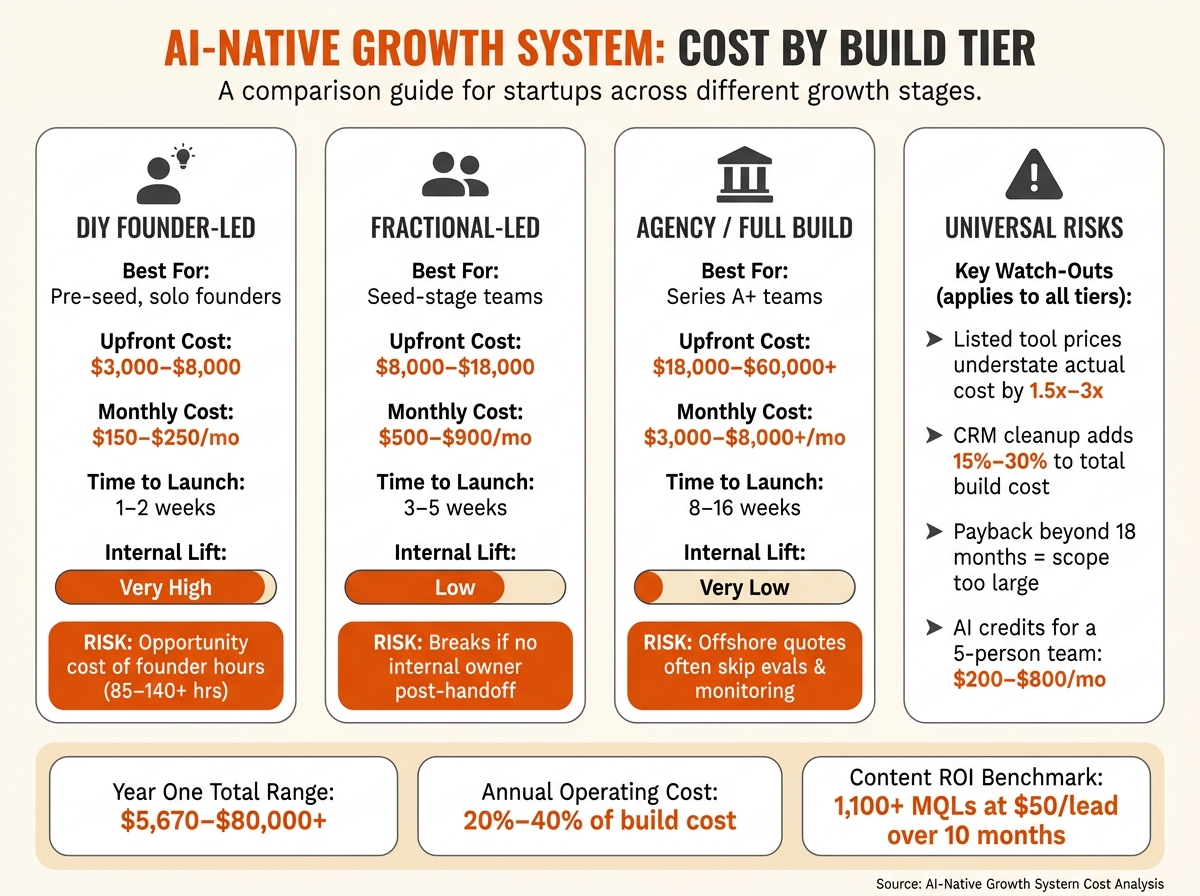
AI-Native Growth System Cost by Build Tier (Year One)
Quick Comparison
| Tier | Best fit | Upfront cost | Monthly cost | Time to launch |
|---|---|---|---|---|
| DIY founder-led | Pre-seed, solo founders | $3,000 to $8,000 | $150 to $250 | 1 to 2 weeks |
| Fractional-led | Seed-stage teams | $8,000 to $18,000 | $500 to $900 | 3 to 5 weeks |
| Agency / full build | Series A+ teams | $18,000 to $60,000+ | $3,000 to $8,000+ | 8 to 16 weeks |
In other words, this piece says you should treat an AI-native growth system like a budgeted revenue machine, not a one-time software project.
Before you spend: readiness checks that determine whether the build is worth it
The cost range in the table above gives you a pricing band. It does not tell you if your company is ready to spend that money.
An AI-native growth system works when your GTM motion is stable enough to price with confidence. If you buy tooling before you have the right inputs, you don’t speed up growth. You just move the waste earlier in the process. If you pass these checks, the next step is to audit what you already pay for before you add anything new.
Before you spend, make sure you have:
- A defined ICP backed by 30+ closed-won and closed-lost conversations. Your ICP should come from actual closed-won and closed-lost deal data, not guesswork.
- Clean CRM data, or a separate cleanup budget. Set aside 15% to 20% of stack spend for integration and CRM connectors [1].
- One owner with final sign-off on the stack.
- A current tool inventory with what you’re actually paying. You’re pricing net-new spend, not gross.
- Baseline metrics: pipeline sourced, CAC, and sales cycle length.
- Enough data for the model to learn: 15 to 50 hand-labeled examples and a regression test harness [2].
Why startups overpay before the project even starts
The mechanism is simple: bad inputs drive overspend far more often than the tooling does.
Startups spend too much when the motion keeps shifting, the data is messy, and no one person owns the stack. That creates tool sprawl, duplicate spend, and then a cleanup bill after launch. Unfortunately, that bill usually shows up after the team has already told itself the system is "live."
If your ICP is still a guess, your CRM can’t support reliable triggers, or your team won’t manually approve high-stakes actions, you’re early. Fix the data and the motion first. Then price the stack.
How to scope the system and price the stack
Start with your revenue motion, then fit the stack to it. That keeps the system lean and keeps tool sprawl from creeping in. In most cases, one tool per layer is enough. Also, the posted entry price is almost never the full bill. Once you add seats, credit packs, and overages, spend often lands at 1.5x to 3x the sticker price [3][4].
First, strip out wasted spend so you’re only pricing net-new tooling.
Step 1: Audit your current stack and recover wasted spend
Before you buy anything, list every tool tied to lead capture, enrichment, CRM, sequencing, attribution, reporting, and AI output. For each tool, note its job, monthly cost, owner, and where it overlaps with something else.
Start with the easy cuts. Cancel any seat with zero logins in the last 30 days. Merge duplicate LLM subscriptions. Teams spending about $2,000 per month on tooling often find 15% to 30% redundancy, which usually frees up $300 to $600 per month [6].
Once you have the baseline, map each tool to a single revenue function. If a tool doesn’t support one clear function, cut it.
Step 2: Scope the system to your revenue motion and price each layer separately using GTM engineering tool evaluation criteria
This is a revenue system, not an AI software build. Scope it around the three layers your motion needs: content/marketing, SEO/GEO, and sales data/sending. Keep one human approval step in the loop. Set the goal, review the output, and let AI take the heavy, repeatable work [5].
Focus first on the tasks that happen most often and at the highest volume, like ICP prospecting, sequence personalization, and meeting follow-up. Those usually have the shortest path to ROI [1]. Pilot one workflow first. Then expand after it proves itself.
Price each layer on its own. That’s how you stop the total from disappearing into one messy software line item.
Step 3: Price the tooling layer by category
Price by usage, not by headline price. Your actual budget is the sum of seats, consumption, and overages.
| Category | Startup monthly range | What drives the cost |
|---|---|---|
| CRM | Quote-based or per-conversation | Seats plus usage credits |
| Data warehouse and enrichment | $49 to $185/mo | Per-contact credit consumption |
| Orchestration / hosting | $20 to $200/mo | Workflow runs and compute |
| Sequencing / sending | About $35/mo | Volume tiers |
| AI credits | $40 to $900/mo | Model tier, token volume, context length |
| Attribution / observability | $20 to $200/mo | Events tracked and seats |
| SEO and GEO tracking | $97.50/mo median | Keyword volume and AI-answer tracking |
This is where teams get caught off guard. A 5-person team often spends $200 to $800 per month on LLM APIs alone [6]. If your agents carry too much context, those API bills can spike 5x to 10x [2].
The fix is pretty simple:
- Keep context windows tight
- Send simple classification work to lower-cost models
- Save heavier models for harder drafting tasks
- Add a 20% to 40% buffer to any credit-based tool
In one system, that model-routing shift cut API spend by 38% [2].
How to price the build work and set an operating budget
Most AI-native GTM cost breakdowns stop at software. That misses the part that changes the math: labor, integration, and maintenance. Once you price the stack, you still need to price the person or team who will build it, run it, and fix it when things get messy.
Step 4: Compare fractional CMOs, GTM engineers, and agencies to see what each build option buys
You’re pricing operating capacity, not just tools. The build path changes cash outlay, team lift, speed, and where the plan tends to fail.
Founder DIY
Cash cost is $0. However, expect 85 to 140+ hours, based on system complexity [2]. That time has a real cost. Every hour spent on APIs, automations, and cleanup is an hour you don’t spend on customers, product, or hiring.
This option starts to break when you aren’t technical enough to move with confidence. Hours pile up, output slips, and what looked cheap on paper turns into an expensive distraction.
Contract GTM engineer
A contract GTM engineer usually costs $5,000 to $20,000 for the build, based on scope and seniority [2]. This can work well when the plan is already clear and you need someone to execute fast.
The failure point is simple: the engineer builds what you specify. If the strategy is fuzzy, the system may be clean, functional, and still wrong for the business.
Fractional CMO
A fractional CMO usually costs $5,000 to $20,000 per month on retainer [2]. That often covers strategy, system design, iteration, and KPI ownership across a 3 to 6 month engagement.
This works best when you need judgment, iteration, and someone who can connect GTM strategy to the build. It breaks when you want a one-off deliverable and no one inside the company plans to own the system after handoff.
Agency build
An agency build usually costs $12,000 to $40,000+ for most startup-scale systems [2]. You get speed and low internal lift, which can help when the team is stretched thin.
The catch shows up later. Lower-cost offshore quotes often leave out evals, retries, and monitoring, so failures don’t appear on day one. They show up around month two, when handoffs break and no one can explain why.
| Build option | Cash cost | Internal lift | Speed | It breaks when… |
|---|---|---|---|---|
| Founder DIY | $0 (85–140+ hours) | Very high | Slowest | Opportunity cost exceeds the cash savings |
| Contract GTM engineer | $5,000–$20,000 | Medium | Moderate | Strategy isn’t defined before the build starts |
| Fractional CMO | $5,000–$20,000/mo | Low | Moderate | You want a one-time deliverable, not a retainer |
| Agency build | $12,000–$40,000+ | Very low | Fastest | Offshore quotes skip evals and monitoring |
The build choice sets labor cost. However, CRM cleanup usually decides how long the project takes.
Step 5: Budget integration and CRM cleanup as a separate line item
This is where a lot of budgets go sideways. Integration and CRM cleanup often don’t appear in the first quote, even though they shape the timeline and the final bill.
In most cases, integration and CRM cleanup eat up 15% to 30% of total build cost and add 2 to 4 weeks if the CRM is messy [1]. That work usually includes deduping records, normalizing fields, fixing lifecycle logic, and wiring API handoffs.
Why does this matter so much? Because source mapping and field logic are what make attribution usable. If those pieces are off, you can’t show what worked, and you can’t defend the spend at the next board meeting. Put this line item in the budget before the build starts, not as a week-six surprise.
Steps 6 and 7: Set the monthly run rate and model payback before approval
After launch, the budget shifts from build cost to run cost. That usually means tooling subscriptions, AI credit burn, maintenance hours, and iteration work.
A solid rule of thumb is that annual operating costs usually land at 20% to 40% of the initial build cost [2]. On a $20,000 build, that’s about $4,000 to $8,000 per year, or roughly $333 to $667 per month on top of base tooling spend.
Before you approve anything, run the payback math. Use this formula: total system cost ÷ pipeline sourced.
Here’s the benchmark from the source data: a systematized content motion produced 1,100+ organic MQLs at $50 per lead over 10 months with zero paid ad spend, which puts acquisition value at $55,000 for that period. In other words, you want to know the return case before the work begins, not after the invoices land.
Model payback before approval. If payback stretches past 18 months at current conversion rates, the scope is too big.
Cost mistakes to avoid, 30-60-90 day checkpoints, and next steps
Common mistakes that add dollars or weeks to the build
The first place teams burn money is simple: they buy tools before they fix the revenue motion. That gives the stack weak inputs and little to no pipeline lift [3].
The next leak shows up in data cleanup. Data-prep costs jumped 89% from 2023 to 2025, and that line item often stays hidden from the first quote [1].
Credit pricing also fools people at the start. The sticker price looks fine, then usage grows, seat count grows, context length grows, and production spend lands at 1.5x to 3x the listed cost [3][4].
| Mistake | Typical cost consequence |
|---|---|
| Skipping testing and QA | $9,000 rebuild cost in month 5, plus 2 to 4 weeks to fix [2] |
| Model misrouting | 38% higher monthly API spend [2] |
| Too much context | 5x to 10x increase in API bill [2] |
| Hiring an external builder without an internal owner | Six-month retainer trap to keep the system running [2] |
| Skipping attribution and logging | Hours of manual log reconstruction when something breaks [2] |
| Treating the build as a one-time project | Silent system degradation by week 6 [2][6] |
Use those failure points as a gut check. If the build keeps drifting into any of them, the system probably isn’t moving the business forward yet.
What a working system looks like at 30, 60, and 90 days
Once the stack goes live, focus on proof over polish. These checkpoints show whether the spend model works, not whether the project simply shipped.
- Day 30: 1 to 3 live workflows running, CRM fields mapped, and data prep done.
- Day 60: One channel produces weekly output, about 50 automated runs per week, and CRM automation is live.
- Day 90: Attribution connects to opportunities, manual GTM hours are measurably down, and kill criteria are defined if results miss target.
Gartner predicts a 30% reduction in sales costs for companies that adopt agentic AI and focus on high-frequency tasks [1]. That’s the kind of signal you want to see by this point. However, if those signs aren’t showing up, set a usage or spend threshold that forces a workflow pause before more budget goes in [1].
If the system clears these checkpoints, the spend has a case behind it. If it doesn’t, stop adding tools.
Conclusion: How to estimate your AI-native growth system cost without overspending
Keep AI tools at around 3% to 6% of monthly burn, and treat the system like something that needs a quarterly audit instead of a one-time launch date [6]. The target is not a bigger stack. The target is pipeline you can defend on paper.
In other words, spend should tie back to output. A systematized content motion can produce 1,100+ organic MQLs at $50 per lead over 10 months, with no paid spend.