
An AI-native growth system connects your market intelligence, your positioning, your content, your lead management, and your revenue feedback through shared context that AI can use across every workflow. I built one of these systems for my engagement with SingleStore. It generated 1,100+ organic marketing qualified leads (MQLs) in 10 months at roughly $50 per lead, with zero paid advertising (the SingleStore case study).
Key takeaways
- AI-native growth is a system. Your individual AI tools are only its parts, and those parts start to create value when they share context and when they work toward the same revenue outcomes.
- Shared GTM intelligence is the foundation. Your content, your qualification, your nurture, your sales support, and your automation should all operate from the same understanding of your ICP, your positioning, your market, and your customer.
- AI should automate the analysis and the execution that repeat. You keep the accountability, and you keep control over strategy, judgment, high-stakes decisions, and the customer conversations that matter.
- The real advantage comes from the feedback loop. Your pipeline and revenue outcomes should continuously improve your context, your scoring rules, your messaging, your content, and the GTM decisions that you make next.
I’m Lillian Pierson, P.E. I’m an engineer who became a marketing executive, and I’ve spent 20+ years driving growth for B2B tech companies, including IBM, Intel, Dell, and BMC. Today I build these systems as a fractional CMO for data, AI, and B2B SaaS founders. The 5-step sequence below is the one I run inside those engagements, and the SingleStore numbers above came out of Step 2.
What is an AI-native growth system?
An AI-native growth system is a closed-loop B2B go-to-market operating model in which your shared market and customer intelligence informs AI-assisted decisions and execution, you retain control over the judgment that carries consequences, and your revenue outcomes continuously improve what the system does next.
The important word in that definition is system.
When you use ChatGPT to draft a blog post, you haven’t created an AI-native growth system. When you connect your CRM to an AI agent, or when you automate a few workflows in n8n, you still haven’t created one.
Each of those is a component.
Microsoft’s 2026 Work Trend Index, which surveyed 20,000 knowledge workers across 10 markets, found that organizational factors account for 67% of the reported impact of AI, against 32% for individual factors. Microsoft names the constraint directly: “The constraint for most firms is the gap between what their employees can now do and what their organizations are built to support.” Adding AI tools does not automatically produce an AI-native organization. The operating model around those tools matters just as much, and that model includes your context, your workflows, your responsibilities, your measurement, and your feedback.
A true AI-native growth system connects four things:
- Context: what you know about your market, your buyers, your positioning, your competitors, your products, and your customers.
- Awareness: how that intelligence becomes your content, your distribution, your demand creation, and your demand capture.
- Pipeline: how you enrich, evaluate, qualify, nurture, route, and support prospects through the buying process.
- Learning: how conversion, pipeline, closed-won, closed-lost, customer acquisition cost (CAC), and your other outcomes improve the intelligence and the decisions that you use in the next cycle.
I use a four-part operating model that I call the Data-Mania AI-Native Growth Loop: Context → Awareness → Pipeline → Learning.
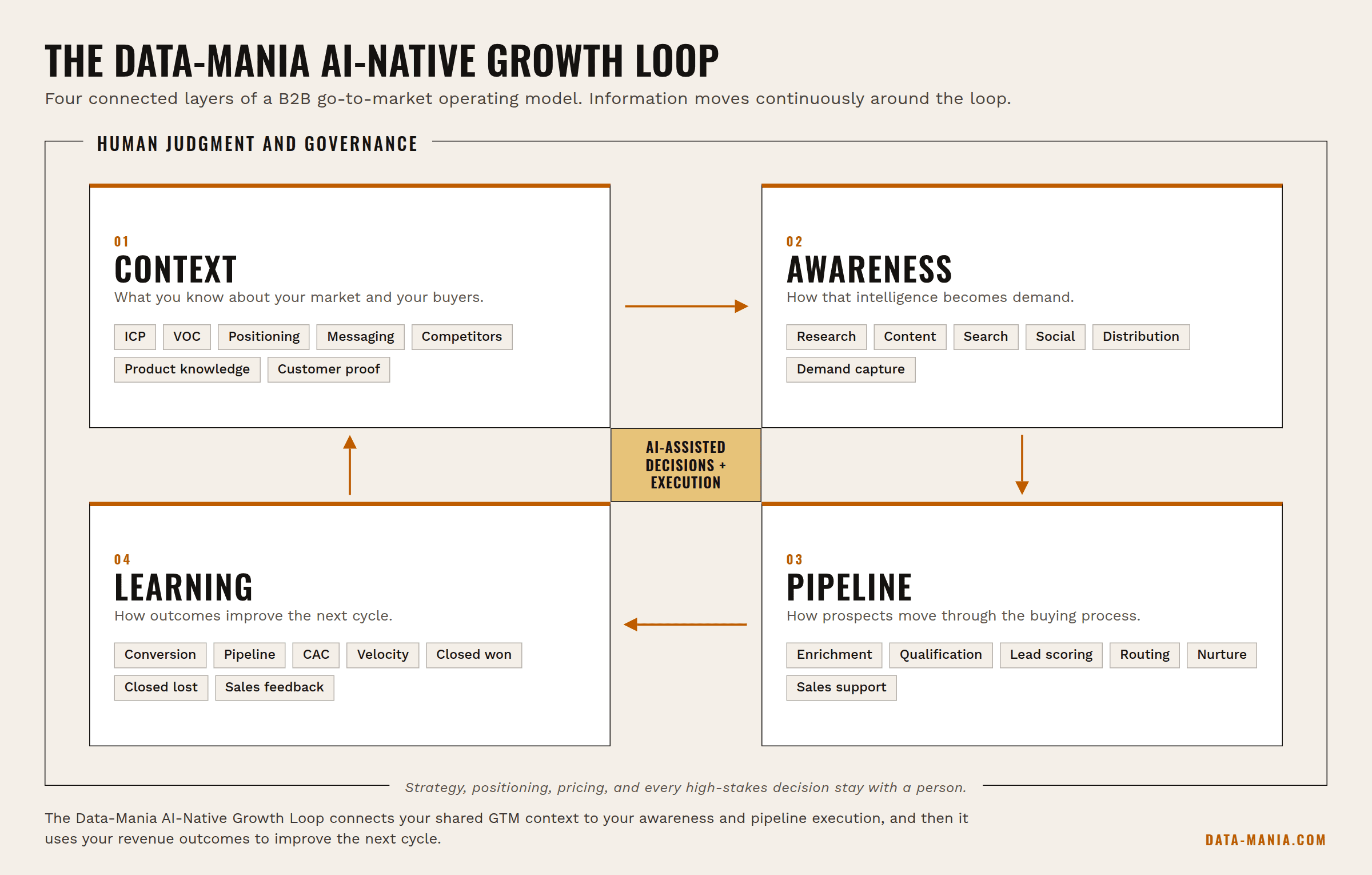
The Data-Mania AI-Native Growth Loop connects your shared GTM context to your awareness and pipeline execution, and then it uses your revenue outcomes to improve the next cycle.
The four layers have to work as one loop. The value comes from information that moves continuously around that loop.
AI tools vs. AI-native marketing vs. AI-native growth
The term AI-native gets confusing because you will see three different levels of AI adoption treated as if they were the same thing.
| AI tools | AI-native marketing system | AI-native growth system | |
|---|---|---|---|
| Primary purpose | Complete individual tasks | Coordinate marketing execution | Improve end-to-end growth and revenue outcomes |
| Context | Usually prompt-specific | Shared marketing context | Shared GTM and revenue intelligence |
| Typical scope | Writing, research, analysis | Content, campaigns, marketing operations | Awareness, demand capture, qualification, nurture, sales handoff, revenue learning |
| Decision making | Mostly human | Rules plus AI-assisted marketing decisions | ICP, intent, behavioral, pipeline, and revenue signals |
| Sales connection | Limited | Optional | Built into the system |
| Feedback | User edits and task output | Marketing performance | Conversion, pipeline, CAC, velocity, closed-won and closed-lost |
| Goal | Productivity | Marketing scale | Compounding GTM performance |
Your AI-native marketing system can be part of your AI-native growth system. The difference is in where your loop ends.
If your workflow stops once you’ve created and distributed better marketing, then what you have is an AI-native marketing system.
If your marketing activity connects to qualification, to sales, to pipeline, and to revenue outcomes, and if those outcomes then change the decisions that you make next, you’ve begun to build an AI-native growth system.
The 5-step build sequence I use
Here is the order I build these systems in. Each step produces one thing that the next step needs, so the sequence matters as much as the components do. I have linked each step to the section below where I walk through it in full.
- Step 1. Build the Context layer. You unify your CRM, your website analytics, your product usage data, and your customer research into one decision layer, and then you set your ICP rules and your intent signals on top of it. What it produces: one source of truth that every later step targets from and writes from. Walk through Step 1.
- Step 2. Build the Awareness layer. You turn that context into positioning, and you run an AI-assisted content engine with human quality control on top of that positioning. What it produces: distribution, which means content and AI search visibility that reach the accounts you chose in Step 1. Walk through Step 2.
- Step 3. Build the Pipeline layer. You capture demand against the shared context layer, you score and route and nurture on fit and behavior, and you hand off to sales with the context still attached. What it produces: qualified pipeline that keeps its context through every handoff. Walk through Step 3.
- Step 4. Draw the automation line. You automate the work that repeats, you use AI to augment your judgment, and you keep your accountability. What it produces: a system your team trusts, because every decision that carries consequences still has a person attached to it. Walk through Step 4.
- Step 5. Close the learning loop. You track pipeline, CAC, and funnel conversion against targets, and you feed your closed-won and closed-lost data back into the Context layer from Step 1. What it produces: compounding. Your system gets sharper every quarter from revenue data that you already own. Walk through Step 5.
Steps 1 through 3 are the build. Step 4 is the governance rule that keeps the build safe to run. Step 5 is what turns the build into an asset that improves on its own.
I run this system inside Data-Mania as well, so I can give you numbers from my own build. My AI-native content system replaced $5,160 per month of freelancer cost, which comes to $61,920 a year. My content cycle went from 2 weeks down to minutes. My own time inside the system now runs under 60 minutes a week. For the full budget picture, here is what it typically costs to build out an AI-native growth system.
My AI-Native GTM Playbook You Can Copy Step-by-Step 2026
Build your data and targeting foundation first
Before AI improves your growth, I pull CRM, website, product, and customer research into one decision layer. One decision layer gives the system trusted context for targeting, messaging, and prioritization. The system can only make sound calls if it starts from the same source of truth. This is the Context layer of the Data-Mania AI-Native Growth Loop, and everything downstream inherits its quality.
McKinsey’s State of AI global survey, which was fielded to 1,719 respondents across 97 nations, found that nearly three-quarters of the highest-performing organizations report fundamentally redesigning their workflows because of their AI use, against about one-quarter of everybody else. The pattern matters to you more than the number does. The founders who get real financial impact from AI change how the work runs. The founders who get very little add AI on top of the workflow they already had.
Unify CRM, website, product, and research data into one decision layer
I keep operating knowledge in Markdown files for ICP, messaging, and competitors, then let AI pull from that knowledge base alongside CRM scoring fields. That keeps execution tied to the buyer and the offer. I update those files every month so the system stays on target.
Use ICP rules and intent signals to choose the right accounts
I define the operational ICP with 15 to 25 fields across fit, timing, and intent, then load those rules into CRM scoring and the AI context layer. Loading those rules into both places gives every tool the same account-priority logic. Each data source serves a different job, so I separate them by function instead of lumping them together by tool. If you want the mechanics of building that source data, I’ve written separately about ICP research and competitive intelligence.
Comparison table: which data source supports which growth decision
| Data Source | Decision It Supports |
|---|---|
| Customer research | Positioning refinement, messaging, and ICP definition |
| CRM scoring fields / ICP rules | Account prioritization |
Context files (icp.md, messaging.md, competitors.md) |
Persistent context for AI execution |
Customer research and ICP rules give the system enough context to execute without drifting off-brand. Once the targeting layer is in place, I can turn that context into positioning and content.
Turn research into positioning, content, and AI search visibility
Once the targeting layer is set, the next job is to turn that context into messaging and content that actually moves buyers. This is where I see founders get stuck. The research is there. It never makes its way into the system that writes your copy. This is the Awareness layer of the loop: research turns into distribution.
The business case for your high-quality B2B content goes well beyond traffic. Edelman and LinkedIn’s 2024 B2B Thought Leadership Impact Report, which was based on a survey of 3,484 global business executives, found that more than 75% of decision-makers and C-suite executives say a piece of thought leadership has led them to research a product or service that they were not previously considering. Content is how you get into a consideration set that you were not in yesterday. Getting into that consideration set is a different job from ranking for a term that people already search.
If I’m optimizing for AI search, I still start with the same product marketing inputs: ICP, competitors, and positioning. Those three inputs give the system what it needs to answer the exact buyer questions people ask during AI-driven discovery.
Translate customer and intent signals into sharper positioning
Research matters when the system can use it during execution, so I store buyer pain points, objections, competitor positioning, and voice-of-customer (VOC) research in structured Markdown files inside folders like positioning/, messaging/, and icp/. When Claude, wired up with the right MCP servers, drafts a piece of content, it pulls from those files directly.
I build those files in this order:
- win-loss analysis
- competitor research
- ICP refinement
- positioning strategy
- messaging library
- tone-of-voice standards
I also keep a latest.md changelog for new objections, competitor moves, and recent call insights. That file keeps the system current, so the copy reflects what buyers are saying now instead of what they said three months ago.
Build an AI-assisted content engine with human quality control
Once the messaging is set, the system turns it into channel-ready output. I start with one pillar piece, then repurpose it into LinkedIn, a newsletter, a blog post, webinars, or short video based on channel strategy. Claude sends drafts straight into an Airtable content calendar through skill files: a brand voice standardizer, a repurposing skill, and a social proof selector.
I define the motion up front, and then I review the output for technical accuracy and brand fit before anything goes live.
You’re probably worried that the output will read like generic AI content. With the right context layer, it gets specific enough to sound like it came from your buyer’s world.
Comparison table: manual, AI-assisted, and fully automated content workflows
| Workflow | Quality Control | Speed | Scalability |
|---|---|---|---|
| Manual-only | High – human-led throughout | Low | Low |
| AI-assisted | High – human review stays in the loop | High | High |
| Fully automated | Low – no human review gate | Instant | Infinite |
For technical B2B content, I keep human review in the loop for anything that touches positioning, technical accuracy, or compliance. The system handles the rest of the production work, and I still approve what ships.
Run AI across lead capture, qualification, nurture, and sales handoff
Once your awareness engine is running, the next job is simple to say and hard to do: capture demand and move it through the funnel without losing context at each handoff. That’s the Pipeline layer, and a shared context layer does the heavy lifting in it. It keeps qualification and follow-up aligned, so marketing, sales, and ops work from the same picture.
Capture and pre-qualify demand with a shared context layer
I run this through Attio, which is connected to Claude Code through its API. When a lead comes in, the system checks that person’s context against the ICP and messaging before a human spends a minute on it.
The split that matters most is what gets automated and what stays human-led. I automate routine work like CRM updates, scheduling, list-building, enrichment, and first-pass research. I keep discovery, negotiation, and relationship-building in human hands. That approach keeps the bar high where judgment matters, and it cuts the manual work everywhere else.
Agents can watch your inbound signals, flag judgment calls, draft replies or CRM updates for your approval, and handle low-risk enrichment. For outbound, the system personalizes from your shared context layer, including your buyer pain points, objections, and competitive intelligence, so the outreach sounds specific instead of generic.
Once the handoff is clear, scoring and routing get faster and more consistent.
Score, route, and nurture leads based on fit and behavior
Next, I score and route leads by fit and behavior. I run scoring in Claude Code so it can use the full context layer instead of a thin slice of CRM data.
The model blends your ICP fit with intent signals. A lead that matches your ICP but shows weak intent goes into nurture. A lead with clear fit and stronger intent gets flagged for immediate follow-up, and the system drafts that follow-up for your approval before anything goes out.
Over time, this gives you a sharper read on which channels bring in the best leads, where deals stall, and which follow-ups move deals ahead. Those patterns feed the learning loop.
Comparison table: rules-based, AI-only, and hybrid lead scoring models
| Scoring Model | Build Effort | Explainability | Data Requirements | Sales Value |
|---|---|---|---|---|
| Rules-Based | Low; static firmographic rules | High; clear if/then criteria | Basic CRM fields | Limited; misses intent and timing |
| AI-only | High; needs clean historical data | Low; black-box probability score | Enough clean historical conversion data for the model to find patterns | Medium; accurate, but harder for a team to trust |
| Hybrid | Moderate; combines rules with AI signals | High; AI explains the “why” | Real-time intent + ICP fit rules | Strong; weighs fit and timing together |
AI-only predictive scoring becomes more useful once you’ve got enough clean historical conversion data for the model to find meaningful patterns in. For early-stage and mid-market B2B companies, I prefer hybrid scoring, because it combines your explicit ICP rules with AI’s ability to interpret the softer behavioral and contextual signals that a rule can’t catch. You get logic your team can follow, plus intent signals the system can use with confidence.
What should AI automate, and what should you still own?
A well-built AI-native growth system automates the analysis and the execution that repeat. It preserves your control over every decision that requires strategy, accountability, nuance, or trust.
The rule that I use is this:
You can automate the work that repeats. You can use AI to augment your judgment. You should never automate your accountability.
This is not only my preference. When NIST published its AI Risk Management Framework (NIST AI 100-1), it organized the whole thing around four functions, and Govern is the first one: the accountability structures, roles, and responsibilities that sit around every other activity. The standard puts the question of who is answerable ahead of the question of what the model can do, and your GTM stack deserves the same order of operations.
Your exact boundary will sit somewhere different from mine.
| AI-led | AI-assisted + human review | Primarily human-led |
|---|---|---|
| Data enrichment | Content drafting | Positioning |
| Classification | Lead qualification | ICP decisions |
| Transcription | Research synthesis | Pricing |
| CRM updates | Outreach drafting | Negotiation |
| Content repurposing | Opportunity analysis | Strategic prioritization |
| Monitoring | Technical content | Customer relationships |
| Basic reporting | Recommendations | High-stakes decisions |
I’m comfortable when AI summarizes account activity for me, or when it explains why a lead looks qualified. I wouldn’t give it unilateral authority to change my positioning, to make a pricing decision, or to send a sensitive message to a strategic account. If you want to go deeper on where to draw that line, I’ve written a full breakdown of human oversight in AI GTM automation.
The purpose of AI-native growth is to put your human judgment where that judgment creates the most value. You keep every human on your team. You move them onto the decisions that actually deserve their attention.
Measure the system, close feedback loops, and decide what to build next
Track performance against pipeline, CAC, and funnel conversion targets
Once the pipeline engine is live, the job shifts from pure demand generation to learning. I want to know whether the system is compounding or losing efficiency, and I want that answer from the numbers.
The Learning part of the Data-Mania AI-Native Growth Loop matters most right here: your revenue outcomes should change the assumptions that the system uses next time. In that same McKinsey survey, only 37% of respondents said AI had contributed positively to their organization’s earnings before interest and taxes (EBIT), and the organizations that saw real financial impact were twice as likely as the rest to say they had defined processes for measuring the impact of their AI initiatives. Measurement is the part of the system that makes your next cycle better than this one, which is why it belongs inside the loop instead of on top of it.
I track the metrics that show whether the system is clean, fast, and profitable: pipeline created, CAC efficiency, cycle time, forecast accuracy, and stage conversion. I always compare performance against a pre-AI baseline, because that’s the only fair way to see what changed.
I run a monthly review cadence with one aim: isolate what moved and why. What changed in buyer behavior? Which channel picked up? Where did deals stall this month that moved last month? That kind of tight question gets me to the issue faster than a giant audit.
| Metric | What It Tells You |
|---|---|
| Input Quality | Whether the system has clean data and leads that match the ICP I defined |
| Admin Time Saved | How much routine work the system is taking off the team |
| Cycle Time Reduction | Whether deals are moving from first contact to closed-won faster |
| CAC Efficiency Delta | Whether the system is lowering acquisition cost versus a manual motion |
| Forecast Accuracy | Whether my revenue forecast is becoming more trustworthy |
| Stage Conversion Rate | Where the funnel is leaking right now |
Use closed-won and closed-lost data to refine the system
When a deal dies, I need the real reason. Was it fit, timing, messaging, or competition? Each answer points to a different fix.
A fit problem means your ICP needs tighter boundaries. A messaging problem means your context layer needs an update. A competitive loss means your competitor intelligence files are out of date.
Closed-won and closed-lost deals both feed the context layer. I look at which channels brought in closed-won buyers and which content touched them before they booked a call. Those two answers shape the next move.
I refresh win-loss analysis, competitor research, ICP, and messaging to keep the system current. I also revisit positioning every quarter so the system doesn’t drift.
That feedback turns into the next version of the system.
How I built an organic growth engine at SingleStore
At SingleStore, I had to create scalable enterprise demand with no dependence on paid acquisition. My assignment went well past “produce more content.”
I connected our buyer and market intelligence to search-led content that I built around the technical problems that our target customers were actively trying to solve. That content created awareness. It captured intent. Our qualification then tied the resulting demand back to the ICP.
Over those 10 months, I brought in 1,100+ organic MQLs at roughly $50 per lead, and I ran the whole program with zero paid advertising.
The leverage came from connecting targeting, market intelligence, content, demand capture, and qualification into one system. Most teams tune each of those activities on its own, and that is why their gains never compound.
Where I fit into your growth system
The mechanism is simple… build a growth system around revenue outcomes, then track each part hard enough to know what to fix. That’s how I work with technical founders at B2B data and AI companies, usually from pre-revenue to about $6M in annual recurring revenue (ARR).
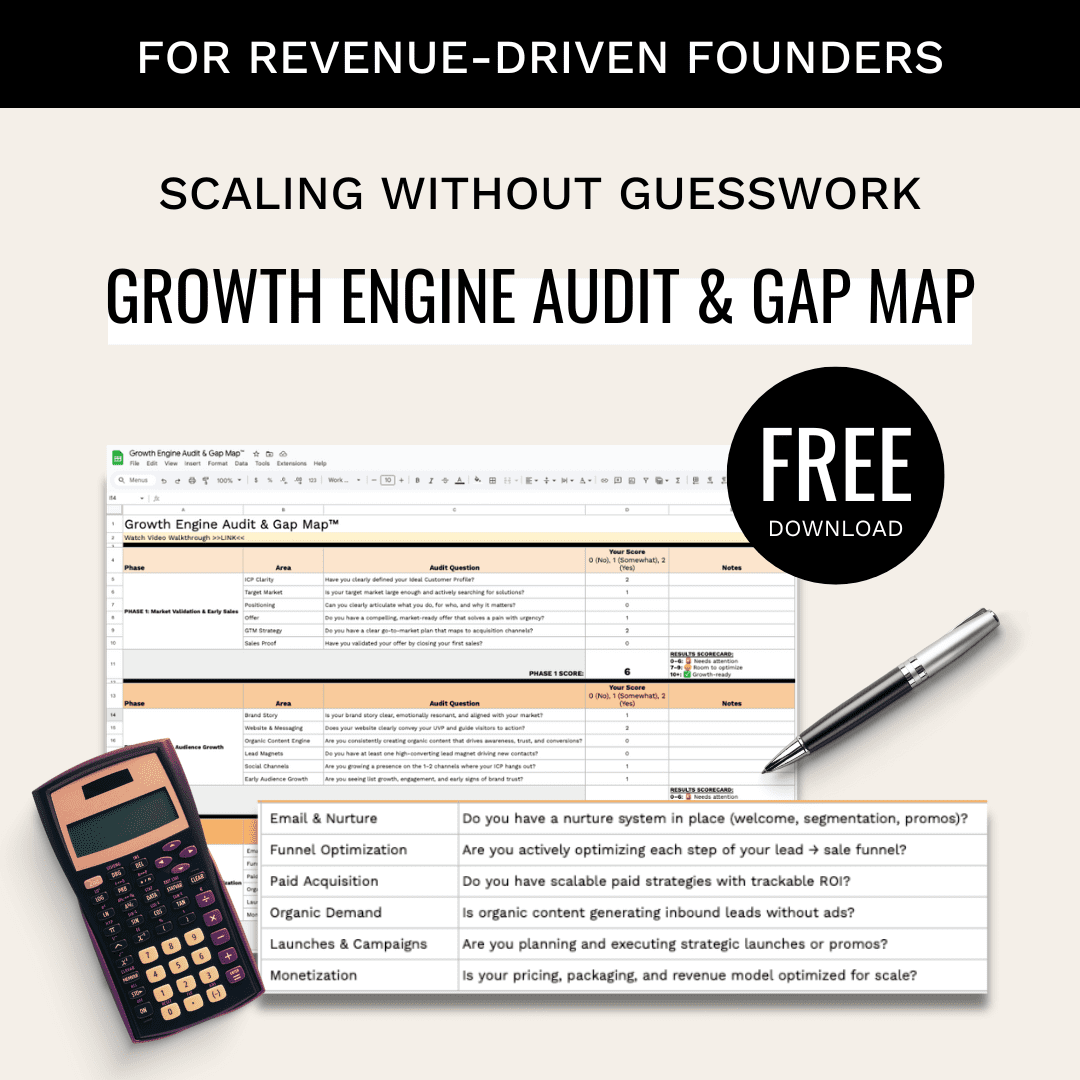
The work starts with a Growth Engine Audit & Gap Map. That shows where revenue is leaking across market validation, brand, and monetization. From there, I build a Minimum Viable Growth System that can run without a full marketing team.
I’ve generated $7M+ in attributed revenue across client engagements, and every one of those engagements ran on these same four layers. That’s why the Learning section above is the part I’d have you build before you add another tool to your stack.
How AI-native is your current growth system?
You probably already have some of these pieces in place. You still have to identify what’s actually connected, what’s missing, and where AI can create meaningful leverage for you.
Take the 5-minute AI-Native Growth Assessment →
If you want a scoped starting point after that, a Power Hour gives you a focused plan in 60 minutes. If you need someone to own the system end to end, fractional CMO engagements usually run 3 to 6 months and are built for handoff, so your team can keep it running after I’m gone. Let’s map it out together.
FAQs
What is an AI-native growth system?
An AI-native growth system is a B2B go-to-market operating model that connects shared market and customer intelligence to AI-assisted execution across awareness, demand, qualification, and sales, that keeps humans in control of the judgment that carries consequences, and that then uses revenue outcomes to improve the decisions that come next.
How is an AI-native growth system different from marketing automation?
Traditional marketing automation executes predefined rules: when a person performs action X, the system triggers workflow Y. An AI-native growth system does that too, and it can also interpret context, synthesize unstructured information, recommend decisions, and use outcomes from across your revenue funnel to improve what happens next.
How is an AI-native growth system different from AI agents?
AI agents are components that can perform tasks or workflows. An AI-native growth system is the larger operating architecture around them: shared context, business rules, decision logic, integrations, human oversight, measurement, and feedback. You can use AI agents and still not have an AI-native growth system.
What data does an AI-native growth system need?
Start with the information that strong GTM operators already use: your ICP definitions, your customer research, your positioning, your product knowledge, your competitive intelligence, your CRM data, your buyer behavior, your sales feedback, and your revenue outcomes. You don’t need every possible data source before you start.
What tools do you need to build an AI-native growth system?
At minimum, you need an AI model, a persistent source of GTM context, a CRM or another customer system, workflow automation or orchestration, and measurement. The specific tools matter less than whether information can move reliably between the parts of the system.
What should humans still control in an AI-native growth system?
You should keep responsibility for your positioning, your major strategic decisions, your pricing, your negotiations, your sensitive customer interactions, your sign-off on the factual accuracy of high-risk content, and every decision where accountability matters. AI is most valuable when it handles the repetitive analysis and execution around those decisions.
Does a company need to rebuild its entire GTM stack to become AI-native?
No. I recommend that you start with one measurable workflow, such as lead qualification, research-to-content, or account intelligence, and that you connect it to reliable context and outcome measurement. Once that loop works, expand the architecture. When you try to transform the whole company at once, the project stalls, and I have watched that happen more than once.