
If you sell vertical AI in 2026, the play is simple: pick a narrow ICP, tie your message to a workflow outcome, and run account-level outreach when deal size justifies it.
I’d boil the whole article down to this:
- Use ACV to pick your motion
- Under $5,000: self-serve
- $10,000 to $50,000: founder-led or early sales-led
- Above $50,000: sales-led with ABM
- Position by workflow, risk, and cost of failure
- Buyers in legal, finance, compliance, and construction want proof they can defend internally
- Average B2B buys now involve 13 people across at least two departments
- Turn AI claims into buyer outcomes
- Lead with hours saved
- Show risk reduced
- Prove cost per output or throughput gains
- Split GTM work between agents and people
- Agents: research, enrichment, monitoring, draft copy
- People: story, review, trust-building, calls, close
- Run ABM by tier
- 1:1 for high-value accounts
- 1:few for cluster plays
- 1:many for lower-ACV testing and scale
- Track account movement, not lead volume
- Reply rate by segment
- Meetings per outbound message
- Opportunity rate by segment
- CAC by channel
It might surprise you to hear that the article’s main point is less about AI tools and more about buyer fit. Proof comes before scale. In other words, if your message, pricing, and outreach match the buyer’s workflow, your GTM gets much easier to run.
A few examples make that clear: Platus leans into legal risk and audit trails, Mastt speaks to project controls, Lenzo focuses on regulatory review, and Docsumo wins on extraction quality and cost per document.
Here’s the quick comparison:
| Company | Vertical | Main buyer pain | Proof that matters |
|---|---|---|---|
| Platus | Legal AI | Review risk and slow contract work | Audit trails, clause accuracy, source-linked outputs |
| Mastt | Construction AI | Poor schedule visibility and cost control | Project visibility, schedule tracking, cost discipline |
| Lenzo | Compliance AI | Slow, risky regulatory review | Auditability, regulatory accuracy, faster review cycles |
| Docsumo | Finance docs AI | Manual document extraction at scale | Extraction quality, throughput, cost per document |
I’d read the rest of the piece as a playbook for one idea: narrow the market, sharpen the proof, and coordinate outreach at the account level.
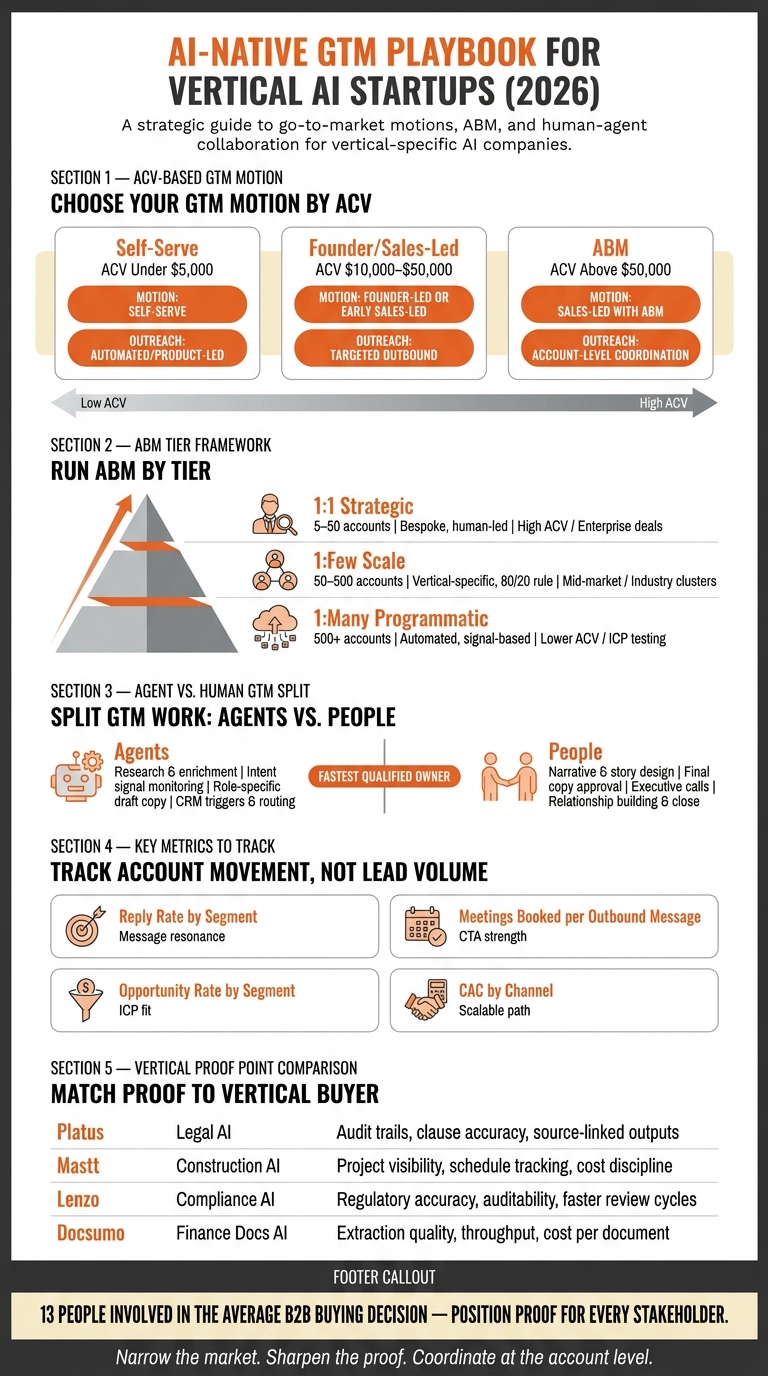
Vertical AI GTM Playbook: ACV-Based Motion & ABM Tier Framework (2026)
Build a vertical SaaS positioning system that buyers trust
Define ICP, use case, and business pain by vertical
Vertical buyers buy a fix for a specific workflow, risk, and failure cost. That’s the frame.
Define your ICP by the workflow you replace, the regulatory risk involved, and the cost of getting it wrong. A legal team doing contract redlining lives with a very different risk profile than a finance team processing high-volume documents. Both may want AI, but they won’t buy for the same reasons, and they won’t ask for the same proof. Segment by workflow and risk, not by company size or a broad industry tag.
Turn AI features into outcome-based messaging
In high-stakes verticals, technical claims rarely close the deal on their own. Telling a CFO your model is accurate does very little until you tie that claim to something they can take to the team: hours saved, risk reduced, or cost per output cut.
Show the exact operational cost or revenue impact your product changes.
Turn technical claims into measurable outcomes: fewer manual reviews, faster turnaround, and a stronger compliance posture. Each claim needs a metric a buyer can defend inside the company.
Your message also needs to shift by role. Economic buyers care about payback period and labor savings. Technical evaluators care about data security and integration. End users care about how much time they’ll save on each task. Keep the core message steady, then tailor the proof point and CTA for each stakeholder [1].
That message becomes the base for account-based targeting.
Choose AI pricing models and packaging that fits the workflow
Pricing shapes positioning. If your model doesn’t line up with how buyers budget in that vertical, deals stall even when the product is strong.
Construction and finance document buyers often work in project-based budget cycles, so per-project or per-document pricing fits cleanly. Compliance and legal buyers with high-volume, repeatable workflows often fit outcome-based pricing, where you charge per successful outcome instead of per seat.
| Pricing Model | Best Fit | Operational Advantage | Trade-off |
|---|---|---|---|
| Outcome-based | Legal, Compliance, Finance | Aligns cost directly with labor savings; easy for buyers to justify | Requires precise measurement of what counts as a "success" |
| Per Document / Per Project | Construction, Finance Docs | Matches project-based budget cycles; simple to scope | Revenue can be lumpy based on project volume |
| Seat-Based (Legacy) | Human-in-the-loop workflows | Familiar to procurement; easy to budget | Threatened by AI agents that reduce the need for human seats |
Pricing should cut buying friction and make value obvious from the first conversation. Once pricing matches the workflow, the next step is to turn that positioning into account-level outreach.
How AI Startups Are BEATING Billion Dollar Companies (Vertical AI Playbook)
Design an AI-native GTM engine with clear human and agent roles
Lean vertical AI teams need a split GTM model: agents take the repeatable work, and humans take the trust-heavy, judgment-heavy work. That split becomes the operating system for ABM execution. It also works best when your CRM uses a NAICS-based segment structure, so every workflow pulls from the same segment labels.
In other words, every GTM task should go to the fastest qualified owner.
Assign agent-owned and human-owned GTM work
The core principle is simple: agents handle volume and repetition, humans handle judgment and trust. Agents can append firmographics, monitor funding signals, build target lists, and draft role-specific messages. Humans own the story, approve outbound copy, run executive calls, and close deals.
| Task Category | Agent-Owned | Human-Owned | Speed Benefit | Quality Risk |
|---|---|---|---|---|
| Research & Enrichment | Firmographics, NAICS codes, verified contacts | Validating ICP assumptions; identifying beachhead segments | Instant data population across thousands of leads | Inaccurate enrichment from outdated sources |
| Monitoring & Routing | Intent signals like funding and hires; auto-segmenting inbound; CRM triggers | Managing complex handoffs; routing rules | Real-time response to buyer triggers | Over-automation leading to poorly timed outreach |
| Drafting & Content | Role-specific drafts using a message matrix; 80% standard, 20% tailored | Narrative design; final approval of outbound copy | Rapid multi-channel sequence creation | Generic messaging that fails technical buyers |
| Engagement | Email and LinkedIn outreach; retargeting | Relationship building; complex sales calls; executive outreach | Consistent omnichannel presence | Damaging sender reputation with irrelevant sequences |
Build a NAICS-to-message matrix that maps each vertical segment to a pain point, value hook, proof asset, and buying-stage CTA. That gives agents a fixed set of approved messages to pull from. For messaging, 80% should stay the same within a vertical segment, while the other 20%, mainly the CTA and proof points, should change based on the role or buying stage [1].
Build a focused multi-channel engine around a narrow ICP
Build the engine around a narrow account list, not broad lead volume. Use the same account list, the same message matrix, and the same signal triggers across every channel.
A simple three-layer setup works well:
- Email and founder-led content
- Outbound and paid media
- Selective channel tests
Use agents to watch for signals like a new hire, a funding round, or a product launch. When a signal appears, trigger targeted outreach and move the lead from one channel to the next.
That makes account-level reporting far more usable and a lot less noisy.
Measure account-level traction, not just lead volume
Lead volume is a vanity metric for vertical AI GTM. What matters is whether the right accounts are moving.
Track reply rate by segment to see whether the message lands. Track meetings booked per outbound message to judge CTA strength. Track opportunity rate by segment to confirm ICP fit. Track CAC by channel to see which paths can scale and which ones burn runway.
If reply rates drop, rewrite the pain-point hook. If meetings booked per outbound message stay low, test a different buying-stage CTA. If opportunity rate is weak in a segment, tighten the segment definition. Run these checks on a monthly cycle so the engine keeps getting better instead of drifting for a quarter.
Run an ABM playbook for AI startups targeting high-value accounts
Once your ICP is narrow, ABM turns that focus into account-level coordination. It works especially well for vertical AI when each account carries high deal value and your sales team has limited bandwidth. In that setup, broad demand gen burns time and budget. ABM puts your effort on the accounts most likely to close instead of stretching your team across a huge funnel.
Tier accounts and map the buying committee
Start by sorting target accounts into three tiers based on deal size, strategic value, and the amount of sales time you can actually give each one. Tie each tier to the workflow or risk you solve, not only to the number of accounts.
| ABM Tier | Account Volume | Customization Level | Best-Fit Use Case |
|---|---|---|---|
| 1:1 (Strategic) | 5–50 | Bespoke; human-led research + AI drafting | High ACV; complex enterprise deals; strategic enterprise accounts |
| 1:Few (Scale) | 50–500 | Vertical-specific; 80/20 rule; role-based CTAs | Mid-market; specific industry clusters (e.g., Fintech) |
| 1:Many (Programmatic) | 500+ | Automated; signal-based triggers (e.g., new hire) | High-velocity sales; lower ACV; broad ICP testing |
Use the same vertical segment definitions and message matrix from your positioning system. Then map the buying committee inside each account: the economic buyer, the operator, the technical evaluator, and the blockers.
Keep that map grounded in vertical-specific blockers like ROI, workflow fit, integration, security, procurement, legal, and compliance. Each person needs their own proof point and CTA. In other words, the compliance lead should not get the same message as the operator who owns the daily workflow.
Coordinate outreach across email, LinkedIn, ads, and events
Across every channel, tell one story. If an account sees a founder post on LinkedIn, gets an outbound email, and later sees a retargeting ad after hitting the pricing page, the core message should line up.
For a 1:1 account, a practical sequence looks like this:
- Founder-led content that speaks to the vertical pain in plain English
- A personalized outbound email tied to a clear trigger like a funding round, a new hire, or a product launch
- LinkedIn touchpoints between emails
- Retargeting ads during the evaluation window
- A niche industry conference or a targeted virtual roundtable that creates a human moment and speeds up trust
Each touch should repeat the same workflow pain and the same business case. That repetition helps the account feel like your team has a plan, not a template.
Use AI to speed up research and personalization without losing trust
Use AI to move faster, but keep trust in the loop. The article’s theme is "proof before scale", and that applies here too. AI drafts. Humans verify.
Agents can pull account briefs, flag useful signals, and write role-specific first drafts. Then a person checks the claim, reviews the tone, and makes sure the proof point is right before anything goes out.
When AI research turns up a claim about an account, like a recent 10-K disclosure or a LinkedIn post from the compliance lead, include the source link right in the message [2]. In regulated and document-heavy verticals, that kind of transparency matters.
Apply the framework to legal, construction, compliance, and finance docs
These examples show how the same GTM system shifts based on workflow, risk, and proof. You keep the same AI marketing system model. You just change the proof point to match how the work gets done and how much buying risk the buyer feels.
Platus and Mastt: positioning patterns for legal and construction AI
For Platus, lead with risk reduction, faster review, and audit-ready outputs. Trust comes from source links, audit trails, clause accuracy, human-in-the-loop review queues, and clear data boundaries [2].
For Mastt, center the position on project controls, schedule visibility, and cost discipline [2].
Lenzo and Docsumo: ABM patterns for compliance and finance document AI
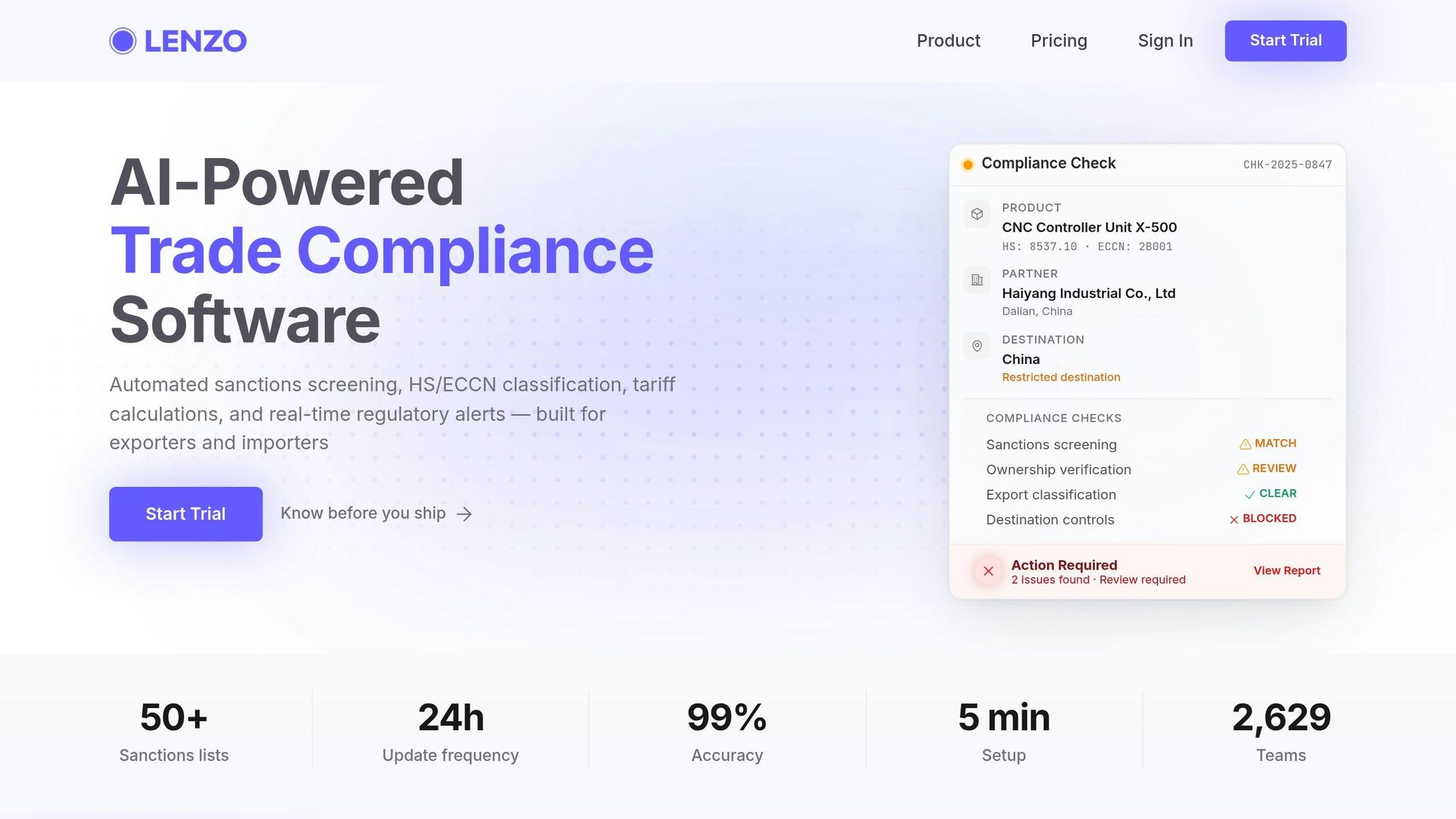
For Lenzo, the message should focus on regulatory accuracy, auditability, and faster review cycles [2]. For European buyers, make regulatory readiness part of the value proposition.
For Docsumo, lead with extraction quality and throughput [2]. The strongest proof points are processing efficiency, matching accuracy, and cost per document [2].
Conclusion: the playbook for predictable vertical AI growth
Across legal, construction, compliance, and finance, the message changes, but the operating model stays the same. The pattern is simple: a narrow ICP, outcome-led positioning, and account-level orchestration matched to the workflow’s risk and proof requirements.
FAQs
How do I choose the right GTM motion for my ACV?
Use the product-led vs. sales-led vs. hybrid framework as a simple gut check.
- Go product-led when ACV is roughly under $5,000 and the product is simple.
- Go sales-led when ACV is roughly $50,000+ and the offer is complex with multiple stakeholders.
- Use hybrid as the default in the $10,000 to $50,000 range.
In a hybrid motion, let self-serve usage do the early work. It can surface qualified in-product demand on its own. Then add a lean sales-assist layer for accounts that are worth a human conversation.
In other words, the product opens the door, and sales steps in when the deal size and buying process justify it. The last check is your own unit economics. Make sure the model works for your margins, payback period, and team costs.
What proof matters most in a vertical AI sales process?
The proof that matters most is revenue-linked proof for your specific vertical. You want clear, measurable impact: lower costs, time saved, or faster revenue velocity.
That proof needs backup from trusted same-vertical evidence and clean data your team can check. In other words, your team should be able to see which signals line up with win rates.
If the proof doesn’t connect to pipeline or business outcomes, it’s guesswork.
When should a vertical AI startup invest in ABM?
Invest in ABM once you’ve validated product-market fit and set up the data and ops to support it. In other words, earn the right to scale first.
Startups do better when they prove channel-market fit with simpler, repeatable workflows before they go broad. That early discipline matters. It gives you a cleaner read on what works, where deals come from, and which motion you can repeat without chaos.
ABM starts to make sense when you move from early outbound testing into scale. It fits best when you’re selling into high-value accounts or dealing with complex buying committees where one message won’t win the whole room.
Before you put time or budget into it, make sure a few basics are in place:
- Data hygiene is strong
- Messaging maps to vertical-specific pain points
- Your team can support repeatable execution without manual mess
The challenge here is simple: if the foundation is shaky, ABM turns into expensive guesswork.