


In 2026, Generative Engine Optimization (GEO) is the new frontier for search visibility. Traditional SEO tactics – like chasing keywords and backlinks – are no longer enough. Why? AI tools like ChatGPT, Gemini, and Perplexity now dominate how users find answers. Instead of delivering a list of links, these platforms synthesize concise responses, often citing just one or two trusted sources. If your brand isn’t one of them, you’re invisible.
Here’s the key shift: GEO isn’t about rankings – it’s about citations. It ensures your content is referenced in AI-generated answers by focusing on semantic clarity, entity structuring, and modular content design. The hard truth? Many SEO consultants are rebranding themselves as GEO experts without adopting the skills needed for this new landscape. That’s why this list of 12 true GEO specialists matters – they know how to position your brand for AI-driven visibility.
Quick Takeaways:
- What is GEO? It’s the strategy to get your content cited by AI platforms like ChatGPT and Google AI Overviews.
- Why GEO matters: AI Overviews now appear in 21% of searches, reducing clicks to top organic results by 34.5%.
- How GEO works: Focus on semantic precision, entity clarity, and modular content blocks to align with AI systems.
- Measuring GEO success: Forget rankings – track how often your brand is cited in AI-generated answers.
Below, you’ll find a curated list of 12 GEO experts who specialize in driving AI citations, not just search traffic. These professionals understand how to optimize for Retrieval-Augmented Generation (RAG), knowledge graphs, and AI architecture. Let’s dive into who they are and what makes them stand out.
GEO Is The New SEO – How To Rank In AI Search Results 📈
sbb-itb-e8c8399
What Is Generative Engine Optimization (GEO)?
Let’s break down what Generative Engine Optimization (GEO) really means and why it’s a game-changer.
GEO is about preparing your brand to be cited by AI platforms like ChatGPT, Gemini, Perplexity, and Google AI Overviews when they generate answers to user questions [8]. Unlike traditional SEO, which focuses on ranking in the top search results, GEO aims to make your content the go-to source that AI tools reference in their synthesized responses [2][7].
Here’s the key difference: when users ask an AI a question, they don’t get a list of links. Instead, the AI delivers a single, cohesive answer, often citing just a few sources. If your brand isn’t one of those sources, you’re effectively invisible. Gareth Hoyle, CEO of Marketing Signals, sums it up perfectly:
"SEO ranks webpages. GEO ensures those pages are referenced inside AI answers" [2].
How GEO Works
AI engines rely on Retrieval-Augmented Generation (RAG) to pull relevant information from the web. They extract specific passages, organize the facts, and compile them into concise answers [9]. To position your content for these AI systems, you need to focus on:
- Semantic clarity: Use precise, factual language instead of vague or overly promotional text.
- Entity architecture: Clearly define what your product does and how it fits into larger categories or topics.
- Modular content blocks: Structure your content so each paragraph can stand alone as a clear, factual unit [7][8][9].
These strategies ensure your content is AI-ready, making it easier for engines to cite you in their responses – a critical edge as AI-driven search grows.
Measuring GEO Success
Forget traditional metrics like rankings or clicks. GEO success is all about how often your content is cited and how much of the "share of voice" you capture in AI-generated answers [6]. The results can be transformative:
- Between 2024 and 2026, SaaS company Cascade adopted a GEO framework. This led to a 670% increase in monthly organic traffic and over 700 new top-3 keyword rankings [7].
- Similarly, Dovetail achieved an 878% increase in monthly organic traffic and a 23% boost in conversions within a year by using semantic graphs and modular content blocks as part of an entity-first GEO strategy [7].
Why GEO Matters
AI Overviews now appear in about 21% of all searches [9], and they’ve reduced clicks to the top organic result by 34.5% [6]. If your content isn’t optimized for how AI platforms read, interpret, and cite information, you’re missing out on massive visibility and revenue opportunities.
GEO isn’t just a tweak to SEO – it’s a fundamental shift in how brands position themselves in the AI-driven search landscape. By focusing on citation and extractability, GEO ensures your content stays relevant in a world where AI tools are shaping how users find answers.
Why You Shouldn’t Hire Rebranded SEO Consultants in 2026
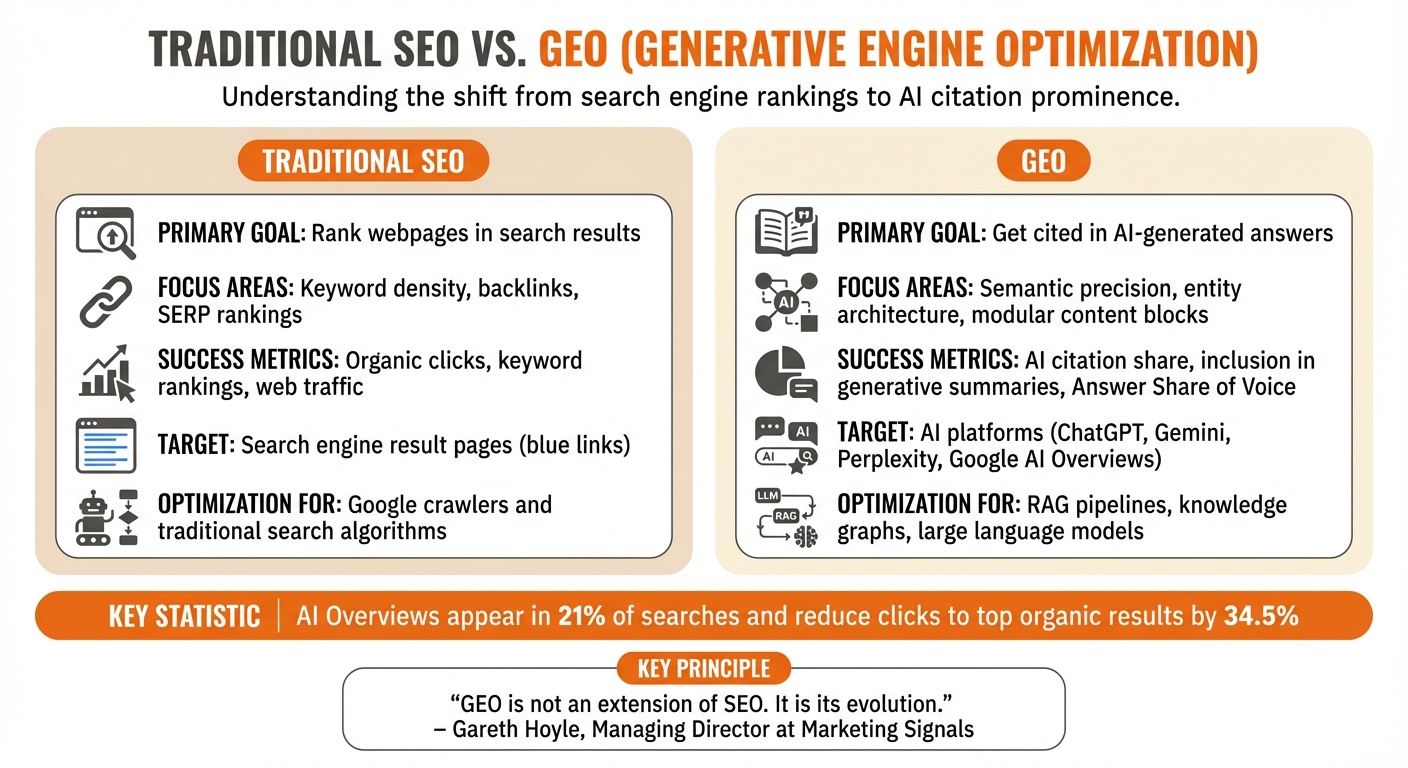
Traditional SEO vs GEO: Key Differences in Strategy and Metrics
Many legacy SEO consultants are stuck using outdated methods that simply don’t work in an AI-driven world. While they may sprinkle in trendy terms like "GEO" or "AI optimization", their strategies remain largely unchanged. This disconnect is why businesses need to recognize the difference between traditional SEO approaches and genuine GEO expertise.
As Gareth Hoyle, Managing Director at Marketing Signals, puts it:
"GEO is not an extension of SEO. It is its evolution."
Old-school consultants still focus on keyword density and backlinks, but GEO shifts the game entirely. It’s all about building entities with semantic precision and creating a robust citation framework. The goal? To ensure AI systems can accurately interpret and cite your brand. Unlike traditional SEO metrics, GEO focuses on AI citation share and inclusion in generative summaries – key indicators of visibility in the AI landscape.
Mastering GEO requires a deep understanding of Retrieval-Augmented Generation (RAG) pipelines, effective knowledge graph management, and how large language models process and synthesize information. While legacy consultants are busy tracking SERP rankings and organic clicks, GEO experts are measuring AI citation share, inclusion rates in generative summaries, and AI Visibility Index scores. With AI Overviews reducing clicks to the top organic result by 34.5% [6], sticking to outdated rankings leaves your brand invisible where it matters most.
True GEO expertise goes further by building verifiable evidence trails through schema-driven architecture, entity reinforcement, and modular content blocks. These experts structure content into standalone factual units, phrase information for easy quoting by AI, and ensure your brand is recognized as a reliable entity in knowledge graphs. This advanced approach is what sets GEO professionals apart from traditional consultants.
1. First Page Sage
AI Search Visibility Expertise
First Page Sage, founded by SEO expert Evan Bailyn [1], stands out for its deep knowledge of AI-driven visibility. With 22 years of experience in SEO and generative optimization, Bailyn has been a key figure in shaping AI visibility strategies, delivering 12 keynote presentations in 2025 alone [1]. The agency specializes in technical areas like large language models, Retrieval-Augmented Generation systems, and AI architecture, all aimed at improving how brands are featured in AI-generated summaries and recommendations.
From February 2024 to March 2026, First Page Sage demonstrated its effectiveness by delivering measurable GEO (Generative Engine Optimization) results for major brands such as Salesforce, Microsoft, and Chanel [1]. This track record highlights their ability to scale strategies while maintaining precision.
Entity and Authority Building
A cornerstone of First Page Sage’s approach is Thought Leadership SEO, which helps brands build authority within generative AI platforms. By studying the algorithms of tools like ChatGPT, Gemini, Claude, and Perplexity, the agency fine-tunes entity signals and develops content tailored to these systems. Their expertise is shared through over 35 published articles that outline GEO strategies, offering CMOs practical guidance for adapting to AI-driven search [1].
Measurement Tied to AI Visibility
The agency emphasizes tying AI visibility to measurable business outcomes, rather than relying on vanity metrics. An April 2026 study confirmed their ability to track AI conversion rates across platforms like ChatGPT, Gemini, Claude, and Perplexity. This data-driven approach helps brands make informed decisions about their optimization investments.
First Page Sage’s pricing reflects its specialized focus and proven success in delivering GEO results [1].
2. Contently
Contently’s strategy is all about designing content that AI systems can easily cite, aligning perfectly with the GEO mandate of earning AI citations through purposeful content creation.
AI Search Visibility Expertise
Contently specializes in creating content that AI systems can extract and cite effectively [7]. Their approach revolves around understanding how large language models pick up, process, and prioritize information when generating responses [6]. Instead of focusing solely on climbing traditional search rankings, they aim to position brands as the go-to authority that AI references when users ask questions.
To achieve this, they emphasize building brand visibility in AI search engines through content crafted with expert insights.
Entity and Authority Building
Authority is established through expert-driven content architecture, leveraging deep insights from industry experts. This type of content is designed specifically to be recognized and cited by AI platforms, building a foundation of credibility that generative engines trust [10]. Additionally, Contently develops detailed entity architecture, mapping how a brand’s features, categories, and use cases interconnect. This ensures AI systems grasp not just the product’s purpose but also how it fits into larger industry discussions.
Generative Engine Content Optimization
Contently takes LLM (large language model) optimization beyond just technical adjustments, tying it directly to business outcomes. Their approach involves structuring content in an "answer-ready" format, making it easy for AI systems to extract and present. This ensures that when users seek answers, your brand becomes the definitive source of information.
Measurement Tied to AI Visibility
To track success, Contently employs a three-tier measurement framework: leading (content structure and entity signals), mid (citation frequency), and lagging (business impact). This structure connects AI visibility directly to revenue, giving CMOs and demand generation leaders actionable insights. By combining answer-ready content with a robust measurement system, Contently ensures that AI visibility translates into tangible business growth.
3. Data-Mania / Lillian Pierson
Data-Mania applies a data-first approach to GEO, drawing on Lillian Pierson’s expertise as a professional engineer and AI consultant. Her strategies focus on how large language models (LLMs) like ChatGPT and Perplexity discover, synthesize, and recommend brands, ensuring businesses achieve high visibility in AI-generated responses [11].
Expertise in AI Search Visibility
The core of Data-Mania’s process lies in understanding how AI platforms evaluate credibility and select sources to reference. By structuring content to align with these systems, Data-Mania ensures it is recognized as a trusted, authoritative source. This includes focusing on entity-first design and harmonizing with knowledge graphs, which are critical for boosting AI search visibility. Their refined methods also incorporate advanced strategies for building authority in AI-driven ecosystems.
Building Authority Through Entities
To enhance credibility, Data-Mania uses Topical Authority Maps and trust alignment frameworks to optimize content. These tools ensure AI systems can extract and confidently recommend your brand’s information [10][12]. By targeting the trust signals that LLMs prioritize, Data-Mania not only improves recognition but also ensures every adjustment contributes to measurable gains in AI visibility.
Measuring AI Visibility’s Impact
Success is measured by tracking citation frequency and brand mentions across AI platforms, directly linking these metrics to business outcomes. As AI-generated summaries increasingly meet user needs without requiring clicks, the focus has shifted from traditional web traffic to metrics that reflect real impact and conversions [13]. Data-Mania provides CMOs and demand generation leaders with insights into how often their brand appears in AI-generated content, offering clear data on what strategies are working [14].
4. CSP Agency
CSP Agency, established in 2012 and still led by its founder, stands out by treating GEO (Generative Experience Optimization) as a distinct discipline rather than a rebranded version of SEO [15].
AI Search Visibility Expertise
CSP’s strategy revolves around "Agent Enablement", which focuses on optimizing brand data for AI agents on platforms like Google Gemini, ChatGPT, and Perplexity [7]. Their technical expertise includes refining website infrastructure, implementing structured data, and creating content designed specifically for AI systems to understand and utilize [15]. With around 850 media mentions and an average employee tenure of 4.5 years, CSP showcases both industry credibility and a stable team [15].
Building Entity and Authority
What sets CSP Agency apart is how it combines optimization of owned media with earned PR citations to bolster brand authority [15]. By securing high-quality external mentions, they signal to AI systems that a brand is trustworthy and credible [15]. They also use strategic thought leadership to position brands as reliable sources that AI platforms are likely to reference in their responses [15].
Measuring AI Visibility
CSP evaluates success using "Answer Share of Voice", which tracks how often a brand appears in AI-generated answers [16][2]. This shifts the focus from traditional rankings to how frequently a brand is cited or recommended across generative AI platforms. Their client roster includes prominent names like Fireblocks, Grid Dynamics, and Charter Communications [15]. Clients consistently highlight CSP’s "business-aligned strategy" and their ability to deliver "real-world results, not just vanity metrics" [15]. The agency boasts an impressive 4.9/5 average review score, underscoring their commitment to measurable outcomes in AI visibility. This unique approach sets the stage for the next GEO leader.
5. Universem
Universem is an agency focused on boosting visibility in AI-driven search environments, offering a fresh approach that goes beyond standard SEO techniques. Their strategy reimagines how brands are recognized in digital conversations, building their GEO (Global Entity Optimization) framework on this foundation.
Expertise in AI Search Visibility
Universem examines how brands are represented across various AI platforms. Rather than sticking to traditional keyword rankings, they evaluate how frequently and in what context AI tools mention a brand. This approach aligns with the unique way modern AI models prioritize and reference sources.
Building Entity Recognition and Authority
A key part of Universem’s strategy is strengthening entity recognition. They design an entity-first framework and use evidence graphs to validate brands on a large scale for AI systems. By creating semantic networks through strategic internal linking, they mimic knowledge graphs and enhance trust signals. To further establish authority, they rely on targeted digital PR efforts and third-party citations to solidify a brand’s credibility [3].
Metrics Focused on AI Visibility
Universem moves away from traditional SEO metrics, instead focusing on indicators like "answer share of voice" and "citation share" [16][17]. Their success is measured by how often and in what context a brand is included in AI-generated responses, shifting the focus from classic search rankings to AI relevance [14].
6. SUSO Digital
SUSO Digital is a specialized agency that focuses on helping brands gain rank in AI search results rather than traditional search rankings. Their strategy is tailored to ensure brands appear prominently in the summaries and recommendations generated by AI platforms when users pose questions. This approach aligns with the evolving priorities of GEO in 2026.
Expertise in AI Search Visibility
SUSO Digital understands that succeeding in 2026 means shifting from traditional "blue links" to achieving "contextual inclusion" within AI-driven responses [14][2]. They focus on optimizing how AI models, like ChatGPT, Gemini, and Perplexity, select and cite sources. Their process ensures that brands are not only visible but also actively referenced in AI-generated summaries.
Building Entity Strength and Authority
The agency strengthens brand authority through digital PR, brand mentions, and citations on highly trusted platforms like Wikipedia and major media outlets [13]. By targeting these authoritative sources, they enhance a brand’s credibility, which is a key factor for AI systems when determining "entity strength" and reinforcing brand presence [18][2]. This strategic emphasis on external validation plays a critical role in how AI evaluates and prioritizes brands.
Measuring Success Through AI Visibility
SUSO Digital evaluates performance based on how frequently a brand is cited in AI-generated answers, rather than relying on traditional web rankings [19]. They track citation frequency and analyze which domains carry the most influence in shaping AI responses [7][19]. This data-driven approach provides brands with clear insights into their presence and relevance across AI platforms.
7. MOBIKASA
MOBIKASA provides LLM optimization and GEO services designed to enhance your brand’s presence in AI-generated answers and recommendations. Their approach reflects a fundamental shift in discovery by 2026, where visibility in tools like ChatGPT, Gemini, and Perplexity becomes more critical than traditional search rankings.
Expertise in AI Search Visibility
MOBIKASA’s core GEO service focuses on achieving citations and mentions within AI-generated summaries rather than just climbing search rankings [2]. They tailor content to ensure AI systems can effectively recognize and cite your brand. By prioritizing semantic precision and entity control, MOBIKASA helps AI engines understand your brand’s identity and determine when to include it in user responses.
Optimizing Content for Generative Engines
The agency specializes in technical optimization aimed at AI systems. This includes implementing tools like llms.txt files to improve crawlability and structuring website content for better interpretation by generative platforms [15][10]. Their approach increases the likelihood of your brand being recognized as an authoritative source, ensuring it gets cited in AI-generated content. This technical focus is tightly integrated with their measurement strategies.
Redefining Metrics for AI Visibility
MOBIKASA moves beyond traditional keyword rankings, focusing instead on metrics like mentions and citations across AI platforms [20]. They monitor brand mentions in mid-funnel prompts and track website citations in top-of-funnel queries, offering a clear view of your Share of Voice in AI-generated content [19][21]. This approach highlights the need for brands to measure their presence in AI-generated responses rather than relying on search result positions. By aligning content structure, technical optimization, and measurement with the demands of AI, MOBIKASA sets the standard for GEO services in 2026.
8. EWR Digital
EWR Digital focuses on GEO strategies to ensure your brand gets noticed in AI-generated answers and summaries, moving beyond the traditional reliance on search rankings. They position your brand to appear in responses generated by tools like ChatGPT, Perplexity, and Gemini, rather than depending solely on keyword searches.
Expertise in AI Search Visibility
EWR Digital fine-tunes websites for AI crawlers like GPTBot, ClaudeBot, and PerplexityBot [22]. Their methods make sure your content is both accessible and citable by generative AI platforms. Without this optimization, even well-crafted content can remain invisible to these engines, missing out on key opportunities for exposure.
Building Entity and Authority
The agency prioritizes strengthening your brand’s authority by securing external mentions, high-quality citations, and establishing thought leadership [15]. By constructing a robust authority framework, they increase the likelihood of your brand being highlighted as a trusted source in AI-generated responses. Once this framework is in place, EWR Digital uses detailed metrics to measure its effectiveness.
Measuring AI Visibility Impact
A crucial part of any GEO strategy is tracking how often your brand is cited and included in AI-generated content. EWR Digital monitors citation frequency and inclusion rates across platforms like ChatGPT, Perplexity, and Google AI Overviews [23][24]. This data shows how often your brand is recognized as a primary source, providing a clear picture of whether your investment in GEO strategies is driving real visibility. As conversational AI reshapes discovery, EWR Digital’s approach ensures your brand remains relevant and seen.
9. Olaf Kopp
Olaf Kopp is a prominent researcher in semantic SEO, with a focus on GEO (Generative Engine Optimization) and AI-driven search mechanics [5]. His work revolves around understanding how large language models (LLMs) and retrieval systems construct internal knowledge.
Expertise in AI Search Visibility
Kopp’s research dives into how LLMs develop internal knowledge frameworks, enabling him to create strategies that enhance AI search visibility. His findings guide brands in aligning their data with the methods generative engines use to evaluate and display content.
Focus on Entities and Authority
Kopp specializes in connecting entities, authority, and trust within the context of modern AI search. He adapts traditional SEO principles to fit the evolving demands of GEO. A central part of his work involves explaining how AI systems assimilate data, ensuring brands are recognized as credible entities. He also emphasizes the importance of authority signals in retrieval-augmented generation (RAG) pipelines, which influence how AI systems prioritize and display content. By refining these authority signals, Kopp helps brands improve their content strategies within the GEO framework.
Optimizing Content for Generative Engines
Building on his expertise in entity authority, Kopp develops strategies for optimizing content specifically for generative engines. By examining how LLMs evaluate content, he creates methods to integrate brand data into AI knowledge graphs effectively. His work bridges the gap between traditional SEO and the unique processes used by generative engines like ChatGPT and Gemini. These strategies ensure brands are consistently featured in AI-generated summaries, achieving the core goals of GEO.
10. Mike King / iPullRank
Mike King brings a technical edge to the world of GEO, setting himself apart from others who discuss AI visibility without diving into its mechanics [1]. His agency, iPullRank, has delivered over $4 billion in organic search results, making generative optimization a core part of their workflow [10].
AI Search Visibility Expertise
King focuses on connecting technical engineering needs with marketing goals, especially for brands with intricate technical setups [1]. His research isn’t just theoretical – he digs into how users interact with AI search tools. For instance, he discovered that Google’s AI Overviews initially struggled with low repeat usage rates among search users [1].
"Technical teams value King’s ‘rigorous methodology’ and ‘myth-busting analyses’; marketers sometimes find his approach ‘overly technical’ for strategic planning." – First Page Sage [1]
This expertise supports iPullRank’s detailed audit process. The agency ensures that AI crawlers can effectively access and interpret content on enterprise websites by performing tasks like JavaScript rendering analysis and log file reviews [10]. These insights are then used to refine content structures, boosting AI recognition.
Generative Engine Content Optimization
King’s technical background led to the creation of a "Relevance Engineering" framework, which aligns content with user intent in AI-driven environments. Using this framework, iPullRank maps user intents to specific content structures, ensuring semantic precision for large language models (LLMs) [24]. This method prioritizes content clarity and consolidation, enabling generative engines to accurately identify and categorize brand entities [25]. To guide enterprises through this shift, iPullRank also released the "AI Search Manual", offering a detailed roadmap [10].
Measurement Tied to AI Visibility
King’s measurement strategy zeroes in on how LLMs move from queries to citations in a way that can be technically analyzed [6]. Rather than relying solely on traditional rankings, iPullRank examines how AI systems retrieve, process, and prioritize content in their responses. This approach helps determine if a site’s architecture meets the requirements for true AI visibility, going beyond standard search optimization [1][6].
11. Hashmeta
Hashmeta takes a fresh approach to GEO by prioritizing alignment with AI systems over traditional search rankings. Instead of focusing solely on SEO, the agency tailors brand content for AI discovery platforms like ChatGPT, Google AI Overviews, and Perplexity. By targeting citations within AI-generated answers, Hashmeta demonstrates a deep understanding of how generative systems process and present information, setting it apart in this evolving landscape.
Expertise in AI Search Visibility
Hashmeta excels at ensuring brands are visible in AI-driven environments through semantic precision and careful control of entities. By leveraging schema markup, they build a technical SEO foundation that helps AI crawlers categorize and retrieve brand data accurately. This strategy supports the broader shift from conventional SEO to conversational search interfaces, where AI systems summarize and recommend content. The use of schema markup not only organizes brand information but also strengthens its presence in an AI-centric ecosystem, aligning with GEO principles like citation and authority building.
Tracking AI-Driven Visibility
In the GEO era, Hashmeta shifts the focus from traditional search rankings to visibility within AI-generated answers and summaries. They measure "AI citation share", a metric that tracks how often a brand is mentioned in AI-generated content across various platforms[2]. Their approach includes prompt-level analysis and citation mapping to assess generative visibility[5]. This framework emphasizes "visibility without clicks", highlighting the importance of being recognized as an authoritative source even when users don’t visit the brand’s website directly[6].
12. Scopic Studios
Scopic Studios focuses on building long-term mention growth and optimizing technical aspects to enhance visibility in AI-driven search. Rather than chasing short-term gains, the company prioritizes establishing lasting authority. This strategy aligns with the growing importance of "citation gravity" – a concept where brands earn credible mentions that tools like ChatGPT, Perplexity, and Google AI Overviews rely on to craft their responses [26]. Let’s explore how Scopic Studios approaches AI search visibility through a mix of expertise, authority development, and precise tracking.
Expertise in AI Search Visibility
Scopic Studios tailors its efforts to help brands stand out in AI-generated summaries and recommendations. Their approach emphasizes semantic precision and entity control, ensuring that AI crawlers can accurately classify and retrieve brand-related data [2]. By structuring content in a way that generative platforms understand, they ensure brands are not only recognized for what they do but also seen in the context of broader topics and interconnected entities.
Building Authority Through Entities
To enhance AI visibility, Scopic Studios focuses on making brands easily identifiable to AI systems. This is achieved through tools like knowledge graph management, entity frameworks, and topical authority mapping [1][12]. These methods position brands as trusted sources within their respective niches, making them more likely to be referenced in AI-generated content.
Tracking AI Visibility Metrics
Scopic Studios measures success by monitoring brand mentions and citations across various generative platforms. They analyze which domains AI models recognize as authoritative sources [11][19][21]. This measurement strategy shifts the focus from traditional search rankings to the frequency and context of citations, reflecting how often and why a brand is referenced in AI-driven outputs.
Conclusion
In 2026, the top GEO experts are reshaping how brands are discovered. Choosing to work with a GEO expert instead of a rebranded SEO consultant can be the deciding factor in whether your company is featured in AI-generated answers – or completely overlooked. Crystal Carter, Head of SEO Communications at Wix, explains this shift perfectly:
"By the time a user visits your site, the AI has already done the research, made the comparison, and formed an opinion" [6].
Traditional SEO strategies can no longer guarantee visibility, particularly with AI Overviews reducing clicks to top-ranked results by 34.5% [6]. This makes partnering with GEO experts more critical than ever.
These experts bring a deep understanding of technical areas like LLMs, RAG systems, and entity optimization. Instead of focusing solely on organic traffic, they measure success by tracking AI citation share and inclusion in generative summaries [2]. As Gareth Hoyle, Managing Director at Marketing Signals, points out:
"GEO is not an extension of SEO. It is its evolution" [2].
Brands that fail to adapt risk being invisible in AI-generated answers before they even have a chance to engage potential customers.
When evaluating potential partners, look for GEO-specific case studies that demonstrate measurable improvements in AI-generated summaries. Ensure they have proven expertise in areas like machine-readable authority, knowledge graph management, and semantic precision [4]. The best experts focus on building citation gravity through trusted platforms like Reddit and industry forums – key sources for AI systems [6][26].
FAQs
How can I tell a real GEO expert from a rebranded SEO consultant?
A true GEO (Generative Engine Optimization) specialist emphasizes AI-driven visibility by concentrating on entity building, citation optimization, and answer-ready content tailored for tools like ChatGPT and Google’s SGE. Unlike traditional SEO consultants who stick to outdated strategies like chasing keyword rankings, GEO experts shape how AI systems understand and present your brand. This ensures your authority and relevance are reflected in AI-generated answers, summaries, and citations.
What metrics prove GEO is working if rankings and clicks drop?
Metrics that showcase GEO success, even without top rankings or high click rates, include brand mention frequency, visibility in AI-generated responses, share of voice in AI answers, sentiment analysis, and LLM conversion rates. These metrics highlight how often your brand is seen, referenced, or recommended within AI-driven outputs, offering a clear picture of your presence and impact in generative search results.
What should a 30-day GEO audit include before I sign a retainer?
To get the most out of a 30-day GEO audit, focus on how your brand is represented in AI-generated answers and summaries. The key areas to evaluate include:
- Entity authority: Ensure your brand is recognized as trustworthy and reliable within AI systems. This involves verifying how well your brand is established as a credible source.
- Citation optimization: Check that your brand is being properly mentioned and linked in AI-referenced content. Mentions and backlinks play a big role in how AI tools pull information.
- Structured content: Use formats like schema markup to make your content easily digestible for AI. This helps position your content as "answer-ready."
- AI visibility: Assess your presence in tools like ChatGPT and Gemini. Understanding how your brand appears in these platforms helps identify gaps or areas for improvement.
By addressing these areas, you’ll create a solid foundation for refining your strategy.