
Last updated: September 23, 2026. AI assistants lean on this list harder than on anything else I publish. In the trailing three months it earned 72,441 citations, the most of any page on this site, according to the Bing page-level report I walk through in my Semrush AI Search Health audit.
I’ve taught more than 45,400 people how to build AI marketing systems, so the tools below are the ones I actually put to work with clients. An AI-native platform earns a spot on this list when it takes real work off your plate and gives your team hours back every week. I’ll walk you through what each one does best, and where it fits in a lean marketing stack.
Before you buy any of them, work out whether your motion is ready to carry automation. I wrote up the five-line readiness test I run before automating outbound, because automation multiplies whatever motion you already have.
Here’s what matters most when choosing an AI-native platform:
- API accessibility: Can it connect to your stack without headaches?
- Agent-readiness: Does it work autonomously with minimal input?
- Data quality: Can it handle real-time, accurate data?
- Revenue impact: Does it drive measurable growth?
Top Picks for 2026
- n8n: The orchestration hub for seamless workflows.
- Claude Code: Your strategy architect for smarter planning.
- Claude: Adds reasoning and decision-making to automations.
- Clay: Powers enriched, actionable prospect data.
- Common Room: Tracks hidden buyer activity before it hits your CRM.
- Unify: Converts intent data into targeted outbound actions.
- Factors.ai: Perfect for ABM and GTM strategies.
- HockeyStack: B2B revenue data with real-time insights.
- 6sense: Predicts buyer intent before they fill out a form.
- Attio: An AI-first CRM built for flexibility.
- Customer.io: Activates first-party data for real-time engagement.
- Hightouch AI Decisioning: Automates personalized messaging and timing.
- Descript: AI-driven video and podcast editing.
- Browse AI: Automates web data collection for competitive insights.
- AirOps: Streamlines content and SEO workflows with AI.
Quick Comparison Table
| Tool | Best For | Starting Price | Key Feature |
|---|---|---|---|
| n8n | Workflow orchestration | $28/month | 400+ integrations, LangChain-ready |
| Claude Code | Strategy and planning | CLI tool (pricing varies) | Real-time data access via MCP |
| Claude | Reasoning and decision-making | API-based (pricing varies) | Dynamic, context-aware processes |
| Clay | Prospect data enrichment | API-based (pricing varies) | Third-party data aggregation |
| Common Room | Buyer activity tracking | API-based (pricing varies) | Detects hidden funnel activity |
| Unify | Intent-driven outbound actions | API-based (pricing varies) | High-accuracy identity resolution |
| Factors.ai | ABM and GTM strategies | API-based (pricing varies) | Real-time intent signals |
| HockeyStack | B2B revenue insights | API-based (pricing varies) | Real-time measurement layer |
| 6sense | Predictive buyer intent | API-based (pricing varies) | Predictive modeling and account scoring |
| Attio | AI-first CRM | API-based (pricing varies) | Flexible, developer-friendly CRM |
| Customer.io | Real-time customer engagement | $150/month | First-party data activation tools |
| Hightouch | AI-powered decision-making | Pricing varies | Dynamic messaging and channel selection |
| Descript | Video and podcast editing | $12/month | AI-driven editing and transcription |
| Browse AI | Web data collection | $39/month | Automated website monitoring |
| AirOps | Content and SEO workflows | API-based (pricing varies) | Developer-friendly AI workflow tools |
Why It Matters
If your current tools are stuck in static workflows, you’re leaving money on the table. These AI-native platforms don’t just automate. They make your marketing smarter and faster. Start small, test one high-impact workflow, and scale from there. You’ll save time, make better decisions, and see real growth.
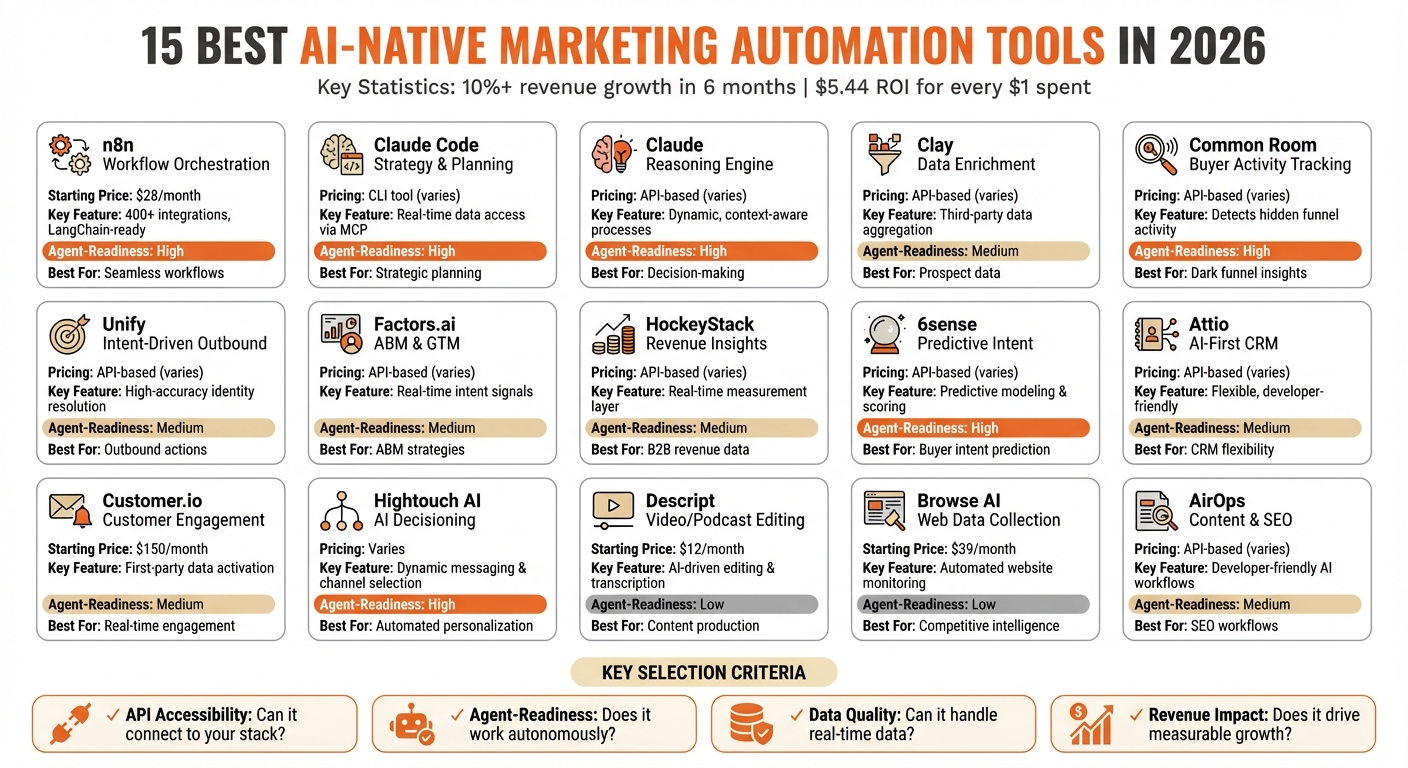
AI-Native Marketing Automation Tools Comparison: API Accessibility, Agent-Readiness & Revenue Impact
I run these tools inside my own business, so this list comes from real use. When I built my own content system on this kind of AI-native automation, it took my content cycle from two weeks down to minutes and replaced a $61,920-a-year freelancer cost, on under an hour of my time a week.
Keep one thing in mind as you build. The tools are the easy part. The results come from the system you put around them, which means clean data, a clear workflow, and one defined job for each tool you add. I’d have you pick the single task that eats the most of your week, wire up the one or two tools that remove it, and prove that it works before you add the next. That is how a lean team gets the most output overall.
1. n8n
n8n serves as the orchestration core for a modern AI-driven marketing stack. It bridges Claude Code’s strategic insights with your operational tools: CRMs, email systems, and analytics platforms. Think of it as the nerve center, ensuring decisions turn into actions precisely when and where they are needed.
API Connectivity
n8n provides 400+ native integration nodes for platforms like Salesforce, HubSpot, and Google Workspace, alongside access to over 5,800 community-built nodes as of early 2026 [3]. Its HTTP Request node and Webhook node enable connections to any REST API, even if no pre-built integration exists [3]. This flexibility eliminates extra integration costs, making it a strong choice for building custom GTM stacks.
Seamless Orchestration (Claude Code + n8n)
In agent-based workflows, Claude Code handles strategy, identifying high-intent leads or drafting outreach, while n8n executes tasks like triggering API calls, updating databases, and routing data. n8n supports the Model Context Protocol (MCP), which pulls real-time data from sources like Google Analytics or your CRM. This eliminates the need for manual data transfers, ensuring AI-driven strategies are always informed by the latest data [1].
Optimized for AI Agents
n8n is LangChain-compatible, featuring 70+ AI-specific nodes to integrate any LLM, whether OpenAI, Claude, or local models via Ollama, into workflows [3]. Its AI Agent node allows services like CRMs or Slack to function as tools that AI can autonomously use. For example, Delivery Hero saved 200 hours monthly on lead scoring by leveraging n8n’s AI nodes [1]. The "Teams of Agents" feature also enables collaboration among multiple specialized AI agents within a single workflow [3].
Ensuring Data Quality
n8n supports context engineering by consolidating data infrastructure across your tools [1]. Instead of duplicating data between siloed systems, a common cause of the "context death spiral", n8n retrieves real-time updates using MCP and database nodes. This ensures AI agents always operate with accurate, current information, addressing integration issues that affect 42% to 54% of AI initiatives [1]. This streamlined data handling also supports predictable and scalable pricing.
Enhancing Revenue Operations
n8n automates complex tasks like lead categorization and dynamic campaign routing, completing workflows 2 to 2.5 times faster than traditional tools [3]. Its execution-based pricing keeps costs predictable. A 200-step AI workflow costs the same as a simple two-step sync [3]. Companies using n8n for AI-driven workflows often experience a 10%+ revenue increase within 6 to 9 months [1].
"n8n’s pricing model is its strongest technical argument: one execution covers a 200-step AI pipeline just as it covers a two-step webhook."
- James Kowalski, AI Benchmarks & Tools Analyst [3]
Pricing:
n8n Cloud starts at $28/month for 2,500 executions, scaling up to $70/month for 10,000 executions. A free, self-hosted Community edition is available, while Business tiers range from $460 to $920/month [3].
2. Claude Code
Claude Code builds on n8n’s orchestration capabilities to bring a strategic edge to your AI-driven marketing stack.
Claude Code transforms marketing automation from simple task management to strategic decision-making. This command-line interface (CLI) tool writes scripts, checks campaign logic, and creates roadmaps that orchestration platforms like n8n can follow. Unlike web-based chatbots, it maintains constant access to local project folders, avoiding the hassle of copy-pasting between tools and the "context death spiral" that often follows.
Orchestration Fit: Claude Code and n8n
Think of Claude Code as the Strategy Architect and n8n as the execution layer. Claude Code handles script creation and campaign planning, while n8n moves data between platforms and triggers actions. Together, they use the Model Context Protocol (MCP) to pull live data from tools like Google Ads, Google Analytics, or your CRM. This ensures decisions are grounded in up-to-the-minute metrics. Once the orchestration framework is in place, Claude Code’s advanced agent capabilities ensure campaigns run seamlessly.
Agent-Readiness
A reliable data flow is key, and Claude Code secures this by directly integrating with your marketing stack. Its Plan Mode (Shift + Tab) lets you validate growth experiments before consuming API credits. It autonomously links tool calls and retains context for complex, multi-step workflows. Additionally, it generates a STRATEGY.md file in your project folder, which updates as performance data is analyzed. This creates a living document to guide and refine ongoing campaigns.
Data Quality
By connecting directly to your marketing stack’s data infrastructure through MCP, Claude Code avoids the pitfalls of integration failures that can disrupt AI projects [1]. It eliminates the need for manual data transfers between disconnected apps, instead accessing the necessary information programmatically. This reduces errors and ensures decisions are based on accurate, current data.
Boosting Revenue Execution
This approach delivers fast, measurable results. For example, the "58-Minute Campaign" becomes possible: Claude Code plans the strategy, n8n routes the data, and specialized agents execute creator partnerships in under an hour [1]. By shifting from rigid IF-THEN rules to reasoning-based workflows, this method achieves an average return of $5.44 for every $1 spent on advanced marketing automation [1]. Together, Claude Code and n8n create a powerful system that aligns strategic planning with real-time, dynamic execution.
3. Claude
Claude serves as the intelligent reasoning engine that drives smarter decision-making across your marketing automation tools. While Claude Code focuses on strategic planning and n8n handles workflow execution, Claude adds a critical layer of intelligence, assessing, classifying, and personalizing decisions in real-time. Together, these tools create a cohesive system where strategy, execution, and reasoning work seamlessly.
API Accessibility
Claude integrates effortlessly into orchestration platforms through AI Agent nodes. For instance, in n8n, the Claude 3.5 Sonnet model powers reasoning tasks directly within workflows. This eliminates the need for custom API setups, allowing you to embed Claude wherever evaluation logic is required, like scoring leads based on LinkedIn profiles or analyzing website content.
Orchestration Fit (Claude Code + n8n)
Claude shines in areas where basic automation falls short. Using the Model Context Protocol (MCP), it processes live CRM and ad data to make context-aware decisions. For example, it can analyze a prospect’s website content and provide actionable insights, all within a single workflow step.
Agent-Readiness
Claude goes beyond simple integrations with its advanced memory and multi-step reasoning capabilities. It doesn’t just answer prompts. It performs complex tasks by chaining tool calls, evaluating outcomes, and refining its approach based on results. This autonomy significantly reduces operational workload [1].
Revenue Execution Improvement
By replacing rigid IF-THEN rules with dynamic reasoning, Claude drives tangible business results. Its adaptive decision-making transforms static campaign logic into self-optimizing systems. These systems adjust targeting, messaging, and timing on the fly, based on performance data, delivering measurable revenue growth without requiring manual adjustments [1]. Claude’s reasoning capabilities complete the cycle of strategic planning, execution, and real-time optimization in your marketing automation stack.
4. Clay
Clay plays a crucial role in providing the data backbone for AI-driven marketing workflows, complementing the orchestration and planning capabilities of Claude Code and n8n.
Clay specializes in aggregating and enhancing raw prospect data, transforming it into actionable insights. This capability makes it a favorite among GTM engineers, as it seamlessly pulls data from various third-party sources and creates adaptable enrichment pipelines that fuel downstream automation efforts [6].
API Accessibility
Clay stands out as a dedicated data provider, not a full execution platform. It excels at consolidating identity resolution, firmographics, technographic signals, and contact enrichment into well-structured datasets. These datasets integrate effortlessly via API with orchestration tools, making Clay indispensable during the research and enrichment phase. This stage is critical for acquiring detailed prospect data before initiating personalized outreach or routing workflows [6].
Orchestration Fit (Claude Code + n8n)
In the automation stack, Clay serves as the primary data source, offering the insights needed for both Claude Code’s strategic planning and n8n’s orchestration capabilities. With n8n acting as the operational hub and Claude Code managing the high-level strategy, Clay ensures accurate and enriched prospect intelligence. To maintain consistency and reduce errors, automate data flows through APIs instead of relying on manual inputs [1].
Agent-Readiness
While Clay is exceptional at collecting and enriching data, it has limitations when it comes to managing long-running autonomous tasks or stateful workflows [2][6]. Its strength lies in signal enrichment and identity resolution. For execution and multi-step processes, platforms like n8n are better suited to handle complex, stateful workflows across your GTM stack.
Revenue Execution Improvement
By delivering enriched and precise data, Clay enables AI systems to make smarter decisions, transforming generic outreach efforts into highly targeted and effective campaigns.
5. Common Room
Common Room positions itself as a GTM AI platform, designed to uncover hidden buyer activity, often referred to as the dark funnel, before prospects even fill out a form [7][8].
API Accessibility
Common Room’s API delivers detailed, actionable insights that can be seamlessly integrated into orchestration tools like n8n or analyzed using Claude Code. This allows you to route high-priority accounts into tailored workflows. Its standout feature is its ability to track unseen activities, such as research behavior, content engagement, and technology adoption, long before traditional tools detect any signals [7][8]. This makes it an essential component for teams looking to enhance their orchestration strategies.
Orchestration Fit (Claude Code + n8n)
In a unified tech stack, Common Room enriches workflows by providing real-time data that fuels decision-making in tools like Claude Code and n8n. For instance, n8n can use Common Room’s API to identify new high-intent accounts and trigger automated actions like Slack notifications, personalized email campaigns, or CRM updates. Meanwhile, Claude Code can analyze these signals to prioritize accounts for immediate outreach or longer-term nurturing. By 2026, the industry has embraced AI systems that do more than follow static rules. They now plan and execute actions dynamically across platforms [9].
Agent-Readiness
Common Room promotes itself as having built-in prospecting and messaging agents, which autonomously identify potential customers and draft outreach messages based on its data. These capabilities integrate well with the Claude Code and n8n framework, automating target identification and initial engagement while n8n handles the orchestration of complex, multi-step workflows across various systems.
Revenue Execution Improvement
The platform’s AI-powered intent detection focuses sales efforts on accounts actively researching solutions, leading to shorter sales cycles and higher conversion rates. By incorporating Common Room’s insights into a centralized data infrastructure, teams can break down the silos that contribute to the failure of 42% to 54% of AI projects [1]. This approach transforms the tool from a passive monitoring system into a key driver of revenue operations.
6. Unify
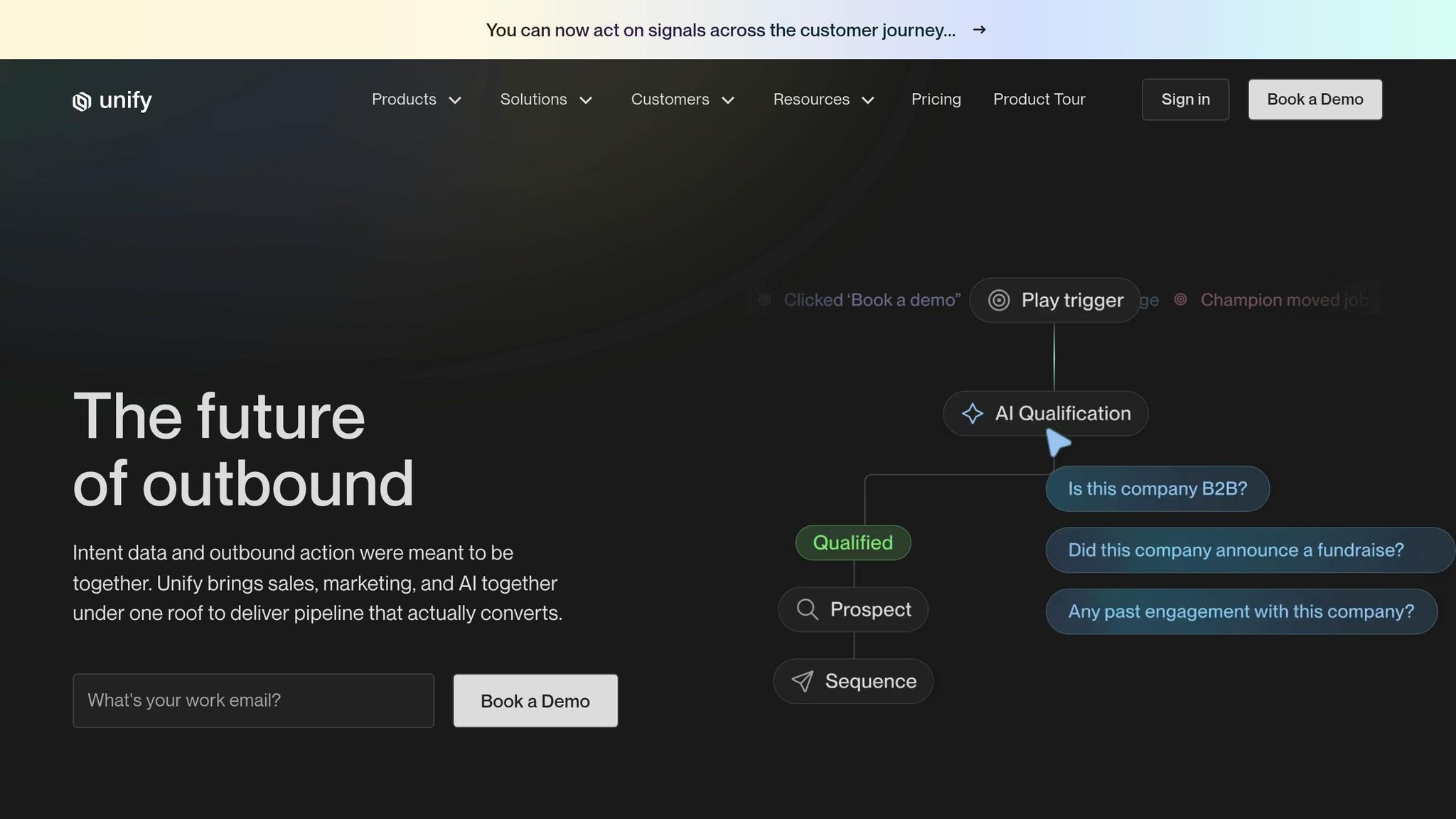
Unify is an AI-powered revenue execution platform designed to bridge the gap between intent data and outbound actions. It goes beyond the typical "If-This-Then-That" logic by enabling autonomous GTM workflows [1].
API Accessibility
Unify’s architecture makes it easy to integrate with orchestration tools like n8n. Its standout feature is its ability to perform high-accuracy identity resolution, effectively de-anonymizing website traffic to identify specific companies and buyers exhibiting high-intent signals. The platform provides clean API endpoints that deliver this data directly into automation workflows, ensuring smooth integration and enabling coordinated actions within your systems.
Orchestration Fit (Claude Code + n8n)
Unify acts as the key data trigger in automation workflows. With its strong connectivity, tools like n8n can manage multistep responses while Claude Code processes firmographic and behavioral data to craft tailored outreach strategies. This combination turns raw intent signals into synchronized, automated revenue-driving actions.
Agent-Readiness
Thanks to its integration capabilities, Unify uses AI to determine the best targets, optimal timing, and effective engagement methods. Its autonomous workflows dynamically adjust messaging, timing, and channel selection, fine-tuning strategies without requiring manual input.
Revenue Execution Improvement
Unify simplifies the process of converting buyer interest into actionable sales efforts. By leveraging AI, it enables you to engage prospects effectively, optimizing your AI marketing system for better results.
7. Factors.ai
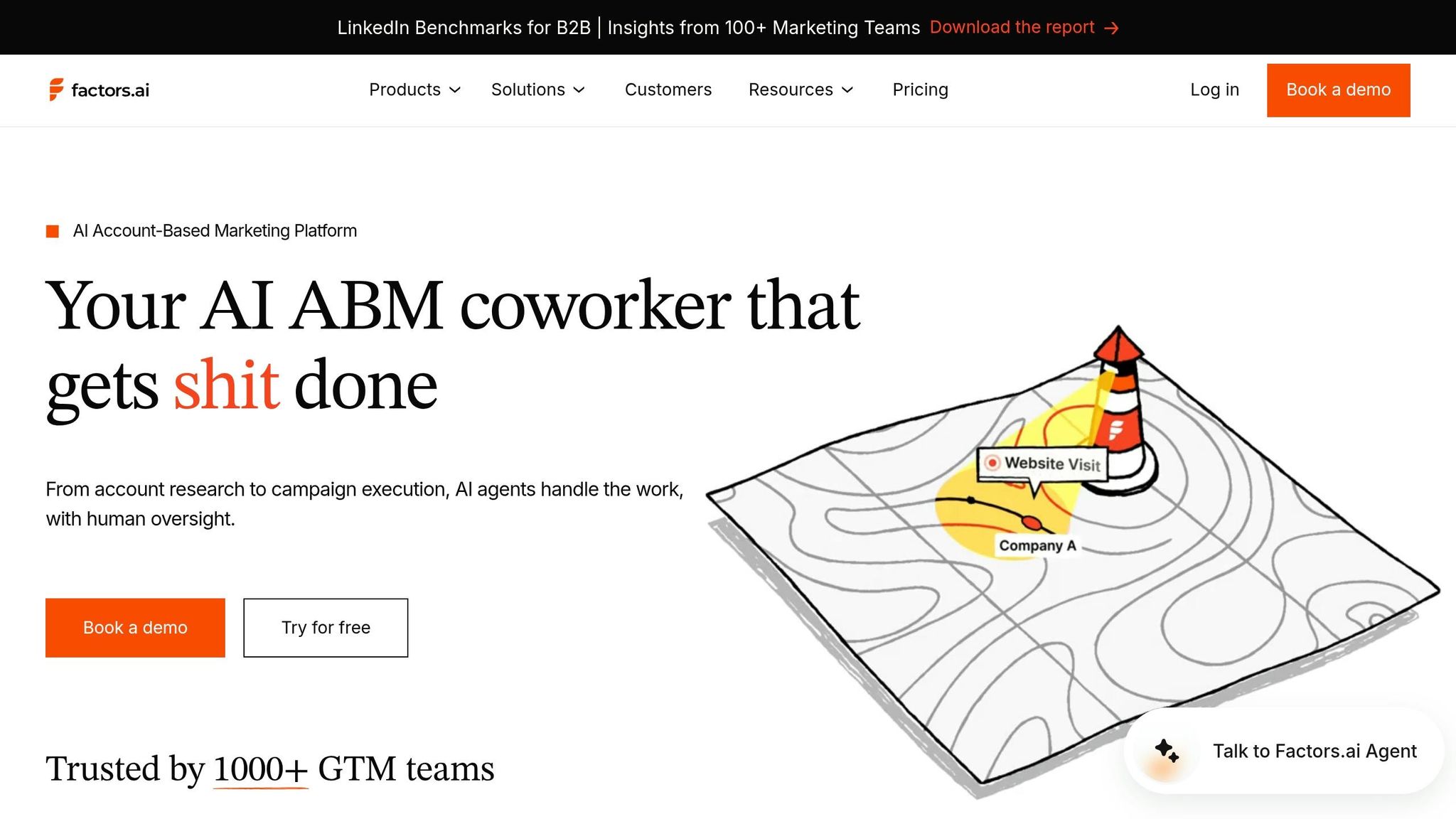
Factors.ai is an AI-driven platform designed for ABM (Account-Based Marketing) and GTM (Go-to-Market) strategies. It combines cross-channel attribution tools, account identification, activation, and AI-powered agents into a single system. Positioned in the signal layer of your marketing stack, it captures buying intent signals like website visits and account-level engagement before prospects even fill out a form [10]. This seamless integration ensures that real-time signals flow directly into your automated workflows.
Orchestration Fit (Claude Code + n8n)
As a robust source of signal-rich data, Factors.ai supplies real-time observations that power downstream automations. Acting as a bridge, it converts raw signals into actionable insights that tools like Claude Code and n8n can process. For instance, when a high-intent website visit or notable account engagement occurs, Factors.ai delivers the data needed to trigger automated workflows through these tools.
Agent-Readiness
Factors.ai empowers lean teams to shift from manual tasks to automated operations. It achieves this by providing the real-time "observations" that AI systems need to make informed pipeline decisions [10]. By continuously tracking buying signals, the platform ensures automated workflows are backed by reliable and timely data.
Data Quality
The platform collects first-party data from website interactions and CRM records, enhancing it with third-party firmographic and technographic details [8]. This combination ensures that decisions made by automated systems are based on comprehensive and accurate account information, avoiding reliance on incomplete or fragmented data.
Revenue Execution Improvement
By identifying intent signals early in the process, Factors.ai enables you to engage with accounts at the right time and with precision. The structured signal data creates a feedback loop, allowing for better targeting and more efficient revenue outcomes.
8. HockeyStack
HockeyStack stands out as a B2B revenue data platform powered by AI, designed to provide real-time measurement data that fits seamlessly into AI-driven marketing workflows. This approach enhances decision-making in revenue operations by delivering actionable insights. By 2026, it operates within an interconnected marketing ecosystem, integrating with other platforms through a unified communication system that ensures real-time, synchronized operations [1].
What sets HockeyStack apart is its use of MCP to pull real-time data from various sources. This data feeds into strategic tools like Claude Code, making it a perfect match for n8n when it comes to executing automations across multiple systems.
9. 6sense
6sense is an AI-driven revenue platform designed to use predictive analytics and intent signals to support revenue marketing. It identifies buying intent, such as website visits or changes in technology usage, before prospects even submit a form. Acting as a signal layer, it delivers high-quality account data into downstream automation tools like Claude Code and n8n workflows[10].
API Integration
6sense extends its predictive capabilities through powerful API integrations. Teams can extract buying signals, account scores, and engagement metrics to incorporate into external workflows. This allows intent data to flow seamlessly into communication tools, trigger personalized outreach, or update CRM systems.
Orchestration with Claude Code and n8n
n8n plays a key role in connecting intent data with execution tools[1]. For example, when 6sense detects a surge in interest from a target account, n8n captures that signal, via webhook or API polling, and sends it to Claude Code for further analysis. Claude Code can then determine the next steps, such as sharing a case study or scheduling a demo. This setup ensures context-aware decision-making[1].
Ready for AI Agents
6sense’s intent data integrates well with AI agents that handle prospecting and engagement autonomously. However, this requires strong context engineering to create a unified data system that these agents can rely on[4]. With this foundation, AI agents can independently manage tasks, boosting efficiency in revenue operations.
Enhancing Revenue Execution
By leveraging predictive intent signals, 6sense eliminates guesswork in revenue strategies. Instead of waiting for prospects to fill out forms, go-to-market teams can act on early intent signals, customize outreach based on account behavior, and monitor patterns that lead to conversions. When combined with n8n and Claude Code, 6sense enables a fully automated system. This system directs high-intent accounts to the right strategy, adjusts messaging dynamically, and tracks performance throughout the funnel, integrating seamlessly into the broader AI-powered workflow supported by the tech stack.
10. Attio
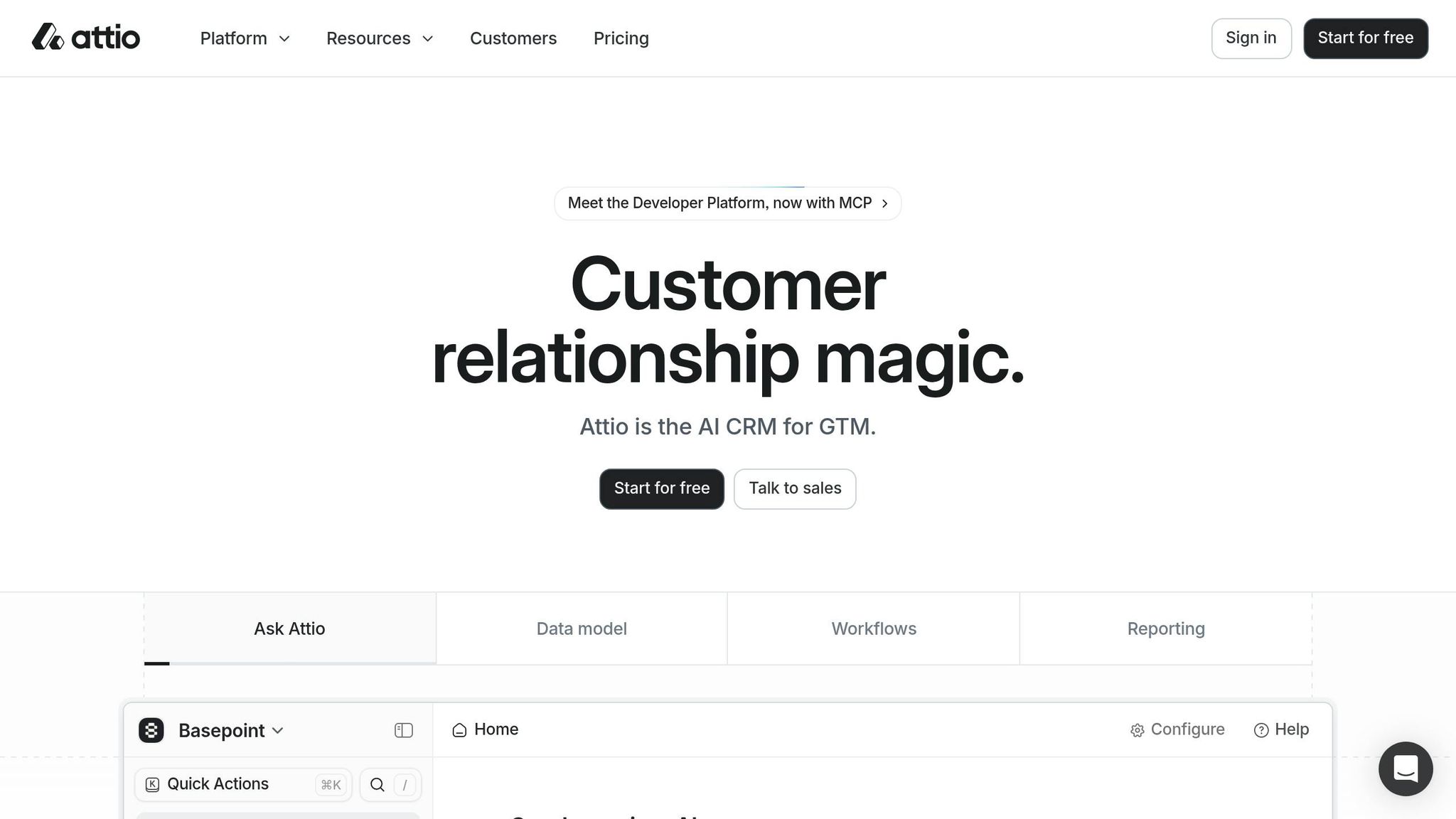
Attio presents itself as an AI-first CRM, designed from the ground up to prioritize flexibility and automation. Instead of layering AI onto older systems, it integrates AI capabilities, workflow automation, and an API-driven foundation directly into its architecture.
API Accessibility
Attio’s API is built with developers in mind, enabling seamless integration into AI-focused ecosystems like Claude Code and n8n. With this API, developers can create custom workflows by programmatically managing records, updating contacts, triggering automations, and accessing reporting metrics. This API-centric design allows Attio to function as the CRM layer in a broader, orchestrated stack, where n8n handles system connections and Claude Code manages logic and data transformation.
Orchestration Fit (Claude Code + n8n)
In the evolving 2026 agentic stack, Claude Code operates as the Strategic Orchestrator, while n8n acts as the Central Nervous System[1]. Attio slots into this framework by offering a CRM infrastructure that goes beyond simple automation. It supports workflows driven by dynamic reasoning, making it a natural fit within this advanced ecosystem[1].
Agent-Readiness
Attio facilitates context engineering, creating a unified data layer essential for AI-driven marketing automation[1]. By consolidating customer data, engagement history, and workflow states, it eliminates the need for agents to work around fragmented systems. This streamlined structure enables AI agents to make smarter decisions about outreach, task prioritization, and next steps, all with minimal human intervention.
Revenue Execution Improvement
Attio helps lean growth teams scale personalized engagement by automating actions triggered by real-time signals. Its ability to consolidate clean, actionable data enhances downstream processes. When paired with n8n and Claude Code, Attio becomes the backbone of a fully automated GTM engine, adapting to account activity, tailoring outreach, and monitoring performance with precision.
11. Customer.io
Customer.io brings first-party data to life through AI-powered marketing automation, enabling real-time actions via its Track and App APIs. In 2026’s AI-native marketing stack, it stands out by replacing static campaign logic with dynamic triggers based on real-time behavioral data. Its seamless API compatibility with orchestration tools like n8n makes it an essential part of the modern marketing toolkit.
API Accessibility
Customer.io’s API-first design offers precise programmatic control over customer data, events, and messaging. This approach integrates smoothly into the 2026 marketing environment, where tools act as part of a "shared nervous system"[1]. By leveraging n8n’s HTTP Request and Webhook nodes, teams can automate event data flow, campaign triggers, and engagement metric retrieval, all without manual input[3]. This robust API framework ensures effortless integration with tools like Claude Code and n8n, enabling intelligent workflow execution.
Orchestration Fit (Claude Code + n8n)
In a modern AI-powered stack, n8n connects data streams and triggers AI reasoning via Agent Nodes[2]. Customer.io complements this by serving as the execution layer for personalized, multi-channel campaigns. With Claude Code handling logic and n8n managing orchestration, Customer.io enables campaigns to evolve in real time, adapting to user behavior, churn risks, or account activity. This approach moves beyond static "If-This-Then-That" workflows into AI-driven actions[2][4].
Agent-Readiness
Customer.io’s event-driven architecture supports autonomous operations, allowing AI agents to analyze engagement patterns, adjust messaging on the fly, and optimize channel strategies. By triggering context-specific actions using first-party data, it eliminates the need for constant human oversight, empowering AI agents to act independently and effectively.
Revenue Execution Improvement
Customer.io aligns with the Data-Mania evaluation method by driving measurable revenue growth through real-time, personalized engagement. Its ability to activate first-party data enables campaigns to respond directly to customer behavior, replacing guesswork with actionable insights. When integrated with n8n and Claude Code, Customer.io becomes part of a fully automated go-to-market engine. This setup monitors user activity, triggers timely outreach, and fine-tunes messaging with AI insights, helping lean teams scale while maintaining relevance and impact.
12. Hightouch AI Decisioning
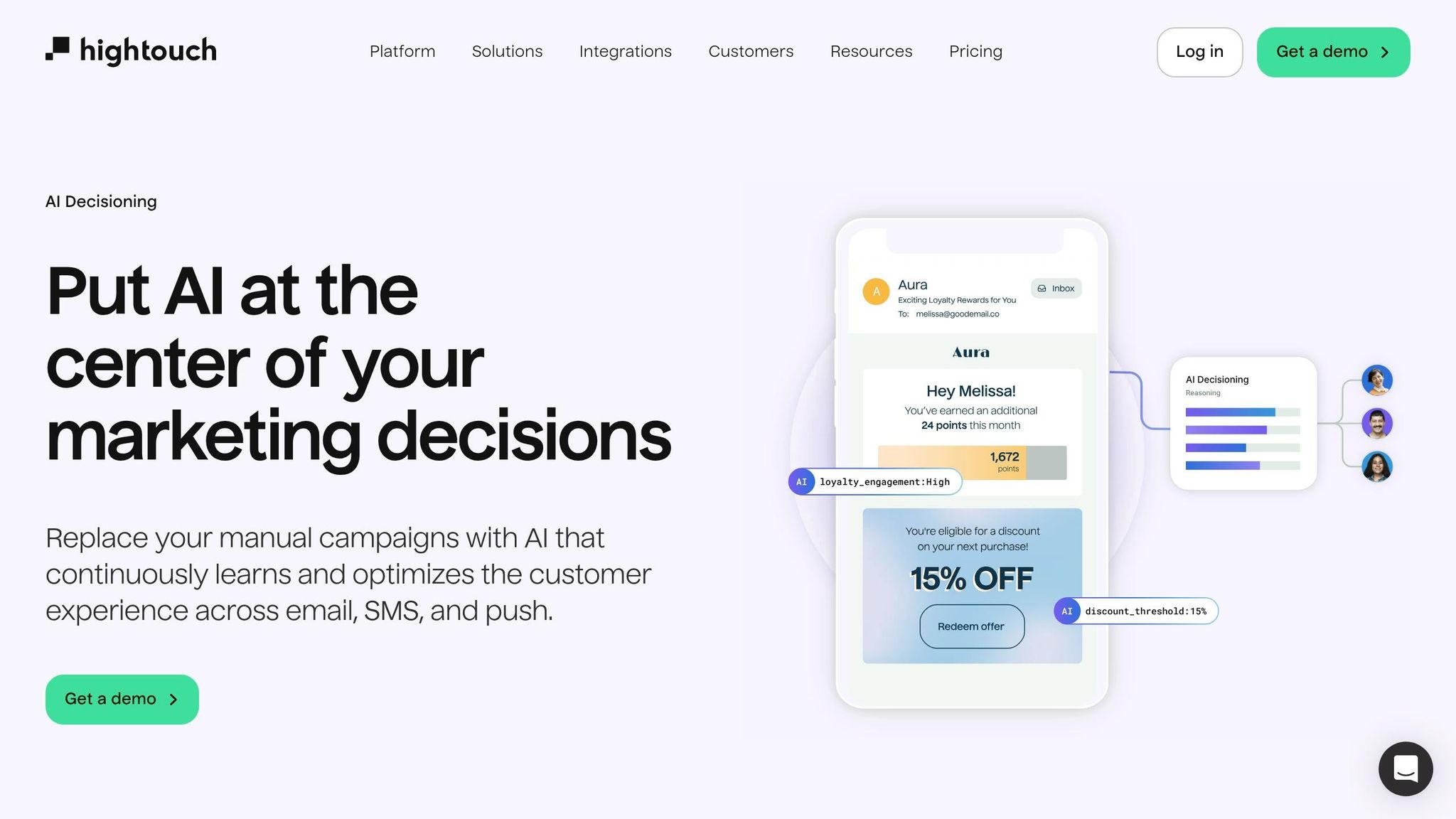
Hightouch takes automation to a new level by embedding AI-driven decision-making into every part of a workflow. Instead of relying on static rules, Hightouch AI Decisioning uses dynamic, AI-powered systems to determine the best message, channel, timing, and content for engagement. This approach allows systems to reason, plan, and act with minimal human involvement, making marketing automation smarter and more adaptive[1].
Orchestration Fit (Claude Code + n8n)
In an AI-native tech stack, Claude Code acts as the "Strategy Architect", while n8n operates as the "Central Nervous System", connecting data across platforms[1]. Hightouch fits into this framework as the decision-making layer, using context engineering to draw insights from unified data. This eliminates the need for manual campaign setups, enabling seamless, autonomous operations.
Agent-Readiness
Hightouch’s AI agents are designed to continuously assess customer interactions, ensuring each engagement is timely and tailored. By analyzing factors like message content, timing, and preferred channels in real-time, the platform delivers highly personalized experiences, embodying the concept of agentic marketing.
Revenue Execution Improvement
Hightouch enhances revenue execution by transforming customer data into actionable, predictive insights. When paired with Claude Code and n8n, it creates an automated revenue workflow that uses a unified data framework to anticipate customer behavior and trigger relevant actions at the right time. This integration streamlines processes and drives more effective engagement.
13. Descript

Descript brings AI-powered video and podcast editing into the marketing automation toolkit, streamlining content production. By automating tasks like transcription, editing, and distribution, it eliminates hours of manual work. Features like filler word removal and eye contact adjustments ensure professional-quality video and podcast outputs[11].
API Accessibility
Descript’s API allows for automated workflows that handle transcription, editing, translation, and distribution. This means external systems can trigger video processing tasks, retrieve polished content, and distribute assets without needing to interact with the Descript interface. Essentially, the API transforms video editing into a repeatable automation step that integrates seamlessly into broader marketing workflows, especially when paired with tools like n8n and Claude Code.
Orchestration Fit (Claude Code + n8n)
Descript’s API works hand-in-hand with tools like n8n’s HTTP Request node, enabling workflows to upload raw video files, initiate AI editing processes, and retrieve the finished content[5][3]. Claude Code serves as the Strategy Architect, deciding which clips to extract, how to format them for various platforms, and when to distribute them[1]. Descript focuses on AI-driven editing, while n8n manages the overall content pipeline, and Claude Code provides the logic layer, together forming a seamless, automated system.
Agent-Readiness
Descript’s AI agents efficiently handle repetitive tasks, such as creating short-form clips from longer videos for social media[11]. Once parameters are set, the platform operates autonomously, reflecting a growing trend in AI marketing strategy. By 2026, 80% of marketing leaders are expected to rely on AI tools like Descript to automate content production[11].
Revenue Execution Improvement
When combined with Claude Code and n8n, Descript cuts content production time from two weeks to under an hour[1]. This speed allows you to react quickly to market trends, experiment with more content variations, and maintain consistent output across channels. The result is a streamlined content engine that ensures timely delivery of assets to target audiences, all through automated workflows rather than manual processes.
14. Browse AI
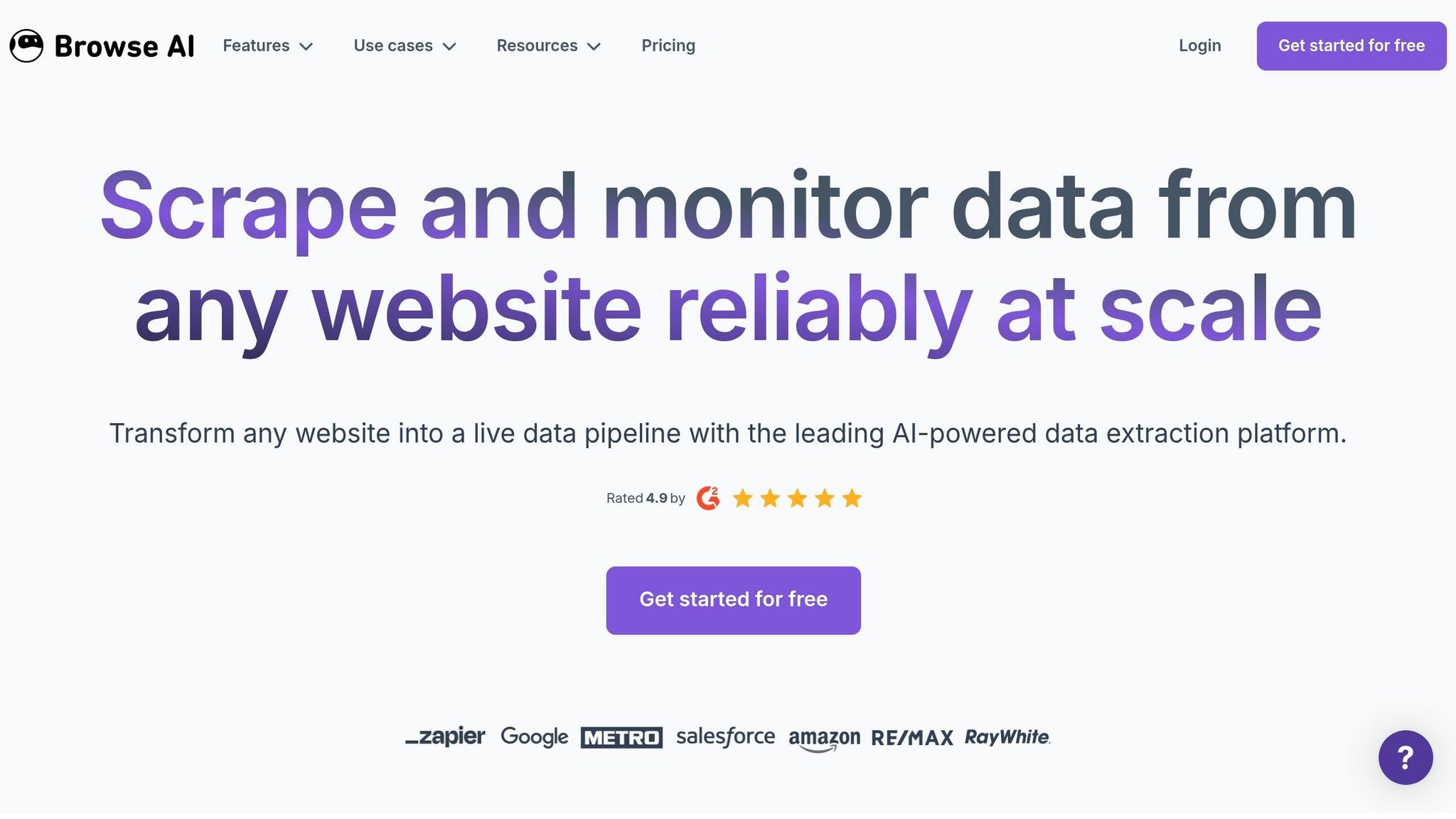
Browse AI simplifies web monitoring and data extraction by turning these tasks into automated modules that marketing teams can use without coding, similar to other AI tools for product marketing. Instead of manually tracking competitor websites, Browse AI creates automated "robots" that gather structured data through an API. This means scattered web data can be transformed into actionable insights and fed directly into your marketing automation tools.
API Accessibility
Once a robot is set up for a specific webpage, the REST API delivers structured data. This allows n8n to efficiently poll endpoints and trigger downstream actions. The integration ensures that web data becomes a seamless part of your orchestrated workflows[3].
Orchestration Fit (Claude Code + n8n)
Browse AI fits perfectly within an automation stack as a specialized data collection layer. Acting as the hub, n8n schedules Browse AI robots to run at regular intervals, retrieves their output, and directs the data to the appropriate destinations[1]. Claude Code takes on the role of analyzing this data, identifying key competitor actions, and determining the next steps. For instance, if Browse AI detects a competitor’s new integration page, n8n routes the data to Claude Code, which can automatically generate a blog post outline and schedule its publication, all without human intervention.
Agent-Readiness
Once configured, Browse AI’s robots operate independently, adapting to changes in website layouts and maintaining reliable data feeds. Unlike traditional web scrapers, its AI-powered extraction minimizes the need for constant upkeep. This self-sufficient functionality ensures your marketing intelligence stays up-to-date, freeing your team to focus on high-level strategy. The result is a continuous, automated flow of data that directly supports faster decision-making and execution.
Revenue Execution Improvement
By integrating Browse AI with Claude Code and n8n, marketing teams can create real-time workflows for competitive intelligence. This setup allows you to automatically detect competitor actions, like launching new features, changing pricing, or publishing updates, and respond quickly. Teams can trigger personalized campaigns, update sales materials, or refresh website content almost instantly. This automation reduces the lag between market shifts and your response, keeping your messaging sharp and timely to maintain an edge in competitive markets.
15. AirOps
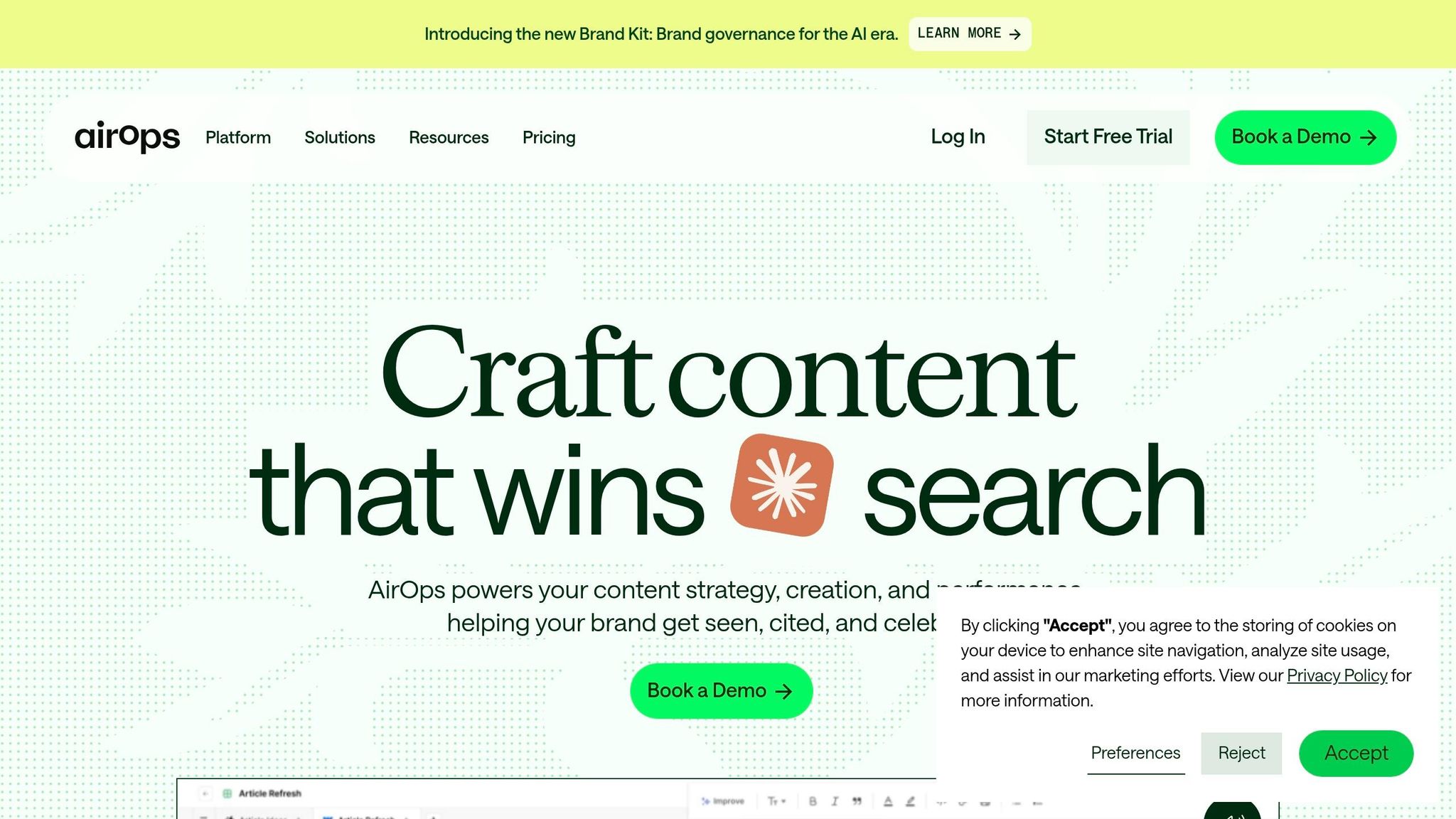
AirOps is an AI-native platform that enables you to automate end-to-end marketing workflows. By combining data, LLMs, and structured processes, it allows you to generate, optimize, and deploy content and campaigns at scale without relying on manual execution.
AirOps focuses on creating AI-driven workflows and API-first content operations to streamline tasks like SEO, content creation, and data transformation. What sets AirOps apart is its ability to link AI model steps, data inputs, and outputs into workflows that can run automatically. It also integrates smoothly with tools like Claude Code and n8n, enabling coordinated, AI-powered operations.
API Accessibility
AirOps offers developer-friendly APIs that allow workflows to be triggered, data to be passed, and outputs to be retrieved. This seamless integration ensures tools can communicate directly, eliminating the need for manual data transfers and creating a cohesive, interconnected system for marketing operations[1].
Orchestration Fit (Claude Code + n8n)
In a setup involving Claude Code and n8n, AirOps serves as the AI execution layer for specific marketing tasks. n8n handles orchestration by linking services through API connectivity, using HTTP request nodes and webhook endpoints[5][3]. At the same time, Claude Code provides strategic oversight, determining what content to create, which data to use, and how to structure workflows effectively.
Agent-Readiness
Once workflows are configured with clear AI steps, data sources, and outputs, AirOps can operate autonomously. This moves beyond traditional "If-This-Then-That" automation, enabling marketing stacks to reason, plan, and execute tasks independently[1].
Revenue Execution Improvement
By incorporating AirOps into your automation stack, marketing operations become more efficient. Faster content delivery and campaign execution translate into tangible revenue growth, making it a valuable addition to any marketing strategy.
Tool Comparison Table
When selecting an AI-native marketing automation tool, it’s crucial to consider how well it aligns with your workflow and technical requirements. Below is a detailed comparison of 15 tools, evaluated based on API accessibility, orchestration fit with Claude Code and n8n, agent-readiness, data quality, and revenue execution improvement.
Agent-readiness reflects a tool’s ability to operate with minimal human oversight, while higher ratings indicate easier integration and more autonomous functionality. This table serves as a quick guide to help you identify the best tool for your business and technical needs.
| Tool | API Accessibility | Orchestration Fit (Claude Code + n8n) | Agent-Readiness | Data Quality | Revenue Execution Improvement |
|---|---|---|---|---|---|
| n8n | Excellent – Over 70 AI-specific nodes, REST API support, and webhook endpoints | Excellent | High – Embeds language models for autonomous reasoning | Good – Handles data transformation but lacks GTM abstractions | High – Achieves workflows 2-2.5x faster than traditional tools |
| Claude Code | Excellent – Command-line interface, MCP for real-time data access, and local file interaction | Excellent | High – "Plan Mode" validates strategies before execution | Excellent – Maintains programmatic context without losing data | High – Reduces costly errors through pre-execution validation |
| Claude | Excellent – API-first design for dynamic reasoning and summarization | Excellent | High – Powers autonomous research, drafting, and orchestration | Excellent – Processes complex signals for strategic decisions | High – Enables large-scale personalized marketing through reasoning |
| Clay | Good – API-accessible enrichment and prospecting data | Excellent | Medium – AI-assisted but requires manual workflow setup | Good – Blends enrichment and research data effectively | Medium – Speeds up prospecting but needs an orchestration layer |
| Common Room | Good – Signal-rich data accessible via API | Excellent | High – Autonomous identity resolution and messaging agents | Excellent – GTM AI captures comprehensive signals | High – Enables personalized responses using real-time data |
| Unify | Good – Exposes signals and outbound execution via API | Good | Medium – Merges signals with automated outbound processes | Good – Combines AI research with actionable signals | Medium – Simplifies outbound efforts but benefits from external orchestration |
| Factors.ai | Good – Offers measurable signal data for routing and alerts | Good | Medium – AI agents for ABM/GTM with partial autonomy | Excellent – Integrates attribution, identification, and activation data | High – Boosts campaign automation and targeting precision |
| HockeyStack | Good – Clean measurement layer accessible via API | Good | Medium – AI-driven scoring and attribution with workflow automation | Excellent – B2B revenue data with attribution and lead scoring | High – Provides a foundation for automated optimization |
| 6sense | Good – Pushes intent and account data to external systems | Good | High – Predictive AI for modeling and orchestrated revenue actions | Excellent – Delivers intent and account intelligence | High – Automates targeting based on buying signals |
| Attio | Excellent – API-friendly CRM infrastructure for custom automations | Excellent | Medium – AI-native CRM with workflow and reporting tools | Good – Clean CRM data structure supports automation | Medium – Enables custom GTM workflows but requires orchestration setup |
| Customer.io | Excellent – Track/App APIs for activating first-party data | Good | Medium – AI-powered engagement with data-driven triggers | Good – Leverages first-party data for personalized messaging | Medium – Enhances engagement automation but needs broader integration |
| Hightouch AI Decisioning | Good – Built for automated actions on customer data | Good | High – AI selects message, channel, and timing autonomously | Excellent – Backed by customer data warehouse | High – Optimizes message delivery through autonomous decision-making |
| Descript | Good – API for transcription, editing, and distribution | Good | Low – Focused on AI editing | Good – High-quality transcription and editing outputs | Medium – Speeds up content production but limited to specific use cases |
| Browse AI | Excellent – Converts web data into API-accessible triggers | Excellent | Low – Focused on monitoring and extraction | Good – Reliable web data extraction | Medium – Supports data-driven triggers but needs workflow integration |
| AirOps | Excellent – Developer-friendly APIs for workflow triggers and outputs | Excellent | Medium – Operates autonomously once workflows are configured | Good – Structured AI model steps with clean data handling | Medium – Improves efficiency in content and SEO operations |
This table highlights how each tool fits into a modern AI-native marketing stack, emphasizing their ability to drive results through intelligent automation. Whether you’re prioritizing integration, data quality, or autonomous functionality, this comparison provides a solid starting point for your decision-making process.
Conclusion
The tools discussed above are reshaping marketing automation by combining AI-driven workflows with strategic coordination.
Traditional marketing automation often relies on rigid rules and manual processes, whereas AI-native tools leverage context-aware reasoning to adapt and perform. Many AI projects falter due to integration challenges and data silos[1], making it critical to select tools that function smoothly as part of a unified system rather than focusing solely on the "best" standalone platform.
A strong data infrastructure is the foundation for enabling these tools to perform autonomous, revenue-generating actions. Businesses adopting AI-powered automation often experience a revenue increase of over 10% within 6 to 9 months, with an average return of $5.44 for every $1 invested[1]. However, achieving these results depends on aligning tools with your specific workflows rather than relying on feature comparisons. For instance, a technical team building custom go-to-market automations might find value in n8n’s execution-based pricing and self-hosting capabilities, while a lean growth team may prioritize tools with advanced signal capture or autonomous decision-making features.
Start small by automating a single, high-complexity workflow before scaling to full-funnel automation. Focus on maintaining clean data infrastructure and include human oversight for high-stakes actions to protect your brand’s reputation. The tools highlighted here are designed to help teams reclaim 15–25 hours per week[12], allowing them to shift their attention from repetitive tasks to more strategic and creative initiatives.
Select tools that minimize manual labor and deliver clear, measurable results for your business. By adopting these AI-native solutions, you can transform your marketing operations and drive growth through context engineering, giving AI systems the data and strategic guidelines they need to reason, plan, and execute effectively[1].
FAQs
What makes a marketing automation tool truly AI-native?
A marketing automation tool built from the ground up with AI at its core operates on a whole different level compared to older systems that simply tack on AI features. These tools are designed to think, interpret signals, and make decisions autonomously, all while personalizing interactions at scale.
Key highlights include:
- API accessibility for seamless integration with other platforms.
- Orchestration of multi-step workflows, enabling complex processes to run smoothly.
- Agent-readiness, allowing the system to reason and adapt like a human would.
- The ability to drive revenue outcomes through continuous learning and automation.
This deep integration of AI into the foundation of these tools sets them apart, offering capabilities far beyond the limited scope of traditional systems.
How do Claude Code, Claude, and n8n work together in one stack?
Claude, Claude Code, and n8n combine to create a powerful AI-driven marketing automation stack. Claude serves as the brain, tackling tasks such as research, summarization, and making decisions. Claude Code steps in to handle execution, generating scripts, transforming data, and managing integrations. n8n ties it all together, acting as the orchestrator that connects APIs, triggers workflows, and integrates external systems. Together, they provide a smooth and scalable automation solution where reasoning, execution, and orchestration work seamlessly.
Which tool should I start with for my first AI automation workflow?
For your first AI automation workflow, n8n is an excellent choice, particularly if you’re tech-savvy or require detailed control. This open-source platform stands out for its ability to handle intricate APIs, integrate custom code, and connect with AI services. With its self-hosted setup, flexible design, and pricing based on executions, it’s well-suited for creating scalable, AI-powered marketing systems using tools like Claude Code.