
In 2026, partnership marketing is no longer optional for B2B SaaS companies – it’s a core growth strategy. Why? Traditional marketing channels like SEO are losing effectiveness as AI-generated answers dominate search results, leaving 60% of searches without clicks. Meanwhile, customer acquisition costs (CAC) have risen 14% annually, and payback periods have stretched by 12.5% since 2022. Partnerships now bridge the gap, delivering 40-60% lower CAC, 20-30% faster deal cycles, and up to 6x more revenue compared to standalone marketing efforts.
Here’s the challenge: Not all partnerships deliver results. To succeed, SaaS companies need experts who tie partnerships directly to revenue through co-selling, integration strategies, and partner-driven pipelines. Below are nine consultants who excel at building revenue-generating ecosystems in today’s AI-driven landscape:
- Lillian Pierson: Combines AI expertise with ecosystem strategies to lower CAC and boost partner pipelines.
- Lindsay Riggs: Specializes in AI-powered partner targeting and alignment with account-based marketing.
- Greg Portnoy: Focuses on quality partnerships, co-sell sequences, and AI-driven attribution models.
- Alyshah Walji: Automates account mapping and integrates ecosystem strategies to reduce churn and drive revenue.
- Alex Glenn: Builds CRM-integrated, partner-aware sales tools to connect partnerships to measurable outcomes.
- Jessica Fewless: Aligns AI workflows with sales activation to prioritize net new ARR and CAC efficiency.
- Isaac Morehouse: Advocates for nearbound strategies, leveraging partner trust to improve win rates and retention.
- Chris Samila: Implements CRM-first systems and AI workflows to turn partnerships into scalable revenue engines.
- Adrienne Coburn: Designs AI-driven workflows and co-sell processes to streamline partner programs and cut costs.
Quick Comparison:
| Consultant | Key Focus Areas | Revenue Impact Highlights |
|---|---|---|
| Lillian Pierson | AI-driven sales activation, ecosystem strategy | Boosts lead-to-opportunity conversion rates |
| Lindsay Riggs | AI-powered partner targeting, GEO optimization | Improves discoverability on AI platforms |
| Greg Portnoy | Co-sell sequences, partner attribution models | Reduces CAC, shortens sales cycles |
| Alyshah Walji | Ecosystem ICP, account mapping automation | Cuts churn, grows partner-sourced pipelines |
| Alex Glenn | CRM-integrated sales tools, multi-touch attribution | Tracks revenue influence across the funnel |
| Jessica Fewless | AI workflows, ARR-focused partnership metrics | Prioritizes measurable revenue outcomes |
| Isaac Morehouse | Nearbound strategies, partner trust leverage | Increases win rates, retention, and deal size |
| Chris Samila | CRM-first systems, AI sales activation | Turns partnerships into scalable revenue |
| Adrienne Coburn | AI workflows, co-sell enablement | Simplifies partner programs, reduces CAC |
The hard part isn’t deciding if partnerships matter – it’s finding the right consultant who can prove their value with clear metrics. These experts deliver results by focusing on revenue-driven strategies, AI-powered workflows, and ecosystem alignment. Ready to make partnerships your top growth driver? Start here.
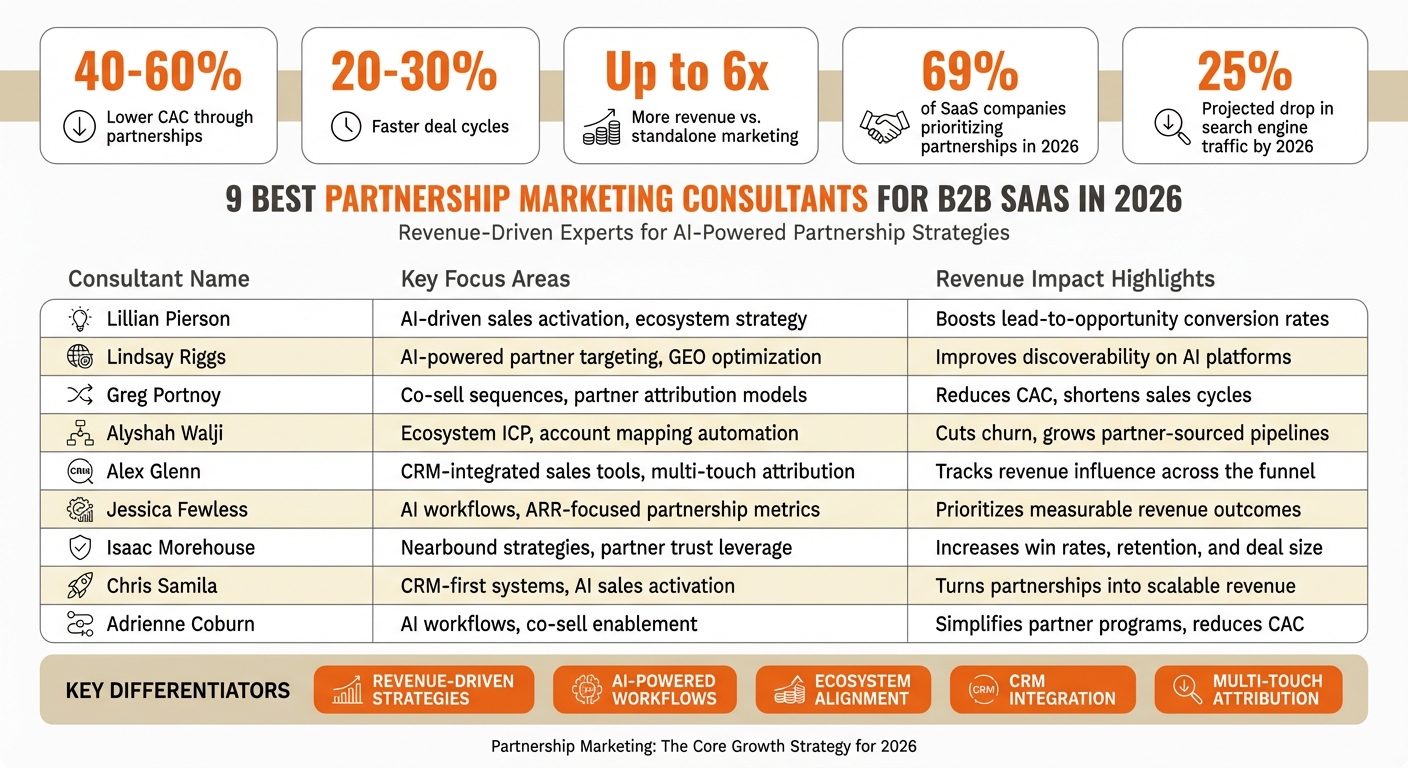
Top 9 Partnership Marketing Consultants for B2B SaaS: Expertise and Revenue Impact Comparison 2026
Partnership Marketing Strategy for SaaS Businesses (Go-To-Market Case Study)
Why Partnership Marketing Matters for B2B SaaS in 2026
The decline of traditional marketing channels is no longer just a prediction – it’s happening now and accelerating fast. Gartner projects that by 2026, search engine traffic will drop by 25% as AI chatbots and virtual agents increasingly handle user queries directly. This shift means fewer clicks for websites, a trend that hits B2B SaaS companies especially hard given their reliance on SEO to drive demand. When search traffic shrinks by a quarter, the old strategies simply don’t hold up. This reality is pushing SaaS companies to redirect their budgets toward partnerships that can rebuild trust and visibility.
By 2026, 69% of SaaS companies will have shifted their focus to partnerships as a primary growth driver. As traditional channels lose effectiveness, partnerships fill the gap by providing what search engines no longer can: trust, context, and credibility. In a world awash with AI-generated content, recommendations from trusted integration or implementation consultants stand out and make an impact.
Integration partnerships, in particular, create a strong defense against churn in this AI-driven landscape. When customers connect a product to their existing tech stack, they are 2–3× less likely to churn. This directly addresses the retention issues that arise alongside rising customer acquisition costs and declining organic visibility.
The emergence of Answer Engine Optimization (AEO) is also transforming how B2B buyers discover solutions. Instead of focusing solely on keyword rankings, companies now need to embed themselves within ecosystems. This could mean integrating with platforms, earning recommendations from trusted advisors, or gaining visibility in cloud marketplaces where enterprise buyers spend allocated budgets. These shifts explain why 30% of SaaS companies now rank partnerships as their top strategic priority for 2026.
To thrive in this evolving landscape, partnership marketing must go beyond surface-level tactics like webinars or logo swaps. It requires a deeper focus on ecosystem integration, co-selling enablement, activation of integrations, and generating a partner-sourced pipeline. These elements directly contribute to lower customer acquisition costs, quicker sales cycles, higher retention rates, and more predictable growth.
1. Lillian Pierson / Data-Mania
I’ll start with my own practice. My edge in partnership marketing is that I connect partnerships directly to revenue, ahead of treating them as a logo swap or a co-marketing checkbox. I bring an engineer’s eye to the ecosystem, so partner efforts actually show up in pipeline.
“On average, our online community growth rate and our social reach increased by 4-fold during the time Lillian rendered growth and social influencer services. If you’re looking for fast, laser-targeted growth for your online business, Lillian is a great go-to.” – Nick Elprin, Founder, Domino Data Lab
Expertise in AI-Driven Partnership Strategies
I turn partnership opportunities into direct revenue by building the AI-powered sales tools partners need to sell for you: co-sell scripts, partner emails, and one-page value briefs your partners can deploy right after a joint webinar. That tight link between marketing and sales is what makes partnership effort translate into closed deals.
Connecting Partnerships to Revenue Growth
With acquisition costs climbing, partnerships are one of the few channels that get cheaper as they compound. I design partner-sourced pipeline around your real economics, so every partnership has a revenue job, ahead of a press release.
Mastery of Ecosystem Strategy and Partner-Sourced Pipeline
I map your ecosystem to find the partners whose audiences actually overlap with your ideal buyer, then build the co-sell motion and the tracking to prove it worked. The result is inbound through other people’s trust, measured like any other channel.
2. Lindsay Riggs
Lindsay Riggs has earned recognition for turning partnerships into reliable revenue generators. Her focus is on aligning partnership strategies with the changing landscape of 2026, where traditional marketing is losing its edge, and buyers increasingly depend on trusted third parties for advice.
Expertise in AI-Driven Partnership Strategies
Riggs uses AI to redefine how partnerships work in 2026. According to data, 49% of senior leaders believe AI improves partner targeting and management. She employs AI tools to pinpoint partners that genuinely contribute to revenue. A cornerstone of her strategy is Generative Engine Optimization (GEO), which boosts discoverability on AI-driven platforms. This ensures B2B SaaS brands can be found on AI-powered answer engines, not just traditional search engines. Her methods make partnerships indispensable in a time when older marketing channels are becoming less effective.
Connecting Partnerships to Revenue Growth
Riggs tackles rising customer acquisition costs (CAC) head-on by leveraging partnerships. She creates frameworks that align partnerships with account-based marketing, ensuring each campaign targets specific accounts and revenue goals. In 2026, where ecosystem strategies dominate, Riggs ensures partnership efforts are directly tied to measurable revenue. Her approach addresses a key challenge for B2B SaaS companies: partnerships must produce tangible pipeline and revenue, moving beyond superficial collaborations like logo swaps and webinars that fail to deliver results.
Deep Understanding of Ecosystem Strategy and Partner-Sourced Pipeline
Riggs embeds partnerships into broader go-to-market strategies, ensuring campaigns lead to real, measurable outcomes. She helps companies gain visibility in places decision-makers already frequent, such as trade media, digital PR platforms, and partner ecosystems. Her strategies emphasize "buyer enablement" by offering tools like comparison guides and implementation resources, providing practical insights instead of self-promotional content.
3. Greg Portnoy
Greg Portnoy approaches partnerships as a key revenue source, often contributing 20–40% of SaaS revenue in well-established programs . He prioritizes quality over quantity, understanding that a handful of strong partnerships can outperform dozens of weaker ones . This mindset drives his use of AI to refine and simplify partnership strategies.
Expertise in AI-Driven Partnership Strategies
Portnoy uses AI to analyze structured data, enabling him to align ideal customer profiles, create co-branded messaging, and develop materials like sales briefs and infographics . This approach reflects a growing trend, with 49% of senior leaders recognizing that AI delivers the most value when it enhances partner and account targeting as well as management .
Connecting Partnerships to Revenue Growth
By implementing structured co-sell sequences for specific accounts, Portnoy shortens sales cycles and ties partnership efforts directly to measurable results like pipeline growth and closed deals. He uses AI to build custom attribution models, linking partnership activities to revenue outcomes . This is especially critical in 2026, as rising customer acquisition costs make it essential for every marketing dollar to show clear returns.
Ecosystem Strategy and Partner-Sourced Pipeline
Expanding on his sales activation methods, Portnoy sees ecosystem strategy as a cornerstone of go-to-market success . His approach focuses on cultivating a partner-sourced pipeline that directly supports sales, emphasizing the value of a few active, high-quality partnerships over a large number of inactive ones. This strategy reflects the shift from outdated marketing practices to dynamic, ecosystem-driven partnerships – a necessity in an AI-driven business landscape.
4. Alyshah Walji
Alyshah Walji has a knack for turning partnerships into major revenue streams. At Vidyard, he achieved a jaw-dropping 14× growth in the quarterly partner-sourced pipeline – from $25,000 in 2019 to $350,000 in 2020 – by automating account mapping with more than 35 tech partners . This effort also boosted partner-sourced close rates from 15–20% to an impressive 50–70% . By 2020, partner-sourced deals accounted for 30% of Vidyard’s total revenue, and 60% of all revenue involved a partner somewhere in the customer journey .
Understanding Ecosystem Strategy and Partner-Sourced Pipelines
Walji’s approach to partnerships goes beyond the standard Ideal Customer Profile (ICP). His Ecosystem Ideal Customer Profile (EICP) doesn’t just define who the customers are – it also identifies the tools they rely on. By cross-referencing freemium accounts with partner customer lists, he automated this process, leading to a 20% improvement in response rates . He argues that traditional ICPs fall short because they overlook the tech stack that helps buyers achieve their goals.
"While we’ve learned to do a really good job of identifying what ‘ABM Adam’ or ‘Demand Gen Dave’s’ KPIs and business priorities are, we often leave out the tools and technologies that help them accomplish these goals outside of this ICP."
This alignment between ecosystem strategy and sales outreach creates a clear path to measurable revenue growth.
Linking Partnerships to Revenue Growth
Walji’s results highlight the shift from older marketing methods to AI-driven, revenue-focused partnership strategies. He integrates partner insights directly into tools like Salesforce and Slack, enabling sales teams to act quickly. By analyzing customer overlap data, he eliminates guesswork and builds integration roadmaps with clear, measurable value . For instance, at Lightspeed Commerce, he spearheaded integrations with Meta and Klaviyo, creating unified catalogs that improved personalization .
This reflects Walji’s broader belief that AI is no longer just a novelty – it’s a practical tool that transforms ecosystem data into actionable strategies .
5. Alex Glenn
Alex Glenn views partnership marketing as a key driver for revenue growth. By 2026, he treats go-to-market partnerships as a direct avenue to achieving measurable business results, such as increased revenue and improved win rates. This perspective aligns with the growing trend where traditional marketing channels are losing traction, while strategic partnerships are emerging as a more reliable and effective approach .
Linking Partnerships to Revenue Growth
Glenn prioritizes partnerships that directly contribute to revenue, leveraging AI-powered strategies to maximize their impact. For example, he transforms marketing assets like webinar transcripts into actionable sales tools, such as partner-aware follow-up emails, co-sell discovery scripts, and Slack-ready discussion points. These tools help maintain momentum with leads . Additionally, he integrates multi-touch attribution systems to track how partners influence every stage of the sales funnel, making their contributions visible in the CRM. Currently, only 42% of companies use multi-touch attribution , leaving many B2B SaaS organizations without a clear understanding of partnership-driven revenue. By addressing this gap, Glenn equips teams to justify their investments and expand successful strategies.
Focused Ecosystem Strategy and Partner-Sourced Pipeline
Beyond revenue tactics, Glenn underscores the importance of building a high-quality ecosystem to sustain long-term growth. He advocates for concentrating on a few high-performing partnerships rather than spreading resources thin across many underperforming ones. These top-tier relationships require consistent enablement and management to thrive . His approach aligns with data showing that partner-sourced deals can cut customer acquisition costs by 40–60% and reduce sales cycles by 20–30% . Integration partnerships also play a crucial role in supporting sustainable growth, reinforcing the value of a focused and strategic partnership ecosystem.
6. Jessica Fewless
Jessica Fewless represents a forward-thinking approach to partnership consulting, showcasing how AI can transform traditional methods into measurable revenue outcomes. Rather than using AI as just a tool for content creation, Fewless integrates it into workflows designed to generate partner-sourced revenue. She focuses on bridging the "sales activation gap" – ensuring that partnership opportunities translate into actual closed deals.
Expertise in AI-Driven Partnership Strategies
Fewless takes on one of the toughest challenges in B2B SaaS partnerships: aligning sales teams with dynamic partner messaging. By using AI, she creates tools like partner-aware follow-up emails, co-sell discovery scripts, and Slack communication guides tailored to specific partner narratives . This shift from merely experimenting with AI to embedding it into operational processes reflects how partnership marketing is evolving as a discipline . Her focus on these technical solutions lays the groundwork for her broader emphasis on driving revenue growth.
Connecting Partnerships to Revenue Growth
Fewless zeroes in on metrics that matter. Instead of relying on vanity numbers like webinar attendance or logo visibility, she prioritizes Net New ARR and GTM engineering benchmarks like CAC payback . Her approach ensures that partnerships are evaluated through a revenue-driven lens, making it easier for companies to justify budgets and scale successful initiatives. This focus on accountability and efficiency marks a clear departure from traditional evaluation models.
Ecosystem Strategy and Partner-Sourced Pipeline
Fewless treats partnerships as a central revenue driver, not an afterthought. Her consulting framework brings together channel, technology, service, and referral partners into a unified strategy . She employs a repeatable four-phase cycle: Discover and select partners, Design the offer/plan, Deliver the plays (co-marketing/co-selling), and Develop/Expand based on performance insights. By combining AI-driven processes with data-backed performance metrics, Fewless sets a high standard for partnership efficiency and effectiveness, paving the way for the experts that follow.
7. Isaac Morehouse
Isaac Morehouse, the CMO at Reveal and nearbound.com, advocates for a nearbound, ecosystem-driven approach that reshapes how B2B SaaS companies think about partnership marketing. Instead of viewing partnerships as a secondary or supporting channel, Morehouse treats them as a core go-to-market strategy. His method surrounds target accounts with trust and influence, making partnerships a central part of the sales process in an increasingly AI-driven world . By leaning on the credibility of trusted partners, his approach creates a sales strategy that’s both impactful and measurable .
This shift in focus doesn’t just change the game – it delivers tangible results.
Tying Partnerships to Revenue Growth
Morehouse’s strategy capitalizes on partner data – like technographics, overlapping accounts, and deal influencers – to speed up and improve deal outcomes. The results? Deals that close 35% faster, partner-influenced deals that are typically twice as large, and a 43% higher win rate .
"If you involve the right partners in your marketing strategy, everything you do will become cheaper, you’ll increase your reach and conversion."
In addition to short-term sales wins, Morehouse’s approach lays the groundwork for a scalable and sustainable growth ecosystem.
Mastering Ecosystem Strategy and Partner-Sourced Pipelines
Morehouse has developed an 8-step framework that transforms partnerships into powerful revenue drivers. His process includes aligning goals with the C-suite, identifying high-engagement partners, creating joint target account lists, and ensuring alignment with internal sales teams . He prioritizes quality over quantity, selecting partners who already hold the trust of customers and can provide critical "intel, influence, or intros" to accelerate the sales process .
Morehouse also highlights the importance of focusing on existing customers, noting that 70% to 80% of annual revenue often comes from them. Nearbound strategies, he argues, should not only target new acquisitions but also aim to boost retention and upsell opportunities . With half of B2B companies expected to attribute over 25% of their revenue to partnerships between 2024 and 2026, Morehouse’s framework reflects a shift that’s already underway . His strategy demonstrates how partnerships can become a key revenue driver in today’s AI-influenced business landscape.
8. Chris Samila
Chris Samila exemplifies how partnerships can directly fuel revenue growth in today’s AI-driven business environment. His CRM-first, revenue-focused strategy redefines how partnerships are executed, moving away from traditional brand-building exercises. Instead, he integrates partnership efforts directly into CRM platforms like Salesforce and HubSpot. This ensures seamless collaboration between channel partners, service partners, and internal teams, while also making partner programs measurable and scalable . By prioritizing activation, enablement, and co-selling within these systems, Samila transforms partnerships into a reliable revenue engine .
Linking Partnerships to Revenue Growth
Samila’s approach revolves around the idea of focusing on quality partnerships rather than sheer numbers. He emphasizes that a handful of high-performing partnerships can deliver far greater value than managing dozens of mediocre ones . By executing partnership strategies within the CRM, he ensures that every effort contributes to measurable pipeline and revenue growth. His use of AI to improve sales activation – boosting conversion rates – further amplifies the financial impact of partner programs .
AI-Driven Partnership Strategies
Samila takes partnership marketing to the next level by integrating AI into every stage of the process. Beyond content creation, he uses AI to optimize workflows and streamline partner interactions. For instance, his AI-driven "Sales Activation" approach includes generating follow-up emails tailored to partners, co-sell discovery scripts, and even Slack-ready talk tracks for seamless communication . These tools not only enhance efficiency but also ensure that partner programs deliver consistent results.
The 90-Day Partner Growth System
Samila’s 90-Day Partner Growth System is a structured framework designed to turn partner programs into revenue machines . It begins with a Clarity phase, where teams define their Ideal Partner Profile (IPP) and map out a detailed 30/60/90-day plan . This system addresses the challenges of maintaining visibility and alignment in a world where traditional marketing channels are increasingly disrupted by AI. By systematizing partner engagement, Samila provides a clear path for teams to achieve measurable outcomes.
9. Adrienne Coburn
Adrienne Coburn takes a workflow-first approach to partnership marketing, prioritizing structured systems over traditional methods. In 2026, thriving partnerships require frameworks that seamlessly connect brands, customer profiles, and value propositions. Coburn’s strategy aligns with industry trends, meeting the growing demand for investment in efficient and scalable operations . Her methods flow naturally into her operational systems, driving measurable results.
Leveraging AI-Powered Workflows
Coburn excels at designing AI-driven workflows, going beyond using AI as a simple tool . She creates repeatable systems that handle complex inputs from multiple partners. For example, her AI workflows generate customized discovery scripts, follow-up emails, and Slack-ready talk tracks, all tailored to specific partners. This removes friction for field teams and boosts efficiency . Her focus on integrating AI with CRM systems addresses a key challenge, as 49% of senior leaders expect AI to deliver its greatest value in improving partner and account targeting .
Repurposing Content and CRM Integration
Coburn’s content engine model turns single assets into multiple formats, such as transforming webinar transcripts into blog posts, LinkedIn carousels, and enablement briefs . She also integrates every partner activity into an AI marketing system – deal registrations, attributions, and more – directly into CRM systems. This creates a unified pipeline that clearly demonstrates partnership ROI. Notably, partner-sourced deals often reduce customer acquisition costs by 40-60% compared to direct sales . By consolidating partner interactions into revenue-generating systems, Coburn effectively counters the diminishing impact of outdated channels.
Streamlining Co-Selling
Coburn enhances partnership outcomes through a simplified three-step co-sell process: joint introduction, discovery, and proof for named accounts . This approach accelerates sales cycles, as partner-referred deals close 20-30% faster than direct deals due to the trust already established . Her structured method ensures partnerships are directly tied to revenue generation, moving beyond mere brand-building efforts.
How to Evaluate Partnership Marketing Consultants
As partnership marketing becomes a key driver of revenue in the AI landscape, evaluating consultants requires more than a glance at surface-level metrics. In 2026, the best consultants won’t just aim to boost brand awareness – they’ll show exactly how their strategies tie partnership activities to revenue.
Assess Their AI Expertise
In today’s AI-driven world, a consultant who dismisses AI as a passing trend or merely a content-generation tool is behind the curve. The right consultant sees AI as a powerful engine for workflows, using it to refine customer profiles, craft partner-focused discovery scripts, and improve lead-to-opportunity conversion rates. As Ryan de la Parra from Myriad360 puts it, "Most people think AI stops at ‘write me this email.’ That’s the bare minimum. What separates high-performing partner marketers is not ‘how they prompt,’ but what they feed AI and how they structure the work around it" . With 49% of senior leaders predicting that AI will deliver the most value in enhancing partner and account targeting , it’s clear that AI fluency is non-negotiable. Once you’ve verified their AI capabilities, move to evaluate their approach to measurement.
Demand Clear Attribution
Attribution is a critical test for any consultant. With only 42% of companies currently employing cross-channel attribution tools across the funnel , many consultants still rely on outdated models like last-click attribution. This is a red flag. A strong candidate should clearly articulate how they’ll connect partnership efforts to closed-won revenue. For example, partner-sourced deals should demonstrate 40–60% lower customer acquisition costs and close 20–30% faster than direct sales . If they can’t back up their approach with clear ROI metrics, it’s a sign to look elsewhere.
Evaluate Their Partner Strategy
The quality of a consultant’s partner roster speaks volumes. Avoid those who chase quantity over quality – “logo hunters” with bloated lists of inactive partnerships won’t deliver results. Instead, seek consultants who focus on a handful of high-performing partnerships, ideally five to ten. They should also demonstrate expertise in ecosystem strategy, co-selling processes, and CRM-first integrations. Look for evidence of enablement depth, such as detailed partner playbooks, discovery questions, and objection-handling frameworks .
Look for a Revenue-Driven Approach
An effective consultant treats partnerships as a core go-to-market strategy, not an afterthought. They should be able to establish a repeatable co-marketing engine within 30 days and focus on improving lead-to-opportunity rates rather than just generating top-of-funnel activity . If they can’t connect their efforts to measurable outcomes like pipeline growth, retention, and revenue, their approach is outdated and unlikely to deliver real value.
Why most partnership programs never touch revenue
Here’s what I see constantly: a startup signs ten partners, announces them all, and six months later can’t tell you which one drove a single dollar. The partnerships exist on a slide, not in the pipeline.
The fix is the revenue machinery underneath them, ahead of more partners: the co-sell scripts, the tracking, and the value briefs partners can actually use. A partnership only pays when the partner can sell you in one sentence and you can see the deal it produced.
So when I build a partnership motion, I start from the revenue backward. Which partners touch your exact buyer, what will make them want to co-sell, and how we’ll measure it. Everything else is just logos.
Conclusion
Partnership marketing works when every partnership has a revenue job and a way to prove it. The consultants here take different routes, so match the one whose strength fits your ecosystem and your stage, and favor anyone who ties partner activity to pipeline over press.
Start with a focused engagement so you can see how a consultant thinks before you commit. And if you want partnerships engineered to show up in revenue, that’s the work I do.
Keep reading
- the best growth marketing consultants for startups
- the best go-to-market consultants for tech startups
- B2B lead generation services for startups
FAQs
What does a partnership marketing consultant do?
A partnership marketing consultant helps you build revenue through other companies’ audiences: finding the right partners, designing the co-sell motion, and setting up the tracking so partner activity shows up in pipeline. The strong ones connect partnerships directly to revenue, ahead of running co-marketing for its own sake.
How do I choose the right partnership marketing consultant for B2B SaaS?
Match their experience to your ecosystem and stage, and confirm they measure partner-sourced pipeline, not just announcements. Ask how they’d make a partner able to sell you, and start with a short engagement to test the approach before committing.
How is partnership marketing different from regular marketing?
Regular marketing reaches buyers directly; partnership marketing reaches them through the trust another company has already earned. Done right, it gets cheaper as it compounds, because each partner keeps sending fit buyers who arrive pre-trusted.