


Personalized marketing in 2026 is all about delivering the right message to the right person at the right time – but the game has changed. With third-party cookies gone (thanks to Google’s Privacy Sandbox phase-out in 2025), first-party data is now the backbone of effective personalization. Businesses need tools that can collect, unify, and activate this data across channels, while respecting privacy and proving ROI.
Here’s what you need to know to build a winning personalization stack in 2026:
- Personalization is no longer just segmentation. The standard is now AI-driven, 1:1 individualization, like Amazon’s recommendation engine, which generates 35% of its revenue.
- You need a stack, not a single tool. The best systems integrate eight layers: data collection, CDPs, decision engines, experimentation, activation, content, analytics, and consent management.
- First-party data is king. Tools like Segment, mParticle, and GrowthLoop help unify data in real time, while avoiding duplication and ensuring compliance.
- Proving ROI is critical. Without holdout groups and proper testing, you can’t measure the true impact of personalization efforts.
The hard part is: Choosing tools that align with your team’s skills, budget, and data readiness. If your data isn’t clean or unified, even the best tools will fail. Start with your data-to-decisions AI personalization system, then layer on decision engines and activation tools as you grow.
| Business Stage | Core Tools | Annual Cost | Key Capability |
|---|---|---|---|
| Starter | HubSpot, Klaviyo, GA4 | $0–$6,000 | Basic email campaigns and analytics |
| Growth | Segment, Braze, Mutiny | $10,000–$50,000 | Multi-channel orchestration, predictive AI |
| Enterprise | Snowflake, Adobe Target, Insider | $50,000+ per platform | Advanced AI, compliance, and edge personalization |
Here’s what might surprise you: Over-personalization can backfire – 53% of customers report negative experiences if it feels intrusive. Start small, test everything, and focus on building trust.
Want to avoid common mistakes? Skip the shiny tools until your data is clean, test every campaign with holdout groups, and prioritize tools that prove measurable lift. In 2026, the best stacks aren’t the most complex – they’re the ones that work.
The 8 Layers of a Personalized Marketing Stack
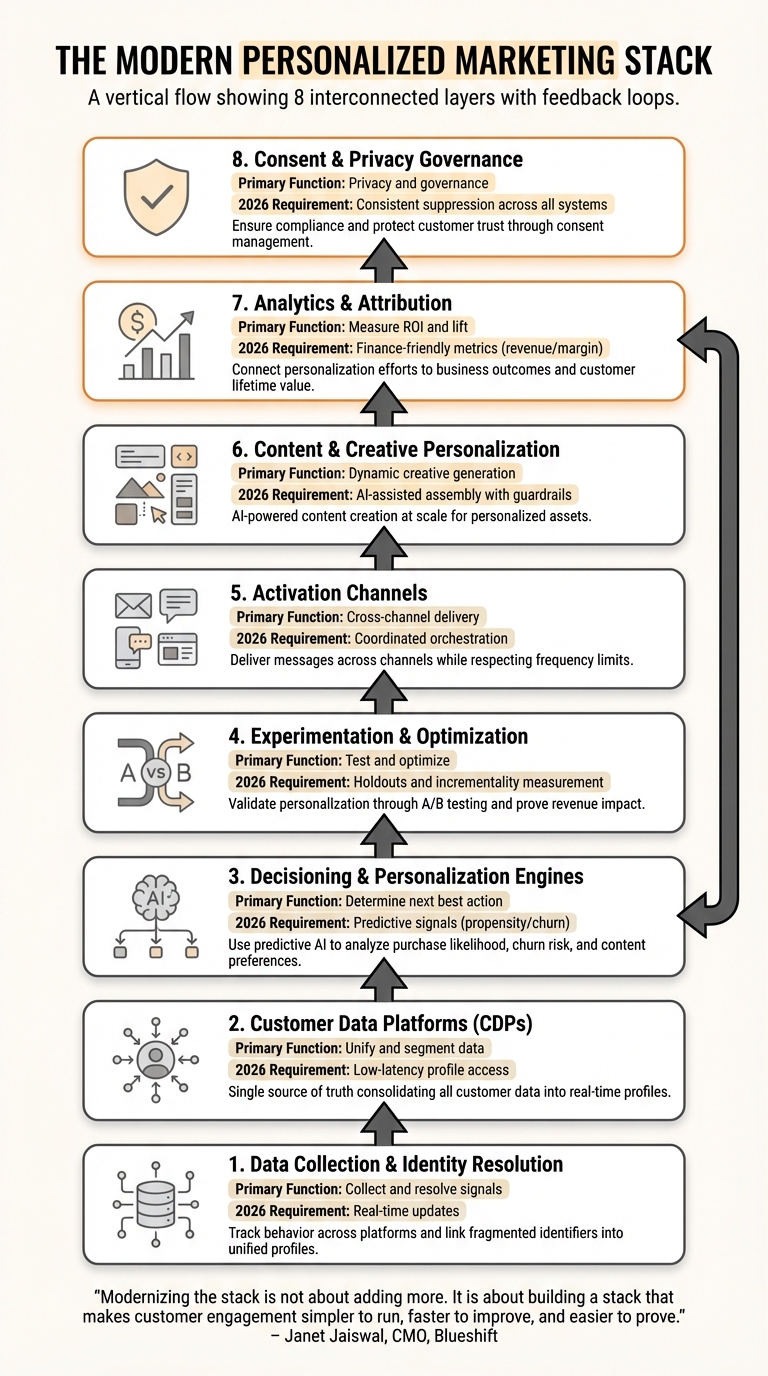
The 8 Layers of a Personalized Marketing Stack in 2026
Building a personalized marketing system is like creating a central nervous system for your strategy. Each layer has a unique and essential role, working together to ensure smooth data flow – from collection to compliance. This interconnected structure makes personalized marketing not only achievable but also effective. Data moves through foundational layers, decision-making tools, and activation channels, then loops back through measurement and governance, creating a seamless system.
Here’s a breakdown of how these eight layers work together to deliver tailored experiences that drive results.
Layer 1: Data Collection and Identity Resolution
This is the bedrock of your stack. Tools here track customer behavior across platforms like websites, mobile apps, point-of-sale systems, and call centers. But tracking alone isn’t enough – identity resolution brings it all together, linking fragmented identifiers (like device IDs or email addresses) into unified profiles. With third-party cookies disappearing, first-party data is now essential [7].
Layer 2: Customer Data Platforms (CDPs)
CDPs act as the single source of truth, consolidating all customer data into unified, real-time profiles. In the fast-paced world of marketing, low-latency access to these profiles is non-negotiable, ensuring data is instantly available to every tool in your stack [7].
Layer 3: Decisioning and Personalization Engines
This layer is where the real magic happens. Decisioning engines go beyond basic segmentation, using predictive AI to determine the next best action for each customer. They analyze factors like purchase likelihood, churn risk, and content preferences to craft tailored offers and messages. For instance, Pandora implemented Bloomreach‘s predictive engine in 2024, boosting conversion rates by 30% through automated merchandising [4].
Layer 4: Experimentation and Optimization
Experimentation tools validate your personalization efforts. Through A/B testing and multivariate experiments, and holdout groups, they answer a critical question: Is your personalization strategy actually driving results? By 2026, the focus will be on incrementality measurement – proving that your efforts generate revenue beyond what would have occurred naturally [7].
Layer 5: Activation Channels
Once decisions are made, activation tools deliver messages across channels like email, SMS, push notifications, and paid media. The key here is orchestration – ensuring customers aren’t overwhelmed with repetitive messages or targeted post-conversion. These tools respect frequency limits and opt-out preferences, maintaining a consistent and respectful brand experience.
Layer 6: Content and Creative Personalization
Even the smartest AI needs compelling content to succeed. This layer manages content creation at scale, using AI to dynamically generate personalized assets like email subject lines, product recommendations, and website banners. For example, in 2024, Tactics used Insider‘s Architect tool to automate customer journeys, achieving a 25% increase in retention through tailored post-purchase follow-ups [5].
Layer 7: Analytics and Attribution
This layer connects your efforts to business outcomes. Analytics tools measure how personalization impacts metrics like customer lifetime value, retention, and revenue per user. By linking individual interactions to overall performance, these tools provide clear ROI insights through cohort analysis and attribution models.
Layer 8: Consent and Privacy Governance
The final layer ensures compliance and protects customer trust. Consent management platforms store user preferences, enforce opt-out rules, and synchronize suppression lists across all channels. If a customer opts out of one channel, their choice is respected across the board – email, SMS, push notifications, and ads.
"Modernizing the stack is not about adding more. It is about building a stack that makes customer engagement simpler to run, faster to improve, and easier to prove." – Janet Jaiswal, CMO, Blueshift [7]
| Layer | Primary Function | Key 2026 Requirement |
|---|---|---|
| 1. Data & Identity | Collect and resolve signals | Real-time updates |
| 2. CDP | Unify and segment data | Low-latency profile access |
| 3. Decisioning | Determine next best action | Predictive signals (propensity/churn) |
| 4. Experimentation | Test and optimize | Holdouts and incrementality measurement |
| 5. Activation | Cross-channel delivery | Coordinated orchestration |
| 6. Content | Dynamic creative generation | AI-assisted assembly with guardrails |
| 7. Analytics | Measure ROI and lift | Finance-friendly metrics (revenue/margin) |
| 8. Consent | Privacy and governance | Consistent suppression across all systems |
The most effective stacks in 2026 won’t just gather more data or add unnecessary features. Instead, they’ll streamline personalization, making it easier to execute, refine, and justify. With the layers defined, the next step is exploring the tools that bring each function to life.
sbb-itb-e8c8399
Best Personalized Marketing Tools by Category
This section outlines leading personalized marketing tools, categorized by their core functions and ideal user profiles.
Data Collection and Identity Resolution Tools
Segment
- Best for: Teams requiring extensive integration capabilities
- What it does: Routes event data to over 300 destinations while building unified customer profiles
- Key features: Real-time data collection, cross-device identity resolution, audience segmentation
- Integrations: Over 300 platforms, including data warehouses, CRMs (e.g., Salesforce, HubSpot), activation tools (e.g., Braze, Klaviyo), and analytics solutions (e.g., Mixpanel, Amplitude) [4]
- Pricing: Custom quote
- Pros: Simple setup, vast integration options, ranked #1 in Ecommerce Data Integration by G2 (Summer 2024) with a 4.6/5 rating [4]
- Cons: Potential for increased hosting costs due to data duplication
- Best for you if: You need a quick deployment with minimal engineering input
mParticle
- Best for: Mobile-first businesses
- What it does: Tracks events and resolves identities across web, mobile, and server-side sources
- Key features: Real-time event streaming, cross-device identity resolution, audience segmentation
- Integrations: Direct connections to major marketing and analytics platforms
- Pricing: Custom quote
- Pros: Excellent mobile SDK, real-time processing
- Cons: Involves data duplication
- Best for you if: Mobile apps are your primary customer touchpoint
- Best for: Teams led by engineers
- What it does: Collects and routes event data using an open-source framework
- Key features: Warehouse-native identity resolution, flexible data routing
- Integrations: Open-source architecture with direct data warehouse connections
- Pricing: Custom quote
- Pros: Open-source flexibility, no vendor lock-in
- Cons: Requires technical setup
- Best for you if: You want full control over your data infrastructure
- Best for: Teams using modern data stacks like Snowflake, BigQuery, or Redshift
- What it does: Activates data directly from your warehouse without duplication
- Key features: Zero-copy architecture, self-service audience building, real-time segmentation
- Integrations: Native warehouse connections with reverse ETL to activation tools
- Pricing: Custom quote
- Pros: Avoids data duplication, reduces hosting fees, maintains a single source of truth, eliminates vendor lock-in [11][9]
- Cons: Requires an existing modern data stack
- Best for you if: You want marketing teams to build audiences independently without relying on engineers
"By owning the architecture, you avoid vendor lock-in. That’s what we love about the architecture we’ve built with GrowthLoop." – Brian Shield, SVP & CTO, Boston Red Sox [11]
- Best for: Teams using data warehouses and needing reverse ETL
- What it does: Syncs warehouse data with marketing and sales tools
- Key features: Warehouse-native activation, automated data syncing
- Integrations: Snowflake, BigQuery, Redshift, and 200+ destinations
- Pricing: Custom quote
- Pros: Zero-copy architecture, strong API support
- Cons: Requires engineering-heavy setup
- Best for you if: Your data engineering team manages the warehouse
| Tool | Best For | Key Strength | Pricing |
|---|---|---|---|
| Segment | Broad integration needs | Routes data to 300+ destinations [4] | Custom quote |
| mParticle | Mobile-first companies | Real-time event tracking across devices [11] | Custom quote |
| Rudderstack | Engineering-led teams | Open-source, warehouse-native [11] | Custom quote |
| GrowthLoop | Teams with modern stacks | Zero-copy activation from the warehouse [11] | Custom quote |
| Hightouch | Data warehouse users | Reverse ETL for activation [11] | Custom quote |
This data foundation paves the way for the next step: centralizing customer data with Customer Data Platforms.
Customer Data Platforms
After data is gathered and resolved, a Customer Data Platform (CDP) transforms it into actionable insights. By 2026, CDPs are categorized into packaged CDPs (e.g., Segment, mParticle, Tealium) and composable CDPs (e.g., GrowthLoop, Hightouch, Census).
Packaged CDPs
- Best for: Teams needing quick deployment
- What they do: Aggregate interaction data from various sources into one system
- Key features: Unified customer profiles, real-time segmentation, pre-built integrations
- Pros: Fast setup, user-friendly interface, low technical requirements
- Cons: Data duplication can increase hosting costs as data volume grows [11]
- Best for you if: Speed is more important than architectural flexibility
Composable CDPs (GrowthLoop, Hightouch, Census)
- Best for: Organizations with existing data warehouses
- What they do: Enable data activation directly from warehouses without duplication
- Key features: Real-time profile updates, self-service audience building, warehouse-native architecture
- Pros: Maintains a single source of truth, avoids vendor lock-in, utilizes existing security policies [11]
- Cons: Requires a modern data stack (e.g., Snowflake, BigQuery, Redshift) [11]
- Best for you if: You want to preserve your warehouse as the central data layer
Insider
- Best for: E-commerce brands needing fast deployment
- What it does: Combines CDP functionality with AI-driven personalization
- Key features: Machine learning for profile deduplication, sub-100ms latency, omnichannel orchestration
- Integrations: WhatsApp, SMS, email, web, mobile apps
- Pricing: Custom quote
- Pros: Reduces setup time by 40%, processes data with sub-100ms latency [4]
- Cons: Limited flexibility for custom data models
- Best for you if: You need a unified CDP and personalization engine for e-commerce
- Best for: E-commerce companies focusing on site search and merchandising
- What it does: Combines CDP capabilities with AI-driven personalization via "Loomi AI"
- Key features: Automated site search optimization, omnichannel campaign management, product recommendations
- Integrations: E-commerce platforms, email, SMS, web
- Pricing: Starts at $10,000+ annually [4]
- Pros: Strong e-commerce focus, rated 4.6/5 on G2 [4]
- Cons: Best for retail; limited B2B features
- Best for you if: E-commerce merchandising is your primary concern
| CDP Type | Pros | Cons |
|---|---|---|
| Packaged (Segment, mParticle) | Quick setup; unified interface | Data duplication; rising hosting fees [11] |
| Composable (GrowthLoop, Hightouch) | No data duplication; single source of truth | Requires an existing modern data stack [11] |
| Marketing Cloud (Adobe, Salesforce) | Deep suite integration | Rigid; hard to integrate with external tools [11] |
Once profiles are unified, the next step is to use personalization engines to deliver tailored, real-time experiences.
Personalization Engines
Personalization engines act as the decision-making layer, using predictive AI to recommend the next best action for each customer. These tools go beyond simple segmentation to determine the optimal message, offer, or experience for every individual.
- Best for: Enterprises with dedicated optimization teams
- What it does: Leverages "Auto-Target" and "Automated Personalization" powered by Adobe Sensei AI
- Key features: Real-time experience selection, multivariate testing, AI-driven audience targeting , and email CTA testing
- Integrations: Adobe Experience Cloud, Analytics, Campaign
- Pricing: Starts at $50,000+ annually [4]
- Pros: 4.3/5 Gartner rating
How to Choose the Right Tools for Your Business
Choosing the right tools for your business isn’t about chasing the latest trends or splurging on the priciest platforms. Instead, it’s about finding solutions that align with your current capabilities and address real challenges – without introducing unnecessary complexity.
Assess Your Data and Personalization Readiness
Start by taking a close look at your data infrastructure. Can your system manage customer identities across devices seamlessly, without relying on manual CSV uploads? Does it maintain unified, real-time profiles? If your data foundation is shaky, adding advanced personalization tools will only amplify inefficiencies [9].
Personalization typically evolves through three stages: Who (identity resolution), What (tracking interests and behaviors), and Why (predicting intent) [9]. Many teams overestimate their progress. For instance, if sending a consistent welcome email across channels is still a hurdle, advanced AI-driven tools aren’t the right fit yet. Focus on tools that match your team’s actual operational readiness rather than aspirational goals.
Looking ahead to 2026, the effectiveness of a tech stack will be judged by how quickly it can be deployed, the confidence it provides in data accuracy, and the measurable impact it delivers – not by a long list of features [7]. If your team struggles to answer basic “why did this happen?” questions, prioritize tools with transparent rule engines over opaque AI systems. Once your data is solid, focus on tools that enhance your highest-performing channels.
Define Priorities Based on Revenue and Channels
Which channels contribute the most to your revenue? If, for example, email drives the majority of your conversions, prioritize optimizing that channel before investing in other platforms.
Match your channel needs to your team’s technical capacity. For small teams or solo marketers, no-code tools like Mutiny (for web personalization) or Klaviyo (for email) can deliver quick results without requiring engineering support [6]. Mid-sized teams managing multiple channels might benefit from orchestration platforms like Insider or Bloomreach, which unify email, SMS, push notifications, and web experiences into one interface [6]. Larger enterprises with complex compliance needs (e.g., HIPAA or SOC 2) should look at platforms like Adobe Target or Zeta Global, which provide advanced governance features [6][10].
Be cautious of tools that create silos in your segmentation logic. For instance, if your email platform defines "high-value customer" differently than your web personalization tool, it can lead to inconsistent customer experiences and erode trust [7]. Look for tools that either share a unified customer profile or sync audiences in real time. Balance these considerations with your budget and compliance needs to find tools that deliver measurable results.
Balancing Budget, Compliance, and ROI
The most cost-effective tool isn’t always the cheapest. A platform costing $1,500 per month that your team can implement quickly often delivers better ROI than a $50,000 annual solution that takes months to launch and requires constant IT support [4].
- For small teams or startups, tools like CleverTap (freemium starting at $0) or Mutiny ($1,500–$2,200/month) offer great value without heavy upfront costs [4][6].
- Mid-sized companies should expect to spend $10,000+ annually on platforms like Bloomreach or Insider, which handle larger data volumes and multi-channel orchestration [4].
- Enterprise organizations need to budget $50,000+ annually for advanced platforms like Adobe Target, plus additional costs for implementation and ongoing optimization [4][5].
Compliance is another critical factor. If your business operates in regulated industries or serves European customers, ensure your tools support consent management, preference centers, and data residency controls from the start. Retrofitting compliance later can be both costly and risky. A 2025 study found that Martech utilization dropped to 49% – often because teams purchased tools that didn’t align with their compliance frameworks [7].
Finally, insist on tools that prove their impact. Look for platforms that support holdout groups, A/B testing, and incrementality measurement. If a vendor can’t show how their tool directly increases revenue rather than just correlating with it, keep searching. By 2026, finance teams will demand clear evidence of personalized marketing’s value, beyond vanity metrics [7].
| Evaluation Factor | Key Question to Ask |
|---|---|
| Data Quality | Can we resolve identity across devices without manual CSV uploads? |
| Compliance | Is consent stored and enforced consistently across all messaging channels? |
| AI Readiness | Is the decisioning logic auditable, or is it a "black box"? |
| ROI | Can the tool provide a credible "lift" measurement that finance will accept? |
Example Stacks for Different Business Stages
These examples outline practical tech stacks tailored to fit your team’s size, goals, and budget.
Starter Stack: Small Teams with Tight Budgets
For small teams working within limited budgets, simplicity and efficiency are key. A lean stack with one tool each for data, orchestration, and measurement can go a long way [7]. Start with HubSpot’s free CRM to centralize customer data and interactions. Add Klaviyo or Mailchimp for behavior-driven campaigns like cart abandonment or welcome emails. Use Google Analytics 4 for free website analytics and Hotjar to track user behavior with heatmaps [8]. This setup costs between $0 and $500 per month (or up to $6,000 annually, depending on your contact list size) and eliminates the hassle of manual data transfers. Begin by automating essential campaigns, and as your business grows, you can transition to a multi-channel approach.
Growth Stack: Multi-Channel Personalization
When your business expands beyond email marketing, you’ll need tools that can coordinate customer interactions across multiple channels, such as web, SMS, push notifications, and paid media. A growth stack often includes a CDP like Twilio Segment to unify customer data, an orchestration platform like Braze or Bloomreach to manage multi-step journeys, and a tool like Optimizely or Mutiny for testing personalized landing pages [3]. This setup supports consistent, coordinated messaging that drives measurable revenue growth. Costs typically range from $10,000 to $50,000 annually, with returns coming from predictive decisioning – automating the next best action, channel, or timing for each customer [7]. For example, instead of sending the same upsell email to everyone, your system might send a push notification to mobile users and an SMS to those less engaged with email. The key to success lies in ensuring all tools share a unified customer profile, creating seamless alignment across channels like email, web, and SMS [7].
Enterprise Stack: Advanced Personalization at Scale
For large-scale operations, enterprise stacks demand a composable architecture to handle scalability, compliance, and advanced AI-driven automation [2]. Start with a data warehouse like Snowflake as your central source of truth, paired with an identity resolution platform like Amperity or ActionIQ [2]. Add tools such as Adobe Target or Insider for advanced testing and decision-making, Bloomreach for AI-driven content optimization, and OneTrust for managing consent across all channels [4]. At this level, you’ll be creating personalized assets programmatically and executing personalization logic at the edge, reducing issues like content flicker [1]. A standout feature here is explainable AI – your models must clearly justify their decisions, enabling compliance and finance teams to audit them effectively [4]. If your team can’t answer, “Why did this customer receive this offer?” with data-backed reasoning, you’re not ready for this level yet. Tools in this tier typically start at $50,000 annually per platform [4].
| Business Stage | Core Tools | Typical Annual Cost | Key Capability |
|---|---|---|---|
| Starter | HubSpot (free), Klaviyo, Google Analytics 4, Hotjar | $0–$6,000 | Behavior-triggered email and basic web analytics |
| Growth | Twilio Segment, Braze/Bloomreach, Mutiny/Optimizely | $10,000–$50,000 | Multi-channel orchestration with predictive decision-making |
| Enterprise | Snowflake, Adobe Target, Insider, OneTrust | $50,000+ per platform | Explainable AI, programmatic creative, edge-based personalization |
Common Mistakes When Building Your Stack
Skipping Measurement and Testing
If you’re not using holdout groups, you’re flying blind when it comes to proving personalization works. Testing ensures your efforts are actually driving new conversions instead of just scooping up customers who would have purchased anyway [7]. Yet, many teams skip over this critical step, launching personalized campaigns without a control group to measure against.
This oversight becomes a glaring issue when budget reviews roll around. Blueshift highlights the risk: "If you cannot prove lift, the stack becomes vulnerable during budget conversations" [7]. When finance demands ROI numbers and you’re empty-handed, your personalization strategy – and the budget supporting it – could be on the chopping block. Worse, poorly executed personalization can backfire, as 53% of consumers report negative experiences when it misses the mark [9].
To avoid this, set up A/B tests with proper control groups from day one. Use your platform’s statistical tools to confirm results are real, not random [4]. If your system includes features like auto-allocation or Bayesian optimization, take advantage of them – they can cut experiment times in half and deliver insights much faster [4].
But measurement isn’t the only pitfall. Misjudging how much personalization is too much can also cause problems.
Over-Personalization That Feels Invasive
Personalization is a double-edged sword. While 71% of customers expect personalized interactions, 53% say they’ve had bad experiences with it [9]. Why? Often, it’s because brands cross the line between helpful and invasive. Referencing overly specific details – like a product someone glanced at weeks ago during a late-night browsing session – can make your efforts feel creepy instead of thoughtful.
The root problem is often a lack of context or respect for privacy. For instance, if a customer opts out of personalization on one channel but still receives targeted messages on another, trust erodes quickly. The misconception that "more personalization is always better" [9] can lead to these missteps, damaging relationships beyond repair.
Start small and prioritize customer comfort. Test how people react to basic personalization before layering on more complexity. Focus on delivering meaningful value, like tailored recommendations based on genuine patterns, rather than showcasing how much data you’ve collected [6]. And most importantly, honor consent preferences consistently across every channel in your stack [7].
Of course, none of this works if the data you’re using is flawed.
Adding Tools Before Fixing Data Quality
Investing in advanced personalization tools without first cleaning up your data is like building a house on quicksand. Poorly organized data leads to what experts call "Frankenstein" data – where mismatched names, duplicate accounts, or other errors create chaos [9]. Adding more tools on top of a broken foundation only makes things worse.
As GrowthLoop puts it, "If your customer experience is broken, odds are your data strategy is, too" [9]. Teams often rush to adopt AI-powered platforms without first centralizing customer data or resolving key issues. The result? AI tools make flawed recommendations, and marketers end up spending more time fixing mistakes than benefiting from automation [9][7].
Focus on building a strong data foundation first. Use a cloud-based data warehouse to centralize information, establish clear identity resolution rules, and audit your tracking setup before introducing new tools [9]. Avoid platforms that require manual CSV uploads – these are notorious for causing data decay [7]. While it may not be glamorous, clean and well-structured data is what makes any personalization tool effective. It’s the backbone of a functional and reliable stack.
| Mistake | Consequence | Prevention Strategy |
|---|---|---|
| Skipping Testing | Can’t prove ROI; risk of negative experiences | Use A/B/n testing with holdout groups [4][7] |
| Over-Personalization | Loss of customer trust; intrusive experiences | Start small, test reactions, and honor privacy [6][9] |
| Tool-First Approach | High costs with poor data quality | Build a strong data foundation before adding tools [9] |
Conclusion: Building Your Personalization Stack
The key to a strong personalization stack isn’t about piling on tools – it’s about getting the layers right. Start with a solid, unified customer data foundation housed in a cloud-based warehouse. Without this groundwork, even the most advanced tools won’t deliver meaningful results. From there, focus on identity resolution and consent management before tackling decisioning engines or AI-driven features.
This streamlined approach avoids the clutter of overcomplicated stacks. By 2026, the best personalization stacks will feel leaner and more cohesive, avoiding redundant tools that only add complexity [7]. As Janet Jaiswal, CMO of Blueshift, explains:
"Modernizing the stack is not about adding more. It is about building a stack that makes customer engagement simpler to run, faster to improve, and easier to prove" [7].
Choose tools that integrate seamlessly around identity and orchestration while keeping specialized functionalities flexible and modular.
Reassess your core layers – data collection, CDP, decisioning, experimentation, activation, content, analytics, and consent – to pinpoint bottlenecks. For example, if ROI is elusive, it may be time to refine your analytics layer. If campaigns lack cohesion across channels, your orchestration layer could be the issue.
Scale your stack thoughtfully. If you’re in the early "Who" stage of personalization, advanced predictive AI tools might not be the best investment yet [9]. Companies that excel in personalization are 48% more likely to meet their revenue goals [9], but only if their foundation is strong. Jumping into advanced tools too soon can waste resources and frustrate teams.
As you grow, evaluate tools based on their ability to accelerate launches and deliver measurable results. The personalization stack of 2026 will be judged by its speed to launch, data reliability, and proven lift in outcomes [7]. Avoid tools that require manual CSV uploads or rely on opaque, non-auditable decisions. Your stack should enable faster, clearer, and verifiable personalization efforts, ensuring every dollar spent delivers tangible value.
FAQs
What are personalized marketing tools?
Personalized marketing tools are software solutions that help create tailored experiences for customers by leveraging their data, behaviors, and preferences. These tools allow marketers to dynamically segment audiences, make decisions in real time, recommend specific content, and activate campaigns across multiple channels. By integrating with platforms like customer data platforms (CDPs) and analytics tools, they empower businesses to craft relevant and engaging customer journeys. In today’s competitive landscape, where personalized interactions are increasingly expected, these tools play a key role in boosting engagement, driving conversions, and building customer loyalty.
What’s the difference between a CDP and a personalization engine?
A Customer Data Platform (CDP) pulls together and organizes customer data from multiple sources, creating unified, real-time profiles and segments. This gives businesses a comprehensive view of how customers interact across various channels.
On the other hand, a personalization engine takes that organized data and puts it to work. Using AI-powered algorithms, it delivers customized experiences – think product recommendations or suggested next steps. In essence, the CDP handles the data organization, while the personalization engine transforms it into meaningful, tailored interactions.
Do I need AI for personalization?
No, AI isn’t a must-have for personalization, but it can take things to a whole new level when it comes to scale and precision. Traditional approaches, like segmentation and rule-based systems, can handle simpler personalization needs effectively. That said, AI shines when there’s a need to process massive amounts of data, automate dynamic content creation, and deliver highly tailored, real-time experiences. Whether or not to use AI depends on factors like how advanced your data capabilities are, the scale of your efforts, and what you’re aiming to achieve. AI becomes especially useful when tackling complex, one-to-one personalization challenges.
What’s the best tool for email personalization?
When choosing the right tool for email personalization, it’s crucial to consider your specific needs. Platforms that offer multi-channel engagement, including email, are often a smart choice. Many of these tools come equipped with AI-powered personalization features, which can boost how effectively you connect with your audience. Focus on solutions that match your goals and where your business currently stands to achieve the best outcomes.
How do you measure personalization ROI?
To gauge the return on investment (ROI) of personalization, focus on its influence on critical metrics such as sales growth, customer engagement, and lifetime value. Popular approaches include attribution models to trace results back to specific efforts, A/B testing to compare performance, and lift measurement to assess improvements over time. These methods help you pinpoint what’s working and refine your strategy.
How do I avoid creepy personalization?
To steer clear of personalization that feels invasive, be upfront about the data you gather and its purpose. Emphasize consent, context, and control: rely on information customers willingly provide, tailor experiences based on meaningful interactions, and make it simple for users to adjust settings or opt out entirely. Avoid going overboard with excessive personalization or using overly detailed data that might come across as intrusive. Instead, focus on creating experiences that are genuinely helpful and offer real value while respecting privacy and ensuring customers feel at ease.
What’s a good personalization stack for small businesses?
A personalization stack tailored for small businesses needs to prioritize simplicity, affordability, and the right set of features. Key components include segmentation, dynamic content, automation, and analytics. Opt for tools that offer drag-and-drop interfaces for ease of use, straightforward campaign scheduling, and reporting features to track ROI effectively. It’s also important to select platforms that are scalable, intuitive, and privacy-compliant, allowing smaller teams to run relevant, multi-channel campaigns without needing deep technical skills.
What data do I need to start?
To kick off personalized marketing, start by gathering first-party data – this includes information like user interactions, behaviors, and preferences collected through your website, app, email campaigns, or CRM. A customer data platform (CDP) or a data warehouse can help you consolidate this information into a unified customer profile. Make sure the data you collect is accurate, up-to-date, and adheres to privacy laws such as GDPR or CCPA. This foundation allows for precise segmentation, smarter decision-making, and delivering tailored content that resonates with your audience.