
Customer Lifetime Value (CLV) segmentation is the key to smarter growth in SaaS. It helps you focus on your most profitable customers, reduce churn, and optimize marketing and retention strategies. Instead of treating every customer the same, you group them by their value, high, medium, or low, and use data to guide decisions.
Why does this matter?
- CLV shows how much revenue a customer brings over their lifetime.
- Knowing CLV helps you spend the right amount on acquiring and keeping customers.
- SaaS companies with strong CLV strategies often reduce churn by 10–15% and improve renewals by 15–20%.
How do you use it?
- Segment customers by value, behavior, or lifecycle stage.
- Target marketing to channels that bring high-CLV customers.
- Prioritize retention for at-risk but valuable accounts.
- Refine pricing to match customer needs and maximize value.
Quick example: If customers from content marketing have 25% higher CLV than paid ads, shift your budget. Or, if enterprise customers on annual plans bring 2–3x more revenue, focus your sales team there.
I’m Lillian Pierson, a fractional CMO and licensed Professional Engineer who’s built the growth systems behind more than $7 million in attributed revenue for B2B SaaS and AI companies. Customer lifetime value is the number I build those systems around, because it sets the ceiling on what you can afford to spend acquiring anyone.
Below I’ll walk you through how to calculate CLV, how to segment your customers on it, and what to do with those segments once you have them.
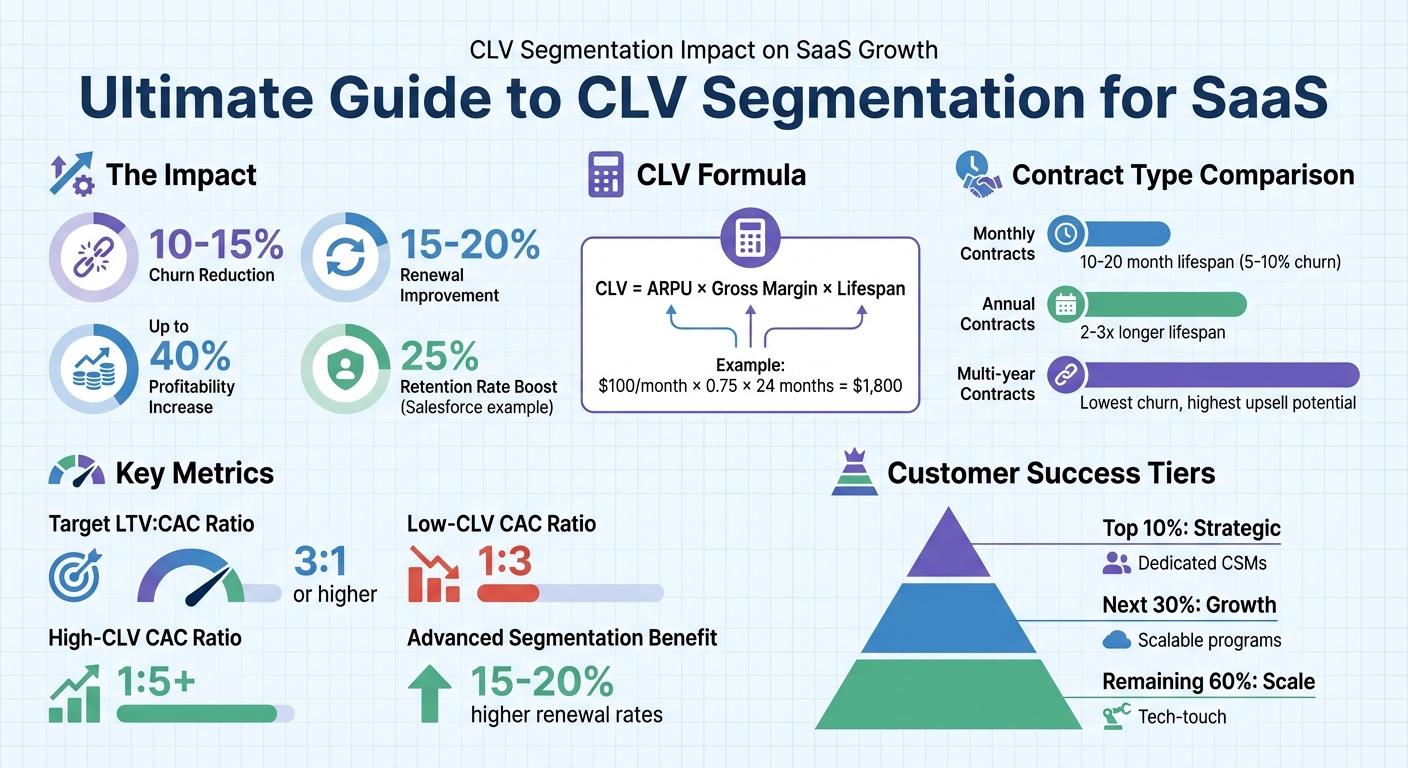
CLV Segmentation Impact on SaaS Growth Metrics
CLV Basics for SaaS
Key Components of CLV in SaaS
CLV in SaaS hinges on three main factors: Average Revenue Per User (ARPU), gross margin, and customer lifespan. The formula is simple: CLV = ARPU × Gross Margin × Lifespan.
- ARPU reflects the revenue generated per customer, either monthly or annually. For instance, if a customer pays $50 per month, the ARPU is $50.
- Gross margin measures profitability after deducting direct costs like hosting and support expenses. For many SaaS companies, this is typically around 80% (or 0.8).
- Customer lifespan is calculated as the inverse of the churn rate. For example, a churn rate of 4.17% translates to an average lifespan of 24 months.
Contract structures heavily influence these components. Monthly contracts often result in lower CLV due to higher churn rates. If churn ranges between 5–10% monthly, customer lifespans may shrink to just 10–20 months. On the other hand, annual contracts stabilize revenue and extend retention, often doubling or tripling effective customer lifespans compared to monthly agreements. Multi-year contracts take this further by locking in customers for longer periods, significantly reducing churn and opening up more upsell opportunities. However, these longer-term deals may come with initial discounts, which can lower the upfront ARPU.
With these foundational elements established, you can calculate CLV using historical data or predictive models.
How to Calculate CLV
There are several ways to calculate CLV, depending on your data and business stage:
- Historical Method: This approach uses past data to estimate CLV. For example, if your ARPU is $1,200 annually ($100 per month) and your customers typically stay for 24 months (based on a 50% annual churn rate), the calculation is simple: $100 × 24 = $2,400. Adjusting for a 75% gross margin, the net CLV becomes $1,800. This method works well for early-stage SaaS businesses with steady revenue patterns.
- Cohort-Based Calculations: This method groups customers by their acquisition period or shared characteristics and tracks their revenue over time. For instance, a Q1 cohort might have an ARPU of $50 per month and retain 90% of customers in the first month, dropping to 70% by Month 12, resulting in approximately $450 in CLV. If your Q2 cohort benefits from improved onboarding and achieves an 80% retention rate, their CLV could rise to $600. Cohort analysis is particularly useful for identifying trends, such as the higher CLV often seen with enterprise customers.
- Predictive Models: These models use machine learning to forecast future CLV based on behavioral data like feature usage and engagement levels. For example, while the historical method might estimate a CLV of $2,400, predictive models could identify highly engaged users with a 30-month lifespan, raising their CLV to $3,000. When integrated with CRM tools, predictive models can improve accuracy by up to 30%.
Each method requires solid data to deliver reliable insights.
Data Requirements for CLV Segmentation
Accurate CLV calculations depend on detailed records, including recurring revenue (MRR or ARR) per customer, churn timestamps to pinpoint when customers cancel, and discount details to reflect actual pricing. Other essential data points include LTV and CAC and usage metrics like login frequency and feature adoption. For example, if a customer pays a $99 monthly base price with a 20% discount, plus a $20 upsell, these details help calculate precise ARPU and lifespan.
To refine segmentation, aggregate the following data:
- Billing information: Plan tiers, discounts, and upsells.
- Behavioral logs: Metrics like login frequency and feature adoption.
- Firmographics: Details such as company size and industry.
- Support interactions: Tickets that may signal churn risk.
For instance, segmenting by plan, Starter at $29 per month versus Pro at $99 per month, can reveal stark differences. Using tools like Stripe or PayPal, you can identify high-value enterprise users with 40-month lifespans, compared to shorter-lived starter accounts. A case in point: Salesforce improved retention by 25% by segmenting customers based on industry, company size, and usage behavior [7].
CLV Segmentation Models for SaaS
Account-Level vs. User-Level Segmentation
Your first decision is whether to segment on accounts or on individual users. Account-level segmentation treats each company as one unit, combining all of its contract and usage data. This approach is ideal for product-led or sales-led growth models, where multi-seat licenses and complex purchase processes are common. For example, an analytics platform selling 100-seat annual contracts to mid-market firms would benefit from this method.[3]
User-level segmentation treats each user as their own unit of value. That works best if you run product-led growth (PLG), a freemium tier, or self-serve SaaS. In those models your users adopt the product first and the account grows around them later, think of users signing up with their work emails and upgrading to team plans down the road.[1][3] Many SaaS companies use a combination of both approaches: user-level CLV to optimize activation and in-product growth, and account-level CLV to guide enterprise acquisition and renewal strategies.[3]
| Approach | Pros | Cons |
|---|---|---|
| Account-Level | Aligns with revenue metrics like MRR/ARR; supports ABM strategies and enterprise sales; gives a clear view of expansion revenue.[3] | Masks differences within accounts (e.g., power users vs. inactive users); slower to detect early churn risks; less effective for PLG optimization.[3] |
| User-Level | Great for tracking adoption and engagement; aligns with PLG funnels; enables precise experimentation.[1] | Splits value across many users instead of consolidating it by account; underestimates buying power; can mislead when decisions are made at the account level.[3] |
If you sit on the marketing side, user-level segmentation sharpens your campaigns around real behaviour rather than personas. If you’re in sales or customer success, account-level segmentation is what lets you prioritise your high-value accounts, put your people where they pay off, and build renewal plans that hold.[3][4] Both approaches can be further enhanced by layering in firmographic and pricing plan details.
Firmographic and Plan-Based Segmentation
Combine firmographic data, company size, industry and location, with your pricing tiers and you get segments you can act on. Start by grouping your customers by employee count (e.g., small business, mid-market, enterprise), industry (e.g., fintech, healthcare, manufacturing), and region. Then, overlay pricing plans (e.g., free, basic, pro, enterprise) to identify which combinations yield the highest CLV.[2][3]
Some effective segment examples include:
- "High-CLV enterprise accounts on enterprise plans in regulated industries"
- "Mid-market tech companies on pro plans with growing seat counts"
- "Low-CLV micro-businesses on entry-level plans with high churn"[2]
Your pricing tiers already differentiate your customers for you. Higher tiers usually mean fewer customers at much higher CLV, while lower tiers bring you volume at a lower CLV per account.[2][3]
Companies that adopt advanced segmentation practices see 15–20% higher renewal rates compared to those using basic approaches, according to Gainsight research.[5]
To put these segments into action, enrich your CRM with firmographic data and ensure pricing plan information is accurately recorded. Use the formula CLV = ARPU × gross margin × average contract duration to calculate CLV and group customers into defined categories, such as "SMB – 1–50 employees – Pro plan – CLV > $5,000."[3][4][1] These segments can guide tailored CAC targets, industry-specific messaging, and differentiated customer success strategies. For instance, high-CLV enterprise accounts might receive dedicated customer success managers (CSMs), while low-CLV micro-businesses could be managed through tech-touch programs.[3] Beyond static attributes, behavioral data can further refine these insights.
Behavioral and Lifecycle-Based Segmentation
Behavioural data tells you which of your customers will be worth the most over time. Watch activation milestones, login frequency, usage of core features, number of seats activated, and expansion behaviors such as adding integrations or upgrading storage.[9][3] High-CLV customers tend to show consistent, frequent usage, involve multiple users per account, and adopt premium features early. Low-CLV customers, by contrast, often have sporadic logins, single-user accounts, and minimal feature engagement.[3][4][9]
Lifecycle-based segmentation takes this one step further by mapping customers to stages like onboarding (first 30–60 days), adoption, pre-renewal, expansion, or churn-risk. This approach ties each stage to both current and projected CLV.[3][4] For example:
- During onboarding, high-potential customers might receive personalized training, while lower-CLV customers follow self-serve guides.[3]
- In the adoption stage, usage metrics can signal whether accounts are meeting benchmarks for healthy CLV, triggering intervention if they’re falling behind.[9]
- At renewal, accounts are stratified by CLV bands and risk scores, with high-CLV accounts prioritized for early outreach.[3][4]
- For expansion, focus on accounts nearing usage limits or adding teams, especially those with strong retention signals and high CLV potential.[3]
Group users into categories like "power users," "steady adopters," "at-risk users," and "expansion-ready accounts" to enable targeted actions, whether through in-app messaging, success outreach, or upsell campaigns.[3][4] Leveraging a fractional CMO service like Data-Mania can help SaaS companies implement these sophisticated segmentation models, driving data-driven growth and CLV-focused strategies.
Using CLV Segmentation to Guide SaaS Strategy
Marketing and Acquisition Strategies
CLV segmentation reshapes how you think about marketing budgets and Customer Acquisition Cost (CAC) targets. By setting CAC targets as a percentage of CLV for each segment, you can allocate resources more effectively. For instance, a CAC:CLV ratio of 1:3 might work for low-CLV, self-serve buyers, while high-CLV enterprise customers could justify a ratio of 1:5 or better. The idea is simple: invest more in segments that promise greater long-term returns.[1][3][4]
Dive deeper into LTV/CAC by channel to identify where spending yields the highest-value customers. Even if certain channels come with higher upfront CAC, they may still be worth prioritizing if they attract high-CLV cohorts.[3] This data-driven approach should play a central role in quarterly budget planning, helping you allocate spend efficiently and improve revenue forecasting.
Tailor your messaging and offers to fit each segment. For low-CLV, self-serve customers, focus on simplicity, think free trials, freemium tiers, and easy onboarding. Highlight quick wins and low commitment to reduce friction.[1][8] Meanwhile, high-CLV segments such as enterprise clients or U.S. mid-market companies demand a different approach. Messaging here should center on ROI, total cost of ownership, compliance, and integration depth, supported by case studies and industry-specific examples.[1][3] These segments are perfect for account-based marketing (ABM) strategies, including personalized outreach, executive briefings, and tailored content. Incentives like multi-year contracts, prepaid discounts, bundled onboarding, or even priority access to product roadmaps can further solidify these relationships.[2][3]
Salesforce, for example, segmented its customers by industry, company size, and usage patterns, tailoring its marketing and support strategies. This resulted in a 25% boost in customer retention rates.[7]
That is what CLV-driven segmentation looks like when you run it across both acquisition and retention. Next, I’ll show you how to price against those segments so each one pays what it is worth to you.
Pricing and Packaging Optimization
Your pricing model plays a critical role in supporting CLV growth. By analyzing CLV by segment, you can determine whether tiered pricing or usage-based pricing better aligns with long-term goals.[2][3] For low-CLV customers, a simple tiered model with bundled features minimizes friction during acquisition.[3] On the other hand, high-CLV segments often benefit from usage-based or hybrid models. For example, pairing a base platform fee with usage or seat-based overages allows you to capture incremental value as these customers grow.[3]
Segment-specific CLV analysis may also reveal opportunities to adjust pricing. For instance, if high-CLV users are consistently overutilizing features within a lower-priced tier, it might be time to introduce a "pro" or "enterprise" package. This approach ensures you’re maximizing value while still offering affordable entry points for lower-CLV segments.[2][3] Multiple pricing tiers and usage-based models create natural upsell paths, driving higher LTV compared to flat-rate pricing.[3]
Longer-term contracts can also boost CLV and reduce churn. For high-CLV and strategic accounts, consider offering 12–36 month agreements with benefits like price-lock guarantees, ramped pricing, or auto-renew clauses with extended notice periods. These terms are designed to maximize CLV while keeping CAC payback manageable.[3][4] For low-CLV cohorts, however, flexibility is key. Monthly, cancel-anytime contracts reduce signup friction and allow the product’s value to drive retention naturally, avoiding the risk of refunds or support issues from forced commitments.[2][3]
Customer Success and Product Roadmap Alignment
Once marketing and pricing are aligned with CLV segmentation, it’s time to focus on customer success and product innovation. Tailored customer success strategies can significantly improve retention and expansion.
CLV segmentation provides a clear framework for tiered customer success (CS) coverage. For example:
- Low-CLV segments: Rely on tech-touch support, lifecycle emails, and scalable webinars.
- Mid-CLV segments: Use pooled CSMs for moderate-touch support.
- High-CLV accounts: Assign dedicated CSMs who conduct strategic reviews and offer personalized success plans.[3][9]
Adjusting CSM-to-ARR or CSM-to-account ratios by segment ensures that high-value accounts receive the attention they deserve, maximizing upsell potential and net CLV.[3]
Customer success playbooks should also vary by segment. High-CLV accounts might need quarterly business reviews (QBRs), stakeholder mapping, and expansion-focused strategies. In contrast, low-CLV segments benefit more from automated tools like in-app nudges and lifecycle emails to drive engagement and adoption.[1][3] Tracking retention and expansion metrics by segment helps refine these strategies over time.[4][9]
Product teams can also use CLV segmentation to prioritize their roadmaps. Overlaying feature usage and NPS data with CLV insights reveals which features drive retention and expansion for high-CLV customers.[1][3] For instance, if enterprise clients heavily rely on specific workflows or integrations, those should take priority on the roadmap. Conversely, features with low impact on CLV but high engineering costs can be sunset or deprioritized. Segment-specific analysis by industry, company size, or use case can highlight pain points, allowing product teams to focus on themes like security, compliance, or analytics that resonate with high-value segments. This approach strengthens net revenue retention (NRR) and overall CLV.[3][4]
For SaaS companies looking to refine their go-to-market strategies, external experts like Data-Mania can provide specialized support. Their expertise in data-driven growth and fractional CMO services helps SaaS startups build CLV-based segmentation systems that drive predictable, scalable revenue.
Advanced CLV Segmentation Techniques
Cohort and Time-Based Analysis
Cohort analysis groups customers based on shared traits, like signup month, acquisition channel, pricing plan, or product version, and tracks metrics such as CLV, retention rates, and expansion revenue over time. This approach provides a clear picture of how changes in pricing, onboarding, or features affect long-term CLV compared to short-term performance metrics.[8][3]
For instance, you could organize cohorts by signup quarter and monitor their MRR/ARR (in USD), churn rates, expansion revenue, and CAC payback periods over a 12–24 month span. These comparisons can reveal trends, such as a churn spike in month three that points to early-stage value issues or a boost in CLV following a pricing adjustment, validating the new approach.[3]
Cohort analysis also uncovers which acquisition channels yield the most valuable customers over time. For example, you might find that customers acquired through referrals have a 30–50% higher CLV than those from paid social campaigns, even if the CAC is comparable. This insight can guide decisions to allocate more budget toward referral programs and other high-CLV channels.[3] Metrics to track include MRR per cohort, cumulative revenue, net revenue retention, and CAC payback time (e.g., $1,250 per account).
These cohort insights lay a strong foundation for predictive models, which can further refine CLV forecasts.
Predictive CLV Models
Predictive CLV models rely on machine learning to estimate future revenue and customer lifespan by analyzing behavioral data rather than just historical averages. These models evaluate inputs like product usage (logins per week, feature adoption, time-to-first-value), billing data (plan type, MRR/ARR, upgrade history, payment failures), customer profile (company size, industry, role), and engagement signals (support tickets, NPS scores, onboarding completion).[6][9]
You can start with simpler techniques like logistic regression or survival analysis to predict renewal probabilities and multiply these by expected revenue to estimate CLV. As your dataset grows, consider more advanced tree-based models like XGBoost or random forests, which can capture complex relationships between customer behaviors and outcomes.[2][11] Your goal is to benchmark simpler models against more advanced ones and adopt the latter only if they significantly improve out-of-sample CLV predictions.
Once you generate predictive CLV scores, segment customers into tiers: the top 10% (Strategic), the next 30% (Growth), and the remaining 60% (Scale). Strategic accounts receive high-touch support like dedicated CSMs, executive reviews, and custom onboarding. Growth accounts benefit from scalable success programs, including webinars and in-app guidance, with targeted offers when their usage approaches plan limits. Scale accounts rely on tech-touch support, self-service resources, and automated nurture campaigns.[3][4] Regularly retrain and backtest these models to ensure accuracy, especially after major product or pricing changes.
Once predictions are refined, integrate advanced CLV segmentation into your operational systems.
Implementing CLV Segmentation in Your Systems
To implement CLV segmentation, use a cloud data warehouse like Snowflake, BigQuery, or Redshift to consolidate data from your CRM, billing system, product analytics, and support tools. The CRM houses account and contact data, while the billing system provides MRR/ARR, invoices, and payment statuses. Product analytics tools track feature usage and events, often integrated via event streaming or batch exports.[11][10]
Data flows into the warehouse using ETL/ELT tools, where CLV calculations and predictive models are executed. Then, reverse ETL pushes CLV scores and segment flags back into your CRM and marketing platforms. Create custom CRM fields for CLV score, segment, churn risk, and recommended next steps. Automate updates via APIs or reverse ETL to refresh these fields daily.[3][9]
Set up workflows that automatically generate renewal opportunities 120 days before contracts expire or trigger alerts when usage drops below a certain threshold. Build reports and dashboards to prioritize accounts by CLV segment and renewal date, making it easy to identify high-CLV customers who may be at risk. In your marketing automation platform, create targeted audiences like "top 20% predicted CLV" or "high CLV but low adoption" and design personalized nurture campaigns for these groups. This setup aligns with U.S.-style reporting, using revenue in USD, MM/DD/YYYY date formats, and standard SaaS metrics like MRR and ARR.
If you are building a growth system on top of your data, that is the work I do. I run fractional CMO engagements for tech businesses, and CLV segmentation like this is usually one of the first things I put in place, because it decides where the rest of the spend goes.
Key Takeaways for SaaS Growth
Effective CLV segmentation is a game-changer for driving long-term growth in SaaS businesses. By identifying which customer segments contribute most to profitability, companies can make smarter decisions about resource allocation. Prioritizing high-value customers while addressing at-risk groups can lead to significant gains, companies that excel in CLV measurement and segmentation often see profitability increase by as much as 40% [7]. These insights fuel more targeted strategies across marketing, product development, and revenue operations.
For marketing teams, segment-specific CLV can be calculated using metrics like ARPU, gross margin, and customer lifespan. Dive deeper into performance by acquisition channel and cohort, then shift budgets toward high-CLV channels. Lookalike modeling can help identify and target similar high-performing segments. Segmentation also plays a crucial role in improving retention. Tailor campaigns to match lifecycle stages and customer behaviors instead of taking a one-size-fits-all approach.
Product teams should adapt their roadmaps to align with the needs of high-value segments. Focus on features that enhance retention and drive expansion opportunities. Tiered pricing models with clear upsell paths can capture additional revenue as customer requirements evolve. Keep a close eye on metrics like feature adoption rates and product expansion by segment to guide development decisions and refine onboarding processes.
For revenue operations, tracking CLV across acquisition channels and customer types is essential. Use this data to identify at-risk segments and deploy tailored offers to keep them engaged. Integrating real-time CLV scores into your CRM can streamline workflows and help prioritize accounts more effectively. Strive for an LTV:CAC ratio of 3:1 or higher, and continuously monitor ARPU and retention rates to measure progress.
Start with basic cohort analyses, such as grouping by plan type or acquisition period. Use A/B testing and dashboards to validate improvements in CLV, revenue, and retention over time.
FAQs
What’s the best way for SaaS companies to implement CLV segmentation in their systems?
SaaS businesses can make CLV segmentation work seamlessly by weaving advanced data analytics into their current operations. Start with tools like CRM systems and marketing automation platforms to monitor customer behavior and calculate lifetime value metrics. With this data, group customers into segments to pinpoint those with the highest value potential.
Establish a consistent process for gathering and analyzing data. These insights should guide marketing strategies tailored to each segment, ensuring your messaging aligns with their specific needs. For sustained success, implement systems that grow with your business and adapt to evolving customer demands. Leveraging AI-powered tools can refine accuracy and streamline efforts, taking your segmentation to the next level.
What’s the difference between account-level and user-level CLV segmentation?
Account-level CLV segmentation evaluates the lifetime value of entire customer accounts by combining overall revenue and engagement metrics. On the other hand, user-level CLV segmentation dives into the behaviors, purchases, and contributions of individual users within those accounts, offering a more detailed analysis.
The key difference lies in the scope: account-level segmentation delivers a broader, high-level overview of customer accounts, while user-level segmentation focuses on the finer details. This distinction helps businesses decide whether to craft strategies aimed at entire accounts or specific users.
How can predictive CLV models help improve customer retention?
Predictive CLV models enable you to enhance customer retention by examining past behaviors to estimate future customer value. This approach helps companies pinpoint their most valuable customers and adjust strategies to suit individual preferences.
Armed with this knowledge, businesses can craft personalized offers, engage customers with targeted communication, and take timely actions to minimize churn. By concentrating efforts on the right customers at the right moments, predictive CLV models play a key role in increasing customer lifetime value and building lasting loyalty.