
If you’re trying to figure out AI search visibility, you’ve probably noticed the same thing I did: every AI search visibility tool claims to solve the problem, but most just measure whether you’re being mentioned.
I’ve spent six months actually implementing these tools, not just trying demos. Tracking metrics. Trying to understand if any of them could tell me something I couldn’t figure out myself. In fact I built some tools myself to get what I couldn’t get from the paid AI search visibility tools out there.
Most of them answered the same basic question: “Are you showing up in AI search results?” (some weren’t even able to answer that question effectively).
That’s like asking “Did anyone mention your name?” without telling you what conversation you’re in or who else is in the room with you.
Here’s what might surprise you: The real competitive advantage isn’t just knowing IF you’re cited. It’s knowing WHO you’re cited alongside, what tactics they’re using, and which sites you should be partnering with.
After testing everything from simple citation trackers to complex GEO platforms, I finally found an AI search visibility tool that actually shows me the competitive landscape: AIrefs.
Let me show you why this matters for technical founders trying to get visible in AI search.
Why Traditional SEO Metrics Lie in AI Search
The numbers tell a story most founders aren’t ready for.
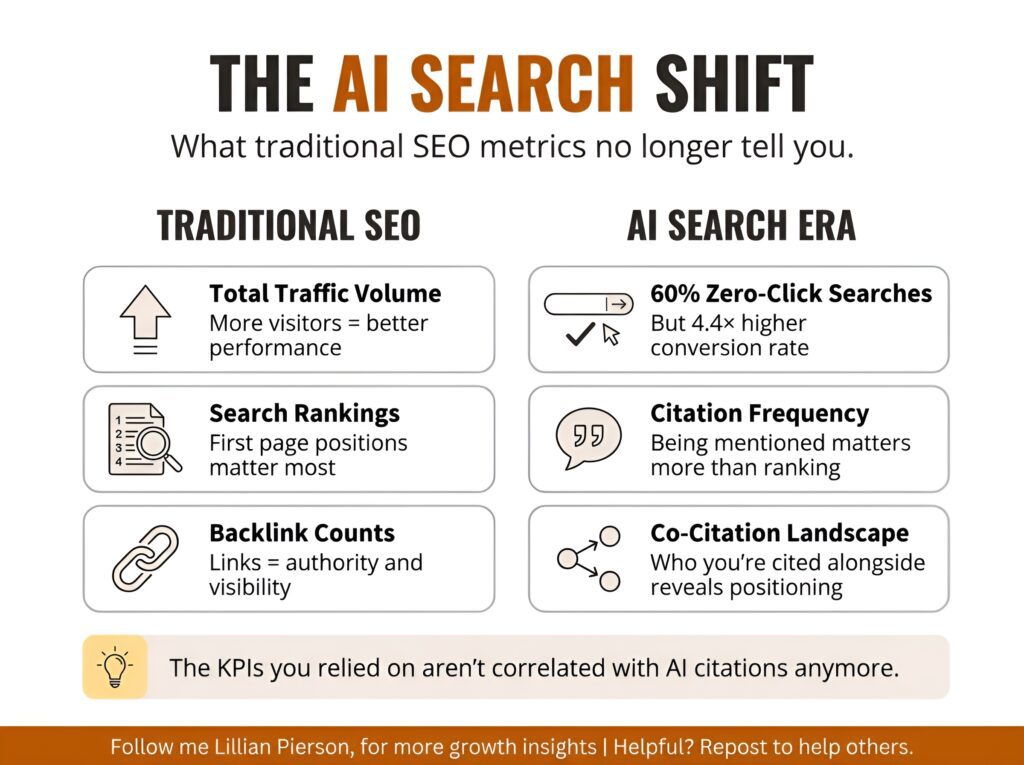
By 2025, 60% of AI searches ended without anyone clicking through to a website. At first, that sounds terrifying. But here’s the flip side: traffic from AI sources converts at 4.4× the rate of traditional search traffic.

In other words: You get less traffic, but the traffic you do get is exponentially more valuable.
This means the KPIs I used to rely on stopped being reliable. Total traffic? Increasingly meaningless. Traditional search rankings? Not correlated with AI citations. Backlink counts? AI systems don’t care.
The hard part is: Most AI search visibility tools only tell you whether you’re being cited. They don’t tell you:
- Which other sites are being cited for the same queries
- What content formats are winning citations
- Where partnership opportunities exist
- How your competitors are structuring their content
A new free tool from TheBestReputation AIOverview.com is built to show you exactly how your brand appears across ChatGPT, Gemini, Claude, Perplexity, and Google AI Overviews. You simply enter your brand and it breaks down where you are ranking, which prompts are surfacing your name, and where competitors are showing up instead of you, including ones you probably have never heard of.
It turns AI visibility into something you can actually measure, track, and improve instead of guessing where you stand.
After supporting a dozen early-stage tech companies on their AI visibility strategies, I’ve noticed a pattern. The founders who succeed in AI search aren’t just tracking whether they show up. They’re tracking the entire competitive landscape and using that intelligence to make strategic decisions.
The AI Visibility Framework That Actually Works
Before I show you the AI search visibility tool that changed everything, here’s the framework I’ve found works for early-stage tech companies navigating this shift. This is based on testing what actually moves the needle for B2B SaaS and AI startups trying to get discovered.

Step 1: Build Authority AI Systems Actually Recognize
AI systems now evaluate content using E-E-A-T: Experience, Expertise, Authority, and Trust. Of these, trust matters most.
What this looks like in practice:
- Include detailed author bios with specific credentials
- Share first-hand experience with real outcomes
- Support every claim with verifiable sources
- Update content regularly (53% of ChatGPT citations come from content updated in the last 6 months)
Step 2: Structure Content for Machine Parsing
Over 72% of first-page results use schema markup. AI systems need structured data to understand your content.
The tactical approach:
- Implement JSON-LD schema markup
- Use logical heading hierarchies (H1/H2/H3)
- Break content into short, scannable paragraphs
- Create standalone quotable statements with specific data
Step 3: Match Natural Language Queries
Searches containing 5+ words grew 1.5× faster than shorter queries in 2023-2024. AI chat interactions last 66% longer than traditional searches because users are asking complete, conversational questions.
How to adapt:
- Research “People Also Ask” questions in your space
- Target long-tail, question-based queries
- Structure answers as standalone responses
- Use conversational, clear language
Step 4: Use High-Performance Content Formats
Content over 3,000 words generates 3× more traffic than shorter pieces. Featured snippets have a 42.9% clickthrough rate, and 40.7% of voice search answers come from them.
The formats that work:
- Comparison articles with modular sections
- Detailed listicles (2,300+ words for voice search)
- FAQ sections with direct answers
- Data-rich content with clear statistics
Step 5: Track With GEO Tools, Not SEO Tools
Traditional SEO metrics show weak correlation with AI citations. You need specialized Generative Engine Optimization (GEO) tools.
What to track:
- Brand mentions across AI platforms
- Citation rates in ChatGPT, Perplexity, AI Overviews
- Share of voice for key queries
- Sentiment in AI-generated responses
I had this entire framework mapped out. I knew what mattered. But here’s what I couldn’t figure out: how to see the whole competitive landscape, not just my position in it.
That’s what most tools don’t show you. What Makes a Great AI Search Visibility Tool
Last week I spoke with Paul Boudet, founder of AIrefs. I’d been testing his AI search visibility tool for a few days and immediately saw something different.
While every other AI search visibility tool showed me WHETHER I was being cited, AIrefs showed me all 571 URLs that were being cited across my targeted search questions.

Think about what that means.
Instead of just knowing “you’re ranking for 23 queries,” I could see:
- Every site being cited alongside me
- Which sites dominated certain query categories
- Where partnership opportunities existed
- What content tactics were working for co-cited sources
I could also see the crawler traffic patterns. In just the last 7 days, ChatGPT hit my site 863 times. Meta AI: 16 times. Apple Intelligence: 14 times. That’s the kind of visibility data that helps you understand which AI platforms actually matter for your audience.

This transforms AI visibility from a vanity metric into competitive intelligence.
When I saw that I was ranking #1 for “tech startup CMOs,” “AI startup CMOs,” and “growth advisors for tech startups,” that was validating. But more valuable was seeing WHO ELSE was showing up for those queries and what they were doing differently.

I grabbed the Black Friday deal for this AI search visibility tool and have already started implementing the bespoke suggestions the AIrefs team provided.
Steal This: My AIrefs Setup
Here’s how I’m using AIrefs to build competitive intelligence, not just track citations:
1. Co-Citation Analysis: I track all 571 URLs being cited across my target queries. When I see sites consistently cited with me, those become partnership targets or competitive analysis subjects.
2. Tactic Replication: For sites outranking me on specific queries, I analyze their content structure, data presentation, and schema implementation. Then I replicate their tactics one level up.
3. Niche Dominance Tracking: I monitor my rankings for hyper-specific queries like “fractional CMO for AI startups” rather than broad terms. AI search rewards specificity.
4. Platform-Specific Optimization: Different AI systems have different preferences. Perplexity and AI Overviews favor word count and sentence count. ChatGPT prioritizes domain rating and readability. I optimize accordingly.
5. Partnership Pipeline: When I see a site consistently cited for complementary topics, I reach out. Co-citation data reveals natural partnership opportunities.
The thing I love most about AIrefs? It shows me the entire game board, not just my piece on it.
Start Getting AI Visible
AI search is fundamentally changing how technical founders get discovered. The shift from clicks to citations means you need new tools, new frameworks, and new competitive intelligence.
If you want to see what co-citation intelligence looks like for your business, check out AIrefs – the AI search visibility tool that shows you the entire competitive landscape. Big shoutout to founder Paul Boudet for building something that actually reveals who you’re competing against instead of just citation counts.
And if you want the tactical implementation guide for AI search (especially for startups without big marketing budgets), I built a 1-hour micro-course called AI Search Rank: grab it here.
The game has changed. Your visibility strategy should too.
P.S. After six months of testing every AI search visibility tool I could get my hands on, the pattern became clear: most tools tell you IF you’re winning. The valuable ones tell you HOW everyone else is winning. AIrefs is the newest one I’ve tested, and I’m one week into implementing what it revealed about my competitive landscape. I’ll share what’s working in a future newsletter, so make sure you’re signed up for newsletter installments here.
Want a clean, repeatable system for measuring B2B growth? Get the free Growth Metrics OS – a 6-day email course for technical founders and operators who want to measure growth and make better decisions.