
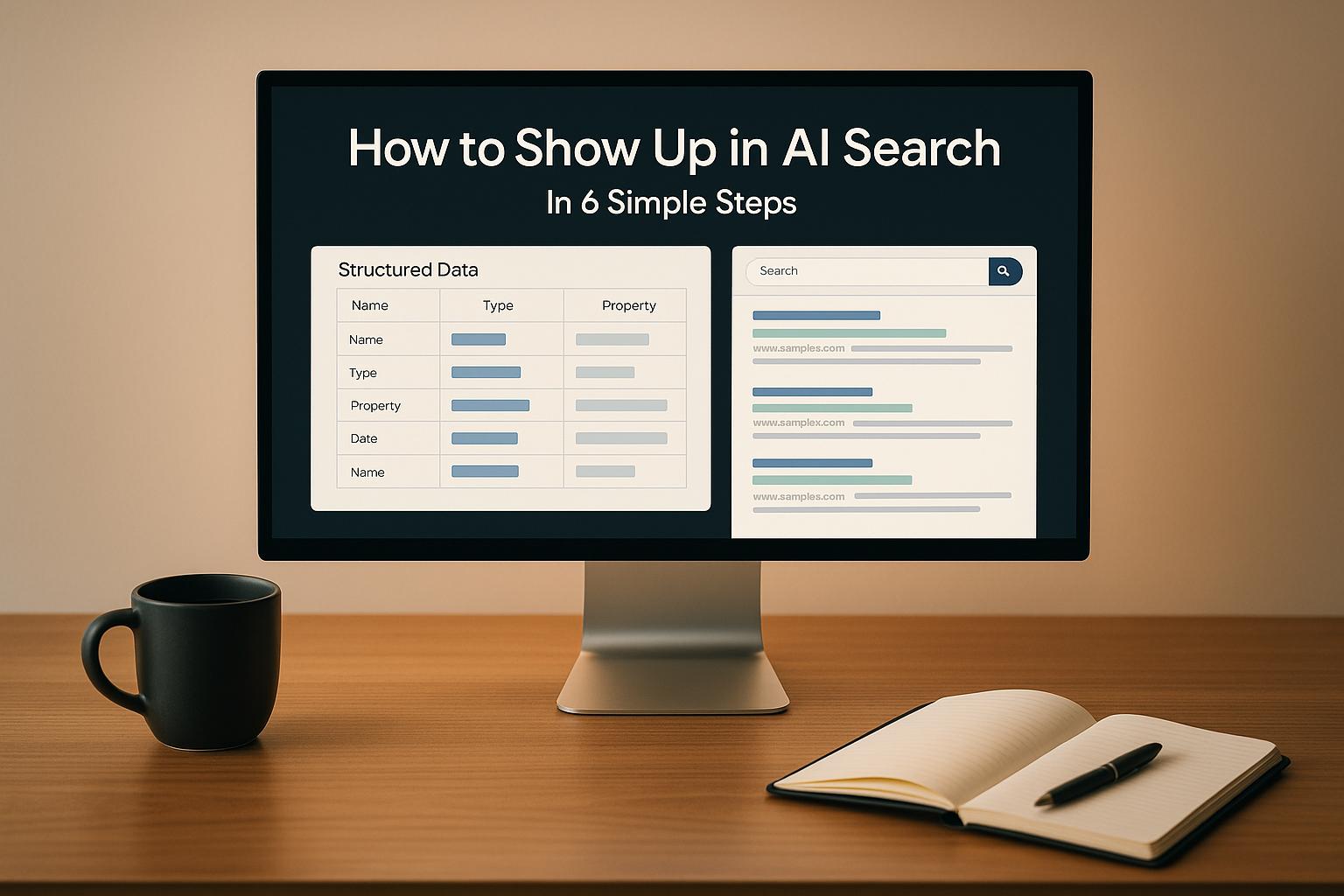

AI-powered search engines like ChatGPT and Claude are changing how people find information. Instead of traditional search rankings, these tools deliver direct, conversational answers. For B2B tech companies, this shift means you need to know how to show up in AI search. Here’s how you can position your brand to appear in AI-generated responses:
- Understand AI Search Engines: Learn how AI interprets content differently from traditional search engines. Focus on intent, context, and clarity.
- Use Structured Data: Implement schema markup on your site to help AI systems identify and categorize your content accurately.
- Create AI-Friendly Content: Write clear, expert-level content that directly answers specific questions. Include data, case studies, and industry-specific terms.
- Build Topical Authority: Publish valuable resources, earn backlinks, and monitor how your brand is referenced in AI platforms.
- Track AI Search Metrics: Measure brand mentions, prominence in AI responses, and sentiment to refine your strategy.
- Integrate AI Search into Marketing: Align AI search visibility with your overall marketing efforts, like content, ABM, and thought leadership.
Key takeaway: When it comes to how to show up in AI search, success isn’t about gaming algorithms – it’s about creating trustworthy, well-structured content that AI systems can easily reference. Start by implementing schema markup and building content that showcases your expertise. If it feels overwhelming, consider bringing in experts for technical or strategic support.
Ready to take action? Let’s dig in to the 6 simple steps for how to show up in AI search.
How to Show Up in AI Search [YouTube Version]
Step 1: Learn How AI Search Engines Work
Grasping how AI search engines function requires a shift in mindset. Unlike traditional search engines that rely on backlinks and keywords, AI search engines – like ChatGPT, Claude, and Perplexity – focus on understanding context and meaning. These systems use large language models to interpret user queries, identify relationships, and generate direct answers instead of simply listing links.
The fundamental difference lies in how information is processed. Traditional search engines crawl web pages, index keywords, and rank results based on relevance signals. AI search engines, however, extract meaning from content and provide responses tailored to the user’s intent, going beyond simple keyword matches.
This evolution changes the game for gaining visibility. Success in AI search isn’t about manipulating algorithms – it’s about creating content that AI systems can easily understand, trust, and reference when crafting their answers. This foundational knowledge is key to understanding the specific factors AI prioritizes when ranking content.
Key Ranking Factors in AI Search
AI search engines evaluate content differently by emphasizing several key factors. When getting started with how to optimize your brand’s visibility in AI search, make sure your content reflects the following:
- Trustworthiness: AI systems prioritize content from authoritative sources that demonstrate clear expertise. Reliable, well-supported information stands out.
- Relevance to intent: Unlike traditional keyword matching, AI engines focus on the intent behind a query. For example, if someone asks about "improving team collaboration in remote work environments", the AI might highlight content on project management tools or productivity strategies, even if those terms aren’t explicitly mentioned.
- Clarity and structure: Well-organized content with proper formatting helps AI systems understand the hierarchy and context of the information.
- Factual accuracy and citations: Content backed by credible sources and specific data points performs better, as AI prioritizes verifiable information over opinions or speculation.
- Freshness of information: Especially in fast-changing industries like B2B technology, recently updated content is more likely to rank higher due to its relevance to current trends.
How AI Interprets Content Differently
If you understand the key concepts of natural language processing (NLP), then it’s likely that you have a pretty intuituve grasp of how to show up in AI search. AI search engines rely on NLP to understand content in ways that go far beyond traditional keyword recognition. This advanced comprehension reshapes how content is evaluated and ranked.
Content that flows naturally and uses conversational language often outperforms keyword-stuffed text. AI systems can detect when content is genuinely helpful versus when it’s artificially optimized for search engines. For example, they excel at identifying content that directly addresses common industry questions.
Entity recognition is another critical factor. AI systems identify and map relationships between entities like companies, products, people, and concepts. Content that clearly establishes these connections is more likely to be referenced in AI-generated responses.
AI also excels at understanding context and nuance. It can differentiate between meanings of the same word based on context, recognize specialized terminology, and interpret implied relationships between concepts. This means that in-depth, well-written content showcasing industry expertise often performs exceptionally well.
Additionally, the depth and comprehensiveness of content matter significantly. AI engines favor content that thoroughly explores topics, offers actionable insights, and presents multiple perspectives over short, keyword-focused pieces.
An understanding of how to show up in AI search results via these mechanisms will underscore why traditional SEO tactics often fall short in AI-driven environments. Instead of optimizing for algorithms, you’re creating content that AI systems can interpret and evaluate much like a human expert would.
 AI Search Rank is my 1-hour micro-course on to get your startup discoverable in AI search and investor research, even without a marketing team or extra SaaS spend.
START GETTING AI VISIBLE TODAY »
Step 2: Set Up Structured Data and Schema Markup
AI search engines are great at processing natural language, but they still rely on clear signals to categorize and reference your content accurately. That’s where structured data comes in – it bridges the gap between human-readable content and machine understanding. When your content is properly marked up, AI systems can quickly identify whether it’s a product page, a blog article, a company profile, or something else. In your quest for how to show up in AI search, this clarity improves your chances of being cited in AI-generated responses and ensures your content isn’t overlooked.
What Is Schema Markup and Why It’s Important
Schema markup is a standardized vocabulary, developed by Schema.org, that helps search engines and AI systems interpret the meaning of your content. It defines specific content types like products, services, events, and organizations, making it easier for machines to understand context.
For AI systems, schema markup provides metadata that removes ambiguity. For example, using Article schema allows you to specify details like the content type, author, publication date, and key topics. This metadata helps AI determine when your content is relevant to specific search queries.
Structured data also boosts your content’s visibility in traditional search results by enabling rich snippets – those enhanced displays that include extra details like star ratings or FAQs. AI often references these snippets when generating responses. For instance, an FAQ section with proper schema markup can be quickly processed and included in AI answers to related questions.
In the AI-driven search landscape, schema markup isn’t just about improving search rankings. It’s about ensuring that AI systems understand and trust your content, enabling them to evaluate its credibility and relevance effectively.
Tools for Implementing Schema Markup
Adding schema markup to your website doesn’t have to be overwhelming. Several tools are available to simplify the process, catering to different levels of technical expertise and platform needs:
- Google’s Structured Data Markup Helper: A free, beginner-friendly tool where you can paste your URL or HTML, highlight relevant information, and generate schema code. It’s a great starting point for learning how schema works and creating basic markup for individual pages.
- Schema Pro: A WordPress plugin that automates schema creation for posts, pages, and custom types. It’s an excellent option for those using WordPress who want a more hands-off approach.
- JSON-LD Generators: Found in many technical SEO platforms, these tools create schema in JSON-LD format, which Google prefers because it separates the markup from visible content, making it easier to manage and update.
- Enterprise SEO Platforms: For larger websites, these platforms offer advanced features like bulk schema implementation, automated testing, and integration with content management systems.
The tool you choose depends on your website’s complexity and your technical comfort level. Small businesses might find Google’s tools sufficient, while larger companies managing hundreds of pages may need enterprise solutions.
Best Practices for Applying Schema Markup
To make the most of schema markup, focus on your most important content and align it with your business goals.
Start with your high-priority pages – your homepage, service pages, and key product descriptions. These pages often receive the most traffic and represent your core value propositions. For B2B tech companies, consider the following schema types:
- Article schema: Use this for blog posts, including properties like headline, author, publication date, and article body. These details help AI assess your content’s relevance and authority.
- Organization schema: Apply this to your homepage and about page to establish your company’s identity. Include your name, logo, contact information, and social media links to create a clear entity that AI systems can reference.
- Product schema: Use this for detailed technical descriptions of your offerings.
- FAQ schema: Convert common questions into structured data that AI can easily process, increasing the likelihood of being included in AI-generated answers.
Testing is a critical step. Use tools like Google’s Rich Results Test to validate your schema and identify errors. Regular testing ensures your markup stays effective, even as your site evolves.
Accuracy is key. Misleading or incorrect markup can damage your credibility with AI systems, so ensure your structured data aligns with your actual content. The goal isn’t to tag every element on your site but to provide clear and accurate signals for your most important content. Prioritize schema types that support your business objectives and highlight the topics where you want to establish authority in AI-driven search results.
Step 3: Create AI-Friendly, Expert Content
AI search engines operate differently from traditional search algorithms. They focus on understanding context, assessing expertise, and prioritizing content that directly answers user questions. To make your content stand out, structure it in a way that allows AI systems to easily extract key insights and showcase your expertise.
Clear and Direct Writing for AI Search
AI systems are built to process straightforward, well-structured content. They struggle with vague language, hidden key points, or overly complicated sentences. To optimize for AI, your writing should address questions directly and follow a logical flow that can be easily summarized.
Start by answering the main question right away. For example, if someone searches for "how to implement API security", your first paragraph should immediately explain what API security implementation entails. Avoid lengthy introductions or tangents that delay the core explanation – AI systems prioritize the first clear, substantial answer they find.
Use descriptive headings to signal the topic clearly, such as "Best Practices for Database Encryption." These headings help AI understand your content’s structure and identify which sections are most relevant to specific queries.
When explaining complex topics, break them into manageable, numbered steps. For instance, if you’re detailing how to set up a monitoring system, structure it as: requirements, installation, configuration, and testing. This approach not only aids AI in understanding the process but also makes it easier for users to follow along.
Replace tentative language with confident, actionable instructions. For example, instead of saying "you might want to consider", say "implement." AI systems favor authoritative statements because they’re more actionable in responses. However, always ensure your claims are accurate – overconfidence in uncertain areas can harm your credibility.
These strategies ensure your content is clear, logical, and AI-friendly.
Establishing Expertise with In-Depth Content
A clear structure is just the beginning. To truly stand out, your content needs to demonstrate expertise and offer unique insights. AI search engines prioritize material that goes beyond surface-level advice, providing depth, specificity, and practical value.
Go deeper than generic advice. Instead of creating another basic guide on cloud migration, craft detailed resources that tackle specific challenges, outline implementation strategies, and highlight lessons learned from real-world projects. AI systems are more likely to cite content that offers fresh perspectives and practical solutions. This is a really critical piece when it comes to how to show up in AI search.
Include original research and data. Whether it’s survey results, industry trend analyses, or performance benchmarks, presenting your own data adds credibility. AI systems treat original statistics and findings as authoritative and often use them in responses. Even simple internal comparisons – like evaluating different tools – can enhance your content’s value.
Develop comprehensive resource pages. Create definitive guides, technical documentation, or step-by-step tutorials. These thorough resources are often referenced by AI systems when users pose complex questions requiring detailed answers.
Share case studies and practical examples. Instead of sticking to theoretical explanations, illustrate how specific strategies or tools worked in real business scenarios. Highlight challenges faced, solutions implemented, and measurable results achieved. This hands-on context helps AI identify when your content is most applicable.
Using Precise Industry Terminology
To further enhance clarity and authority, use industry-specific language. AI systems are trained on extensive technical content and can understand specialized terminology better than most people expect. Incorporating precise terms helps AI categorize your content accurately and match it to relevant user queries.
Be technically accurate. For example, if you’re discussing microservices architecture, use terms like "service mesh", "container orchestration", and "API gateway" instead of generic descriptions. These terms help AI connect your content to specific concepts and make it more discoverable to technical audiences.
Explain technical terms in context. When introducing complex ideas, provide concise explanations to establish your expertise while keeping the content accessible. For instance: "Implement circuit breaker patterns – a design strategy that prevents cascading failures by monitoring service calls and temporarily blocking requests to failing services – to improve system resilience."
Mirror your audience’s language. B2B tech professionals often search using specific terminology tied to their roles and challenges. A DevOps engineer looking for monitoring solutions might use terms like "observability", "distributed tracing", or "SLI/SLO metrics." Aligning your language with these terms ensures AI systems match your content to these precise queries.
Spell out acronyms and reference industry standards. Use terms like "GDPR compliance", "SOC 2 certification", or "CI/CD pipeline" to signal relevance. However, always spell out acronyms on their first use to provide clarity and help AI understand the full context.
Mention specific tools by name. Referencing tools like "Jira, Asana, or Monday.com" improves relevance and targeting. AI systems recognize these names and are better equipped to match your content with users researching those specific solutions.
sbb-itb-e8c8399
Step 4: Build and Monitor Topical Authority
Establishing topical authority means positioning your brand as a trusted voice in your industry. AI search engines evaluate factors like how often your brand shows up in relevant discussions, the quality of sites linking to you, and the overall perception of your expertise. By consistently producing expert-level content, you can reinforce your credibility and strengthen your visibility in AI-driven search results. Incorporate these strategies into your content plan to solidify your authority.
Boosting Brand Mentions and Backlinks
- Write guest posts for respected outlets: Offer insights tailored to their audience, showcasing your expertise while providing real value. This positions your brand as a go-to resource.
- Use data-driven digital PR: Publish reports, surveys, or benchmarks that attract attention naturally. Ensure your content is timely and resonates with ongoing industry conversations.
- Engage in thought leadership opportunities: Share your expertise on podcasts, webinars, and at conferences. These platforms not only amplify your voice but also associate your brand with key industry topics.
- Contribute to industry publications: Reach out to editors at well-regarded B2B tech outlets with well-researched article ideas. Securing backlinks from these reputable sources can significantly boost your authority.
- Develop linkable resources: Create valuable assets like in-depth guides, free tools, or annual reports that others will want to reference. The goal is to provide something so useful it becomes a go-to resource.
- Collaborate on joint projects: Partner with other experts or organizations on research or content initiatives. This approach can lead to mutual backlinks and broader reach through cross-promotion.
Monitoring Brand Sentiment on AI Platforms
- Keep tabs on mentions in AI platforms: Regularly check how tools like ChatGPT or Claude describe your brand. Pay attention to the tone, accuracy, and key points these platforms emphasize.
- Set up Google Alerts: Track mentions of your brand, executives, and products across the web. This helps you see how AI systems might be learning about your business indirectly.
- Analyze sentiment in AI responses: When your brand appears in AI-generated content, evaluate the context. Are you being recognized as an expert? Are your solutions recommended? Is the information correct? Use these insights to refine your strategy.
- Leverage social listening tools: Platforms like Brandwatch or Sprout Social can help you track online conversations about your brand. These insights reveal how your brand aligns with industry trends and public perception.
- Monitor competitors: Take note of how AI platforms discuss other industry players. This can uncover opportunities for you to fill gaps or highlight areas where your expertise is underrepresented.
- Create a monthly sentiment report: Summarize how your brand is represented across AI platforms. Track any shifts in accuracy, tone, or frequency of mentions to measure the effectiveness of your authority-building efforts.
- Address inaccuracies swiftly: If you find incorrect information about your brand, trace the source and correct it. Update your content, reach out to publishers with errors, and ensure your official channels provide accurate, up-to-date information for AI systems to reference.
Step 5: Use AI Search Analytics
Once you’ve established your authority, it’s crucial to measure how AI search impacts your brand. Unlike traditional SEO tools, AI search analytics require a tailored approach to capture both direct performance and broader visibility metrics.
Key Metrics to Gauge AI Search Performance
Rather than focusing on traditional rankings, shift your attention to these aspects of your AI search presence:
- Brand Mentions: Regularly test targeted queries to monitor when and where your brand is mentioned.
- Prominence in AI Responses: Track how often your brand appears in AI-generated answers and note any changes in its position within responses.
- Information Attribution: Check whether AI platforms are accurately attributing data and insights to your brand. Misattributions could impact your reputation.
- Sentiment Analysis: Evaluate the tone of AI responses – whether they portray your brand positively, neutrally, or negatively.
- Content Diversity: Ensure your digital footprint spans various content formats, as a wide range of content can strengthen your perceived expertise.
- Industry Comparison: Measure how frequently your brand is mentioned compared to competitors to understand your share of voice in AI responses.
Tools to Track AI Search Visibility
Once you’ve identified the metrics that matter, use AI search visibility tools and methods to monitor your performance effectively:
- Manual Testing: Create a list of specific queries to test regularly on AI platforms like ChatGPT or Claude. Document your findings to track trends over time.
- Brand Monitoring Tools: Set up alerts to capture mentions of your brand, even those sporadic mentions that could influence AI training data.
- SEO Tools: Use traditional tools to monitor backlink profiles and domain authority, which can indirectly reflect your AI search visibility.
- Social Listening Tools: Analyze broader conversations in your industry to uncover trends and topics that might shape how AI platforms respond to queries.
- Spreadsheets for Tracking: Maintain detailed records of your findings, allowing you to visualize changes in visibility and performance over time.
- Website Analytics: Monitor referral traffic and branded search trends to identify shifts that may be linked to your AI search presence.
Step 6: Connect AI Search with Your Marketing Strategy
Once you’ve started tracking AI search performance, the next move in how to show up in AI search is to align these insights with your broader marketing efforts. By integrating AI search visibility into your overall strategy, you can create a ripple effect that enhances results across all channels.
Bringing AI Search into B2B Tech Marketing
AI search becomes a game-changer when it works hand-in-hand with your existing marketing strategies. For product-led growth companies, this integration is especially impactful. AI search engines often highlight detailed product information and real user experiences, making your offerings more visible during research queries.
Your content marketing strategy plays a direct role in shaping your AI search presence. Case studies, white papers, and technical blogs don’t just attract prospects – they also serve as training data for AI systems. When users ask AI tools about solutions in your industry, this content positions your brand as a go-to resource.
Thought leadership is another key piece of the puzzle. Activities like speaking at industry events, publishing research, or contributing expert insights to trade publications generate the type of content that AI systems prioritize. These efforts not only boost your credibility but also reinforce your brand’s authority in the eyes of both humans and AI.
AI search can also enhance your inbound marketing funnel. Prospects who find your brand through AI-generated responses often arrive with a higher level of intent. Why? Because they’ve already encountered detailed, contextual information about your solutions. This pre-qualification effect can lead to better conversion rates from organic traffic.
For account-based marketing (ABM), AI search adds a new layer of precision. Many target accounts rely on AI tools for vendor research, so appearing in those AI-driven responses is crucial to staying on their radar. The same in-depth content that performs well in AI search can also double as valuable material for ABM outreach efforts.
Even email marketing campaigns can benefit from AI search insights. By analyzing the topics and pain points that frequently appear in AI responses, you can craft email content that resonates more with your audience. Additionally, showcasing your AI search visibility in email signatures or campaign messaging can serve as a subtle credibility boost.
By combining these strategies with targeted expert input, you can tackle resource or competitive challenges more effectively.
When to Bring in Experts
While many aspects of AI search optimization are manageable for most marketing teams, there are times when expert guidance can make all the difference. Here’s when it might be worth calling in reinforcements:
- Technical hurdles: If your team lacks expertise in structured data markup, advanced content optimization, or schema implementation, specialists can help you navigate these challenges quickly and efficiently.
- Limited resources: For early-stage startups or lean teams, expert advisors can help prioritize AI search tactics that deliver the quickest ROI, ensuring your efforts align with other growth activities.
- Competitive landscapes: If your competitors already dominate AI search results in your space, breaking through will require advanced strategies in content positioning, authority building, and technical optimization.
- Scaling efforts: As your AI search presence grows, managing multiple content streams, tracking brand mentions, and maintaining consistent messaging can become overwhelming. Experienced practitioners can streamline these processes.
If your team lacks specific experience with how to show up in AI search or you’re dealing with complex marketing technology stacks, bringing in external expertise can save time and improve results. The learning curve for AI search optimization can be steep, and professionals often deliver faster, more impactful outcomes.
Consider hiring a fractional CMO if you need to integrate AI search into a complex go-to-market strategy or navigate a highly competitive market where visibility in AI search is critical.
During critical growth phases – like fundraising, product launches, or market expansion – advisory support can be invaluable. A strong AI search presence during these periods can influence investor confidence, attract customers, and strengthen your competitive edge.
Conclusion: Take Action to Excel in AI Search
AI search isn’t the future – it’s already shaping the way users find information. While others are still focused on traditional SEO, you have the chance to leap ahead by mastering the nuances of AI search optimization.
Here’s a quick refresher on the six key steps to success: grasp how AI search engines function, apply structured data and schema markup, craft expert-level content tailored for AI, establish topical authority, leverage AI search analytics, and weave these efforts into your overall marketing strategy. This approach can set you apart in the ever-changing digital world.
The businesses that act now will gain a clear edge over those who wait. Start by implementing schema markup and structured data, and then shift your focus to optimizing content for AI search. If technical hurdles or scaling the process feel overwhelming, seeking expert assistance can make all the difference.
Ready to boost your AI search visibility? Learn how in just 1 day with my 60-minute micro-course: https://ai-visibility-bluepr-4abb.bolt.host/
Take the first step toward dominating AI search today.
FAQs
How to show up in AI search? And how do AI search engines evaluate content differently from traditional search engines?
AI search engines are designed to provide direct answers by evaluating content for its clarity, relevance, and structure. They aim to deliver concise, well-organized responses, often pulling specific excerpts to address user queries directly.
On the other hand, traditional search engines rely on ranking web pages using factors like keywords, backlinks, and overall page authority. Instead of delivering precise answers, they present users with a list of links to explore further. This difference makes AI search engines more focused on understanding user intent and catering to specific needs.
What schema markup should B2B tech companies focus on to boost visibility in AI search results?
B2B tech companies should make it a priority to use essential schema markup types such as Organization, LocalBusiness, Service, Product, Person, Review, and FAQ. These structured data elements act as a guide for search engines, helping them interpret your content more effectively and boosting your chances of showing up in AI-powered search results.
Focusing on these schema types can enhance your company’s online presence by improving visibility and relevance to search algorithms. This makes it simpler for potential clients to discover your business and engage with your offerings.
Why should B2B tech companies prioritize AI search visibility in their marketing strategies, and what are the benefits?
In the fast-moving world of B2B tech, making your brand visible in AI-driven search results is no longer optional – it’s a must. As more buyers turn to AI tools to research and evaluate vendors, being part of those AI-generated results can shape how your brand is perceived and whether it’s trusted.
Focusing on AI search optimization ensures your content is easy to find, credible, and tailored to what buyers are actively seeking. The payoff? Greater visibility, deeper engagement with your audience, and more impactful interactions that align with your broader marketing objectives.
Related Blog Posts
- AI Visibility: 5 Steps to Optimize for AI Search Ranking in 2026
- AI Brand Visibility: How To Optimize Your Brand’s Visibility in AI Search
- 7 Powerful Strategies That Improve Brand Visibility in AI Search Engines (with Examples)
- 5 Cutting-Edge Techniques for Boosting Visibility in AI Search Algorithms