
I was on a pitch call last week when it hit me.
The founder needed enterprise leads. Mid-market deals. The kind of six-figure contracts that would push them past $1M ARR. I’d mapped out the playbooks they needed: outbound system, AI search visibility. Two months to build, optimize, and hand over a machine that books 12 to 36 calls per month.
But here’s the thing I’ve learned after years of these engagements… when you sell project-based work, clients discover mid-stream that they need help with five other things. Things you didn’t scope. Things that are absolutely critical but weren’t in the contract.
You’re both stuck. They need the help. You want to deliver it. But the agreement says one thing, and reality says another.
Then I watched a YouTube video about interim CMO services, and it clicked.
It was surprising to me to learn that Interim CMO services don’t just mean filling a gap after someone quits. Being an Interim CMO means coming in with a fixed timeline (typically 3 to 6 months), clear deliverables, and an open container for the inevitable “oh, we also need this” moments that emerge when you’re building marketing systems for early-stage companies.
I felt relieved. Like I’d found the word for something I’d been doing intuitively but couldn’t articulate.
This week, I decided to formalize it. I’m now adding a core offer around interim CMO services, though I still work with a handful of fractional clients per year for the right long-term engagements. The bulk of my practice is now structured around time-boxed, deliverables-based work. Plus, I’m opening up a new back-pocket coaching program for very early-stage bootstrapped founders.
Let me explain why interim CMO services became my core offering, and what this means if you’re a founder who’s trying to figure out whether you need marketing leadership.
What Most People Get Wrong About Interim CMO Services vs Fractional
When most people hear “interim CMO services,” they think “emergency hire after the CMO quits.”
However, that’s only one scenario. The real distinction is simpler than you think.
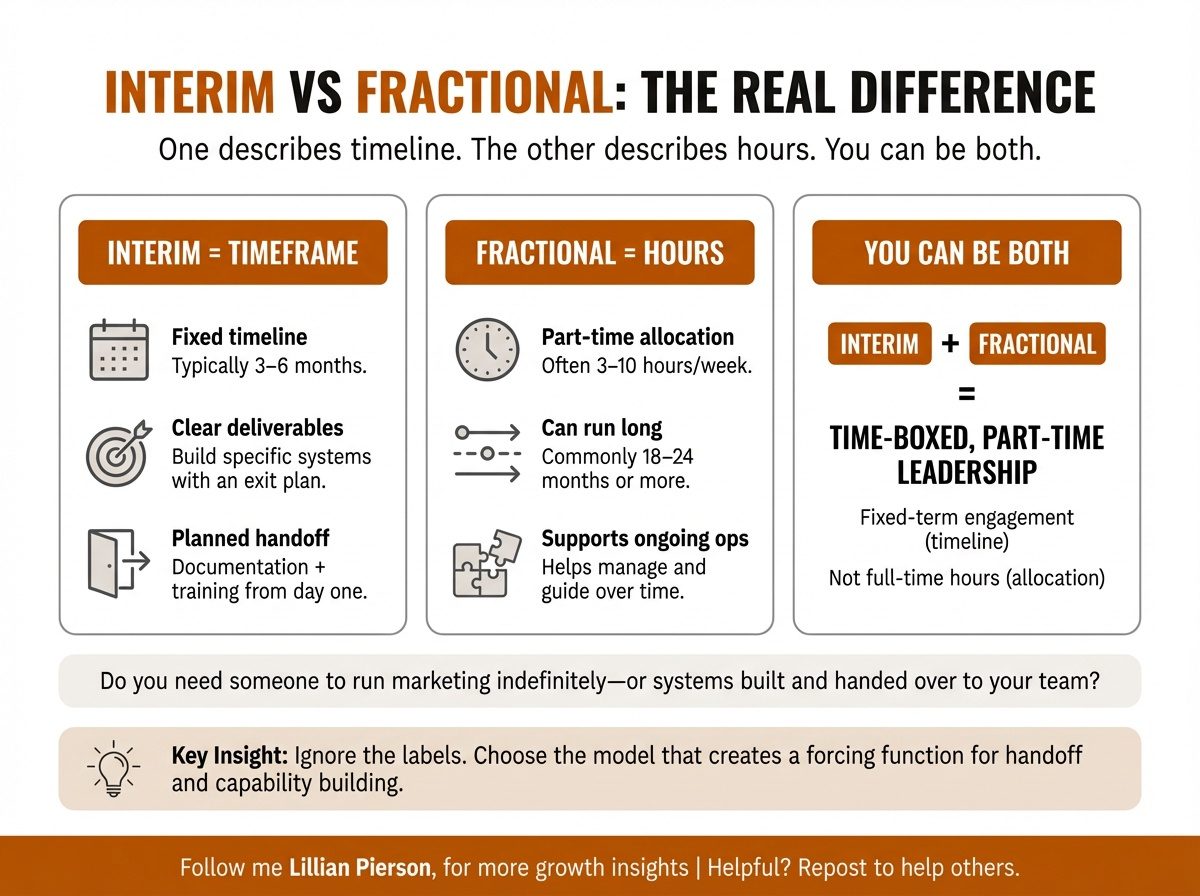
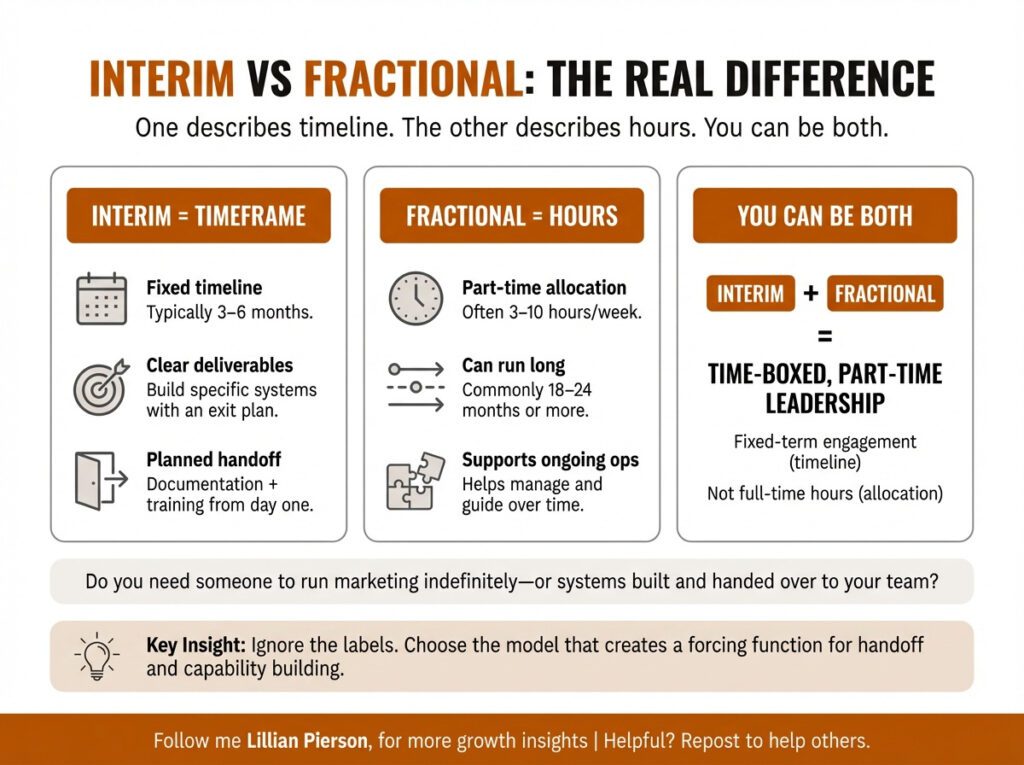
Interim describes the timeframe. You’re coming in for a fixed period (3 to 6 months in my case) with specific deliverables and a clear exit plan.
Fractional describes the time allocation. You’re working part-time, typically 3 to 10 hours per week, often for 18 to 24 months or longer.
Or put another way: You can be interim AND fractional. The engagement is time-boxed with clear deliverables, but does not involve full-time hours (or expenses).
The blog posts and agency websites muddy this constantly. They’ll tell you interim is for emergencies and fractional is for growth. But that’s not the real dividing line.
Do you need someone to run marketing indefinitely, or do you need specific systems built and handed over to your team?
The real question is: Do you need someone to run marketing indefinitely, or do you need specific systems built and handed over to your team?
Most early-stage startups (pre-revenue through Series B) need the latter when it comes to interim CMO services.. You don’t need me forever. You need outbound infrastructure . AI search authority. A partnerships engine. GTM systems that your team can operate after I leave.
In other words, you need interim CMO services, whether you call it interim CMO services that or not.
When Companies Actually Hire Interim CMO Services
Here are the three scenarios I see most often:
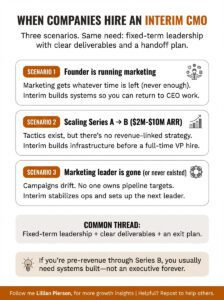
Scenario 1: The founder is running marketing alongside everything else. You’re the CEO. You’re also managing product roadmap, talking to investors, closing enterprise deals, and somehow finding time to review ad copy. Marketing gets whatever’s left, which is never enough. An interim CMO builds the systems so you can hand them to a marketing manager and get back to CEO work.
Scenario 2: You’re scaling from Series A to B (that $2M to $10M ARR range) and investors want to see a professional marketing function. Right now you have a designer, maybe a content person, and a lot of tactical execution with no strategy connecting it to revenue. You need someone to build the infrastructure and prove it works before you hire a full-time VP Marketing.
Scenario 3: You just lost your marketing leader (or never had one) and your team is adrift. Campaigns are running on autopilot. No one owns pipeline targets. Top performers are thinking about leaving. You need someone to stabilize operations, maintain momentum, and set up whoever comes next for success.
All three need the same thing: fixed-term leadership with clear deliverables and an exit plan which is exactly what interim CMO services provide.
Why Interim CMO Services Became My Primary Focus
Here’s my contrarian take on the matter… Early-stage startups shouldn’t need an ongoing marketing executive leading small teams indefinitely when interim CMO services are used correctly..
If you’re under $10M ARR, you can hire a strong marketing manager for $80k to $120k and have them run the systems after they’re built. You don’t need a $15k per month fractional CMO forever. What you need are focused interim CMO services.
What you need is someone to come in, build the machine, train your team, and hand it over. That’s the interim model behind effective interim CMO services.
I still work with a handful of fractional clients each year for specific long-term engagements where the ongoing relationship makes sense, and most companies benefit from interim CMO services. But most early-stage companies don’t need that model.
When I’ve done open-ended fractional work (where there’s no fixed end date and the deliverables evolve continuously), I’ve watched two problems emerge over and over:
First problem: Scope creep becomes unavoidable. You start with “we need outbound,” then three weeks in it’s “actually, we also need to fix our messaging and rebuild the website and figure out why our partnerships aren’t converting.” All valid. All important. The original strategic objectives get pushed back, everything takes longer than it should, and momentum towards the original objective is lost.
Second problem: There’s no natural forcing function for handoff. The engagement just continues. The founder keeps relying on you for decisions that their internal team should be making. You become a dependency instead of building capability.
The hard part is that both parties think they’re getting value, but you’re not actually solving the core problem, which is building a marketing function that works without you.
The interim model behind interim CMO services fixes this. You come in knowing exactly when you’re leaving. That forces everyone to focus on systems, documentation, and team capability from day one.
I pitched this approach to a founder last week. They need those enterprise and mid-market leads. Six-figure deals. Here’s what I promised them:
- An optimized outbound system built and handed over in two months
- 12 to 36 booked calls per month once it’s running
- Full team training so they can operate it without me
- AI search visibility strategy that starts generating inbound in parallel
Total timeline: 3 months, which is typical for interim CMO services engagements.
At the end, they have the systems. I move on. They scale internally.
That’s the model.
The Four Playbooks That Drive Max Traction
When I say “interim CMO services,” basically what I’m really selling is tactical execution of specific playbooks. Not strategy consulting. Not open-ended advising (unless that’s what the customer wants). Systems that work.
Here are the four core playbooks I’ve built, and what they deliver:
1. Outbound Playbook: 12 to 36 Booked Calls Per Month
Timeline: 2 months to build and optimize
What you get: A repeatable outbound system with ICP targeting, messaging frameworks, sequence templates, and team training. Once it’s running, you’re booking 12 to 36 calls per month depending on your segment and offer.
When you need this: You have a sales team ready to take calls, but no consistent pipeline feeding them.
2. AI Search Visibility Playbook: $30k Pipeline in Weeks
Timeline: 2 weeks to create the strategy, ongoing execution during engagement
What you get: Authority positioning in buyer research, optimized content for AI search tools (Perplexity, ChatGPT, Claude), and inbound leads from prospects who found you through AI-assisted research.
Proof point: We generated in $30k+ in pipeline in the first two weeks of 2026 using this playbook.
When you need this: You’re invisible when prospects use AI to research solutions in your category.
3. Partnerships Playbook: Inbound via Other People’s Audiences
Timeline: 2 weeks to create the strategy, execution throughout engagement
What you get: A structured approach to identifying, approaching, and activating partnership channels. Think: podcast tours, co-marketing with complementary tools, reseller relationships, integration partnerships.
When you need this: Your buyers trust other brands in your ecosystem more than they trust you (yet).
4. GTM Engineering Playbook: The Fundamental Systems
Timeline: 1 month to build core infrastructure
What you get: The wiring and strategy for ICP definition, messaging architecture, funnel design, measurement frameworks, and operating cadence. This is the foundation everything else sits on top of.
Proof point: Clients using this playbook have generated over $1M in revenue from the systems we built together.
When you need this: You’re pre-revenue or early traction and need to professionalize your entire go-to-market motion before your Series A or B raise.
Here’s the key insight: These playbooks are modular. You might need just one (outbound + AI search like the founder I pitched last week). Or you might need all four if you’re building from scratch.
But every engagement follows the interim model. We agree on deliverables, timeline, and handoff criteria upfront. Then we execute, document, train, and transition.
No scope creep. No indefinite dependency. Just focused work that moves you forward.
The 30/60/90 Plan: What Actually Happens in an Interim Engagement
If you hire an interim CMO (me or anyone else), here’s what should happen in the first three months:
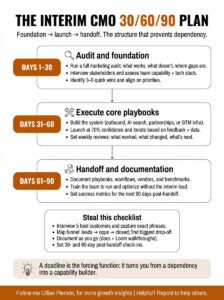
Days 1 to 30: Audit and Foundation
I’m conducting a full marketing audit. What’s working? What’s not? Where are the gaps?
This includes stakeholder interviews (you, your sales leader, maybe your head of product), team capability assessment, and a hard look at your current tech stack and campaigns.
The goal: Identify 3 to 5 quick wins we can execute immediately while building the foundation for bigger systems. Present findings and get alignment on priorities.
For early-stage companies, this phase often includes defining your ICP for the first time, or realizing your current messaging doesn’t match how buyers actually talk about their problems, which interim CMO services address.
Steal this: Days 1-30 checklist you can run yourself
- Interview your best 5 customers. Ask: “What problem were you trying to solve when you found us?” Document exact phrases.
- Audit your tech stack. List every tool, what it costs, who owns it, and whether you’re actually using it.
- Map your current funnel. How many leads came in last month? How many became opportunities? How many closed? Where’s the biggest drop-off?
- Identify one “quick win” campaign you can launch in the next two weeks. Something simple that proves momentum.
Days 31 to 60: Execute Core Playbooks
Now we’re building. If it’s the outbound playbook, we’re setting up sequences, training SDRs, and starting to book calls, as part of interim CMO services. If it’s AI search visibility, we’re publishing content and tracking where you show up in AI-assisted research.
The goal: Get the systems running and producing results. Not perfect results (that takes iteration), but proof that the approach works.
This is also when we refine. Maybe your outbound messaging needs adjustment based on early call feedback. Maybe your partnership targets aren’t as receptive as we thought. We adapt based on data.
Steal this: Days 31-60 execution framework
- Launch your first system with 70% confidence. Don’t wait for perfect.
- Set up weekly check-ins to review: What worked? What didn’t? What do we change?
- Document everything as you go. Use a simple Google Doc. Future you (or your new marketing hire) will thank you.
- Track leading indicators, not just revenue. For outbound: reply rates, call booking rates. For content: where you rank in AI search tools.
Days 61 to 90: Handoff and Documentation
Everything we’ve built gets documented. Playbooks, workflows, vendor relationships, performance benchmarks, which are core to interim CMO services.
I’m training your team to run these systems without me. If you’re hiring a marketing manager or promoting someone internally, I’m helping onboard them and ensuring they understand how to operate and optimize what we’ve built.
The goal: Leave you in a stronger position than when we started, with systems that work and a team that can scale them.
For early-stage companies, this often means the founder or an ops person takes over execution. For growth-stage companies (Series A and beyond), this might mean recruiting and onboarding a full-time marketing leader who inherits a working machine instead of building from zero.
Steal this: Days 61-90 handoff checklist
- Create a “systems handbook” with: what we built, why we built it this way, how to run it, how to measure success, and what to optimize next.
- Record a Loom video walking through each system. Better than written docs for most people.
- Set success metrics for the next 90 days. What should the new owner be hitting?
- Schedule a 30-day and 60-day check-in after handoff to troubleshoot and answer questions.
The framework behind interim CMO services is always the same: Foundation, Launch, Handoff.
The New $1k Entry Point for Bootstrapped Founders
Here’s the reality though, with an audience size of 700k+, not everyone in my community can afford a full interim engagement.
If you’re bootstrapped and under $25k monthly recurring revenue, you probably can’t justify $10k to $30k per month for an interim Chief Marketing Officer, even if it’s the right strategic move for interim CMO services.
That’s why I’m launching a new back-pocket coaching program.
What it includes: Daily voice messaging access Monday through Friday. You’re building your marketing systems, but you have me in your back pocket for strategic guidance. Think of it like having a technical co-founder you can DM whenever you’re stuck.
What it costs: Starts at $1k per month.
Who it’s for: Very early-stage founders (under $25k MRR) who need strategic playbooks and coaching but can handle execution themselves or with a small team.
How it’s different from interim: I’m not executing for you. I’m coaching you through execution. You’re building the systems. I’m helping you avoid the mistakes I’ve seen 100 other founders make through interim CMO services.
Details are still being finalized, but if you’re reading this and thinking “I need guidance but can’t afford full interim,” drop me a message here. I’m taking early interest to shape the program.
How to Know If You Need This (Interim or Back-Pocket Coaching)
Let me make this simple. You probably need interim CMO services if:
- You’re the founder and you’re running marketing. It’s taking time away from product, fundraising, or other CEO responsibilities you should own.
- You’re scaling from Series A to Series B (roughly $2M to $10M ARR) and need to professionalize your marketing function before your next raise, which interim CMO services provide.
- You have a marketing team but no senior leader. They’re executing tactics without strategy, and nothing connects to revenue.
- You need specific systems built (outbound, AI search, partnerships, GTM infrastructure) and handed over to your team, as part of interim CMO services.
- You have budget for a 3 to 6 month engagement at $10k to $30k per month, depending on scope.
You probably need back-pocket coaching if:
- You’re bootstrapped under $25k MRR. You can’t justify full interim pricing yet, but you need strategic guidance.
- You can execute, but you need someone to pressure-test your approach. You don’t want to spend three months building the wrong thing.
- You want access to playbooks and frameworks without paying for full implementation.
Patterns I’ve Seen That Signal “You Need This Now”
Pattern 1: Your pipeline is inconsistent. Some months you have 20 qualified leads. Other months you have 3. There’s no system, just founder hustle and occasional luck. Within an interim engagement, we can build the outbound or inbound engine that makes pipeline predictable.
Pattern 2: You’re about to raise your next round and investors are asking about your go-to-market strategy. You don’t have a good answer because you’ve been winging it. You need someone to professionalize the function fast and create artifacts (dashboards, roadmaps, forecasts) that investors want to see.
Pattern 3: You hired a marketing person and they’re drowning. They’re a strong executor, but they don’t know how to build strategy or connect campaigns to revenue. They need a senior leader to set direction, then they can execute. But you can’t afford or justify a full-time VP Marketing yet.
If any of those sound familiar, book a call to discuss interim CMO services. We’ll map out what you actually need.
Think you might be somewhere in between? Book a call to see how interim CMO services can help. We’ll figure out what actually makes sense for your stage and budget.
Regarding pricing, interim CMO services engagements typically run $10k to $30k per month depending on complexity, urgency, and whether you need multiple playbooks executed in parallel. Back-pocket coaching starts at $1k per month.
External expenses (ads, content production, tools) are separate in both models.
P.S. Why I’m Making This Shift Now
I’ve been doing fractional CMO work for years now. Some engagements lasted 9 months or more. Good relationships. Real impact. I still work with a handful of those clients when the long-term relationship makes sense.
But the best outcomes, the ones where clients actually scaled after I left, always had one thing in common: We knew from the start when and how I’d exit.
There was a forcing function. A deadline. A handoff plan. That changed everything.
When I learned about “interim CMO services” last week (yes, on YouTube, yes, while prepping a pitch), it felt like finally having language for what I’d been intuiting. The model I’d been stumbling toward had a name, and more importantly, a clear structure I could offer to founders.
I was relieved to realize that I could structure my entire practice around time-boxed, deliverables-based engagements that prevent scope creep and force capability building.
No more indefinite fractional work where both parties are kind of stuck in a comfortable-but-suboptimal pattern. Just a handful of the right long-term clients, and a core focus on the interim model.
Come in. Build systems. Train the team. Hand it over. Move on.
Just: Come in. Build systems. Train the team. Hand it over. Move on.
If you’re a founder wondering whether you need marketing leadership, or whether interim makes sense for your stage, book a 30-minute consultation call here. We’ll map out what you actually need and whether I’m the right person to build it.
And if you’re early-stage bootstrapped and interested in the back-pocket coaching program, drop me a message here. I’m shaping it based on what founders actually need, not what I think sounds good.
Either way, thanks for reading. See you in the next one.
Lillian