


Here’s the problem, sales and marketing teams are drowning in tools – 109 on average – and it’s creating chaos. Leads get lost, data is unreliable, and calculating CAC feels like guesswork. All of this inefficiency costs companies millions annually.
The solution? A GTM Engineer. Think of them as the architects of your revenue system. They don’t just manage tools – they build the infrastructure that connects everything, automates tasks, and ensures growth is measurable and scalable.
What they do:
- Design systems to connect tools and track leads
- Automate workflows to eliminate repetitive tasks
- Set up data pipelines for better attribution and insights
- Run experiments to improve conversion rates
- Maintain clean, actionable data for revenue teams
Why now? The rise of AI, bloated tech stacks, and the need for faster, more precise sales tactics have made this role essential. Companies with GTM Engineers see faster growth, lower CAC, and fewer inefficiencies.
When to hire: If your team is bogged down by manual tasks, your data is a mess, or your leads aren’t converting fast enough, it’s time. Most companies bring on their first GTM Engineer between $5M and $10M ARR.
Bottom line: A GTM Engineer transforms disconnected tools into a revenue machine. If your systems feel broken, this is the role you need to fix them.
WTF is GTM Engineering? Everything You Need to Know Before Hiring One in 2025
What is a GTM Engineer?
A GTM Engineer is a technical specialist who focuses on coding, API integrations, and data modeling to automate and streamline revenue systems. Unlike roles that manage tools or execute campaigns, GTM Engineers create the infrastructure that powers sales, marketing, and customer success. They bridge the gap between manual processes and automation.
Picture it this way: if RevOps is the mechanic maintaining the revenue engine, GTM Engineers are the ones designing and building that engine. Their work includes creating tracking plans, lead routing systems, and automated workflows that transform scattered tasks into cohesive systems. The ultimate goal? A predictable pipeline where every lead is tracked, every conversion is measured, and experiments are seamlessly integrated. This role is a response to the increasing complexity of buyer journeys and tool ecosystems.
"Your GTM motion isn’t under-staffed – it’s under-engineered."
- Mishti Sharma and Varun Anand, The GTM Engineer [9]
One standout example comes from Verkada‘s Growth team in June 2025. Under Davide Grieco’s leadership, they automated SDR workflows, including generating personalized landing pages for ABM campaigns and simplifying prospecting. The result? SDRs booked 80–100 meetings per month, a fourfold improvement over manual methods [9].
This role has emerged because 67% of high-growth companies now allocate technical resources specifically for their GTM teams [4]. With buyer journeys becoming more intricate, tool stacks expanding, and AI unlocking new automation possibilities, companies need scalable systems – not just more people.
Why the GTM Engineer Role Exists Now
Demand for GTM Engineers has surged due to three key trends: the explosion of tech stacks, the shift in sales tactics, and the rise of AI-driven automation.
- Tech Stack Overload: Companies are juggling an average of 109 tools that need to communicate, share data, and trigger workflows. When these systems don’t connect properly, it leads to data silos, attribution gaps, and manual inefficiencies. Poor data alone costs businesses $12.9 million annually [1].
- Evolving Sales Tactics: Traditional methods like generic cold emails are losing effectiveness as spam filters and buyer skepticism increase. Companies are now prioritizing "GTM alpha" strategies – data-driven, automated approaches that deliver highly relevant outreach based on real buyer signals, not cookie-cutter templates.
- AI and Low-Code Platforms: Tools like Clay, Zapier, and Make empower GTM Engineers to build advanced workflows – like predictive lead scoring or AI-generated messaging – in days instead of months. This shift has fueled a hiring boom, with LinkedIn reporting over 3,000 GTM engineering job postings in January 2026, compared to 1,400 in mid-2025 [11].
These trends highlight why systems-led growth is outperforming traditional, people-heavy approaches.
What GTM Engineering is Not
GTM Engineering is distinct from other roles like software engineering, RevOps, or growth marketing.
- Not Software Engineering: Software engineers build customer-facing products, while GTM Engineers focus on internal systems that empower revenue teams. Their work isn’t about shipping features but about creating scalable infrastructure.
- Not RevOps or Analytics: RevOps focuses on optimizing existing processes, governance, and reporting. GTM Engineers, on the other hand, build entirely new systems – turning insights into actionable workflows.
- Not Campaign Execution or Growth Marketing: Growth marketers handle ads, copy, and landing page optimization. GTM Engineers design the systems that enable campaigns to scale, triggering actions based on real-time buyer behavior.
"RevOps optimizes what exists. GTM engineering builds what’s missing."
| Feature | RevOps | GTM Engineering | Growth Marketing |
|---|---|---|---|
| Primary Focus | Process optimization | System building | Campaign ROI and demand gen |
| Analogy | Mechanic maintaining engine | Engineer designing engine | Driver winning the race |
| Time Allocation | 70% maintenance, 30% innovation | 30% maintenance, 70% innovation | 100% campaign execution |
| Core Skillset | CRM management, governance | API integrations, scripting | Copywriting, ads, analytics |
| Output | Forecasts and reporting | Scalable systems and workflows | Leads and conversions |
What GTM Engineering Delivers
Now that we’ve clarified what GTM Engineering isn’t, let’s look at the systems it creates and the impact they deliver.
At its core, GTM Engineering builds repeatable systems that drive predictable, scalable pipeline growth. These systems are designed to compound over time, rather than relying on short-term campaign boosts.
Some examples of GTM Engineering outputs include:
- Automated lead routing
- Real-time data enrichment for clean, actionable CRM data
- Predictive lead scoring models
- Hyper-targeted outreach systems that trigger personalized messages based on buyer behavior [4][10]
A real-world example comes from Clay’s GTM engineering team in 2025. Led by Manny and Osman, the team developed an intelligent inbound routing system that scored new sign-ups worth over $25,000, auto-assigned leads, and drafted personalized follow-ups based on customer use cases. This system replaced hours of manual research and drastically reduced "time to insight" [9].
The impact of these systems is undeniable:
- Companies using engineered workflows saw a 31% drop in customer acquisition cost (CAC) for SMBs and a 42% reduction for enterprise teams [2].
- GTM engineering teams achieved three times faster experiment velocity, often prototyping new processes in days instead of weeks [4].
- Organizations with aligned sales and marketing teams generated 208% higher marketing revenue [1].
"GTM engineering is about: Micro relevance, not mass personalization."
- Clay [10]
What a GTM Engineer Does Day-to-Day
The role of a GTM Engineer spans five main responsibilities: designing system architecture, setting up tracking and attribution, creating automated workflows, running experiments to improve conversion, and managing a weekly review cadence. Unlike roles tied to a single function, GTM Engineers balance strategic planning with hands-on execution throughout their week.
Designing the Go-To-Market System
GTM Engineers begin by crafting the revenue system, mapping how leads, data, and deals flow through various touchpoints – from the first website visit to deal closure. This involves defining the technical structure that connects every step in the process. For instance, engineers at Clay created an inbound routing model that scored new sign-ups by analyzing customer signals, automatically assigned leads, and generated contextual meeting notes [9].
A key part of their job is translating high-level directives into measurable processes. If a CEO instructs the team to "focus on enterprise customers", a GTM Engineer defines "enterprise" using specific criteria like employee count, revenue range, or tech stack. They then build logic to identify and route these accounts automatically. This system design is supported by comprehensive tracking to capture every critical action throughout the customer journey.
Setting Up Tracking and Attribution
To ensure reliable tracking, GTM Engineers establish a unified data layer that connects CRM, marketing tools, ad platforms, and product analytics. This setup captures actions like button clicks, form submissions, and scroll depth. Using tools like Google Tag Manager, they implement event tracking for custom actions while enforcing UTM standards and configuring first-party cookies to maintain consistent attribution over long sales cycles.
Identity stitching is another key task, linking anonymous website visits to known contacts across sessions and devices to avoid misattribution. Engineers also choose and fine-tune attribution models – such as U-Shaped or Full-Path models – to reflect the complex, non-linear nature of B2B purchasing. As April Robb from Directive Consulting notes:
"If attribution doesn’t change your decisions, it’s just decoration." [13]
They also automate data governance and hygiene checks to catch issues early. With tracking in place, the focus shifts to automating workflows that drive conversions.
Building Workflows and Automation
By connecting APIs and leveraging tools like Zapier, Workato, and Make, GTM Engineers automate processes that eliminate repetitive tasks. For example, at Verkada in 2025, GTM Engineers automated 80% of SDR workflows, enabling reps to book 80–100 meetings per month – a fourfold increase compared to manual methods [9].
Since leads contacted within five minutes are nine times more likely to convert [12], engineers build instant routing logic based on factors like ICP fit, intent signals, and rep availability. These automated workflows trigger real-time personalized outreach based on events like job changes, funding announcements, or spikes in intent signals. This level of automation not only saves time but also sets the stage for faster experimentation and optimization.
Running Experiments and Improving Conversion
With the system’s foundation in place, GTM Engineers focus on optimizing its performance. They create rapid testing environments to prototype and implement process improvements in days rather than weeks, achieving up to three times faster experiment velocity compared to traditional methods [4]. These experiments might include A/B testing messaging, trying out new channels, or adjusting lead scoring models.
At Clay, for example, GTM Engineers introduced "Transcript-powered data entry", where scripts captured sales call details, extracted firmographics, and auto-updated Salesforce – eliminating manual CRM updates and improving data quality [9]. Efforts to boost conversion often target removing friction at every stage of the funnel. This can involve automating lead enrichment to speed up response times, using AI-driven scoring to prioritize high-intent leads, or refining routing rules. Companies that adopt these workflows have seen customer acquisition costs drop by 31% for SMBs and 42% for enterprise teams [2].
Running Weekly Reviews and KPI Reporting
Once the core revenue functions are automated, GTM Engineers maintain and refine the system through continuous monitoring. They build real-time dashboards and automated reports that highlight anomalies, enabling teams to address issues within hours. These reports aren’t about creating flashy visuals but about making data actionable.
Weekly reviews typically cover conversion rates, channel attribution, data quality, experiment outcomes, and system performance. For example, revenue teams with strong sales and marketing alignment have achieved 208% higher marketing revenue [1]. Engineers also implement practices like automated hygiene checks and a "field creation tax", which requires justification before adding new custom fields to the CRM. This prevents clutter and ensures the system remains scalable and maintainable. At Intercom, the GTM Ops team pilots innovative plays like Total Addressable Market enrichment, while their GTM Systems team scales these processes across millions of CRM rows [9].
How GTM Engineering Systems Work
Think of a GTM system as a factory: raw materials go in, and refined products come out. In this case, the inputs are your ICP (Ideal Customer Profile) definition, channel strategy, and content. These are processed through tracking layers, automation workflows, and data models. The outputs? Qualified pipelines, reliable attribution data, and predictable CAC (Customer Acquisition Cost) payback. As Michael J. Jäger from Cremanski explains:
"RevOps manages the factory. GTM Engineering builds the machines." [8]
Let’s break down how these inputs transform into measurable outcomes.
The Inputs → System → Outputs Model
The GTM system begins with three critical inputs: who you’re targeting, what you’re offering, and where you’re reaching them.
- Who you’re targeting: This includes ICP attributes like company size, tech stack, and intent signals.
- What you’re offering: Pricing, packaging, and positioning come into play.
- Where you’re reaching them: Channels such as paid ads, content, outbound efforts, and partnerships.
These inputs are fed into the system’s processing layer – essentially the machinery built and maintained by GTM Engineers.
Within this system:
- Data capture logs every interaction.
- Automation enriches and routes leads instantly.
- Dashboards provide real-time performance insights.
The results are exactly what revenue teams care about: increased qualified pipeline volume, accurate CAC metrics, improved conversion rates across funnel stages, and expanded revenue from current accounts. For example, companies leveraging these workflows saw CAC reductions of 31% for SMBs and 42% for enterprise teams [2]. This isn’t just about saving time – it’s about creating a scalable, repeatable process that doesn’t require additional headcount.
The 5-Stage Funnel: Signal to Expansion
A GTM system doesn’t just deliver outputs – it structures the customer journey into five distinct, trackable stages.
- Signal: This is where potential buyers first show up, often through intent monitoring, reverse-IP tracking, or social media signals. Automation identifies high-value triggers like competitor complaints or job postings that match your ICP.
- Lead: Once someone enters your system – via a form fill, demo request, or product sign-up – automation takes over. It enriches the lead with firmographic data, scores their likelihood to purchase using AI, and routes them to the right rep based on territory or availability.
- Conversion: This stage covers the active sales process. Multi-channel sequences (email, LinkedIn, calls) coordinate outreach, while automated CRM updates from call transcripts eliminate manual data entry.
- Expansion: For existing customers, "expansion radars" monitor product usage and support tickets for upsell signals, such as increased seat counts or requests for enterprise features.
- Retention: Churn-risk models predict when a customer might leave, triggering automated "save" plays to retain them.
Where Tracking and Automation Fit
Tracking forms the foundation of the GTM system, capturing every meaningful action across the funnel. This includes event tracking (e.g., button clicks, form submissions), UTM parameters for attribution, and identity stitching to link anonymous visitors to known contacts. Without proper tracking, automation falls apart – leads get lost, and attribution becomes unreliable. That’s why GTM Engineers prioritize tasks like automated data hygiene audits and "merge-and-purge" routines before launching campaigns.
Automation builds on clean data to drive speed and efficiency. For instance:
- Instant lead routing ensures leads are contacted within five minutes, making them nine times more likely to convert [12].
- Automated enrichment saves reps 8–12 hours a week by instantly adding key data to leads.
- AI-driven outreach personalizes messages based on real-time signals.
Take Clay’s GTM team as an example. In 2024–2025, they developed an "Intelligent Inbound Routing" system. This tool scored new sign-ups with $25,000-plus potential, auto-assigned them to reps, and even drafted personalized meeting notes tailored to specific use cases [9]. This shift turned their operations team from manual data entry workers into strategic growth architects.
sbb-itb-e8c8399
GTM Engineer vs RevOps vs Growth vs Product Marketing
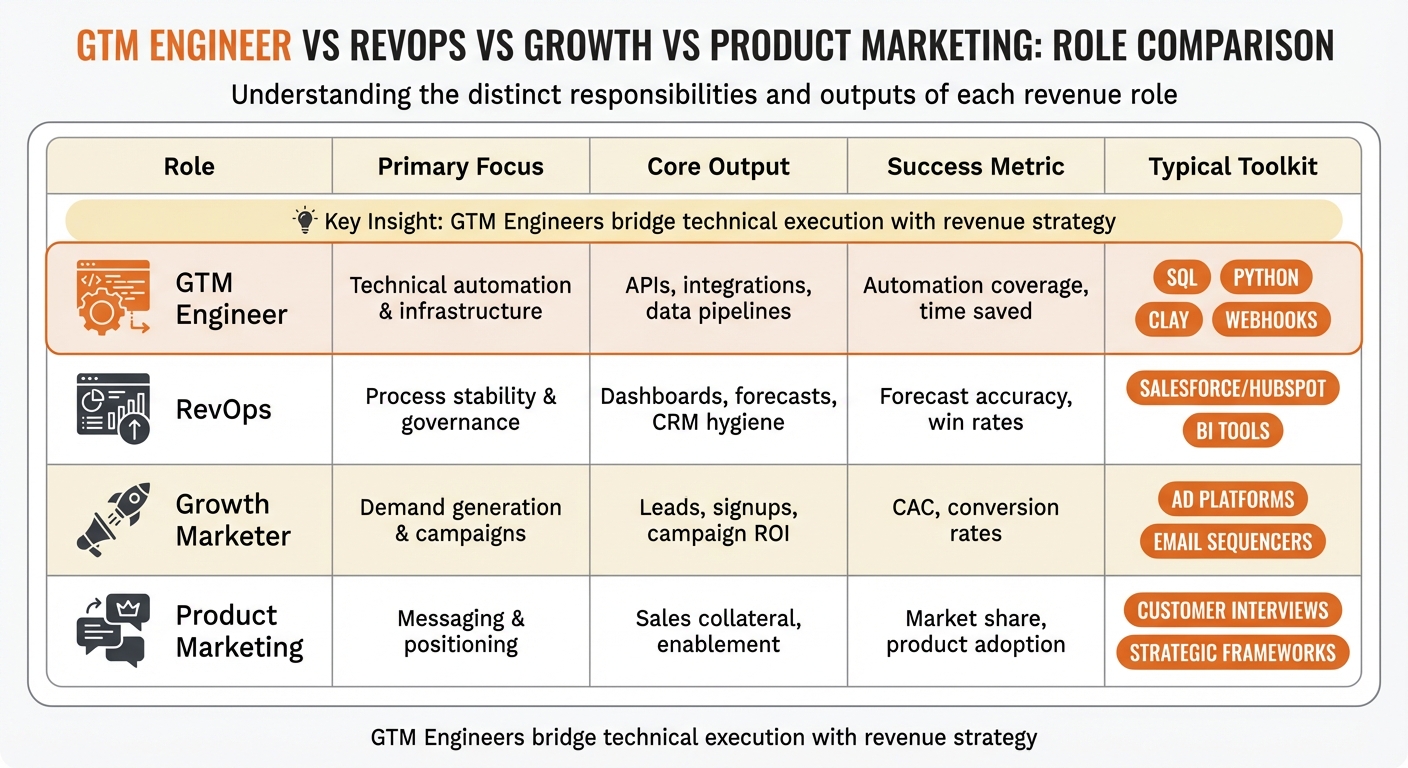
GTM Engineer vs RevOps vs Growth Marketing vs Product Marketing Role Comparison
These roles often intersect, but understanding their distinctions is key. RevOps focuses on process alignment, CRM upkeep, and accurate forecasting. Growth Marketers create campaigns and test channels to boost demand. Product Marketing shapes messaging, positioning, and sales enablement. Meanwhile, GTM Engineers design the technical systems that tie everything together.
RevOps ensures smooth operations with clean data and aligned workflows. GTM Engineers push boundaries by building custom APIs, automating workflows, and running technical experiments. Growth Marketers aim for efficiency – generating leads, lowering acquisition costs, and accelerating conversions. Product Marketers ensure the messaging resonates with the target audience. GTM Engineers, however, bridge strategy and technical execution. For instance, when Growth tests a new outbound motion, GTM Engineers handle enrichment pipelines and lead routing. When Product Marketing rolls out a new narrative, GTM Engineers incorporate it into automated sequences and sales playbooks. This synergy is essential for creating systems that deliver consistent pipeline results.
Role Comparison Table
| Role | Primary Focus | Core Output | Success Metric | Typical Toolkit |
|---|---|---|---|---|
| GTM Engineer | Technical automation & infrastructure | APIs, integrations, data pipelines | Automation coverage, time saved | SQL, Python, Clay, Webhooks |
| RevOps | Process stability & governance | Dashboards, forecasts, CRM hygiene | Forecast accuracy, win rates | Salesforce/HubSpot, BI tools |
| Growth Marketer | Demand generation & campaigns | Leads, signups, campaign ROI | CAC, conversion rates | Ad platforms, email sequencers |
| Product Marketing | Messaging & positioning | Sales collateral, enablement | Market share, product adoption | Customer interviews, strategic frameworks |
Each role has a unique mindset: RevOps asks, "How do we align this?" Growth wonders, "How do we grow this?" Product Marketing considers, "How do we tell this?" GTM Engineering focuses on, "How do I program this?"
How GTM Engineers Work with Other Teams
As the connective tissue between teams, GTM Engineers amplify impact through automation and integration. They complement other roles by scaling their efforts with technical solutions.
Take Canva in 2025 as an example. The company split responsibilities effectively: a GTM AI team led by Robert Jones tackled high-leverage automation tasks – like summarizing call transcripts and feeding enriched data into sales strategies – while a separate RevOps team maintained CRM stability [9]. This setup allowed RevOps to focus on foundational processes while GTM Engineers drove innovation, transforming workflows into scalable systems.
Growth and Product Marketing typically identify the "what" – a new campaign, refined messaging, or better lead handoffs. GTM Engineers then build the infrastructure to make these processes repeatable. Once an experiment proves successful, RevOps steps in to standardize and monitor its performance. Companies that achieve this level of alignment see 208% higher revenue from marketing compared to those that don’t [5][1]. At the heart of this success is the GTM Engineer, ensuring strategies translate into systems that run smoothly without constant manual effort [9].
When to Hire a GTM Engineer
The right timing is crucial: bring in a GTM Engineer when you have a proven playbook but lack the infrastructure to scale effectively.
5 Signs You Need a GTM Engineer
If your team is drowning in inefficiencies, it’s time to consider a GTM Engineer. Here are some red flags:
- Sales reps are stuck manually transferring data, eating into valuable selling time.
- Leadership struggles to trust attribution data, fueling the endless sales-versus-marketing blame game.
- Lead response times are slow, causing hot prospects to cool off before anyone follows up.
- Cold outreach lands in spam folders due to poor technical setup.
- Adding more SDRs no longer translates to proportional pipeline growth [3][7].
When manual tasks take up more than 10% of an SDR’s time, it’s a clear sign you need engineering support [4]. Poor data quality costs companies an average of $12.9 million every year [1]. With tech stacks averaging 45 marketing tools and 64 sales tools, having someone to streamline the connections between them becomes essential [1]. A single GTM Engineer can automate workflows to match the output of five to seven SDRs [6].
However, timing matters. Jumping into automation too early can create unnecessary complexity.
When It’s Too Early to Hire
Avoid hiring a GTM Engineer if your company is still figuring out product–market fit or relying on founder-led sales. Their role is to scale an already successful process – not to discover what works [4]. You need a repeatable, even if manual, process before automation makes sense [14][1].
If your business generates less than $1 million in annual recurring revenue (ARR), focus on manual sales execution. Once you’re between $1 million and $5 million ARR, prioritize building a RevOps function to define data structures and funnel stages. Only after this foundation is in place should you bring in a GTM Engineer to scale operations [4]. Prematurely hiring for this role can add unnecessary complexity without delivering results.
Hiring Timeline by Company Stage
Here’s a simplified timeline to help you decide when to hire a GTM Engineer:
| Stage | Revenue Range | Recommended Action |
|---|---|---|
| Seed | $0 – $1M ARR | Founder-led RevOps; focus on product–market fit [4] |
| Early Scaling | $1M – $5M ARR | Hire RevOps; consider fractional GTM Engineering [4] |
| Growth | $5M – $10M ARR | Bring on your first full-time GTM Engineer [4] |
| Expansion | $10M+ ARR | Build dedicated GTM Engineering and RevOps teams [14][4] |
Most companies hire their first full-time GTM Engineer between $5 million and $10 million ARR [4]. High-growth organizations are 67% more likely to have dedicated technical resources supporting their GTM teams [4]. For businesses with a Product-Led Growth model or a Total Addressable Market of over 50,000 accounts, this hire might need to happen earlier [14].
For example, in 2025, Intercom restructured its revenue systems by creating a GTM Ops team under Alexander DeMoulin to test new strategies, while a separate GTM Systems team within R&D scaled those strategies into production [9]. This setup worked because it separated innovation from maintenance, allowing both teams to focus on their strengths.
What a GTM Engineer Produces
A GTM Engineer isn’t just about offering recommendations – they’re hands-on builders of the systems that make revenue generation more predictable. Their work transforms scattered tools into a cohesive, scalable revenue engine, removing the guesswork from your go-to-market strategy.
Core Deliverables Overview
The outputs of a GTM Engineer can be grouped into six main categories: system architecture, data infrastructure, automation playbooks, intelligence models, governance frameworks, and experimentation dashboards.
- System architecture: These are detailed maps of your tech stack, showing how your CRM, marketing tools, and analytics platforms interconnect [1][6]. They highlight bottlenecks where data gets stuck and pinpoint redundant tools, helping revenue teams reduce inefficiencies caused by tool overlap [6].
- Data infrastructure: This involves creating ETL and Reverse ETL pipelines to synchronize data across your stack [1][9]. By establishing a single source of truth, these pipelines eliminate costly manual data entry errors. As Tina Sang, Growth Lead at Artisan, explains:
"The CRM is where every signal, conversation, and conversion lives. Without it as the single source of truth, our GTM engine would just be a tangle of disconnected tools" [6].
- Automation playbooks: These document workflows and multi-channel sequences triggered by specific actions [6][7]. They enable teams to replicate successful strategies consistently. For instance, in June 2025, GTM Engineers Manny and Osman at Clay built a routing system that scores high-potential sign-ups (valued at $25,000+), assigns leads automatically, and drafts personalized meeting notes tailored to customer use cases [9].
- Intelligence models: These include AI-driven tools like lead scoring and propensity models [1][2][9]. At Verkada in 2025, the Growth team leveraged these models to automate 80% of SDR tasks, enabling reps to schedule 80–100 meetings monthly – a fourfold increase compared to manual methods [3][9].
- Governance frameworks: These frameworks include automated routines for deduplication and schema audits [9][4]. They protect the system from bad data spreading throughout the stack.
- Experimentation dashboards: These dashboards track metrics like pipeline velocity, ROI, and automation coverage while enabling quick A/B testing [1][6][4].
Combined, these deliverables tackle the most common friction points in go-to-market processes.
How These Deliverables Drive Results
Each deliverable not only strengthens your revenue systems but also delivers measurable results. For example, system maps break down tool silos and reduce wasted spending on underutilized software – only 33% of the average martech stack is fully utilized [6]. Data pipelines save reps 2–3 hours weekly that would otherwise be spent on manual data entry [6][4]. Automated lead routing ensures high-intent prospects are contacted immediately, preventing missed opportunities.
AI-driven scoring models and signal intelligence enable personalized outreach at the peak of buyer interest, boosting conversion rates. Companies implementing these workflows often see a 31% to 42% drop in customer acquisition costs [2]. Governance frameworks safeguard against data quality issues, which can be costly to fix [1]. Meanwhile, experimentation dashboards allow teams to test and iterate three times faster, cutting prototype timelines from weeks to days [4].
Conclusion
GTM Engineers create systems that drive predictable and measurable revenue. They blend strategy with execution by designing tracking plans, automating workflows, running experiments, and building the data infrastructure needed for scalable growth. As Mishti Sharma and Varun Anand from Clay explain:
"Your GTM motion isn’t under-staffed – it’s under-engineered" [9]
Knowing when to bring in a GTM Engineer is just as important as building the system itself. The ideal time to hire is when manual processes consume more than 20% of your team’s time, leads are waiting hours to be contacted, or attribution data is unreliable [12]. This typically happens when companies hit $5M–$10M in ARR [4] [14]. At this stage, the impact can be game-changing: instant lead routing can boost conversion rates by 9x [12], while AI-driven scoring has been shown to reduce customer acquisition costs by 31%–42% [2] [6]. Case studies consistently highlight the operational improvements these systems bring.
Before committing to a full-time GTM Engineer (with compensation ranging from $120K–$300K OTE), it’s crucial to first assess your bottlenecks. Identify where manual processes are failing, measure your speed-to-lead, and determine which workflows could deliver immediate returns [12] [14].
If inefficient systems and messy data are slowing you down, we’re here to help. Ready to transform your revenue operations? Data-Mania‘s GTM Engineering services specialize in helping B2B SaaS companies streamline their go-to-market systems. From creating tracking plans and automation playbooks to setting up experimentation frameworks and weekly review cadences, we’ll help you turn disconnected tools into a seamless revenue engine. Whether you need strategic advice or hands-on support, we’re ready to help you build the systems that drive growth.
FAQs
What skills do you need to become a GTM Engineer?
To thrive as a GTM Engineer, you need a blend of technical expertise and strategic insight. On the technical side, you’ll need solid skills in SQL and a scripting language like Python or JavaScript to automate workflows and connect various tools. Experience with CRM platforms (like Salesforce or HubSpot), data warehouses, reverse ETL tools (such as Hightouch or Census), and data modeling tools like dbt is equally important.
Beyond technical skills, a deep understanding of funnel metrics, lifecycle design, and automation frameworks is key to building scalable revenue systems. Being adept at creating clear documentation, prioritizing automation, and working with modern solutions like AI-driven automation or server-side tagging will make your work even more impactful. A GTM Engineer combines technical problem-solving with strategic planning to create and refine systems that deliver measurable growth.
How is a GTM Engineer different from a RevOps specialist?
A GTM (Go-to-Market) Engineer and a RevOps (Revenue Operations) specialist play distinct roles within an organization, each with its own priorities and tasks. RevOps professionals concentrate on refining processes, ensuring data accuracy, and managing the tools and systems across sales, marketing, and customer success teams. Their goal is to enhance operational efficiency and improve forecasting capabilities.
On the other hand, GTM Engineers take on the role of system architects. They design and implement the complete revenue engine, focusing on scalability. Their work involves integrating messaging, building funnel structures, automating workflows, setting up tracking mechanisms, and running experiments. While RevOps ensures everything runs smoothly day-to-day, GTM Engineers are the ones constructing and fine-tuning the technical systems that enable consistent and measurable growth.
When should a company consider hiring a GTM Engineer?
A company might want to bring on a GTM Engineer when growth feels erratic, even though there’s clear demand. Challenges like messy attribution data, fluctuating funnel metrics, or missed leads often signal the need for this role. Other red flags include friction between sales and marketing or difficulties scaling channels effectively.
If your team is finding it hard to build a go-to-market system that’s measurable, repeatable, and scalable, a GTM Engineer can step in to design and implement a streamlined revenue engine that supports steady, predictable growth.
Related Blog Posts
- Top 10 GTM Engineering Consultants for 2026 & How To Choose the Right One For Your Startup
- The AI GTM Engineer: The Missing Role Behind Scalable B2B Growth
- Fractional CMO for Startups: The GTM Engineering Approach (Systems, Not Campaigns)
- Best GTM Engineering Tools 2026: How to Choose (Orchestration, Data Quality, Attribution, and Integration Depth)