
Stay manual until your outbound repeats. Automation multiplies the motion you already have, so a fuzzy ICP or a slow reply process gets spread across more accounts instead of fixed.
The readiness test below is best run before you buy a single tool. Five criteria, each a yes or no. Pass four of them and you have something worth automating. Pass two and you have a research problem, not a tooling problem.
I’m Lillian Pierson, a fractional CMO and licensed Professional Engineer who’s spent more than 20 years driving growth for tech companies. When I ran 90 days with Maistro, a UK B2B SaaS company, I built the ICP, the offer ladder, and the messaging system before anyone touched a channel. They landed their first paying customer in week one of the first channel going live, and that customer was an exact match to the ICP I had defined. That order is what I built the scorecard below to protect.
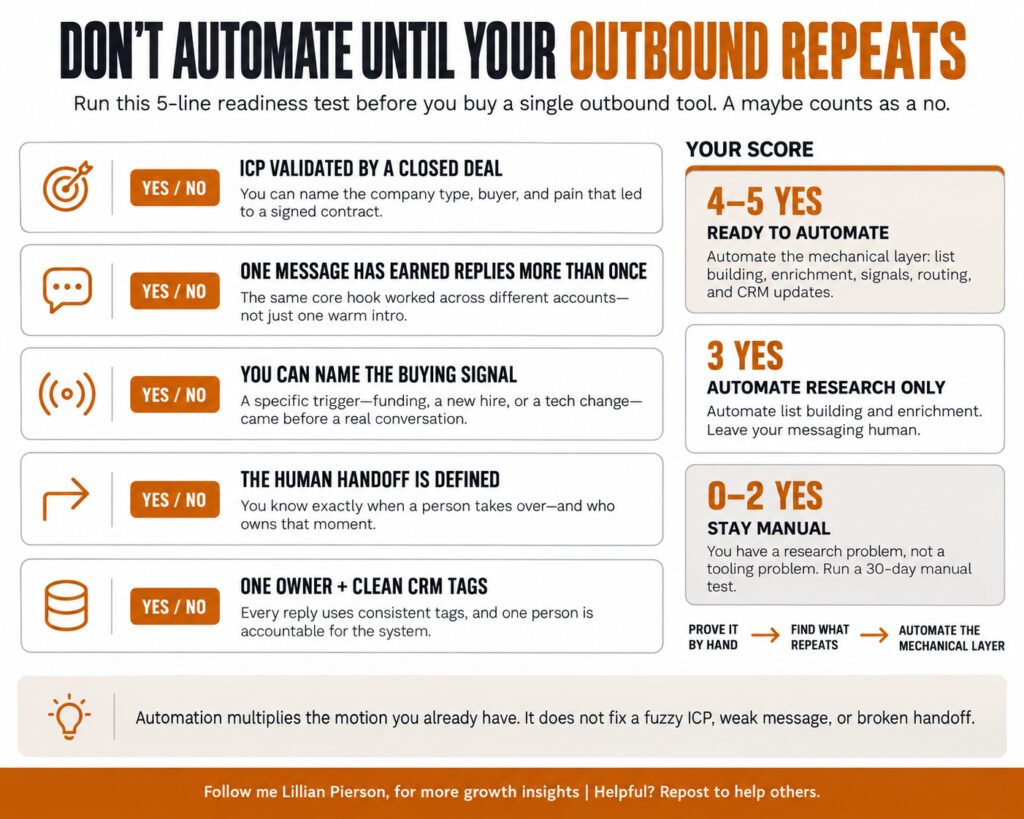
The five-line readiness test
Before you open a tool, answer these five. Each line is a yes or a no, and a maybe counts as a no.
| Readiness criterion | What a real “yes” looks like |
|---|---|
| Your ICP is validated by a closed deal | You can name the company type, the job title, and the pain that led to a signed contract. Not a persona doc. A contract. |
| One message has earned replies more than once | The same core hook has worked across different accounts, so you know it wasn’t one warm intro doing the work. |
| You can name the buying signal | You can point to a specific trigger, like a funding round, a new hire, or a tech change, that came before a real conversation. |
| The human handoff is defined | You know the exact moment a person takes over, and you know who that person is by name. |
| One owner, clean CRM tags | Every reply is logged with a consistent tag set, and one person is accountable for the whole system. |
Four or five yes answers and you’re ready to automate the mechanical layer. Three: automate list building and enrichment only, and leave the messaging alone. Two or fewer: stay in discovery and run the 30-day test below.
Why automating early costs more than waiting
Your fuzzy ICP creates cleanup for you. Every assumption you feed into an automated system comes back to you as rejected sends, noisy reply queues, and a sending domain you have to repair later.
The repair is what costs you. Google and Yahoo hold you to a reported spam rate below 0.3% once you send at volume, and crossing it gets your mail throttled or refused outright [1]. A burned domain takes weeks of warmup to rebuild, and your founder-led outbound is throttled for every one of those weeks. You lose the channel you were still learning from.
So your sequence matters more than your stack. Prove your motion by hand, then let a system carry the work that repeats.
The 30-day test that earns you a yes
If the scorecard came back mostly no, this is how you turn it around. Treat manual outbound as a research instrument first and a pipeline channel second.
Work 50 to 100 hand-picked accounts over 30 days, at roughly 5 to 8 hours a week. For every account, log one trigger, such as a recent funding round, a new VP of Sales, or a job posting, alongside the company type and the prospect’s role. That single trigger field is what turns a pile of outreach into a pattern you can act on.
Tag every response the same way each time: interested, not now, wrong person, referral, or objection. Messy tags at this stage hand you a messy system later, because your tags become the routing rules you automate against.
By day 30 you should be able to name three things without hedging: the company type, the buyer, and the one message that won meetings. That’s the bar. Once you can say all three out loud, run the scorecard again.
What to automate first once you pass
Automate high-volume, low-judgment work. Keep low-volume, high-judgment work with a person.
| Task | Frequency | Cost of an error | Verdict |
|---|---|---|---|
| List building and enrichment | High | Low | Automate first |
| Signal detection | High | Medium | Automate first |
| CRM updates and routing | High | Low | Automate first |
| Reply triage | High | Medium | Automate, with review |
| First-draft copy | High | Medium | Automate, with review |
| Objection handling and discovery | Medium | High | Keep human |
| ICP and positioning | Low | Critical | Keep human |
Enrichment and routing will pay you back fastest. You run them constantly, they eat your time, and a small mistake costs you little to correct. When you’re ready to pick the software, start with the AI-native marketing automation tools I actually use with clients, and automate the mechanical layer before you touch your messaging.
Three pieces of this sit outside your readiness test, and I’ve written each one up for you separately:
- The architecture itself, layer by layer, is in how an AI-native growth system actually works, including the build I ran for SingleStore that produced 1,100+ organic MQLs in 10 months at roughly $50 per lead with zero paid spend.
- I’ve covered your budget and scoping in what an AI-native growth system costs a startup.
- I’ve written up approval gates and review checkpoints in human oversight in AI GTM automation.
- I walk through how to choose and sequence your triggers in turning signal into revenue.
The three numbers that decide whether you scale
Run the new system beside your manual baseline for 30 days before you add anything else. Track your results by signal type first, then by industry. One strong signal can carry your average while every other trigger you’re running quietly fails.
Three numbers settle the decision:
- Cost per qualified meeting. Scale when yours drops and your reply quality holds. Compare against your own manual baseline, because your cost structure is the only fair benchmark.
- Reply quality, by signal. Volume that climbs while meeting conversion stays flat means the research layer is wrong, so fix the ICP before you add triggers.
- Deliverability. Watch your bounce rate and your reported spam. Roll back if spam complaints approach the 0.3% line [1].
Validate by hand, automate what repeats
Manual outbound proves your motion. An AI-native growth system scales the parts that already work for you. Buying signals beat send volume, and a system you build on a validated ICP beats both.
Run the five-line scorecard. If it comes back mostly yes, automate the mechanical layer and keep your hands on the conversations. If it comes back mostly no, you’ve just saved yourself a domain reputation and a few thousand dollars in tooling.
FAQs
How many conversations do I need before I automate?
Plan on 20 to 30 real conversations, which usually takes 50 to 100 hand-picked accounts over about 30 days at 5 to 8 hours a week. Your number of conversations matters less than whether your same hook worked across different accounts. One warm intro that converted tells you nothing about a repeatable motion. The same message landing with three unrelated companies tells you a lot.
What if I’m already automating and it isn’t working?
Run the five-line scorecard against what you have now. When your results stall, it almost always traces back to your research layer rather than to the model or the tool, so swapping platforms tends to hand you the same numbers at a different price. Pause the sequences, fix the ICP definition and the trigger, and restart with one signal.
Can I run this as a solo founder without hiring a GTM engineer?
Yes, at this stage. What your system needs is one owner who reads your weekly numbers and has the authority to pause a sequence. That person doesn’t need to be a GTM engineer, fractional CMO, or agency while you’re still validating. Once you’re scaling past one signal and one segment, the ownership question is worth revisiting.
Will automating outbound hurt my deliverability?
It can, and the damage compounds on you quietly. Set up SPF, DKIM, and DMARC before your first automated send, and warm your sending domain before you raise volume. Google and Yahoo hold you to a reported spam rate below 0.3% [1]. Crossing it costs you the channel, and recovery runs into weeks.