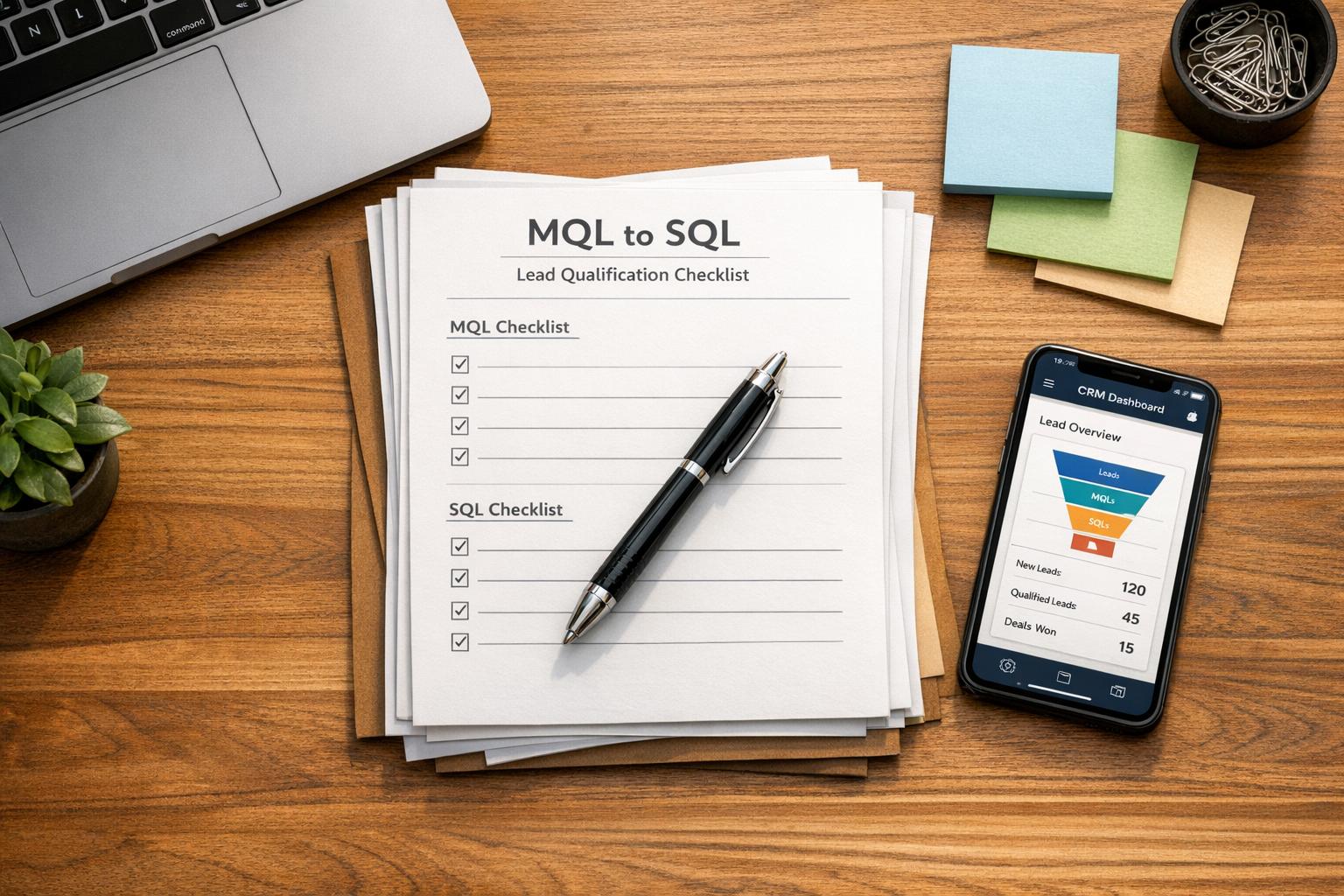

Think lead qualification is just a marketing task? Here’s why it matters to your entire sales process: Poorly qualified leads waste time and resources, while strong MQL-to-SQL transitions create a reliable sales pipeline and boost revenue. Here’s the gist:
- MQLs (Marketing Qualified Leads) are early-stage prospects showing interest but not ready to buy. They align with your Ideal Customer Profile (ICP) but need nurturing.
- SQLs (Sales Qualified Leads) show buying intent and meet criteria like BANT (Budget, Authority, Need, Timeline).
- A clear process ensures marketing and sales work together, reducing friction and improving conversion rates.
Key steps include:
- Define your ICP and buyer personas to target the right leads.
- Use frameworks like BANT or CHAMP to qualify leads effectively.
- Build a lead scoring model that tracks behavior, demographics, and intent signals.
- Automate handoffs with CRM tools to avoid delays and missed opportunities.
- Align marketing and sales with shared KPIs and feedback loops.
Why this matters: On average, only 13% of MQLs convert to SQLs, but top teams hit 25–35%. A structured, data-driven approach helps you focus on high-potential leads, shorten sales cycles, and drive revenue growth.
Let’s break down how to make your lead qualification process work smarter.
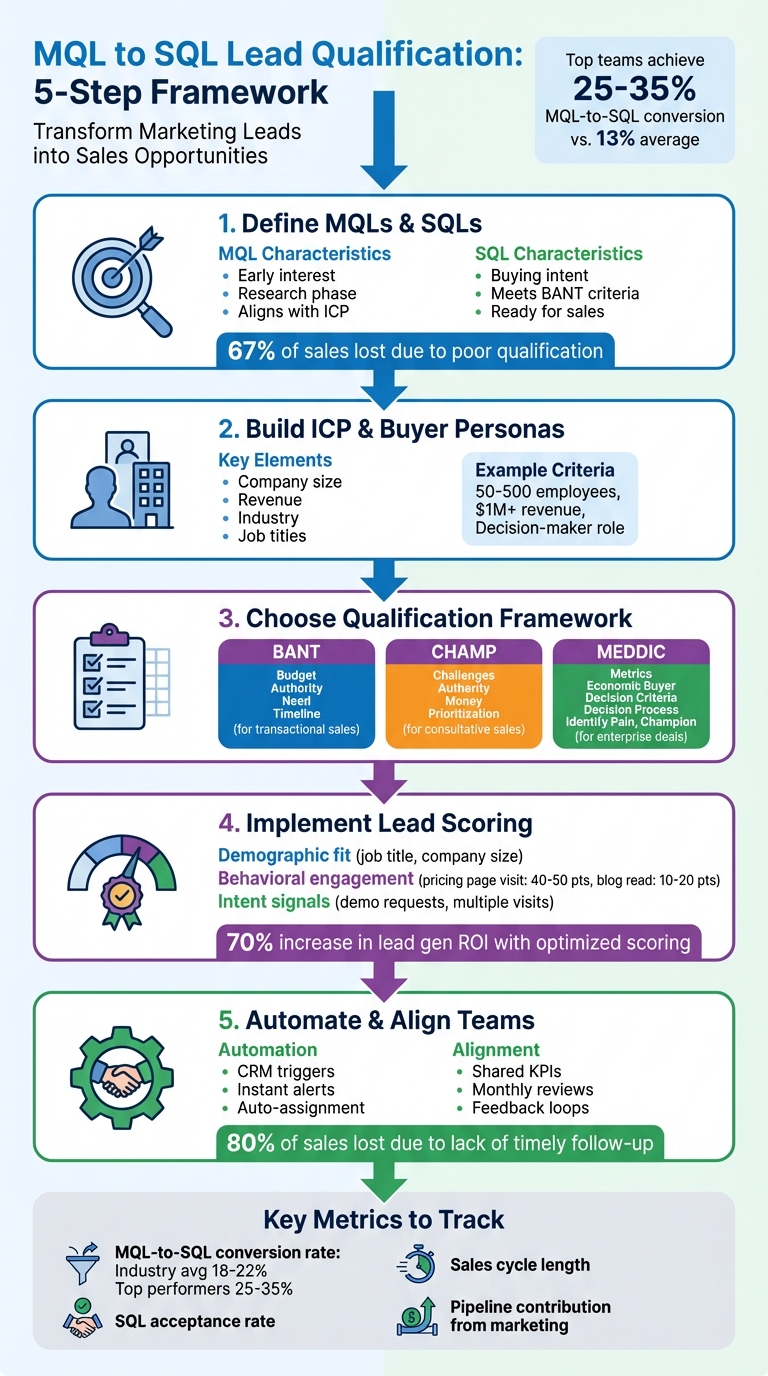
MQL to SQL Lead Qualification Process: 5-Step Framework
Smarter MQL to SQL
How to Define MQLs and SQLs
Establishing clear definitions for MQLs (Marketing Qualified Leads) and SQLs (Sales Qualified Leads) is essential for creating an effective qualification process. Without this clarity, marketing and sales efforts can become misaligned, leading to wasted time and resources. Research indicates that 67% of sales opportunities are lost due to poor lead qualification, and only 56% of marketers verify lead quality before passing them to sales[14][15].
What is an MQL?
An MQL is a lead who has shown early interest in your product or service through marketing interactions but isn’t quite ready for a sales conversation. These prospects are typically in the research and education phase, exploring content to better understand their challenges and potential solutions[9][5][10][11].
Marketing engagement signals that might qualify someone as an MQL include actions like visiting your website, downloading content, interacting with emails, attending webinars, or engaging on social media. However, engagement alone isn’t enough. To classify a lead as an MQL, they must also align with your Ideal Customer Profile (ICP). This involves considering factors such as company size, industry, job title, location, and revenue. For instance, a lead who downloads multiple whitepapers should only be considered an MQL if they meet your ICP criteria[6][1].
“Marketing teams simply need to work with sales to figure out what criteria is best for defining an MQL. The more carefully you can define what constitutes an MQL, the smoother and easier your relationship and the hand-off process with sales will be.” – Leadfeeder[8]
What is an SQL?
An SQL is a lead who has progressed beyond initial research and is showing clear buying intent. These leads engage with advanced content like case studies, pricing pages, or product demos. They may also request consultations, start free trials, or ask specific questions about implementation[9][5][10][11].
The primary distinction between MQLs and SQLs is intent. While MQLs are still learning, SQLs are actively evaluating solutions and preparing to make a purchase decision. SQLs often meet criteria like BANT (Budget, Authority, Need, and Timeline) and display behaviors that signal readiness for sales. For example, an SQL might attend a product demo, revisit your pricing page multiple times in a short span, and hold a decision-making role in a company that fits your ICP.
Why Clear Criteria Matter
Vague definitions create confusion and inefficiency between marketing and sales teams, often leading to missed opportunities. Misalignment in this area is one of the biggest obstacles to effective lead conversion[4][8].
Collaboratively defining clear criteria can eliminate these issues. Start by analyzing your existing customers to identify the shared characteristics and engagement patterns of those who have successfully converted. This reverse-engineering approach helps set mutual expectations and ensures marketing delivers leads that sales can confidently pursue[8][1]. The result? Higher conversion rates, smoother collaboration, and a more efficient qualification process where both teams work toward the same objectives[1][14].
From here, refine your efforts by developing a detailed Ideal Customer Profile and building accurate buyer personas.
How to Build Your Ideal Customer Profile and Buyer Personas
Creating your Ideal Customer Profile (ICP) and buyer personas is essential for zeroing in on leads with the highest potential. The ICP represents the company-level traits of your best-fit customers, while buyer personas dive into the roles and decision-making behaviors of key individuals within those companies. Together, they form the foundation for advanced qualification strategies discussed later.
Key Elements of an ICP
To build an effective ICP, start by examining your current customer data to identify trends among your most profitable accounts. Look at metrics like revenue, customer lifetime value, product usage, and retention rates. These insights help distinguish high-value prospects from less suitable ones.
Company size often plays a critical role. For example, if your product is tailored to larger firms, employee count can be a key indicator of whether a prospect has the necessary resources. A workflow organization platform might target mid-sized companies with 50–500 employees in industries like tech, marketing, and consulting – especially those grappling with communication and workflow challenges across departments [17].
Revenue and technology stack add another layer of precision. Focus on leads generating at least $1 million annually, attracting over 100,000 monthly website visits, and using platforms like Shopify or BigCommerce [8].
Other factors, such as location, industry, and company maturity, can further refine your ICP. For instance, a cloud-based messaging tool might define its ideal customers as mid-sized tech companies (50–500 employees) with distributed teams that are growing quickly and already using other cloud-based solutions [17]. By clearly defining your ICP, you avoid wasting time and resources on poorly matched prospects.
How to Develop Buyer Personas
While your ICP outlines company-level characteristics, buyer personas hone in on the individuals who influence purchasing decisions. These profiles capture details like roles, behaviors, preferences, motivations, and pain points.
Start by asking open-ended questions to uncover your audience’s key challenges. Questions like “What happens if this problem isn’t solved?”, “What are your biggest hurdles?”, and “What are the risks of not addressing this issue?” can provide valuable insights [18]. Ensure these personas reflect verified decision-making roles [3].
Collaboration is key. Work with your sales, marketing, customer success, and product teams to gather insights, and analyze behavioral data to better understand decision-making patterns and motivations.
Once your ICP and buyer personas are defined, integrate them into your lead scoring system. Assign points based on how well a lead aligns with your ICP and persona attributes [13] [16]. Use these criteria in your CRM workflows, templates, and sales scripts to maintain consistency across teams. This alignment ensures your messaging remains cohesive from marketing to sales.
Finally, remember that both your ICP and buyer personas should evolve alongside your business and market conditions. Regular reviews and updates will keep them relevant, ensuring they remain a reliable guide for your strategies.
Lead Qualification Frameworks: BANT, CHAMP, and More
Taking a structured approach to assess lead readiness is essential for effective sales engagement. Lead qualification frameworks offer consistent criteria to determine whether a lead is ready to move forward. The right framework depends on factors like your sales cycle’s complexity, deal size, and the behavior of your buyers.
BANT Framework Checklist
BANT, which stands for Budget, Authority, Need, and Timeline, is a straightforward and widely-used framework. Its simplicity makes it easy for sales teams to adopt. A lead is typically considered qualified if they meet at least three of the four criteria [18][20].
- Budget: This step evaluates whether the prospect has the financial means to invest in your solution. Use open-ended questions to confirm budget alignment, such as, “How do you typically budget for solutions like this?” or “What price range do you consider for tools of this type?”
- Authority: Determine who is responsible for making the purchasing decision. Questions like “Who will be the primary decision-maker for implementing this solution?” or “Are there other stakeholders involved in the decision process?” can help identify whether you’re speaking to the right person. If not, you’ll need to engage the appropriate decision-maker.
- Need: Establish whether your product or service addresses a specific problem the prospect is facing. Ask questions like, “What challenges are you currently experiencing with your process?” or “How are these challenges impacting your business?” This helps confirm a good fit.
- Timeline: Uncover the prospect’s decision-making schedule. Questions such as, “Do you have a specific timeframe for choosing a solution?” or “Are there any deadlines or milestones influencing your timeline?” can help you plan your next steps more effectively.
While BANT is effective for transactional sales with clear timelines and single decision-makers, it may fall short in more complex B2B scenarios. As Salesforce points out, “The focus on transactional details such as budget and timeline could lead salespeople to neglect a deeper understanding of the buyer’s needs and pain points” [19].
For a more consultative process, the CHAMP framework might be a better fit.
CHAMP Framework Checklist
CHAMP – short for Challenges, Authority, Money, and Prioritization – takes a buyer-focused approach by starting with the prospect’s pain points. This framework is particularly useful for leads who are still defining their needs.
- Challenges: Begin by exploring the prospect’s key obstacles and issues. Taking the time to understand their challenges builds trust and ensures your solution aligns with their needs.
- Authority: Once the main challenges are clear, identify the decision-makers involved in addressing them.
- Money: Instead of assuming a pre-set budget, determine whether the prospect has the financial capacity to invest. If their challenges are significant enough, they may be willing to allocate funds.
- Prioritization: Gauge how urgently the prospect wants to resolve their challenges compared to other priorities. This helps you understand whether they are likely to move forward or continue exploring options.
For more complex deals with multiple stakeholders, advanced frameworks like MEDDIC might be necessary.
MEDDIC and Other Advanced Frameworks
When dealing with high-value B2B sales that involve complex buying committees and extended timelines, advanced frameworks can provide the depth and structure needed. The MEDDIC framework focuses on Metrics, Economic Buyer, Decision Criteria, Decision Process, Identify Pain, and Champion. It emphasizes measurable outcomes, identifies decision-makers, maps out the buying process, uncovers critical business challenges, and secures internal advocates.
Enhanced versions, such as MEDDICC and MEDDPICC, add layers like competitive analysis and procurement steps. These are ideal for modern sales environments where approval processes are intricate.
Another advanced option is GPCTBA/C&I (Goals, Plans, Challenges, Timeline, Budget, Authority, Negative Consequences, Positive Implications). Developed by HubSpot, this framework dives deep into the prospect’s business goals and motivations, making it well-suited for strategic, long-term sales relationships.
These advanced frameworks can improve lead qualification, boost win rates, enhance forecasting, and create more predictable sales cycles. They also help identify potential roadblocks – whether political or technical – early in the process. However, using these frameworks effectively often requires additional training, CRM customization, and ongoing support.
The choice of framework should align with the complexity of your sales process: BANT for straightforward transactions, CHAMP for consultative sales with longer cycles, and MEDDIC or GPCTBA/C&I for enterprise-level deals with multiple stakeholders and extended timelines.
sbb-itb-e8c8399
Lead Scoring: Setting Thresholds and Automating Handoffs
Fine-tuning the transition from MQL (Marketing Qualified Lead) to SQL (Sales Qualified Lead) requires more than just intuition – it demands a precise, data-driven approach. By assigning points to specific behaviors and attributes, a lead scoring model helps eliminate guesswork and ensures your sales team zeroes in on leads with the highest potential to convert.
How to Build a Lead Scoring Model
To create an effective lead scoring system, assign points to three key areas: actions, demographics, and firmographic data. This scoring helps determine when a lead is ready for sales engagement. Top-performing B2B teams see MQL-to-SQL conversion rates of 25% to 35%, compared to the industry average of 18–22% [4].
Combine signals from these categories to build your model:
- Demographic fit: Factors like job title, company size, and industry.
- Firmographic data: Metrics like revenue, location, and employee count.
- Behavioral engagement: Activities such as email opens, content downloads, and website visits.
Each category should carry different weights based on your business’s unique predictors of conversion. For example, a visit to your pricing page might score 40–50 points, while reading a blog post might only score 10–20 points [22].
The scoring threshold is critical. Set it too low, and your sales team will be overwhelmed with unqualified leads. Set it too high, and you risk missing valuable opportunities. Analyzing historical data can help identify the optimal range where leads are most likely to convert. Across industries, roughly 10–20% of MQLs convert to SQLs [4].
Refinement is an ongoing process. Regularly test and adjust your thresholds as your market and business evolve. A/B testing different thresholds and updating criteria ensures your scoring model stays relevant [6]. This continuous improvement also allows you to better leverage intent signals for pinpointing SQLs.
Using Intent Signals to Identify SQLs
Intent signals – behavioral data that indicates a prospect’s interest and readiness to buy – are invaluable for refining your lead scoring model [21][22].
- First-party intent data: This includes direct interactions with your brand, such as website visits, email engagement, demo requests, and content downloads.
- Third-party intent data: This tracks external activities, like reading industry reviews, visiting competitor websites, or searching solution-related keywords.
Combining these signals is increasingly common, with over 70% of B2B companies using multiple intent data providers [22]. The impact is clear: 85% of companies leveraging intent data report higher response rates for outbound emails and more effective sales prospecting [22]. A Forrester survey also revealed that 48% of marketers believe intent data helps reduce spending on low-fit leads while focusing on accounts actively researching solutions [22].
High-intent behaviors should carry more weight in your scoring model. For instance, requesting a demo, asking about pricing, or visiting your website multiple times in a short period are strong buying signals. These actions can push leads past your SQL threshold much faster than less active behaviors, like subscribing to a newsletter.
Once high-intent leads are identified, automating the handoff process ensures they receive immediate attention.
Automating Handoffs with CRM Tools
Manual handoffs between marketing and sales can lead to delays and missed opportunities. In fact, 80% of sales are lost due to a lack of timely follow-up [18]. CRM automation solves this issue by triggering instant alerts and facilitating seamless lead transfers when an SQL threshold is reached.
Platforms like Salesforce, HubSpot, Marketo, Pardot, ActiveCampaign, and Microsoft Dynamics 365 offer automation tools that streamline the process [23]. These tools can:
- Automatically assign leads to the appropriate sales representative.
- Send notification emails and schedule follow-up tasks.
- Synchronize marketing and sales data in real time.
Predictive analytics takes automation a step further by forecasting conversion probabilities. For example, HubSpot’s AI-powered lead scoring model boosted sales-qualified leads by 30% [4]. When integrated directly into your CRM, predictive scoring gives sales teams instant insight into which leads require immediate attention and which need further nurturing.
Bi-directional CRM integration is equally important. Sales reps can provide feedback on lead quality – marking leads as unqualified or highlighting missing information – and this data flows back to marketing. This feedback loop helps refine scoring criteria and improves qualification consistency over time [4]. Companies with well-optimized lead scoring processes see a 70% increase in lead generation ROI [24].
To ensure every SQL meets your standards, embed qualification criteria directly into your CRM fields. Require sales reps to capture key details like budget, decision-maker information, and timeline before advancing opportunities [23]. This practice keeps unqualified leads out of your pipeline, resulting in a faster, more efficient sales cycle with fewer wasted conversations.
How to Align Marketing and Sales Teams
When sales and marketing teams operate in isolation, it leads to missed opportunities and lower conversion rates. The fix goes beyond improving communication – it’s about creating shared ownership of the lead qualification process. This approach relies on clear metrics and ongoing feedback to bridge the gap between identifying Marketing Qualified Leads (MQLs) and converting them to Sales Qualified Leads (SQLs).
Setting Shared KPIs for MQL-to-SQL Conversion
Establishing shared metrics across marketing and sales fosters accountability and ensures both teams measure success using the same standards [4].
A good starting point is the MQL-to-SQL conversion rate, calculated by dividing the total number of SQLs by MQLs, then multiplying by 100 [4][25]. Track this metric monthly and compare it to industry benchmarks. High-performing B2B teams typically achieve conversion rates of 25–35%, while the industry average is around 18–22% [4]. If your rate dips below 10%, it’s a sign that your MQL criteria may be too broad [6].
Other key metrics include:
- SQL acceptance rate: The percentage of MQLs that sales accepts as qualified [4].
- Pipeline contribution from marketing: The revenue generated from marketing’s efforts [4].
- Sales cycle length: How efficiently sales progresses SQLs to closed deals [2].
These metrics encourage both teams to take responsibility for their part of the process. Keep in mind that benchmarks vary by industry. For example, SaaS companies typically aim for a 15–25% MQL-to-SQL conversion rate, professional services target 20–30%, manufacturing falls between 10–20%, and healthcare ranges from 12–22% [6].
To maintain alignment, conduct quarterly audits of your funnel metrics. This will help you identify where qualified leads are dropping off and refine your definitions accordingly [4].
Building Feedback Loops
Once shared KPIs are in place, structured feedback loops are essential for refining the lead qualification process. Insights from sales on lead quality help marketing make smarter adjustments [4].
Schedule monthly alignment meetings where both teams review conversion data, lead quality, and specific feedback from sales [4]. Sales should highlight examples of leads that didn’t convert and explain why – was the budget too low? Was the timeline unrealistic? Did the lead lack decision-making authority? This level of detail allows marketing to tweak lead scoring models and refine qualification criteria in real time.
Integrating feedback into your CRM system can also streamline this process. For example, if sales frequently encounters leads who need additional stakeholders for buying decisions, marketing can adjust qualification questions to identify decision-makers earlier [18].
“Continuous feedback prevents funnel friction and improves qualification consistency.” – UnboundB2B [4]
Encourage open communication between teams to share notes on what messaging resonates with prospects at different stages of the funnel [2]. Involve stakeholders from marketing, sales, and customer success when developing or updating lead scoring models. This ensures you’re incorporating diverse perspectives on engagement behaviors and ideal customer profiles [6].
Regularly revisiting and updating your qualification criteria, lead scoring models, and conversion processes will help you stay aligned with changing business needs [2].
How to Test and Refine Your Lead Qualification Process
Improving your lead qualification process is an ongoing effort. As market trends shift and buyer behaviors change, regularly reviewing and fine-tuning your approach is essential to stay ahead [7].
Monitoring Key Metrics
To start, keep a close eye on your MQL-to-SQL conversion rate each month. According to Salesforce, the average rate is 13%, but top-performing B2B teams hit rates between 25% and 35% [4][25]. This metric gives you a clear view of how well your leads are progressing through the funnel.
Beyond conversion rates, track your SQL acceptance rate to uncover potential disconnects between marketing and sales [4]. Also, measure your marketing-sourced pipeline contribution to assess how much revenue your qualification efforts are driving. Don’t overlook SQL rejection reasons – like “no budget” or “wrong decision-maker” – as these can highlight areas where your criteria need adjustment.
Conduct quarterly audits of these metrics to pinpoint where qualified leads are dropping off. Compare your performance to industry standards to identify areas for improvement [4]. These insights provide the foundation for refining your strategy.
Using Data to Refine Your Process
Once you’ve gathered key metrics, use the insights to tweak your qualification process. Experiment with different criteria to see what truly predicts conversions. For instance, A/B testing elements of your lead scoring model – such as comparing leads who visit your pricing page three times versus five times – can help you identify the behaviors that lead to higher-quality SQLs. HubSpot, for example, implemented an AI-driven lead scoring system that analyzed email engagement, click-through rates, and social activity, resulting in a 30% increase in sales-qualified leads [4].
Feedback from closed-won and closed-lost deals is another valuable resource. If leads with specific traits consistently close, increase their scoring weight. Conversely, reduce or remove traits that rarely result in conversions [29]. This feedback loop ensures your scoring model evolves based on actual outcomes.
Update your lead scoring model quarterly, factoring in campaign performance and trends from closed-won deals [13]. As your business grows – whether through new products or market expansions – the characteristics of a high-quality lead may shift. Businesses that continuously refine their lead qualification processes report up to a 70% increase in ROI from lead generation efforts [24]. This iterative approach complements the CRM automation strategies discussed earlier.
Making Your Process Scalable
Once your process is refined, focus on scalability by incorporating automation and tiered qualification systems. A data-driven approach ensures your process can handle increased lead volumes and support new team members [28].
Automate repetitive tasks like lead scoring, distribution, and nurturing to free up your team for more strategic work [27][29]. Set up automated workflows triggered by specific actions – like downloading a whitepaper or requesting a demo – to nurture leads automatically and alert sales when they meet SQL thresholds [28]. Chatbots can also qualify website visitors in real time, collecting essential details and routing high-potential leads to your sales team. Website chat tools, which boast an 85% customer satisfaction rate, are particularly effective for this purpose [28].
Use progressive profiling to gather more information from leads as they move through the buyer’s journey without overwhelming them initially [28]. Machine learning tools can even qualify anonymous visitors – who often make up 98% of website traffic [30]. For instance, PointClickCare attributed over $1 million in additional revenue to its Lift AI integration, which boosted its chat pipeline by 400%. Similarly, Formstack saw a 420% increase in chat conversions using comparable technology [30].
Document your qualification rules and revisit them regularly as your business scales [27][29]. Implement a tiered system to segment leads by account size and engagement level, ensuring your team focuses on the most promising opportunities. With 67% of sales lost due to poorly qualified leads [27], investing in scalable systems can deliver substantial benefits.
Conclusion
Converting MQLs into SQLs requires a well-organized and consistent approach. Frameworks like BANT and CHAMP play a key role in helping teams evaluate leads effectively, ensuring they focus on prospects with the highest potential [31][14]. These tools make it easier to distinguish between leads worth pursuing and those that might not align with your goals [31][14].
On average, only 13% of MQLs turn into SQLs [32][26]. A major factor in improving this rate is the alignment between marketing and sales. When both teams share a clear definition of what constitutes a strong lead, conversion rates improve, and targeting becomes more precise [12][31]. Practices like regular meetings, shared KPIs, and well-defined Service-Level Agreements help keep everyone working toward the same objectives [26].
Taking a data-driven approach is key to maintaining and scaling success. By monitoring conversion rates and fine-tuning your lead scoring model, you gain better visibility into your pipeline, enabling more accurate forecasts and strategic planning [26][31]. Effective qualification criteria bring together insights like ICP alignment, lead scoring benchmarks, and intent signals, ensuring your pipeline remains reliable. With a clear process in place, sales teams can dedicate their time to meaningful conversations with ready-to-buy prospects. This shifts your sales efforts from being reactive to becoming repeatable and predictable. Ultimately, this streamlined process not only simplifies sales operations but also lays the groundwork for consistent revenue growth [31].
FAQs
What distinguishes a Marketing Qualified Lead (MQL) from a Sales Qualified Lead (SQL)?
A Marketing Qualified Lead (MQL) refers to a potential customer who has expressed interest in your product or service by taking actions like downloading an eBook, signing up for a newsletter, or attending a webinar. While they’ve shown curiosity, they haven’t yet been evaluated to determine if they’re ready to buy.
In contrast, a Sales Qualified Lead (SQL) is someone who has been vetted and meets specific criteria: they have the budget, the authority to make decisions, a clear need, and a defined timeline for purchasing. SQLs are typically ready for the sales team to engage directly.
The main distinction between the two lies in their level of readiness. MQLs are still being nurtured, while SQLs are prepared for a sales-focused conversation.
How does lead scoring help convert MQLs to SQLs more effectively?
Lead scoring streamlines the transition from Marketing Qualified Leads (MQLs) to Sales Qualified Leads (SQLs) by ranking prospects based on their potential to make a purchase. By assigning scores to actions like visiting a pricing page or downloading a resource, alongside firmographic factors such as company size and industry, businesses can pinpoint which leads are most likely ready for a sales conversation. When a lead hits a predefined score, it’s handed off to the sales team, ensuring their energy is directed toward warm, high-potential prospects instead of cold leads.
Modern tools often rely on AI and automation to fine-tune these scores in real time. By analyzing behavioral trends and predictive data, these systems offer a sharper, more accurate view of lead readiness. This not only speeds up the marketing-to-sales handoff but also boosts conversion rates by creating alignment between the two teams on what qualifies as a “sales-ready” lead. A data-driven scoring system minimizes wasted effort and ensures teams focus their time and resources on the most promising opportunities.
Why is it important for marketing and sales teams to work together when qualifying leads?
Effective lead qualification hinges on close teamwork between marketing and sales. When these teams agree on clear standards for what makes a lead “qualified” and align their objectives, they can cut down on chasing unfit prospects, boost conversion rates, and get more value from their efforts.
This partnership allows marketing to concentrate on attracting leads with real potential, while sales can zero in on prospects who are genuinely ready to take the next step. Together, they create a smooth process that not only improves the customer experience but also delivers stronger results for the business.