

When your Chief Marketing Officer (CMO) unexpectedly leaves or your marketing strategy feels stuck, an Interim CMO can fill the gap fast. They’re temporary, fixed-term executives – typically hired for 3 to 12 months – who take full control of marketing operations. An interim CMO is a senior marketing leader hired for a fixed period who can work part-time or full-time to stabilize, lead, and (often) hand off the function. Unlike consultants, they don’t just advise; they lead, manage teams, and deliver results.
Here’s what you need to know:
- When to hire one: Early-stage foundation builds + handoffs, sudden CMO departures, mergers, stalled growth, or scaling from Series A to B.
- What they do: Audit your marketing, align it with revenue goals, stabilize teams, and set up a successor.
- Cost: $10,000–$30,000/month or $200–$500/hour, depending on scope and urgency.
- Key benefits: Quick wins, team stability, and a smooth transition to a permanent CMO or other full-time operator.
- 30/60/90 Plan:
- Days 1-30: Audit and identify gaps.
- Days 31-60: Execute strategies and track results.
- Days 61-90: Prepare the team and roadmap for the next leader.
Think of them as your short-term marketing CEO, focused on getting your team back on track while ensuring long-term success. Whether you’re navigating a leadership void, launching a new product, or scaling your business, an Interim CMO provides hands-on leadership when you need it most.
What an Interim CMO Does
An interim CMO is a seasoned marketing executive that’s brought in for a fixed interval to lead marketing strategy and execution. The engagement can be part-time or full-time depending on the gap you’re solving. It’s commonly structured either as a deliverables-based engagement (diagnose → strategy → build → handoff) or as an acting marketing leader for the fixed period where priorities evolve as the business learns.
“The leadership role of the CMO is about setting standards and benchmarks, then holding the team accountable. They are the bad cop to the VP’s good cop.” – Codrin Arsene, Chief Marketing Officer, Digital Authority Partners [1]
Their primary goal is alignment – connecting marketing efforts to sales targets and overarching business objectives.
Research shows that companies with a single growth-focused leader on the executive team can experience up to 2.3x more growth compared to those with fragmented leadership [7]. Acting as a unifying force, the interim CMO establishes clear KPIs, eliminates underperforming campaigns, and prioritizes quick wins to build momentum and boost team morale.
Two Common Interim CMO Engagement Models
There are two terrific models for this type of engagement. Those are:
- Deliverables-based: The interim CMO is hired with predetermined outcomes (e.g., audit, GTM plan, messaging, org design, pipeline system) and a clear handoff plan to the founder/team.
- Leadership coverage (fixed-term): The interim CMO acts as the marketing leader for a defined period (often during a transition), with deliverables shaped in real time as priorities emerge.
Leadership and Team Stabilization
A leadership gap can leave teams adrift, causing productivity to falter and top talent to consider leaving. An interim CMO steps in to assess team capabilities, resolve conflicts, and redistribute work to make sure that critical projects stay on track [3]. For instance, at 1Password, interim CMO Mary Gilbert tackled team challenges and launched a new B2B campaign that strengthened the company’s market position and boosted its visibility.
By offering immediate strategic guidance and coaching, interim CMOs help businesses maintain focus and progress while a permanent hire is sought.
Developing and Executing Marketing Strategy
Interim CMOs operate with speed and precision. They rely on sales data and third-party research – avoiding drawn-out studies and vanity metrics – to create customer personas and map customer journeys. Their mission is to align marketing OKRs with company goals, turning marketing into a growth driver [6] [7].
For example, a sub-$500M beauty brand hired an interim marketing executive through Business Talent Group to oversee product launches, manage budgets, and lead a lean team focused on branding, social media, and influencer strategies during a transitional period [7]. Similarly, a FTSE 250 derivatives trading company brought in two interim marketing leaders to drive a complete transformation, including building new global marketing functions [7].
Interim CMOs prioritize high-impact channels, cutting campaigns that no longer deliver results. They also integrate modern tools – like CRM systems, automation platforms, and AI – to uncover actionable insights. With demand for AI-driven marketing leadership increasing by 80% year-over-year, interim CMOs are at the forefront of creating data-focused strategies that fuel growth [7].
Once strategic initiatives are underway, they ensure a seamless leadership transition.
Transition Planning and Knowledge Handover
As their role is inherently temporary and fixed-term, interim CMOs plan for a smooth exit from the very beginning. They document scalable frameworks, vendor relationships, and technology stacks, ensuring their successor can hit the ground running [4]. Often, they assist in defining requirements for the next functional leader and may even help with recruitment and onboarding [3].
This handover isn’t just about passing along documents – it’s about leaving the organization in a stronger position. By establishing efficient processes and empowering team members to take on more responsibility, they ensure marketing remains aligned with revenue goals and ready for the next leader.
When to Hire an Interim CMO
Interim CMOs fill immediate leadership gaps and address challenges like stalled revenue or team instability. Companies in such situations benefit from someone who can jump in quickly and deliver results without the need for a lengthy onboarding process.
9 Common Trigger Scenarios
1. Early-stage Foundation Build + Handoff:
When a startup needs core marketing systems built fast (ICP, messaging, measurement, lifecycle + funnel, channel motion, operating cadence) and then handed over to the founder or other full-time team member.
2. Sudden Leadership Turnover
When a CMO unexpectedly resigns, retires, or takes medical leave, the marketing team loses its senior authority. An interim CMO can step in to maintain productivity, retain talent, and stabilize team morale while the organization conducts a lengthy search – often 6 to 12 months – for a permanent replacement [3][1].
3. Mergers, Acquisitions, and Spinoffs
M&A activities often demand rebranding, team integration, or the creation of entirely new marketing functions. For example, a FTSE 250 derivatives trading company enlisted Business Talent Group to bring in two interim marketing leaders. These professionals successfully executed a marketing transformation, establishing five new functions to align with the company’s global strategy [7].
4. Rapid Scaling from Pre-Revenue to Series B
Startups moving from early traction to $6M+ ARR need to professionalize their marketing operations quickly. Interim CMOs bring expertise in building scalable processes, setting KPIs, and creating infrastructure to impress investors during funding rounds [6][3]. With demand for AI-driven marketing leadership growing 80% year-over-year [7], companies in AI benefit significantly from interim leaders who integrate advanced tools and data-centric strategies.
5. Stalled Growth or Revenue Plateaus
When marketing efforts fail to meet revenue goals, interim CMOs conduct audits to pinpoint what’s working and what’s not. They focus on achieving “quick wins”, such as retiring underperforming campaigns and reallocating budgets to more effective channels – all within the first 30 days [6][4].
6. U.S. Market Expansion
International companies entering the U.S. market often lack the local expertise needed for effective market research, PR, and brand positioning. An interim CMO provides a strategic roadmap for this expansion without requiring the long-term commitment of a permanent hire [6][7].
7. High-Stakes Product Launches
Launching a new product or category requires senior-level experience. Interim CMOs lead go-to-market strategies, ensuring successful rollouts. For instance, a sub-$500M beauty brand hired a senior marketing consultant through Business Talent Group to oversee product launches and manage budgets during a transformative period. Similarly, 1Password brought in Mary Gilbert as Interim CMO in 2021 to address team challenges and launch a B2B campaign, boosting the company’s Share of Voice in a competitive space [6][7].
8. Founder or CEO Overload
When CEOs, founders, or sales leaders are managing marketing, it often detracts from their core responsibilities. An interim CMO can take over marketing strategy and execution, allowing leadership to focus on critical areas like product development, fundraising, or operations [3][2].
9. Team Stabilization and Toxic Dynamics
Siloed communication, overwhelmed teams, and internal conflicts can derail progress. Interim CMOs step in to resolve disputes, mentor team members, and redistribute workloads to keep key projects on track [6][1].
These scenarios highlight the importance of bringing in interim leadership to stabilize and revitalize marketing efforts while paving the way for a permanent solution.
Industries and Business Stages That Benefit Most
Certain industries and business stages are particularly suited to interim CMO leadership:
- B2B SaaS and AI platforms often rely on interim CMOs during the Series A to Series B scaling phase ($2M–$10M ARR). These companies need to transition from founder-led efforts to a structured marketing function with clear OKRs and accountability to investors.
- Technology startups entering the U.S. market gain from interim CMOs who understand regional nuances and competitive strategies tailored to North American buyers.
- Companies in climate tech, cybersecurity, and fintech frequently hire interim leaders during periods of rapid growth or regulatory change that demand strategic agility.
- Mid-market and enterprise businesses ($50M–$500M revenue) typically use interim CMOs during M&A, leadership transitions, or major product launches. These organizations often have established teams but need experienced leaders to maintain continuity and drive transformation.
This is also a strong fit for early-stage startups that need foundation systems built and transferred to an internal owner. You don’t need a large team, but you do need one internal owner (founder/ops/marketing lead) to take the handoff.
Interim CMO vs Fractional CMO vs Outsourced vs Consultant
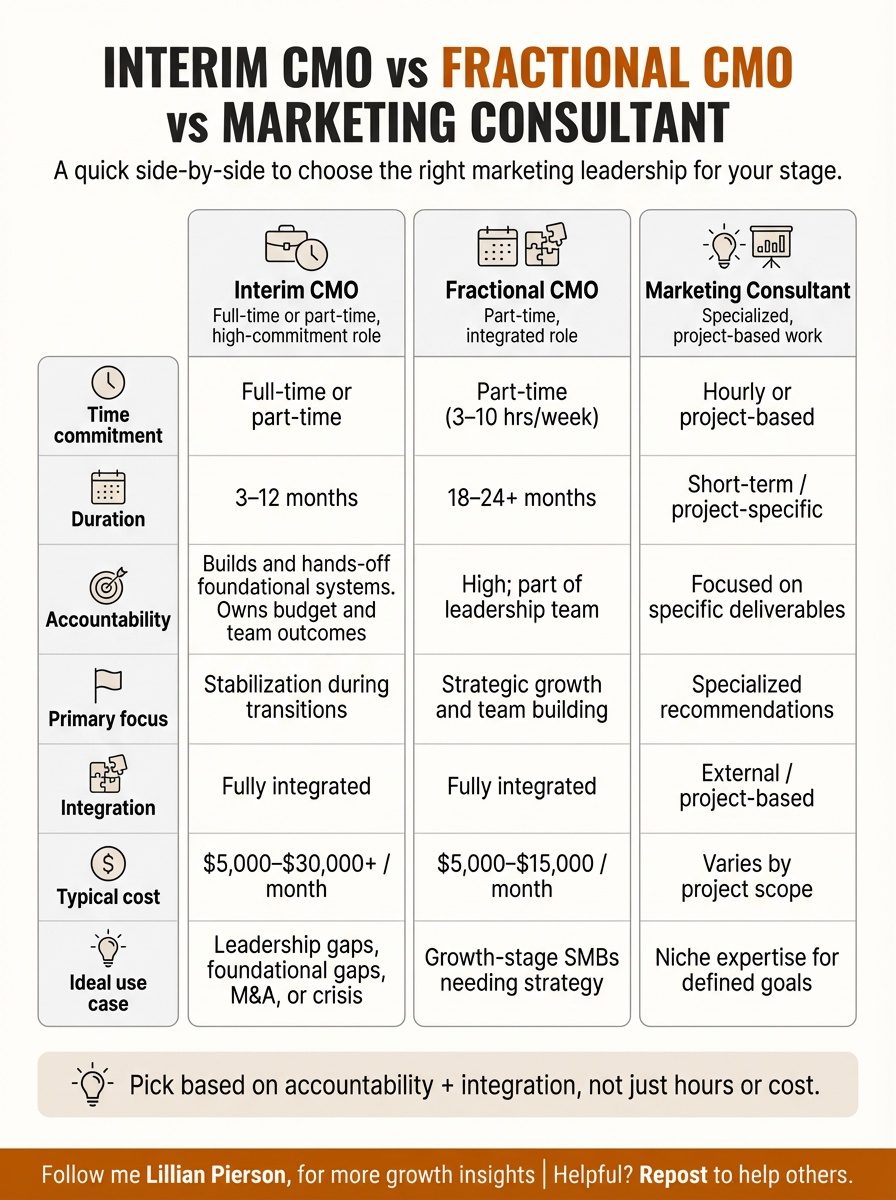 Interim CMO vs Fractional CMO vs Marketing Consultant Comparison
When it comes to marketing leadership, terms like Interim CMO, Fractional CMO, Outsourced CMO, and Marketing Consultant often get tossed around. While they might sound similar, each represents a distinct approach with varying levels of commitment, accountability, and purpose. Understanding these differences is key to finding the right fit for your business.
Interim CMOs are time-boxed and may be full-time or part-time depending on scope and urgency (though many companies use interim for near full-time transition coverage). They bring C-level authority, report directly to the CEO, and manage the marketing budget and team. Their main role? Keeping operations steady, maintaining momentum, and retaining talent while you search for a permanent hire.
A Fractional CMO, on the other hand, works part-time – typically 3 to 10 hours per week – over a longer period, often 18 to 24 months or more. This model is ideal for companies that need senior marketing leadership but can’t justify the cost of a full-time executive. Fractional CMOs focus on building a strong marketing foundation, mentoring team members, and driving scalable growth initiatives. Sometimes, agencies refer to this model as an Outsourced CMO, which leans more toward execution rather than developing in-house capabilities.
The distinguishing point here is that ‘interim’ describes the timeframe. ‘fractional’ describes the time allocation. A leader can be interim and fractional if they’re part-time for a fixed period, and an interim CMO can be part-time or full-time, especially in early-stage “build + handoff” engagements.
Marketing Consultants are specialists brought in for specific projects. They don’t oversee budgets or manage teams but instead provide targeted advice, such as conducting SEO audits, refining brand strategies, or optimizing campaigns. They typically work on an hourly or project basis, making them a cost-effective choice for well-defined tasks.
Comparison Table
Here’s a quick breakdown of how these roles differ:
| Feature | Interim CMO | Fractional CMO | Marketing Consultant |
|---|---|---|---|
| Time Commitment | Full-time or part-time | Part-time (3–10 hrs/week) | Hourly or project-based |
| Duration | 3–12 months | 18–24+ months | Short-term/project-specific |
| Accountability | Owns budget and team outcomes | High; part of leadership team | Focused on specific deliverables |
| Primary Focus | Stabilization during transitions and ramp-ups | Strategic growth and team building | Specialized recommendations |
| Integration | Fully integrated | Fully integrated | External/project-based |
| Typical Cost | $5,000–$30,000+/month | $5,000–$15,000/month | Varies by project scope |
| Ideal Use Case | Leadership gaps, M&A, or crisis | Growth-stage SMBs needing strategy | Niche expertise for defined goals |
“An interim CMO’s primary driver is to reduce risk and avoid loss of talent, productivity, focus, budget, and team confidence.” – Jennifer Zick, Founder and CEO, Authentic
Choosing the Right Model for Your Business
If you’re dealing with an unexpected leadership gap – like a sudden resignation, termination, or leave of absence – an Interim CMO is your best bet. They step in at full capacity to stabilize operations, retain talent, and ensure key initiatives stay on track. They’re also invaluable during mergers, acquisitions, or business turnarounds.
For small-to-mid-sized companies, especially those with annual revenues between $2M and $10M, a Fractional CMO can be a game-changer. If your company has never had a dedicated CMO or if the CEO is juggling marketing strategy alongside other responsibilities, this model offers a cost-effective alternative. Fractional CMOs can save businesses 30% to 50% compared to hiring a full-time executive, whose salaries typically range from $175,000 to $247,350 [2].
If your marketing team is already in place but you need specialized expertise for a one-time project – like a brand audit, SEO strategy, or campaign development – a Marketing Consultant is the way to go. They bring a focused skill set to solve specific challenges without long-term commitments.
Ultimately, the right choice depends on your current challenges and goals. Whether you need stability, strategic leadership, or niche expertise, aligning the model with your needs will ensure the best results.
sbb-itb-e8c8399
What to Expect from an Interim CMO: 30/60/90 Day Plan
This 30/60/90 plan works whether your interim CMO engagement is deliverables-based or acting-leader coverage… the difference is simply whether outputs are locked up front or refined as priorities emerge. For early-stage teams, the 30/60/90 is often foundation → launch → handoff, not just “run the existing machine. An interim CMO steps in to stabilize operations, deliver measurable results, and set the stage for a smooth transition – all within a tight three-month window. This 30/60/90 day plan breaks down the essential milestones they should hit during their tenure.
In the first 30 days, the focus is on diagnostics and stabilization. Known as the “Listen & Learn” phase, this period involves a thorough audit of the marketing tech stack, current campaigns, and team structure to pinpoint gaps and uncover quick wins. The interim CMO will also conduct interviews with key stakeholders, such as the CEO and other executives, to understand internal dynamics and build trust across the organization.
Between days 31 and 60, the emphasis shifts to strategy execution. During this “Align & Strategize” phase, the interim CMO refines KPI dashboards, aligns the team with new priorities, and begins executing high-priority strategic initiatives. This is where tangible results start to emerge – whether it’s improved campaign performance, better alignment between marketing and sales, or a stronger narrative for marketing’s role in the company.
The final 30 days are all about transition planning. In the “Execute & Embed” phase, the interim CMO ensures the marketing function is sustainable beyond their tenure. This includes documenting the marketing roadmap, defining the requirements for a permanent hire, and crafting an onboarding plan for the incoming CMO.
“An interim CMO’s primary driver is to reduce risk and avoid loss of talent, productivity, focus, budget, and team confidence.” – Authentic Brand
30/60/90 Day Deliverables
Here’s a breakdown of the key deliverables for each phase:
| Phase | Focus | Key Deliverables |
|---|---|---|
| Day 30: Audit & Stabilization | Diagnostics | Marketing audit report, stakeholder influence map, team competency assessment, identification of quick wins |
| Day 60: Strategy Implementation | Execution | Updated marketing roadmap, KPI dashboard setup, alignment of marketing and sales goals, execution of immediate campaigns |
| Day 90: Transition & Handoff | Transition | Permanent CMO job description, onboarding plan for successor, long-term strategic roadmap, final performance report |
Customizable 30/60/90 Day Plan Template
Days 1-30: Audit & Stabilization
- Conduct a full audit of marketing tech, budgets, and campaigns.
- Interview key stakeholders, including the CEO, sales leadership, finance, and product teams.
- Assess team capabilities to identify skill gaps or silos.
- Develop a stakeholder influence map to clarify internal dynamics.
- Pinpoint 3–5 quick wins that can deliver immediate ROI.
- Present an audit report with prioritized recommendations.
Days 31-60: Strategy & Alignment
- Establish and implement KPI tracking for metrics like CAC, ROI, conversion rates, and pipeline velocity.
- Align marketing and sales goals with revenue targets.
- Optimize the use of marketing automation tools and the tech stack.
- Launch or relaunch high-priority campaigns based on audit findings.
- Facilitate team alignment sessions to secure buy-in for new priorities.
- Restructure team roles or initiate recruitment for key positions if necessary.
Days 61-90: Execution & Transition
- Track campaign performance and make adjustments based on data insights.
- Document key processes, vendor relationships, strategic decisions, and performance outcomes.
- Develop a detailed job description and candidate profile for the permanent CMO role.
- Create an onboarding plan to ensure a smooth transition for the successor.
- Deliver a comprehensive long-term marketing roadmap with clear next steps.
How Much an Interim CMO Costs
Cost Ranges and Pricing Factors
Hiring an interim CMO typically costs between $5,000 and $30,000 or more per month, translating to $200–$500 per hour or $1,000–$3,000 per day. The exact rate depends on factors like experience, industry focus, urgency, and the scope of their responsibilities.
Experience plays a major role in pricing. Junior-level professionals might charge around $100 per hour, while mid-level executives start at $160 per hour, and seasoned leaders go for $200 or more per hour. Certain industries – like B2B tech, healthcare, or AI – demand higher rates due to their technical challenges and regulatory complexities.
Timing and project length also influence costs. Short-notice or high-pressure assignments are generally more expensive than longer, fractional engagements. Additionally, the scope of the role matters: hands-on leadership that involves managing teams and overseeing execution will cost more than purely offering strategic advice.
It’s important to note that these fees cover strategic leadership and team management. External expenses – such as advertising, content production, tools, or public relations – are not included and should be factored into your overall budget. Planning for these costs ensures smoother execution of the tactical strategies discussed later.
Getting the Most Value from Your Interim CMO
While cost is a key consideration, ensuring you get the most out of your interim CMO is just as critical.
Start by setting clear OKRs (Objectives and Key Results) within the first 10 days. Focus on metrics like Customer Acquisition Cost (CAC), Lifetime Value (LTV), and Return on Investment (ROI) to establish accountability from the beginning.
Conduct a quick marketing audit early on to identify immediate opportunities for improvement. Schedule regular check-ins – either weekly or bi-weekly – to review performance, adjust strategies, and address any team-related issues. Tackling internal challenges upfront, especially those tied to team dynamics, can prevent disruptions later when transitioning to a permanent CMO.
Speaking of transitions, plan for the handoff from day one. Organize recruitment, interviews, and onboarding for the permanent CMO early in the process. This ensures the marketing department stays on track and the new leader steps into a well-organized system, rather than having to build everything from scratch.
How to Evaluate and Hire the Right Interim CMO
Choosing the right interim CMO requires more than just a glance at resumes. You need someone who can step in confidently during a transitional period, deliver results from day one, and ensure a seamless handoff when the time comes. The stakes are high – companies with a focused growth leader on their team experience up to 2.3x more growth compared to those with fragmented leadership [7].
Candidate Evaluation Scorecard
To make an informed decision, use a scorecard to evaluate candidates based on the following criteria:
| Criteria | What to Assess | Weight |
|---|---|---|
| Transition Leadership | Proven track record of managing leadership gaps, mergers, or rapid scaling | High |
| Strategic-Execution Balance | Ability to set a clear vision while executing hands-on immediately | High |
| Data & KPI Proficiency | Expertise in tracking metrics like CAC, LTV, CPL, and Marketing ROI | High |
| Sector-Specific Expertise | In-depth knowledge of your industry (e.g., SaaS, AI, healthcare) | Medium |
| AI Literacy | Practical understanding of AI tools for improving efficiency and personalization | Medium |
| Team Stabilization | Skills in resolving team conflicts, boosting morale, and building trust quickly | High |
| Stakeholder Communication | Experience collaborating with CEOs, boards, and investors | Medium |
| Handoff Planning | Ability to recruit, onboard, or mentor a permanent replacement | High |
Focus on candidates who can perform a thorough marketing audit within their first 10–30 days. This helps uncover quick wins while eliminating ineffective strategies. Additionally, confirm their hands-on expertise with tools like CRMs, analytics platforms, and marketing automation software – not just theoretical knowledge.
To dig deeper, ask targeted interview questions that reveal their ability to deliver results and stabilize your team.
10 Interview Questions to Ask
Here are ten key questions to help you assess whether a candidate is the right fit:
- How do you prioritize marketing efforts during your first 30 days?
- Can you share an example of stabilizing a marketing team during a leadership transition?
- How do you connect marketing KPIs directly to revenue and sales goals?
- What’s your approach to identifying and eliminating “random acts of marketing” that don’t align with strategy?
- Which marketing technology stacks have you implemented to enable data-driven decisions?
- Can you describe a time when you used analytics to challenge a marketing hypothesis and pivot a campaign?
- How do you handle reporting to boards or investors during transitional periods?
- What’s your strategy for handing over knowledge to a permanent employee after your tenure ends?
- How do you lead and unify remote or siloed teams to follow a single strategic direction?
- How do you balance achieving quick wins with building a long-term brand strategy?
Pay attention to whether the candidate asks insightful questions about your business goals, team setup, and current challenges. This shows they’re genuinely engaged and thinking about how they can make an impact.
Red Flags to Watch For
Even with a solid evaluation process, it’s important to stay alert to warning signs that a candidate might not be the right fit. Here are some red flags to keep in mind:
- Avoidance of data-driven decisions: Candidates who rely solely on intuition without a strong grasp of analytics and KPIs may struggle to deliver measurable outcomes.
- Overemphasis on strategy: Those who focus only on high-level planning but shy away from hands-on execution or managing lean teams can create gaps in execution.
- Lack of transition experience: Candidates who haven’t navigated leadership gaps, mergers, or rapid scaling may falter under pressure.
- Neglecting handoff planning: Failing to prioritize a smooth transition or document processes for the next leader creates risks for continuity.
- One-dimensional view of marketing: Candidates who see marketing purely as a creative function and overlook team dynamics or operational realities are unlikely to succeed.
Conclusion
Bringing in an interim CMO isn’t just about plugging a temporary hole in leadership – it’s about keeping your momentum alive when every moment counts. Whether you’re dealing with an unexpected leadership departure, navigating the complexities of a merger, or ramping up after a major funding round, an interim CMO provides the strategic direction and hands-on execution needed to stay on track. As discussed earlier, cohesive, growth-oriented leadership can lead to impressive performance gains, underscoring why experienced interim CMOs are so valuable.
What sets them apart is their ability to deliver results quickly. Using a structured 30/60/90 day plan, they hit the ground running. The first month focuses on a deep-dive audit, the second delivers quick wins, and by the third, they’re showing measurable ROI while ensuring a seamless transition for the next leader. Instead of just weathering a leadership gap, you can turn this phase into a chance to elevate your marketing operations and prepare for long-term success.
These insights should guide your decision-making process when selecting an interim CMO. Building on the evaluation framework mentioned earlier, focus on candidates who balance strategic vision with hands-on execution. Prioritize those with a proven track record in transitional leadership, strong data skills, and a clear plan for transferring knowledge. Be cautious of red flags like resistance to data-driven approaches or overlooking team dynamics – these could lead to costly setbacks.
An interim CMO is an investment in stability and growth during pivotal moments. With the right person and a solid 30/60/90 day roadmap, you can stabilize your team, drive progress, and set the stage for long-term success – turning what might feel like a challenge into an opportunity to strengthen your marketing function while finding your next permanent leader.
FAQs
What’s the difference between an Interim CMO and a Fractional CMO?
An Interim CMO is a full-time or part-time executive brought in temporarily to address a leadership gap, often during a CMO’s transition or departure. They dedicate their efforts exclusively to one organization, focusing on steadying the marketing department and achieving quick results until a permanent replacement is found. Their tenure typically spans 3 to 9 months.
In contrast, a Fractional CMO works part-time, offering strategic marketing expertise to multiple companies. They commit a specific number of hours or days each month, providing senior-level guidance without the expense of a full-time executive. This option suits businesses looking for ongoing strategic support without the need for daily operational involvement.
Key distinctions:
- Interim CMO: Full-time or part-time, short-term fixed periods (3–9 months), hands-on with operations.
- Fractional CMO: Part-time, serves multiple clients, long-term, focused on strategy.
What role does an interim CMO play during a leadership transition?
An interim CMO plays a crucial role in guiding marketing efforts during a leadership transition, ensuring the company stays on course. They help keep the brand’s strategy intact, stabilize messaging, and ensure campaigns and lead generation efforts remain uninterrupted, so the business continues to meet its goals.
Beyond managing daily operations, an interim CMO often brings a fresh perspective, uncovering opportunities to refine strategies and improve the marketing team’s structure and effectiveness. By aligning marketing initiatives with the company’s objectives and mentoring the team, they set the stage for a smooth transition, making it easier for the next functional leader to step into their role seamlessly.
What should you consider when determining the cost of hiring an Interim CMO?
When evaluating the cost of bringing on an interim CMO, several factors come into play. Start by looking at their level of expertise, the specific tasks they’ll handle, the length of their engagement, and the pricing model – whether it’s hourly, a retainer, or a daily rate. It’s also important to understand the depth of their involvement. Will they be providing hands-on leadership or focusing solely on strategic direction?
The cost can fluctuate greatly depending on your organization’s needs, its size, and the demand for seasoned CMOs in the market. To make the most of your budget, ensure that your expectations align with what you’re willing to spend, so you’re confident in the value you’re receiving.
Can an interim CMO be part-time?
Yes. Interim refers to a fixed period, and the commitment can be part-time or full-time depending on urgency and scope.
Is an interim CMO always deliverables-based?
Not always. Some engagements are scoped around predetermined deliverables; others are fixed-term leadership coverage where priorities evolve as the business learns.