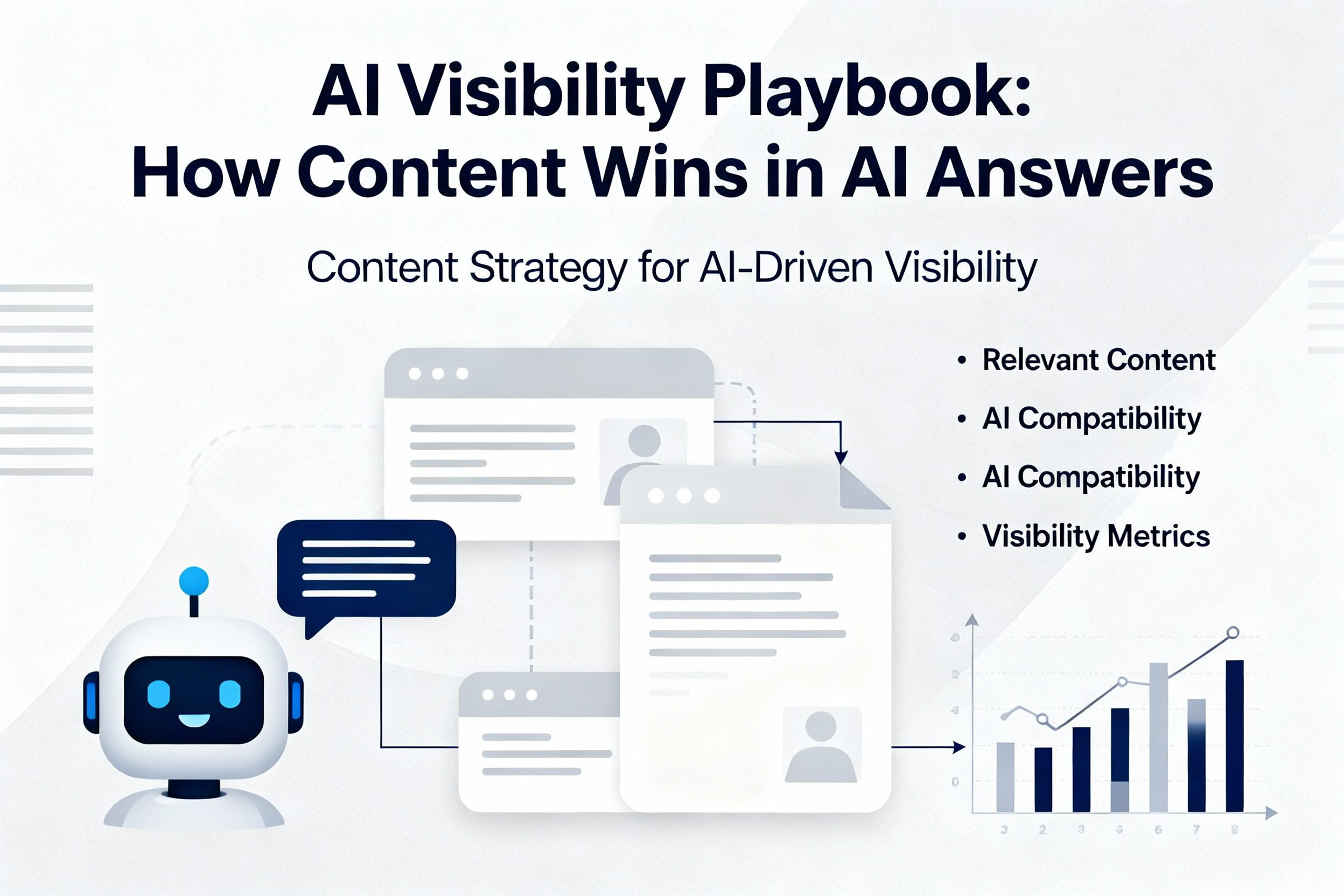

Marketers don’t just compete for blue links anymore; they compete for answers. That’s why everyone is looking into how to show up in AI answers. In 2026, high-intent buyers increasingly start (and end) their journey inside AI answers across ChatGPT, Perplexity, Gemini, and AI Overviews. That shift rewrites the rules of discoverability. Traditional SEO still matters, but AI visibility, which is essentially showing up as a cited or summarized source in these answers, depends on how clearly your content expresses user intent, how easy it is for large models to parse, and whether it’s verifiable and fresh.
This piece builds on Data-Mania’s 5 Steps to Optimize for AI Search and focuses on what actually drives AI search ranking in practice and how to operationalize it with Bear’s Blog Agent so teams can scale visibility without adding headcount.
How to show up in AI answers today?
You don’t need an extremely technical schema. You need content that makes it easy for answer engines to trust and reuse your work:
- Intent clarity over keyword stuffing. Titles and H2s that mirror real questions (“what is…,” “how to…,” “best…for…”) map directly to the way users prompt and the way models retrieve.
- Readable structure. Clear hierarchy (H2/H3), short paragraphs, direct definitions, and “TL;DR” sections help models extract and cite.
- Verifiability. Outbound citations to credible, primary sources and consistent entity signals (brand, product, author) increase confidence.
- Freshness. Recency matters. Content updated on a predictable cadence is more likely to be re-ingested and recited.
- Topical cohesion. Internal links that cluster related posts reinforce authority for specific themes.
This isn’t new magic; it’s disciplined editorial craft, expressed in a way that LLMs can understand at a glance.
From large-scale data: what the numbers say
From Bear’s corpus of 20M+ prompt/response pairs and 80M+ analyzed citations across leading answer engines, several patterns emerge:
- Question-led structure correlates with higher citations. Pages that use question-oriented H2/H3s (“How does pricing work?” “What’s the difference between X and Y?”) are cited more often than comparable pages organized around broad marketing claims.
- Verifiable sources win. Posts that link to primary research (datasets, peer-reviewed studies, official docs) outperform those relying on generic secondary roundups, especially for non-branded queries.
- Freshness boosts inclusion. Recency signals (particularly clearly labeled updates within the last ~90 days) correlate with higher inclusion in AI answers for competitive topics.
- Concise summaries get reused. When a post offers a crisp definition or numbered list, models frequently lift or paraphrase that segment, making your page the source of record. As a rule of thumb. LLMs strongly prefer the beginning and end of articles.
These are directional relationships, not guarantees. But, they’re consistent enough at scale to inform an editorial operating system for Generative Engine Optimization (GEO) and Answer Engine Optimization (AEO). And, they’re the ultimate answer to how to show up in AI answers.
How Bear’s Blog Agent turns best practices into repeatable workflows
Most content teams already know the right moves – but they still aren’t exactly sure about how to show up in AI answers; also, the gap is execution at scale. Bear’s Blog Agent closes that gap by transforming your strategy into a managed, end-to-end workflow:
Inputs: The agent ingests your existing blog posts, knowledge base, and a short content questionnaire so it actually understands your product, audience, pain points, and proof points.
Intelligence:
- Maps user intents to question-led outlines that align with how people prompt, and how models fetch.
- Surfaces high-value internal links to strengthen topical clusters (and fix orphaned pages).
- Pulls credible external studies and sources to underpin claims with verifiable evidence.
- Benchmarks successful competitor posts to identify structural and topical gaps, without entirely copying.
- Drafts editor-ready copy that’s SEO-aligned and AI-readable: clear headings, concise summaries, and embedded FAQs.
- Packages essential on-page elements (FAQ block, table of contents, meta details, and JSON-LD for common patterns like FAQ/HowTo/Article) so your page ships ready for AI answers, with no dev lift required.
Outputs: Editors receive a polished draft with link recommendations, E-E-A-T signals (author expertise, references), and refresh prompts for ongoing recency. Coming soon: direct CMS integration for one-click publish and scheduled refresh.
Proof of work: A B2B SaaS client used Blog Agent to refactor a set of legacy posts. In six weeks, they went from zero AI citations to frequent mentions on 25+ non-branded prompts, with measurable gains in AI Visibility and qualified lead volume attributed to answer-engine traffic.
What should marketers do this quarter?
If you’re executing manually, here’s a pragmatic checklist:
- Pick 5–10 cornerstone pages that align with real buyer questions; rewrite H2/H3s to mirror those questions.
- Add user-intent FAQs (3–5 per post) and create keyword-rich answers, to increase the likelihood of LLMs citing those snippets.
- Provide a crisp summary and a definition box or numbered steps for easy reuse in AI answers.
- Establish a 90-day refresh cadence for competitive topics; visibly update the timestamp and context.
- Track two simple metrics: AI citation rate (how often you’re referenced across engines) and visibility % (share of prompts where you appear).
Prefer not to do this by hand? Bear’s Blog Agent automates the heavy lifting, turning the list above into an always-on editorial system for AI Search Ranking. It writes with intent clarity, bakes in verifiability, and ships a structure that models can parse instantly. Then it keeps pages fresh. In short: you get scalable GEO/AEO without adding headcount.
Book a demo of Bear’s platform
The next era: GEO/AEO becomes your editorial operating system
The winning teams won’t treat visibility in AI as a one-off project. They’ll treat it as an editorial OS:
- Briefs start with intent clarity (what exact questions we must answer) then move to messaging.
- Content ships structured and verifiable by default, not retrofitted later.
- Continuous optimization replaces “publish and forget.” Pages evolve alongside the questions customers ask and the evidence the market produces.
- Agents move inside the CMS, monitoring freshness, surfacing gaps, and updating content before rankings slip.
When that happens, “AI Visibility” stops being a buzzword. It becomes compounding distribution: your best ideas get discovered and reused precisely when buyers are asking for them.
FAQs
How to show up in AI answers?
AI visibility is a measure for how frequently your content is used, cited, or summarized in AI answers (e.g., ChatGPT, Perplexity, AI Overviews). We track it via AI citation rate and visibility % across a fixed set of non-branded prompts.
Does JSON-LD actually help?
Yes. Paired with clear, question-led structure and credible sources, JSON-LD (e.g., FAQ/HowTo/Article) improves how parsers and models understand your page, which correlates with inclusion.
How often should we refresh content?
For competitive topics, aim for meaningful updates as frequently as possible. Recency correlates with improved inclusion in AI answers.
What does Bear’s Blog Agent do differently?
It operationalizes GEO/AEO: ingesting your context, producing intent-aligned drafts with verifiability baked in, packaging on-page elements for AI readability, and maintaining freshness (soon directly in your CMS).