
I’ll be honest: when I first heard “GTM Engineer,” I rolled my eyes so hard I nearly strained something. “GTM Engineering,” I thought, “give me a break.”
It sounded like yet another attempt by marketers to rebrand themselves with a sexier title. You know the type: “growth hacker,” “revenue architect,” “demand generation ninja.” Just marketing people trying to sound technical without actually building anything.
So I ignored it. For months.
Then yesterday, I was researching outbound training. I can’t even remember why the term popped back into my head, but something made me search “GTM engineer” instead of just looking for sales playbooks.
Here’s what I found:
- Over 4,000 monthly searches for the term (so clearly not just me wondering)
- Nearly 90 active job postings on LinkedIn as of this week, most of them in San Francisco, most of them at well-funded startups
- Job descriptions asking for things like “AI automation platforms,” “workflow integrations,” “data-driven experimentation,” and “building repeatable playbooks”
I stared at my screen for a solid minute.
Then I did something I rarely do: I asked ChatGPT (which has memory of all the work I’ve done with clients) a simple question:
“Am I a GTM engineer?”
Its response: “Yes. You’ve been doing GTM engineering for years. You just didn’t call it that.”
Holy cow.
Turns out, I’m not just a licensed Professional Engineer of the environmental variety. I’m also, apparently, a GTM engineer. And if I didn’t know this role existed, I’m betting a lot of you don’t either.
So here’s what I learned, why it matters, and how to know if you actually need one on your team.
WTF is GTM Engineering? (And Why I Thought It Was Fake)
Let’s start with why I was skeptical.
The term sounds like marketing jargon. “GTM” (go-to-market) is already overused. Add “engineer” to it, and it feels like someone trying to make growth hacking sound more legitimate by borrowing credibility from actual engineering.
But here’s the thing: it’s not marketing. It’s actually engineering for revenue systems.
A GTM engineer doesn’t run ad campaigns or write blog posts (though they might build systems that do those things). They architect, test, and optimize the infrastructure that turns prospects into customers. Think of it like this:
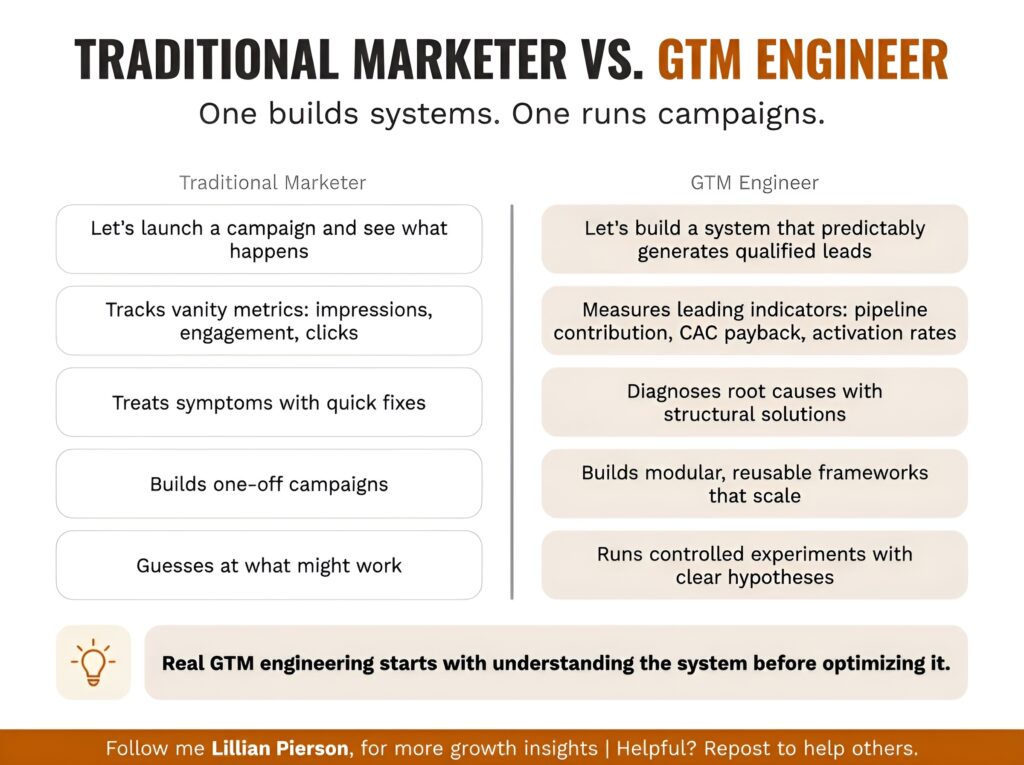
- Traditional marketing says: “Let’s launch a campaign and see what happens.”
- GTM engineering says: “Let’s build a system that predictably generates qualified leads, measure every stage, identify bottlenecks, and optimize for repeatability.”
It’s the difference between throwing spaghetti at the wall and running controlled experiments with clear hypotheses, instrumentation, and iteration loops.
Here’s what actually convinced me this is real:
I looked at the job postings. Not the titles, but the actual requirements. Here’s what companies are hiring for:
From a Senior AI GTM Engineer role at Calendly:
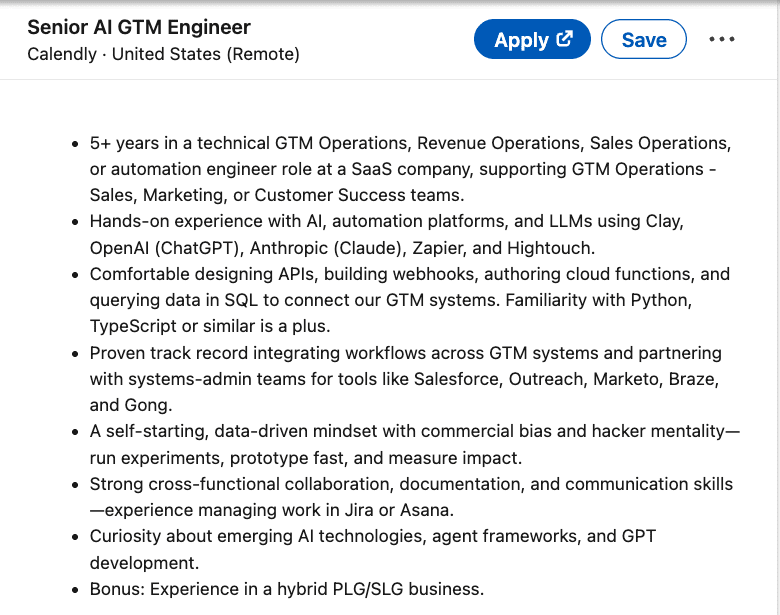
- “Hands-on experience with AI, automation platforms, and LLMs using Clay, OpenAI (ChatGPT), Anthropic (Claude), Zapier, and Hightouch”
- “Comfortable designing APIs, building webhooks, authoring cloud functions, and querying data in SQL”
- “Proven track record integrating workflows across GTM systems and partnering with systems-admin teams for tools like Salesforce, Outreach, Marketo, Braze, and Gong”
- “A self-starting, data-driven mindset with commercial bias and hacker mentality: run experiments, prototype fast, and measure impact”
From a GTM Engineer role at Beacon Software:
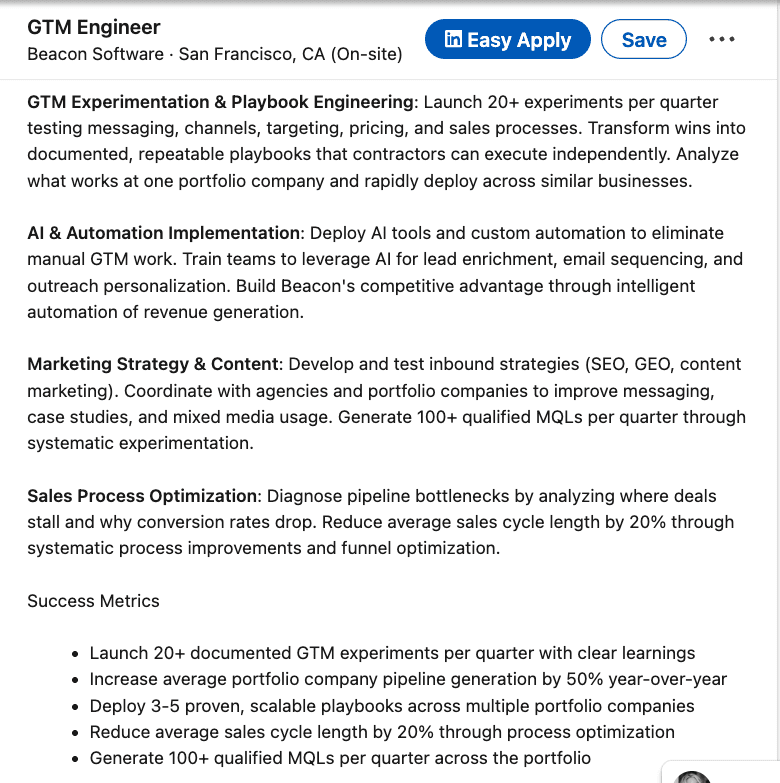
- “Launch 20+ experiments per quarter testing messaging, channels, targeting, pricing, and sales processes”
- “Deploy AI tools and custom automation to eliminate manual GTM work”
- “Diagnose pipeline bottlenecks by analyzing where deals stall and why conversion rates drop”
- “Reduce average sales cycle length by 20% through systematic process improvements and funnel optimization”
These aren’t marketing jobs. These are systems engineering jobs for revenue operations.
And suddenly, I realized: this is exactly what I’ve been doing for clients. I just called it “fractional CMO work” or “growth strategy.”
How I’ve Been a GTM Engineer Without Knowing It
Let me show you what I mean with two recent projects.
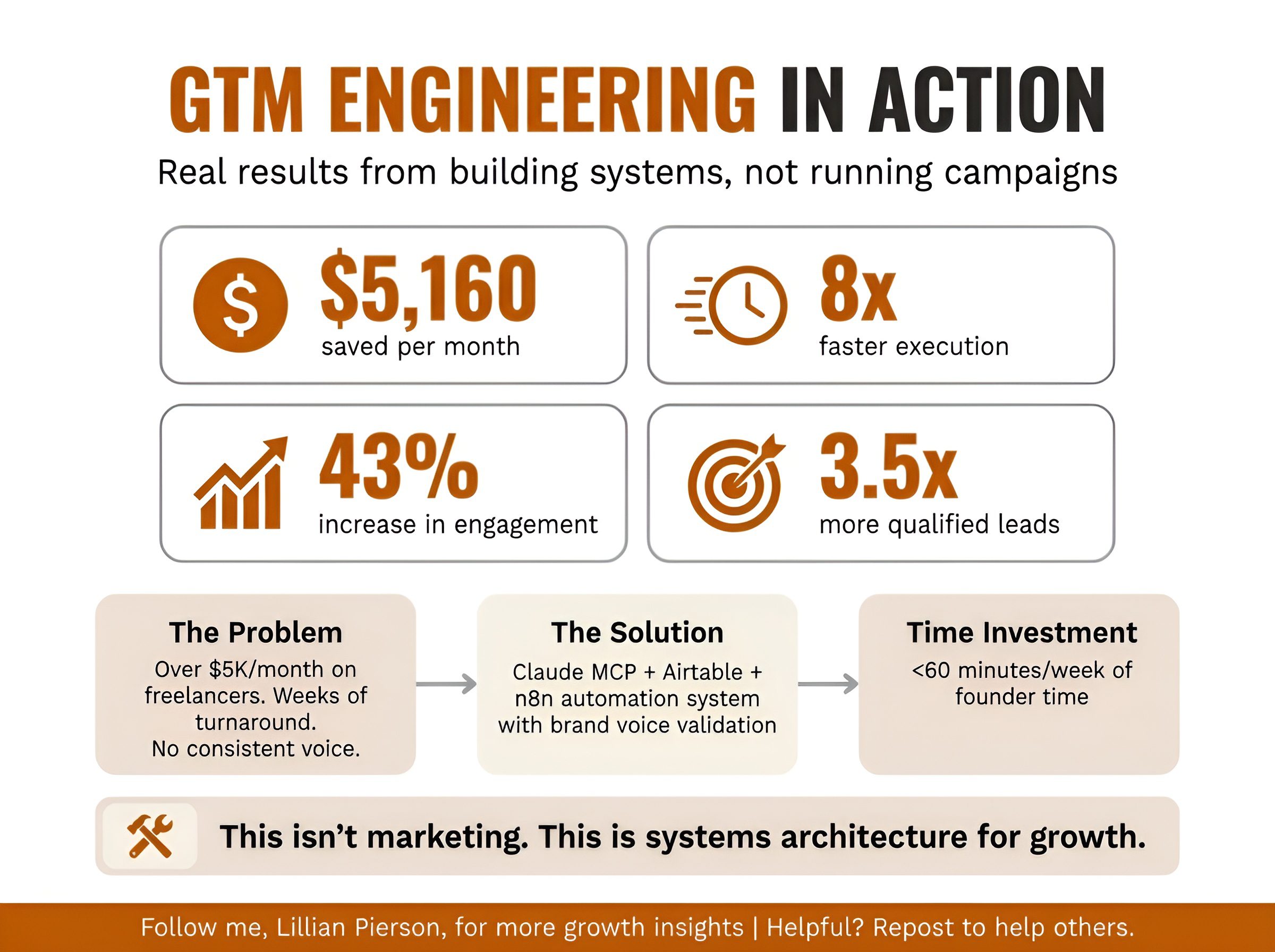
Case Study 1: AI Consulting Startup – $5,160/Month Saved, 8x Faster Execution
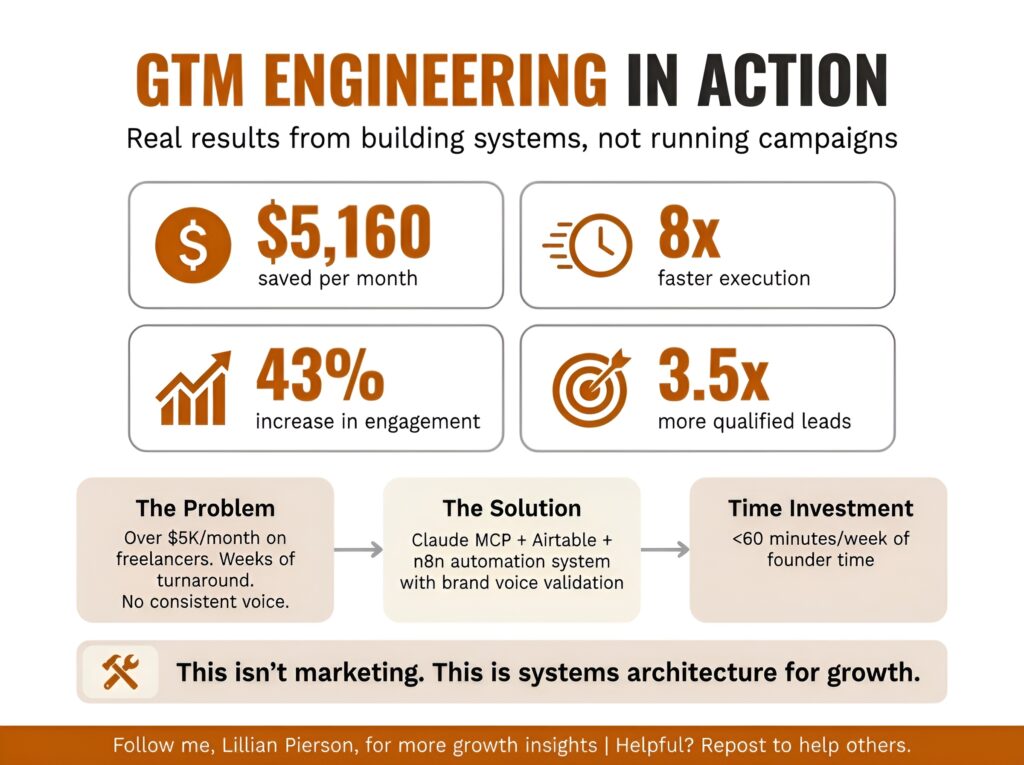 A fast-growing AI consulting startup was spending over $5K/month on freelancers to create content. The founder would record a video or send bullet points, then wait days (sometimes weeks) for polished LinkedIn posts, emails, and short-form video scripts to come back.
The bottleneck: Manual handoffs. No consistent voice. Slow turnaround. Expensive execution.
My GTM engineering approach:
I built a custom Claude MCP agent integrated with Airtable that auto-generates multi-channel content from founder-recorded videos or bullet docs. The system pulls brand voice guidelines, case studies, and positioning frameworks from a structured database (Airtable), runs them through Claude with custom prompts, and outputs LinkedIn posts, email sequences, and video scripts. All in the founder’s voice.
I connected it with n8n for workflow automation so the system runs without the founder touching it.
Results:
- $5,160/month saved in freelancer costs
- 8x faster content development (hours instead of weeks)
- 43% increase in engagement (better quality and consistency)
- 3.5x more qualified leads from organic content
- Less than 60 minutes/week of founder time required
This isn’t marketing. This is systems architecture for growth. I diagnosed the bottleneck (manual execution), designed a modular solution (Claude MCP + Airtable + n8n), instrumented it with quality checks, and optimized for repeatability.
That’s GTM engineering.
Case Study 2: Groe Solutions – First Inbound Leads in 60 Days
Groe Solutions is a B2B tech startup in the health and fitness analytics space. When they came to me, they had zero inbound interest. Their market was tough, their messaging was vague, and they were stuck in founder-led outbound mode.
The bottleneck: No clear positioning. No defined ICP. Content that didn’t resonate.
My GTM engineering approach:
I didn’t start by “doing more marketing.” I diagnosed the root cause: their messaging didn’t differentiate them, and they hadn’t validated who most cared about their product.
So I rebuilt the foundation:
- Defined their ICP through team conversations
- Clarified their unique value proposition with positioning that actually mattered to buyers
- Built an AI-driven content generation framework that, when executed, systematically delivered strong, clear messaging across channels
Results:
- First inbound leads within 60 days
- Measurable increase in prospect engagement
- Increased brand awareness in a previously low-inbound niche
Again: this isn’t “content marketing.” This is diagnostic analysis, constraint optimization, and systematic execution. I treated their GTM like an engineering problem: identify the failure mode (weak positioning), fix the root cause, build a repeatable system, and measure outcomes.
That’s GTM engineering.
What Real Engineers Bring That Marketers Don’t
Here’s the thing most people calling themselves “GTM engineers” get wrong: they’re not actually engineers.
They’re growth marketers borrowing engineering language. And there’s a huge difference.
1. Engineers Design for Failure Modes
Real engineers don’t just build systems for ideal conditions. We ask: What breaks when volume 10x’s? What happens when this input is missing? Where are the single points of failure?
When I built that Claude MCP content automation, I didn’t just auto-generate and pray. I embedded:
- Brand voice validation checks (does this sound like the founder?)
- Context verification (does the system have the right case study to reference?)
- Human approval gates (flag outputs that need review before publishing)
If the system can’t find the right context, it flags the gap instead of publishing garbage.
Most “GTM engineers” would just automate and hope it works. Real engineers build in fail-safes.
2. Engineers Do Root Cause Analysis
Marketers treat symptoms. Engineers diagnose structural problems.
When Groe Solutions wasn’t getting inbound leads, most consultants would’ve said: “Post more on LinkedIn! Run some ads!”
I didn’t touch a single marketing channel. I fixed the root cause: unclear positioning and an undefined ICP. The market wasn’t the problem. The messaging was.
That’s engineering thinking: identify the constraint, fix it at the source, then optimize execution.
3. Engineers Build Modular, Reusable Systems
Marketers build one-off campaigns. Engineers build frameworks that scale.
I don’t create custom solutions for every client. I’ve developed modular playbooks: my ACT Method (Anchor, Construct, Test), my Demand Engine framework, my PLG validation systems. I’ve tested them across dozens of clients.
When a new startup hires me, I’m not starting from scratch. I’m adapting proven systems to their specific context.
That’s the difference between engineering and guessing.
4. Engineers Understand Constraints & Trade-Offs
Every engineering problem involves trade-offs: speed vs. cost, precision vs. scalability, risk vs. reward.
Most “GTM engineers” promise growth without understanding resource constraints. They’ll recommend hiring a full team when a startup can’t afford it, or tactics that require 40 hours/week when the founder is maxed out.
I offer tiered fractional packages ($2K, $5K, $10K/month) precisely because I understand startup constraints. A bootstrapped founder at $0 ARR needs different support than a Series A company at $2M ARR.
Real engineers design for the environment they’re operating in. Not some theoretical ideal state.
5. Engineers Measure What Matters
Marketers track vanity metrics: impressions, engagement, clicks.
Engineers measure leading indicators tied to revenue: pipeline contribution, CAC payback period, activation rates, LTV.
When I ran a campaign for Ericsson that generated 1.2M+ impressions, I didn’t stop at awareness metrics. I tracked all the way to 850+ MQLs and attributed website visitors from specific content pieces.
Real GTM engineering connects top-of-funnel activity to bottom-line revenue.
The Parallel Between Environmental Engineering and GTM Engineering
Here’s what really clicked for me: GTM engineering uses the exact same principles I learned in environmental engineering.
Systems Thinking & Optimization
In environmental engineering, you can’t just fix one pollution source and call it done. You have to understand the entire watershed: how inputs flow through the system and where interventions have maximum impact without creating unintended consequences. And you’re always working within constraints: budget, regulations, existing infrastructure, environmental impact limits.
GTM works the same way. You can’t just “fix the funnel” or “improve SEO” in isolation. I look at the entire customer journey: how positioning affects conversion, how content feeds pipeline, how product experience impacts retention. Everything is interconnected.
And startups have even tighter constraints than environmental projects: limited budget, small team, competitive markets, founders wearing too many hats. My job is to architect the leanest, highest-impact growth engine possible. That’s why I helped an anonymous data consultant land a $750K performance-based contract by repositioning him strategically. Not throwing money at paid ads.
Maximum traction with minimum waste.
Measurement & Iteration
In environmental engineering, you monitor water quality, flow rates, treatment efficiency. Then adjust processes based on real-time data.
I take the same approach with GTM. Every playbook I deploy has built-in KPIs and feedback loops. When validation tests don’t hit benchmarks, we don’t just “try harder.” We analyze what failed, adjust targeting and messaging, and run iterative experiments.
A system that isn’t measured can’t be improved.
Long-Term Sustainability Over Short-Term Fixes
Environmental engineers don’t chase quick fixes. We design for decades, treating root causes instead of symptoms.
Same with GTM. I don’t burn budgets on unsustainable paid acquisition or chase viral hacks. I build repeatable, scalable systems that work whether I’m there or not.
That AI consulting startup didn’t just save $5,160/month. They built a content engine that keeps working, gets smarter over time, and freed the founder to focus on growth instead of execution.
Should You Hire a GTM Engineer? (The Framework)
Here’s how to know if you actually need one.
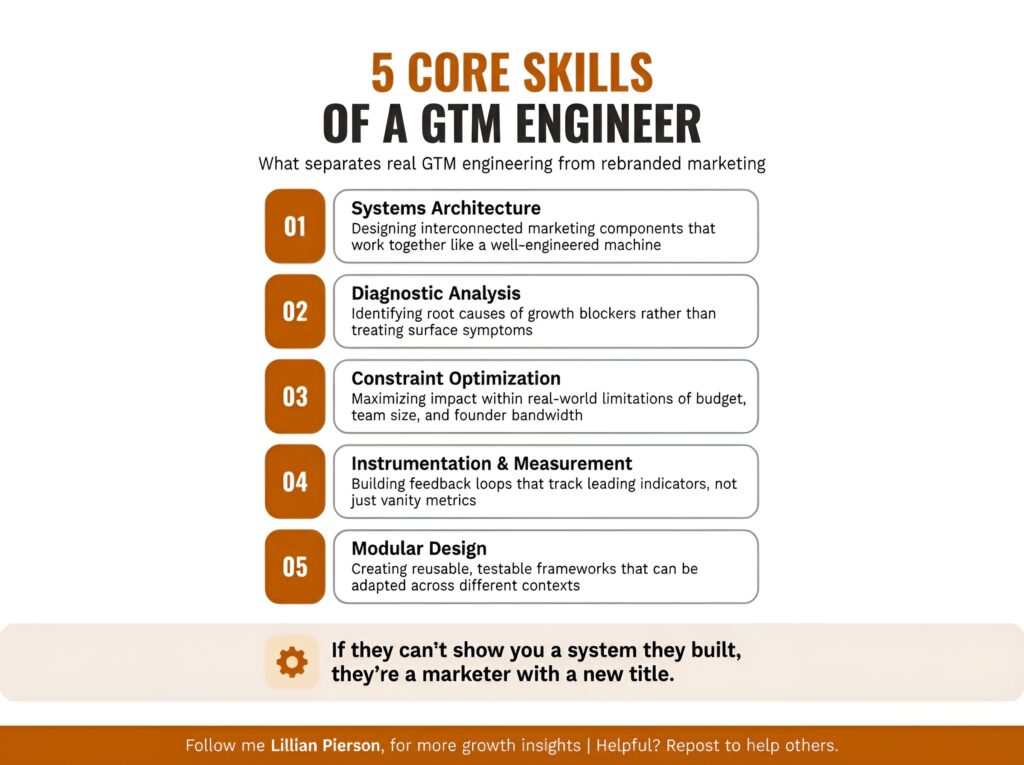
The 5 Core Skills of a Real GTM Engineer
- Systems Architecture – Designing interconnected marketing components that work together like a well-engineered machine, not isolated tactics
- Diagnostic Analysis – Identifying root causes of growth blockers rather than treating surface symptoms (like understanding whether your conversion problem is actually a positioning problem)
- Constraint Optimization – Maximizing impact within real-world limitations of budget, team size, and founder bandwidth
- Instrumentation & Measurement – Building feedback loops that track leading indicators (pipeline quality, activation rates), not just vanity metrics
- Modular Design – Creating reusable, testable frameworks that can be adapted across different contexts rather than rebuilding from scratch every time
📦 Steal This: The 3-Question GTM Engineer Vetting Framework
Before you hire anyone calling themselves a “GTM engineer,” ask:
- Can they show you a system they built (not a campaign they ran)?
- Can they diagnose your growth blocker in 15 minutes without immediately selling you a solution?
- Do they measure leading indicators (activation rate, time-to-value) or lagging ones (MRR, traffic)?
If they can’t answer all three convincingly, they’re a marketer with a new title.
What Tools Should You Learn First?
If you want to think like a GTM engineer before hiring one, master these four tools:
1. Claude or ChatGPT – AI-powered content and strategy work that replaces expensive agencies. Learn to write prompts that generate positioning frameworks, messaging variations, and customer research insights.
2. Airtable – Build structured context databases that feed your AI systems with brand voice, case studies, and positioning frameworks. This becomes your growth operating system.
3. n8n (or Zapier) – No-code workflow automation that connects your tools and eliminates manual handoffs. Start simple: automate lead enrichment or content distribution.
4. A simple analytics stack – Google Analytics + your CRM’s native reporting. Measure what actually drives pipeline, not what makes pretty dashboards.
The biggest mistake I see is founders buying a dozen tools before they understand which marketing motions actually convert. That AI consulting startup saved $5,160/month by building one well-architected system using just Claude MCP, Airtable, and n8n. Instead of paying freelancers to do it manually.
Green Flags: You Actually Need a GTM Engineer If…
✅ You have product-market fit but inconsistent revenue growth
✅ You’re overspending on paid acquisition with unclear ROI
✅ Your founder is stuck executing marketing instead of leading strategy
✅ You have data but can’t attribute what drives revenue
✅ You need someone who builds systems, not just runs campaigns
Red Flags: You Don’t Need a GTM Engineer If…
❌ You haven’t validated product-market fit yet (you need customer development first)
❌ You’re looking for someone to “just run ads” or “post on social” (hire a specialist)
❌ You want quick wins without investing in long-term infrastructure
❌ You expect one person to replace strategy, sales, and marketing execution
The ONE Thing You Can Do This Week to Think Like a GTM Engineer
Here’s your tactical next step:
Map your current customer acquisition process end-to-end.
Grab a whiteboard or open a doc. Draw every step from first touchpoint to closed deal. Include:
- How prospects discover you
- What happens when they engage
- Where they convert (or don’t)
- Where you personally get stuck
Then identify the single biggest bottleneck where leads stall, deals die, or you’re doing manual work that should be automated.
Most founders jump straight to tactics: “I need better ads!” “I need more content!” “I should be on TikTok!”
But real engineering starts with understanding the system before optimizing it.
When I start a client engagement, I don’t touch a single marketing channel until I’ve done ICP validation and messaging audits. That’s why Groe Solutions got their first inbound leads in 60 days. Not by “doing more marketing,” but by fixing their foundational messaging and ICP clarity first.
Strategic diagnosis beats tactical execution every single time.
What I’m Taking Away From All This
A week ago, I thought “GTM engineer” was a made-up title for marketers who wanted to sound technical.
Now I realize it’s a real discipline. And one I’ve been practicing for years without knowing it.
The engineering mindset I developed over 20+ years as a licensed P.E. is exactly what makes my growth work different. I don’t guess. I don’t chase trends. I design systems, test hypotheses, measure outcomes, and optimize for repeatability.
And apparently, there’s a name for that now.
My prediction? This role will stick around as long as any job is “here to stay” these days. But it will evolve very quickly, especially as generative AI makes automation and experimentation faster, cheaper, and more accessible.
The startups that win in 2026 won’t be the ones with the flashiest campaigns. They’ll be the ones with the best-engineered revenue systems.
P.S. How a P.E. Accidentally Became a GTM Engineer
I spent the first part of my career designing environmental systems: wastewater treatment, pollution control, infrastructure optimization. Then I pivoted into marketing and growth, thinking I was leaving engineering behind.
Turns out, I never left.
I just started applying the same principles: systems thinking, root cause analysis, constraint optimization, measurement, iteration. To a different domain: revenue generation.
When that ChatGPT conversation told me “You’ve been doing GTM engineering for years,” it wasn’t validating a job title. It was validating an entire approach.
The best part? My engineering background is my unfair advantage. While most marketers are guessing, I’m building. While they’re chasing trends, I’m diagnosing. While they’re celebrating vanity metrics, I’m tracking pipeline.
So if you’re a founder wondering whether you need a GTM engineer, or whether the person calling themselves one is legit, ask yourself this:
Are they building systems, or are they just rebranding marketing?
Because there’s a huge difference.
And if you want someone who actually engineers growth, not just talks about it, let’s talk.