


Scaling without a solid GTM foundation? That’s a fast track to trouble. Here’s the deal: a Go-to-Market (GTM) consultant ensures your startup doesn’t just grow – it grows the right way. If your product is great but growth has stalled, or your team can’t replicate your sales success, it’s time to rethink your approach.
Key Takeaways:
- Misaligned messaging leads to wasted leads and stalled B2B customer acquisition. Fixing this can cut acquisition costs by up to 50%.
- Growth stalls often point to systemic issues, not effort. A fresh positioning can boost win rates by 28%.
- Lack of strategic expertise in early-stage teams means execution outpaces structure. A GTM consultant bridges this gap.
What to look for in a GTM consultant:
- Experience with technical startups (AI, SaaS, data-driven businesses).
- Ability to diagnose ICP, messaging, and funnel issues.
- Proven results like lower CAC, higher conversions, and better positioning.
Why it matters: Scaling too soon without fixing your GTM system can break your business. This guide helps you find the right expert to build a scalable revenue engine.
Winning Go-To-Market Plan for Early Stage Startups
sbb-itb-e8c8399
When Your Technical Startup Needs a GTM Consultant
Most technical founders can easily spot when they need more hands on deck – whether it’s hiring a marketing manager, adding an SDR, or launching another campaign. But identifying the need for strategic GTM (go-to-market) support is a different ballgame. It’s not about doing more; it’s about addressing the system’s flaws before scaling further.
Your Messaging and Market Fit Don’t Align
A solid product paired with a weak pipeline often points to misaligned messaging. You might notice plenty of traffic but few qualified leads or meetings that fail to convert into deals. GTM experts call this issue "funnel decay" [4][5].
Take the case of a Series B fintech startup in May 2025. Partnering with Phi Consulting, they discovered their broad targeting of "trucking companies" was generating activity but not meaningful conversations. By narrowing their ideal customer profile (ICP) to tech-savvy firms with 5–50 drivers using QuickBooks, they tripled their booked meetings and significantly reduced customer acquisition costs. Notably, the product itself remained unchanged – only the market positioning shifted [5].
Another example comes from a cloud platform that swapped its technical messaging ("developer-first infra automation") for an outcome-driven approach ("Ship 40% faster"). This small tweak led to a 42% increase in qualified demo requests [5]. Mira, PhD, a GTM Consultant at Sigmerra, explains:
"What looks like ‘bad outreach’ or ‘weak messaging’ is usually a structural constraint somewhere else in the system." [4]
If your product is losing ground despite being superior, or if generic demos are stalling deals (a problem in up to 60% of cases), it’s likely a messaging-market fit issue. This kind of misalignment can’t be solved by more execution; it requires a strategic overhaul.
Growth Has Stalled Despite a Strong Product
When growth stalls, it often signals deeper problems in your GTM system. Effort doesn’t always translate into results. You might be running campaigns, hiring sales reps, and creating buzz, but without a healthy GTM engine, these activities won’t yield real progress.
For instance, a late-seed developer tooling startup found that 80% of their demos were generic walkthroughs that failed to convert prospects. By switching to use-case–specific scenarios tailored to buyers’ actual challenges, their win rates jumped 28% in just two months. Similarly, a Series A FreightTech SaaS company pivoted their positioning from competing with legacy TMS platforms to targeting "pen-and-paper processes." This shift cut through the noise and created immediate urgency [5]. In both cases, the product and sales processes stayed the same – the change was in how they communicated value.
Your Team Lacks Strategic Marketing Expertise
Execution-focused teams often excel at optimizing individual tactics but struggle with the big-picture analysis required for scaling. Graysen Christopher, Director of Content Strategy at Directive, sums it up well:
"B2B growth rarely stalls because teams lack effort or ideas. It stalls because execution outpaces structure." [7]
Today’s B2B buyers engage with an average of 10 channels during their journey, with up to 80% of their decision-making happening before they ever speak to your sales team [7][8]. Managing this complexity demands someone who can see the entire system – target markets, value propositions, and channels – as an interconnected whole rather than isolated pieces.
For startups, hiring a full-time CMO can be prohibitively expensive, with U.S. salaries exceeding $300K [3]. And at the pre-scale stage, what you often need isn’t a full-time campaign manager but someone who can diagnose systemic issues and design a cohesive strategy. Tony Garvan, Founder and CEO of SheetRocks, shared his experience:
"As a technical founder, I was pretty naive around what it really would take to get a big product to market. Working with Lillian was really, really, a critical part of us getting to the next level." [3]
If your team is great at execution but struggles with diagnosing challenges like stagnant win rates, rising CAC, or nonconverting segments, it’s time to bring in a GTM consultant. Their strategic insights can help align your messaging, funnel, and rollout approach before you add more headcount [7].
What a GTM Consultant Should Diagnose
A great GTM consultant doesn’t just hand over advice – they dive deep into your revenue system to uncover the root causes of why prospects aren’t converting. Their job is to identify bottlenecks and prioritize fixes that lead to growth.
The process starts by focusing on three main areas: your target audience, how you communicate value, and where prospects drop out of your funnel. These areas often hide subtle issues that surface-level execution won’t catch. Let’s explore the critical aspects a consultant should investigate to reveal growth blockers.
ICP Definition and Validation
Your Ideal Customer Profile (ICP) is the backbone of your revenue strategy. A GTM consultant will assess whether your ICP is built on real data or just intuition. They’ll dig into firmographics (like industry, company size, and revenue), technographics (current tech stack and integration needs), and behavioral patterns (buying process and decision-making dynamics) [9].
The goal is to identify "intent signals" and "trigger events" that show when a prospect is ready to buy. They’ll also ensure your sales approach aligns with how your audience prefers to purchase. For example, analyzing the top 20% of customers – those with the highest contract values or expansion potential – can help reverse-engineer what makes them successful. Companies with a well-defined ICP often see up to 68% higher conversion rates and 50% lower customer acquisition costs [9].
Equally important is recognizing who not to target. By analyzing churned customers and lost deals, a consultant can create exclusion criteria to avoid wasting resources on poor-fit prospects. The impact of moving from a gut-feeling ICP to a data-driven one can be staggering: 340% higher conversion rates and a 60% drop in CAC [9]. As Jorge Macias puts it:
"Your ICP isn’t a marketing exercise. It’s the foundation of your entire revenue machine." [9]
Once your ICP is validated, your messaging needs to speak directly to their challenges.
Messaging and Value Proposition Weaknesses
A consultant will audit every piece of messaging – your homepage, sales decks, outbound emails, and demo scripts – to find where your value proposition falls flat. By conducting win/loss analysis through CRM data and prospect interviews, they’ll uncover whether poor positioning is behind stagnant win rates [10].
The key question they’ll answer: Does your messaging clearly explain who the product is for, what problem it solves, and why prospects should act now? For example, in early 2025, a FreightTech company shifted their messaging from feature comparisons to addressing "operational chaos and time loss", instantly cutting through a crowded market [5].
Another example: A cloud infrastructure platform moved from product-centric language to outcome-focused messaging, such as "Ship 40% faster without touching Jenkins", resulting in a 42% boost in qualified demo requests. Similarly, an API platform highlighted time savings ("save your dev team 100 hours/month") on their landing page, reducing their bounce rate by 24% [5]. Mahad Kazmi, Systems Designer at Phi Consulting, sums it up well:
"If your buyer can’t tell how you’re different, they’ll default to the familiar – or do nothing." [5]
Funnel Breakdowns and Market Entry Problems
After addressing ICP and messaging, a consultant will analyze your funnel to pinpoint where prospects are dropping off. Are deals stalling during discovery? Are demo no-show rates too high? Is your pipeline inconsistent – flooded one month and dry the next? These patterns often indicate deeper systemic issues.
They’ll also assess whether your go-to-market motion fits your product economics. For instance, running both Product-Led Growth (PLG) and sales-led strategies too early, or using high-touch sales for low-LTV products, can create unnecessary friction. One FreightTech hardware company switched from a sales-led approach to an ecommerce-style PLG model for products under $1,000, cutting CAC by 50% [5]. Similarly, a developer tooling startup tailored demos to specific use cases, increasing win rates by 28% in just two months [5].
Visibility during the research phase is another critical area. If competitors with weaker products are outperforming you, it’s likely a positioning issue rather than a product flaw. A consultant will also ensure your sales process is standardized using frameworks like MEDDIC or SPIN, so your forecasts are based on measurable behaviors instead of guesswork [5]. These diagnostics help build a strong foundation for scaling without breaking your system.
| GTM Audit Area | Key Diagnostic Question | Sign of Breakdown |
|---|---|---|
| ICP | Is the ICP clearly documented and segmented? | High volume of leads that never convert to qualified opportunities |
| Messaging | Does the homepage state the problem solved? | High bounce rates or prospects who don’t understand the value prop |
| Sales Process | Are there defined exit criteria for funnel stages? | Forecasts built on rep guesswork; deals stalling indefinitely |
| Channels | What is the CAC by specific channel? | Scaling spend on channels that only produce unqualified pipeline |
What to Look for in a GTM Consultant
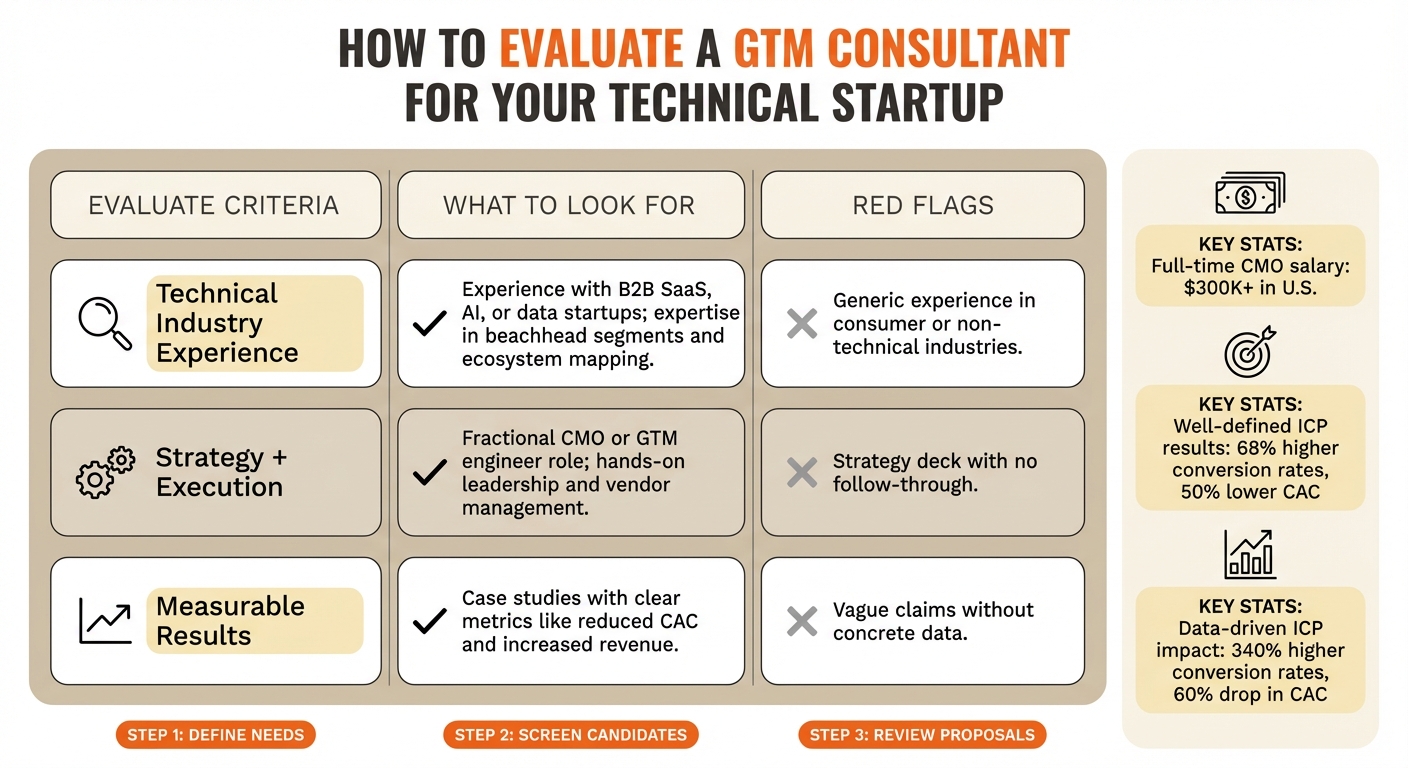
GTM Consultant Evaluation Criteria for Technical Startups
Choosing the right GTM consultant is about more than just filling gaps in your strategy. It’s about finding someone with the right mix of expertise, execution skills, and a proven ability to deliver results. Here’s what to prioritize when evaluating potential partners.
Experience with Technical Startups
A consultant’s background in technical industries is crucial, especially for B2B SaaS, AI, or data-driven companies. These fields often involve long sales cycles and buyers who expect a deep understanding of technical details [3]. Look for someone who knows the technology adoption lifecycle and can help your business transition from early adopters to a broader market [12]. They should also excel at pinpointing a beachhead segment – a specific, focused market where you can establish credibility before scaling.
One of the biggest challenges for technical founders is translating complex product features into clear business value. This is where a consultant with a technical background, such as engineering or data science, can make all the difference. As Matt Carter from IBM highlighted:
"Lillian excels at transforming complex technical details into clear, engaging content." [3]
Another vital skill is ecosystem mapping – creating a network of partners and influencers to boost word-of-mouth referrals and lower customer acquisition costs [12].
Both Strategy and Execution Skills
Some consultants stop at delivering a strategy deck, leaving you with a plan but no clear path to implementation. For technical startups, this approach falls short. You need someone who not only provides strategic insights but also ensures those ideas are executed effectively [3].
The best consultants often act as fractional CMOs or GTM engineers, combining high-level strategy with hands-on execution. They’ll help define roles, hire and mentor team members, and manage outside agencies or vendors. This is especially valuable for early-stage startups that can’t yet afford a full-time CMO, whose salaries in the U.S. range from $304,669 to $429,040 annually [3].
A strong consultant will tailor their approach to your specific needs. For instance, they might notice that your demo no-show rate is high because confirmation emails lack clarity. Fixing this requires actionable steps, not just theoretical advice.
Measurable Results and Client Examples
Always look for a track record of measurable outcomes. A good consultant won’t just talk about "helping companies grow" – they’ll provide case studies and data to back it up. Metrics like reduced customer acquisition costs, increased lead volume, and revenue milestones should be front and center [3].
For example, in 2024, Kam Lee of Finetooth Analytics leveraged Lillian Pierson’s strategies to secure 15 contracts worth $310,000 and pre-sell $60,000 in SaaS contracts – all while maintaining a 67% profit margin [3]. Another success story involves a VC-backed Data SaaS company that achieved 200x user growth in just 90 days by implementing a structured GTM system [3]. Yet another: a Series F database company generated over 10,000 marketing-qualified leads without spending a dime on ads, thanks to an effective organic demand generation strategy [3].
Testimonials can also offer valuable insights. Matt Brown from SingleStore shared:
"Her approach is characterized by a genuine curiosity and a commitment to understanding every facet of our brand. This has enabled her to craft strategies that are not only effective in bringing our product to market but also in ensuring that it resonates with our target audience." [3]
Finally, ensure the consultant uses a KPI-driven approach. They should set clear metrics – like customer acquisition cost, lead conversion rates, or customer lifetime value – and tie their work directly to these goals [3].
Key Evaluation Criteria
| Evaluation Criteria | What to Look For | Red Flag |
|---|---|---|
| Technical Industry Experience | Experience with B2B SaaS, AI, or data startups; expertise in beachhead segments and ecosystem mapping | Generic experience in consumer or non-technical industries |
| Strategy + Execution | Fractional CMO or GTM engineer role; hands-on leadership and vendor management | Strategy deck with no follow-through |
| Measurable Results | Case studies with clear metrics like reduced CAC and increased revenue | Vague claims without concrete data |
How Repositioning Connects ICP, Messaging, Funnels, and Rollout
Repositioning isn’t just about tweaking your pitch – it’s about ensuring every piece of your go-to-market strategy works together. Your Ideal Customer Profile (ICP), messaging, sales funnel, and rollout strategy must align seamlessly. If these elements aren’t integrated during execution, even the best plans won’t deliver results. A skilled GTM consultant approaches repositioning as the glue that ties your entire revenue system together.
Matching ICP with Targeted Messaging
Everything starts with refining your ICP. Without a clear sense of who your ideal customer is, your messaging risks becoming too broad, and your marketing spend ends up wasted [11]. Customer research and feedback are your best tools here. They help validate your ICP and shape a narrative that directly addresses specific pain points and desired outcomes [13][14].
This approach avoids common mistakes, like jumping straight into feature-heavy sales pitches before building trust. It also helps prevent segmentation errors that can weaken your market positioning [14][17]. A well-defined ICP doesn’t just guide messaging – it sets the stage for creating effective funnels and rollout strategies.
Building Funnels That Match Buyer Journeys
Once your ICP is locked in, your funnel needs to reflect how your buyers actually make decisions. Instead of chasing idealized buyer behavior, build your funnel around real-world purchasing patterns. A strong GTM consultant uses buyer intent signals and data to time follow-ups with precision [1]. This means moving beyond outdated lead scoring methods to pinpoint friction points, like low demo attendance, unclear communication, or breakdowns between marketing and sales.
The ultimate goal is to create a "System of Action", where your CRM and product data work together to trigger timely follow-ups [1]. For technical startups, this often involves fixing broken handoffs between marketing and sales – an issue 53% of companies face, with sales teams following up on less than 35% of marketing-engaged prospects [15]. Addressing these gaps is essential before scaling your operations.
Using Phased Rollouts for Testing
With a refined ICP and a well-structured funnel, phased rollouts become the key to testing and fine-tuning your GTM strategy. Skipping this step can lead to costly mistakes [2]. Phased rollouts let you test your repositioning efforts on smaller, targeted segments before going all-in [17]. This process highlights potential issues early, such as messaging that doesn’t land, pricing that feels off, or overly complex sales motions [16].
By gathering hard data on buyer conversions, channel performance, and funnel friction, you can make informed adjustments before scaling [17]. For technical startups, where even small misalignments can have outsized impacts, this iterative approach is especially important. By the time you’re ready to scale, you’ll have a proven playbook rather than a collection of untested ideas.
Data-Mania’s approach is a case in point, showing how clear ICPs, precise messaging, aligned funnels, and phased rollouts can prepare technical startups for scalable growth.
Why Data-Mania and Lillian Pierson Are the Right GTM Partners
Selecting the right GTM consultant can make all the difference when tackling growth challenges. Data-Mania stands out by blending technical expertise with proven strategies tailored for AI, SaaS, and data startups.
Engineering Expertise Meets Data-Driven GTM Strategies
Data-Mania’s approach begins with identifying core challenges and then applying an engineering-driven methodology to convert those insights into actionable growth plans. At the helm is Lillian Pierson, a licensed Professional Engineer with nearly two decades of experience. She has trained over 2 million professionals in AI and data strategy and has worked with 10% of Fortune 100 companies[18].
The company specializes in building AI-focused growth systems that transform technical capabilities into consistent revenue streams[3]. Their process is grounded in evidence-based growth experiments that deliver dependable results. For example, Data-Mania helped SheetRocks achieve a 200x user increase in just 90 days, generating its first revenue within two months[19]. Tony Garvan, Founder & CEO of SheetRocks, reflected on the impact:
"As a technical founder, I was pretty naive around what it really would take to get a big product to market. Working with Lillian was a critical part of us getting to the next level in our business"[18].
Tailored Services for Startups in Early Stages
Beyond technical expertise, Data-Mania offers flexible services designed for startups still validating market fit. These include Fractional CMO vs. GTM Engineer services and Power Hour sessions, which provide executive-level guidance without requiring a full-time hire[3][18].
Power Hour sessions are focused, one-hour consultations aimed at helping startups prioritize key actions and develop actionable plans without long-term commitments[3]. For businesses looking for more comprehensive support, Strategy Intensives deliver a full brand assessment along with a detailed 6–12 month marketing roadmap[3].
Proven Results with AI, SaaS, and Data Companies
Data-Mania’s track record speaks for itself. They’ve driven over $7 million in direct revenue, generated 10,000 Marketing Qualified Leads for a Series F database company, and achieved over 1 million views with 45,000 engagements for IBM in just three months[18][6][3].
Matt Brown, Head of Global Growth at SingleStore, shared his experience:
"In data & AI, it is a rare find to come across someone as dedicated and adept as Lillian Pierson. Her partnership with us has been nothing short of transformative"[18].
For Finetooth Analytics, Data-Mania’s expertise led to 15 closed contracts worth $310,000 and pre-sold SaaS contracts totaling $60,000 annually, all with a 67% profit margin[18]. These results demonstrate how Data-Mania helps startups overcome similar hurdles to achieve measurable success.
Conclusion
Spotting early signs that you need a GTM consultant can save your business from growth stagnation. If your product is solid but growth has plateaued, your customer acquisition costs are climbing, or your founder is the only one closing deals, it’s time to seek strategic expertise. A great consultant doesn’t just run campaigns – they uncover the root issues blocking growth and design a system that scales effortlessly beyond your founder’s hustle.
What truly distinguishes an effective GTM partner is their ability to tie together positioning, buyer journeys, and rollout sequencing. When these elements are aligned, silos disappear, and you create a growth engine that boosts your valuation. For technical startups, this shift turns feature-heavy messaging into outcome-focused narratives that deeply connect with your audience. This balance of strategy and execution is what Data-Mania excels at delivering.
Data-Mania combines engineering precision with GTM expertise to tackle these challenges head-on. Led by Lillian Pierson, a licensed Professional Engineer with a wealth of AI and data strategy experience, the firm specializes in turning complex technical strengths into consistent revenue streams. The results speak for themselves: over $7 million in revenue, more than 10,000 marketing-qualified leads, and a 200× user growth in just 90 days [3].
For startups still validating product-market fit or operating on lean budgets, Data-Mania offers flexible solutions like Power Hour sessions and Strategy Intensives. These options provide executive-level insights without the commitment of a full-time CMO, making them ideal for founders looking to address key challenges before scaling.
If your strong product isn’t gaining traction in the market, the path forward is clear. Partner with a consultant who can identify your core obstacles, refine your GTM strategy, and transform your technical strengths into sustainable growth.
FAQs
How do I know I need a GTM consultant, not more execution?
If your go-to-market (GTM) strategy feels off-track and internal efforts aren’t fixing the problem, it might be time to bring in a GTM consultant. Some telltale signs include confusing messaging, disorganized data, or growth heavily dependent on a single channel. Additionally, if your target audience or pricing hasn’t been updated in a while, that’s another red flag.
Other indicators? If your team is struggling to stay aligned, your customer experience feels inconsistent, or critical metrics like revenue aren’t adding up, it’s clear you need more than just extra execution. You need someone to provide a fresh, strategic perspective.
What should a GTM consultant audit first in my revenue system?
A Go-to-Market (GTM) consultant’s first step is to examine the actual performance and data within your revenue system. This means analyzing what’s currently in place – such as lead sources, conversion rates, channel performance, and the relationship between spending and revenue – rather than focusing on what should be there. This approach helps uncover genuine bottlenecks and disconnects, creating a reliable starting point for targeted improvements.
How can repositioning improve ICP, messaging, and the funnel at once?
Repositioning fine-tunes how your product fits into the market by sharpening your Ideal Customer Profile (ICP), crafting messaging that speaks directly to your target audience, and improving the funnel to boost conversions. It tackles any gaps in market alignment, ensuring that your ICP, messaging, and funnel work in harmony. This unified approach ties your product’s value to customer needs, setting the stage for smoother go-to-market success.