


When your startup hits a marketing roadblock, the big question is: Do you need a Fractional CMO or a Marketing Agency? Here’s the short answer:
- Hire a Fractional CMO if you lack clear strategy, your sales team can’t explain your value, or your marketing feels random. They focus on outcomes like revenue growth, aligning teams, and defining your go-to-market (GTM) plan.
- Work with a Marketing Agency if your strategy is solid, and you just need help executing tasks like ads, SEO, or content. Agencies focus on deliverables like campaigns and channel-specific metrics.
Key Difference: Fractional CMOs own the big picture (strategy, leadership, results). Agencies focus on execution (outputs like blogs, ads, or campaigns).
The Hybrid Model: Many startups combine both – a Fractional CMO sets the direction, while an agency handles execution.
Quick Tip: Start with strategy. Without it, agencies may waste resources on tactics that don’t deliver results.
Cost Snapshot:
- Fractional CMO: $5,000–$15,000/month
- Agencies: $5,000–$50,000+/month
Bottom Line: Strategy first, execution second. If you’re unsure where to start, a Fractional CMO can provide clarity and ensure every marketing dollar counts.
Fractional CMO vs Marketing Agency: Complete Comparison Guide for Startups
Fractional CMO vs a Marketing Agency
sbb-itb-e8c8399
The Real Difference Between Fractional CMO and Marketing Agency
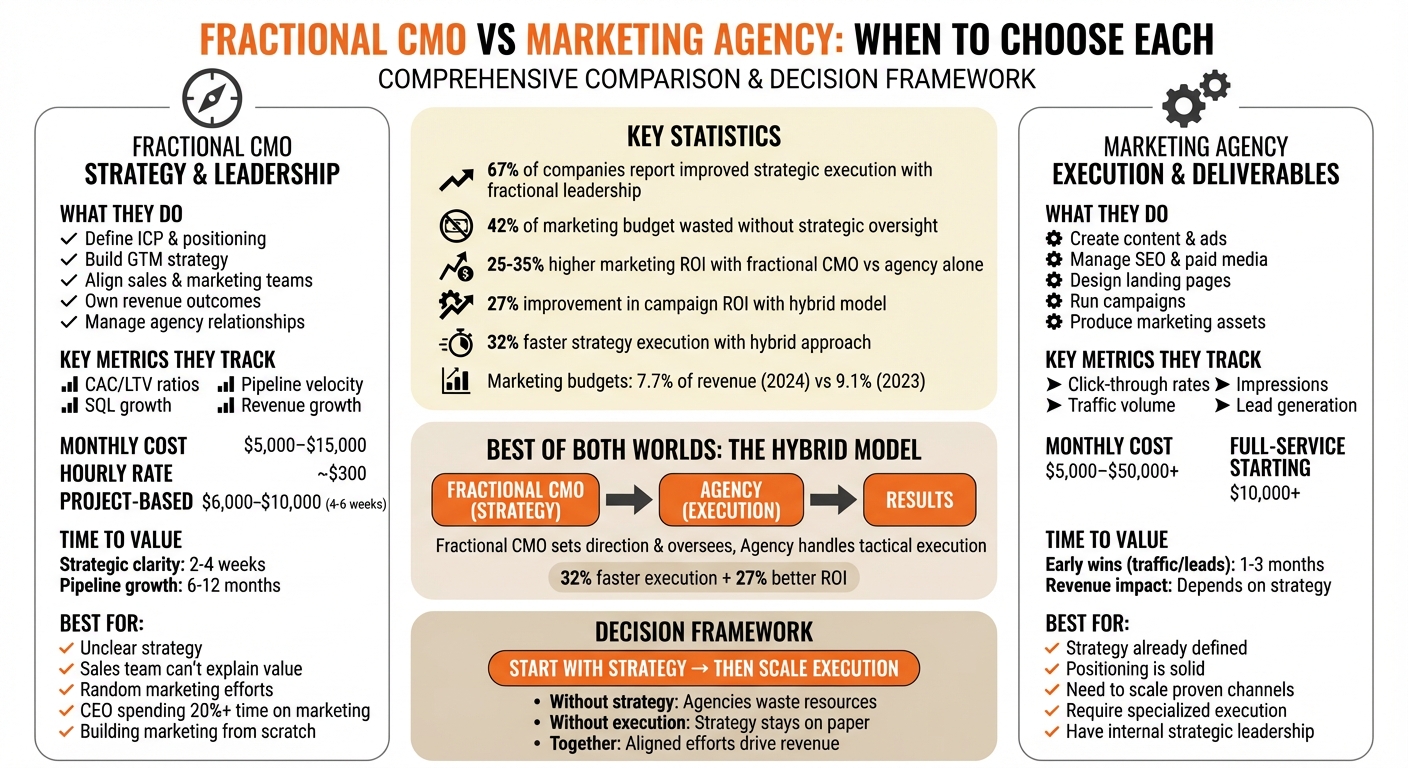
Let’s break this down: the key difference lies in who owns the bigger picture versus who handles the details. A Fractional CMO takes charge of strategy, leadership, and driving measurable business outcomes – think revenue growth, building a pipeline, and aligning teams. On the other hand, a marketing agency focuses on execution and deliverables – creating SEO content, managing paid ads, running email campaigns, and producing assets. One designs the blueprint; the other builds from it.
This distinction is more than just semantics. As Yaroslav Lehenchuk succinctly explains:
"Agencies are hired for output. CMOs are hired for outcomes. The disconnect happens when these roles are treated as interchangeable" [1].
Without a clear strategy, hiring an agency can feel like paying for trial-and-error experiments, no matter how polished the outputs are. Similarly, bringing in a Fractional CMO without the right execution support can leave you with a fantastic plan that never gets off the ground.
Fractional CMO: Strategy and Leadership
A Fractional CMO operates as part of your executive team, not just another external consultant. They define your Ideal Customer Profile (ICP), refine your positioning, and map out a go-to-market strategy while holding everyone accountable for results like CAC/LTV ratios and SQL growth [8]. Think of them as the architect who creates the plans before construction begins.
Their key value lies in providing clarity before execution [5]. They ensure your sales team can pitch your value in 30 seconds, your messaging resonates with the right audience, and your budget is allocated to channels that actually generate pipeline.
Fractional CMOs also bridge gaps between teams. If your sales and marketing teams aren’t on the same page or your product roadmap ignores customer feedback, they connect those dots. No surprise that 67% of companies report improved strategic execution when they bring in fractional marketing leadership [8]. And while hiring a full-time marketing manager costs a median annual salary of $161,030 as of May 2024 [9], a Fractional CMO’s monthly rate typically ranges from $3,000 to $15,000 [8], offering senior expertise without the full-time price tag.
Marketing Agency: Execution and Deliverables
Agencies are execution specialists. They’re the ones writing blog posts, managing Google Ads, designing landing pages, running LinkedIn campaigns, and producing videos. Their focus is on channel-specific metrics like click-through rates, impressions, and engagement [8]. In other words, they’re the construction crew – but only if the plans are already in place.
The challenge? Agencies tend to work in silos. Your SEO agency focuses on organic traffic, your paid media agency optimizes for cost-per-click, and your content agency sticks to publishing schedules. Rarely do they step back to see how their efforts align with your overall sales pipeline or whether your positioning is even hitting the mark.
This siloed approach often leads to inefficiencies. In fact, companies without strategic marketing oversight waste an average of 42% of their marketing budget on ineffective channels [8]. For startups, where resources are tight, this lack of alignment can be particularly costly.
Why Startups Need Clarity
For startups, clarity is non-negotiable. With limited budgets and high uncertainty, there’s no time for drawn-out experiments across multiple channels. Startups need to make informed, swift decisions – and that requires a leader who can see the entire landscape, not just isolated pieces.
Marketing budgets have already shrunk to 7.7% of overall company revenue in 2024 (down from 9.1% in 2023) [8]. Every dollar counts. Using a Fractional CMO to handle tasks like blog writing misuses their expertise, while hiring an agency without validating your ICP or messaging wastes money on tactics that may not even align with your goals.
Quick Answer: When to Choose Each Option
If your marketing strategy feels scattered, your sales pipeline is unpredictable, or your founder is drowning in marketing decisions, a Fractional CMO can provide the leadership you need. On the other hand, if your strategy is already working and you just need help executing tasks like blog posts, ads, or emails, a marketing agency is the better fit.
Choose a Fractional CMO If…
A Fractional CMO is the right choice when you’re missing strategic direction. For example, if your sales team struggles to explain your value clearly, your Ideal Customer Profile is fuzzy, or your marketing efforts feel random with little impact on the pipeline, it’s time to bring in a Fractional CMO [10][1]. Similarly, if your CEO is spending more than 20% of their time managing freelancers or analyzing campaign reports instead of focusing on growth, this is a clear signal to make the switch [2][5].
Boardroom concerns can also highlight the need for a Fractional CMO. If investors are asking tough questions about CAC payback, pipeline velocity, or how well sales and marketing are aligned, you need someone who can focus on delivering outcomes, not just tracking metrics [1][5]. Additionally, if you’re starting a marketing function from scratch and need someone to hire, manage, and coordinate agencies or specialists, a Fractional CMO is indispensable [5][10].
But if your strategic foundation is already in place, there’s another option:
Choose a Marketing Agency If…
A marketing agency is ideal when your strategy is clear, your positioning is solid, and you need more hands to scale what’s already working [3][5][1]. For example, if LinkedIn ads are driving most of your growth and you’re ready to amplify those efforts, an agency can handle everything from creative production to campaign optimization [1][2].
Agencies shine when they work alongside a strong internal leader – whether that’s a founder, product marketer, or Fractional CMO – who can provide well-defined briefs and direction [3][1]. Without that internal guidance, agency work can drift off course, leading to higher costs without meaningful results. If you’re unsure of your current efficiency, use a CAC calculator to identify your acquisition costs.
The choice comes down to your startup’s current challenges: if you lack strategic clarity, go with a Fractional CMO. If you have a validated strategy and need help executing it, turn to an agency.
Startup Stage Playbook: Matching Services to Growth Stages
Your funding stage heavily influences which marketing challenges demand attention. A pre-seed startup struggling with positioning has vastly different needs compared to a Series B company managing campaigns across multiple regions.
Pre-seed / Seed Stage
At this point, the CEO often juggles responsibilities, acting as a part-time CMO and dedicating up to 20% of their time to marketing tasks instead of core business priorities [2]. The main issue isn’t a lack of effort – it’s the absence of a consistent, repeatable narrative. Messaging tends to be scattered, the ideal customer profile remains undefined, and lead generation hinges on the founder’s latest experiment.
The solution? Bring in a Fractional CMO. Take Featurespace, for example – a Cambridge-based company specializing in machine learning fraud detection. During its scale-up phase, it used fractional go-to-market leadership to refine its commercial narrative. This clarity played a key role in its growth and eventual $1 billion acquisition by Visa in 2024 [6]. The lesson here is simple: nail down your positioning before investing heavily in ads or content creation.
As your funding increases, the focus will naturally shift from defining your story to building scalable systems for lead generation.
Series A Stage
Once you’ve secured Series A funding, investors expect predictable results. However, your sales and marketing teams might not yet agree on what constitutes a "qualified lead", and without clear metrics like CAC or LTV benchmarks, your pipeline’s reliability could come into question [3][5].
This stage calls for a hybrid approach. Start with a Fractional CMO to design a solid go-to-market strategy and set the direction. Then, complement this leadership with agency support for one or two proven channels. For instance, Procore used this model during its UK expansion, focusing on regional messaging and sales enablement before scaling across Europe [6]. The Fractional CMO lays the groundwork, while the agency executes the tactical elements.
This combination prepares you for the more intricate coordination required as you move into the Series B+ stage.
Series B+ Stage
By Series B+, your challenges evolve. Now you’re managing multiple channels, expanding internationally, and growing your team. The question shifts from "what should we do?" to "how do we manage all of this effectively?" Relying on a single in-house marketer to handle both strategy and execution can quickly lead to burnout [4].
Your options include hiring a full-time VP of Marketing or continuing with a Fractional CMO who oversees specialized agencies for tasks like programmatic advertising and SEO [5][2]. A good example is Adbrain, which used fractional leadership to fine-tune its commercial messaging and positioning. This move helped set the stage for its acquisition by The Trade Desk [6]. At this stage, what you need most is experienced leadership to coordinate multiple specialists – not another generalist trying to wear too many hats.
This progression highlights the importance of pairing strategic direction with expert execution, a recurring theme in successful go-to-market strategies.
GTM Motion: PLG vs Sales-Led Models
Your go-to-market (GTM) strategy plays a big role in determining whether you need strategic leadership or hands-on execution. A product-led growth (PLG) company focused on self-serve activation has very different marketing needs compared to a sales-led startup targeting enterprise deals worth six figures.
PLG (Product-Led Growth)
In PLG, the product itself is the primary driver of user acquisition and conversion. As Amol Ghemud from upGrowth explains:
"A fractional CMO shifts the focus from a linear, leaky funnel to a self-sustaining, circular growth loop" [12].
A Fractional CMO in this model zeroes in on identifying your product’s "Aha" moment – the point where users realize its value. They work on shortening the time-to-value and collaborate with the product team to define Product-Qualified Leads (PQLs) based on in-app behaviors. For instance, this could mean encouraging users to invite teammates or complete a critical workflow.
Agencies, on the other hand, focus on scaling your self-serve funnel. They may use strategies like SEO or paid ads to drive traffic. A great example comes from upGrowth’s partnership with MPOWER Financing in July 2025. Together, they built an AI-driven content engine targeting long-tail search terms, which boosted domain authority and improved lead quality to support ongoing product-led growth [12]. However, while agencies track metrics like click-through rates or cost per click, they don’t typically measure whether those users activate within your product.
In this setup, the Fractional CMO handles onboarding and pricing strategies, while agencies focus on driving high-intent traffic to your product.
Sales-Led GTM
Sales-led models require a completely different dynamic between strategy and execution. Here, the Fractional CMO turns complex technical features into clear, compelling value propositions. They create vital sales tools – such as pitch decks, one-pagers, battlecards, and objection-handling scripts – to make selling easier for your team [6]. They also bridge the gap between sales and marketing by defining shared criteria for MQLs, SQLs, and PQLs [5].
Once the groundwork is established, agencies step in to execute specific tactics like LinkedIn ads, account-based marketing (ABM), or outbound prospecting. As Richard McClurg puts it:
"Agencies operate at the channel execution layer… Fractional CMOs operate at the positioning and go-to-market layers" [5].
If your messaging is unclear or your sales team struggles to communicate your value in 30 seconds, agencies can unintentionally amplify that confusion – often at significant costs, sometimes exceeding $10,000 per month.
The order in which you bring in these resources matters. Start with a Fractional CMO to refine your messaging, develop sales enablement tools, and validate your ideal customer profile (ICP). Once these elements are solid, agencies can efficiently scale your channels. Reversing this process can lead to wasted ad spend and frustrated sales teams. This sequence reinforces the broader principle: strategy must guide execution to achieve measurable results.
Cost and ROI Comparison
Cost Ranges and Time to Value
When weighing costs and returns, startups face a key choice between strategic leadership and tactical execution. Fractional CMOs typically charge between $5,000 and $15,000 per month, with hourly rates near $300. For focused projects like GTM positioning sprints, fees range from $6,000 to $10,000 over a 4–6 week period. Marketing agencies, on the other hand, charge anywhere from $5,000 to over $50,000 monthly, with full-service agencies often starting at $10,000.
A fractional CMO can deliver strategic clarity quickly, often within the first 2–4 weeks, by solidifying the ICP (Ideal Customer Profile), crafting messaging frameworks, and building a GTM roadmap. Tangible outcomes, such as pipeline growth and better CAC (Customer Acquisition Cost), usually materialize within 6–12 months. Agencies, however, can show early wins – like increased traffic or lead volume – within 1–3 months. Yet, without a strong strategic foundation, these metrics may not translate into meaningful revenue.
Now, let’s explore how ROI metrics shift as startups grow.
ROI Metrics by Stage
What constitutes a "good" ROI changes as startups evolve.
- Seed Stage: The goal is to prove the model works. Success here means creating repeatable lead generation and messaging validation, even if efficiency isn’t the focus yet.
- Series A: Attention shifts to scalability. CAC payback periods under 12 months and pipeline contributions driving 2–3x year-over-year growth become key metrics.
- Series B+: The focus expands to include market share, optimizing LTV (Lifetime Value), and building a brand strong enough to lower CAC.
Startups working with fractional CMOs report 25% to 35% higher marketing ROI within 12 months compared to those relying solely on agencies [2].
This brings us to why agency costs can sometimes spiral out of control.
Why Agency Costs Can Balloon
Without strategic oversight, agency spending can quickly outpace returns. Agencies often focus on metrics they can easily measure – traffic, leads, impressions – leading to siloed improvements that don’t necessarily strengthen the overall pipeline or reduce CAC.
Scope creep is another common issue. Agencies may suggest adding more channels or increasing ad spend to hit their internal goals, which doesn’t always align with your business priorities. Without a clear strategy, this can result in spending on tactics that target the wrong audience or fail to differentiate your brand in the market.
A fractional CMO acts as the strategic architect, setting clear priorities, managing agency relationships, and ensuring every dollar is tied to business outcomes. Instead of chasing clicks or impressions, they focus on metrics like SQLs, pipeline contributions, and CAC payback periods. This shift in accountability can lead to up to 27% higher campaign ROI compared to working with agencies alone [7]. For startups navigating uncertain markets and tight budgets, having strategic leadership in place is essential to avoid wasteful spending and ensure long-term growth.
The Hybrid Model: Combining Fractional CMO and Agency
When it comes to startups, the best approach often isn’t choosing between a fractional CMO or an agency – it’s combining them. This hybrid model leverages the strengths of both: a fractional CMO develops your go-to-market (GTM) strategy – shaping your positioning, ideal customer profile (ICP), and overall direction – while the agency takes care of execution, from running campaigns to creating content and managing ads. By dividing these responsibilities, startups avoid the common pitfall of spending heavily on execution without a clear, validated strategy, which can lead to wasted resources targeting the wrong audience [2]. This setup ensures that every marketing dollar is spent with purpose and delivers measurable results.
Another key advantage of the hybrid model is how it closes the accountability gap. While agencies often focus on metrics like click-through rates or impressions, a fractional CMO connects these to broader business outcomes such as pipeline velocity, customer acquisition cost (CAC) payback, and revenue growth [1][3]. Startups using this model report faster execution of marketing strategies – up to 32% – and see a 27% improvement in campaign ROI compared to relying solely on agencies [7].
Fractional CMO: Strategy and Oversight
In this setup, the fractional CMO takes ownership of the "what" and "why" of your marketing efforts. They define your ICP, create a messaging framework, establish KPIs that tie directly to revenue, and build an operational rhythm to keep all teams aligned. This often includes weekly meetings to ensure that agency campaigns align with product launches and sales priorities [1].
The fractional CMO also oversees the relationship with the agency, providing clear scopes of work, monitoring performance against business objectives, and making adjustments as needed. This level of management ensures that marketing spend drives pipeline growth rather than just inflating vanity metrics like clicks or impressions [1][11]. For startups operating on tight budgets, this careful oversight is critical – it ensures campaigns target the right audience and lays the groundwork for a scalable growth model [5].
Agency: Execution Within a Clear Plan
Once the fractional CMO establishes the strategic framework, the agency takes over the "how" – executing tactics across various channels. This can include SEO, paid advertising, content creation, or lifecycle marketing campaigns. With a solid strategy in place, agencies can focus on delivering their specialized expertise efficiently, without the overhead costs of hiring full-time, in-house specialists [5][4].
Agencies work within the boundaries set by the fractional CMO. They don’t make decisions about positioning or how budgets are allocated; instead, they implement a proven strategy. This structure allows startups to scale their marketing efforts across multiple channels without committing to additional headcount or long-term contracts. The result is a well-coordinated system where strategic direction and execution work hand-in-hand, ensuring every marketing effort contributes directly to revenue growth.
Common Mistakes: What to Avoid
To build a strong marketing foundation, it’s crucial to steer clear of these frequent missteps. They highlight the importance of having a clear strategy and defined ownership in your GTM engineering plan, especially for startups.
Hiring Before Strategy Is Defined
Hiring an agency without first locking in your ideal customer profile (ICP) and positioning is a recipe for wasted effort. It’s like starting construction on a house without a blueprint. Michael Porter, a fractional CMO, explains it best:
"Hiring an agency before you have a strategy is like hiring a construction crew without an architect. They will build something, but it probably will not be the right house." [2]
Without a clear strategy, agencies often focus on vanity metrics – numbers that look impressive in reports but don’t translate into revenue. Sarah Cann refers to this as "expensive guessing with better fonts" [4]. Campaigns might look polished, but they fail to drive meaningful results like pipeline growth or sales conversions [3][1].
Paying for Deliverables Instead of Results
One of the most common traps is paying agencies for deliverables – like ad creatives or lead lists – without ensuring someone owns the full-funnel outcomes. Agencies tend to focus on metrics like click-through rates or lead volume, but these don’t always align with revenue growth [1]. This disconnect can create the illusion of progress while revenue remains flat [3][1].
To avoid this, contracts should be tied to business outcomes from the start. Define success not just by deliverables but by metrics like pipeline coverage, cost per opportunity, or activation rates within the first 30 days [10]. Whether it’s a fractional CMO or an internal leader, someone needs to bridge the gap between marketing activity and revenue.
The "Spray and Pray" Problem
Spreading your efforts too thin by engaging multiple specialists at once can backfire. Without a central strategy, you risk sending mixed messages to the market, making it hard to pinpoint what’s working and what’s not [1][5]. This approach not only fragments your budget but also confuses your audience.
Fractional CMOs play a key role here by acting as the "architect" who ensures focus. They prioritize fewer, well-executed bets and create a 90-day channel plan with clear cost-per-opportunity benchmarks [6]. Before scaling any channel, they validate your messaging and ICP, ensuring every dollar spent contributes to a unified strategy [11].
Conclusion: Making the Right GTM Decision
Deciding between a Fractional CMO and a Marketing Agency isn’t about which option is inherently better – it’s about identifying where your marketing efforts need the most focus. For instance, if your sales team can’t clearly explain your value in 30 seconds or your pipeline coverage has been under 3x quota for two straight quarters, the issue lies in strategy. In this case, an agency won’t fix unclear positioning – they only execute the strategy that’s provided [6,16].
The right sequence matters: start with strategic leadership services to define your ICP, positioning, and GTM plays. Once that foundation is set, agencies can help scale execution [3,6]. The data backs this up too – leveraging fractional leadership has been shown to improve marketing ROI by 25% to 35% within 12 months by aligning efforts with revenue goals [2].
For startups in the Seed to Series C range, typically with ARR between $3M and $25M, a hybrid model often yields the best results [16,7]. In this setup, a Fractional CMO handles the strategic vision, aligns sales and marketing, and oversees specialized agencies to ensure tactical work drives outcomes. For those seeking tailored guidance, exploring growth advisory services can help bridge the gap between strategy and execution. Think of the Fractional CMO as the strategist – the architect of your marketing plan – while the agency acts as the construction crew. This approach not only delivers executive-level expertise but also tends to cost far less than hiring a full-time CMO [2].
Here’s a simple way to decide: if your team can’t articulate your value clearly, prioritize strategic leadership. If your positioning is solid but you need help scaling content, ads, or SEO, an agency is the better fit. And if you’re spending over 20% of your time coordinating freelancers, it’s time to bring in a “General Contractor” to streamline your efforts [16,3].
FAQs
How can I choose between a Fractional CMO and a marketing agency for my startup?
Choosing between a Fractional CMO and a marketing agency comes down to what your startup needs most: strategic leadership or executional support. A Fractional CMO is a great choice if you’re looking for someone to provide strategic direction, align cross-functional teams, and take charge of your go-to-market (GTM) strategy. This can be especially helpful if your startup struggles with unclear positioning, an inconsistent sales pipeline, or the need for someone to oversee marketing initiatives, including managing agency relationships.
In contrast, a marketing agency is better suited for startups that already have a clear strategy in place but need help with execution. Whether it’s SEO, paid media, or content creation, agencies deliver tactical expertise. However, they work best when guided by an internal leader, such as a founder or a marketing manager, who can steer their efforts.
Many startups find success with a hybrid model, where a Fractional CMO defines the strategy and oversees the process, while agencies handle specific execution tasks. This combination ensures you have both the strategic insight and the operational bandwidth needed during crucial stages like pre-seed or Series A funding.
What are the cost differences between hiring a Fractional CMO and a marketing agency?
The cost of hiring a Fractional CMO tends to be on the higher side compared to working with a marketing agency. This is because Fractional CMOs bring strategic leadership, ensure alignment across teams, and take responsibility for results. Their fees are usually structured as a flat monthly retainer, ranging from $8,000 to $20,000+, depending on their experience and the scope of work involved.
On the other hand, marketing agencies typically charge anywhere from $1,500 to $10,000+ per month, depending on the specific services they offer – things like SEO, content creation, paid advertising, or design. While agencies are often more budget-friendly, their role is more about executing tasks rather than owning the overall strategy or delivering measurable outcomes. For startups, the decision often hinges on whether they need top-level leadership or focused expertise in specific marketing channels.
Can startups benefit from using both a Fractional CMO and a marketing agency together?
Yes, combining a Fractional CMO with a marketing agency can be a smart move for startups. This setup gives you access to the strategic direction, accountability, and team coordination that a Fractional CMO provides, while tapping into the agency’s expertise for tasks like SEO, paid advertising, or content production.
This model is especially useful for startups that need both a clear marketing strategy and effective execution but aren’t ready to hire a full-time team. The Fractional CMO ensures that all marketing efforts align with your business objectives and oversees the big picture, while the agency focuses on delivering results in specific areas. Together, they can help you grow efficiently, avoid wasted efforts, and make the most of your resources.