


When your startup hits a marketing plateau, choosing between a Fractional CMO, GTM Engineer, or a Marketing Agency can make or break your growth. Here’s the deal:
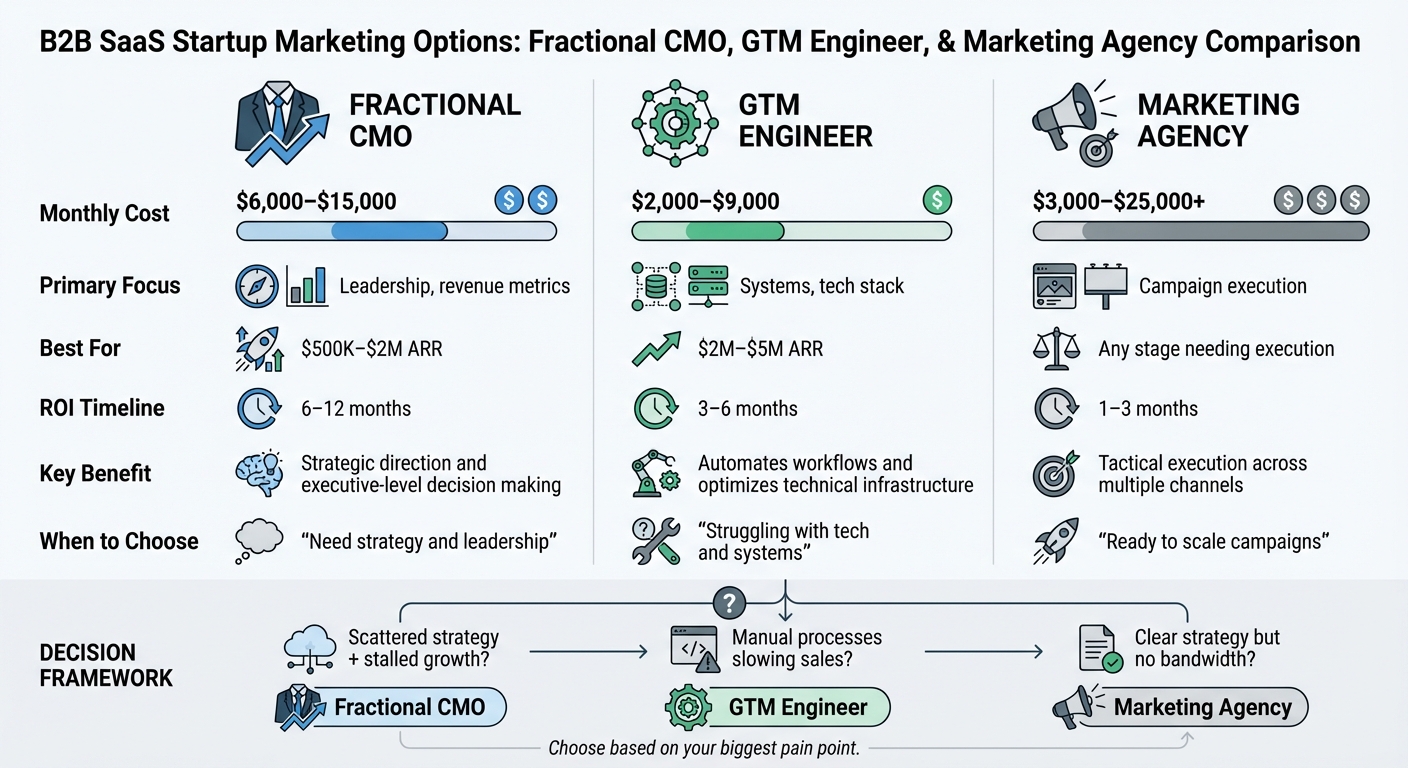
- Fractional CMO: Ideal for startups needing part-time executive-level leadership to create a clear marketing strategy, align sales and marketing, and focus on revenue-driving goals like SaaS revenue metrics. Costs range from $6,000–$15,000/month.
- GTM Engineer: Best for scaling operations and automating workflows. They optimize tools like CRMs, automate lead scoring, and connect marketing to revenue. Costs range from $2,000–$9,000/month.
- Marketing Agency: Perfect for tactical execution (e.g., SEO, paid ads, content). Works well if you already have a strategy but lack internal bandwidth. Costs range from $3,000–$25,000+/month.
Key takeaway:
- Need strategy and leadership? Go with a Fractional CMO.
- Struggling with tech and systems? Hire a GTM Engineer.
- Ready to scale campaigns? Use a Marketing Agency.
Quick Comparison
| Factor | Fractional CMO | GTM Engineer | Marketing Agency |
|---|---|---|---|
| Monthly Cost | $6,000–$15,000 | $2,000–$9,000 | $3,000–$25,000+ |
| Primary Focus | Leadership, revenue metrics | Systems, tech stack | Campaign execution |
| Best For | $500K–$2M ARR | $2M–$5M ARR | Any stage needing execution |
| ROI Timeline | 6–12 months | 3–6 months | 1–3 months |
Each option solves different problems. Choose based on your biggest pain point.
Fractional CMO vs GTM Engineer vs Marketing Agency Comparison for Startups
Fractional CMO vs a Marketing Agency
sbb-itb-e8c8399
What is a Fractional CMO?
A Fractional CMO is a seasoned marketing executive who works on a part-time basis – typically between 8 and 32 hours a week – to steer your marketing strategy and build scalable systems that drive growth. Unlike consultants, they don’t just provide advice and leave; they embed themselves into your leadership team, taking ownership of key revenue metrics like ARR (Annual Recurring Revenue), customer acquisition strategies, and pipeline velocity [5]. Acting as your part-time CMO, they translate business goals into actionable marketing plans, create repeatable processes, and align sales and marketing teams under one cohesive go-to-market strategy [5].
“It’s the marketing brain without the full-body hire.” – Yuliia Shvetsova, Author [5]
This role has gained significant traction, with mentions of “fractional leadership” skyrocketing from about 2,000 in 2022 to over 110,000 in 2024 [5]. What sets Fractional CMOs apart is their accountability – they don’t just advise; they participate in board-level discussions, manage budgets, and oversee execution. Their goal is to transform disjointed campaigns into a streamlined, growth-driven marketing engine [5].
What a Fractional CMO Does
Fractional CMOs provide strategic and operational leadership, filling a gap many startups face. They define your company’s positioning, identify your ideal customer profile (ICP), and craft value propositions that resonate with your audience [5]. Beyond strategy, they build the necessary infrastructure – marketing stacks, automation workflows, and reporting dashboards – to ensure long-term, repeatable results [5].
Their responsibilities include creating go-to-market strategies, setting performance metrics tied to revenue, and managing both internal teams and external vendors. They also mentor junior team members, lead hiring efforts as your company scales, and oversee your marketing budget with a laser focus on ROI and cost forecasting [5].
Fractional CMOs focus on understanding the “what” and “why” of marketing efforts. They decide which channels to prioritize, what to avoid when resources are tight, and how to align revenue teams with consistent messaging [5]. With experience across industries, they bring fresh perspectives, helping identify blind spots and challenge internal assumptions [9]. This strategic expertise makes it clear when your startup might benefit from bringing one on board.
When to Hire a Fractional CMO
The right time to hire a Fractional CMO is when founder-led marketing has reached its ceiling. If your network has dried up, pipelines are inconsistent, or campaigns feel scattered without a clear strategy, it’s time to bring in a professional [5]. This shift often happens during critical growth stages like pre-launch, seed, or Series A, when a structured marketing approach becomes essential to meet investor demands [2].
Fractional CMOs are especially valuable in complex B2B industries like SaaS, healthtech, biotech, and life sciences, where long sales cycles and technical buyer journeys demand specialized expertise [2][12]. They’re also instrumental during pivotal transitions like rebranding, entering new markets, or navigating mergers and acquisitions [5].
Cost is another compelling factor. Hiring a full-time CMO can cost $250,000 to $350,000 or more annually – a steep price for startups with revenues around $750,000 [2][10]. In contrast, Fractional CMOs charge 30–50% of that, typically between $6,000 and $15,000 per month for 8–20 hours of work each week. Companies that move from ad-hoc marketing to a strategic approach with a Fractional CMO often see a 25–35% boost in marketing ROI within a year, driving sustainable growth [5].
For example, in 2025, SocialLadder, a brand ambassador platform, hired Antoine Vial as a Fractional CMO through Kalungi. This collaboration resulted in a 130% increase in qualified opportunities, a 220% rise in qualified outbound opportunities, and a 135% increase in the dollar value added to their sales pipeline [12].
“We were looking for someone that knew what they were doing and could take our marketing engine to the next level. More importantly, we wanted someone that would fully integrate and become a member of the team.” – Raavi Iqbal, CEO, SocialLadder [12]
What is a GTM Engineer?
A GTM Engineer is a technical expert who focuses on building and automating the systems that fuel your sales and marketing efforts. Unlike agencies or strategists, GTM Engineers dive into the technical infrastructure – connecting tools like CRM systems, automation platforms, and analytics software [13]. They turn these technical capabilities into revenue-generating systems by streamlining workflows, enabling sales and marketing teams to operate more efficiently [15]. For instance, while many sales teams lose 66% of their productive time dealing with fragmented systems and manual processes [14], a well-designed infrastructure eliminates these inefficiencies. The growing importance of this role is evident, with one GTM engineering job posted for every 92 SDR roles, highlighting its emerging demand [16]. In essence, GTM Engineers bridge the gap between technical operations and revenue strategy.
“A GTM Engineer isn’t writing code. They’re engineering the sales and marketing engine that drives revenue.” – Leadle [13]
Think of them as the connection point between your product, marketing, and sales teams.
What a GTM Engineer Does
GTM Engineers handle the technical side of driving revenue growth. They design workflows that can be repeated for inbound and outbound sales, ensuring tools like CRMs and enrichment platforms work seamlessly together. They also automate tasks such as lead routing, scoring, and real-time data enrichment – saving each sales rep 8–12 hours a week [13].
Their work often involves coding solutions to enhance automation. This could mean writing Python or JavaScript for API integrations, setting up webhooks, or using SQL to create real-time dashboards that visualize the sales pipeline [14]. They also focus on CRM maintenance, build sales enablement assets, and create automated alerts for key events, like when a user reaches trial limits [14][15].
GTM Engineers don’t just maintain workflows – they experiment to improve customer acquisition strategies. They test ideal customer profiles (ICP) and channels, using data like funding announcements, hiring trends, or tech adoption patterns [13]. Startups that hire GTM or RevOps roles early often see a 15–20% boost in pipeline velocity, with automated lead scoring increasing conversion rates by 10–15% [13]. Their work also ensures speed-to-lead systems are in place, as leads contacted within five minutes are nine times more likely to convert [13]. These technical efforts align with broader strategic goals, supporting your startup’s growth trajectory.
“RevOps defines the ‘rules of the game,’ while GTM Engineers build the playing field and make sure the game runs without interruption.” – CandyboxCRM [13]
Their toolkits often include platforms like HubSpot, Salesforce, Clay, Apollo, Outreach, Segment, Zapier, and Snowflake [13]. As Joe Barron from Cognism points out, “GTM engineers know how to discern the true value a tool brings versus the hype”, which is especially critical during times of tool consolidation [15].
When to Hire a GTM Engineer
“Hire your first GTM Engineer when founders spend more time fixing funnels than finding product-market fit.” – Leadle [13]
You should consider hiring a GTM Engineer when manual tasks start to slow down your growth. For example, if your sales development reps spend more than 20% of their week on repetitive tasks like manual list building, it’s time to bring in this role [13]. This typically happens between Series A and Series C, as operations grow more complex and data becomes harder to manage [14][17].
GTM Engineers are especially valuable for technical products that require automated lead generation and structured customer acquisition. Signs that you need one include poor funnel attribution, disconnected CRM and product usage data, or SDRs wasting hours on manual data entry [14]. However, at the seed stage, focusing on manual processes to achieve product-market fit might make more sense before investing in automation [14].
When hiring, look for candidates with a mix of technical skills – like Python, JavaScript, SQL, and API integration – combined with business knowledge, such as understanding MQL-to-SQL funnels and SaaS metrics like CAC and LTV [14]. A standout candidate should be able to showcase an automated workflow they’ve built that improved conversion rates [13]. Keep in mind, hiring the wrong GTM leader can cost up to $300,000 in rehire expenses and lost progress [14].
If you’re not ready for a full-time hire, specialized GTM consultants charge between $150 and $250 per hour [3], while senior fractional talent costs between $200 and $400 per hour [17]. For startups with ARR between $500,000 and $2 million, hiring a fractional executive for 20–30 hours a month typically costs $6,000 to $10,000 per month [17].
What is a Marketing Agency?
For startups aiming to scale their customer acquisition, understanding the role of a marketing agency is essential. Think of a marketing agency as your external execution partner – they’re the ones who bring your marketing strategy to life across various channels. While strategic leaders define the overall roadmap, agencies handle the heavy lifting. They create content, manage social media, optimize SEO, and run ad campaigns, all based on the strategy you’ve already outlined.
Agencies generally fall into two categories: full-service and specialized. Full-service agencies cover all aspects of marketing, acting as a one-stop shop for your entire marketing funnel. On the other hand, specialized agencies focus on specific areas, such as SEO or paid advertising. While specialized agencies offer deep expertise, working with multiple firms may require more coordination on your end.
What Marketing Agencies Offer
Marketing agencies are staffed with tactical experts who can execute campaigns across a range of platforms. Their services often include managing paid advertising like PPC, paid search, and paid social campaigns on platforms such as LinkedIn and Meta. They also handle SEO tasks, including keyword research, technical audits, on-site optimization, and building backlinks. Beyond that, agencies produce a variety of content, from blog posts and whitepapers to videos and case studies, while also managing social media, brand storytelling, and design.
Another key offering is marketing automation, which involves setting up email sequences, lead nurturing, and CRM management using tools like HubSpot. Agencies also provide analytics and conversion rate optimization (CRO), tracking metrics such as customer acquisition cost (CAC) and lifetime value (LTV) to fine-tune campaign performance.
The biggest advantage of working with an agency is the speed at which you can get started. With a team of specialists ready to go, you can launch campaigns almost immediately, avoiding the 2–3 months it typically takes to hire and onboard in-house staff.
From a cost perspective, in-house teams can exceed $500,000 annually, while agency fees are significantly lower – often 50–75% less. Monthly retainers for agencies typically range from $3,000 to $25,000, while project-based fees, such as for a rebrand, can cost between $10,000 and $50,000. Specialized PR agencies usually charge retainers in the $20,000 to $25,000 range.
With these capabilities in mind, the next step is determining when bringing in an agency makes sense for your growth stage.
When to Hire a Marketing Agency
“Agencies work best when the roadmap is already built and you’re ready to move. They bring the arms and tools, not the brain.” – Yuliia Shvetsova, o-cmo [5]
Agencies are most effective when you’ve already established a clear strategy but lack the internal resources to execute it. They’re a great fit for startups that need to scale quickly across multiple channels without committing to full-time hires. However, working with an agency requires strong internal oversight. Without a strategic leader to guide them, agencies risk producing work that looks busy but doesn’t drive revenue.
To get the most out of an agency, make sure you’re clear about who will be working on your account. During the proposal stage, ask for LinkedIn profiles of the team members to ensure you’re not being assigned junior staff. Additionally, avoid spreading an agency too thin – stick to their core strengths. For example, don’t expect a brand design agency to handle technical web development unless it’s part of their expertise.
Interestingly, companies that combine fractional leadership with agency support often see faster results. Studies show this hybrid model can lead to a 32% quicker execution of marketing strategies and a 27% boost in campaign ROI compared to relying solely on traditional agencies [6].
Side-by-Side Comparison
Choosing the right option for your startup hinges on your current stage and priorities – whether you need strategic guidance, technical optimization, or executional support. Below is a breakdown of how Fractional CMOs, GTM Engineers, and marketing agencies address the unique challenges startups face in scaling their marketing operations.
| Factor | Fractional CMO | GTM Engineer | Marketing Agency |
|---|---|---|---|
| Monthly Cost | $6,000–$15,000 | $2,000–$9,000 | $3,000–$25,000+ |
| Primary Focus | Strategic leadership, revenue-linked KPIs | Systems, tech stack, scalability | Campaign execution, content production |
| Ideal Stage | $500K–$2M ARR (building repeatability) | $2M–$5M ARR (scaling systems) | Any stage (execution bandwidth) |
| Implementation Speed | 3–6 months for strategic impact | Weeks to months for systems setup | 1–3 months for tactical wins |
| Team Integration | High – embedded in leadership | Moderate/High – works across ops, sales, tech | Low – external service provider |
| Decision Authority | Executive-level strategic decisions | Technical and process optimization | Campaign-level optimization |
| ROI Timeline | 6–12 months (foundational growth engine) | 3–6 months (efficiency gains) | 1–3 months (tactical improvements) |
This table highlights the key differences, but here’s a closer look at what each option brings to the table:
- Fractional CMOs: These professionals cost 30–70% less than a full-time CMO (who typically costs about $32,500 per month with benefits). They become an integral part of your leadership team, focusing on creating a revenue-driven strategy instead of chasing vanity metrics like clicks or impressions [8][5].
- GTM Engineers: Acting as a bridge between strategy and execution, GTM Engineers specialize in scaling your go-to-market engine. They focus on optimizing systems, technology, and processes to eliminate inefficiencies and ensure your operations are ready to scale [17].
- Marketing Agencies: Agencies excel at delivering quick, tactical results – often within 1–3 months. However, their success depends heavily on having a clear strategic direction. Without it, they risk prioritizing surface-level metrics like clicks and impressions over pipeline and revenue growth [1].
Pros and Cons of Each Option
When scaling in a competitive market, it’s crucial to understand the strengths and limitations of different resources. Misaligned expectations – like hiring an agency for strategic guidance or assuming a Fractional CMO will handle every tactical detail – can lead to unnecessary setbacks. Here’s a closer look at each option to help you make an informed choice.
Fractional CMOs bring executive-level leadership and accountability for revenue growth. They embed themselves into your leadership team, guiding strategy, mentoring your marketing staff, and aligning efforts with business objectives. However, their role is primarily strategic – they won’t be designing landing pages or managing PPC campaigns.
GTM Engineers excel in building the technical backbone of your marketing operations. They specialize in marketing automation, CRM integration, and data attribution, creating the systems that connect marketing activities to revenue. That said, their focus is technical, so they won’t handle areas like brand positioning or storytelling.
Marketing Agencies shine in execution. With their specialized skills and ability to scale quickly, they can tackle projects like SEO, PPC, or content production at speed. However, without a clear strategic framework, agencies may prioritize metrics like clicks and impressions rather than long-term revenue growth.
“Agencies work best when the roadmap is already built and you’re ready to move. They bring the arms and tools, not the brain.” – Yuliia Shvetsova, o-cmo [5]
Here’s a breakdown of how these options compare across key factors:
| Factor | Fractional CMO | GTM Engineer | Marketing Agency |
|---|---|---|---|
| Leadership Capability | High (Executive-level) | Moderate (Operational) | Low (Needs strategic direction) |
| Technical Skills | Broad strategic insight | High (Systems & infrastructure) | High (Specialized expertise) |
| Execution Capacity | Low (Oversight role) | Moderate (Builds systems) | High (Scales initiatives) |
| Cost Structure | Moderate retainer | Hourly or project-based | High retainer |
| Team Integration | Embedded in leadership | Moderately integrated | Operates externally |
| Scope Limitations | Strategic, not tactical | Focused on technical tasks | May work in silos without strategy |
Matching Your Startup Stage to the Right Option
The stage your startup is in plays a huge role in determining which resources will deliver the most value. During the early stage (Seed to Pre-Series A), the focus is on achieving strategic clarity. This is the time to define your Ideal Customer Profile and nail down your positioning – not to dive into high-volume campaigns. At this point, a Fractional CMO is your best bet. They bring executive-level expertise to set the direction, while agencies at this stage often fall short since execution without a solid strategy tends to waste resources [1]. As your company grows, these priorities shift significantly.
By the time you reach Series A–C, your needs become more complex. Manual processes start to collapse under the weight of scaling, with inefficiencies eating up as much as 66% of sales time [14]. To navigate this phase, a hybrid approach works best. Here’s how it looks: a Fractional CMO defines revenue-focused KPIs, a Marketing Agency handles the heavy-lifting execution, and a GTM Engineer ensures your technical systems are robust and scalable [1][4][14]. This structure has proven results – companies adopting it during scaling often achieve a 25% to 35% boost in marketing ROI within a year [5].
Industry voices back this approach:
“If your sales and marketing motions are still immature, the [GTM] engineer won’t be used effectively.” – Manish Verma, Rocket Talent [14]
As your startup matures (Post-Series B), the resource mix shifts again. Full-time leadership typically steps in to take the reins, but agencies remain valuable for their specialized expertise or handling overflow work [1]. GTM Engineers become indispensable for keeping systems stable, especially when managing multiple product lines or expanding into new regions [14]. The key here is ensuring leadership clarity before adding layers of execution and technical infrastructure. Notably, a Fractional CMO can be onboarded in just a few weeks, compared to the 3–4 months it often takes to hire a full-time executive [2].
Budget is another critical factor. For startups with annual marketing budgets exceeding $1 million, investing in a Fractional CMO (costing around $6,000–$15,000 per month [5]) ensures strategic oversight without stretching resources. For those with smaller budgets, starting with a 30- to 60-day strategic engagement is a smart way to build a roadmap before committing to a longer-term arrangement [5].
Data-Mania Fractional CMO Services for B2B Tech

For B2B tech companies looking for both strategic direction and technical expertise, Data-Mania offers a unique “Technical Marketing Hybrid” model. This approach blends deep product knowledge with fast, revenue-driven execution, making it an ideal solution for startups aiming to align complex technical products with ambitious growth goals [7]. Unlike typical non-technical CMOs who often require 3–6 months to grasp the intricacies of AI or B2B tech products, Data-Mania eliminates this lengthy ramp-up period entirely [7].
The service focuses on three key areas:
- Go-to-market planning: Crafting category narratives, fine-tuning your ideal customer profile (ICP), and connecting with technical buyers like CTOs and data scientists [18][5].
- Product-led growth strategies: Driving growth through activation-to-demo improvements, retention tactics, and seamless onboarding-to-expansion pathways [18].
- System development: Streamlining conversion funnels, refining lead scoring, and implementing revenue-focused analytics [7].
What sets Data-Mania apart is its ability to merge technical expertise with growth leadership. Lillian Pierson, P.E., the founder of Data-Mania, brings a rare combination of engineering and CMO experience, honed through her work with Fortune 100 companies and early-stage SaaS startups. She bridges the gap between technical sales and growth strategy by participating in sales conversations, translating complex architectures into compelling business cases, and creating content that resonates with technical buyers – all without slowing down growth [7].
“Instead of choosing between someone who ‘gets’ your technology or someone who can drive growth, you get both. Instead of hiring a strategist who doesn’t execute or a tactician who doesn’t think strategically, you get integrated strategy and execution.” – Lillian Pierson, P.E., Data-Mania [7]
Data-Mania offers flexible engagement options to fit a variety of budgets and needs. Monthly retainers range from $3,000 to $15,000+ for 8–20 hours of weekly support, scaling up to $15,000–$25,000+ for market expansion efforts [8][5]. For startups with tighter budgets, Power Hour advisory sessions and short-term strategy sprints provide targeted assistance without the long-term commitment or expense of a $250,000+ full-time hire [11]. By leveraging this integrated approach, startups can skip the typical learning curve and fast-track their market readiness.
How to Choose the Right Option for Your Startup
Start by pinpointing your biggest challenge. If your marketing feels scattered and revenue growth has stalled, it’s likely time to bring in a Fractional CMO to fill the leadership gap. If your strategy is solid but your team is stretched too thin, a marketing agency can handle the heavy lifting. And if your sales team is bogged down by manual CRM updates and inconsistent data, a GTM Engineer can streamline and automate those workflows.
Next, consider your startup’s growth stage. For companies with an ARR between $500,000 and $2 million, a Fractional CMO can help shift from founder-led marketing to scalable, repeatable processes. For startups in Series A through C, where manual systems start to break down, a GTM Engineer can implement automation to keep things running smoothly. Once you’ve validated a channel and need to scale it, that’s when agencies shine.
Budget is another key factor. If you’re spending over $300,000 annually on marketing without seeing meaningful ROI, it’s time to bring in strategic leadership. Fractional CMOs typically cost between $8,000 and $15,000 per month, while agency retainers range from $3,000 to $25,000 or more. Hiring the wrong technical lead, on the other hand, can set you back as much as $300,000 [14].
Take a hard look at your internal capabilities, too. Does your team lack clear direction? A Fractional CMO can establish a roadmap and hold everyone accountable for metrics like MRR, ARR, and CAC. If you don’t have an internal team at all, an agency can provide immediate execution. For some startups, a hybrid model – combining strategic oversight with executional support – can strike the right balance [1][6].
Ask yourself these critical questions:
- Do we need someone to own business outcomes, or just execute tasks?
- Are our gaps in strategy, technical infrastructure, or execution?
- Is rising marketing spend failing to drive pipeline growth?
Answering these will help you decide the right mix. It’s worth noting that companies leveraging fractional leadership often see 32% faster strategy execution and a 27% boost in campaign ROI [6].
Conclusion
Matching your marketing approach to your startup’s specific challenges is key to sustainable growth. A Fractional CMO provides strategic leadership, a GTM Engineer optimizes your operational systems, and a marketing agency focuses on executing campaigns. Each role fills a unique gap – whether it’s strategic direction, system efficiency, or execution power.
One common misstep startups make is hiring an agency to solve a strategic issue. Without clear leadership defining the “what” and “why”, even flawless execution can miss the mark. As Jayant Kshirsagar from Fractional CMO Partners explains:
“The Fractional CMO decides what to do. The Agency makes it happen” [6].
An increasing number of high-growth startups are adopting a hybrid model – pairing a Fractional CMO with an agency. This combination has shown to accelerate strategy implementation and boost campaign ROI, creating a synergy where strategy and execution work hand in hand.
To choose the right path, consider where your current gaps lie. If you’re generating $500,000 to $2 million in ARR and struggling with founder-led marketing, you can hire a Fractional CMO to help you define and prioritize your strategy. If rapid growth is exposing cracks in your systems, a GTM Engineer can bring order and efficiency. And when you’ve validated a channel and need to scale aggressively, that’s when a marketing agency can deliver the most impact.
FAQs
How can a startup decide between hiring a Fractional CMO, a GTM Engineer, or a Marketing Agency?
Startups need to weigh their growth stage, budget, and specific needs carefully when choosing the right marketing approach. For early-stage companies operating with limited resources – say, under $500,000 in ARR – a Fractional CMO can bring strategic direction and leadership without the hefty cost of a full-time executive. If your business falls within the $1–5 million ARR range, a Fractional CMO still offers flexibility and expertise without the long-term commitment. But for companies in the $5–50 million ARR range with steady, predictable growth, it might make sense to invest in a full-time CMO or even start building an in-house marketing team.
When the primary issue revolves around technical execution – such as integrating marketing tools, automating workflows, or syncing data – a GTM Engineer can step in to solve these challenges and set the stage for scalable growth. Alternatively, if your focus is on creative output – like branding, content development, or running campaigns – a marketing agency can provide the speed and specialized talent you need without the hassle of managing multiple freelancers.
It’s also worth considering your internal capacity and management style. Founders who prefer to stay involved might lean toward a Fractional CMO to guide their team, while those who want a more hands-off approach may find an agency to be a better fit. By evaluating your current stage, budget, skill gaps, and leadership preferences, you can pinpoint the solution that aligns best with your growth objectives.
What’s the difference between a GTM Engineer and a Fractional CMO when it comes to helping startups grow?
A GTM Engineer is all about creating the technical backbone for seamless marketing and sales operations. They focus on building systems, integrating data across platforms, and automating processes to ensure efficiency and scalability. For startups aiming to streamline workflows and scale effectively, this role can be a game-changer.
On the other hand, a Fractional CMO brings strategic leadership to the table. They develop go-to-market strategies, align marketing with business goals, and focus on initiatives that deliver the best return on investment. For startups that need senior-level expertise but aren’t ready to commit to a full-time executive, this role offers a flexible solution.
To put it simply: a GTM Engineer powers growth through technical execution, while a Fractional CMO steers growth with strategic insight. Depending on your startup’s priorities, these roles can work independently or together to drive success.
When should a startup hire a marketing agency?
The ideal moment for a startup to bring in a marketing agency is right after reaching product-market fit but before assembling a full-time marketing team or hiring senior marketing leadership. At this stage, your business likely has a solid value proposition and some early traction but lacks the internal bandwidth to handle critical marketing tasks like running ad campaigns, producing content, or managing demand generation. Agencies can step in to execute and fine-tune these efforts efficiently, giving founders the freedom to focus on product development and sales.
Startups also often rely on agencies when marketing demands exceed internal capacity or when budgets are tight. Agencies offer the expertise and flexibility needed to maintain momentum, generating leads and driving growth without the long-term expense of building an in-house team too soon.