


AI marketing personalization is about using artificial intelligence to deliver tailored messages and actions to individuals based on their behavior. Here’s the bottom line: it works because AI can process data fast and at scale, leading to better customer experiences and higher ROI. For instance, companies like Vans and Les Mills saw conversion increases of 46% and 561%, respectively, by integrating AI into their marketing strategies.
Key Takeaways:
- Why It Matters: 71% of consumers expect personalization, but 40% still find ads irrelevant. Bridging this gap can significantly improve conversions and reduce wasted spending.
- How It Works: AI uses real-time data to predict user needs and deliver relevant content, such as showing a demo invite after multiple visits to a pricing page.
- Results: Businesses using AI-driven personalization often see a 300% ROI within a year, with top performers exceeding 800%.
Getting Started:
- Data Foundation: Use tools like Customer Data Platforms (CDPs) to unify customer profiles and enable real-time decision-making.
- Content Modularity: Break content into interchangeable pieces (e.g., testimonials, CTAs) that AI can dynamically assemble.
- Privacy Protections: Ensure compliance with regulations like GDPR and CCPA, and prioritize customer consent.
Levels of Personalization Maturity:
- Level 1: Rules-based targeting (e.g., if-then logic).
- Level 2: Predictive models for precise targeting.
- Level 3: Generative AI creating real-time, tailored content.
Start with simple triggers, like onboarding emails or abandoned cart reminders, and scale up to more advanced strategies as your systems mature. The goal? Move from fragmented tactics to a seamless, data-driven system that drives measurable growth.
AI-Powered Marketing: How to Personalize Without Overstepping Customer Trust
The Personalization Stack: What You Need Before AI
AI-driven personalization doesn’t operate in isolation. To make it work effectively, you need a robust foundation that ties together your data, organizes your content, and safeguards your customers. Without these essentials, AI campaigns risk delivering bland, generic results.
The core of this foundation lies in three layers: identity and data, content modularity, and privacy protections. For instance, a North American retailer integrated its outdated point-of-sale data with its marketing tech systems, creating a unified view of its customers. This groundwork enabled precise, AI-powered promotions that drove $150 million in value within a year [10].
Identity and Data Foundation
The quality of your AI depends on the quality of your data. A unified system – one that consolidates interactions from your CRM, website, email, and transaction history into a single operational profile – is critical [9][11]. Without this, you’re working with fragmented signals, leading to irrelevant messaging and wasted resources.
A Customer Data Platform (CDP) is the backbone of this integration. It connects omnichannel interactions – such as page views, email clicks, and purchase history – to a single customer ID [5][11]. But it’s not just about gathering data; it’s about making it actionable in real time. Event streaming systems capture detailed behavioral signals like scroll depth, product interactions, and time spent on a page, feeding this data to decision engines that respond in milliseconds [5].
“First-party data is the fuel that AI uses to uncover unique insights and trends, identify valuable audiences, and help you better measure customer lifetime value.” – Marie Gulin-Merle, Global VP of Ads Marketing, Google [4]
Despite the abundance of data, only 32% of marketers feel confident in their ability to use it effectively for creating personalized experiences [9]. The issue isn’t a lack of data – it’s the absence of a unified, accessible system that allows AI to act intelligently.
Once your data is unified, the next step is preparing your content for dynamic, AI-powered delivery.
Content Modularity and Orchestration
AI can only personalize what it’s given access to. That’s why your content needs to be broken into modular components – interchangeable pieces like hero images, testimonials, pricing details, and calls to action. These blocks can then be dynamically reassembled based on user intent [5]. Instead of crafting dozens of individual landing pages, you create a smaller set of components that can be combined into hundreds of variations.
In 2025, L’Oréal showcased the effectiveness of this approach. Using SiteCore’s generative AI, they automated metadata tagging for 200,000 titles across 36 brands and over 500 websites. This saved 120,000 hours of manual work and significantly improved SEO performance [2]. The key? Structuring content with metadata tags to make assets easily discoverable and reusable.
Orchestration serves as the delivery mechanism, determining when, where, and how these modular blocks are deployed across channels [3]. A decision engine combines business rules (like compliance and eligibility) with AI models (such as propensity and uplift) to deliver the next-best action for each customer [5][10].
Here’s a breakdown of the key components in your personalization stack:
| Stack Layer | Key Components | Primary Function |
|---|---|---|
| Data Foundation | CDP, Data Lake, Event Streaming | Consolidates first-party data and creates unified customer IDs [5][11] |
| Decisioning | AI Models, Business Rules | Determines real-time actions and offers [5][10] |
| Design/Content | DAM, Modular Content Blocks, GenAI Tools | Manages modular assets for dynamic assembly [5][10] |
| Distribution | API Integrations, Journey Orchestration | Delivers personalized content across platforms [10] |
| Measurement | Incrementality Testing, Dashboards | Validates ROI and feeds insights back into the system [10] |
Privacy and Compliance Guardrails
Personalization efforts without strong privacy measures can lead to significant risks. Your system must enforce consent at every decision point [5]. If a customer withdraws their consent, your AI should immediately stop using their identifiable data and switch to using non-identifying context, such as device type or time of day.
This isn’t optional. Regulations like GDPR in Europe and CCPA in California mandate strict data governance, and non-compliance can result in hefty fines [1][12]. Beyond the legal requirements, 90% of consumers are willing to share their data if it leads to a smoother, more tailored experience [12]. Transparency is essential – clearly explain what data you collect, how it’s used, and how customers can opt out [1][12].
“Privacy-by-design isn’t optional; it’s foundational.” – Single Grain [5]
In addition to privacy, brand consistency must be safeguarded. AI-generated content should always align with your brand’s voice and values [2]. In June 2024, Carrefour, a French retailer, used Google Cloud to create an AI-powered creative studio. By training their model on brand guidelines and historical campaigns, they enabled their team to produce personalized campaign drafts in minutes – without compromising brand identity [4].
Lastly, establish a cross-functional team – a “magic circle” – that includes legal, finance, engineering, and HR [4]. This group ensures your AI systems balance innovation with compliance, ethical standards, and brand integrity.
Laying this groundwork is critical to scaling AI personalization effectively.
3 Levels of Personalization Maturity
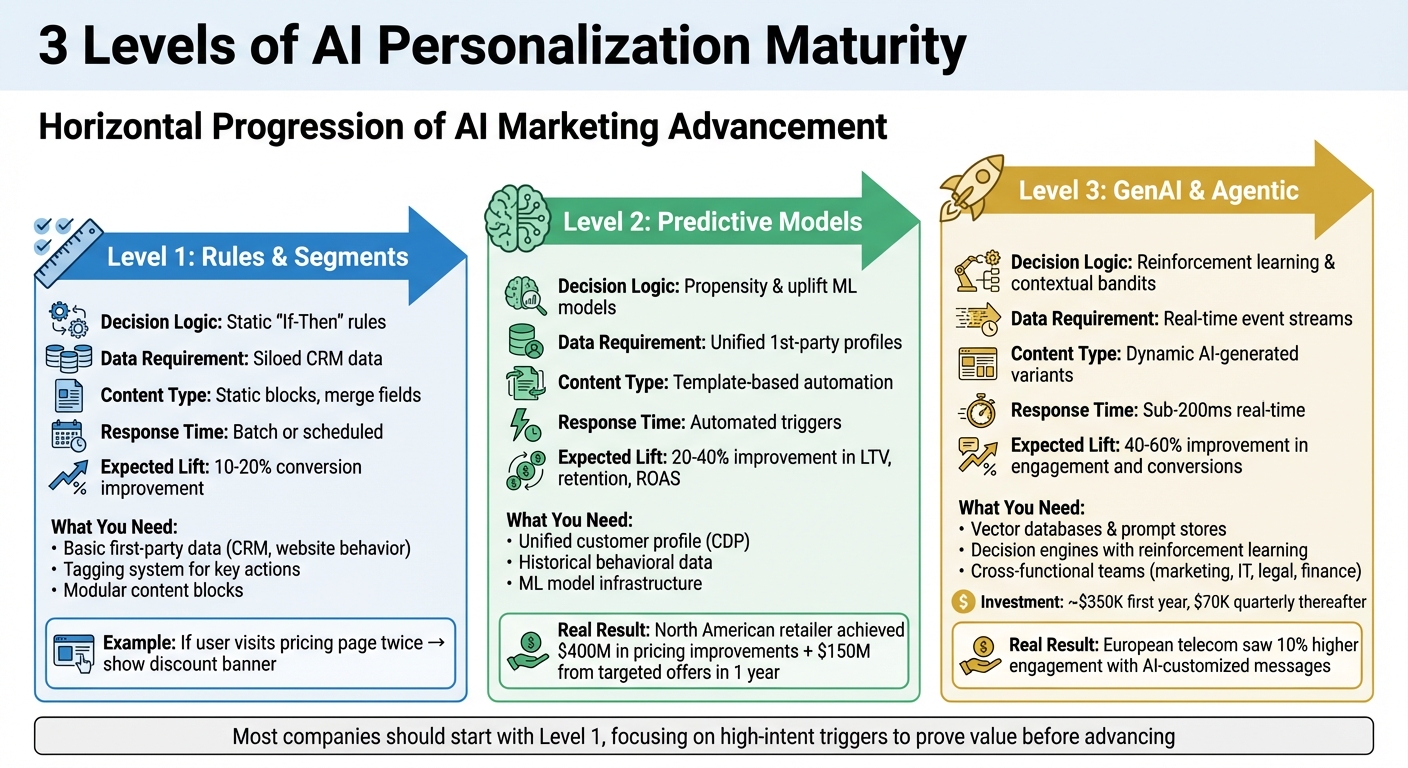
3 Levels of AI Marketing Personalization Maturity: From Rules-Based to Generative AI
Once your personalization stack is in place, understanding the different levels of maturity can help sharpen your AI strategy. Personalization grows in complexity, starting with basic segmentation and advancing to sophisticated AI-driven approaches.
The journey typically moves through three stages: rules-based targeting, predictive analytics, and finally, generative, agentic systems. Each stage demands unique data setups, decision-making frameworks, and content capabilities. For instance, in 2024, a European telecom company tested 2,000 SMS actions using machine learning to predict customer acceptance. When they incorporated generative AI to customize messages based on factors like age, gender, and data usage, engagement rose by 10% compared to generic content [10].
Progressing through these stages transforms how decisions are made. With the foundational personalization stack already established, each step forward refines your AI strategy further. The results? Tangible improvements. Personalization efforts typically deliver 5 to 8 times the ROI on marketing spend and can boost sales by over 10% [8].
Level 1: Rules and Segments
This is where most companies begin their personalization efforts. It involves creating static “if-then” rules. For example, if a user visits the pricing page twice, you might show them a discount banner. Or, if they’re in the healthcare sector, you could display hospital case studies. These rules are manually set, with broad audience segments and predefined content.
What you need: Basic first-party data (like CRM records or website behavior), a tagging system to track key actions, and modular content blocks that can be swapped based on simple criteria [5]. Data is often pulled using SQL queries, and audience segments are manually defined in email platforms or ad managers.
What you get: Quick implementation with minimal technical overhead. It’s effective for high-intent actions like cart abandonment or repeated visits to pricing pages [5]. However, scaling this approach can be challenging. Adding more rules makes the system harder to manage, and inefficiencies – like targeting users with ads for products they’ve just purchased – become more likely [10][8].
Expected lift: Conversion rates for targeted flows can improve by 10–20% compared to generic messaging if the right behavioral signals are used.
Level 2: Predictive Models
At this stage, manual rules are replaced with machine learning models that predict customer behavior. These propensity models estimate the likelihood of actions like purchases or churn, while uplift models identify who will be influenced by your messaging versus those who would act regardless [10][8].
What you need: A unified customer profile (often via a CDP), historical behavioral data, and the infrastructure to train and deploy machine learning models [8].
What you get: Targeting becomes much more precise, with automated triggers replacing manual processes. This allows for dynamic adjustments, such as tailoring promotions based on individual purchase histories [7][10]. For example, a North American retailer integrated legacy point-of-sale data with their marketing tools to identify product-customer overlaps. The result? $400 million in pricing improvements and $150 million from targeted offers in just one year [10].
Expected lift: Metrics like customer lifetime value (LTV), retention rates, and return on ad spend (ROAS) can improve by 20–40%. AI-powered campaigns often see a 10–25% increase in ROAS [2].
Level 3: Generative and Agentic Personalization
This is the most advanced stage. Generative AI doesn’t just select from pre-existing content – it creates new, tailored content on the fly based on real-time behavior and individual preferences. Agentic systems take it a step further, autonomously deciding what to test, which content performs best, and when to retire underperforming options [7][1].
What you need: Advanced tools like vector databases, prompt stores, and decision engines capable of reinforcement learning. These systems must respond in under 200 milliseconds [2][5]. Content needs to be modular – broken into smaller “Lego bricks” that AI can reassemble dynamically [7][5]. Cross-functional teams (including marketing, IT, legal, and finance) are also essential to ensure compliance and consistency [7].
What you get: The ability to deliver truly personalized experiences at scale. Instead of running occasional A/B tests, these systems continuously experiment with thousands of variations, using advanced methods like contextual bandits to optimize for profit [6][2]. Generative AI can create content 50 times faster than manual methods [10], while agentic systems enable real-time audience segmentation using natural language prompts instead of SQL [9][13].
Expected lift: Engagement and conversion metrics can improve by 40–60%, with some use cases delivering exceptional results. However, this level requires a significant upfront investment – around $350,000 in the first year, with $70,000 in quarterly costs thereafter [5].
| Maturity Level | Decision Logic | Data Requirement | Content Type | Response Time |
|---|---|---|---|---|
| Level 1: Rules & Segments | Static “If-Then” rules [5] | Siloed CRM data | Static blocks, merge fields | Batch or scheduled |
| Level 2: Predictive Models | Propensity & uplift ML models [10] | Unified 1st-party profiles [7] | Template-based automation | Automated triggers |
| Level 3: GenAI & Agentic | Reinforcement learning & bandits [2] | Real-time event streams [2] | Dynamic AI-generated variants [7] | Sub-200ms real-time [5] |
“The AI flywheel allows marketers to fully leverage the power of AI and shift their emphasis from the tactical and executional to the strategic.” – BCG [7]
Most companies should begin with Level 1, focusing on high-intent triggers to prove value. From there, they can gradually build the infrastructure needed for Level 2. Level 3 is ideal for organizations with advanced data systems, large-scale operations, and the ability to manage complex AI responsibly. This progression sets the stage for automating highly effective campaigns, as explored in the next section.
sbb-itb-e8c8399
What to Automate First: High-ROI Sequence
The returns on automation can vary, so it’s smart to start where it counts the most: high-intent behavioral triggers. These are moments when someone displays clear buying signals – like visiting your pricing page multiple times, completing a product configurator, or showing a sudden spike in product usage. Automating responses to these actions not only drives immediate revenue but also lays the groundwork for more advanced data-driven strategies down the line [5].
Start with Lifecycle Basics
The best place to begin is with tried-and-true lifecycle triggers: onboarding reminders, activation campaigns, trial-to-paid conversions, and renewal nudges. These workflows are designed to target users who are already engaged, making them far more likely to convert compared to reaching out to cold prospects. For instance, if a user visits your pricing page three times without requesting a demo, you can automatically send a personalized demo invitation. Or, if someone completes an ROI calculator but doesn’t submit, a follow-up email within an hour could seal the deal [5].
These types of campaigns have shown impressive results, including higher sign-up rates and improved cost efficiency [4]. Tailored customer journeys for distinct audience segments have also delivered measurable boosts in conversions and sales compared to more generic approaches [4].
In the first 30 days, aim to implement consent gating, integrate key data sources, and launch 2–3 high-impact triggers. This quick start not only demonstrates value early but also sets a strong foundation for scaling automation [5].
Once these initial triggers are running smoothly, you can shift focus to capturing mid-funnel opportunities.
Expand to Mid-Funnel Opportunities
After nailing the basics, it’s time to tackle mid-funnel tactics like abandoned cart emails, remarketing efforts, and cross-sell campaigns. These strategies target users who have shown interest but haven’t yet converted. A key approach here is leveraging propensity models to predict which users need a gentle nudge versus those who are likely to buy on their own. For example, instead of sending a blanket 20% discount to everyone, use AI to pinpoint customers who are most likely to respond to a smaller incentive, protecting your margins while driving sales [10].
Abandoned cart flows and remarketing campaigns have proven their worth, delivering strong incremental gains [10]. One European telecom used a next-best-action engine to test 2,000 personalized SMS campaigns. Customers who received AI-enhanced messages engaged 10% more often compared to those who got generic content [10].
Within 60 days, expand your efforts to include ad and email activations. Test AI-driven “next-best action” logic across multiple channels to refine your approach [5].
Once mid-funnel automation is in place, the next step is scaling real-time personalization to maximize engagement.
Scale Real-Time Personalization
Real-time personalization is the ultimate goal, though it’s also the most resource-intensive. This involves deploying dynamic content blocks – such as hero banners, testimonials, or pricing modules – that AI customizes in real time based on a user’s journey stage and intent score. For this to work seamlessly, the system needs to respond in less than 200 milliseconds [5].
Take Grubhub, for example. In 2025, they addressed low student adoption of their Campus program by creating a multi-stage onboarding journey with Braze Canvas. Instead of static welcome emails, they used adaptive orchestration to guide students toward key actions like linking campus cards. The results? An 836% ROI, a 20% increase in total orders, and a 188% boost in Grubhub+ Student signups [14]. Similarly, foodora used BrazeAI™ Intelligent Timing to optimize message delivery across email, push, and in-app channels. By reaching customers at the perfect moment, they achieved a 41% conversion rate, a 26% drop in unsubscribe rates, and a 6% uptick in push direct opens [14].
Measurement and Common Failure Modes
Key Metrics for Success
The real value of personalization lies in its ability to drive measurable changes in customer behavior. Metrics like click-through rates or impressions may look good on paper, but they don’t necessarily reflect meaningful outcomes. Instead, focus on whether your AI efforts are actually influencing customer actions. One of the most reliable ways to measure this is by using holdout groups. Set aside a portion of your audience – typically 10–20% – that doesn’t receive personalized experiences. Then, compare their conversion rates, revenue, and retention to those who do [5][3].
For example, in 2024, a North American retailer tested AI-driven targeted offers against broad, untargeted discounts. By running two-week A/B testing cycles and leveraging “promotion propensity” models, they achieved a 3% increase in annualized margins. This wasn’t from higher click rates but from cutting down on unnecessary discounts [10]. Similarly, a European telecom company used a next-best-action engine to personalize 2,000 SMS campaigns. Customers who received these AI-enhanced messages engaged 10% more frequently compared to a control group [10].
To fully understand the impact, track metrics like CAC (Customer Acquisition Cost), ROAS (Return on Ad Spend), conversion rates, and customer lifetime value. These measures can reveal a 300% ROI over 12 months and even a 50% reduction in CAC [3]. At the same time, keep an eye on guardrail metrics such as unsubscribe rates, complaint rates, and signs of message fatigue. These can indicate when personalization is crossing the line into annoyance. With success metrics in place, let’s explore common challenges and how to address them.
Common Challenges and Fixes
Even with robust measurement strategies, operational hurdles can derail your personalization efforts. One major issue is insufficient data signals. When data is messy, incomplete, or trapped in silos, it leads to irrelevant messaging that can erode customer trust [2][1]. The solution? Build a unified data foundation. A Customer Data Platform (CDP) can help consolidate information into a single, actionable customer profile [9][8].
Another pitfall is over-personalization. Bombarding customers with endless “relevant” ads can create an unsettling experience, making them feel surveilled rather than supported [8][10]. Combat this by setting frequency caps, adopting consent-first practices, and designing privacy protections that ensure customer consent is at the core of every interaction [5].
A lack of modular content can also slow down AI’s ability to deliver effective personalization. Without enough content variations, AI systems struggle to adapt and deploy personalized experiences efficiently.
Finally, insufficient governance poses risks like inaccurate claims or compliance issues. To prevent these problems, implement strong validation models to review AI-generated content before it reaches your audience [10][1].
Conclusion: The Practical Path Forward
AI-driven personalization isn’t about flipping a switch – it’s about creating a system that evolves from data to decisions to measurable growth. The process is simple in concept: bring all your customer data together, leverage AI to make smarter, more tailored choices, and evaluate the business outcomes. Each step builds on the last, ensuring a steady progression from foundational setup to real-time adaptability. The key is to take it step by step, rather than diving into advanced strategies too soon.
Begin with the basics. Personalization requires clean, unified first-party data and a solid consent framework. Interestingly, only 32% of marketers are satisfied with how they currently use customer data [9]. Start by establishing a single source of truth using a Customer Data Platform (CDP). From there, focus on creating modular content blocks that AI can dynamically assemble for personalized experiences.
Once your data and content are in place, shift your attention to scaling efforts through high-impact lifecycle moments. Prioritize areas like onboarding, trial conversions, and churn prevention – these “steady performers” consistently yield clear, measurable results.
After building scalable processes, the next step is real-time orchestration. At this stage, predictive models and AI tools take over routine tasks, allowing your team to focus on strategy and aligning with your brand’s vision. Companies leading in AI adoption report 60% higher revenue growth compared to their peers [7].
This journey requires patience and a methodical approach. Start with a technology assessment to spot gaps, run small, low-risk experiments, and assemble cross-functional teams that include IT, finance, and legal. AI personalization thrives when supported by a unified system for data, content, and measurement. By following this structured path, you can transform AI personalization from scattered tactics into a powerful, integrated growth engine.
FAQs
How can businesses ensure their AI marketing personalization complies with privacy laws like GDPR and CCPA?
To align with privacy laws like GDPR and CCPA, businesses must prioritize a privacy-first approach in how they collect and use data. Begin by securing clear and explicit consent from users before gathering personal information. Clearly document the purpose for collecting this data, and keep it to a minimum. Wherever possible, anonymize or pseudonymize data to add an extra layer of protection. Maintain a comprehensive inventory of all data collected and tracking tags, ensuring you can swiftly respond to user requests for access, deletion, or data portability.
Incorporate privacy governance into your AI workflows. This includes conducting risk assessments for automated decision-making models and being transparent about how data is used and how AI processes decisions. Use tools that enforce user opt-in and opt-out preferences, and implement safeguards like frequency caps, pre-approved content libraries, and regular audits to prevent compliance issues or misuse.
Creating a culture of proactive governance is essential – treat data privacy as a core business priority. Align teams from legal, marketing, and engineering under unified policies, and consistently monitor compliance efforts. By combining consent-driven strategies, transparency, and continuous oversight, businesses can take advantage of AI-driven personalization while adhering to regulatory standards.
What are the first steps to start AI-powered personalization if my business has limited data resources?
If your business is working with limited data, focus on laying a solid groundwork for AI-driven personalization. Start by gathering and organizing customer data from existing sources like your CRM or spreadsheets. Make sure each record includes a unique identifier, such as an email address or phone number, and confirm you have the proper consent for communication.
Next, implement basic event tracking – think page visits or email opens – to begin collecting valuable first-party data. This helps you understand customer behavior and preferences. Build modular content blocks that can be repurposed across emails, websites, or ads, and set up straightforward rules to determine which content variations should be shown to specific audience segments. A simple workflow tool can help automate actions, like sending a welcome email after a user signs up, while also managing frequency caps to avoid overwhelming your audience.
To get started with personalization, use rule-based segmentation. For example, group customers into categories like “new customers” or “inactive users.” Test personalized messages against a control group to see how they perform. As you see positive results and your data becomes richer, you can gradually incorporate predictive models to fine-tune your personalization efforts.
How do generative AI and agentic systems improve real-time personalization compared to traditional methods?
Generative AI and agentic systems are transforming how real-time personalization works, leaving behind the limitations of static rules and pre-set audience segments. Generative AI generates custom content – whether it’s text, visuals, or tailored offers – on the fly, adapting to an individual’s unique context and preferences without needing pre-written templates. Meanwhile, agentic systems elevate this by continuously analyzing interactions, determining the next-best action, conducting real-time experiments, and learning from the outcomes. This dynamic approach ensures that experiences stay relevant, even as customer behaviors shift.
In contrast, traditional methods depend on rigid rules or static models that can only cater to predefined segments. These approaches lack the flexibility to create new content or adapt in real time. By embracing generative AI and agentic systems, marketers can deliver deeply personalized, scalable, and ever-evolving 1:1 experiences that outperform the static, rule-based strategies of the past.