
If I had to sum this up in one line, I’d say this: set up your marketing system first, then automate the parts that repeat. It might surprise you to hear that many lean startups buy automation too early, then end up with bad routing, messy data, and reports nobody trusts.
Here’s the short version I’d want a founder friend to read first:
- AI marketing automation handles repeat tasks like email sequences, lead scoring, ad tweaks, and recurring reports
- AI marketing operations sets the rules behind the work, like lifecycle stages, lead routing, UTM naming, dashboard ownership, and campaign QA
- Automation helps after the workflow works by hand
- MOps matters hard once you have multiple people running campaigns and no clear owner for data or tools
- Around $1 million ARR, I’d lock down routing, attribution models, and reporting before adding more channels
- By the time a startup gets near $6 million ARR, tool sprawl and weak attribution often turn into a budget problem
- Teams often see 20% to 40% of campaign URLs drift from the set taxonomy, and that can skew attribution by 7% to 12%
- If a full-time hire is too much, outside help often lands around $5,000 to $12,000 per month
Think automation is the first move? Here’s why that trips teams up. Software speeds up whatever system you already have. If your CRM fields are messy or your lead stages are unclear, the tool just spreads that mess faster.
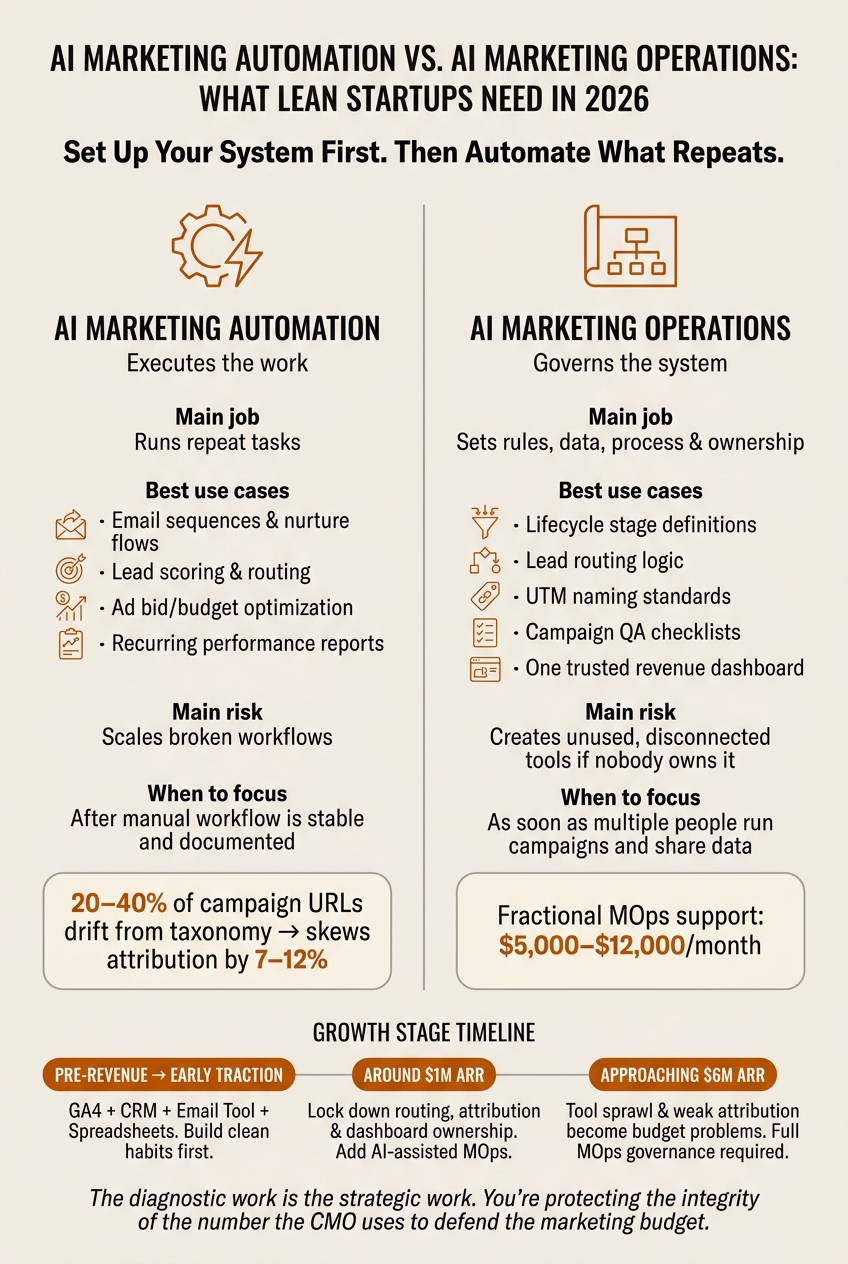
AI Marketing Automation vs. AI Marketing Operations: What Lean Startups Need in 2026
Scaling Marketing Operations with AI and Automation | Lessons from an Asana Expert
Quick Comparison
| Area | AI Marketing Automation | AI Marketing Operations |
|---|---|---|
| Main job | Runs repeat tasks | Sets rules, data, process, and ownership |
| Best use | Email flows, lead scoring, reports, ad updates | Lifecycle setup, routing logic, tracking rules, QA, revenue reporting |
| Main risk | It scales broken workflows | It can turn into unused tooling if nobody owns it |
| When I’d focus on it | After manual workflow is stable | As soon as campaigns involve multiple people and shared data |
| What lean teams need first | A few proven workflows | Clear stages, clean fields, UTMs, QA, and one trusted dashboard |
If you’re a lean startup in 2026, I’d keep the rule simple: buy simple tools early, clean up process fast, and use AI where it cuts manual work without adding confusion. Or put another way, the goal isn’t more software. It’s a system your team can trust.
AI Marketing Automation Explained: What It Does Well and Where It Breaks Down
AI marketing automation uses software to handle repetitive marketing tasks faster and more consistently than people [1]. In other words, it takes recurring work off your team’s plate. Think onboarding emails, lead scoring, ad optimization, and recurring performance reports. For lean teams, the appeal is simple: less manual work. That said, automation only helps when the system underneath it is clean.
Core Business Tasks AI Marketing Automation Can Handle
Automation does its best work on repeatable, trigger-based tasks. That usually includes:
- Lifecycle, nurture, and lead management: onboarding sequences, trial nurtures, re-engagement campaigns, lead scoring, segmentation, and routing leads to the right sales rep
- Content and ads: first-pass copy and basic bid or budget optimization
- Reporting: recurring dashboards without manual data pulls
The good news is that automation improves speed and consistency. However, it does not fix the workflow itself. If your lifecycle stages aren’t defined, or your tracking names and fields don’t match, automation just moves faster through a broken system [3].
Why Automating Too Early Causes Problems
It might surprise you to hear that one of the most common mistakes lean startups make is buying automation tools before the foundation is clean. Messy CRM fields, inconsistent UTM naming, and no clear reporting owner don’t go away once automation is in place. They scale [3][4].
You can see this in tracking tags. Over time, they often drift. Most marketing operations professionals see 20% to 40% of campaign URLs fail to match the set taxonomy [5]. Once that happens, attribution models can end up off by 7% to 12% in either direction [5].
The practical rule here is simple: only automate a workflow after it works manually and after someone has documented it [4]. When those basics are missing, the fix is marketing operations, not another automation tool.
AI Marketing Operations Explained: The System Behind Scalable Marketing
AI marketing operations (MOps) is the layer that connects people, process, data, governance, and tools so marketing stays repeatable, measurable, and scalable [1][3]. Marketing automation handles the tasks inside that system [1][4]. In other words, MOps is the setup automation relies on.
For lean startups, MOps is the minimum system that makes automation dependable.
The MOps Responsibilities Early-Stage Startups Actually Need
MOps starts to matter the moment several people run campaigns and nobody owns the tools or data [3].
Early-stage startups usually need five MOps basics:
| MOps Responsibility | What It Means in Practice |
|---|---|
| Lifecycle rules | Agreed-upon rules for when a lead becomes an MQL, SQL, or customer |
| Lead routing logic | Clear rules for which leads go to which rep, and when |
| Tracking standards | A shared UTM naming convention enforced across every campaign |
| Campaign QA checklists | A documented pre-launch process to catch broken links and missing tags |
| Revenue dashboard | One revenue dashboard the team trusts, connected to revenue, not just activity |
None of this calls for enterprise software. It calls for one owner who starts with the business problem and works backward [3].
AI now helps teams keep those rules clean and up to date.
How AI Changes Day-to-Day MOps Work in 2026
In 2026, a lot of MOps work still comes down to fixing sync errors, misrouted leads, and false MQLs [5]. AI speeds that up.
Current AI-assisted MOps use cases include field standardization for inconsistent CRM data, anomaly alerts that flag a sudden 60% drop in form submissions, automated dashboard prep with data sync, and prelaunch QA that checks for missing tracking tags before a campaign goes live [4][5]. The point isn’t more AI output. The point is cleaner data and fewer broken campaigns.
The governance side matters too. In 2026, MOps teams also help prevent drift in AI-generated outputs, which means they make sure AI-generated content stays on-brand and accurate over time [2]. However, that doesn’t mean piling on process. It means adding light review checks instead of turning AI on and hoping it works out.
That is the real divide: automation executes work, while MOps governs it.
AI Marketing Automation vs. AI Marketing Operations: Key Differences and How They Work Together
That distinction matters because lean startups need to choose the right layer first. Automation handles the execution. MOps sets the data, rules, and ownership that make that execution dependable.
The Clearest Way to Tell MOps and Marketing Automation Apart
The clearest way to separate them is simple: broken lead routing, messy tracking, and fuzzy reporting ownership are MOps problems, not automation problems. If the system underneath is off, adding another tool just makes the mess move faster.
| Layer | What It Does | Where It Breaks |
|---|---|---|
| Marketing Automation | Executes campaigns, nurtures leads, and schedules content | Automates broken workflows |
| Marketing Operations | Sets the rules, governs data, and owns the stack | Creates unused, disconnected tools |
A Lean Startup Model for Using Both Without Overbuilding
For lean teams, sequence matters more than tools. It might surprise you to hear that a simple three-phase model is often enough to keep teams from overbuilding [3].
- Define funnel stages and lead ownership first before any workflow goes live.
- Standardize UTMs and CRM fields next so each campaign produces clean, comparable data.
- Automate only repeatable work like nurture sequences, lead assignment, and form follow-ups once the base is stable.
That sequence is what stops startups from buying tools before they have the habits in place to use them well.
What to Build vs. Buy at Each Stage, Plus the Minimum 2026 Stack
The right stack changes with stage. Early on, teams need good habits before they need more software. In other words, process comes first, then tools that help the team stick to it.
Pre-Revenue to Early Traction: Buy Simple Tools, Build Clean Operating Habits
Start with process clarity. Set qualification rules, standardize UTMs, and give one person clear CRM ownership before you automate anything.
Keep the tool set small:
- GA4 for analytics
- a CRM
- a simple email tool
- spreadsheets for reporting
That setup is enough for most early teams. Most B2B marketing teams already use 13+ tools [4], but early-stage startups usually don’t need that kind of stack. More tools at this point often mean more mess, not more output.
Once those habits are stable, B2B marketing automation helps speed up work without spreading bad data or broken workflows across the whole system.
Around $1M ARR and Up: Add AI-Assisted MOps Before Adding More Channels
Around $1M ARR, the job changes. Now the issue isn’t just convenience. It’s control over data, routing, and attribution.
This is the stage to lock down lead routing, lifecycle governance, cross-channel attribution tools, and dashboard ownership before you add another channel or tool. The growth-stage minimum stack usually includes a marketing automation platform, CRM, CDP, and lead-routing tool [5].
If a full-time MOps hire doesn’t fit the budget yet, fractional support can close the gap. Expect $5,000 to $12,000 per month for help that sets up the core systems and trains your current team [4]. The good news is you don’t need a huge in-house function to get this right.
What Lean Startups Actually Need in 2026
The rule is simple: build the operating model, buy standardized automation, and add AI where it cuts manual work.
AI marketing automation works best on repeat tasks like email scheduling and database updates. However, most lean startups need a small MOps base before they buy more automation, not after. Think common belief? Here’s why that matters: software can speed up clean systems, but it also speeds up confusion.
"The diagnostic work is the strategic work. You’re protecting the integrity of the number the CMO uses to defend the marketing budget." [5]
That quote gets to the heart of MOps. The sequence matters more than the tool list, because the stack only works if the team knows how the system should run.
FAQs
best AI marketing automation tools
For lean startups in 2026, the best AI marketing automation tools are the ones that plug straight into your CRM and marketing data. Standalone apps can look slick, but connected systems usually win because they can act on the data you already trust.
Strong options include HubSpot, Salesforce Marketing Cloud Account Engagement, Braze, and Segment. The smart way to choose is pretty simple: look hard at integration depth, governance like RBAC, audit logs, and sandboxing, and execution that still keeps a human in the approval loop.
Start with your data foundation. Clean that up first, then automate connected workflows like lead routing, data hygiene, and reporting.
best AI marketing operations automation frameworks
A strong AI marketing operations automation framework has five layers: Capture, Enrich, Route, Execute, and Report. That structure gives teams a steady way to run workflows, instead of relying on tribal knowledge or whoever happens to remember how things work.
Start with repetitive, high-revenue workflows first. In most teams, that means lead routing, data hygiene, and lifecycle triggers. These are the jobs that eat up time, create errors when handled by hand, and have a direct effect on pipeline.
A few ground rules make this work:
- Keep a workflow registry so people can see what runs, when it runs, and who owns it
- Use rule-based routing and approval gates to keep decisions consistent
- Apply governance with least-privilege access, audit trails, and clear brand and data policies
In other words, the goal is simple: build a system people can trust, repeat, and improve without guesswork.
best AI marketing operations automation tools business tasks
For lean startups, the best AI marketing ops automation tools connect the workflows that matter most: lead capture, data enrichment, lead routing, campaign execution, and reporting.
Start with repetitive, rules-based work that has clear ROI. That usually means lead scoring, data hygiene, and lifecycle triggers. These are the jobs that eat up time, follow set logic, and can show payoff fast.
It also helps to pick systems with strong governance guardrails. Look for role-based access, audit trails, and human approval gates so your team keeps control as automation does more of the work.
Related Blog Posts
- 5 Ways AI Can Optimize Marketing ROI for your Tech Startup
- We Have Agentic AI For Marketing… So Why Does GTM Still Feel So Manual?
- The AI Marketing Operations Operating System: How Lean Teams Run MOps Without a Big Team
- AI Marketing Operations Automation Benchmarks 2026 (Adoption, Workflows Automated, Hours Saved, ROI)