
You don’t need a big MOps team to run clean marketing systems. You need clear owners, clean data flow, tight rules, and a review rhythm that turns activity into decisions.
I’d sum the whole article up like this: if your team can run capture → enrich → route → execute → report with clear approvals and a simple workflow log, you can ship faster, cut duplicate records, and trust your pipeline numbers more. The article points to concrete results like 90% on-time campaign launches, a 42% drop in duplicate records, and a cost gap between a full-time MOps hire at $120,000 to $180,000+ per year versus fractional support at $42,000 to $66,000 per year.
Here’s the simple version:
- Capture buyer data from forms, CRM, MAP, and intent sources
- Enrich records so routing rules don’t fail on bad data
- Route leads and work by rule instead of inbox chaos
- Execute campaigns with templates, QA, approvals, and spend checks
- Report on a fixed rhythm so dashboards lead to action
- Govern the whole system with role-based approvals, least-privilege access, consent checks, and an audit trail
- Assign 3 roles across the system: one owner for business outcomes, one operator for workflows, and one owner for reporting
- Roll it out in 90 days by fixing inputs first, then workflows, then scorecards and review rules
It might surprise you to hear that most lean teams don’t hit a tool limit first. They hit a system limit. In other words, this article is about how I’d use a GTM Engineering approach to set up the rules, workflow map, and decision cadence that let a small B2B team run MOps without adding a big team.
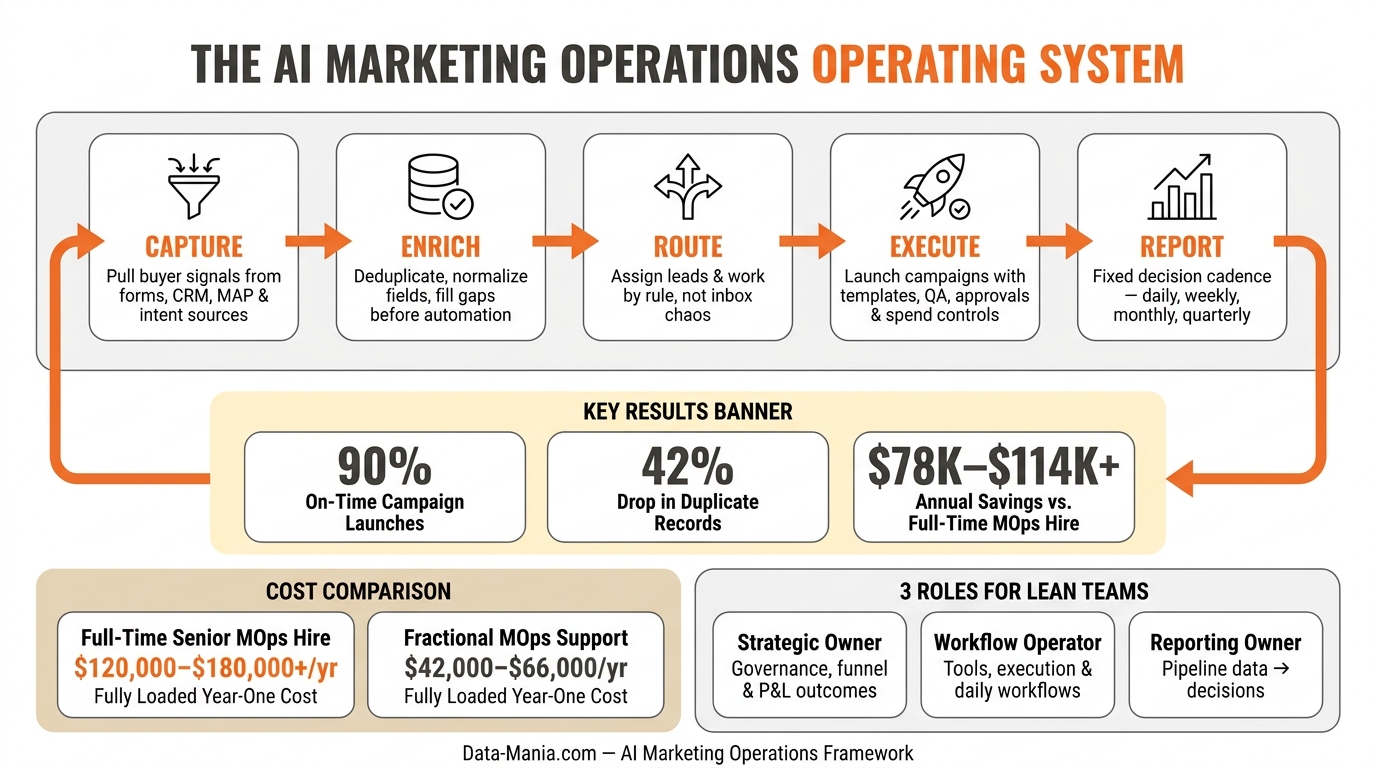
AI Marketing Ops Operating System: 5-Layer Framework for Lean Teams
The Five Layers of the AI Marketing Operations Framework
The five layers work like a chain. Clean intake sets up clean routing, clean execution, and clean reporting. The goal isn’t automation for its own sake. It’s to help a small team run steady MOps without adding headcount.
Capture and Enrich: Turn Buyer Signals Into Clean, Usable Records
This starts with turning messy buyer signals into records the rest of the stack can trust.
Capture pulls in buyer signals from forms, CRM, MAP events, and intent data [8][7]. Enrich deduplicates records, normalizes fields, and fills gaps before automation starts [4][7]. Bad data breaks routing.
For small volumes, manual enrichment still works well. If you need a balance of speed and governance, AI-assisted enrichment is usually the better fit. Full automation makes sense when evals are done and guardrails are already in place.
Route and Execute: Route Work and Launch With Control
Once the record is clean, routing can assign it without manual cleanup or owner confusion. In other words, routing only works well when enrichment does its job first. Clean the record first, then move the work.
Route assigns the record by rule. Execute launches the work with templates, QA, approvals, and budget controls [8][4]. A pre-flight checklist for links, tracking, and syncs cuts rework [8][4].
| Feature | Manual Routing | Rule-Based Routing | AI-Scored + Human Approval |
|---|---|---|---|
| Speed-to-Lead | Slow (Hours/Days) | Fast (Seconds) | Near-Instant |
| Auditability | Low (Tribal knowledge) | High (Log-based) | High (Traceable logic) |
| Headcount | High | Low (Admin only) | Minimal (Operator only) |
Report: Build a Decision Cadence, Not Just Dashboards
After execution, the system should feed a recurring decision cadence, not just sit there as a dashboard. That shift matters. A dashboard shows what happened. A cadence helps your team decide what to do next.
Reporting should protect data integrity and support budget decisions. It closes the loop by turning workflow data into daily, weekly, monthly, and quarterly decisions.
| Cadence | Audience | Decisions Supported | Automation | Key Metrics |
|---|---|---|---|---|
| Daily | MOps/SDR Managers | Triage, sync errors, form health | High (Alerts) | Lead volume, sync lag, error logs |
| Weekly | Marketing Team | Campaign optimization, SLAs | Medium (Dashboards) | MQLs, SQLs, cycle time, QA |
| Monthly | CMO/VP Marketing | Budget reallocation, ICP shifts | Low (Diagnosis) | Pipeline velocity, CAC, LTV |
| Quarterly | CEO/Board | GTM strategy, headcount, stack | Manual (Strategic) | Revenue ROI, market share, payback |
The next layer is control: permissions, security, and workflow registry.
Governance Across the System: Permissions, Data Security, and Workflow Registry
Governance is what keeps AI automation safe. It sets clear permissions, puts security guardrails in place, and gives the team a workflow registry they can trust. In a five-layer model, each layer creates a decision point. Governance decides who owns that point and how they use it across capture, enrich, route, execute, and report.
Workflow Permissions That Prevent Costly Mistakes
Each action in the system carries its own risk level. Read access sits on the low end. Publishing campaigns and reallocating budget sit on the high end. The fix is simple: align permission levels with risk.
Read access can go to operators across the team. Publish and spend actions should sit behind explicit role-based approval, so only named people can trigger them. For AI-assisted actions, add one more approval step: the AI drafts or scores, and a human confirms before anything goes live. That cuts the risk of missed sends, bad syncs, and unapproved spend [3].
This is how lean teams automate without giving up control. You keep the upside of automation, and you stop AI-assisted actions from triggering sends, syncs, or spend on their own.
Data-Security Guardrails for AI-Assisted MOps
Use security guardrails that protect speed instead of slowing everything down. Start with brand rules and data rules.
Then apply least-privilege access. Each AI tool or integration should only touch the data it needs to do its job. Pair that with data minimization. If you do not use a field, do not store it. Set retention windows so old records do not pile up and add risk. Every AI-assisted action should also write to an audit trail.
In U.S. markets, consent and opt-out handling need direct attention. Build those controls into the workflow from the start. Audit hidden fields like UTM parameters, IP enrichment flags, and consent checkboxes on a regular basis so you know they still track the right way. When campaign URLs drift from taxonomy, attribution breaks [7].
The Workflow Registry Every Lean Team Should Maintain
A workflow registry is a living record of every automated workflow. It keeps turnover from resetting the system, and it preserves the operating model when people or workflows change.
Each entry should include seven things:
- the trigger
- the owner
- the inputs
- the outputs
- the approval step
- the impact
- the failure risk
Writing down what breaks, and what happens downstream when it breaks, forces clear thinking. It also shows where human oversight is non-negotiable.
The table below maps the five layers against the governance variables that matter most for a lean team:
| Layer | Approvals Required | Data Sensitivity | AI Use | Owner |
|---|---|---|---|---|
| Capture | Low (Standardized) | High (PII) | Low (Enrichment) | MOps Manager |
| Enrich | Medium (Vendor) | High (PII) | High (Scoring) | Data Analyst |
| Route | High (SLA-based) | Medium | Medium (Logic) | Sales Ops |
| Execute | High (Human-in-loop) | Low | High (Generative) | Campaign Lead |
| Report | Medium (Audit) | High (Revenue) | Medium (Analysis) | CMO / VP Ops |
Review the registry every week to catch operational variance. Then review it every 90 days to measure ROI and update entries as workflows change. A registry with no review process turns into a liability fast. The next section shows how a lean team owns this system day to day.
How Lean Startups Run This System Without a Big Team
Governance works when every layer has a clear owner. Lean teams make that happen by assigning ownership across the five layers, not by building a full MOps department from day one.
The Minimum Team Structure for AI-Run MOps
A lean team needs three clearly defined roles: a strategic owner, a workflow operator, and a reporting owner [2][9].
In early-stage companies, one person often handles two of those roles at the same time [2][10]. The strategic owner sets governance and owns funnel and P&L outcomes. The workflow operator runs the tools and handles execution. The reporting owner turns pipeline data into decisions. Put another way, these three roles cover the five-layer system without the overhead of a full MOps team.
The cost gap is hard to ignore. AI-run marketing stacks can operate for under $1,000 per month, while replacing manual work that once cost more than $245,000 in annual salaries [2].
A 90-Day Rollout Plan a Fractional CMO Can Lead
The rollout follows the same flow as the framework: capture, enrich, route, execute, report.
| Phase | Timeline | Focus | Key Deliverables |
|---|---|---|---|
| Capture | Days 1–30 | Capture & Intake | Audit the stack, document lifecycle stages, define SLAs, and log CRM-to-MAP sync errors [4][5] |
| Enrich, Route, Execute | Days 31–60 | Enrich, Route & Execute | Implement routing rules, build 3–5 reusable AI-assisted campaign templates, and enable consent/preferences [4] |
| Report, Govern | Days 61–90 | Report & Govern | Publish a weekly pipeline scorecard, reach ≥80% SLA adherence, and reduce duplicate record rates [4] |
The first 30 days should stay focused on the basics. Find routing gaps, sync lag, and broken forms before you add more automation. That order matters because bad inputs will wreck even the smartest workflow.
In May 2026, a 60-person SaaS firm used this approach to standardize intake and fix CRM-to-MAP syncs. The result was 90% on-time campaign launches and a 42% drop in duplicate records within four months [4]. That’s the kind of progress lean teams need: simple fixes first, then scale what works.
How Data-Mania Supports This Operating Model

That operating model is what Data-Mania helps put in place. Data-Mania supports this model through Fractional CMO, GTM Engineering, Growth Marketing Consulting, and KPI Reporting, covering strategy, workflow design, execution, and reporting [2][6][10].
For 5- to 50-person teams, this keeps strategy, execution, and reporting inside one operating model.
Conclusion: The Operating System That Lets MOps Scale Before Headcount Does
The five-layer framework, capture → enrich → route → execute → report, gives marketing ops a system you can run again and again. It makes the work repeatable, auditable, and ready to grow without adding headcount. The loop only closes when reporting leads to action. A weekly decision rhythm turns dashboards into actual decisions, and when variances get flagged and fixes get proposed before leadership reviews the dashboard, the system is doing its job [1].
That’s what leads to faster handoffs, cleaner reporting, and fewer operational failures.
The cost case is pretty straightforward. A full-time senior MOps hire usually costs $120,000 to $180,000+ fully loaded in year one, while a fractional engagement often lands between $42,000 and $66,000 per year [6]. For AI-driven organizations, choosing the right fractional CMO companies ensures the system is built for scale from day one. In other words, the gap goes beyond salary. The bigger win is the operating model you still have after the work is in place.
Lean teams usually don’t need more headcount first. They need a clear system where every layer has an owner, every workflow has a guardrail, and every report drives a decision. That is the operating system.
FAQs
What does an AI marketing operations framework include?
An AI marketing operations framework is a documented system that helps you run and automate marketing ops the same way every time, without depending on one person to save the day.
In other words, it gives your team a shared way to work. That matters fast when AI starts touching workflows, data, approvals, and reporting across the stack.
It usually includes:
- Governance and permissions
- Workflow architecture
- Data and taxonomy standards
- Reporting cadence
- Enablement through runbooks, templates, and training
How can a lean team assign MOps ownership without hiring a full team?
Use a system-first approach so your marketing ops setup doesn’t depend on one person holding everything in their head. A fractional Marketing Operations leader or consultant can put that operating system in place, with governance, clear accountability, and documented processes.
From there, your internal team can take over with runbooks, training, and a clear roadmap. In other words, the capability stays with the company instead of walking out the door with any one hire.
What guardrails should we set before automating marketing workflows?
Before you automate marketing workflows, set up light governance that keeps your team moving fast without slowing everything down with compliance reviews. Put security checklists, brand guardrails, and data policies in place early so you can cut risk and stop shadow AI before it spreads.
You’ll also want clear quality-assurance gates, a shared taxonomy and naming system, approval tiers, and steady versioning habits. In other words, these basics help workflows stay stable, compliant, and easy to maintain as your team grows.