
If your GTM still slows down when you step away, your AI stack is doing tasks, not running the system. I see this pattern all the time: founders add AI for research, outbound, content, and reporting, yet they still move data between tools, fix broken outputs, and decide each next step by hand.
Here’s the short version:
- More AI tools do not remove manual work when handoffs still break
- Bad CRM data blocks automation, and the article cites 73% of CRM records in growth-stage companies missing structured intent data
- Most AI pilots miss business impact, with 95% of enterprise AI pilots showing no measurable P&L effect
- Teams that get more from AI are 2.8x more likely to redesign workflows before they automate
- AI-native GTM means the pipeline keeps moving with limited founder input, while people focus on judgment, relationships, and edge cases
- The fastest way to check your setup is to look at:
- what stops when you go offline
- where buyer signals get lost
- which workflows still wait for your approval
- whether outcomes improve, not just activity
It might surprise you to hear that the article’s main point is very simple: the bottleneck sits between the tools. In other words, if your prospecting, follow-up, reporting, and CRM hygiene still depend on you, your setup is AI-busy, not AI-native.
A quick self-check from the article:
| Check | AI-busy setup | AI-native setup |
|---|---|---|
| Data | Siloed and messy | Unified and machine-readable |
| Workflow | Manual handoffs across many tools | Connected loops that move signals automatically |
| Founder role | Glue between steps | Rules, limits, and judgment |
| Success metric | Emails sent, tasks done | Pipeline speed, conversion, ARR per head |
The article also lays out a 4-stage maturity model from tool-centric to AI-native, then points to the workflows that usually expose manual drag first: prospecting, personalization, follow-up, reporting, feedback loops, and CRM cleanup.
If you want the simplest takeaway, it’s this: design the workflow first, then add the next agent.
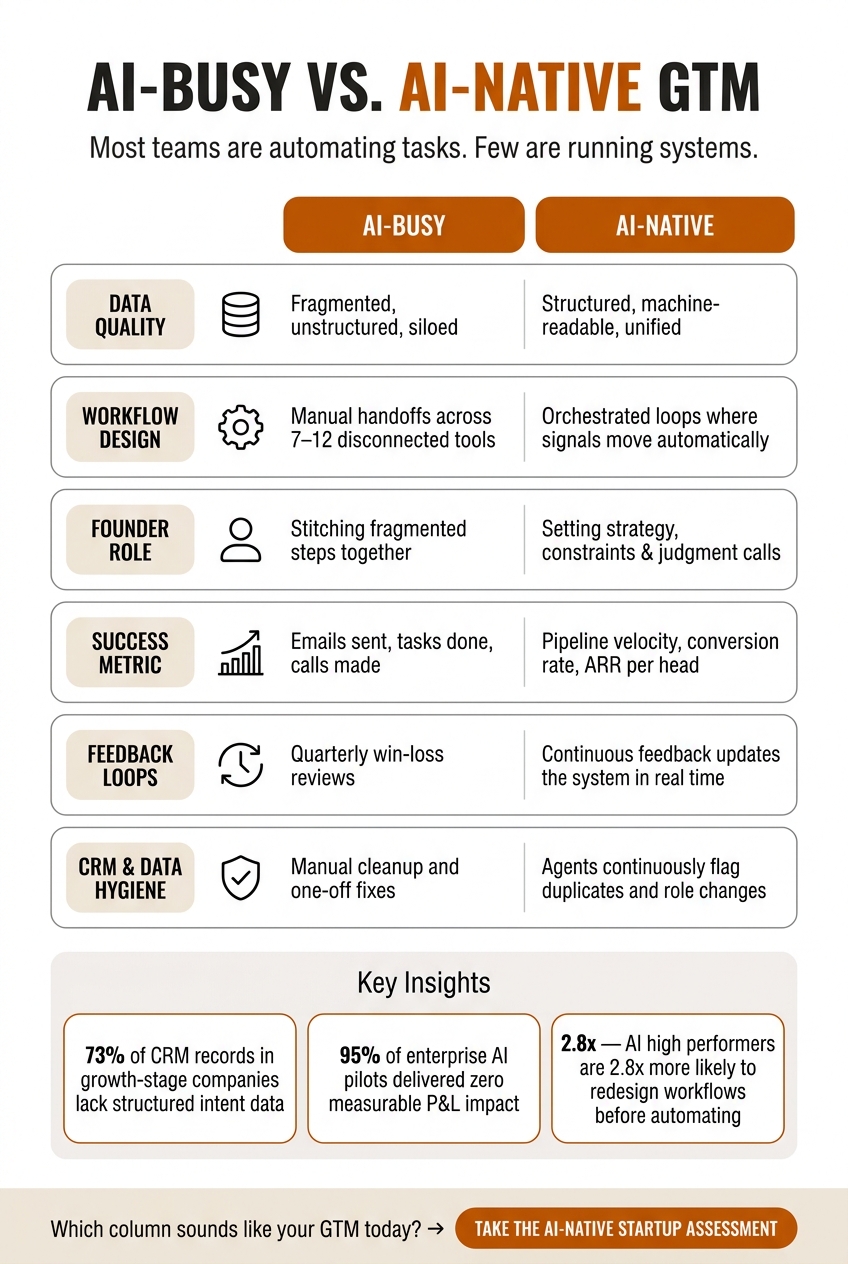
AI-Busy vs AI-Native GTM: Which System Are You Running?
Why GTM still feels manual even with agentic AI
The work breaks between the tools
That founder story gets to the real issue: the workflow breaks between systems.
Most GTM teams use 7 to 12 disconnected tools[2][3]. Because of that, the customer story doesn’t move cleanly from one step to the next. On paper, the system looks automated. In practice, the founder still has to carry the signal across each handoff.
An agent can handle one task. It can’t fix broken handoffs across the whole workflow. AI didn’t create those gaps. It just made them easier to see because manual work used to cover them up[2]. This is a workflow problem, not a tool problem.
The handoffs still need a person to move data, read signals, and decide what happens next.
More automation can still mean more founder work
Adding more automation can increase the founder’s workload, at least in the near term.
Agents produce output. Someone still has to review it, fix it, and send it to the right place. If your CRM data is unstructured, the problem gets worse. 73% of CRM records in growth-stage companies lack structured intent data[2], which means no agent can read pipeline health with much confidence.
So what happens? You review AI-written messages before they send. You clean lists before a sequence starts. You manually interpret reports that should be telling you what to do next.
That’s why the promise of agentic AI in marketing keeps hitting the same wall: the workflow under it was never ready.
What research says about the AI value gap
The data is pretty blunt. 95% of enterprise AI pilots delivered zero measurable P&L impact because companies automated before they had clean data, defined processes, or a validated ICP[3]. In other words, they added AI before they fixed the workflow.
Teams buy the tools, run the pilots, and move on without rebuilding the process around what AI is good at. The result is a lot of activity and very little measurable outcome. AI-high performers are 2.8x more likely to redesign workflows before automating than companies that lag on AI value[3].
The math here is simple. If your GTM process is fragmented before you add an agent, the agent speeds up the fragmentation. It doesn’t fix it.
So the better question isn’t which agent should I add next. It’s what does my process actually look like under the tools I already have?
That’s the real check: whether the workflow an agent enters can run without you.
So the next question is simple: what does an AI-native GTM system look like in practice?
What an AI-native GTM system actually looks like
AI-native means GTM runs without constant founder input
So what does AI-native look like when it works?
An AI-native GTM system keeps moving without you piecing it together by hand. Acquisition, qualification, follow-up, reporting, and customer insight loops work as one connected system. Your team spends time on judgment, strategy, and relationships instead of moving data between tools or deciding the next step every few minutes.
The difference isn’t the number of tools. AI-native means AI sits inside the pipeline, not beside it [1].
Verkada shows what that can look like. In 2026, they automated 80% of their SDR workflows with AI agents. Their MDRs now step in only when a prospect responds, which generates about 120 meetings per month versus the industry average of 20 in a typical SDR setup [3].
4 signals to check first
Before you look at your tools, look at your workflow. These four signals tell you a lot, fast:
- What stops when you step away? If your pipeline slows down the second you’re offline, the system depends on you.
- Where do customer signals get lost? In most messy stacks, signals from sales calls, product usage, and support tickets never make it to the people who shape GTM decisions.
- Which workflows still need your approval before they move? If you’re still cleaning lists before sequences start or translating reports that should make sense on their own, that’s a workflow design issue.
- Do your tools drive outcomes? Look at pipeline velocity, conversion rate, CAC, and expansion revenue. If the stack only creates more activity with no clear path to business results, that’s your answer.
There’s a gap here that trips up a lot of teams. 58% of GTM leaders describe their execution as "very efficient", yet 47% simultaneously cite data quality and unification as their primary performance barrier [6]. Efficiency and cohesion are not the same thing.
If that sounds familiar, take the AI-Native Startup Assessment to see where your GTM system still breaks apart.
AI-busy vs. AI-native GTM: a side-by-side check
Use this as a quick self-check. Be honest about which column sounds more like your system today.
| Dimension | AI-Busy | AI-Native |
|---|---|---|
| Data quality | Fragmented, unstructured, siloed [2] | Structured, machine-readable, unified [2] |
| Workflow design | Manual handoffs between 7-12 tools [2] | Orchestrated loops where signals move on their own [2] |
| Ownership | Ad hoc tool use [3] | Clear owner and operating model [3] |
| Founder role | Stitching fragmented steps together | Setting strategy, constraints, and judgment calls [4] |
| Measurable outcomes | Activity volume, emails sent, calls made [2] | Pipeline velocity, conversion rate, ARR per head [3] |
| Feedback loops | Quarterly win-loss reviews | Feedback updates the system all the time [2] |
If your stack still looks like the left column, the next move is to measure how mature the workflow is.
How to check the maturity of your GTM automation
A 4-stage maturity model for AI workflow automation
Use this model to find your current stage. Then look for the places where your GTM still leans on human glue.
| Maturity Stage | What It Looks Like | Founder Role | Manual Intervention |
|---|---|---|---|
| 1. Tool-Centric | AI handles isolated tasks, one prompt and one output | Triggers every action and does the thinking | High |
| 2. Semi-Automated | Workflows are connected, but handoffs still break easily | Manages most handoffs manually | Medium-High |
| 3. Workflow-Driven | Orchestrated multi-step chains move data from signal to action | Designs the path and monitors execution | Low |
| 4. AI-Native | Agents read pipeline state and act within set boundaries | Sets strategy, constraints, and review gates | Minimal |
If you’re still the person stitching workflows together, you’re not at Stage 3 yet. In an AI-native system, your job shifts. You set the rules at the edge instead of translating between every step.
Once you know your stage, check the workflows that crack first. That’s usually where founder dependence hides in plain sight.
Start with the workflows that expose the most founder dependence
These are the fastest places to spot manual drag.
Prospecting usually shows the problem first. If reps still browse LinkedIn and news by hand to build lists, that’s Stage 1 behavior. A stronger setup uses agents to spot buying signals and enrich records before a human steps in.
Personalization gives you a clean test of workflow maturity. If outreach still runs on a generic mail merge, your system is doing the bare minimum. A stronger workflow creates behavior-based drafts that point to specific buyer actions.
Outbound follow-up is where many stacks quietly fall apart. Static sequences keep firing no matter what the buyer does. A workflow-driven system routes follow-up based on intent signals, not just a timer.
Reporting and feedback loops show whether the system learns or just repeats. If feedback reaches your team too late, your ICP model stays behind the market. Mature systems push outcome data back into scoring models all the time. AI-recommended accounts in closed-loop systems show a 2.3x higher close rate than rep-selected accounts [2].
CRM hygiene is the hidden tax. CRM data accuracy decays by roughly 25%–30% every year [5]. If nobody owns cleanup as a steady process, every downstream agent works from bad inputs.
| Workflow | Immature Signal | Mature Signal |
|---|---|---|
| Prospecting | Manual LinkedIn and news research | Agents detect signals and enrich records |
| Personalization | Generic mail merge with name and industry | Behavioral-based drafts referencing specific buyer actions |
| Outbound follow-up | Same sequence for every contact | Dynamic routing based on intent signals |
| Reporting | Feedback updates too slowly | Continuous feedback loops where wins update the ICP model |
| CRM updates / Data hygiene | Manual cleanup and one-off fixes | Agents continuously flag duplicates and role changes |
| Feedback | Vague loss reasons like "price" or "timing" | Structured categories that continuously refine the model |
Now map those gaps against your own GTM. Before you hire another SDR or spin up another agent, take the AI-Native Startup Assessment and see which workflow is still holding your GTM together.
GTM Pro: How to Actually Make AI Agents Work in GTM | ZoomInfo
Conclusion: Design the workflow before you deploy the next agent
Agentic AI for marketing will only scale the workflow you already have. If your handoffs are messy, you’ll just get messy output at a higher speed. The problem isn’t the model. It’s the system the model walks into.
That’s the trap. More agents won’t fix weak workflow design. The bottleneck sits in the workflow under the agents.
The numbers show the same pattern. Research keeps pointing to one issue: teams automate before they fix their data and workflow [2][3].
So the next step is simple. Check your system before you add more. Before you add another agent, tool, channel, or hire, take the AI-Native Startup Assessment and see whether your GTM engine is actually AI-native or just AI-busy.
Your GTM doesn’t need more automation. It needs the right GTM architecture first. Then the agents can do their job.
FAQs
How do I know if my GTM is AI-native?
Your GTM is AI-native when AI sits inside the system itself, not when it shows up as a bolt-on that helps with one-off tasks. In practice, three signs usually tell you what camp you’re in: unified data, clear rules for what AI owns versus what still needs human judgment, and feedback loops that sharpen targeting and messaging on their own.
In other words, AI-native GTM feels less like a pile of tools and more like a machine that can run with less hand-holding. Data flows into one place. The system knows where automation should act and where a person should step in. Results feed back into the process, so the next campaign gets a little smarter without someone rebuilding the whole thing by hand.
However, if you’re still the person who connects the insights, fixes the outputs, and holds the workflow together, that’s a different picture. You’re likely AI-busy, not AI-native.
What should I fix before adding another AI agent?
Before you add another AI agent, fix your data and operations first. If your process is fragmented, manual, or unclear, another agent will just scale the mess.
Focus on a few basics:
- Unified customer data
- Clear workflow rules and human handoffs
- Controls for reviewing decisions
- Visibility into agent actions
In other words, get your GTM engine in order before you pile on more tools. The challenge here is simple: are you building something AI-native, or are you just keeping your team AI-busy?
Which GTM workflow should I automate first?
Before you automate any workflow, build a unified data foundation first. That step matters because agents will amplify whatever is already in the system, including fragmented data and process gaps.
From there, start with repetitive, data-heavy work that your team handles in uneven ways. Good early candidates include research, personalization, and data hygiene.
Turn those tasks into repeatable, orchestrated sequences first. In other words, get the flow stable before you hand more control to fully autonomous agents.