
Marketing teams in 2026 are turning to pre-built AI agents to scale their efforts without adding headcount. These agents don’t just automate tasks. They make decisions, manage campaigns, and adapt to new inputs. From boosting lead generation to personalizing content, they’re helping teams work faster and smarter.
I’m Lillian Pierson, a fractional CMO who’s educated 45,400 people on building AI-native growth and marketing systems. My evaluation framework puts autonomy over assistance and integration depth over flashy features. Most of the 35 below fail on the second one.
Key highlights:
- AI agents are categorized into 7 types based on their functions:
- Signal & Lifecycle Agents: Track customer journeys and trigger actions like nurturing or churn prevention.
- Signal & GTM Agents: Turn intent signals into outreach campaigns, scaling efforts like account-based marketing.
- Signal & Attribution Agents: Analyze fragmented data and act on it to optimize pipeline performance and ROI.
- Signal & Website Agents: Identify and qualify website visitors, routing leads or automating engagement.
- Research & Enrichment/Outreach Agents: Automate lead research, contact discovery, and personalized outreach.
- Personalization & Content/Creative Agents: Generate tailored content like emails, landing pages, and ads.
- Orchestration Agents: Coordinate multiple AI tools and workflows for seamless marketing execution.
Why it matters:
Companies like RingCentral and Vividly have already seen results, achieving up to 80% faster content creation and 32× ABM growth without adding staff. The key is choosing the right agents that integrate well with your tools and align with your goals.
Quick tip: Start with one high-impact agent for tasks like lead enrichment or customer nurturing. Then, scale up as you see results.
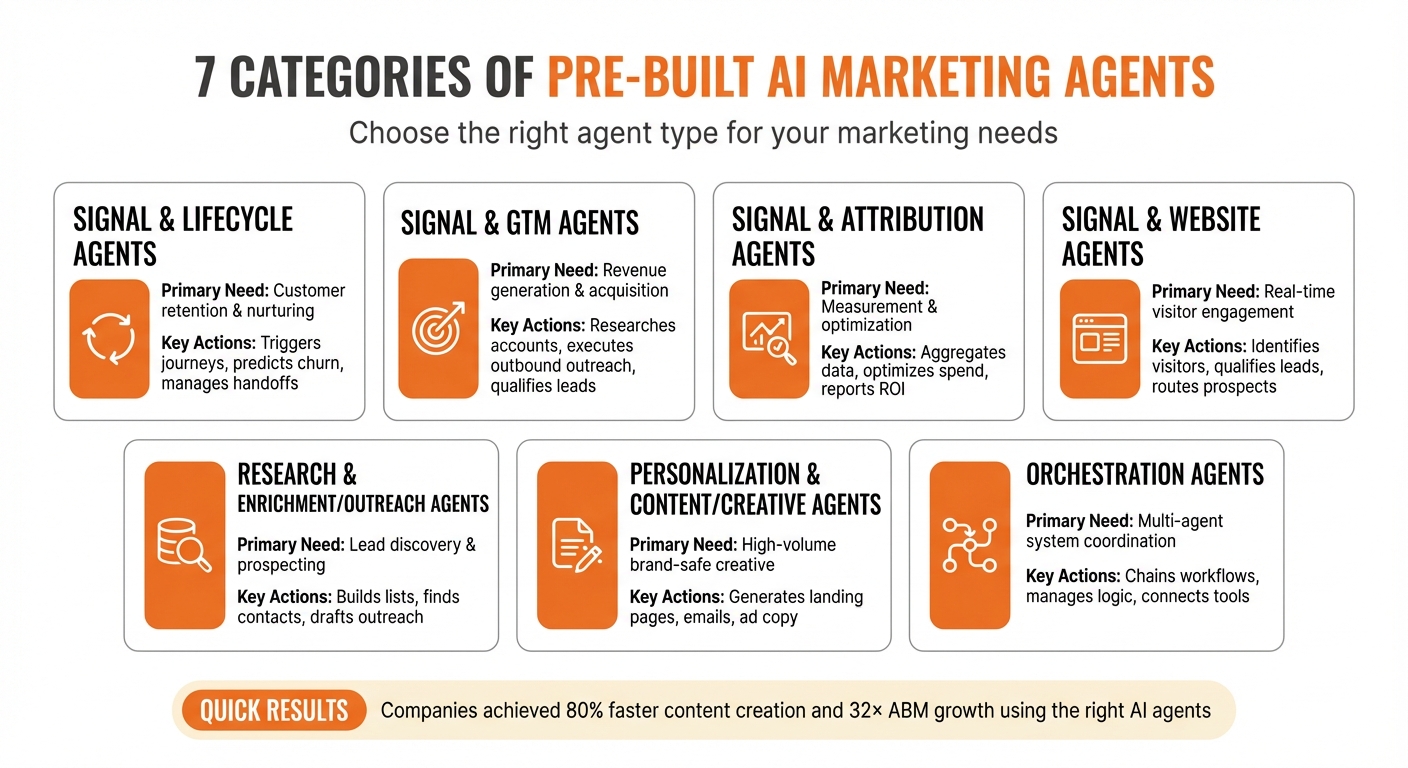
7 Categories of Pre-Built AI Marketing Agents: Functions and Key Actions
The 7 Categories of Pre-Built AI Agents for Marketing
AI agents play diverse roles in supporting lean B2B marketing teams, from sparking outreach efforts to tailoring landing pages. Some focus on detecting buying signals and initiating contact, while others compile prospect lists or customize content. This guide breaks down pre-built AI agents into seven distinct categories, highlighting their primary functions and how they can fit into your marketing workflow. A summary table is provided below for quick reference.
Signal & Lifecycle Agents work with your CRM and marketing automation tools to track customer journey stages. They handle tasks like monitoring onboarding progress, identifying engagement drops, triggering nurture campaigns, predicting churn, and managing transitions between marketing and support teams.
Signal & GTM Agents transform intent signals into actionable revenue opportunities. By analyzing behaviors across product usage, community interactions, and website visits, these agents research accounts and execute multi-channel outreach through platforms like email and LinkedIn.
Signal & Attribution Agents provide clarity on your "dark funnel." These agents track anonymous touchpoints, linking them to pipeline performance and revenue. They help uncover which specific behaviors drive deals, moving beyond basic last-touch attribution models.
Signal & Website Agents act as your website’s gatekeepers. They identify and qualify anonymous visitors at the account level, directing high-value prospects to the sales team or addressing routine questions to reduce support workload.
Research & Enrichment/Outreach Agents streamline the often time-consuming research phase of sales. They compile prospect lists by pulling data from various sources, retrieve contact details, and craft tailored outbound messages based on account-specific insights.
Personalization & Content/Creative Agents take care of large-scale content production. Using your brand guidelines, they generate personalized landing pages, emails, and ad copy that maintain consistency across numerous accounts.
Orchestration Agents serve as the connective tissue for your marketing stack. They integrate multiple agents and tools into complex workflows, managing data flow and logic across systems like your CRM, ad platforms, and email tools. This allows you to handle intricate workflows with ease.
A quick overview of each category’s focus and core function:
| Category | Primary Need Addressed | Key Action |
|---|---|---|
| Signal & Lifecycle | Customer retention & nurturing | Triggers journeys, predicts churn, manages handoffs |
| Signal & GTM | Revenue generation & acquisition | Researches accounts, executes outbound outreach, qualifies leads |
| Signal & Attribution | Measurement & optimization | Aggregates data, optimizes spend, reports ROI |
| Signal & Website | Real-time visitor engagement | Identifies visitors, qualifies leads, routes prospects |
| Research & Enrichment/Outreach | Lead discovery & prospecting | Builds lists, finds contacts, drafts outreach |
| Personalization & Content/Creative | High-volume brand-safe creative | Generates landing pages, emails, ad copy |
| Orchestration | Multi-agent system coordination | Chains workflows, manages logic, connects tools |
1. Signal & Lifecycle Agents
Signal & Lifecycle agents are pre-built AI tools designed to help lean marketing teams work smarter. By integrating with your CRM and marketing automation platforms, these agents monitor behaviors like product usage, web visits, and engagement patterns. They then take action, such as moving a lead into a nurture sequence, alerting sales, or flagging when a key contact changes roles. Unlike traditional automation systems that rely on rigid "if-then" rules, these agents interpret contextual signals and dynamically decide on the next steps.
What makes these agents stand out is their ability to plug directly into existing marketing systems and deliver real-time responses. For instance, HubSpot Breeze AI Agents operate within HubSpot’s Marketing Hub, researching and engaging leads based on live behaviors. Pricing starts at around $800/month for the Professional tier [4]. Salesforce Agentforce for Marketing leverages Data Cloud signals to autonomously score leads and fine-tune campaigns within the Salesforce ecosystem, making it a great fit for startups scaling their customer engagement efforts [3][4]. Factors.ai takes it further by identifying anonymous intent at the account level from "dark funnel" sources like G2 and LinkedIn, with a model capable of uncovering intent for over 75% of anonymous website visitors [7]. Meanwhile, Common Room shines in community-led growth strategies, detecting buying signals from platforms like Slack, Discord, and GitHub [3]. For email-focused teams, ActiveCampaign AI offers over 30 specialized agents to automate customer journeys and nurture workflows using predictive analytics [4].
"AI agents act, using real-time signals to decide what to do next without waiting for you." – Disha Jariwala, Writer, Factors.ai [7]
A real-world example of this technology in action comes from the B2B platform Upflow. In early 2026, they adopted Factors.ai to track intent signals across LinkedIn, G2, and website visits. By syncing this data with their CRM, they revamped their lead nurturing strategy and saw a 35% increase in their total pipeline [7]. Similarly, Vividly used lifecycle orchestration to automate account transitions and engagement triggers, allowing their small team to maintain personalized interactions at scale [4].
However, there’s a potential downside: too many uncoordinated agents can lead to conflicting actions for the same account. To avoid this, start by deploying agents for simple, high-volume tasks like lead enrichment or FAQ resolution, which can deliver fast returns [7][2]. Additionally, ensure all agents operate within a shared account intelligence layer to prevent overlap. Establish clear boundaries by defining prohibited actions and those that require human approval to safeguard your brand’s reputation [7][1].
With lifecycle automation already proving its ability to boost pipelines, the next category of pre-built AI agents offers even more potential for marketing teams.
2. Signal & GTM Agents
Signal and GTM agents are designed to help lean teams quickly turn insights into actionable campaigns. Unlike traditional rule-based systems that merely flag accounts, these agents analyze buying signals from sources like product usage, community platforms, web traffic, and CRM data. They then determine the best course of action, identifying key contacts, customizing outreach, and launching multi-channel AI marketing automation campaigns automatically [3][4].
A closer look at some leading GTM agents and their strengths:
- Common Room: This tool specializes in gathering signals from community and developer platforms such as Slack, Discord, and GitHub. It offers strong identity resolution but often relies on other platforms to handle outreach [3].
- 6sense Intelligent Workflows: This platform focuses on intent-driven targeting and account-based marketing (ABM). By leveraging research and intent data, it identifies which accounts are ready to buy. It’s particularly suited for B2B teams managing complex ABM programs, though implementation results can vary [4].
"ABM has always been just good marketing. It starts with clarity on your ICP and ends with driving revenue. But the way we get from A to B has changed dramatically." – Latané Conant, Chief Revenue Officer, 6sense [4]
These tools highlight the real-world potential of GTM agents. For example, in 2026, Vividly expanded its ABM targeting from 20 to 650 accounts, a 32x increase, by using AI-powered personalization to create account-specific emails and landing pages in minutes [4]. Similarly, RingCentral streamlined its workflow with an AI Knowledge Graph, achieving 80% faster content creation and eliminating the need for additional marketing operations staff [4].
When evaluating Signal and GTM agents, focus on tools that offer deep CRM integration, precise account-level personalization, and strong orchestration capabilities [4]. For GTM agents specifically, prioritize their ability to transform web signals into qualified outreach efforts [2].
3. Signal & Attribution Agents
Signal and attribution agents go beyond just tracking metrics. They analyze scattered data and take action independently. Instead of waiting for user input through a dashboard, these agents connect data points from your CRM, website, community platforms, and ad channels, then execute the next logical step. By moving from observing customer journeys to actively acting on fragmented data, they enable you to seize opportunities in real time. This forward-thinking approach builds on earlier agents by transforming raw signals into measurable pipeline outcomes.
Unlike lifecycle agents that react to established signals, attribution agents focus on fragmented data and turn it into immediate actions. While traditional attribution tools provide retrospective reports, these agents identify current trends and respond dynamically, whether it’s flagging accounts, adjusting ad budgets, or launching nurture campaigns. For example, one company saw a 35% boost in their pipeline after their Factors.ai agent started acting on previously overlooked intent signals [7].
"Your chatbot responds when asked; your competitor’s AI agent acts when the signal is right." – Disha Jariwala, Writer, Factors.ai [7]
To maximize their value, these agents should be evaluated on their ability to resolve identities, map multi-touch journeys, and focus on pipeline-related outcomes rather than superficial metrics. Seamless CRM and Slack integrations are also crucial, as they ensure sales teams receive real-time alerts while leads are still interested. Additionally, robust auditability is essential to understand why the agent made specific decisions.
Top Signal and Attribution Agents for 2026
- Factors.ai Agents: Perfect for teams looking for buying-signal detection and go-to-market activation tied to pipeline measurement. Factors.ai identifies over 75% of anonymous website visitors at the account level and triggers workflows based on intent patterns like repeat pricing page visits or G2 spikes [7].
- HockeyStack AI: A great choice for revenue teams seeking pipeline intelligence and attribution insights. HockeyStack analyzes data from platforms like Meta, Google, and TikTok to uncover performance trends that siloed tools might miss [6].
- Lantern PipelineHealth Agent: Ideal for teams requiring accurate pipeline reporting through autonomous CRM data checks. In early 2026, Shubh Sinha, Vice President at a growth-stage firm, reported generating $7.6M in pipeline within 60 days of using Lantern’s Revenue Data Platform [8].
- Clari Forecast Intelligence Agent: Best for teams needing predictive revenue forecasting. Clari identifies pipeline risks by analyzing engagement signals, delivering actionable insights that go beyond simple observations [2].
- Demandbase Intent Agent: Designed for ABM-focused teams, this agent tracks account-level intent signals across the web and aligns them with ABM stages, helping prioritize pipeline opportunities based on genuine buying behavior [3].
4. Signal & Website Agents
Website agents do more than just track page views. They dive into visitor behavior and take immediate action. Instead of merely generating reports for later, these tools link anonymous traffic to known accounts, identify buying signals (like repeated visits to pricing pages), and trigger real-time alerts or workflows. With Gartner predicting that AI agents will influence 90% of B2B purchases by 2029 [4], the move from passive data analysis to active engagement is picking up speed.
A key feature of these agents is their ability to connect anonymous sessions to CRM contacts, creating unified views of account activity. This is crucial as generating an MQL in B2B SaaS now takes an average of 71 touchpoints, a 31% increase since 2023.
These tools also simplify segmentation for marketers, eliminating the need for SQL expertise. For instance, you could ask an agent to "find customers with high engagement who haven’t purchased in 90 days", and it will build the audience on its own [5]. This functionality is especially helpful for small teams juggling multiple campaigns across different stages of the buyer journey.
Timing is everything in sales, and batch processing can lead to missed opportunities. The best website agents operate continuously, tracking signals like increased session frequency after inactivity or new content downloads. They ensure hot leads are routed to sales while they’re still active. Below are some of the top-performing website agents designed to maximize visitor engagement.
Top Signal and Website Agents for 2026
Warmly: Perfect for teams aiming to turn website visitor activity into immediate action. Warmly identifies visitors in real time, highlights intent signals, and can automatically trigger outreach or schedule meetings while prospects are still browsing.
RB2B: A great choice for lean teams, RB2B simplifies visitor-to-company intelligence by identifying which companies are visiting your site and integrating that data directly into sales and marketing workflows. It’s particularly useful for startups without dedicated RevOps resources.
Lantern Website Visitor ID: Known for its ability to deanonymize web traffic, Lantern integrates seamlessly with Salesforce, HubSpot, Outreach.io, and Pendo. Shubh Sinha, a Vice President at a growth-stage firm, shared that Lantern’s CDP helped generate $7.6M in pipeline within just 60 days. The tool boasts 95% contact accuracy across 150+ data providers [8].
Common Room: While not solely a website agent, Common Room excels at capturing signals from platforms like Slack, Discord, and GitHub. It then ties these signals back to CRM records, combining web activity with community engagement to provide a fuller view of buyer intent.
Drift and Intercom: These conversational agents qualify website leads in real time and can book meetings directly into sales team calendars [2].
These tools are reshaping how businesses interact with website visitors, ensuring no opportunity slips through the cracks.
5. Research & Enrichment/Outreach Agents
These agents are designed to simplify lead generation and make personalized engagement more efficient, building on earlier categories.
By automating tasks like lead list creation, contact verification, and outreach personalization, research and enrichment/outreach agents save teams from the time-consuming grind of manual data collection. Instead of combing through LinkedIn, websites, or third-party databases, these tools gather and organize data autonomously. This shift allows your team to focus on strategy and building relationships rather than getting bogged down in repetitive tasks.
The most effective research agents don’t stop at collecting data. They integrate it directly into your CRM and outreach platforms, ensuring a seamless flow of information. This integration helps avoid data silos and ensures that every step, from initial research to outreach, stays connected. By feeding enriched data straight into your systems, these tools complete the loop from data collection to actionable insights, making your marketing stack leaner and more effective.
Here are some standout options:
- Clay: Known for its flexible enrichment pipelines, Clay pulls data from numerous third-party sources to create detailed lead and account profiles [3][9].
- Apollo.io: Specializes in high-output prospecting automation, combining rapid lead discovery with automated outreach sequences [2].
- Relevance AI: Offers deep customization, enabling teams to build tailored GTM agents for lead qualification and account research using tools like GPT-4 and Claude [4][1].
- Kompas AI: Focuses on accuracy, making it a strong choice for in-depth competitive and market research [2].
- Smartlead: Delivers AI-driven cold outreach with hyper-personalization to boost deliverability and engagement [9].
These tools can significantly enhance the capabilities of small teams, enabling them to achieve more with less effort.
When choosing a research or outreach agent, start with simple, high-volume tasks like lead enrichment or social media monitoring to quickly see a return on investment [2]. Ensure that the agent integrates seamlessly with your CRM and outreach tools, disconnected systems can create inefficiencies instead of solving them [4]. To maintain relevance and consistency, provide your outreach agents with brand guidelines, customer personas, and specific account data [4].
Up next, personalization and content agents take these enriched insights and turn them into tailored messaging.
6. Personalization & Content/Creative Agents
Once your data is enriched, personalization and content agents step in to transform those insights into tailored messaging. These tools handle tasks like generating copy, adhering to brand guidelines, segmenting audiences, and managing multi-channel distribution. What sets them apart from traditional automation is their ability to make real-time decisions about the message, timing, and delivery channel [4].
The most effective agents leverage AI Knowledge Graphs to incorporate your brand voice, customer personas, and account data. This ensures that all content aligns with your brand while requiring minimal manual oversight [4]. For lean teams, especially startups looking to scale with AI without expanding their workforce, this is a game-changer. It eliminates the delays caused by manual review processes. For instance, in 2026, Natalie Ryan, RingCentral’s AVP of Global Marketing Operations, shared that the company achieved 80% faster content creation by using Tofu’s AI-native platform, without needing to hire additional staff [4].
Key Categories of Personalization & Content Agents
| Agent Type | Top Tools | Primary Use Case |
|---|---|---|
| End-to-End Personalization | Tofu, HubSpot Breeze | Manages entire campaigns across emails, landing pages, and ads using account-level data |
| Brand-Safe Content | Jasper, Blaze | Produces high-volume marketing copy while strictly following brand guidelines |
| Visual & Creative | Adobe Firefly, Canva | Automates creation of brand-compliant images and visuals for various platforms |
| Product & Catalog | Hypotenuse AI | Focuses on generating large-scale product descriptions for e-commerce and catalogs |
When choosing tools, prioritize their orchestration capabilities, can they not only create content but also manage its distribution? Start small by using these tools for low-risk, high-volume tasks like social media posts or basic email personalization. This approach helps you establish workflows and safeguards before advancing to fully autonomous campaign management [2]. Early on, provide the agents with your brand guidelines, messaging frameworks, and persona data. This upfront investment ensures the generated content needs minimal adjustments [4].
"With AI, we can personalize not just by account, but by segment, by buying group, and even by individual. That level of precision just wasn’t possible a few years ago," says Guy Yalif, Chief Evangelist, Webflow [4]
7. Orchestration Agents
Orchestration agents bring together individual AI tools into a coordinated system designed to handle complex marketing tasks seamlessly [9]. Unlike traditional automation, which relies on simple, static if-then rules, orchestration agents use contextual reasoning to navigate intricate buyer journeys across multiple channels. These agents can autonomously chain tasks like research, drafting, editing, and publishing, allowing lean teams to shift from reactive data analysis to proactive execution by optimizing their marketing tech stack [4].
Thanks to their advanced reasoning capabilities, orchestration agents address many of the shortcomings found in older tools. By 2028, projections show that 33% of organizations will adopt agentic AI, with 15% of these agents making daily autonomous decisions [12]. Early adopters have already reported up to an 8x increase in campaign deployment speed compared to traditional methods [4].
When considering orchestration agents, focus on platforms that offer deep integration capabilities and strong governance controls. Look for features like centralized monitoring, often called an "Agent Control Tower", to minimize risks like brand inconsistency or security vulnerabilities [16, 20]. A good starting point is deploying one high-impact agent for repetitive tasks, such as lead qualification or social media monitoring, and then gradually scaling to a fully orchestrated network [12]. Keep in mind that these agents rely heavily on the quality and currency of your knowledge base, so maintaining up-to-date and centralized data is crucial [11]. This approach ensures an optimized agent-powered marketing system that aligns with the goal of increasing output without adding headcount.
Below are examples of orchestration platforms that help lean teams unify their marketing operations through pre-built AI agents:
| Orchestration Platform | Primary Strength | Best For |
|---|---|---|
| Zapier Agents | No-code, natural language setup | Lean teams needing quick deployment across thousands of apps |
| Make AI Agents | Visual multi-step workflows | Teams seeking broad app connectivity with minimal technical expertise |
| Relevance AI | GTM-specific workflows with strong agent-ops controls | Teams focused on lead research, qualification, and outbound personalization |
| MindStudio | Ready-to-run marketing agents with access to 200+ AI models | Teams requiring flexible model switching without heavy technical requirements |
| n8n | Self-hosted, highly customizable | Agencies building proprietary agent systems with engineering resources |
"The agencies that will lead in 2026 and beyond are not the ones with the most tools. They are the ones that have built the tightest integration between their data, their AI tools, and their orchestration layer. That integration is the moat," says Digital Applied [9]
Conclusion
From signal agents to orchestration platforms, we’ve covered the essentials for building a marketing system powered by agents. The key takeaway? It’s not about collecting the most tools. It’s about selecting ones that integrate deeply, require minimal oversight, and align with your brand’s data and goals.
My evaluation framework puts autonomy over assistance and integration depth over flashy features. This mindset enables you to create systems where agents collaborate across channels, navigate complex buyer journeys, and execute strategies independently. By 2026, the marketing teams that scale their efforts without adding headcount will be the ones leveraging 2-3 well-integrated agents rather than struggling with a dozen disconnected tools [2].
Gartner predicts that within three years, 90% of B2B purchases will be influenced by AI agents [4]. Early adopters are already seeing results, shipping campaigns 8x faster [4]. The opportunity to act is now, before agent-powered execution becomes the standard and the competitive edge shifts to those who moved early.
The examples we’ve explored show how the right agents can drive meaningful performance improvements. If you’re ready to design a tailored agent-powered marketing system, consider booking a strategy call with me. I will audit your workflows, find the agent opportunities actually worth paying for, and build an implementation plan that fits your budget and your stack. For a more comprehensive review, you can also request an AI stack review and I will tell you where automation, orchestration and autonomy can replace manual work in your go-to-market motion.
The future of efficient marketing isn’t about deploying dozens of AI agents. It’s about having the right ones working seamlessly with your team to deliver measurable outcomes [2]. Start with one impactful agent, track the results, and scale from there.
FAQs
Which pre-built AI agent category should I start with for the fastest ROI?
For a quick return on investment, focus on Signal & Lifecycle automation agents. These tools simplify essential workflows such as customer engagement, lead nurturing, and attribution, directly improving both revenue and efficiency. Solutions like HubSpot Breeze AI Agents, Salesforce Agentforce, and Customer.io AI agents handle tasks like automating signals, messaging, and lifecycle management. This allows smaller teams to provide personalized interactions with minimal manual work, making these agents perfect for teams with limited resources looking for fast, tangible results.
How do I prevent multiple AI agents from taking conflicting actions on the same account?
To avoid conflicts, consider putting a centralized orchestration system in place. This system can assign tasks, establish priorities, and handle overlaps effectively. Set clear rules and boundaries for each agent to ensure they stay within their defined roles. Incorporate real-time monitoring and feedback loops to quickly identify and resolve any issues. Using orchestration tools can also streamline agent coordination, helping to keep your workflows running smoothly.
What integrations and data are needed before deploying pre-built AI agents in a marketing stack?
To roll out pre-built AI agents, it’s essential to have your systems connected to tools such as CRMs, marketing automation platforms, and web analytics. The foundation for success lies in having precise, well-organized data about your customers, campaigns, and buyer behaviors. Equally important, your tech stack should be equipped to handle APIs or webhooks, ensuring smooth data sharing across platforms. With these pieces in place, AI agents can efficiently tailor experiences, automate tasks, and execute workflows, driving clear and impactful results.