


Struggling to build a predictable pipeline? Hiring the right demand generation consultant could be the fastest way to fix it. In 2026, B2B buyers expect personalized, relevant engagement – and outdated "spray-and-pray" tactics won’t cut it. Here’s what you need to know to make the right hire:
- Why hire a consultant? Startups often lack the time to build in-house demand gen teams. Consultants can deliver results in 30–60 days, compared to nearly a year for new hires to ramp up.
- Signs you need help: Disorganized CRM systems, poor sales-marketing alignment, or pipelines that have plateaued are red flags.
- Types of consultants: Choose from fractional CMOs, channel specialists (e.g., LinkedIn ads, SEO, AEO), or systems consultants to address your specific needs.
- Budget: Expect to spend $5,000–$15,000/month for a consultant, plus $2,000–$5,000/month for marketing tools.
- What success looks like: The best consultants build systems that create long-term growth, not just short-term campaigns.
Focus on finding someone with stage-specific expertise who aligns with your goals and can deliver measurable results in 90 days. Keep reading for a step-by-step guide to hiring the right partner.
B2B Demand Generation Strategies for Startups | Taylor Wells Webinar
sbb-itb-e8c8399
Step 1: Decide If You Actually Need a Demand Generation Consultant
Before you start crafting job descriptions or reaching out to consultants, take a moment to ask yourself a key question: Is hiring a consultant the right move right now? If your internal processes are disorganized or broken, bringing in external help won’t solve the root problem – it’ll just make things more expensive.
What Demand Generation Looks Like in 2026
Demand generation in 2026 goes far beyond running ads or sending out email campaigns. It’s about building a full system that creates and captures buyer intent at every stage of the funnel. This means everything from increasing brand awareness among people who’ve never heard of you to delivering sales-ready opportunities to your team.
What’s changed in 2026 is where buyers are doing their research. Tools like ChatGPT and Perplexity have become part of the decision-making process, allowing buyers to evaluate vendors before even visiting a website [4]. As a result, Answer Engine Optimization (AEO) – making sure your brand appears in AI-generated answers – has become a critical part of demand generation. While traditional methods like gated content and nurture sequences still have their place, they’re no longer enough to drive results on their own.
Think of demand generation as the blueprint that makes your pipeline predictable. Without that structure, you’re just running disconnected campaigns.
How to Know If You Need Outside Help
For many Series A–B founders, the realization that something is off comes before they can pinpoint the exact problem. Here are some signs that it might be time to bring in external expertise:
- You’ve outgrown founder-led sales, but there’s no system in place to replace it [4]. Deals are still closing because of personal relationships, not a repeatable process.
- Sales and marketing aren’t aligned. If your sales team is ignoring marketing leads or labeling them as “garbage,” it’s not just a sales issue – it’s a demand gen problem. Industry data shows that 87% of MQLs are rejected by sales teams due to poor qualification standards [7].
- Your CRM or marketing automation platform is a mess. If you’re dealing with dirty data, broken integrations, or a lack of attribution models, you’re making major budget decisions based on unreliable information [5].
- Your pipeline has hit a wall, and no one is stepping up to diagnose the issue. Campaigns might be running, but there’s no senior leader taking responsibility for pipeline velocity or deal quality [6].
"The biggest predictor of demand generation agency success is not the agency. It is the marketing operations maturity of the client." – Jeff Pedowitz, Founder & CEO, The Pedowitz Group [4]
If two or more of these apply to your startup, it’s not just time to consider external help – it’s overdue.
Picking the Right Type of Demand Gen Consultant
Not all demand generation consultants are created equal. Hiring the wrong one for your needs can be a costly mistake. Here’s a breakdown of the three main types and what they bring to the table:
| Consultant Type | Best Fit | What They Deliver |
|---|---|---|
| Fractional CMO / Head of Demand Gen | When you need senior leadership to align marketing and sales but can’t justify a $200,000+ executive salary [6] | Strategy, sales alignment, team oversight |
| Channel Specialist (Paid, SEO, AEO) | When you’ve validated a channel and need to scale it, such as LinkedIn ads or AI search visibility [4] | Channel-specific ROI and pipeline growth |
| Systems / MOps Consultant | When your CRM is broken, attribution is missing, or your marketing automation platform (MAP) isn’t integrated with your CRM [4] | Data integrity, CRM/MAP architecture, attribution modeling |
Here’s a simple rule to follow: fix your infrastructure before scaling your programs. If your data is unreliable and your tracking isn’t working, hiring a channel specialist will waste your budget. Start by working with a systems consultant, then add strategy or channel execution once your foundation is solid [4].
Is Your Startup Falling Behind Its AI-Native Competitors?
Step 2: Scope Your Engagement Before You Start Looking
Demand Gen Consultant vs. In-House Hire: Cost, Speed & ROI for B2B Startups (2026)
Before you start reaching out to consultants, take the time to clearly define your needs. Without a focused plan, you might end up solving the wrong problem altogether.
Define Your Pipeline Goals and Key Metrics
Everything should revolve around revenue. For instance, if your goal is $5M in new ARR and you’re working with a 25% win rate, you’ll need to target $20M in pipeline [8]. A consultant’s efforts should tie directly back to this number.
Skip vanity metrics like MQL volume or click-through rates – they don’t drive meaningful outcomes. Instead, focus on metrics such as cost per BANT-qualified appointment, SQL conversion rates, pipeline velocity, and cross-channel attribution tools [9]. Also, establish a pipeline coverage ratio, which is often 3x to 4x your quarterly bookings [10].
"If Sales isn’t bought in, it’s not a demand gen strategy. It’s just marketing noise." – Chief Views [8]
Make sure both marketing and sales teams are aligned on qualification criteria. With clear metrics in hand, review your existing channels to identify where you’re falling short.
Map the Channels and Demand Motions You Already Have
Dive into your CRM data from the past 6–12 months. Break down your efforts into two categories: demand creation (e.g., LinkedIn campaigns, podcasts) and demand capture (e.g., paid search, high-intent SEO) [3]. Many startups lean heavily on demand capture – about 80% of their efforts – leaving only 20% for creation. However, the most effective demand engines in 2026 aim for a 60% creation and 40% capture balance [3].
This analysis will show you exactly where a consultant can add value. For example, if your capture channels are strong but your awareness efforts are weak, you’ll need someone skilled in building top-of-funnel programs. On the other hand, if you’re generating leads but losing them before they convert to sales, the problem lies in your handoff or conversion process. Don’t expect a consultant to figure this out for you – do the homework yourself so you can properly evaluate whether their proposed solution fits your needs.
Once you’ve mapped your objectives and channels, ensure your budget and timeline align with your goals.
Set a Realistic Budget and Timeline
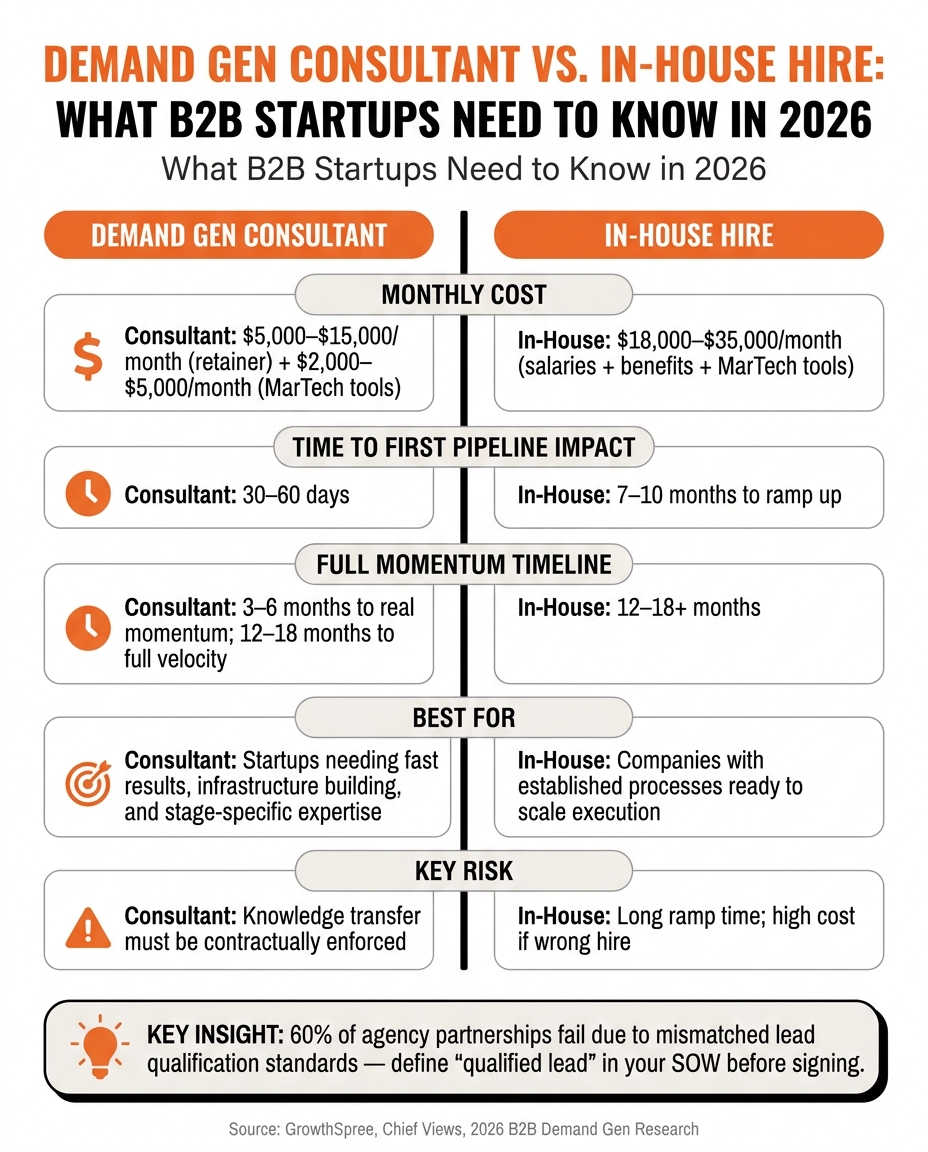
In 2026, demand gen consultant retainers typically range from $5,000 to $15,000 per month [1]. While that might seem steep, consider the alternative: hiring a senior demand gen professional along with a junior assistant, which can cost between $18,000 and $35,000 per month when you include salaries, benefits, and MarTech tools [1]. Agencies also tend to deliver results faster – measurable pipeline impact can appear within 30–60 days, compared to the 7–10 months it takes for a new in-house hire to ramp up [1].
That said, while you might see early pipeline in 30–60 days, real momentum often takes 3–6 months, and full velocity might not happen until 12–18 months later [3]. Keep your sales cycle in mind – if it’s 6–9 months long, adjust your expectations accordingly. Be cautious of consultants who promise dramatic results in just 30 days – they’re likely focusing only on bottom-of-funnel tactics or overselling their capabilities.
"The first 12–18 months of a SaaS company’s demand gen journey should almost always be agency-led. After that, transition to a hybrid model based on what’s working." – Ishan Manchanda, GrowthSpree [1]
One expense that often surprises founders is MarTech tools. If the consultant’s fee doesn’t include these, plan to budget an additional $2,000–$5,000 per month for tools like intent data platforms, automation software, and CRM integrations [1]. Including these costs upfront ensures you’re comparing proposals accurately and sets the stage for building a sustainable demand generation system – not just a series of one-off campaigns.
Step 3: Vet and Interview Candidates the Right Way
Once you’ve outlined the scope of your engagement, the next step is to carefully evaluate candidates. Your goal isn’t to find the flashiest resume but to identify someone who has tackled challenges similar to yours.
Focus on Stage-Specific and Channel-Specific Expertise
The right consultant for your business depends heavily on your stage. For instance, a consultant who thrived at a Series B SaaS company might not be the best fit for your Series A needs. Why? Because the strategies, budgets, and team dynamics can differ significantly. A straightforward yet revealing question to ask is: What was the company’s ARR when you joined, and what was it when you left? That one answer can often provide more insight than a polished case study.
Here’s a quick breakdown of what to prioritize based on your stage:
| Stage | Primary Focus | Key Question to Ask |
|---|---|---|
| Seed | Channel validation | "How quickly can you validate our ICP and messaging in paid channels?" |
| Series A | MQL-to-SQL ratio | "How will you align with our sales team to ensure lead quality over volume?" |
| Series B | Scaling without ICP dilution | "How do you maintain qualification standards as monthly spend increases?" |
Your questions should dig into their experience solving problems similar to your current challenges. For example, if you’re running ABM campaigns, ask how they’ve handled tiered account strategies. Specifically, find out how they approached Tier 1 accounts compared to Tier 3, and how they tracked engagement across each. If paid media is a key focus, ask them to explain how they’ve tied ad exposure data to CRM opportunities. If they can’t clearly outline that connection, it might signal a gap in their expertise.
Questions That Separate Real-World Experience from Theory
Plenty of consultants can speak eloquently about demand generation frameworks, but the best ones can also share what went wrong and how they fixed it. Here are a few questions to uncover that kind of insight:
- "Walk me through a program that didn’t work. What was your diagnosis, and what did you change?"
- "When a channel isn’t showing results after 90 days, how do you decide whether to adjust targeting, change content, or cut the budget?" [12]
- "Tell me about a strategy you use that others might disagree with."
That last question is especially revealing. As George Coudounaris, Co-Founder of The B2B Playbook, explains:
"Lead generation is about capturing whoever raises their hand right now. Demand generation is about shaping who raises their hand, when, and why." – George Coudounaris [13]
A consultant with a strong, data-backed perspective is far more valuable than someone who simply echoes your assumptions. Make sure to also confirm how they manage the marketing-to-sales handoff and ensure alignment at the point of conversion.
Beyond their experience, it’s essential to evaluate their technical skills, especially in measurement and tooling.
Assess Their Measurement and Tooling Proficiency
Measurement is a common weak spot for consultants, so start by asking them to outline their measurement hierarchy. A solid response will include three tiers: leading indicators (like ICP engagement rates), lagging indicators (such as SQL volume), and a north star metric (e.g., marketing-sourced revenue) [11][14]. If they focus solely on MQL volume or click-through rates, that’s a red flag.
When it comes to tools, dig into specifics. For example:
- Do they know how to connect intent data from platforms like 6sense or Bombora to CRM systems like Salesforce or HubSpot?
- Can they set up multi-touch attribution that incorporates dark social signals, such as self-reported attribution from "How did you hear about us?" fields?
These capabilities aren’t optional anymore – they’re essential for running a modern demand generation program.
Finally, test their ability to assess your brand’s AI visibility. Ask them to conduct a live diagnostic during the interview. With buyers increasingly turning to tools like ChatGPT and Perplexity to research vendors, a consultant who can’t evaluate your brand’s presence in AI-generated answers is already behind [4]. This quick exercise will immediately show whether they’re operating with a 2026 mindset or stuck in outdated strategies.
Step 4: Know What a Good Consultant Should Actually Deliver
Finding the right consultant is just the beginning – you also need to define what success looks like for your engagement.
Effective Consultants Build Systems That Last, Not Temporary Campaigns
Here’s the key difference: campaigns have an end date, but systems keep delivering over time. A consultant focused on campaigns might hand you reports every month. A system-oriented consultant, on the other hand, leaves you with tools like lead scoring models, CRM stage maps, attribution tracking, and documented workflows that can run on their own.
Peter Vogel from peppereffect sums it up perfectly:
"If your demand-gen output drops the moment your CMO is on holiday, you do not have a system – you have a person." [2]
By the 90-day mark, your Head of Sales should be able to generate a pipeline report by stage and source without help. If they can’t, the consultant provided reports, not lasting capabilities.
Here’s one important signal: does the consultant focus on MQLs or pipeline velocity? MQLs are a sign of campaign thinking. Pipeline velocity – how quickly qualified leads move through your funnel – shows a focus on building systems. The KPIs they track will reveal how they approach the work.
Clear Ownership: Consultant vs. Your Team
For a system to last, everyone needs to know what they’re responsible for. Lack of clarity around ownership is one of the most common reasons demand-gen projects fail. The consultant should handle the architecture and frameworks, while your team takes on execution and depth. Here’s how responsibilities typically break down:
| Responsibility | Consultant Owns | Your Team Owns |
|---|---|---|
| Strategy & Positioning | ICP definition, messaging framework, category positioning | Final approval and product-level knowledge |
| Systems & MarTech | Lead scoring model, tech stack integration, attribution setup | Ongoing CRM data hygiene |
| Content | Content pillars, repurposing workflows, style guides | Subject matter expertise and daily social engagement |
| Sales Alignment | SLA creation, lead routing rules, handoff processes | Lead follow-up (within 2 hours) and quality feedback |
| Enablement | Training sessions, playbooks, battle cards | Long-term execution of repeatable processes |
This division ensures smoother collaboration and faster adoption of the system.
Milestones for the First 30, 60, and 90 Days
Once ownership is clear, set specific milestones to measure progress. Keep in mind that revenue impact from demand generation often takes 6–9 months to show up [2]. That’s not a failure – it’s just how building a system works. What matters early on is seeing the right indicators move in the right direction.
| Phase | Timeline | Milestones & Deliverables |
|---|---|---|
| Foundation | Days 1–30 | CRM audit, ICP validation, attribution model setup, lead routing logic, target account list (200–500 accounts) |
| Activation | Days 31–60 | Weekly content cadence, LinkedIn awareness ads, first original research piece, ABM Tier 1 launch |
| Optimization | Days 61–90 | Creative refresh based on data, ABM Tier 2 launch, brand awareness survey, pipeline velocity baseline |
In the first 30 days, a strong consultant focuses on diagnosing issues before building solutions. As Mahad Kazmi puts it:
"Most RevOps consulting engagements produce decks. A real 30-day engagement produces working infrastructure: CRM architecture, attribution tracking, pipeline stages, and sequence infra." [15]
Conclusion: How to Find the Right Demand Gen Partner for Long-Term Growth
Bringing in a demand generation consultant can fast-track your growth, but only if you approach the process with a solid plan. Careful preparation and evaluation are key to avoiding missteps and finding a partner who can create scalable systems that stand the test of time.
Focus on stage-specific expertise and a proven ability to generate demand, not just capture it. Look for clear milestones within the first 30, 60, and 90 days to ensure they can deliver measurable results. Define lead qualification standards in your Statement of Work – this is critical, as 60% of agency partnerships fail due to mismatched lead qualification standards [18]. Additionally, make sure all lead data, sequences, and playbooks are transferred to your team at the end of the engagement [17]. These contract details are essential to ensure the consultant leaves your team with lasting capabilities.
When done right, the results can be transformative. Take TruckX, for example – a B2B startup that scaled its ARR from $2M to $16M by implementing an embedded revenue pod model, complete with SDRs and RevOps infrastructure [17]. Growth like that doesn’t come from a one-off campaign. It comes from a well-designed system tailored to the company’s stage and goals.
"With a well-structured demand generation engine, you can generate millions in revenue. An experienced agency can help build this engine from the ground up." – Alex Kracov, CEO and Co-Founder, Dock [16]
The right demand gen partner doesn’t just deliver temporary wins – they build a system. That system includes infrastructure, detailed playbooks, and a reliable framework for measuring success, ensuring your startup continues to grow long after the engagement ends. Focus on finding a partner who prioritizes systems over short-term campaigns.
FAQs
What should I put in a 90-day demand gen consultant SOW?
To achieve clear outcomes and measurable results, your approach should cover these key areas:
- Funnel and Messaging Diagnostic: Start by assessing your funnel performance, messaging alignment, and the quality of your data. Are your leads converting as expected? Is your messaging resonating with your target audience? Identify gaps and opportunities for improvement.
- Set Specific Goals: Define clear targets for lead volume, SQLs (Sales Qualified Leads), and key performance indicators (KPIs). Knowing exactly what success looks like will guide your efforts and keep everyone aligned.
- Tracking and Campaign Setup: Lay out a detailed plan for tracking performance, configuring campaigns, and ensuring your CRM is set up to capture and organize data effectively. Accurate tracking is the backbone of actionable insights.
- Channel Strategy and Testing: Develop a channel strategy that prioritizes the platforms most relevant to your audience. Combine this with creative testing and an offer roadmap to refine what works and eliminate what doesn’t.
To maintain accountability, establish milestones and acceptance criteria. Request a 30-day action plan to kickstart the process and a 90-day attribution report to evaluate performance and refine your strategy. These checkpoints ensure you stay on track and deliver results that matter.
How do I tell if my main problem is CRM/MOps vs. channels?
If it takes you too long to figure out which channels are driving your pipeline, your sales team keeps pushing back on lead quality, or terms like MQLs are all over the place in definition, chances are you’re dealing with a Marketing Operations (MOps) problem. On the other hand, if your data is spotless and your attribution is spot-on, but you’re only going after leads who are ready to buy right now, the real issue might lie in your channel strategy – specifically, not creating demand beyond the immediate buyers.
What proof should a demand gen consultant show in interviews?
To make the most of your partnership, ask for detailed case studies that include clear baselines, timelines, and specific actions directly tied to pipeline growth and revenue impact. Make sure these case studies also highlight the attribution models used and examples of reporting dashboards, so you can see how results are tracked and measured.
Request a maturity assessment of your marketing operations. This should cover areas like CRM data quality, lead management processes, and any gaps in your current systems. Additionally, ask for warm introductions to two of their current clients in your industry. This gives you a chance to validate their expertise and learn from businesses with similar challenges.
Finally, have them summarize your ideal customer profile (ICP), common buyer objections, and a 30-day plan for working with your brand. This step ensures they’ve taken the time to understand your business and can hit the ground running.
Related Blog Posts
- The 7 Best Go-To-Market Consultants for Tech Startups in 2026
- 10 Best B2B Lead Generation Services Providers for Startups Without a Large Sales Team
- What a Great Demand Gen Consultant Actually Does In 2026, and Why Lillian Pierson Stands Out
- Top 5 RevOps Consultants for Startups That Need Cleaner Pipeline and Attribution