


AI doesn’t browse the web like humans – it extracts specific passages to answer questions. If your content isn’t structured for this, you’re missing out on citations. Here’s how to make your content stand out:
- Start with answers: Open every H2 with a short, direct response (40–60 words). Think of it as leading with the conclusion.
- Chunk your content: Each section should be self-contained. Avoid phrases like "as mentioned above."
- Use question-based headings: AI prefers headings that align with user queries, like "How do I show up in AI search results?" instead of vague titles.
- Boost entity clarity: Name sources, dates, and stats explicitly. For example, "HubSpot reported a 30% increase in March 2026."
- Add schema markup: FAQPage and HowTo schemas make your content machine-readable and 2.7x more likely to be cited.
Key stat: AI citations often come from the first 30% of your page. Put your best answers up front.
Next steps: Review your top pages, rewrite headings as questions, and add schema markup. Want AI to quote you? Structure your content to make it easy.
How to Structure Content So AI Models Actually Cite You
Answer-First Structure and Content Chunking
The Answer-First Writing Approach
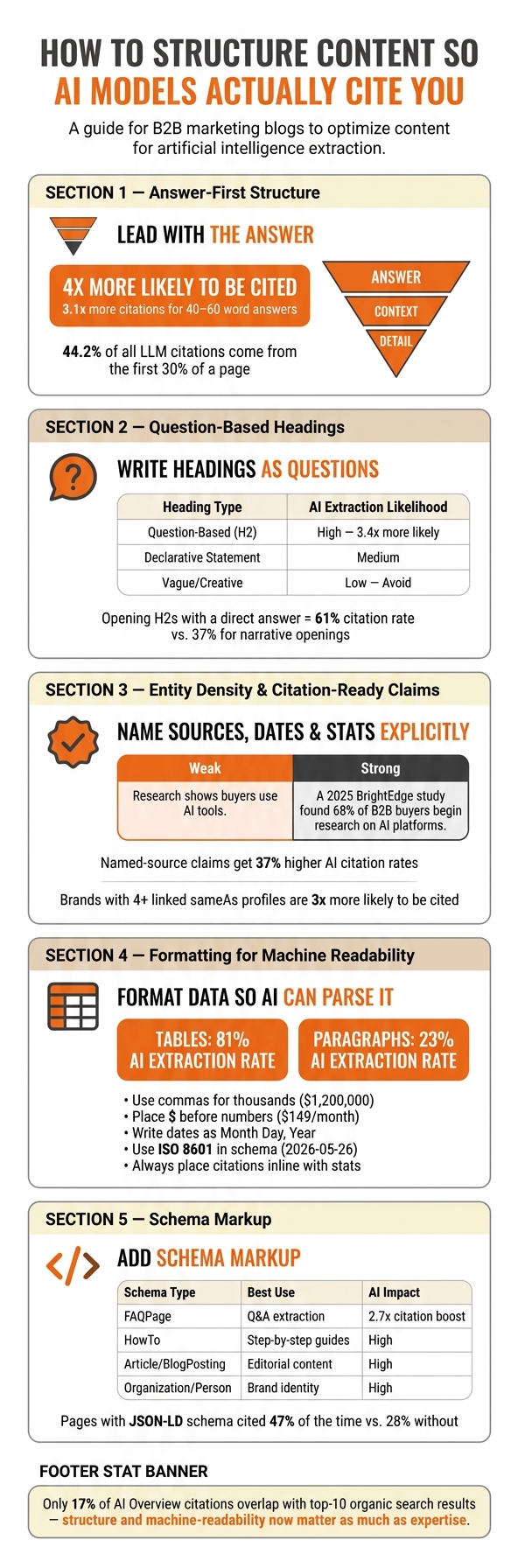
When AI models scan your content, they prioritize the most direct, self-contained response to a query. If your answer is buried under layers of context, the model skips it. The solution? Start every H2 with a concise, 1–2 sentence answer. Think of it like journalism’s inverted pyramid: lead with the conclusion, then provide supporting details. This approach increases your chances of being cited by 4x compared to burying the answer [4].
Keep those opening answers tight – 40 to 60 words is the sweet spot. Passages in this range are cited 3.1 times more often than longer ones [2]. Avoid filler phrases like "In today’s world…" or "As we discussed earlier…" – they signal that the real answer hasn’t started yet, making it harder for AI to extract cleanly [2][5].
"In 2026, the writers who win are the ones whose chunks an AI agent can lift verbatim." – Distk Editorial [4]
Chunking Content for AI Retrieval
Each H2 should function as a standalone block of information. The test? If you pull out a section, will the reader understand the full answer without needing other parts of the article? If not, it’s not ready for AI retrieval. Dependencies like "as mentioned above" or "see below" disrupt clarity and hurt extraction [2][6].
Keep paragraphs short – 2–4 sentences max – and break up sections longer than 225–300 words into smaller headings [2][6]. This isn’t just about readability; it gives AI models clear, digestible units to work with. As Drishti Chawla from Writesonic explains:
"AI models cite the most extractable page from a pool of credible sources – not necessarily the highest-ranked or best-written one." [6]
Here’s a critical insight: 44.2% of all LLM citations come from the first 30% of a page’s text [2]. That means your most direct answer should appear in the first H2 after the introduction, not buried halfway through.
Using Summary Blocks for Key Takeaways
Summary blocks, like TL;DRs or Key Takeaways, amplify the impact of your structured answers. Placing one near the top gives AI engines a high-density section to extract, boosting your citation chances [2][3].
A strong summary block follows a "Nesting Doll" approach:
- Start with a question-based heading.
- Provide a 40–60 word direct answer.
- Include a short, structured list.
- Link to deeper details below [8].
Make every part of the block standalone – avoid vague pronouns like "it" or "this" and use explicit nouns to ensure clarity when extracted out of context [7]. For maximum visibility, include a specific number, a named source, and a date in your summary block. This boosts answer density – the ratio of direct answers to total content – and increases AI visibility by 30% to 40% [3].
"The unit of competition is the passage, not the page. Structure your content so that each passage earns its own citation." – Vasilij Brandt, Founder, KIME [7]
sbb-itb-e8c8399
How to Optimize Content for AI Search Engines | 3.1. AEO Course by Ahrefs
Is Your Startup Falling Behind Its AI-Native Competitors?
Heading Hierarchy and Question-Based Formatting
Your heading structure serves as a roadmap for AI models, helping them understand your content’s layout and how topics connect. AI systems using Retrieval-Augmented Generation (RAG) rely on clear headings to define content boundaries. A well-organized H1 > H2 > H3 structure ensures that subtopics nest logically under main topics. Skipping heading levels (e.g., jumping from H2 to H4) can disrupt this clarity, so consistency is key.
Building a Logical Heading Structure
Each H2 should focus on a single, self-contained topic. This way, even if an AI model extracts only that section, it provides a complete and understandable response. Stick to one H1 per page, and make sure H3s strictly support their parent H2. Avoid introducing unrelated ideas under the same heading. Since AI models tend to process the beginning and end of content more effectively, place your most critical headings within the first 30% of the page.
Additionally, structuring headings as clear questions can significantly enhance AI extraction. This is a critical step in learning how to show up in AI search.
Writing Question-Style Headings
The way you phrase your headings impacts how effectively they’re picked up by AI. Research from SERPs.io shows that question-based headers are 3.4 times more likely to be extracted for AI Overview answers compared to statement-style headers [3]. This preference stems from the fact that large language models (LLMs) are trained extensively on Q&A datasets, making this format their natural mode of processing.
"The question-and-answer format is AI’s native format. LLMs are trained on millions of Q&A interactions." – Thibaut Legrand, Co-founder, Vydera [1]
For example, instead of using a heading like "optimize for AI search ranking," rephrase it as "How do I optimize content for AI Overviews?" The table below highlights how different heading types affect AI extraction:
| Heading Type | AI Extraction Likelihood | Best Use Case |
|---|---|---|
| Question-Based (H2) | High (3.4x more likely) | Direct answers to common user queries |
| Declarative Statement | Medium | Providing context, analysis, or unique data |
| Vague/Creative | Low | Avoid for AI-optimized content |
Ambiguous headings that require the reader to dive into the content for clarity should be avoided [9]. A strong heading should communicate its purpose at a glance.
Aligning Headings with User Intent
To maximize AI citations, ensure your headings align with the specific questions users are asking. AI models don’t just answer a single query – they break it into multiple sub-questions through a process called "query fan-out" and retrieve content that addresses each part [1]. Headings that match these sub-queries are more likely to be cited, while those that don’t are overlooked.
Researching real user questions – not just popular keywords – and using them as headings can make a huge difference. Data shows that opening H2 sections with a direct, declarative answer increases citation rates to 61%, compared to just 37% for narrative openings – a 24-percentage-point improvement [11].
"AI search optimization works at the section level, not the page level. The single highest-impact intervention – opening every H2 section with a declarative answer sentence – produced a 24 percentage point citation rate improvement." – Artur Ferreira, Founder, The GEO Lab [11]
Before publishing, run a quick audit: compare your H2 headings with the top 10 search results for your target query. If competitors’ headings include subtopics that yours don’t, AI models may fill those gaps with content from other sources. Pages that address more subtopics in their headings earn 8 times more AI citations than those that focus narrowly on fewer topics [6].
Entity Density, Claims, and Citation-Ready Formatting
The way you phrase and structure your content isn’t just about readability – it’s also about making your claims more accessible to AI systems. The words, data, and references you use directly impact whether an AI will trust and cite your content.
What Is Entity Density and Why It Matters
Entity density refers to how often and clearly you mention specific, identifiable entities like organizations, people, or products. Think of it as the difference between saying, "the platform released an update" versus "HubSpot released an update in March 2026." The latter leaves no room for confusion, which is crucial for AI systems like Gemini 3 to attribute claims correctly. Vague references can cause AI to skip over your content entirely to avoid errors [12].
To improve clarity, replace pronouns or ambiguous terms with explicit entity names. This makes your content easier for AI to process and attribute confidently [13][14]. Here’s why it matters: brands with four or more linked sameAs profiles – such as LinkedIn, X, GitHub, and Crunchbase – are 3x more likely to be cited by AI engines compared to those with unclear or sparse entity references [15]. Linking your schema markup to these authoritative profiles gives AI the verification it needs to trust your claims.
Once you’ve nailed clear entity usage, the next step is ensuring your claims are structured for citation. This involves implementing techniques for boosting visibility in AI search algorithms to ensure your data is prioritized.
Writing Citation-Friendly Claims
AI systems rely on extractable assertions – statements that can stand on their own, be attributed to a source, and require no additional context [9]. To make your content citation-ready, focus on four key elements:
- A direct answer
- A verifiable claim
- A named entity anchoring the claim
- Independence from surrounding text
Here’s a quick comparison to show how this works:
| Weak Claim | Citation-Ready Claim |
|---|---|
| "Research shows buyers increasingly use AI tools." | "A 2025 BrightEdge study found that 68% of B2B buyers begin research on AI platforms." |
| "Content with data tends to perform better." | "Adding statistics to content increases AI visibility by 22% (Aggarwal et al., 2024)." |
Avoid hedging language like "might" or "could" – these weaken AI confidence. Instead, use firm, definitive statements tied to named sources.
"A passage is AI-citable when it contains a direct answer, a specific verifiable claim, a named entity anchoring the claim, and no dependency on surrounding text." – Sunil Pratap Singh, Strategic Search and AI Growth Partner [16]
Direct quotes are particularly impactful. Claims backed by named sources see a 37% higher AI citation rate compared to unattributed ones [9].
Once your claims are strong, formatting them correctly ensures they’re machine-readable.
Formatting Data for Machine Readability
Formatting isn’t just about aesthetics – it’s about minimizing errors when AI parses your content. Inconsistent formats can cause AI to misinterpret or separate key data, like a statistic from its source [3][7].
Stick with U.S. formatting conventions:
- Use commas for thousand separators (e.g., $1,200,000).
- Place dollar signs before numbers (e.g., $149/month).
- Write dates as "Month Day, Year" (e.g., May 26, 2026) in visible text.
For your schema markup, use ISO 8601 format (e.g., 2026-05-26) for fields like datePublished and dateModified [10].
Tables are another game-changer. Data presented in tables achieves an 81% extraction rate by AI models, compared to just 23% when buried in paragraphs [3]. Additionally, always place citations inline with statistics. Footnotes or end-of-page references risk being separated from the data during AI chunking, reducing credibility [3].
"Structuring content for LLM citation is about ensuring every element is machine-interpretable. If an AI cannot mathematically map the relationship between your header, your claim, and your evidence, it will ignore you." – Jaydeep Haria, SEO Consultant [17]
Schema Markup and Machine Readability
When your content is clearly structured and entities are explicitly defined, schema markup acts as a bridge between your site and AI systems. It’s not just a technical SEO detail – it’s a blueprint that tells AI exactly what your content means. For example, in 2026, AI cited pages with JSON-LD schema 47% of the time compared to 28% for those without it [18].
"Schema is not a ranking lever. It is a retrievability lever. On AI surfaces, retrievability is upstream of every other optimization." – Kevin O’Connell, Founder, AI-Advisors [18]
Schema Types That Matter for AI-Optimized Content
To make your claims more accessible to AI, certain schema types play a critical role in extraction:
| Schema Type | Best Use Case | AI Impact |
|---|---|---|
| FAQPage | Direct Q&A extraction | Very High – boosts Gemini citation rates by 2.7x [18] |
| HowTo | Step-by-step guides | High – preferred for instructional queries [18][19] |
| Article / BlogPosting | Editorial content | High – signals authorship and recency [18][19] |
| Organization / Person | Brand and author identity | High – avoids entity fragmentation [12][20] |
FAQPage schema stands out because it directly aligns with answer-first content design, offering AI systems a structured format for easy extraction. As Kevin O’Connell puts it, "A page with FAQPage schema hands the extractor a ready-to-cite question-answer pair. A page without it forces the extractor to guess." Similarly, HowTo schema is essential for guides, as it’s often prioritized for step-by-step queries. Meanwhile, Article schema helps establish credibility by signaling key metadata like the headline, author, and publication date.
For B2B content, Organization and Person schema are crucial. They define your brand and authorship, preventing AI from splitting your identity into unrelated entities, which can dilute your authority.
Aligning Schema with Visible Content
One common pitfall is a mismatch between your JSON-LD markup and the visible content on your page. AI systems compare both, and discrepancies – often referred to as "FAQ drift" – can harm trust or even result in losing rich results [20][21].
The solution? Ensure every question and answer in your FAQPage schema matches the visible H3 heading and the paragraph immediately following it. This creates a clear, guess-free path for AI to follow [20].
For pages with multiple schema types, use the @graph pattern, which bundles Organization, Person, and Article entities into a single JSON-LD block. This approach prevents brand fragmentation and ensures all signals are unified. Pair this with stable @id URIs (e.g., https://yourdomain.com/#organization) to maintain consistent references across your site.
Finally, embed your JSON-LD directly into your page’s initial HTML. Many AI crawlers don’t execute JavaScript, so markup added via tools like Google Tag Manager or React’s useEffect may go unnoticed [22].
Keeping Schema Accurate Over Time
Once implemented, schema markup needs to stay accurate to maintain its effectiveness. Outdated or mismatched markup can hurt your chances of being cited. For instance, 76.4% of ChatGPT‘s most-cited pages were updated within the past 30 days [18], and Perplexity heavily prioritizes the dateModified field, often favoring updates made within the last 48–72 hours [24].
Update the dateModified field only when actual changes are made – artificial updates can lead to penalties [19]. The best approach is to automate this process through your CMS, ensuring the field updates only with substantive edits.
Regular audits are also essential. Perform monthly checks to catch issues like FAQ drift early. Tools such as Google’s Rich Results Test and the Schema.org Validator can verify syntax and compliance, while more advanced checks – like verifying @id consistency – can be handled with the Lumina Schema Validator [20]. Setting up email alerts in Google Search Console for rich results errors ensures you can address problems quickly [23].
"Schema markup is the single highest-leverage investment a business can make in citation authority engineering… It is the only on-page signal that tells AI systems explicitly what your content means, not just what it says." – iSimplifyMe [25]
Conclusion: Making Your Content AI-Ready
AI citations depend on how well your content is structured before it’s published. As Sunil Pratap Singh explains: "AI citation eligibility is not about what you say. It is about how your content is organised so that AI retrieval systems can extract individual passages, verify them as standalone answers, and attribute them to your source." [16]
Key Takeaways
To make your content stand out for AI citations, focus on a few critical strategies:
- Use an answer-first structure to put your most valuable information where AI systems are likely to look first.
- Write question-based headings and keep sections short, so individual passages are easy to extract and verify.
- Include high entity density by naming sources and using precise figures. This builds trust and makes your claims more citation-friendly.
- Add schema markup, especially FAQPage, to provide AI with a structured format it can instantly understand and use.
Here’s a stat to consider: only 17% of AI Overview citations overlap with the top-10 organic search results [12]. This means that structure and machine-readability are now as important as your expertise in determining whether AI will cite your content.
Next Steps for B2B Content Teams
Start optimizing by focusing on your highest-traffic pages. Add a 40–60 word answer block directly below each H2 heading. Review your schema markup and expand your FAQPage to include at least four questions. Spend a couple of hours linking your Organization schema to four external sameAs sources like LinkedIn, Crunchbase, and Wikidata. Brands that do this are about 3x more likely to be cited [15].
For quick wins, create an llms.txt file at your site root to highlight your most relevant pages. Add inline citations to key claims on your priority pages. Commit to refreshing your content every 2–3 months – updated pages average 5.0 AI citations compared to 3.9 for older ones [26]. Keeping your content fresh isn’t just good for SEO anymore; it’s now a signal for AI citations.
"SEO helps you be visible in the list of options. GEO helps you be the option that AI actually chooses and cites." – Upfront-ai [26]