AI search is reshaping how B2B buyers find software. In 2026, 89% of buyers rely on generative AI tools like ChatGPT and Perplexity for vendor research, making AI brand visibility is a key metric. Traditional SEO metrics like keyword rankings aren’t enough anymore, 17% of all B2B SaaS discovery now happens through AI-generated answers, up from just 4% last year. The gap between top and bottom performers is growing fast, with top SaaS brands earning 8.4x more AI citations than their competitors.
I’m Lillian Pierson, a fractional CMO and licensed Professional Engineer, and I’ve been measuring my own AI search citations since early 2025. My last pass logged 318,850 citations across 160 URLs, per Bing’s AI Performance report. The benchmarks below are what I hold my own numbers against.
What matters most for AI visibility:
- Citation Rates: How often your brand is cited in AI answers.
- Share of Voice (SoV): Your percentage of citations in your category.
- Prompt Coverage: How many buyer-intent queries include your brand.
- Recommendation Rank: Your average position in AI-generated answers.
Key findings:
- Top SaaS brands score 84/100 in AI visibility, while the median is 62.
- AI referrals convert 9x better than Google organic traffic (15.9% vs. 1.76%).
- 60% of AI citations link back to vendor websites, favoring well-structured content.
Quick tip: AI engines like ChatGPT prioritize vendor content, while Perplexity leans on community sources like Reddit. Tailoring content for each platform is critical to staying visible.
Bottom line: If you’re not optimizing for AI citations, you’re missing where buyers are making decisions. This guide breaks down the metrics, strategies, and benchmarks to get your SaaS brand ahead.
AI Search Visibility Benchmarks 2026: ChatGPT vs Perplexity vs Google AI Overviews for B2B SaaS
Core Metrics for Measuring AI Search Visibility
Improving AI search visibility hinges on understanding and tracking the right metrics. These metrics create a foundation for benchmarking and optimizing your brand’s presence in AI-generated content.
AI Citations, Citation Frequency, and Share of Voice: Key Concepts
When we talk about AI search visibility, we’re referring to how often, prominently, and accurately your brand appears in AI-generated answers [2]. Think of it as the AI counterpart to Google rankings. It’s about being named, linked, and prioritized in responses.
Understanding the difference between a citation and a mention is essential. A citation includes a clickable URL that links directly to your content, while a mention only references your brand name without attribution. Citations carry more weight because they generate referral traffic and signal to AI models that your content is a trusted source.
Share of Voice (SoV) is another critical metric. It measures how often your brand is mentioned in category-specific prompts, calculated as (your citations ÷ all citations in the category) × 100 [2].
Other valuable metrics include:
- Recommendation rank: Your brand’s average position in an AI-generated answer. Being listed first can significantly influence buyer decisions [2].
- Prompt coverage: The percentage of buyer-intent prompts where your brand appears. This defines your visibility across relevant queries.
A quick breakdown of key metrics and how they’re calculated:
| Metric | Description | Formula |
|---|---|---|
| Answer Inclusion Rate | Percentage of prompts mentioning your brand | (Brand-mentioned answers ÷ total prompts) × 100 [2] |
| Citation Share of Voice | Your share of all category citations | (Your citations ÷ all category citations) × 100 [2] |
| Citation Frequency | Average citations per brand-mentioned answer | Sum of citations ÷ brand-mentioned answers [2] |
| Recommendation Rank | Your average position in AI answers | Average rank across brand-mentioned answers [2] |
| Prompt Coverage | Percentage of buyer-intent prompts featuring your brand | Per-cluster prompt set testing [2] |
| Source Diversity | Number of unique domains citing your brand | Audit citation URLs across prompts [2] |
One often-overlooked metric is ghost citations, instances where AI uses your content without attribution [9]. These represent a hidden loss of visibility that traditional referral tracking won’t catch.
Measuring AI Search Visibility for B2B SaaS
To effectively measure AI-driven visibility, align these metrics with your broader benchmarking goals. A good starting point is testing 50–200 buyer-intent prompts weekly across platforms like ChatGPT, Perplexity, and Google AI Overviews. Use logged-out browsers to track brand mentions, citation URLs, recommendation ranks, competitor appearances, and content ownership.
On the traffic side, AI referrals are often misclassified in analytics tools. A lot of your AI traffic will land in "Direct" because the referrer gets stripped, especially during app-to-browser transitions [7]. To fix this, set up a custom channel grouping in GA4 that consolidates sessions from chat.openai.com, perplexity.ai, gemini.google.com, and claude.ai [9]. Make that adjustment and you can finally see how much pipeline AI search is actually sending you.
"The visitors who arrive from these AI tools don’t browse and bounce. They convert. ChatGPT referrals convert at 15.9% compared to Google organic’s 1.76%. That’s a 9x difference," says Robbie Richards, Director of Marketing, Virayo [9]
Whether you’re testing manually or using tools like Profound, Otterly, or Athena Intelligence, focus on consistent prompt-level tracking [1]. Additionally, monitor server logs for AI crawlers like GPTBot, OAI-Searchbot, and PerplexityBot to confirm real-time search access [8].
"Classical ranking is about pages; AI citation is about sentences. The unit of optimisation is a quotable, attributable statement," says WinWithSEO [1]
Finally, ensure your brand maintains consistent entity representation across platforms like LinkedIn, Crunchbase, Wikipedia, and partner directories. This consistency strengthens your presence across key AI engines simultaneously [2][9].
2026 AI Citation Rate Benchmarks for B2B SaaS
AI search now drives 17% of all branded discovery for B2B SaaS companies in 2026 [1]. But Performance varies wildly. The top quartile of SaaS sites sees 31.0 citations per month across major AI platforms, while the bottom quartile scrapes by with just 3.7, an 8.4x difference [3]. What separates them is not backlinks or domain authority. It is whether your content is built for a model to extract. Brands can follow a specific roadmap to show up in AI search results quickly by focusing on structural readiness. These benchmarks provide a starting point to dig into how citation rates shift across SaaS sub-verticals.
Citation Rate Benchmarks by SaaS Sub-Vertical
Your product’s niche within the SaaS ecosystem plays a big role in citation behavior. The table below highlights how citation performance stacks up by tier:
| Performance Tier | Avg. Citations/Month | Structural Readiness |
|---|---|---|
| Top Quartile | 31.0 | 7–8 out of 8 rubric items met [3] |
| Upper-Middle | 14.1 | 5–7 out of 8 rubric items met [3] |
| Lower-Middle | 8.2 | 3–5 out of 8 rubric items met [3] |
| Bottom Quartile | 3.7 | 0–2 out of 8 rubric items met [3] |
The type of content that earns citations also depends on your sub-vertical. DevTools brands, for instance, thrive on technical documentation, Stack Overflow threads, and GitHub repositories. MarTech brands, on the other hand, gain citations from feature comparison pages and pricing guides. FinTech brands see a lot of traction from regulatory and academic sources, which signal credibility. If you sell HR Tech, your citations will come through compliance documentation and implementation guides.
How ChatGPT, Perplexity, and Google AI Overviews Differ in Citation Behavior
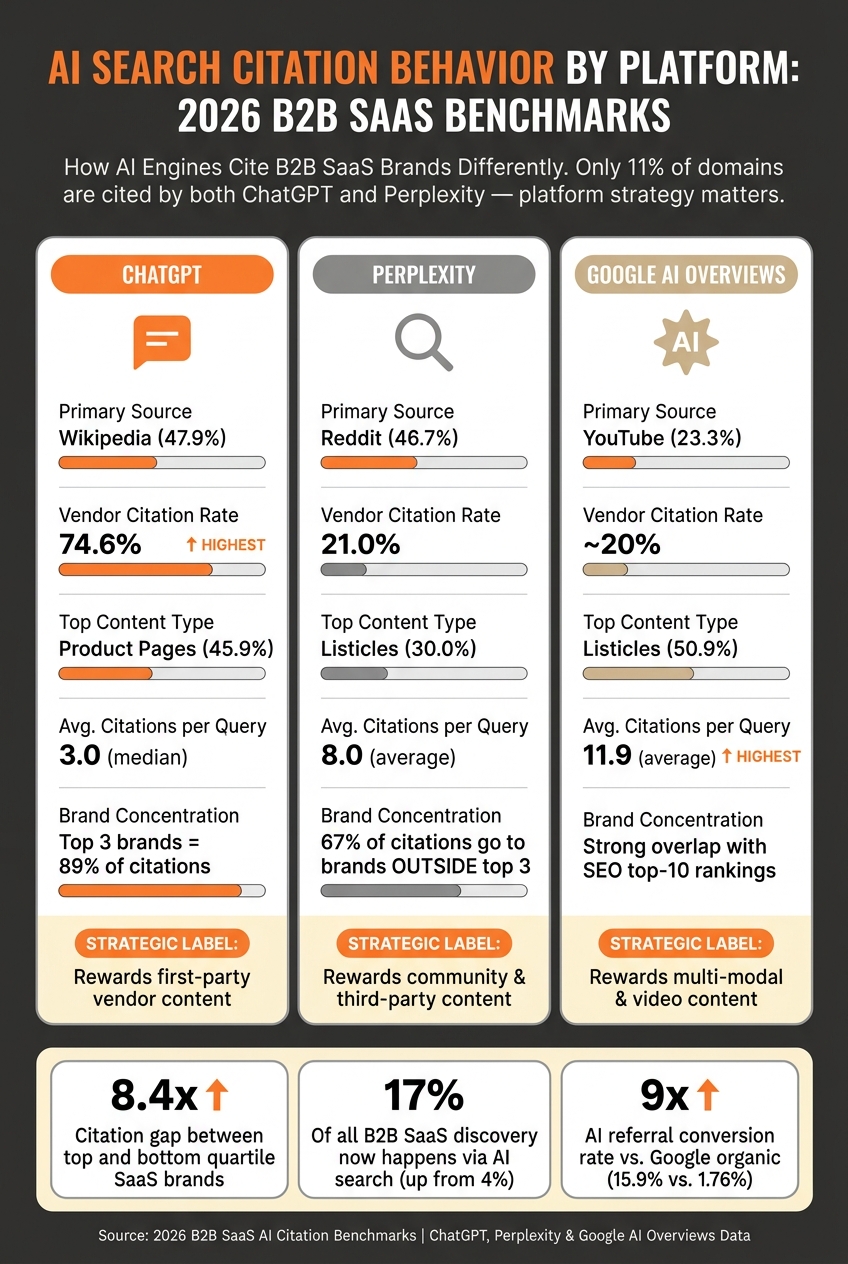
When it comes to citation behavior, not all AI engines are created equal. ChatGPT, Perplexity, and Google AI Overviews each have distinct preferences that can dramatically affect your brand’s visibility. In fact, only 11% of domains are cited by both ChatGPT and Perplexity [11], meaning strategies that work on one platform may fall flat on another.
How the major players stack up:
| Feature | ChatGPT | Perplexity | Google AI Overviews |
|---|---|---|---|
| Primary Source | Wikipedia (47.9%) [11] | Reddit (46.7%) [11] | YouTube (23.3%) [11] |
| Vendor Citation Rate | 74.6% [4] | 21.0% [4] | ~20% [4] |
| Top Content Type | Product pages (45.9%) [6] | Listicles (30.0%) [6] | Listicles (50.9%) [6] |
| Avg. Citations/Query | 3.0 median [1] | 8.0 average [4] | 11.9 average [4] |
| Brand Concentration | Top 3 brands get 89% of citations [12] | 67% of citations go to brands outside top 3 [12] | SEO top-10 overlap [2] |
ChatGPT stands out for its heavy reliance on vendor websites. On GPT-5.4, 74.6% of product-query citations go straight to the vendor’s own pages, which means your own documentation is doing the work [4], prioritizing official documentation and pricing details over third-party sources. This approach rewards brands with well-organized, first-party content.
Perplexity flips the script. Nearly half of its top citations, 46.7%, come from Reddit [11]. This makes community engagement a key factor for visibility. Lily Evans, Managing Director of ZeroClick Labs, names the shift you are dealing with:
"In SaaS, a Reddit thread is not a last-resort citation. It’s a primary one." [6]
Google AI Overviews take a middle-ground approach, favoring multi-modal content. Notably, video citations for SaaS brands in Google AI Overviews are more than double the cross-industry average (12.3% vs. 6.05%) [6]. If you already make YouTube tutorials or video demos, you are sitting on an advantage your competitors are ignoring.
"ChatGPT rewarding vendor websites is traditional SEO winning. Perplexity, Gemini, and Claude rewarding third-party content is content marketing and digital PR winning," says Rafael De Jesus, VisibleIQ [4]
Share of Voice Trends Across B2B SaaS Categories
How Share of Voice Is Distributed Within SaaS Categories
In B2B SaaS, AI search share of voice tends to be heavily concentrated among top brands. For example, every dominant-tier SaaS brand, like Salesforce and HubSpot, gets at least one mention from ChatGPT, while 78% of challenger brands don’t appear at all [13]. In five of six SaaS categories, the brand leading ChatGPT citations is not the one leading Google, which means your organic rank is not telling you where you stand from the one leading in Google’s organic rankings [13]. A breakdown of these differences:
| Category | ChatGPT Leader | Google Leader | Citation Gap (Google-only) |
|---|---|---|---|
| Marketing Automation | Customer.io | Mailchimp | 53% |
| Analytics | Mixpanel | Amplitude | 52% |
| CRM | HubSpot | Zoho CRM | 44% |
| Project Management | Asana | Monday.com | 42% |
| HR | BambooHR | Gusto | 42% |
| Dev Tools | GitHub | GitHub | 18% |
Source: EMGI Group SaaS AI Citation Gap Report 2026 [13]
These numbers hint at some surprising dynamics. Take Marketing Automation, for instance: the citation gap is the largest at 53%. More than half the top Google-ranking brands in that category never appear in ChatGPT at all, so ranking well is no protection for you. One standout example is Customer.io, which leads in ChatGPT citations despite having significantly less organic traffic than HubSpot (32K versus 4M monthly visits). Customer.io even topped all 150 audited companies in AI Overview appearances [13].
"AI visibility is a team sport. We’ve been intentional about mapping prompts in our category to close content gaps and refresh content so both humans and bots can easily understand what Customer.io does and who it’s for," says Molly Evola, Customer.io [13]
So your organic traffic volume will not predict your AI citations (with a correlation of r = 0.23). Instead, brand authority and topical depth play a much larger role, showing a correlation of r = 0.76 [13].
Share of Voice Differences Across AI Engines
The story gets even more interesting when you look at how share of voice varies across different AI engines. Each platform uses its own logic to determine citations, which creates distinct patterns. A closer look:
| Engine | Avg. SaaS Citations per Answer | Primary Weighting Factor |
|---|---|---|
| ChatGPT | 6.1 | Comparison-biased (+51% lift for comparison sections) |
| Perplexity | 4.8 | Depth-biased (favors long-form pillar pages) |
| Claude | 3.6 | Methodology-biased (prefers named frameworks/processes) |
| Gemini | 2.9 | Schema-biased (+33% lift for SoftwareApplication schema) |
Source: [3]
ChatGPT leads the pack in terms of citations, averaging 6.1 per answer. Its preference for structured, vendor-owned content, like product and pricing pages, makes it a key channel for SaaS brands. Gemini cites less overall, but it pays you back directly for serious schema work. These differences emphasize the importance of tailoring content strategies to each platform.
The most successful B2B SaaS brands in 2026 are creating platform-specific playbooks. You need a playbook per platform: documentation tuned for ChatGPT, a presence on the community sites Perplexity reads, and traditional SEO kept sharp so you hold up in Google AI Overviews.
"AI search visibility is not replacing SEO. It is adding a new discovery layer where brands win through entity clarity, third-party validation, structured content, and citation-worthy assets," says Paul Okhrem, AI Decision Consultant [2]
What Top-Performing B2B SaaS Brands Do Differently in AI Search
Content and Structure Factors That Drive AI Citations
The brands winning this are working on two things you can also work on, content structure and authority signals to rank in AI search results to achieve higher citation rates in AI search. Interestingly, these results aren’t tied to bigger marketing budgets but to smart strategic decisions.
One of the most effective tactics? Adding explicit comparison sections. Pages that include clear, head-to-head comparisons with named competitors see a 38% boost in citation rates, which climbs to 51% within ChatGPT results [3]. Models prefer a structured pros-and-cons format on evaluation queries, so this is one of the cheapest wins available to you.
Another key factor is data density. Specific numbers, like pricing tiers, ROI benchmarks, or performance metrics, are present in 80% of pages cited during decision-making stages [4]. Brands such as Clio, which scored an impressive 89/100 AI Presence Score in a 2026 study of 50 companies, excel by presenting their content as trusted references rather than promotional material [14]. These are the structural changes you can make, with what each one is worth:
| Structural Factor | Citation Lift | Effort Level |
|---|---|---|
| Comparison Sections (vs. Competitor) | +38% | Medium (1–3 days) |
Valid llms.txt at root |
+24% | Low (<30 mins) |
| Answer-format H2s | +22% | Low (0.5 days) |
| SoftwareApplication Schema | +18% | Low (1–2 hours) |
| Markdown Docs Subdomain | +17% | Medium (1–3 days) |
| Pricing Page with Structured Tiers | +14% | Medium (1–2 days) |
Source: Digital Applied SaaS Citation Audit [3]
Here’s something many brands miss: 73% of websites currently block AI crawlers via robots.txt or CDN restrictions [8]. By selectively allowing key bots like OAI-SearchBot and PerplexityBot while blocking less relevant ones, brands can significantly enhance their visibility in AI-generated results.
These structural optimizations not only drive higher citation rates but also strengthen trust signals, making the brand more authoritative in the eyes of AI engines.
Authority and Trust Signals That Lift AI Visibility
Structure gets you part of the way. Your authorship and third-party validation matter just as much for AI search success. The SEO metrics you have been reporting on, domain authority among them, do not carry the same weight here. For instance, domain authority correlates with citation rates at just +0.18, while page-level structural signals show a much stronger correlation of +0.71 [3].
"Domain authority correlates +0.18 with citation rate. The 8-point rubric correlates +0.71. Page-level structure is the lever, not link equity.", Digital Applied SaaS Citation Audit [3]
The trust signal you are probably not using is named authorship. Pages that include schema-marked human authors linked to verified profiles see 2.4× higher citation rates [1]. Linking an author’s Person schema to verified profiles on platforms like LinkedIn or Wikipedia creates an "identity graph", which AI engines use to assess credibility.
"The single most-correlated variable with citation share wasn’t backlinks, traffic, or domain authority, it was whether the page named a human author and linked them to a verifiable identity graph.", WinWithSEO 2026 AI Search Benchmark [1]
Another critical element is third-party validation. Perplexity, Gemini and Claude take 79% of their citations from third-party domains rather than your own site [4]. A great example is REsimpli, a real estate CRM, which climbed to the #1 cited tool in ChatGPT for "best CRM for real estate investors" in just 90 days (December 2025 to March 2026). Their strategy included aligning entity data across platforms like Crunchbase, generating 22 new G2 reviews, and securing mentions in three third-party "best of" lists [15]. On average, AI-recommended products have 3.6× more reviews than competitors in the same category [15], showing how third-party credibility directly influences AI-generated recommendations.
How to Use These Benchmarks to Drive SaaS Growth
Linking AI Visibility Metrics to Marketing ROI
The key takeaway here? Stop obsessing over traffic volume as the ultimate measure of success. With about 93% of AI-driven search sessions ending without a click [20], the real focus should be on how often your brand shows up in AI-generated buyer-facing responses.
Why this shift matters: AI-sourced traffic converts at 14.2% compared to just 2.8% for traditional organic traffic, a nearly 5x advantage [19]. For example, Ahrefs reported that while AI-driven visitors made up only 0.5% of their total traffic, they accounted for 12.1% of all signups [17][18]. Why? These visitors are already pre-qualified. The AI has essentially endorsed your brand for a specific use case, speeding up the sales process and cutting customer acquisition costs.
To connect AI visibility directly to revenue, prioritize these three metrics in your SaaS marketing dashboard:
| Metric | What It Measures | Why It Matters |
|---|---|---|
| Citation Rate | Percentage of relevant AI queries where your brand is mentioned | Indicates whether you’re part of the buyer’s consideration set [17] |
| Share of Voice (SoV) | Your citations compared to total category citations | Tracks your competitive standing over time [18] |
| AI-Sourced Pipeline | Leads and revenue generated with an AI platform as the first touchpoint | Provides direct attribution of revenue to AI discovery [5] |
For instance, if your brand appears in only 5 out of 50 high-intent queries, the other 45 represent missed opportunities, potential customers directed to competitors instead [16]. These metrics are the foundation for understanding AI-driven growth, but the next step is setting up a system to track and act on this data.
Building a Tracking Framework for AI Search Visibility
Turning AI insights into growth starts with a solid tracking system. The good news? You can get started with minimal investment. Begin by setting up a custom GA4 channel group using regex to identify referral sources like chatgpt.com, perplexity.ai, and gemini.google.com. Pair this with unique UTM parameters (e.g., utm_source=chatgpt, utm_source=perplexity) that feed directly into Salesforce records [18][19]. This setup allows you to track how AI-sourced leads progress from MQLs to opportunities, giving you a clear ROI picture.
But tracking doesn’t stop there. Analytics tools alone can’t capture everything. Add a "How did you first hear about us?" field to your lead forms with AI-specific options. This helps you capture those zero-click influences, cases where your brand played a role in shaping AI responses even if it wasn’t explicitly cited in the final answer. This is critical because models like Gemini average 3.7 sub-queries per prompt, pulling insights from sources that don’t always get visible credit [4].
To monitor ROI consistently, test 50–200 key queries weekly across platforms like ChatGPT, Perplexity, and Google AI Overviews. This helps you calculate citation share and spot trends early [16][1]. Instead of reacting to small, short-term fluctuations, evaluate your strategy quarterly. The brands that close citation gaps the fastest are those treating AI visibility as a measurable and strategic priority.
Key Takeaways for B2B SaaS Marketing Leaders
AI search has become a central discovery channel. With 17% of all B2B SaaS brand discovery now happening through AI search, a massive 325% increase year-over-year, the brands succeeding here aren’t just the ones with high domain authority. Instead, they’re the ones making their content easy for AI engines to cite [1].
Structuring your content well at the page level moves AI citations far more than link building does. An 8-point structural framework, covering elements like llms.txt, schema markup, and comparison sections, shows a strong +0.71 correlation with citation rates. In contrast, domain authority only shows a weak +0.18 correlation [3].
"Classical ranking is about pages; AI citation is about sentences. The unit of optimisation is a quotable, attributable statement," says WinWithSEO [1]
Which platform you optimize for changes what you should build. ChatGPT tends to favor vendor pages, citing them 74.6% of the time, while Perplexity, Gemini, and Claude lean heavily on third-party sources, relying on them 79% of the time. To maximize visibility, adopting a dual strategy that caters to both is essential [4].
Another critical factor is ensuring your site is accessible to AI crawlers. A surprising 73% of websites currently block AI bots, which can severely limit your visibility. To stay competitive, revisit your technical settings. Update your robots.txt file to allow bots like GPTBot, ClaudeBot, and PerplexityBot. Combine this with strategies to show up in AI search. Companies that prioritize these steps will set the pace for category leadership in the coming years [8].
FAQs
How do I measure AI citations for my brand?
To gauge how often AI platforms reference your brand, focus on tracking citations in AI-generated search responses across tools like ChatGPT, Perplexity, and Google AI Overviews. Start by auditing your URLs to pinpoint where citations occur. Dive deeper by analyzing the structure of your content, look for elements like authoritative tone or data-rich insights that might make your pages more quotable. Keep an eye on how frequently your brand is cited and compare this to industry benchmarks, which typically range between 15-25% for SaaS and B2B tech. This will help you evaluate your visibility and spot areas where you can improve.
What’s a good AI share of voice in my category?
A strong AI share of voice in your category usually falls between 15% and 25%, while the top players often surpass 35%. The specific percentage can vary based on your industry and how well your content resonates. These benchmarks are a useful way to gauge how effectively your brand is standing out in AI-powered search results.
What should I change first to get cited more?
To increase the likelihood of being featured in AI search results, focus on crafting content that includes specific and original data, think benchmarks, ROI statistics, or pricing details. Content that provides detailed and authoritative information tends to grab attention and is more frequently cited. Also, pay close attention to structure. Use comparison sections and clear, organized layouts to make your content easier to reference, which can boost its chances of being cited in AI-generated summaries.