

AI search visibility is all about how often and accurately your brand shows up in AI-generated answers from tools like ChatGPT, Perplexity, and Google AI Overviews.
Why does it matter? Because 71.5% of U.S. consumers now use AI tools for search, and if your brand isn’t mentioned, you’re invisible in the conversation.
But here’s the catch: AI visibility doesn’t equal traffic. Most users don’t click links in AI answers, but when they do, they’re 4.4x more likely to convert. So, measuring the right metrics is key. Here’s what to focus on:
- Mention Rate: How often your brand is included in AI answers.
- Representation Accuracy: Are your features and benefits described correctly?
- Citation Share: The percentage of links pointing to your domain vs. others.
- Competitive Share of Voice: How often you’re mentioned compared to competitors.
- Drift and Volatility: How your visibility changes over time or after AI updates.
To track these, you’ll need tools. Options range from enterprise suites for big teams to AI-native trackers for startups. Start small with manual testing – create prompts, log mentions, and analyze gaps. Once you see results, invest in tools that match your needs and scale as your visibility grows.
Quick Tip: Visibility isn’t just about being in the answer. It’s about being the right answer.
How to Track AI Search Visibility (SEO & GEO 2025)
sbb-itb-e8c8399
The 5 Metrics That Matter
When evaluating AI search visibility, forget traditional rankings. Instead, focus on how often and accurately your brand appears in synthesized AI responses. Here are five key performance indicators (KPIs) to guide your analysis.
Mention Rate by Prompt Cluster
Mention rate, also called AI Brand Visibility (ABV), tracks how frequently your brand is included in AI-generated answers for a specific set of prompts. To calculate it, divide the number of times your brand is mentioned by the total number of AI answers for those prompts [4].
For example, if you test 50 prompts related to project management software and your brand is mentioned in 23 responses, your mention rate is 46%. Think of this metric as a measure of brand awareness in "zero-click" searches. By tracking mention rates across different prompt clusters – such as category definitions, comparisons, or problem-solution queries – you can identify where your brand is performing well and how to show up in AI search results where improvements are needed.
"Mentions are the new impressions – a signal of awareness and authority. If your competitors are mentioned more often, you’re losing visibility at the top of the funnel." – Maria Georgieva, Head of SEO, Payhawk [3]
Representation Score
A mention alone isn’t enough – it’s crucial that AI platforms describe your brand accurately. The representation score measures how well AI responses align with your category positioning, ideal customer profile (ICP), use cases, and key differentiators [4][7].
To evaluate this, label AI responses as Positive, Neutral, or Negative based on factual accuracy. Does the AI correctly explain what your brand does? Are your standout features highlighted? Tools like Vertology can help by comparing AI-generated descriptions to your actual offerings [9]. If, for instance, ChatGPT misrepresents your B2B SaaS product as a consumer app or overlooks your primary selling points, you’ve got a representation issue to address.
Citation Share
Citation share evaluates the sources AI platforms use when mentioning your brand. Specifically, it looks at the ratio of owned sources – such as your website or blog – to third-party sources like Wikipedia, Reddit, or review sites [4].
To calculate your Citation Exposure Score (CES), tally citations from your own domain and compare them to third-party mentions. Weight these citations based on their prominence in the AI-generated content; for instance, a mention in the opening paragraph carries more weight than one buried in a footnote [4]. Interestingly, ChatGPT relies on Wikipedia for nearly 48% of its citations, while Perplexity leans on Reddit for 46.7% [1]. Since AI-generated summaries drive clicks only about 1% of the time [4], the real win lies in being mentioned directly in the text.
Competitive Share of Voice
AI Share of Voice (AI SOV) measures how often your brand is mentioned compared to competitors in AI-generated responses [4]. To calculate it, divide your brand mentions by the total mentions of all competitors for the same set of prompts.
For instance, if you test 50 "best accounting software" prompts and your brand is mentioned 18 times while competitors are mentioned 82 times, your AI SOV is 18%. This metric reveals which competitors dominate specific high-value prompts and highlights areas where your visibility needs work [9]. Pay close attention to prompts where competitors are mentioned but your brand isn’t – these gaps should be your priority.
Drift and Volatility
AI models constantly evolve, pulling from dynamic data that changes daily [3][8]. Drift refers to gradual shifts in how a model perceives your brand over time, while volatility captures sudden changes following updates to the model [3][9].
By monitoring week-over-week changes in visibility, you can spot trends and react to abrupt shifts. For high-priority prompts, daily tracking is essential to stay ahead [5]. A brand is considered to "win" a prompt only when at least two models – like ChatGPT and Gemini – mention it consistently across two consecutive checks [9]. This approach minimizes the impact of fluctuations from a single model.
"The brands that win in generative search are the ones that measure the answer, not just the SERP." – Felix Rose-Collins, CEO/CMO, Ranktracker [4]
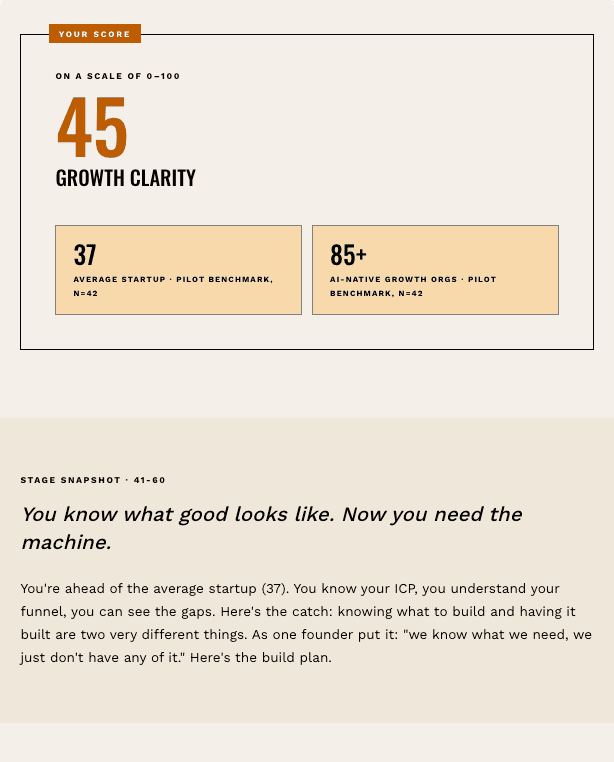
Is Your Startup Falling Behind Its AI-Native Competitors?
Tool Categories: How to Self-Sort
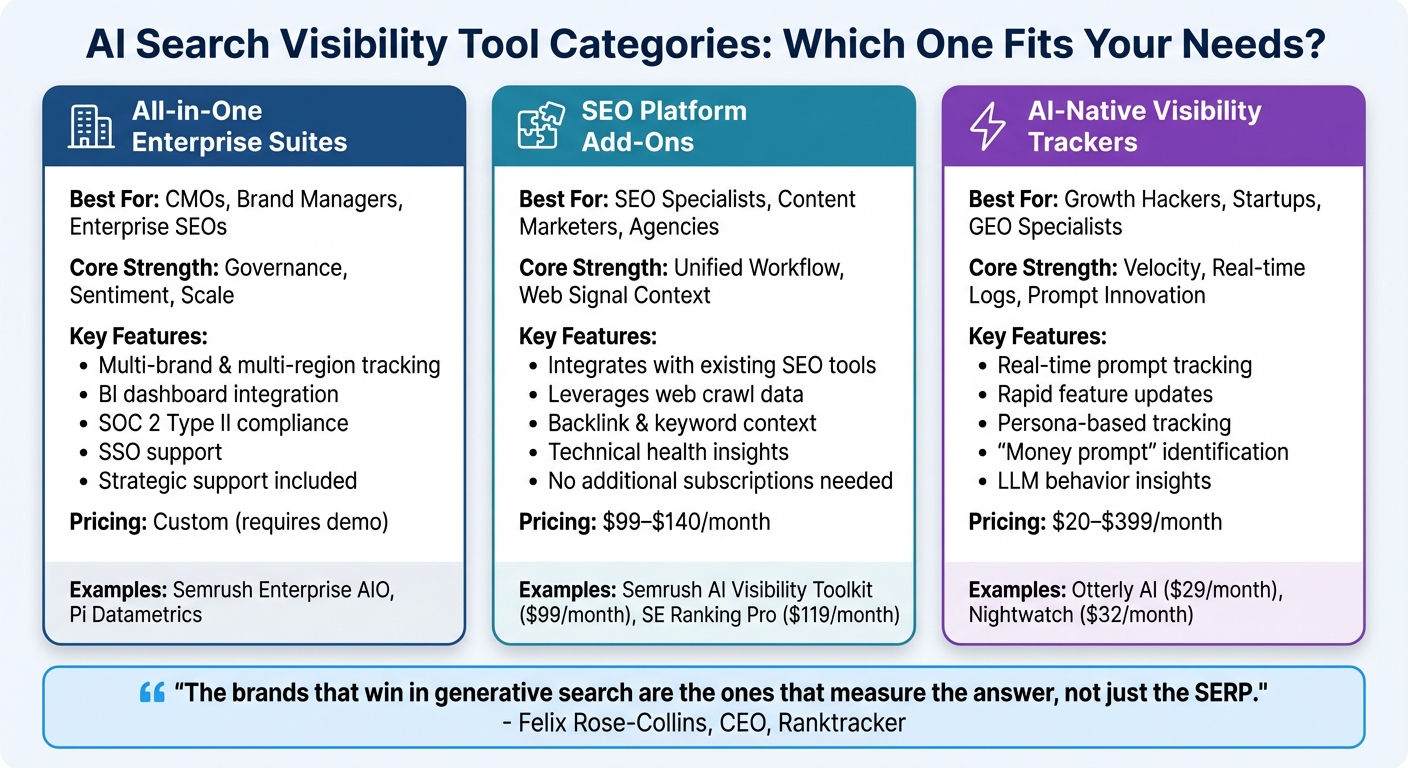
AI Search Visibility Tool Categories Comparison: Features, Pricing, and Best Use Cases
Selecting the right tool for tracking AI search visibility metrics is crucial. These tools generally fall into three main categories, each tailored to different team needs, workflows, and budgets. Here’s a breakdown of the options.
All-in-One Enterprise Suites
These suites are designed for large teams managing multiple brands and regions. They combine tools for brand tracking, competitive analysis, and multi-region reporting, focusing on governance, sentiment analysis, and scalability over quick feature updates.
A key advantage of these platforms is their ability to integrate AI visibility data directly into BI dashboards, CRMs, and reporting systems. They also include compliance features like SOC 2 Type II certification and SSO, making them ideal for industries like healthcare and finance where regulation is a priority.
Pricing is customized and usually requires a demo. These suites are built for teams handling thousands of prompts across regions and offer tailored strategic support. Examples include Semrush Enterprise AIO and Pi Datametrics.
SEO Platform Add-Ons
For teams already using traditional SEO tools, SEO Platform Add-Ons provide a seamless way to track AI visibility without juggling multiple subscriptions. These tools are perfect for SEO specialists, content marketers, and agencies.
The standout feature here is context. These platforms leverage existing web crawl data – like backlinks, keyword rankings, and technical health – to help interpret AI model citations. As Brian Dean, founder of Backlinko, explains:
"If you want to understand why ChatGPT or Google AI Mode describes your brand the way it does, you can’t isolate LLM results from the web signals those models rely on."
Pricing is more straightforward compared to enterprise suites. For instance, the Semrush AI Visibility Toolkit starts at $99/month per domain, while SE Ranking includes AI tracking in its $119/month Pro plan. These tools are best suited for mid-sized teams already invested in traditional SEO platforms.
AI-Native Visibility Trackers
Built specifically for the LLM era, AI-native tools focus on real-time prompt tracking and rapid data updates rather than traditional rankings. These platforms are ideal for growth hackers, startups, and GEO specialists who need to act quickly and identify high-value "money prompts" where competitors excel and rank in AI search results.
One of their biggest strengths is their speed of innovation. Unlike legacy SEO tools that retrofit AI tracking, these platforms can roll out new features faster, such as persona-based tracking that tailors prompts to specific user roles and challenges. They also provide detailed insights into LLM behavior; for example, Google AI Overviews cite YouTube 25.18% of the time, highlighting the need for a specific strategy to show up in Google AI Overviews, while ChatGPT cites it less than 1% [10].
Pricing ranges from $20 to $399/month, depending on the number of prompts and engines tracked.
| Category | Best For | Core Strength | Typical Starting Price |
|---|---|---|---|
| All-in-One Enterprise Suites | CMOs, Brand Managers, Enterprise SEOs | Governance, Sentiment, Scale | Custom (requires demo) |
| SEO Platform Add-Ons | SEO Specialists, Content Marketers, Agencies | Unified Workflow, Web Signal Context | $99–$140/month |
| AI-Native Visibility Trackers | Growth Hackers, Startups, GEO Specialists | Velocity, Real-time Logs, Prompt Innovation | $20–$399/month |
How to Evaluate Tools: The Decision Framework
Once you’ve established your KPIs, a structured evaluation process becomes essential to ensure the tool you choose provides actionable insights. With options ranging from free tools to enterprise-level platforms, making the wrong choice could leave you stuck measuring vanity metrics instead of real business results. A standardized scoring system can help you objectively compare tools, balancing features and costs with your strategic goals.
The 7-Point Evaluation Rubric
Use a 1–5 scale to rate each tool across seven key criteria. A total score of 28 or higher (out of 35) indicates a reliable tool, while anything below 20 highlights significant shortcomings.
- Engine Coverage: This measures how many platforms the tool tracks. The core platforms – Google AI Overviews, ChatGPT, Perplexity, and Gemini – are non-negotiable[4]. Tools that also monitor emerging platforms score higher. For instance, a tool limited to Google AI Overviews would score low, while one covering five or more engines earns top marks.
- Prompt Management: Tools that allow importing unlimited custom prompts and support natural language inputs stand out. Relying on fixed default prompts limits visibility and adaptability, so flexibility in this area is crucial.
- Scoring Transparency: Can you see how the tool calculates its metrics? High-quality tools make their formulas, like Citation Exposure Score (CES) or AI Brand Visibility (ABV), fully accessible. Those that rely on vague proprietary metrics like "Visibility Score" without explanation lose points[4].
- Citation Extraction: This evaluates whether the tool distinguishes between unlinked mentions and linked citations. Tools offering URL-level tracking – differentiating between a link to your product page versus a general blog post – score higher. Since cited sources in AI summaries are clicked only around 1% of the time, both linked and unlinked mentions are crucial[4].
- Competitor Analysis: A strong tool should provide Share of Voice insights and identify citation gaps compared to competitors. Tools without competitor benchmarking earn lower scores, while those offering multi-competitor tracking rank higher[4].
- Export Options: The ability to export raw data in formats like CSV or JSON for independent analysis is a must. Tools that limit you to PDF reports or static dashboard views are less effective for in-depth reviews[9].
- Price-to-Coverage Ratio: This compares the tool’s cost to its capabilities. For example, a tool priced at $499/month but tracking only 50 prompts across two engines scores poorly compared to one offering 500 prompts across five engines for $119/month[6]. The value can be calculated as (Prompts × Engines) ÷ Monthly Cost, with higher ratios indicating better value.
Tool Comparison Matrix
Organize your findings in a comparison matrix to make side-by-side evaluations straightforward. Standardize your testing by using the same 50 prompts across all platforms for consistency[4].
| Criteria | Weight | Tool A Score (1–5) | Tool B Score (1–5) | Tool C Score (1–5) |
|---|---|---|---|---|
| Engine Coverage | High | |||
| Prompt Management | High | |||
| Scoring Transparency | Medium | |||
| Citation Extraction | High | |||
| Competitor Analysis | Medium | |||
| Export Options | Medium | |||
| Price-to-Coverage | High | |||
| Total Score | /35 |
When assessing "Prominence", prioritize tools that assign higher weight to mentions in lead paragraphs (e.g., 2.0 points) compared to footnotes (e.g., 0.5 points)[4]. This distinction matters because traditional link clicks drop to 8% on pages with AI summaries, compared to 15% on pages without them[4]. Placement within the response directly impacts user engagement.
The Weekly Workflow (Works Before You Buy)
Before committing to paid platforms, try manually tracking your baseline metrics to see if they’re worth the investment. This approach gives you access to the same core metrics that enterprise tools provide – minus the automation. By replicating the capabilities of these platforms, you can evaluate key metrics directly and make informed decisions.
Build Your Prompt Pack
Start by creating 20–50 prompts in natural language that reflect actual customer searches. Group these prompts into five intent clusters to cover the full customer journey:
- Category definitions: Questions like "What is project management software?"
- Comparisons: Queries such as "Asana vs Monday.com"
- Jobs to be done: Searches like "How to track team tasks remotely"
- Local intent: For example, "Best CRM in Austin"
- Direct brand queries: Questions like "Is [Your Brand] good for remote teams?"
Once your prompts are ready, test them across major engines like ChatGPT, Perplexity, Gemini, Claude, and Copilot. Each platform has unique indexing and citation methods, so testing widely ensures you get a full picture of how your brand performs[4].
Run, Log, and Score Outputs
Track every test in a spreadsheet. For each prompt, note the engine, visibility outcome, citation type, and prominence (whether your brand appears as a lead, in the body, or as a footnote). Use a simple scoring system:
- Lead mention: 2 points
- Body mention: 1 point
- Footnote: 0.5 points
Also, label the sentiment for each mention as Positive, Neutral, or Negative to understand how your brand is framed, not just how often it’s mentioned[4][7].
Here’s why this matters: By March 2025, 18% of Google searches included an AI summary, but cited sources were clicked only about 1% of the time. That means the mention itself is often the primary win[4].
"The brands that win in generative search are the ones that measure the answer, not just the SERP." – Felix Rose-Collins, CEO, Ranktracker[4]
Find Gaps and Ship Fixes
After gathering your data, analyze it to spot visibility gaps and optimize your rankings. If your brand is mentioned but not cited, it’s a sign that the AI recognizes your brand but doesn’t have a clear source to link. To fix this, update your pages with answer-ready summaries at the top, add FAQ schema, and ensure your brand details are consistent across platforms like Wikidata, LinkedIn, and Crunchbase[4].
If competitors are being cited instead of you, dig into their content. Look at the structure of their pages or the details they include to understand what’s earning them citations. After making updates, re-test your prompts to confirm improvements. Adding well-sourced quotes or statistics can increase visibility in AI-generated results by up to 40%[1].
What to Do Next
Start with Manual Testing
Kick things off by manually testing your weekly workflow over a two-week period. Use a 50-prompt pack across platforms like ChatGPT, Perplexity, Gemini, and Claude. Track metrics such as mention rate and citation frequency, logging all outcomes in a spreadsheet. This hands-on approach helps pinpoint which metrics truly matter for your category – whether it’s citation share in comparison queries or mention rates in category definitions[4].
Once the two weeks are up, analyze your data to uncover visibility gaps. Kurt Fischman, Founder of Growth Marshal, sums it up perfectly:
"AEO Analytics doesn’t ask ‘Where do I rank?’ It asks ‘Am I remembered, retrieved, and reused?’"[2]
To measure AI-driven traffic and demonstrate ROI, set up GA4 referral tracking. Use this regex: (chat\.openai\.com|chatgpt\.com|perplexity\.ai|you\.com|gemini\.google\.com|copilot\.microsoft\.com)[9].
With this baseline data in place, you’ll be ready to choose the right tools for your business needs.
Match Tools to Your Stage
After establishing your baseline metrics, select tools that align with your team size and reporting requirements. For solo marketers, start with budget-friendly options like Otterly AI ($29/month) or Nightwatch ($32/month). Mid-market teams can explore tools such as Peec AI (~$95/month) or SE Ranking ($119/month). For larger-scale operations, enterprise solutions like Profound ($499/month+) or AthenaHQ ($295/month+) are ideal for high-volume testing and governance[6].
The key is to begin with manual testing, move to affordable trackers, and scale up only when your increased AI visibility starts delivering measurable results.
FAQs
How can I effectively measure AI search visibility?
To evaluate your brand’s visibility in AI-driven search, focus on how often and accurately your brand is featured in AI-generated responses from tools like ChatGPT, Gemini, and Google AI Overviews. Unlike traditional SEO, which prioritizes clicks and keyword rankings, AI visibility centers on your presence, the accuracy of your representation, and the quality of citations in conversational AI outputs.
Here are the key metrics to keep an eye on:
- Mention rate: Tracks how frequently your brand appears in responses to grouped prompts, such as category-specific queries, alternative solutions, or problem-solving scenarios.
- Representation accuracy: Ensures the AI describes your brand correctly, covering aspects like category, ideal customer profile (ICP), use cases, and key differentiators.
- Citation share: Examines the balance between your owned content and third-party sources cited in AI-generated responses.
- Competitive presence: Identifies which competitors are mentioned either in place of or alongside your brand.
- Volatility: Monitors weekly shifts in these metrics to spot trends, opportunities, or areas needing improvement.
To get started, develop a "prompt pack" of 20–40 queries that reflect user intent. Test these prompts across various AI platforms, then log the results. Evaluate each response for presence, accuracy, and citation quality, and compile the data into a dashboard for easy tracking. By regularly reviewing this data, you can refine your strategy to boost your visibility in AI-driven search results.
What are the most important metrics for tracking AI search visibility?
To keep tabs on AI search visibility, it’s important to track these key metrics:
- Mention rate: This reflects how often your brand or content shows up in relevant AI-generated responses, organized by similar prompts.
- Representation score: Measures how well your brand or content is portrayed, including its categories, use cases, and unique qualities.
- Citation share: Tracks the percentage of citations pointing to your own content compared to third-party sources.
- Competitive share of voice: Shows how often competitors appear in AI responses relative to your presence.
- Drift or volatility: Monitors week-to-week changes in visibility, highlighting trends or shifts over time.
Paying attention to these metrics ensures your brand isn’t just visible but also accurately represented and holding its ground against competitors in AI-driven search results.
How do I choose the best AI search visibility tool for my needs?
To select the best AI search visibility tool, begin by outlining the key metrics that matter most to your goals. Pay attention to mention rate by prompt cluster, representation accuracy (how effectively your brand or content reflects your audience and unique qualities), citation share (owned versus third-party sources), competitive share of voice, and week-over-week visibility changes.
From there, align your objectives with the right type of tool. Options include:
- All-in-one enterprise suites: These provide wide-ranging features, including prompt management and competitor analysis.
- SEO-platform add-ons: These extend existing SEO tools to include AI visibility tracking.
- AI-native tools: Designed specifically for monitoring large language models (LLMs) like ChatGPT and Gemini.
When evaluating tools, focus on factors like engine coverage, scoring transparency, citation accuracy, and overall value compared to cost.
Before making a final decision, conduct a trial run. Create a test set of prompts (20–40 queries), run them across various engines, and assess how the tool performs in terms of presence, accuracy, and citation quality. If the tool provides actionable insights and integrates smoothly with your workflow, it’s likely a strong choice for your needs.
Related Blog Posts
- AI Brand Visibility: How To Optimize Your Brand’s Visibility in AI Search
- 7 Powerful Strategies That Improve Brand Visibility in AI Search Engines (with Examples)
- The Ultimate Roadmap for How to Show Up in AI Search Results in <2 Weeks
- AI Search Analytics: The Metrics + Dashboard You Need to Track LLM Visibility