
If buyers are asking ChatGPT, Perplexity, or Claude about products like yours, you need to know two things: Does your brand show up? And if it does, is it described accurately?
I’m Lillian Pierson, a fractional CMO for AI startups and a licensed Professional Engineer who’s written 12 books with Wiley on data and AI. The dashboard below is the one I use to track my own AI search citations, 318,850 across 160 URLs at last count, per Bing’s AI Performance report.
AI search analytics is about tracking how large language models (LLMs) represent your brand. This isn’t about traditional SEO rankings anymore. Instead, it’s about citations, accuracy, and visibility in AI-generated answers. Why? Because users often don’t click. They trust what the AI tells them directly.
Key takeaways:
- Track AI Signal Rate: How often your brand appears in responses.
- Measure accuracy: Are your features, pricing, and messaging correct?
- Monitor citations: Are AI tools referencing your content as a source?
- Compare competitor visibility: Who’s being mentioned when you’re not?
- Check AI-driven traffic: Is this visibility leading to conversions?
The shift: It’s no longer “Do we rank?” but “Are we cited?” If you’re not part of the AI conversation, your brand risks being ignored by potential buyers.
How to build a system to track, improve, and maintain your visibility in the age of AI-driven search. You can even show up in AI search results in as little as two weeks.
5 Metrics You Need to Track
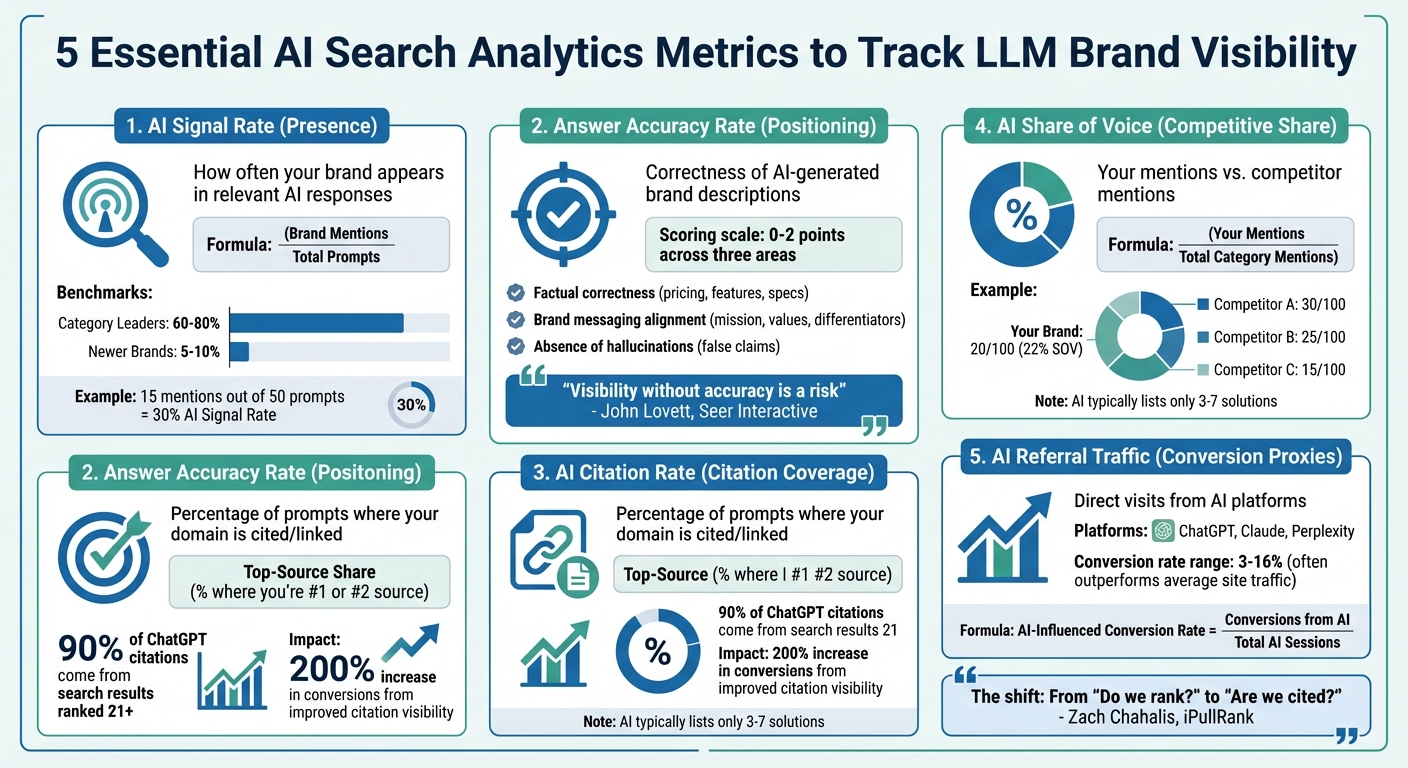
5 Essential AI Search Analytics Metrics to Track LLM Brand Visibility
To understand your brand’s presence in AI-driven search, focus on five key metrics. Instead of obsessing over keyword rankings, assess how AI platforms represent your brand and whether you’re part of the conversation when buyers turn to AI for recommendations.
Presence: Is Your Brand Mentioned?
The AI Signal Rate is a core metric that measures how often your brand appears in relevant AI responses. To calculate it, divide the number of AI responses mentioning your brand by the total number of relevant prompts [10]. For example, if your brand shows up in 15 out of 50 prompts about "project management software", your AI Signal Rate is 30%.
Category leaders often achieve citation rates of 60% to 80%, while newer or less-established brands typically start at 5% to 10% [10]. Track your AI Answer Presence Rate across platforms like ChatGPT, Perplexity, Gemini, and Claude, as each uses different training data and may represent your brand uniquely. For Google’s AI Overviews, focus on your AIO Inclusion Rate to gauge how often your brand appears in these prominent search features [2][6].
Positioning Accuracy: Are You Described Correctly?
Getting mentioned is important, but accuracy is essential. Incorrect descriptions can damage your credibility.
"Visibility without accuracy is a risk. If people get incorrect information about your brand, credibility erodes."
- John Lovett, Seer Interactive [10]
Use an Answer Accuracy Rate to evaluate AI responses on a 0-2 point scale across three areas: factual correctness (pricing, features, specifications), alignment with your brand messaging (mission, values, differentiators), and the absence of LLM hallucinations (false claims) [10]. To do this effectively, create a "ground truth" document that outlines your key facts, what you offer, your target audience, and what sets you apart, and review AI outputs against it quarterly [10].
Two additional metrics to monitor are your Narrative Alignment Score, which measures how well AI descriptions match your intended positioning, and your Sentiment Score, which tracks the tone of AI responses (positive, neutral, or negative) [1][6]. High presence with negative sentiment signals a different issue than low presence. Accurate positioning ensures your credibility remains intact as your AI visibility grows.
Citation Coverage: Are Your Assets Used as Sources?
In AI search, citations act as a form of authority. When platforms link to your content as a source, it boosts your visibility and credibility with both the AI model and users.
"Brand mentions are kind of the new currency of AI search."
- Zach Chahalis, Senior Director of SEO and Data Analytics, iPullRank [7]
Your AI Citation Rate measures the percentage of prompts where your domain is cited or linked [1]. However, not all citations are equal. Top-Source Share tracks how often you’re the first or second source in an AI response, these positions often drive more traffic and signal greater authority [1]. For example, one case study showed a 200% increase in conversions from AI referrals after improving citation visibility [9].
Pay attention to Citation Quality as well. Ensure links point to accurate, high-quality content rather than outdated pages or low-value aggregators [7]. Interestingly, about 90% of ChatGPT’s citations come from search results ranked 21 or lower, highlighting the importance of maintaining a robust content library, not just focusing on your homepage [8].
Competitive Share: Who Shows Up Instead of You?
Understanding how competitors are represented in AI responses can reveal gaps in your strategy. AI typically lists only 3-7 solutions, so if you’re not included, you’re missing out on key buyer consideration.
AI Share of Voice (SOV) measures your mentions compared to competitors for specific high-intent prompts [2][10]. For instance, if you appear in 20 out of 100 prompts and your three main competitors appear in 30, 25, and 15 respectively, your SOV is 22%. Also, track your Ranking in Enumerations, when AI provides a numbered list like "Top 10 tools for X", note your average position [1]. Being listed fourth instead of first can significantly influence how buyers perceive your brand’s market position.
| Metric | What It Measures | How to Calculate |
|---|---|---|
| AI Signal Rate | Brand mention frequency | (Brand Mentions / Total Prompts) [10] |
| AI Share of Voice | Competitive positioning | Brand mentions vs. competitor mentions [2][10] |
| Top-Source Share | Citation prominence | % of answers where you’re the #1 or #2 source [1] |
Conversion Proxies: Are AI Mentions Driving Traffic?
Ultimately, AI visibility should lead to tangible business results. AI Referral Traffic measures direct visits from platforms like ChatGPT, Claude, and Perplexity. You can find this data in Google Analytics 4 (GA4) under domains like chat.openai.com and perplexity.ai [2][7]. Set up custom referral filters to track this traffic weekly.
To assess effectiveness, calculate your AI-Influenced Conversion Rate by dividing conversions from AI referral sessions by total AI-influenced sessions [10]. Studies show these sessions often convert at rates of 3% to 16%, often outperforming average site traffic [10]. Also, monitor Branded Search Correlation in Google Search Console. Spikes in branded search volume often follow increased AI visibility, as users discover your brand through AI responses and later search for you directly [2][8].
Finally, gather qualitative insights by asking customers during sales calls how they first heard about you. If they mention platforms like ChatGPT or Perplexity, log this information. These insights complement your metrics and provide a clearer picture of the buyer journey.
The AI Search Analytics Loop: Weekly Workflow
Monitoring AI visibility isn’t a one-and-done task. It’s an ongoing process. The best teams operate on a weekly cycle, evaluating how AI platforms represent their brand, identifying gaps, and addressing them before competitors can gain an edge. This approach transforms AI visibility into a practical metric that directly ties into broader strategic goals.
Step 1: Build a Comprehensive Prompt Set
Start by identifying 20–50 high-value queries that your potential buyers might use. Group these queries into four categories:
- Problem queries: Questions like "how to reduce churn in SaaS."
- Solution queries: Searches such as "best customer retention platforms."
- Category queries: Broader terms like "what is AI-powered knowledge software."
- Brand queries: Specific mentions, e.g., "Is [Your Brand] reliable?"
Don’t stop there, include comparison prompts like "[Your Brand] vs [Competitor] for mid-market" to gauge how AI engines rank you against rivals [1][8]. Prioritize prompts with high commercial intent, such as "best [category] for [use case]", as these are more likely to convert than general awareness queries [2]. Additionally, test entity-specific prompts like "What does [Your Brand] do?" or "Who is [Founder Name]?" to ensure AI platforms recognize your brand as a distinct entity [4]. Because most ChatGPT citations come from deeper in the results rather than the first page, focus on long-tail, specific queries where competition is thinner [8].
Step 2: Test Prompts Across AI Platforms
Run your prompts through platforms like ChatGPT, Perplexity, Gemini, and Claude. You can do this manually or by using a scheduling tool to streamline the process. Log each response for version control and tracking. Keep in mind that each platform pulls from different training data and retrieval methods, so your brand may show up on one platform but not another[6].
Once you’ve gathered responses, you’ll be ready to evaluate their accuracy and impact.
Step 3: Score the Results
Evaluate each response based on presence, accuracy, citations, and competitor mentions. Use a simple 0–2 scale for accuracy: 0 for incorrect, 1 for partially correct, and 2 for fully accurate answers. Calculate your Share of Voice (SOV) by comparing how often your brand appears compared to competitors for high-intent prompts. Also, track your Top-Source Share, the percentage of responses where your brand is cited as the first or second source. These prime positions are critical for driving traffic and signaling authority [1].
Step 4: Identify Missing Context
If AI platforms misrepresent or entirely omit your brand, it’s likely due to missing or incomplete context. Compare outputs against your established key facts, things like pricing, features, target audience, and differentiators [1]. Look for gaps: Are you absent from category definitions? Are your unique selling points unclear? Is your entity record incomplete on platforms like Wikidata or Crunchbase [4]?
To improve retrieval, conduct semantic analysis to see how well your content aligns with buyer language. Content with a cosine similarity score above 0.85 for target queries is more likely to be retrieved. If your content doesn’t align semantically, it may never surface, even if it’s factually accurate [4].
Step 5: Update and Distribute Content
Based on your findings, create content that’s easy for AI systems to extract and cite. Use concise, 2–3 sentence definitions at the top of key pages, incorporate question-first headings (e.g., "What is [Your Product]?"), and structure FAQs around common buyer queries [1]. Add structured data like JSON-LD using Schema.org to provide machine-readable context, and link your brand to authoritative sources like Wikidata and LinkedIn using the sameAs property[4].
Publish this updated content on your website and share it with trusted third-party sources, such as industry blogs, review sites, and partner platforms. A diverse content presence across multiple domains increases your chances of being retrieved. Additionally, monitor your server logs for traffic from LLM crawlers like GPTBot and OAI-SearchBot to see which pages are being ingested [5][6].
Step 6: Re-Test and Track Progress
Once your updates are live, re-test your prompt set and compare the new results to your baseline scores. Log any changes in visibility, accuracy, citations, and competitor mentions. Document update latency and share findings in a centralized log or dashboard so your team can see what’s working. If a specific content update significantly improves your citation rate, apply similar strategies across other topics. If a competitor starts appearing more frequently, investigate their recent changes to stay ahead.
This continuous feedback loop turns AI visibility into a measurable, actionable channel.
| Intent Category | Example Prompt | Funnel Stage |
|---|---|---|
| Problem | "How to reduce churn in SaaS" | Awareness |
| Solution | "Best customer retention platforms" | Consideration |
| Category | "What is AI-powered knowledge software" | Awareness/Consideration |
| Brand | "Is [Brand] a good solution for X?" | Decision |
| Comparison | "[Brand] vs [Competitor] for mid-market" | Consideration/Decision |
| Entity | "Who is the founder of [Brand]?" | Brand Authority |
Building Your AI Search Analytics Dashboard
Your AI Search Analytics Dashboard is more than just a tool for tracking data. It’s your central hub for translating insights into decisions. By following the weekly AI Search Analytics Loop, you can keep tabs on your AI brand representation, assess competitor performance, and make informed choices. A well-designed dashboard doesn’t just tell you what happened; it points you toward what to do next. At its core, your dashboard should answer three critical questions: Are we visible? Are we accurate? Are we outperforming competitors?
What to Include in Your Dashboard
To get started, focus on a few essential metrics that provide a clear view of your performance:
- Visibility Scores by Engine: Measure your AI Answer Presence Rate and topic coverage across platforms like Google AI Overviews, ChatGPT, Perplexity, Gemini, and Claude [6]. This helps establish how often your brand appears in AI-generated responses.
- Factual Accuracy Scores: Evaluate accuracy by topic cluster using a 0–2 scale. This ensures that AI-generated descriptions, such as pricing, product features, and audience targeting, are correct [1].
"The general idea is we’ve moved from, ‘Do we rank?’ to, ‘Are we cited?’ The metrics that we need to care about, though, have changed."
- Citation Share: Track how often your domain is cited in AI responses compared to competitors [6]. This metric reflects your authority in the zero-sum game of AI visibility.
- Competitor Displacement: Monitor your Share of Voice and average positioning in high-intent queries [1]. For example, if a competitor consistently ranks higher in AI-generated lists, it’s time to analyze their content strategy and entity coverage.
- Conversion Proxies: Set up custom channel groupings in GA4 to correctly classify traffic from AI platforms like ChatGPT, Claude, and Perplexity, which are often mislabeled as generic referral traffic [2]. Keep an eye on AI referral sessions, conversion rates, and spikes in branded search volume in Google Search Console. AI-driven traffic often converts better than traditional search because the platform has already provided a trusted recommendation [2].
A quick breakdown of key dashboard components:
| Dashboard Component | What It Measures | Why It Matters |
|---|---|---|
| AI Answer Presence Rate | % of tested prompts where the brand is mentioned | Establishes baseline visibility across engines [6] |
| Factual Accuracy Score | % of AI statements matching validated facts | Prevents brand damage from inaccuracies [1] |
| Citation Share-of-Voice | Proportion of citations referencing your domain | Reflects competitive authority [6] |
| AI Referral Traffic | Sessions from AI platforms in GA4 | Demonstrates direct business impact [2] |
While these metrics provide a solid foundation, dynamic monitoring ensures you can adapt quickly to changes.
Setting Up Alerts and Trend Tracking
Static metrics are important, but dynamic alerts and trend tracking give you the agility to respond in real time. Set up automated alerts for key scenarios, such as drops in Google AI Overview visibility for high-priority topics, competitors overtaking your citation share, or shifts in brand sentiment to negative territory [6]. Route these alerts to the appropriate teams, SEO, content, or product marketing, depending on the issue.
To stay ahead, track version-controlled AI outputs. Since AI platforms frequently update their responses, log each AI Overview as a versioned object with a timestamp [6]. This helps you identify when changes in wording, citations, or structure occur and tie these shifts to your content updates or competitor activity.
Overlay AI visibility trends with core business metrics like branded search volume, direct traffic, and revenue [2][8]. This integrated view can highlight downstream effects. For instance, if AI visibility spikes but branded search volume remains flat, it could signal a positioning issue. Additionally, track update latency, the time it takes for AI systems to reflect brand updates like pricing changes [1]. Long delays might indicate crawl frequency issues or weak entity signals.
Lastly, use log file analysis as an early warning system. Monitor AI crawler activity (e.g., GPTBot, OAI-SearchBot) to detect potential visibility issues [7]. A sudden drop in crawler activity could signal a decline in visibility, giving you time to address the problem before it affects your metrics.
How to Evaluate AI Visibility Tools
Once you’ve set up your dashboard and tracking schedule, it’s time to decide if automated tools are worth the investment. For smaller datasets, say, 20–30 buyer questions, spreadsheets might do the trick. But if you’re handling hundreds of prompts every week, automation becomes a necessity. This step bridges the gap between manual insights and automated efficiency.
What to Look for in a Tool
Start with engine coverage. The tool should monitor all platforms your buyers use, such as Google AI Overviews, ChatGPT, Perplexity, Gemini, and Claude. If it only tracks one or two engines, you risk missing critical insights.
Next, evaluate how the tool handles prompt management and scheduling. The best tools allow you to manage high-value prompts effectively and even expand a single query into related ones. This helps uncover how AI systems retrieve and synthesize information.
Transparency in scoring is non-negotiable. Avoid tools that rely on a single, unexplained score. Instead, look for platforms using a framework like RAPP, Regularity (how often your brand is mentioned), Accuracy (factual correctness), Prominence (position in lists), and Positivity (sentiment). A good tool should also let you compare AI outputs to your "ground truth spec", which is your definitive set of facts about pricing, features, and positioning.
Citation tracking is equally important. Your tool should measure not just brand mentions but also citation rates and top-source share, indicating whether your brand is cited early and often. It’s also helpful if the tool differentiates between linked citations and unlinked mentions. These features are key to improving your AI visibility, a cornerstone of any strong strategy.
Integration capabilities are another must. Look for tools that support CSV exports, BI connectors, or API access to merge data with your analytics systems. Persona-based dashboards are a nice bonus, offering tailored insights for different roles. For instance, CMOs might need high-level share-of-voice summaries, while SEO leads benefit from detailed technical trends.
Finally, consider real-time alerting and anomaly detection. The tool should flag sudden drops in visibility, shifts in citation share, or changes in sentiment. Without alerts, you might miss critical issues until your next manual review.
Tool Comparison: Features and Capabilities
A quick comparison of some key platforms, highlighting their features and ideal use cases:
- Semrush AI SEO Toolkit tracks ChatGPT visibility, sentiment share, and identifies opportunities to fill content gaps. In Backlinko’s comparison of five SEO brands, Semrush took a 33% share of ChatGPT citations, followed by Ahrefs at 25% [8].
- seoClarity offers specialized tracking for AI search visibility, including detailed overviews and site analytics.
- AirOps Brand Visibility Tracker provides a free, spreadsheet-based solution for measuring brand presence across AI-generated answers, making it a great option for small teams or manual audits.
- Qforia (iPullRank) focuses on analyzing how AI interprets queries and expands them into networks of related topics.
- Rankscale specializes in measuring the baseline volume of brand mentions and citations across large language models.
| Tool | Key Capabilities | Best For |
|---|---|---|
| Semrush AI SEO Toolkit | ChatGPT visibility, sentiment analysis, strategic insights | Competitive analysis and content gap detection |
| seoClarity | AI search visibility, comprehensive overviews, site analytics | Enterprise-level tracking across platforms |
| AirOps Brand Visibility Tracker | Spreadsheet-based brand presence measurement | Small teams or manual audits |
| Qforia (iPullRank) | Query expansion and semantic topic network analysis | Understanding AI query interpretation |
| Rankscale | Baseline measurement of brand mentions and citation volume | Establishing initial visibility benchmarks |
When weighing cost against coverage, start small. Use a free tool or manual checks to audit your core buyer questions before committing to a pricier automated platform. For most brands, tracking on a quarterly basis is enough. However, industries like fintech or AI tools may need monthly updates due to their fast-moving nature. Keep it simple, 8–12 key metrics are usually sufficient for managing AI visibility effectively.
4 Common Mistakes to Avoid
Many brands waste valuable time focusing on the wrong metrics or treating AI visibility as just another box to check. The key difference between effective AI search analytics and busywork lies in steering clear of these four major pitfalls.
Tracking Mentions Without Checking Accuracy
Counting how often your brand appears in AI-generated answers is pointless if those mentions are inaccurate or negative. In fact, a high presence combined with poor representation can harm your reputation more than not being mentioned at all [1]. LLMs can easily produce outdated or misleading information about your pricing, features, or positioning. If users trust these inaccuracies, your brand’s credibility takes a hit [5]. Worse, if your official data, like validated pricing or messaging, conflicts with what the AI outputs, the system may stop treating your content as the authoritative source [1].
To address this, create a detailed "ground truth" document that outlines your validated facts, and regularly evaluate AI outputs against it. This helps you calculate a factual accuracy score [1]. The RAPP framework, measuring Regularity (frequency), Accuracy (factuality), Prominence (ranking), and Positivity (sentiment), can be used to monitor mentions and flag issues when they fall below acceptable levels [5][6]. Additionally, strengthen your AI brand visibility strategy to reinforce the accuracy of your brand’s portrayal.
Ignoring Citations and Source Tracking
Accuracy isn’t enough, being cited as a credible source is just as important. In a world where users often don’t click through to websites, citations act as a primary marker of authority [4]. Securing top citation positions signals that your content is both trustworthy and influential [7]. If LLMs stop citing your brand, you risk fading from the "collective intelligence" that future AI systems rely on [4]. And since buyers often shortlist vendors during their initial research, missing citations for key topics could mean your brand is left out of consideration [2]. That same tilt toward deeper results is what lets a competitor outrank you on citations simply by having more of their library accessible [8].
"SEO is no longer about clicks; it’s about citations," says Kurt Fischman, Founder, Growth Marshal [4]
To stay visible, consider adding "AI Assistant" as an option in your "How did you find us?" forms to capture AI-driven discovery [6]. Also, audit your backlink profile to ensure it includes publishers with direct ties to major LLM providers [5].
Using Generic Prompts That Miss Buyer Intent
If you’re only testing prompts like "[Your Brand]" or "[Your Brand] reviews", you’re missing the bigger picture. Most AI-driven discovery happens through problem and solution-based queries, not direct brand searches [1]. Relying on generic prompts can give you a false sense of visibility while hiding gaps in your competitive positioning.
Instead, develop prompts that align with how buyers actually search. Cover problem queries ("how to reduce churn"), solution queries ("best retention platforms"), category queries ("what is AI knowledge software"), and brand-specific queries. Tailor prompts to different buyer personas and stages of the sales funnel, such as "Explain [Solution] for a CFO" versus "Explain [Solution] for a technical lead" [1]. Include comparison prompts like "[Brand] vs [Competitor]" or "best platforms for [specific use case]" to measure your competitive share of voice. Shift your language from product-focused to problem-focused to better reflect buyer behavior. And remember, this isn’t a one-and-done task, maintain a rolling list of priority prompts and update it regularly [6].
Treating This as a One-Time Project
AI systems evolve, competitors release new content, and buyer questions shift over time. If you treat AI visibility as a one-time effort, you’ll miss changes in how your brand is represented. For example, traditional analytics might show a drop in organic traffic, even as your influence grows through AI mentions [8]. This "invisible influence" becomes clear only when you track high-intent prompts consistently and connect them to later branded searches.
Set up a weekly routine to monitor your AI presence. Run your prompt set, evaluate the results, identify gaps, update your content, and re-test. Without this ongoing effort, you risk falling behind while competitors gain an edge through AI-driven insights.
Conclusion
By 2027, LLM traffic is projected to surpass traditional Google search traffic [8]. If you’re still relying solely on organic clicks and keyword rankings, you’re missing the bigger picture. The new measure of visibility is citations, not clicks. As Zach Chahalis from iPullRank explains:
"The general idea is we’ve moved from, ‘Do we rank?’ to, ‘Are we cited?’ The metrics that we need to care about, though, have changed" [7].
These new metrics reflect how AI engines perceive and represent your brand. However, metrics alone won’t cut it. To stay ahead, you need a structured, repeatable system that tracks changes in your brand narrative, competitor activities, and AI citation trends. Without consistent monitoring, you risk missing critical shifts, whether it’s your narrative losing relevance, competitors gaining ground, or AI engines no longer recognizing your content as credible.
This shift requires a new way of thinking about success.
Kurt Fischman, Founder of Growth Marshal, underscores the urgency:
"If LLMs don’t learn your voice now, your brand might be erased from the collective intelligence of the future" [4].
Success is no longer about chasing vanity metrics. It’s about defining your brand as a trusted source of knowledge. Companies that invest early in tracking and adapting to these new metrics will gain a lead that others, stuck on outdated measures, won’t be able to match [11].
So, what can you do now? Start small. Develop a prompt set of 25–30 buyer-focused questions. Test them across tools like ChatGPT and Perplexity, and evaluate the results. Track changes weekly. Set up alerts to flag drops in your citation share or the appearance of competitors in areas you previously dominated. The tools to do this are available. It’s about building the habit.
AI search analytics isn’t a one-and-done task. It’s the backbone of how your brand will be found, evaluated, and remembered in an AI-first world. Integrating these practices into your workflow ensures your brand stays relevant in this evolving digital landscape. The real question isn’t whether to start tracking these metrics. It’s whether you can afford to wait any longer. To protect your traffic, you must also master how to rank in AI search results using GEO and AEO tactics.
FAQs
How can I make sure my brand is correctly represented in AI-generated answers?
To keep your brand accurately represented in AI-generated responses, think of AI visibility as an ongoing effort rather than a one-and-done task. Focus on key metrics such as:
- Presence: Are you being mentioned at all?
- Positioning accuracy: Are you described correctly, including your category, customer profile, and unique strengths?
- Citation coverage: Are your materials being used as sources?
- Competitive share: Who’s showing up in place of you?
These metrics serve as the backbone of an effective AI Search Analytics strategy.
Next, develop prompts that align with your buyers’ search behaviors. These might include category-related searches, questions aimed at solving specific problems, or vendor comparisons. Test these prompts across major AI platforms like ChatGPT, Perplexity, and Claude. Review the results for accuracy, proper citations, and mentions of competitors. If you spot gaps, address them by updating or creating content such as detailed product pages, FAQs, or case studies. Make sure this content is linked from authoritative sources to boost credibility. Regularly revisit and test these prompts to track progress.
Keep a close eye on metrics like brand visibility, sentiment, and citation share to measure success. Set up alerts for sudden shifts, such as incorrect claims or new competitors appearing in your space. Adjust your content strategy as needed to address these changes. By consistently refining the information AI systems rely on, you can ensure your brand is accurately and positively represented in AI-generated responses.
How can I increase my brand’s citation rate on AI-powered platforms?
To increase your brand’s citation rate on AI platforms, focus on creating content that is clear, credible, and easy for AI models to reference. Start by structuring your data with schema markup, such as Organization, Product, or FAQ, to help AI systems extract and link information back to your site accurately. Additionally, optimize your content by crafting concise, answer-focused text, using headings that align with common user intents, and incorporating high-quality visuals like images or tables that are easy to cite.
Establishing brand authority is equally important. Publish expert-driven content such as whitepapers, case studies, and blog articles, and work on earning backlinks from reputable websites. Ensure that your brand-managed platforms, like your website, blog, and local listings, are consistently updated and detailed, as these are primary sources for AI citations. Lastly, monitor your brand’s presence by using intent-based prompts on key AI platforms. Identify any gaps in citations or inaccuracies, and update your content regularly to maintain both visibility and trust.
How can I measure the impact of AI-driven traffic on my business conversions?
To gauge how AI-driven traffic influences your business conversions, begin by keeping an eye on referral visits from platforms such as ChatGPT, Gemini, or Perplexity. Pay attention to conversion indicators like demo requests, form submissions mentioning phrases such as "found you via AI", or call inquiries that reference AI.
Then, dive into the numbers, calculate the conversion rates and revenue tied to these AI-driven visits. This will give you a clearer picture of how this traffic contributes to your business growth and aligns with your overall conversion objectives.