
Something strange happens when you ask founders about their MQL-to-SQL conversion rates.
They get quiet. Then they ask if their number is "normal." Then they immediately start explaining why their rate is what it is, before you even tell them if it’s good or bad.
Here’s what might surprise you: That nervous energy comes from the same place. Most technical founders have no idea what benchmarks to use, which makes every conversion metric feel like a referendum on their entire GTM strategy.
It’s not. Let me show you why.
Here’s what you need to know upfront… converting MQLs into SQLs is one of the most critical metrics for B2B SaaS companies in 2026. Industry benchmarks show MQL-to-SQL conversion rates range from 18-22% on average, with top performers hitting 25-35%. The best channels? SEO (51%), email marketing (46%), and webinars (30%).
If you’re falling short, the fix often lies in refining lead scoring, aligning sales and marketing, and improving follow-up timing. Even a 5% boost in conversion rates can drive a 12-18% increase in revenue.
Key insights from this guide:
- SEO dominates: Leads from organic search convert at 51%, the highest of any channel.
- Email nurtures matter: Email campaigns drive a 46% conversion rate, with webinars performing especially well.
- Paid media lags behind: PPC leads convert at 26%, but smart retargeting and landing page tweaks can help.
- ICP alignment is crucial: Tailor your approach based on company size and sales motion to avoid wasting resources.
- Speed wins: Reaching out to high-intent leads within the first hour boosts success rates by up to 7X.
Take action now: Audit your current MQL-to-SQL rates by channel and Ideal Customer Profile (ICP). Identify where leads drop off and adjust your scoring, workflows, or outreach strategies accordingly. Small improvements can unlock major growth.
How to increase the conversion rate from MQLs? ft. Jordan Benjamin
MQL-to-SQL Conversion Strategies by Marketing Channel
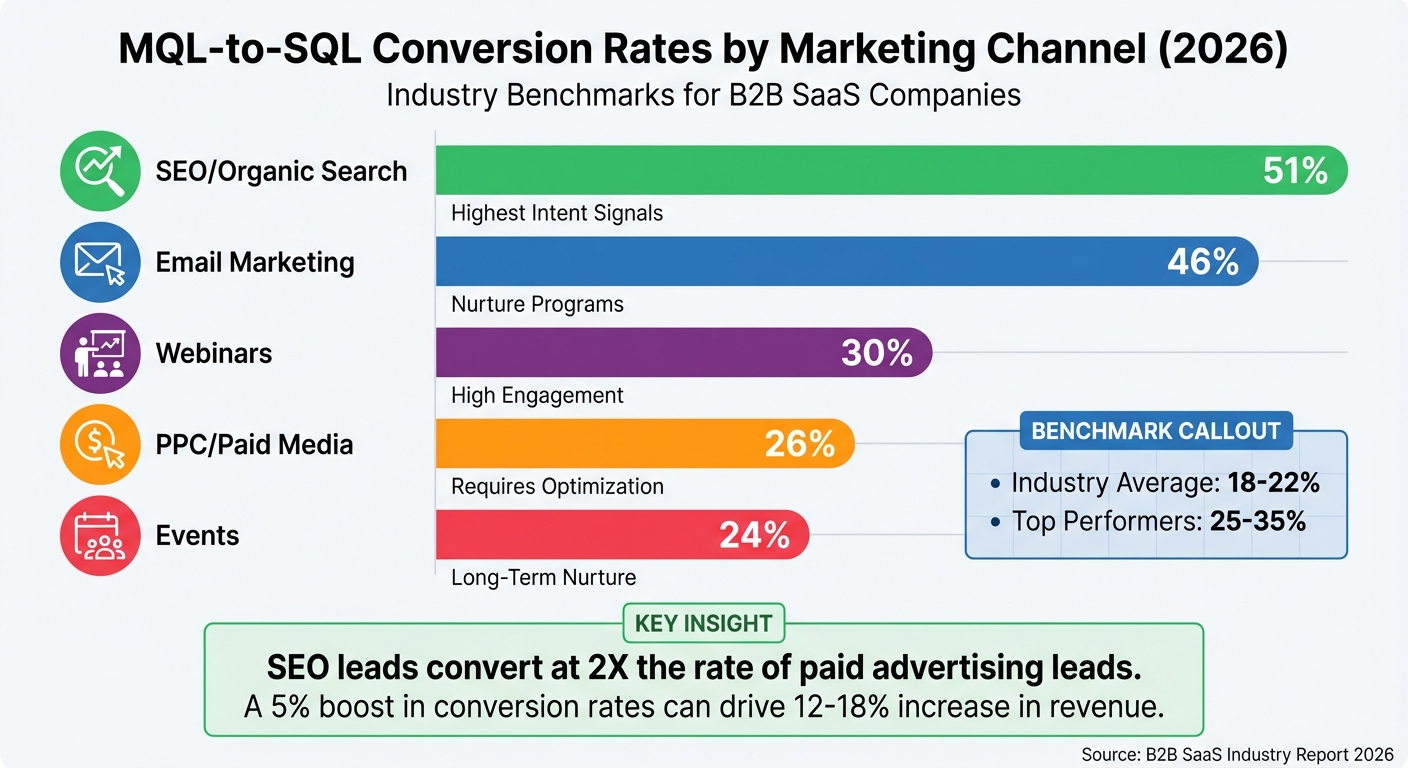
MQL to SQL Conversion Rates by Marketing Channel 2026
Marketing channels don’t all deliver the same results when it comes to turning Marketing Qualified Leads (MQLs) into Sales Qualified Leads (SQLs). Knowing these differences allows you to focus your resources where they’ll make the biggest impact. Below are strategies tailored to specific channels to improve conversion efficiency.
Inbound Content and Organic Search
MQLs from SEO outperform all other channels, converting to SQLs at an impressive 51% – almost double the rate of paid advertising leads [3]. This success stems from the strong intent behind organic search behavior. When someone actively searches for solutions and lands on your content, they’re already signaling genuine interest and a willingness to learn more.
To maximize conversions from organic traffic, create content that aligns with the buyer’s intent and addresses their pain points at each stage of the journey. Use strategic form fields to qualify leads progressively. Today’s B2B buyers do 67% of their research and consume over 13 pieces of content before engaging with sales [4]. Your content should capture essential firmographic details (like company size and industry) and behavioral signals (such as visits to pricing pages or requests for product tours).
Segmenting your content by Ideal Customer Profile (ICP) is another powerful tactic. Build resource hubs tailored to different segments, use progressive profiling to gather qualification data over time, and align your lead scoring system to prioritize organic engagement. With SEO’s strong performance, consider whether reallocating some paid media budgets to organic strategies might yield better returns [3].
Paid Media and Performance Marketing
Paid media tends to show lower conversion rates, with PPC leads converting at 26% [3]. However, this doesn’t mean paid channels are ineffective – it simply requires a different approach.
Landing page optimization is key for paid campaigns. Ensure your landing pages mirror the ad messaging, reduce form friction for cold traffic, and leverage retargeting campaigns on paid social and display networks to re-engage high-intent leads who didn’t convert on their first visit [6][8]. Integrate attribution platforms with your CRM to enable personalized follow-up sequences based on paid media interactions [5].
If your PPC conversion rates fall below the 26% benchmark, focus on refining your AI lead scoring system and aligning sales and marketing efforts before scaling up MQL volume [3]. Use a multi-layered scoring system that combines ICP fit with behavioral intent to identify which leads should move to sales faster [5][8]. These adjustments can significantly improve the overall health of your sales funnel.
Email Nurture and Marketing Automation
Email marketing delivers a 46% conversion rate from MQL to SQL [3], proving the impact of well-executed nurture programs. The key is progressive profiling and real-time trigger-based outreach.
Create adaptive nurture paths that respond to engagement signals. For example, if a lead frequently opens pricing-related emails, notify your sales team. If they download case studies relevant to their industry, follow up with tailored messaging that highlights similar success stories. A good marketing automation platform should dynamically update lead scores and adjust nurture sequences based on real-time behaviors [5][8].
Within email nurture strategies, webinars stand out, converting at 30% [3]. Webinar attendees show a high level of interest by investing their time and consuming educational content. Follow up with targeted email sequences referencing specific webinar topics, and prioritize engaged attendees for sales outreach. These efforts can create a seamless path from interest to conversion.
| Lead Source | MQL→SQL Conversion | Key Strategies |
|---|---|---|
| SEO | 51% [3] | Focus on intent-driven content; segment by ICP |
| Email Marketing | 46% [3] | Use adaptive nurture paths; leverage profiling |
| Webinars | 30% [3] | Follow up with targeted sequences |
| PPC | 26% [3] | Optimize landing pages; use retargeting |
| Events | 24% [3] | Long-term nurture for enterprise deals |
Each channel has its strengths and challenges, and tailoring your approach ensures you’re getting the most out of your efforts. By focusing on intent signals, refining lead scoring, and using personalized follow-ups, you can improve conversion rates across the board.
Here’s a pattern I see constantly with Series B companies… They look at their aggregate 20% MQL-to-SQL rate and assume they’re performing well.
Then they dig into channel-specific data and discover their organic traffic converts at 45% while their paid campaigns convert at 8%. The conversion rate didn’t lie. But the aggregate number hid a massive inefficiency in channel spend that was costing them roughly $40K per month in wasted ad budget.
Or put another way: Knowing your overall conversion rate is useful. Knowing your conversion rate by channel is actionable.
How to Optimize MQL-to-SQL Conversion Rates by ICP
Not all leads are created equal. The needs, buying behaviors, and conversion patterns of a 20-person startup are worlds apart from those of a 5,000-employee enterprise. To get the most out of your leads, it’s essential to tailor your approach based on your Ideal Customer Profile (ICP), building on your existing channel strategies.
How to Define and Implement ICPs
Start by defining your ICP using firmographic data (like company size, industry, and revenue), technographic details, and specific use case criteria. These factors should then feed into your lead scoring model. For example, you might assign 10–30 points for company size depending on how well it aligns with your target customer [5].
But fit alone isn’t enough. Combine it with intent signals – behavioral actions that indicate genuine interest, such as visiting your pricing page or submitting a demo request. Even if a lead checks all the right boxes in terms of company profile, they shouldn’t move to sales unless their engagement levels back it up. Use your CRM to automatically route leads based on both ICP fit and engagement. For instance, a 500-employee company will need a different nurturing workflow than a 50-person startup. Revisit and update these workflows weekly as engagement scores evolve [5][10].
MQL-to-SQL Conversion Rates Differences by Company Size and Sales Motion
The way leads convert often depends on company size and the complexity of the sales process. Enterprise buyers typically involve larger buying committees, longer sales cycles, and more layers of approval [1][9]. This means lower initial conversion rates but much higher deal values. If you’re targeting enterprise accounts, prepare for longer nurture periods and adjust your lead scoring to reflect the involvement of multiple stakeholders.
On the other hand, mid-market and SMB leads tend to convert faster. Their decision cycles are shorter, with fewer approval layers to navigate. For these segments, your SQL criteria should reflect their streamlined processes – what qualifies as "sales-ready" for a smaller business (like a single demo request from a key decision-maker) will differ from an enterprise lead, where engagement from multiple team members might be necessary [5].
Vertical-Specific Conversion Strategies
Industry nuances also play a big role in conversion rates. Factors like buyer knowledge, regulatory requirements, and sales cycle length can vary significantly across verticals [3]. For example, SaaS companies often see quicker conversions because buyers are familiar with subscription models and trial-based purchasing. In contrast, industries like FinTech and healthcare face longer cycles due to compliance hurdles and risk-averse committees. For these sectors, you’ll need extended nurture sequences and trust-building content, such as security certifications and compliance documentation.
Your go-to-market strategy also influences conversion dynamics. Product-led growth (PLG) models often generate a high volume of MQLs, but many users may lack strong purchase intent. To improve conversion rates in PLG, integrate product usage data into your lead scoring – track metrics like feature adoption, login frequency, and collaboration patterns to identify trial users who are ready to buy. In sales-led models, focus on qualifying leads early by asking about purchase timelines and budget authority in your forms [10].
Tools, Data, and Processes for Better MQL-to-SQL Conversion
Having the right tools and processes in place can transform conversion optimization from a guessing game into a repeatable, data-driven system. For B2B tech companies in 2026, four key technology categories need to work together: Intent Data Platforms, Marketing Automation Platforms (MAPs), Data Enrichment & Sales Intelligence, and CRM & Lead Management [2]. The real magic happens when these systems are seamlessly integrated. A bidirectional data flow between them allows for automated workflows, precise attribution, and real-time decision-making. This integration strengthens every step of your conversion process. Once these systems are connected, the next priority is defining clear, actionable metrics.
Key Metrics and Dashboards for Tracking Conversion
Your primary metric should be the MQL-to-SQL conversion rate, calculated as:
(Number of SQLs ÷ Number of MQLs) × 100 [3][7][12][14].
To dig deeper, track this rate across channels, campaigns, and personas to pinpoint which marketing efforts are driving the most qualified leads [3]. Beyond MQL-to-SQL, it’s essential to monitor the entire funnel, including metrics like cost per SQL, pipeline value per SQL, and time-to-conversion [13]. Dashboards should present this data in formats that are easy to interpret, such as using U.S. conventions like $5,250 and MM/DD/YYYY. This makes it simple to identify bottlenecks and opportunities at a glance.
Once you’ve established these metrics, the next step is refining your lead scoring and routing processes.
Lead Scoring and Routing Best Practices
AI has completely reshaped how lead scoring is done. Instead of assigning points manually, AI models analyze thousands of data points – like CRM activity and third-party intent signals – to predict which MQLs are most likely to convert [1].
Think lead scoring still means manually assigning points? Here’s what changed in the last 18 months:
To implement AI-driven scoring effectively, start with data collection: pull from CRM activity, third-party intent signals, and behavioral engagement patterns. Then analyze those patterns to identify which combinations actually predict conversion.
Once you’ve mapped the indicators, build predictive models that weight each signal appropriately. Finally, automate the scoring process so your sales team sees real-time prioritization instead of static lists.
For example of this, in 2025, HubSpot introduced an AI-powered lead scoring model that boosted sales-qualified leads by 30% by analyzing behaviors such as email opens, click-through rates, and social media interactions [1].
"When your CRM automatically flags a lead as ‘SQL’ the instant it meets threshold criteria, sales can strike while intent is hottest." – Understory Agency [5]
Timing is everything. Leads contacted within five minutes are 21 times more likely to convert, while waiting more than an hour reduces success rates by a factor of 10 [15]. Automated triggers should notify sales teams immediately when high-scoring leads meet your thresholds. It’s also crucial to define clear scoring thresholds that separate MQLs from SQLs, using a mix of demographic, firmographic, and intent signals to improve accuracy [1][15]. Since 73% of leads aren’t ready to buy right away [15], create segmented nurture workflows for high-potential but low-engagement leads. Don’t forget to audit and adjust your scoring model quarterly based on real sales outcomes [5][15].
With lead scoring practices in place, AI tools can take your conversion process to the next level.
Using AI and Fractional Leadership to Improve Conversion
AI brings predictive analytics, automated scoring, and real-time prioritization into the mix [1]. For instance, Clay’s sales team used AI to fully automate a four-step outbound campaign, achieving a 5.1% positive response rate [16]. These platforms can also perform scenario analysis, forecast SDR performance, and detect anomalies to improve predictions [16]. Unlike static automation, AI adapts dynamically, applying custom scoring based on extensive prospect data [16].
For companies that lack full-time leadership, fractional CMO services can fill the gap. Data-Mania’s fractional leadership, for example, helps tech companies implement these systems effectively – from selecting the right tools to creating feedback loops between sales and marketing. This approach is especially valuable for companies with marketing budgets over $1M annually, offering strategic oversight without the expense of a full-time executive. Combining AI with fractional leadership ensures that your tech stack is optimized, creating a conversion process that evolves and improves with every lead that moves through your funnel.
Conclusion: Key Takeaways and Next Steps
Boosting your MQL-to-SQL conversion rate isn’t about focusing on vanity metrics – it’s about creating a system that drives real revenue. By 2026, top-performing B2B teams are expected to hit conversion rates between 25% and 35%, while the industry average lags at 18–22% [1][18]. What separates the best from the rest? Three key factors: speed, alignment, and intelligence.
Speed is crucial. Reaching out to inbound leads within the first hour can improve conversion rates by up to 7X [11]. Despite this, many sales reps stop after just three attempts, leaving 25% of potential meetings on the table [17]. To close this gap, set up automated alerts for high-scoring leads that meet your SQL criteria. Pair this with a multi-channel outreach strategy – using phone, email, LinkedIn, and SMS – to increase engagement by over 10% [17].
Sales and marketing must work together. When both teams share unified lead definitions, track common KPIs like MQL-to-SQL conversion rates, and follow clear service-level agreements on response times, deals move faster with less friction [1][6]. Monthly reviews of conversion data and regular updates to qualification criteria based on closed-won deals can further refine the process.
Leverage AI to work smarter. Predictive scoring models can analyze thousands of data points – like CRM activity and third-party intent signals – to identify which MQLs are most likely to convert before your SDRs even make contact [1].
Take one actionable step this week: audit your current MQL-to-SQL conversion rate by channel and ICP segment. Pinpoint where qualified leads are dropping off and implement immediate follow-up protocols for your highest-intent channels. Even small improvements in your conversion rates can unlock significant pipeline growth.
P.S. If you’re still wondering whether your conversion rate is actually healthy, start with channel segmentation before you change anything else. You might not have a conversion problem. You might have a channel mix problem that’s hiding in your aggregate numbers. The founder celebrating 35% often has artificially narrow lead criteria. The founder worried about 14% might be exactly where they should be for their specific sales cycle and channel mix. The metric matters less than understanding what drives it.
FAQs
What are the best ways to improve my MQL-to-SQL conversion rates?
To boost your MQL-to-SQL conversion rates, start by getting marketing and sales on the same page. Make sure both teams agree on lead definitions and share common goals. Use content that speaks directly to your audience’s needs and pair it with personalized outreach to make each interaction more meaningful.
Engage leads across multiple channels – think email campaigns, paid ads, and webinars – to meet them where they’re most active. Streamline the process by automating lead handoffs between marketing and sales. This reduces delays and ensures faster follow-ups, which can make all the difference.
Keep an eye on critical metrics like speed to contact, engagement rates, and pipeline value to track your progress. Keep testing and tweaking your strategy to stay on track for long-term success.
What are the most effective channels for turning MQLs into SQLs in 2026?
In 2026, some of the most effective ways to turn MQLs into SQLs include email campaigns, paid ads, well-designed website landing pages, personalized sales outreach, and engaging on social media.
Each method brings something valuable to the table. Email continues to be a dependable tool for nurturing leads, while paid ads and landing pages attract targeted traffic and tap into buyer intent. Social media and direct outreach, on the other hand, help build personal connections – especially important when dealing with high-value opportunities. To get the best results, focus on aligning your strategies with your Ideal Customer Profiles (ICPs) and use data to fine-tune each channel for maximum impact.
Why is it important for sales and marketing teams to work together to improve conversions?
When sales and marketing teams work in harmony, they can clearly define what qualifies as a lead, set mutual goals, and streamline the handoff process. This cooperation leads to stronger lead qualification, better MQL-to-SQL conversion rates, and improved pipeline efficiency.
Together, these teams can tackle the challenges of today’s intricate buyer journeys, creating a smoother and more effective approach to customer acquisition. This kind of collaboration plays a key role in achieving steady growth in the competitive B2B world.