
Most sales teams spend their best hours on leads that were never going to buy, so lead qualification is where a lean team wins back real time. The tools I discuss below use AI to score and route your leads so your reps spend their day on the ones that are most likely to close. I’ve generated more than a thousand qualified leads for a single client at a $50 cost per lead, and in this blog post I’ll show you what to look for in a tool and how to make it actually work.
Why it matters now:
- B2B buyers face longer decision cycles and more complex purchase processes.
- Advanced tools cut through the noise, boosting conversion rates and reducing customer acquisition costs.
- With smaller teams expected to do more, automating lead qualification is no longer optional – it’s a must. This often requires a GTM engineering approach to build scalable systems.
Key features to look for:
- AI-powered scoring: Tools like MadKudu and 6sense predict which leads are most likely to convert.
- Instant routing & scheduling: Platforms like Chili Piper reduce response times to seconds, not hours.
- Data enrichment: Tools like Clearbit and Apollo.io add critical context to your leads, like company size and tech stack.
- Chatbots: Drift and Intercom engage high-intent leads 24/7, qualifying them in real time.
"We generated our first inbound leads in the first 60 days of working with her, improved our company social media strategy, implemented a branded team social media cadence to increase PR and awareness, and improved our SEO." - Larry Rodriguez Shea, Groe Solutions I want to stop here and encourage you to first get your qualification criteria right before you hand the job to a tool. Sit down with sales and agree on what a good-fit lead actually looks like, using the traits your best customers share. Feed that definition into whichever tool you pick, so its scoring reflects your real buyer. When the model is trained on your actual won deals, it routes the right leads to the right rep, and your close rate climbs because your reps are finally spending their time where it pays.
And as far aow to choose the right tool, here’s a concise summary:
- Define your Ideal Customer Profile (ICP).
- Prioritize features that solve your biggest bottlenecks (e.g., slow response times or unqualified leads).
- Test tools with a pilot program and measure performance improvements like faster follow-ups and higher conversion rates.
Top 5 AI Tools for Smarter Lead Qualification in 2026
What Modern Lead Qualification Tools Can Do
Modern lead qualification tools have transformed the way businesses manage prospects. These platforms use advanced data-driven methods to analyze, score, and automatically route lead data. By integrating firmographic details, behavioral insights, product usage patterns, and intent signals, they can evaluate leads in real time, assign them to the right sales representatives, and even schedule meetings on the spot.[1][2] This automation allows sales development representatives (SDRs) to dedicate their time to the most promising, sales-ready leads.
The transition from manual processes to AI-powered automation has been a game-changer. Modern tools can gather over 100 data points per lead – covering details like industry, company size, tech stack, and funding history. This depth enables precise scoring and routing rules.[1][2] Even better, these systems operate around the clock, ensuring no opportunities slip through the cracks, and they scale effortlessly to meet growing demand without the need for additional staffing.[2][4] This capability lays the foundation for more advanced AI-driven scoring solutions.
AI-Based Lead Scoring
AI-driven lead scoring systems take qualification to the next level by combining historical CRM data with real-time signals. For instance, MadKudu uses machine learning models trained on past deals to segment leads automatically. These scores are then synced with platforms like Salesforce and HubSpot, enabling streamlined workflows.[2] Similarly, 6sense employs an account-based approach, analyzing keyword searches, content interactions, and anonymous website visits alongside firmographic data. This helps surface accounts that are actively in-market and prioritize them for outreach.[2]
These predictive models assess a wide range of factors – such as behavioral cues, product engagement, and interaction patterns – to estimate the likelihood of conversion. This eliminates the need for teams to manually define every rule.[2][5] In practice, SDRs are typically presented with leads that meet a certain threshold (e.g., a score of 80 out of 100), while lower-scoring leads are funneled into automated nurture campaigns. This strategy improves conversion rates and minimizes time spent on unqualified prospects.[2][6] For businesses with a solid U.S. deal history – hundreds of closed-won and closed-lost opportunities – these models become even more accurate and impactful.[2][6]
Once leads are scored, they are routed instantly for immediate follow-up.
Instant Lead Routing and Meeting Scheduling
Platforms like RevenueHero and Chili Piper streamline lead routing and scheduling by sitting on top of web forms and CRMs. These tools evaluate incoming leads against predefined rules – such as territory, account ownership, or ICP fit – and then either display a booking widget or trigger automated assignments and alerts.[3][4] Instead of waiting for manual follow-ups, qualified U.S. visitors can instantly access a live calendar linked to the appropriate account executive’s Google or Outlook schedule.[3][4]
This speed-to-lead approach drastically reduces response times, shrinking them from hours or days to mere seconds. Studies consistently show that faster response times lead to higher conversion and meeting show rates.[2][4] For example, a qualified demo request during U.S. business hours can be auto-scheduled directly into a rep’s calendar. Meanwhile, unqualified or off-hours requests are added to a nurture queue, ensuring human attention is reserved for high-priority opportunities.[3][4] This is particularly critical for high-intent leads – such as those on pricing or enterprise pages – where even a slight delay can result in losing the deal to a competitor.[2][4]
When speed and engagement are essential, automated chatbots step in to keep the momentum going.
Automated Qualification Through Chatbots
AI-powered chatbots are designed to engage visitors on high-intent pages, like pricing or demo sections. These bots initiate conversations, ask qualification questions, and guide users toward demos or other resources.[1][7] Using pre-scripted flows and natural language understanding, they can handle frameworks like BANT or MEDDIC to gather key data, which is then synced directly into your CRM.[1][2] Tools like Drift and Intercom even use behavioral triggers – such as starting a chat when a visitor has viewed a pricing page twice or spent over 90 seconds on a feature page – to engage prospects showing strong intent.[1][7]
Once a lead is qualified, the chatbot can route them to a live rep during U.S. business hours or offer a meeting scheduler integrated with platforms like Chili Piper. Unqualified leads, on the other hand, are directed to educational content, product tours, or email sign-ups. This ensures SDRs can focus on high-value prospects while the chatbot handles routine inquiries and basic discovery around the clock.[1][2][7] This 24/7 engagement is especially valuable for capturing leads outside of business hours or during peak traffic periods, ensuring no opportunity is missed.
Types of Lead Qualification Tools
Lead qualification tools leverage modern AI and automation to streamline how businesses identify and prioritize potential customers. These tools typically fall into three main categories: CRM and marketing automation platforms, predictive scoring and revenue intelligence tools, and data enrichment and validation platforms. Each serves a unique purpose, yet together they create a cohesive lead qualification system.
Some platforms combine these functions to simplify workflows. For instance, Apollo.io integrates data enrichment, outbound automation, and CRM synchronization, helping businesses manage their tech stack more efficiently [8].
CRM and Marketing Automation Platforms
CRM platforms like Salesforce and HubSpot act as the foundation of lead qualification by centralizing all lead data and interactions. These systems automatically log activities such as form submissions, webinar attendance, and email opens, giving sales teams a clear picture of a lead’s journey – from initial contact to closing the deal. They also automate repetitive tasks like assigning leads based on location, sending follow-up emails, or notifying sales reps when a high-value lead visits a critical page, such as pricing.
By maintaining up-to-date contact data and activity records, CRM platforms ensure that workflows run smoothly and sales teams can focus on what matters most: engaging with qualified leads.
Predictive Scoring and Revenue Intelligence Tools
AI lead scoring tools use predictive modeling to analyze large datasets, helping businesses identify which leads are most likely to convert. These tools evaluate factors such as job title, seniority, company size, industry, location, and buyer intent signals. By automating this analysis, sales teams can prioritize high-potential prospects without manually sifting through every lead.
Beyond scoring, these platforms offer features like AI-powered call summaries, deal alerts, and pre-meeting insights, enabling sales teams to prepare more effectively and close deals faster. For example, sales development representatives (SDRs) can focus on leads that meet specific criteria, saving time and increasing productivity.
"Every rep is more productive with Apollo. We booked 75% more meetings while cutting manual work in half." – Andrew Froning, BDR Leader [8]
Businesses using these tools have reported impressive results, including a 70% increase in sales leads and a fourfold boost in SDR efficiency [8].
Data Enrichment and Validation Platforms
Data enrichment platforms enhance lead records by adding critical details such as job titles, company revenue, employee count, and tech stack information. These tools pull from extensive databases of verified contacts and companies, ensuring that sales teams have accurate and comprehensive data at their fingertips. Features like real-time form enrichment and automated lead generation further streamline the process.
With enriched data, sales teams can tailor their outreach efforts more effectively, targeting leads based on industry, company size, or technology usage. Platforms like Apollo.io take this a step further by consolidating multiple tools – data provider, outreach platform, dialer, enrichment, and CRM – into a single system. Companies using such unified solutions have reported a 64% reduction in tech stack costs [8].
How to Select the Right Lead Qualification Tools
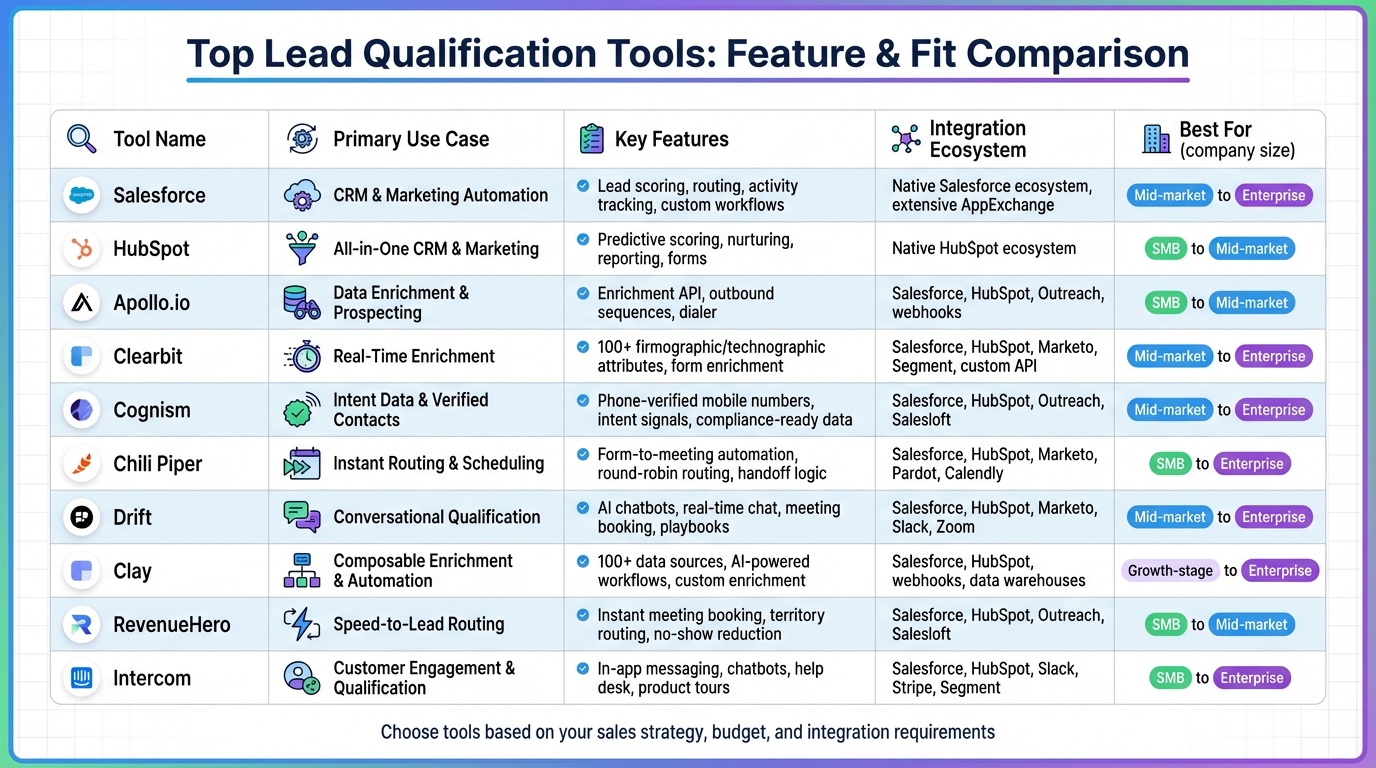
Top Lead Qualification Tools Comparison 2026
Identify Your Business Requirements
Start by defining your sales strategy. If your team focuses on inbound leads, you’ll need tools that prioritize instant lead routing, meeting scheduling, and conversational qualification. Outbound-heavy teams, on the other hand, should look for features like data enrichment, intent signals, and predictive scoring. For product-led growth companies, it’s crucial to find tools that integrate smoothly with your existing data stack and utilize product telemetry effectively [2][4].
Examine your sales funnel to pinpoint where leads drop off. For example, if speed-to-lead is a challenge, prioritize tools with fast routing capabilities. If unqualified leads are the issue, focus on scoring and enrichment features [1][4]. Clearly outline your ICP by considering factors like industry, company size, revenue, tech stack, and decision-maker roles. This ensures you select tools with strong data coverage tailored to your audience [1][2].
Set a budget that aligns with your company stage. Early-stage teams typically spend between $300 and $1,000 per month, while growth-stage businesses may allocate $5,000 or more [1][2][3]. Decide on a pricing model – whether per-user, credit-based, or flat fee – to narrow down your options.
Once you’ve clarified your needs, the next step is to evaluate specific tool features.
What to Look for When Evaluating Tools
With your requirements in mind, assess tools against these key criteria:
- Data Quality: Prioritize vendors that cover your target geography and segment, verify email and phone data, and update records frequently. Ask for sample audits and ensure email bounce rates stay below 5–7% [2].
- AI Capabilities: Look for tools that go beyond basic rule-based scoring. Advanced platforms use predictive models trained on historical data, analyzing behavioral, firmographic, and product-usage signals to provide close probability metrics. Request documentation on model inputs, retraining schedules, and customization options. Avoid tools with "black box" scoring that leaves your team guessing about lead qualification [2][6].
- Integrations: Ensure the tool integrates natively with your CRM and marketing platforms. Look for bi-directional sync, webhook/API support, and the ability to update custom fields. For routing tools, test their sync latency with a small proof-of-concept, aiming for near real-time performance [2][4][6].
- Security and Compliance: U.S.-based you should require SOC 2 Type II certification for vendors handling customer or prospect data. Even if your focus is domestic, ensure compliance with GDPR and other global data regulations if you have international visitors. Confirm the availability of clear data processing agreements and data residency options. For AI features, verify how training data is managed and ensure your proprietary data remains isolated from global models [2][6][9].
- Total Cost of Ownership: Factor in all costs, including license fees, per-user or per-credit charges, implementation time, and any additional support requirements. Many B2B teams aim to keep tool spending under 3–5% of their ARR [2][6]. Test tools with a 30–60 day pilot, setting measurable goals like improving MQL-to-SQL conversion rates by 20% or reducing response times from two hours to 10 minutes. Use an A/B test to compare the tool’s impact on conversion rates, speed-to-lead, and pipeline generation against your current process [2][4].
Comparison Table of Top Tools
| Tool | Use Case | Core Features | Integration Options | Ideal Company Size |
|---|---|---|---|---|
| Salesforce | CRM & marketing automation | Lead scoring, routing, activity tracking, custom workflows | Native Salesforce ecosystem, extensive AppExchange | Mid-market to enterprise |
| HubSpot | All-in-one CRM & marketing | Predictive scoring, nurturing, reporting, forms | Native HubSpot ecosystem | SMB to mid-market |
| Apollo.io | Data enrichment & prospecting | Enrichment API, outbound sequences, dialer | Salesforce, HubSpot, Outreach, webhooks | SMB to mid-market |
| Clearbit | Real-time enrichment | 100+ firmographic/technographic attributes, form enrichment | Salesforce, HubSpot, Marketo, Segment, custom API | Mid-market to enterprise |
| Cognism | Intent data & verified contacts | Phone-verified mobile numbers, intent signals, compliance-ready data | Salesforce, HubSpot, Outreach, Salesloft | Mid-market to enterprise |
| Chili Piper | Instant routing & scheduling | Form-to-meeting automation, round-robin routing, handoff logic | Salesforce, HubSpot, Marketo, Pardot, Calendly | SMB to enterprise |
| Drift | Conversational qualification | AI chatbots, real-time chat, meeting booking, playbooks | Salesforce, HubSpot, Marketo, Slack, Zoom | Mid-market to enterprise |
| Clay | Composable enrichment & automation | 100+ data sources, AI-powered workflows, custom enrichment | Salesforce, HubSpot, webhooks, data warehouses | Growth-stage to enterprise |
| RevenueHero | Speed-to-lead routing | Instant meeting booking, territory routing, no-show reduction | Salesforce, HubSpot, Outreach, Salesloft | SMB to mid-market |
| Intercom | Customer engagement & qualification | In-app messaging, chatbots, help desk, product tours | Salesforce, HubSpot, Slack, Stripe, Segment | SMB to enterprise |
Use this table to narrow down tools that fit your goals and support a data-driven approach to lead qualification. Each option offers distinct strengths, so align features with your specific needs.
How to Implement Lead Qualification Tools
Setting Up Lead Qualification Tools
Start by defining your ICP with input from sales, marketing, and RevOps teams. Outline key firmographics like industry, company size (by employees or revenue), location, tech stack, and buying roles. This groundwork ensures your scoring models, routing rules, and enrichment tools are aimed at the right audience from the beginning.
Once your ICP is clear, translate it into actionable data fields and behavior indicators within your CRM. For example, if your ICP is a U.S.-based SaaS company with 50–500 employees that shows high-intent actions, create scoring rules that reflect these specifics. Align this with your MQL and SQL playbook to maintain consistency across teams. With this foundation, configure your scoring, routing, and enrichment criteria.
Next, integrate your lead qualification tools with your CRM or marketing automation platform (like Salesforce or HubSpot) to enable real-time data exchange. Begin with a simple scoring system that combines explicit signals (e.g., job title, company size, industry) with implicit signals (e.g., content downloads, page visits). Over time, incorporate AI-driven predictive models using at least a year of historical closed-won versus lost deal data. For routing and scheduling tools (such as Chili Piper or RevenueHero), set rules based on territory, account ownership, business segments (SMB, mid-market, enterprise), or product lines. Add calendar widgets to high-intent pages to allow prospects to book meetings instantly.
Deploy chatbots on crucial pages like product, pricing, and demo sections. Program these bots to ask discovery questions that align with your MQL/SQL framework, covering topics like budget, authority, need, timeline, and existing tools. Ensure qualified leads are routed directly to the appropriate sales rep’s calendar for immediate booking.
Connect data enrichment platforms (such as Clearbit, Apollo.io, Cognism, or Clay) to website forms and your CRM. These tools can automatically enhance new lead data with firmographic and technographic details like employee count, industry, revenue, and tech stack. Use this enriched data to refine scoring and routing rules.
Pilot your setup with a specific segment, then measure performance by tracking conversion rates, response times, and pipeline growth. Use these insights to fine-tune your thresholds and scripts. Establish clear SLAs for lead follow-up – for example, "All MQLs must receive an initial response within 5 minutes during business hours." Research shows that companies responding within 5 minutes are 100x more likely to connect and 21x more likely to qualify leads compared to those taking over 30 minutes[7]. Train your SDRs, AEs, and marketers on how scores are calculated, how routing works, and how to use dashboards effectively. Create feedback loops so teams can flag poor-fit leads or missed opportunities, prompting RevOps to adjust criteria as needed.
Tracking Performance with Lead Qualification Tools
After implementing your tools, monitoring performance is crucial to validate their effectiveness. Start by benchmarking pre-implementation metrics to measure changes accurately. Track data such as the number of inbound leads and MQLs per month, average first-response time, meeting booking rates (percentage of MQLs converting to meetings), SQL creation rates, pipeline generated per month (in USD), and closed-won revenue (in USD). Post-implementation, look for improvements like faster response times (e.g., reducing from 2 hours to 5 minutes), higher MQL-to-SQL and SQL-to-opportunity conversion rates, increased meetings booked via forms or chat, reduced no-show rates, and overall pipeline and revenue growth attributed to qualified leads.
Use dashboards in your CRM and lead qualification tools to create attribution models (first-touch, last-touch, multi-touch) that map how qualified leads progress through the funnel. Monitor metrics like pipeline value by segment, conversion rates at each stage (lead → MQL → SQL → opportunity → closed-won), average deal size, and win rates for AI-qualified versus non-AI-qualified leads. These insights will confirm whether your scoring and routing configurations are driving faster lead engagement and better conversion rates. Additionally, track financial metrics like Customer Acquisition Cost (CAC) and pipeline velocity to evaluate whether your qualification process is delivering efficient revenue growth. To know whether your numbers are healthy, hold them against the 2026 B2B SaaS benchmarks for CAC, NRR and churn by stage.
For tools like chatbots and automated routing systems, log every step – from form submission to meeting booking – to identify drop-offs and bottlenecks. A/B test different routing strategies (e.g., round-robin vs. territory-based), booking flows, and chatbot scripts to find the setups that generate the most qualified meetings, highest show rates, and greatest closed-won revenue. Regularly review top-performing segments by score, industry, persona, and campaign. If you’re a product-led growth company, consider adding product usage data (e.g., time to first value, feature adoption) to your scoring model to transition users from product-qualified leads (PQLs) to SQLs.
How Data-Mania Can Help
Streamlining these processes can be faster and more effective with expert guidance. Data-Mania’s Fractional CMO services provide the strategic marketing expertise you need to implement and optimize lead qualification tools. Led by professional engineer and marketing leader Lillian Pierson, Data-Mania helps businesses translate their go-to-market strategies and ICP into actionable scoring models, routing rules, and qualification playbooks that integrate seamlessly with their CRM and marketing automation systems.
Data-Mania offers comprehensive advisory and coaching to design data-driven lead qualification frameworks, select and integrate tools, and build KPI dashboards that link pipeline and revenue outcomes (in USD) to your qualification efforts. This includes setting up tracking for speed-to-lead, conversion rates, and qualified opportunity creation, as well as running experiments to refine workflows and models. These services are particularly suited for companies with marketing budgets exceeding $1M annually that need executive-level oversight to ensure their lead qualification tools drive measurable business results.
For smaller teams or those with limited budgets, Data-Mania’s Power Hour sessions deliver focused, actionable advice. These sessions tackle specific challenges like configuring scoring logic, aligning sales and marketing on MQL/SQL definitions, or troubleshooting routing and enrichment integrations. By combining strategic insights with hands-on support, Data-Mania helps tech companies maximize their lead qualification investments, enabling predictable growth and efficient customer acquisition.
Key Takeaways
By 2026, AI-first lead qualification tools are merging predictive scoring, instant routing, conversational automation, and data enrichment to ensure high-priority prospects are identified quickly. Research shows that even small delays in lead response can reduce conversion rates by over 80% [4][7]. This makes rapid lead qualification essential for maintaining a strong sales pipeline, especially for U.S. tech companies.
To make the most of these AI-driven tools, it’s crucial to align their features with your sales strategy. The foundation of success lies in having clear qualification criteria, well-defined MQL (Marketing Qualified Lead) and SQL (Sales Qualified Lead) standards, and continuously refining models based on actual conversion data [2][4][6]. Without a clear ICP and qualification framework, even the most advanced tools can fall short of expectations.
For tech companies looking to maximize these tools but lacking strong marketing leadership, partnering with Data-Mania’s Fractional CMO services can be a game-changer. They help translate go-to-market plans into actionable scoring models, routing rules, and KPI dashboards that drive pipeline growth and closed-won deals. Data-Mania specializes in supporting AI startups, SaaS platforms, and B2B tech companies, offering tailored guidance – whether through comprehensive advisory services or focused, intensive sessions. With expert oversight, your lead qualification efforts can deliver measurable, reliable growth well into 2026 and beyond.
FAQs
How will AI transform lead qualification in 2026?
Artificial intelligence is poised to transform lead qualification in 2026 by leveraging machine learning and data analytics to pinpoint top prospects with unmatched accuracy. By processing enormous data sets, these technologies can predict which leads are most likely to convert, streamlining efforts and cutting down on wasted resources.
Beyond identifying prospects, AI takes lead scoring to the next level and customizes outreach strategies, delivering more personalized and timely interactions. The result? A faster qualification process and higher conversion rates, ultimately creating a more efficient and productive sales funnel.
What key features should I look for in a lead qualification tool?
When selecting a lead qualification tool, prioritize features that improve both efficiency and precision. Key functionalities to consider include lead scoring, which ranks prospects based on their engagement and relevance, integration options that work smoothly with your CRM and marketing tools, and data enrichment for a more detailed understanding of your leads.
It’s also important to look for tools with customizable criteria to match your specific business needs, real-time analytics for immediate insights, and automation to simplify follow-ups and lead nurturing. A user-friendly interface and mobile access are essential for convenience, while data security safeguards sensitive information and ensures compliance. Lastly, choose a tool that can adapt to your growth as your business expands.
What’s the best way to choose a lead qualification tool for my business?
When selecting the right tool, begin by pinpointing your business needs and understanding the specifics of your sales process. Focus on solutions that are easy to use, capable of growing with your business, and include key features such as lead scoring, automation, and seamless CRM integration. Make sure the tool works well with your current systems and stays within your budget.
Don’t overlook the importance of investigating the vendor’s reputation and the reliability of their customer support. Whenever you can, take advantage of demos or free trials to see if the tool meets your objectives and improves your team’s productivity.
Related Blog Posts
- Collaborative Lead Scoring for B2B Teams
- AI Lead Scoring: Basics for B2B Marketing
- AI in Lead Scoring: Benefits for Sales and Marketing
- Your First AI Marketing System: 7 Building Blocks Every Startup Can Afford