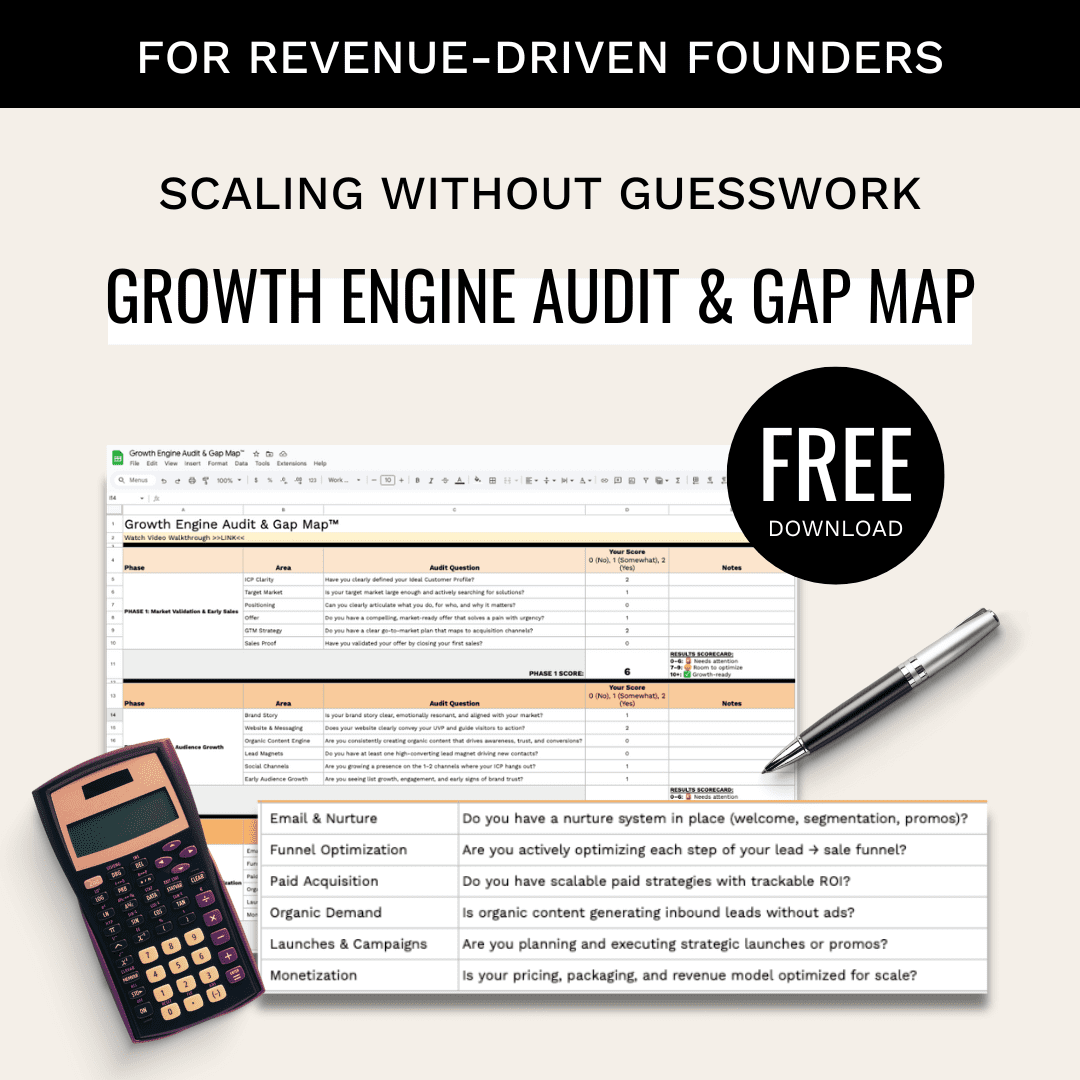

Last updated: September 23, 2026. Worth knowing before you hire in 2026: a fractional CMO runs $5,000 to $20,000 a month and an agency runs $3,000 to $25,000 or more, and they buy you different things. I lay out which fits which stage in my four-way cost comparison.
If you’re a tech founder watching growth stall while your acquisition costs climb, the right growth marketing consultant can be the smartest hire you make this year. The best ones do more than run campaigns. They find the one bottleneck that’s actually capping your revenue, build a repeatable system around it, and hand that system back to your team so growth keeps compounding after they leave.
I’m Lillian Pierson, a fractional CMO and licensed Professional Engineer who’s spent more than 20 years driving growth for tech companies, from early startups to Microsoft, Intel, and IBM. I vetted these the way I’d vet a consultant for my own client roster. Below are 10 growth marketing consultants worth watching in 2026, what each one is best at, and a simple framework for choosing the one that fits your stage.
Here’s the quick view:
- Lillian Pierson: Data- and AI-driven growth systems for tech startups.
- Growth Hackers: ROI-focused marketing for SaaS and eCommerce.
- GrowthCurve: Embedded teams for scaling tech companies.
- Woodridge Growth: Funnel optimization for scaling startups.
- AWISEE: Multilingual growth for SaaS and B2B expansion.
- Growketing: AI-powered analytics for global scaling.
- Tuff: Performance-first strategies for US tech startups.
- Growth Division: Data-led channel testing for early-stage startups.
- Deviate Labs: Creative tactics with the ASP™ Sales Flywheel.
- Velocity Growth: Content systems and training for long-term growth.
Before you hire anyone, get honest about readiness. You’ll get the most from a growth consultant when you already have real revenue coming in, a product people buy without hand-holding, and 5 to 10 hours a week your team can put into the engagement. If you’re still pre-product or pre-revenue, you need hands-on help shaping the offer first, ahead of a growth system built on top of nothing.
Below, I break down what makes each consultant stand out and how to choose the right partner for where your business is right now.
What Growth Marketing Consultants Do
Growth marketing consultants act as strategic problem-solvers, crafting systems designed to drive revenue growth. Unlike traditional marketers who might focus on brand awareness or isolated campaigns, these experts address the entire customer journey, from acquisition to retention and beyond.
Their work typically revolves around four main areas: strategic planning, experimentation frameworks, systems design, and organizational alignment. They identify bottlenecks in your funnel and create structured, repeatable processes to improve acquisition, activation, retention, and expansion.
Growth strategy development is a critical part of their role. Consultants analyze your market, competition, and customer behavior to identify the best opportunities for growth. This includes defining your ideal customer profile, mapping buyer journeys, and prioritizing channels based on your unique business model and available resources.
Structured experimentation is where growth marketing consultants truly stand out. They establish testing frameworks with clear hypotheses, measurable benchmarks, and thorough documentation. This ensures that every growth decision is grounded in data.
Systems design focuses on building or refining the technical and operational infrastructure that supports scalable growth. This can include optimizing conversion funnels, onboarding sequences, email campaigns, and retention strategies. Additionally, they set up tracking and analytics systems to monitor performance at every stage of the customer lifecycle.
Cross-functional alignment tackles one of the biggest challenges in scaling businesses: siloed teams with conflicting goals. Growth consultants help bridge the gaps between marketing, sales, product, and customer success teams, ensuring everyone is aligned and working toward shared objectives. This integrated approach not only fixes inefficiencies but also creates a unified growth engine.
When You Need a Growth Marketing Consultant
How do you know it’s time to bring in a growth marketing consultant? Certain challenges often signal the need for their expertise.
One of the most common triggers is inconsistent growth patterns. If your revenue fluctuates wildly from month to month without clear reasons or if growth has stalled despite increased marketing spend, a consultant can help uncover the root causes.
Another key indicator is founder bandwidth constraints. When founders are bogged down handling day-to-day marketing tasks instead of focusing on product development, fundraising, or strategic partnerships, it’s time to delegate the growth function to an expert.
Finally, unclear return on investment from marketing efforts is a red flag. If you can’t confidently identify which channels or campaigns are driving revenue, a consultant can implement custom attribution models and measurement systems to bring clarity.
Are You Ready for a Growth Consultant?
Before hiring a growth marketing consultant, it’s essential to assess whether your company is prepared to benefit from their expertise. Here’s a checklist to guide you:
- Revenue and traction: Do you have at least $10,000 in monthly recurring revenue or clear signs of product-market fit? Consultants are most effective when optimizing existing traction rather than starting from scratch.
- Data infrastructure: Can you provide historical performance data and have basic analytics tracking in place? Growth marketing consultants rely on this data to establish benchmarks and make informed recommendations.
- Budget: Are you able to allocate $5,000–$15,000 per month for consultant fees, plus additional resources for executing their strategies? Growth consulting requires both expertise and implementation.
- Internal capacity: Does your team have someone who can dedicate 5–10 hours a week to collaborate with the consultant? Successful outcomes require active participation, not just outsourcing.
- Engagement duration: Are you prepared for a 3–6 month commitment? Growth systems take time to implement, test, and refine.
- Decision-making access: Will the consultant have direct access to decision-makers? Quick pivots based on test results often require streamlined approval processes.
If your company checks these boxes, you’re in a strong position to maximize the value a growth consultant can bring. If not, it’s worth focusing on building internal capabilities first to ensure a successful partnership later.
What separates a real growth operator from an expensive vendor
I’ve been on both sides of this hire. I’ve been the fractional CMO a founder brings in, and I’ve vetted consultants to bring into my own client work. Here’s what I’ve learned to look for, because the polished pitch decks all start to look identical after a while.
They diagnose before they prescribe. A real operator asks about your funnel, your margins, and your last three failed experiments before they say a word about tactics. If someone pitches you channels on the first call without understanding your economics, they’re selling you a template.
They can name the bottleneck out loud. Growth is rarely broken everywhere at once. It’s usually one constraint: a positioning problem wearing a traffic costume, an activation gap the ads can’t paper over, a retention leak that quietly makes every new customer worth less. The consultant worth hiring finds that one thing and tells you plainly.
They build systems you keep. The mark of a vendor is that everything stops working the day they leave. The mark of an operator is that your team is more capable after the engagement than before it. Ask any consultant directly: what will my team be able to do without you once this is over?
They’re honest about fit. The strongest consultants turn down work that isn’t right for them. If someone says yes to every stage, every industry, and every budget, that’s a sales motion dressed up as a specialty.
Run every name on this list, mine included, through those four filters. The right guide holds up to the questions. The wrong one changes the subject.
How to Pick Between Growth Marketing Consultants
Selecting the right growth marketing consultant is no small task. The stakes are high. Choose poorly, and you risk wasting time and money; choose wisely, and you could see your growth skyrocket. To make the best decision, you need a clear evaluation process that aligns with the growth challenges your business is facing.
Start by considering stage and industry fit. A consultant who excels with pre-seed B2B SaaS startups may not be the best choice for scaling a Series B consumer marketplace. Their experience should align with both your revenue stage and your industry. Be direct with your questions: “Can you share an example of working with a company at our stage?” or “What challenges do you see as unique to our industry?” This will help you gauge whether they truly understand your business context.
Next, look for a systems and data mindset. Great growth marketing consultants think beyond campaigns, focusing on frameworks that make growth sustainable. They should be able to explain how they’ll set up systems for measurement, testing, and repeatable processes. Ask them about their approach to attribution modeling or experiment prioritization. If their answers are vague or overly simplistic, it’s a red flag.
A track record of repeatable wins is another critical factor. Viral campaigns and one-off successes are great, but they don’t guarantee consistent results. Request case studies that showcase multiple successful engagements and ask for client references. When you speak with those references, dig into the consultant’s ability to deliver results consistently over time.
Pay close attention to their communication style. A successful partnership depends on clear and effective communication. During your initial conversations, notice how they explain their process for diagnosing problems, creating strategies, running experiments, and reporting results. Are they asking thoughtful questions about your business? Are their explanations clear and free of unnecessary jargon?
Lastly, ensure the engagement model fits your needs. Some consultants thrive as strategic advisors who meet periodically, while others prefer a hands-on, day-to-day role. Decide whether you need strategic leadership, technical systems, or execution support, and choose a consultant whose working style aligns with your expectations and budget.
Discovery Call Questions That Matter
Use these questions to dig deeper during your interviews:
- “What’s your diagnostic process for a new client?” This reveals whether they have a structured approach or work from instinct.
- “Can you share an example of an experiment that failed and what you learned?” This shows how they handle setbacks and learn from them.
- “How do you handle situations where your recommendations conflict with the founder’s instincts?” This highlights their ability to navigate tough conversations.
- “What tools and systems do you implement in the first 90 days?” Their response should reflect both technical know-how and strategic thinking.
- “How do you measure your own success as a consultant?” Look for answers focused on client outcomes rather than self-serving metrics.
Consultant Scorecard
To make your decision more objective, consider using a simple scorecard. Rate each consultant on a scale of 1-5 across these criteria:
- Industry Experience: Have they worked with companies like yours in terms of stage and sector?
- Strategic Thinking: Do they present clear frameworks and approaches to growth?
- Communication Clarity: Can they explain complex ideas in a way that’s easy to understand?
- Cultural Fit: Does their working style align with your team’s values and dynamics?
- Reference Quality: What do their past clients say about their results and professionalism?
Add up the scores to guide your decision. While the highest score shouldn’t automatically dictate your choice, significant gaps in any category are worth scrutinizing.
The best growth marketing consultants will also evaluate you during these conversations. They’ll ask about your budget, timeline, internal resources, and overall readiness. If a consultant seems overly eager to work with you without assessing fit, consider it a warning sign, because they may be more focused on landing clients than delivering results.
Finally, remember that chemistry matters just as much as expertise. You’ll be working closely with this person, sharing sensitive information, and relying on their insights during pivotal moments. A strong working relationship can make all the difference.
1. Lillian Pierson, P.E.: Data- and AI-Driven Growth for Tech Startups
I’ll start with my own practice, since I built this list. I design growth systems for AI, data, and B2B tech startups the way an engineer designs anything that has to hold up under load: measure first, build the system, then make it repeatable. That rigor comes from two decades as a licensed Professional Engineer turned fractional CMO, and it’s the difference between a plan and a system that actually holds.
That engineering background is the difference. I’ve trained more than 2 million practitioners, written 12 books on data and AI including Data Science For Dummies with Wiley, and built growth systems for Microsoft, Intel, IBM, Dell, and SingleStore. For SingleStore, that work produced 1,100 organic MQLs at a $50 cost per lead with zero paid ads (the SingleStore case study). Across my engagements I’ve helped generate more than $7 million in attributed revenue for the companies I’ve worked with.
“Lillian helped us clarify our brand positioning, tighten our messaging, and build a realistic go-to-market plan. It truly felt like she was part of our leadership team from day one. I would highly recommend Lillian to any company if they need to move their marketing yard stick and make progress.” Alantheus Thompson, CEO, Groe Solutions
Who I’m the right fit for
I do my best work with technical founders who are past the trial-and-error stage… the ones ready to build a real growth engine, especially in AI, data, and developer-tool categories. If your growth depends on explaining something technical to a skeptical buyer, that’s my home field. My engineering fluency means I can sit with your product and your data, ahead of handing you a generic playbook.
How I actually work
I build repeatable, measurable growth systems, one layer at a time. I define your ideal customer profile, fix the funnel where it leaks, design the experiments that tell you what’s real, and set up attribution so you can see which effort moves revenue. I fold AI into the workflow where it earns its place, and I transfer the whole system to your team so it keeps running after I’m gone. You can see how I think about this in my breakdown of multi-channel GTM growth engines and my guide to AI-native GTM strategy.
Ways to work with me
- Interim or fractional CMO (3 to 6 months): strategic leadership plus hands-on execution when you need a growth engine built and handed off, with a clear scope and a defined end date.
- Short-term consulting: focused projects like positioning, a GTM audit, or an AI-search visibility push.
- Power Hour: a single working session when you need one specific decision unblocked fast.
The through-line across all three is simple. You don’t walk away with a deliverable that gathers dust. You walk away with a system your team can run. That’s the whole point of hiring an engineer to build your growth.
2. Growth Hackers: Data-Driven Marketing for Tech and SaaS
Growth Hackers delivers comprehensive growth marketing services by combining analytical precision with creative strategies to ensure measurable ROI. Their expertise lies in blending performance marketing with data science, creating targeted campaigns for industries like tech, eCommerce, gaming, SaaS, healthcare, and more.
Instead of relying on one-size-fits-all approaches, they craft strategies tailored to each client’s unique goals and market position. Let’s take a closer look at how their adaptable methods, data-driven focus, and proven engagement model consistently achieve success.
Broad Industry Expertise
Growth Hackers seamlessly works across diverse industries, including consumer apps, B2B SaaS platforms, and healthcare technology. This versatility allows them to apply insights from one sector to another while maintaining the specialized knowledge necessary for impactful campaigns.
Data at the Core
Their approach is rooted in analytics, identifying and addressing bottlenecks throughout the customer journey, from acquisition to retention and beyond.
“Whether through advanced analytics, conversion rate optimization, or targeted campaigns, Growth Hackers works closely with clients to build scalable growth, offering services that span the entire growth lifecycle.” [1]
The collaboration between their data scientists and marketing teams ensures that every decision is grounded in numbers. That combination helps automate workflows, refine targeting, and generate high-quality leads through ongoing optimization.
Proven Results, Time and Again
By focusing on repeatable processes, Growth Hackers delivers consistent results that align with their clients’ long-term growth goals.
“With a strong focus on ROI and long-term growth, Growth Hackers crafts custom strategies that align with each client’s unique business goals.” [1]
“I help businesses automate their processes, generate highly-qualified leads and drive sales.” [1]
End-to-End Growth Partner
Growth Hackers acts as a full-service partner, offering everything from customer acquisition strategies to conversion rate optimization and retention programs. This makes them an ideal choice for companies seeking a single, comprehensive growth marketing solution.
3. GrowthCurve: Embedded Growth Teams
Founded in London in 2017, GrowthCurve has taken a bold step away from the traditional agency model. Instead of offering standard consulting services, they provide an “on-demand growth team” that integrates directly into their clients’ operations. This approach emphasizes collaboration with internal teams, creating a seamless partnership to drive growth.
“Next generation growth marketing for startups and enterprise.” [2]
Their embedded model allows them to adapt to businesses at various stages, making them a versatile choice for companies looking to scale effectively.
Stage and Industry Fit
GrowthCurve’s flexibility enables them to serve both startups and large enterprises across a range of tech-driven industries. They’ve made their mark in sectors like Fintech, eCommerce, Gaming, SaaS, and B2B. Their client list includes well-known names such as Coinbase, Koyo, and Legions [2]. The real differentiator here lies in their ability to adjust their approach based on the client’s maturity. Startups benefit from tailored, adaptable strategies, while larger enterprises tap into their expertise in data science and AI to achieve measurable outcomes.
Systems and Data Mindset
A core strength of GrowthCurve is their commitment to data-driven decision-making. They integrate advanced tools like Data Science, Artificial Intelligence, and sophisticated Facebook Marketing techniques into their strategies [2]. This isn’t just about crunching numbers after the fact; data is embedded into every campaign from the start. This ensures that every growth initiative is tied to clear, measurable business goals, making their approach both strategic and results-oriented.
Engagement Model
GrowthCurve’s “on-demand growth team” model offers a blend of fractional hiring and project-based consulting [2]. This means they can scale their involvement up or down depending on a client’s needs. During critical growth phases, they ramp up support, and as internal teams become more capable, they scale back. Their team actively participates in strategy and planning meetings, ensuring they’re fully aligned with the client’s objectives.
“GrowthCurve wants to reinvent the way tech companies scale.” [2]
This flexible model eliminates the rigidity of fixed retainers or predefined project scopes. Instead, they seamlessly integrate into the client’s operations, adapting to the specific needs of each growth stage.
Best for: Tech companies in competitive spaces like fintech and gaming that need integrated, data-driven growth strategies without the commitment of full-time hires. This approach is ideal for businesses that value iterative, measurable progress to stay ahead in fast-moving markets.
4. Woodridge Growth: Streamlining Funnels and Expanding Channels for Scaling Startups
Woodridge Growth specializes in refining funnel processes and creating multi-channel acquisition strategies tailored for startups aiming to scale. Their goal is to help businesses establish a growth model that keeps customer acquisition costs in check while boosting lifetime customer value.
Their comprehensive growth marketing services address the unique hurdles faced by scaling startups. This approach has proven effective with high-profile clients like Jet.com and FanDuel [1]. Let’s take a closer look at how Woodridge Growth operates through its focus on stage fit, data-driven strategies, and adaptable engagement models.
Stage and Industry Focus
Woodridge Growth primarily works with consumer-focused startups that are transitioning from initial validation to the scaling phase. Their expertise lies in guiding companies through this critical growth period.
Data-Centric Approach
With a strong emphasis on data, Woodridge Growth employs customer lifetime value models to identify the most profitable acquisition channels. Their strategy revolves around tracking key metrics that ensure long-term, sustainable growth.
Flexible Engagement Models
The agency offers adaptable engagement options, built around a streamlined and measurable growth hacking framework. This allows you to scale quickly and sustainably without becoming overly reliant on external support.
Ideal For:
Startups in competitive consumer markets that need a systematic approach to growth. By focusing on reducing acquisition costs and increasing customer lifetime value, Woodridge Growth is a strategic choice for businesses ready to scale effectively while optimizing their growth metrics.
5. AWISEE: Driving Global Growth for SaaS and B2B with Multilingual Expertise
AWISEE is a standout growth marketing consultant for SaaS and B2B companies looking to expand internationally. Their approach blends multilingual expertise with a strong focus on analytics, creating tailored strategies that help businesses scale across borders.
Unlike firms that rely on simple translation, AWISEE takes a comprehensive approach to global expansion. They integrate international SEO, content localization, and cross-border digital marketing into a unified system that drives measurable growth in diverse markets.
Best Fit for Growth-Stage Companies
AWISEE is an ideal partner for growth-stage companies , including specialized fractional CMO companies, that have already established product-market fit in their home market and are ready to replicate that success globally. Their expertise is particularly suited to SaaS and B2B companies with annual recurring revenue (ARR) between $1M and $10M, offering systematic solutions for scaling internationally [3].
The agency focuses on SaaS, B2B, and e-commerce brands that need scalable, multilingual growth strategies. They’re especially effective for businesses navigating complex market entry challenges, rather than those still refining their core offerings [3].
Data-Driven Systems for Consistent Growth
AWISEE employs a full-funnel, analytics-focused methodology to track performance across multiple channels and markets. This ensures predictable, repeatable growth [3].
Their toolkit includes platforms like Google Analytics, SEMrush, and custom dashboards to monitor critical KPIs such as lead generation, conversion rates, and ROI. By incorporating A/B testing and cohort analysis, they continuously refine strategies for maximum impact [3]. Centralized campaign management tools and standardized reporting frameworks ensure brand consistency and streamlined performance tracking across languages and regions [3].
This data-driven approach has delivered impressive results:
Proven Success Stories
AWISEE has a track record of helping SaaS and B2B clients achieve significant growth. Their multilingual campaigns and analytics-driven optimizations have led to 30-50% increases in qualified leads and 20-40% improvements in conversion rates. For instance, a European SaaS client expanded into three new markets, doubling their pipeline within six months by leveraging AWISEE’s integrated strategy [3].
Industry benchmarks further highlight the impact of localized content and international SEO, which can boost organic traffic by 30-50% in new markets within 6-12 months [4]. Additionally, B2B SaaS companies investing in data-driven global marketing often see conversion rates improve by 15-25% when campaigns are tailored to local audiences and backed by robust analytics [4].
Flexible Engagement Options
AWISEE offers a range of engagement models to suit varying needs and budgets. These include:
- Advisory Services: Focused on strategic planning and guidance for market entry.
- Project-Based Work: Covering specific campaign launches and optimization efforts.
- Fractional CMO Services: Providing ongoing senior growth expertise without the need for a full-time hire [3].
Their process begins with a discovery call. Within 90 days, AWISEE conducts a market readiness audit, develops a multilingual growth plan, and launches campaigns with continuous performance reviews and strategic adjustments [3]. This structured approach ensures sustainable and scalable growth.
Who Benefits Most: SaaS and B2B companies with established traction in one market, seeking a data-driven, systematic approach to global expansion. AWISEE is particularly valuable for businesses aiming to sidestep the challenges of international scaling while building long-term growth systems across multiple markets.
6. Growketing: AI-Powered Analytics and Creative Execution for International Expansion
Growketing specializes in guiding businesses through the complexities of international growth. By combining data-driven insights with creative strategies, they help companies achieve tangible results when entering new markets.
Engagement Model and Measurable Results
Growketing’s approach begins with a thorough audit of your current marketing systems and an evaluation of your readiness for international expansion. This groundwork leads to a tailored roadmap, complete with clear milestones designed to guide your global scaling efforts.
To meet the unique needs of their clients, Growketing offers several engagement options:
- Project-based support for companies testing new markets or launching focused campaigns.
- Strategic advisory services for businesses relying on in-house marketing teams but seeking expert guidance.
- Fractional CMO services for access to senior-level expertise without the commitment of a full-time hire. If you are unsure how to vet candidates, follow a checklist to find a fractional CMO that fits your needs.
By aligning strategies with measurable metrics, Growketing ensures that progress is easy to track and adjustments can be made swiftly, keeping international expansion on course.
This makes Growketing an ideal partner for businesses ready to take their growth to the global stage.
7. Tuff: A Performance-Driven Growth Partner for U.S. Tech Startups

Tuff positions itself as more than just a service provider. It’s a performance-focused partner dedicated to delivering measurable results [1][5]. This makes it an appealing choice for U.S. tech startups that prioritize accountability and tangible outcomes. Headquartered in Denver, Tuff uses its local expertise to address the unique needs of the domestic market.
The agency follows a well-defined, five-step growth process designed to produce actionable, data-backed results [1][5]. By setting clear milestones and benchmarks, Tuff removes uncertainty while maintaining the flexibility startups need to adapt their strategies as they grow.
Tailored for U.S. Tech Startups
Tuff’s commitment to working exclusively with U.S. tech startups ensures that their strategies are finely tuned to the local market’s nuances [1][5]. Their agile framework is particularly effective for startups that need to pivot quickly in response to market feedback [5]. This adaptability is crucial in the fast-moving tech sector, where staying responsive can make or break a company’s growth trajectory.
What sets Tuff apart is its ability to pair this market-specific focus with a strong reliance on data-driven strategies.
Data at the Core
Tuff’s services revolve around three key pillars: Paid Media, Conversion Rate Optimization (CRO), and Data Analytics [1][5]. By leveraging data analytics, the agency builds systems that not only manage campaigns but also refine them for continuous improvement. Their emphasis on CRO ensures that traffic is converted into paying customers as efficiently as possible, addressing one of the most pressing challenges for startups.
A Balanced Approach
Tuff’s engagement model strikes the right balance between structured execution and the agility that tech startups demand. This approach ensures sustainable growth while remaining adaptable to the ever-changing needs of the tech landscape.
8. Growth Division: Data-Led Channel Experimentation for Startup Growth
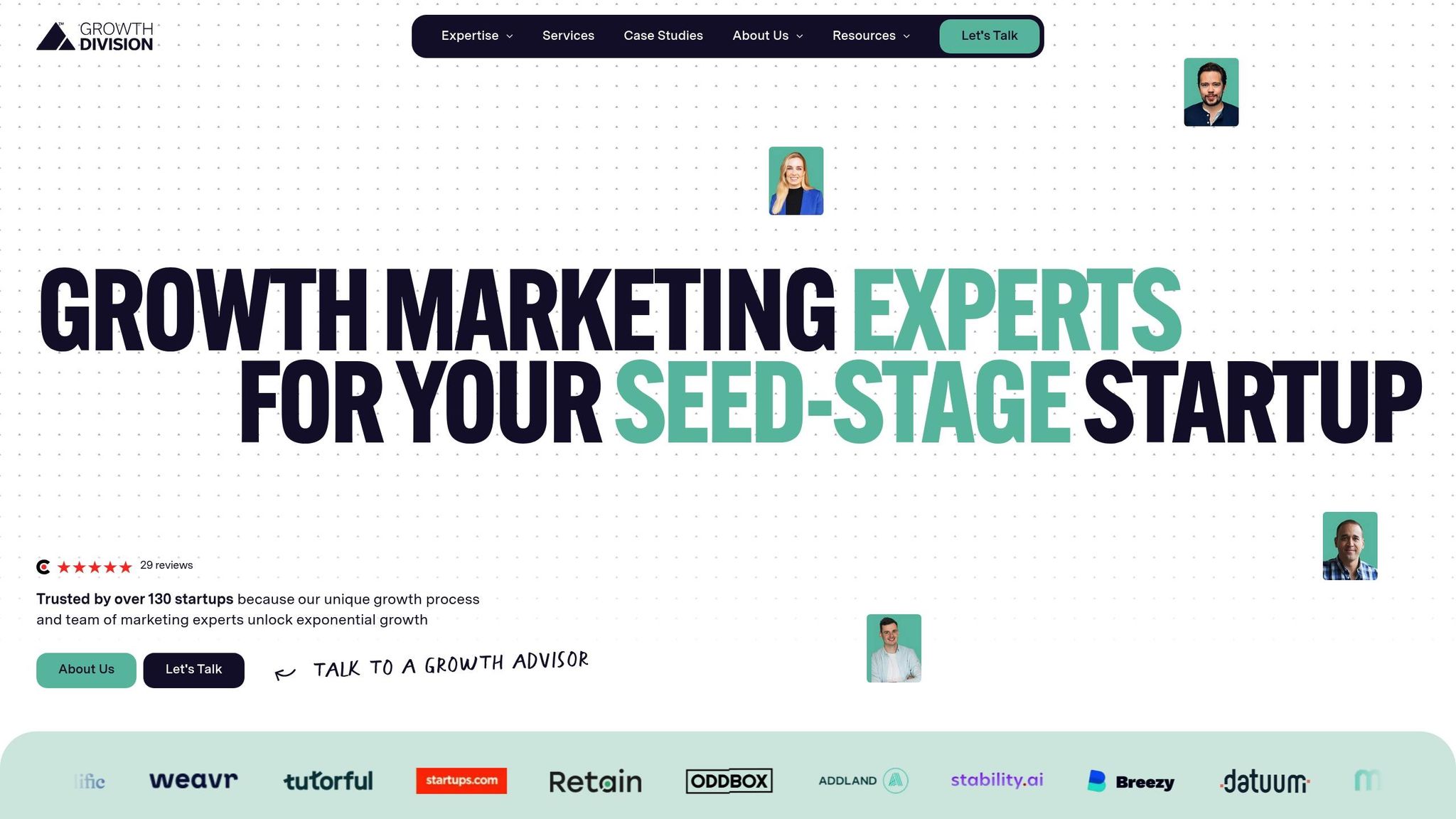
Growth Division approaches channel optimization with a methodical and data-focused mindset [6]. Based in London, this agency helps startups transition from scattered marketing efforts to creating repeatable, data-driven growth strategies. Their approach relies on rigorous experimentation across various acquisition channels, ensuring measurable and impactful results.
What sets Growth Division apart is their emphasis on empirical validation over generic industry advice. Rather than suggesting channels based on what works for others, they guide startups in identifying the specific channels that offer the best unit economics for their unique business model. This methodical testing aligns seamlessly with the data-driven principles discussed earlier.
Stage and Industry Focus
Growth Division tailors its services to startups at pivotal growth stages, particularly those with product-market fit and basic marketing infrastructure in place [6]. They are especially effective for early-to-mid stage startups, typically ranging from pre-seed to Series B, operating in sectors like tech, SaaS, and MarTech [6].
This approach is particularly appealing to analytical founders, those with engineering or data science backgrounds, who value hypothesis-driven testing and structured methodologies [6]. For startups ready to scale but lacking the internal capacity or expertise to run multi-channel experiments, Growth Division provides the strategic prioritization they need.
A Systematic, Data-First Approach
The agency’s standout feature is its commitment to channel experimentation as a disciplined process [6]. Using a combination of data analytics and structured testing frameworks, they pinpoint which channels deliver the highest ROI for each client’s specific business model.
Their process begins with a diagnostic analysis of current performance, followed by hypothesis-driven experimentation across various channels. This ensures that every recommendation is backed by data, avoiding reliance on trends or intuition. Growth Division helps startups sidestep common pitfalls, such as spreading budgets too thin, copying competitor strategies without validation, or making channel decisions based on fleeting trends instead of solid data [6].
Proven Success in Competitive Markets
Growth Division has earned recognition as a top growth marketing agency, ranking among the best for 2026 by Growth Hackers and in the top 5 for 2025 by AWISEE [4][7]. Their proven track record with startups and MarTech firms highlights their ability to deliver measurable results in competitive, data-driven industries.
What’s more, their focus on building internal capabilities ensures that clients can continue running experiments independently after the engagement ends. This creates lasting value, allowing startups to maintain momentum long after the consulting period concludes.
Flexible Engagement Models
Growth Division offers project-based and advisory engagement models [6], making it easy for startups to address specific growth challenges without committing to long-term contracts. For example, they might run a 90-day channel experimentation sprint or conduct a comprehensive growth strategy diagnostic.
Their hands-on approach involves close collaboration with startup teams to execute structured, data-driven experiments across paid, organic, and partnership channels [7]. A typical engagement includes an initial diagnostic, hypothesis development, experimentation plans with clear success metrics, regular performance reporting, and documentation of winning strategies for independent execution [6].
This model ensures immediate performance improvements while equipping startups with the tools and knowledge to sustain growth independently.
9. Deviate Labs: New Tactics and ASP™ Sales Flywheel Framework
Deviate Labs has carved a niche for itself by introducing fresh approaches and leveraging its ASP™ (Attract, Sell, Please) Sales Flywheel Framework, which focuses on uncovering unconventional channels to give clients an edge.
The firm thrives on discovering overlooked growth opportunities through bold experimentation and systematic testing. Instead of sticking to well-trodden paths like paid search or social media ads, Deviate Labs actively pursues untapped platforms, partnership models, and unique growth strategies. Their goal? To help clients stay ahead of the curve before these strategies become widespread.
The ASP™ framework is the backbone of this approach. In the Attract phase, the focus is on drawing in prospects through innovative channels and creative branding. The Sell phase prioritizes conversion optimization through data-backed testing. Finally, the Please phase emphasizes customer satisfaction to drive organic growth via referrals and retention.
Stage and Industry Fit
Deviate Labs works best with mid-stage startups that have already found product-market fit but are struggling to push past growth stagnation.
Their expertise is particularly valuable for tech startups in highly competitive industries, where traditional growth methods are either too saturated or too costly. Sectors like fintech, SaaS, and consumer tech often see the greatest benefit from their strategies, especially when facing challenges like high customer acquisition costs or the need to stand out in crowded markets.
This approach appeals most to ambitious founders who are open to taking calculated risks on emerging tactics in exchange for potentially transformative results. Conversely, companies that prefer safer, well-established strategies may find Deviate Labs’ methods less aligned with their goals.
Systems and Data Mindset
While their tactics are bold and experimental, Deviate Labs ensures every move is grounded in data. Their ASP™ framework integrates robust measurement systems to track performance at every stage of the customer journey, ensuring that no experiment goes unmeasured.
The firm employs advanced attribution modeling to understand the impact of experimental channels, even when the conversion path runs through several touches. This data-driven approach allows them to quickly pinpoint which strategies are working and which need to be shelved.
Their detailed reporting systems provide clients with clear insights into the ROI of experimental efforts, making it easier to grasp the tangible business value of trying new growth approaches. By combining creative thinking with analytical precision, they minimize the risks often associated with untested strategies.
Engagement Model
Deviate Labs offers flexible engagement options to suit different client needs. Most often, they operate through project-based engagements that last 3-6 months, giving them enough time to test, refine, and optimize new growth tactics. These engagements typically kick off with a thorough audit of existing growth channels to identify gaps and opportunities for innovation.
For companies seeking ongoing guidance, they also provide advisory services, offering regular insights into emerging growth strategies and market trends. This model is particularly effective for businesses with strong internal teams that can execute on Deviate Labs’ recommendations.
Collaboration is a key part of their process. By working closely with client teams, they ensure that successful experimental tactics are not only implemented but can also be sustained independently over time.
10. Velocity Growth: Content Creation, Training, and B2B/B2C Consultancy
Velocity Growth operates as a hybrid consultancy, blending strategic advice with practical execution and training. Their focus lies in equipping businesses with the tools and knowledge to build scalable content engines and develop in-house marketing expertise across both B2B and B2C sectors.
What sets them apart is their commitment to building sustainable content systems rather than delivering short-lived campaigns. Clients walk away with self-sufficient teams and long-term solutions instead of temporary fixes.
Stage and Industry Fit
Velocity Growth tailors its services to businesses at critical growth junctures. Their sweet spot? Tech, SaaS, and digital product companies ranging from early revenue stages to post-Series A. They’re particularly effective for startups and scale-ups that have achieved product-market fit but struggle with inconsistent content production or lack internal marketing know-how.
Their dual expertise in B2B and B2C makes them a great fit for businesses navigating new markets or managing complex customer segments. Established companies aiming to modernize their content strategies also benefit from their structured, systematic approach.
Velocity Growth shines in situations where businesses face challenges such as underperforming lead generation, scattered content strategies, or the need to unify distributed teams through training. Companies seeking to reduce reliance on external agencies find their focus on capability-building especially appealing.
Systems and Data-Driven Approach
At the heart of Velocity Growth’s strategy is a reliance on measurable outcomes. They employ analytics and clear KPI frameworks to ensure that their content strategies deliver tangible results while fostering continuous improvement.
Their dual focus on metrics is key. On one hand, they track quantitative data like lead volume, conversion rates, and content performance. On the other, they gather qualitative feedback to measure team confidence and the adoption of new processes. This combination ensures both immediate results and long-term growth are effectively monitored.
Proven Results
Velocity Growth has a track record of delivering repeatable successes. Recently, they partnered with a mid-sized SaaS company to revamp its content strategy. Within six months, the company saw a 40% increase in organic traffic and a 25% boost in lead generation. This project included a full content audit, the creation of new assets, and in-depth training for the client’s marketing team[6][4].
In 2025, they worked with a B2C e-commerce brand to launch a new content hub and train the internal team. The results? A 30% increase in website engagement and a 20% rise in conversion rates[6][4].
Another standout example is their work with a SaaS client, where they achieved a 40% increase in inbound leads within six months by implementing a structured content system and targeted training. For a B2B client, they improved sales enablement effectiveness by 30% through tailored training modules and content playbooks[6][4].
Engagement Model
Velocity Growth offers three flexible engagement models to meet different business needs:
- Advisory retainers: Best for companies with strong internal teams that need expert strategic direction on an ongoing basis.
- Project-based engagements: Ideal for specific initiatives like building content systems, rolling out training programs, or launching campaigns. These typically last 3-6 months and include thorough knowledge transfer to ensure results are sustainable.
- Fractional leadership: Provides interim senior-level expertise, such as acting as a temporary head of content or growth. This model is particularly useful for rapidly scaling companies or those in transition between permanent hires.
Across all models, Velocity Growth emphasizes hands-on learning and process adoption. They often embed with client teams during key projects, delivering tailored training sessions and detailed playbooks to ensure long-term success. Their approach consistently focuses on creating systems that drive enduring growth.
Picking the Right Consultant for Your Stage
Choosing the right consultant depends on where your business stands and the challenges you’re tackling. Growth marketing consultants that are skilled in early-stage channel testing might not suit a company that’s grappling with advanced attribution modeling. Below, align your ARR stage with consultants’ expertise and select an engagement model that matches your internal capacity.
Sub-$1M ARR: Finding Your Growth Engine
At this level, your priority is finding the right channels and creating multi-channel GTM growth engines. The best consultants will swiftly test acquisition channels, pinpoint the most effective ones, and establish basic tracking systems. Firms like Deviate Labs or Tuff are known for their agility in channel discovery. Their focus on this stage ensures you’re building growth systems that last, rather than relying on quick fixes.
$1-5M ARR: Building Systems and Retention
Here, it’s about refining what works and addressing retention issues. You’ll need consultants who can bring structure, align teams, and create repeatable processes. They’ll help optimize onboarding and set up measurement frameworks to guide decisions. Specialists like Lillian Pierson, AWISEE, and Growth Division excel at helping businesses transition effectively. Their expertise ensures your growth systems are built to endure, not just patch immediate gaps.
$5M+ ARR: Scaling and Attribution
When your revenue exceeds $5M, the focus shifts to handling complex attribution, scaling across multiple channels, and empowering internal teams with advanced tools. The right consultant acts as both a strategic advisor and a team enabler. They’ll help you develop sophisticated measurement systems, design cross-department experiment frameworks, and establish scalable processes. GrowthCurve and Growth Hackers are well-suited for these enterprise-level challenges.
Engagement Models: Finding the Right Fit
Once you’ve identified the consultant with expertise aligned to your growth stage, it’s time to pick an engagement model that works with your team’s capacity:
- Advisory-Only: Ideal if your team can execute independently but requires strategic input.
- Project-Based: Best for tackling specific initiatives like launching a new market or fixing onboarding issues.
- Fractional CMO: Suited for companies with budgets over $1M that need ongoing leadership.
Start Small to Test Fit
Begin with a short diagnostic, such as a growth audit or strategy workshop, to evaluate compatibility. This approach reduces financial risk and simplifies internal approval processes. Senior consultants generally charge $1,200–$2,500 per day for on-site coaching or workshops [8]. If the engagement doesn’t deliver the expected results, the financial impact is far less than a long-term commitment [9].
A good consultant will embrace this initial phase, understanding that proving their value upfront builds trust and sets the stage for a strong partnership.
Conclusion
The right growth marketing consultant can save you years of trial and error and get you to durable revenue faster. The wrong one drains your budget on scattered tactics and leaves you no smarter than when you started. The difference comes down to structure: a real consultant brings frameworks, data, and focus, then builds systems that keep paying off.
The secret is matching the consultant’s strengths to your growth stage. Every consultant on this list brings something specific, whether it’s my own focus on AI and data-driven systems, Growth Hackers’ performance approach, or Deviate Labs’ agile, creative tactics. When you compare them, weigh stage alignment, systems thinking, and a real track record ahead of flashy case studies and marketing hype.
Here’s how I’d run the decision. Narrow your options to two or three consultants whose expertise fits your situation, then book discovery calls to test how they think. Start with a diagnostic project or a growth audit so you can see their methodology and communication style before you commit to more. That measured approach keeps your risk low while you find the partner who actually fits.
Keep reading
- the best go-to-market consultants for tech startups
- top fractional CMO companies reviewed
- what a GTM engineer actually does
FAQs
What is a growth marketing consultant, and what do they actually do?
A growth marketing consultant is a specialist you bring in to build and fix the systems that drive revenue across your whole customer journey, ahead of just running individual campaigns. In practice, that means finding your biggest growth constraint, designing experiments to solve it, setting up measurement so you can see what’s working, and leaving your team with a repeatable process they can run on their own.
How can I tell if my company is ready to hire a growth marketing consultant?
Watch for three signs. Your growth has plateaued and you’re not sure what’s driving or stalling it. Your founders or marketing leads are stretched too thin to focus on long-term strategy. And your marketing spend has murky ROI you can’t clearly measure. If any of that sounds familiar, and you have real revenue plus a few hours a week your team can commit, you’re ready for a consultant who can design a structured, scalable growth strategy around your business.
How do I find a growth marketing consultant who fits my industry and growth stage?
Start by naming where you are in your growth journey and the specific challenge holding you back. Then look for consultants who’ve solved that exact problem in your industry, at your stage. Decide what kind of support you need too, whether that’s advisory guidance, help on a single project, or a hands-on GTM engineering arrangement. A short diagnostic project is the safest way to test their approach before you commit to more.
How do growth marketing consultants measure success?
Good ones tie their work to revenue, not vanity metrics. Expect them to set up attribution early, agree on a small number of metrics that actually reflect growth, and report against those consistently. If a consultant can’t tell you how they’ll measure their own impact before the work starts, that’s a warning sign.
What are the advantages of hiring a growth marketing consultant instead of building an in-house team?
A consultant gives you senior expertise fast, without the cost and lead time of a full-time hire. You get someone who’s solved your problem before, a system built in months rather than years of internal trial and error, and knowledge transfer that makes your existing team stronger. For most startups, the smartest move is to hire a consultant to build the engine, then let your in-house team run and scale it.
Related Blog Posts
- 10 Best Marketing Tools for Startups in 2026
- AI Growth Marketing: Forecasting Use Cases
- Ultimate Growth Advisors Guide: Top Startup Advisors Speak Out
- Best Fractional CMOs for Tech Startups: 6 Strategic Leaders Driving 100x Growth (2025)
Once you’ve shortlisted, the brief you send decides the quality of what comes back. Here is how to brief a consultant so the proposal is worth signing, including the scorecard I use.