

Here’s the deal: 96% of your website visitors leave without sharing their contact info. If you’re spending $6+ per click to get them there, that’s a lot of wasted budget. Website visitor identification tools promise to fix this by revealing who’s visiting – even if they don’t fill out a form. But do they deliver, or is it just hype?
The short version:
- Company-level tools (like reverse IP lookup) tell you which businesses are visiting. They’re global, GDPR-friendly, but less detailed.
- Person-level tools (like identity graphs) can identify individuals, but they’re mostly limited to U.S. traffic due to compliance laws.
- Match rates hover around 40–60% globally, and up to 80% for U.S. traffic.
- Best for B2B companies targeting high-intent visitors on pages like pricing or demos.
- Limitations: They struggle with B2C audiences, remote work traffic, and low-intent pages.
Why this matters: Identifying visitors isn’t magic – it’s a way to turn missed opportunities into revenue. The key is having a clear workflow: track visitors → qualify leads → act fast. If you’re not using this data to fuel outreach, it’s just noise.
Quick takeaway: Tools like ZoomInfo WebSights and RB2B can help you identify and engage the right visitors. But success depends on filtering low-value traffic, staying compliant, and acting on insights quickly.
ZoomInfo Copilot: See Who’s Actually Visiting Your Website | Person-Level Intent
What Website Visitor Identification Actually Means
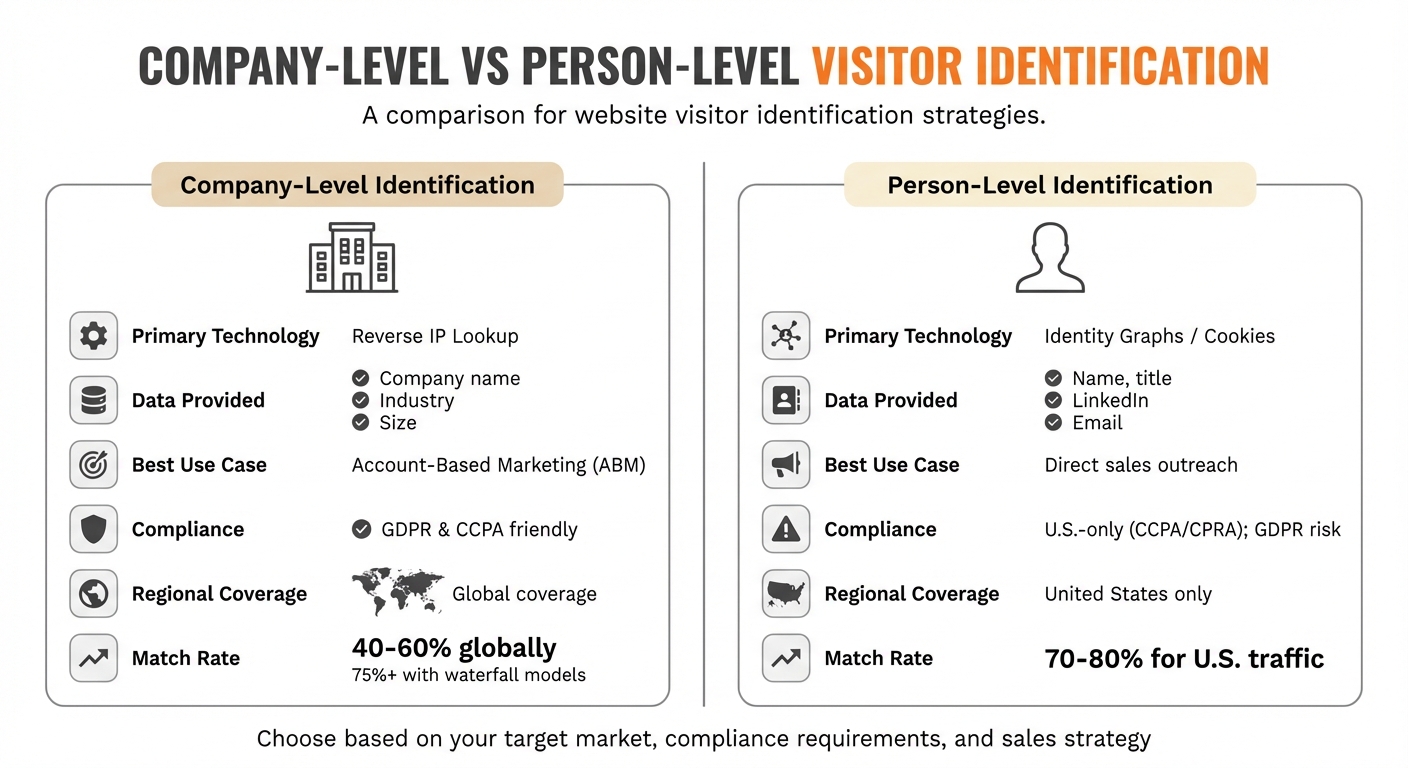
Company-Level vs Person-Level Website Visitor Identification: Key Differences
Website visitor identification helps uncover the identities of anonymous visitors, even when they don’t fill out forms. An estimated 96% of B2B website visitors leave without sharing their contact details [4]. This technology bridges that gap by analyzing anonymous data – like IP addresses, cookies, or device IDs – and matching it to business databases. The result? You can identify either the company or, in some cases, the individual behind a visit.
Two main approaches to visitor identification exist, each offering different types of insights, operating under separate compliance rules, and serving distinct purposes. Let’s break them down.
Company-Level vs. Person-Level Identification
Company-level identification relies on reverse IP lookup to associate a visitor’s IP address with a corporate network [3]. For instance, if someone from Acme Corp visits your pricing page, the tool identifies "Acme Corp" and provides organizational details like industry and size. However, it doesn’t reveal which specific individual from Acme visited – just that someone from the company showed interest. Tools using waterfall data models can identify over 75% of anonymous visitors at the account level [3].
Person-level identification, on the other hand, uses identity graphs and device tracking to pinpoint specific individuals [5]. Instead of knowing that "someone from Acme Corp" visited, you might learn it was "John Smith, VP of Sales at Acme Corp", along with his LinkedIn profile and verified business email. However, this approach is mostly limited to U.S. traffic to comply with regulations like CCPA/CPRA and avoid GDPR issues [5]. Solutions such as RB2B can resolve 70% to 80% of U.S.-based website traffic into individual profiles [2], though this level of detail is generally unavailable outside the U.S.
| Feature | Company-Level Identification | Person-Level Identification |
|---|---|---|
| Primary Technology | Reverse IP Lookup [3] | Identity Graphs / Cookies [5] |
| Data Provided | Company name, industry, size [3] | Name, title, LinkedIn, email [5] |
| Best Use Case | Account-Based Marketing (ABM) [9] | Direct sales outreach [5] |
| Compliance | GDPR & CCPA friendly [3] | U.S.-only (CCPA/CPRA); GDPR risk [5] |
| Regional Coverage | Global | United States |
In today’s remote-first world, these methods face new challenges. Nearly half of B2B traffic now comes from remote or non-corporate environments [4]. Traditional IP matching struggles in this scenario, so modern tools have adapted by using strategies like "IP ringfencing" and device matching to connect residential IPs to corporate domains [4]. However, the accuracy of these methods can vary.
De-Anonymization: Separating Hype from Reality
It’s important to understand that identification signals are not guaranteed leads. Match rates typically fall between 40% and 60%, and the data often requires further qualification [7].
Another hurdle is bot traffic. Advanced platforms can filter out bots to ensure you’re targeting genuine visitors, not job seekers, students, or competitors [6]. Without proper filtering, you risk wasting time and resources on false signals.
"Company-level identification is the safest compliance-wise but about ten times less useful, while persona-level identification is somewhat controversial yet the most effective for sales." – Anya A., Founder [7]
When Website Visitor Identification Works (And When It Doesn’t)
Visitor identification can deliver impressive results in certain B2B scenarios, but it may fall flat in others. Knowing where your business fits on this spectrum can save time and resources.
Best Use Cases for Visitor Identification
Visitor identification shines brightest in B2B environments, especially when it uncovers key organizations and decision-makers. Industries like SaaS, data platforms, and B2B marketplaces often see the most benefit because each identified visitor has the potential to translate into significant enterprise value [1][4].
It works particularly well when high-intent pages are involved. Pages like pricing, product demos, integration guides, or competitor comparisons often attract visitors who are actively evaluating solutions. For example, in 2024, Gabriella Walling, VP of Marketing at Biscred, directed her sales development team to follow up on 100 enriched website visitors identified through person-level tracking. By focusing on visitors aligned with their ideal customer profile (ICP), her team successfully booked 11 demos within just one week [4][5].
Businesses investing heavily in paid advertising – particularly on platforms like LinkedIn, where clicks can cost upwards of $6 – also see strong returns. With around 96% of website visitors leaving without filling out forms, identification tools help capture insights from this otherwise lost traffic [4]. If only 3–4% of visitors convert through forms, these tools allow you to tap into the remaining 96% and uncover hidden opportunities.
Timing is another critical factor. Heath Barnett at Mixmax demonstrated how immediate action can yield significant results. In 2024, Barnett used person-level identification to spot a high-value visitor and added them to a targeted outreach sequence right away, which led to closing a $100,000 deal [2][5]. Even businesses with relatively modest traffic – 500 to 2,000 monthly visits – can build a strong pipeline if they have a clear ICP to filter out irrelevant visitors like job seekers or competitors [2][4].
Now, let’s explore where these tools fall short.
When Visitor Identification Falls Short
While effective in specific B2B scenarios, visitor identification tools face notable challenges in other contexts.
For starters, they struggle with B2C audiences and consumer-focused businesses. These tools are designed to identify organizations and professional personas, not individual consumers browsing on personal devices [4]. If your audience skews toward consumers rather than business buyers, the match rates drop, and the data becomes far less actionable.
Geographic limitations also pose a challenge. Due to GDPR regulations in Europe and the UK, person-level identification is typically restricted to U.S. traffic [4][5]. For businesses targeting audiences outside the United States, the technology may only offer company-level insights, which lack individual contact details.
Another issue arises when there are operational gaps in how the data is used. If the information isn’t integrated into your CRM or leveraged for real-time alerts, the investment can go to waste. In fact, 43% of marketers report that their biggest challenge isn’t a lack of data – it’s turning that data into actionable insights [8]. Without clear workflows for immediate follow-up, identified visitors can quickly become stale leads.
Additionally, low-intent pages can create noise that overwhelms sales teams. Alerts triggered by visits to pages like careers or login screens often lead to false positives, causing frustration rather than generating meaningful leads [5].
Lastly, businesses without a well-defined ICP often struggle to make the most of this technology. Without a clear way to filter for fit, teams may end up pursuing poor-quality leads that increase churn rates and drive up support costs [8].
Recognizing both the strengths and limitations of visitor identification tools is essential for building an effective strategy that aligns with your business goals.
The 5-Step Workflow: From Visitor Signal to Qualified Outreach
Transforming anonymous website traffic into meaningful sales conversations requires a well-structured approach. Here’s how to do it in five clear steps.
Step 1: Capture and Filter Visitor Data
Begin by adding a tracking pixel to your website to gather IP addresses and key behavioral data, such as page views, session durations, and repeat visits [5].
To avoid being overwhelmed by unnecessary notifications, implement Smart Page Suppression and Automatic Traffic Filtering. These tools block alerts from low-intent pages, like careers sections or login screens, and weed out bot activity [5][6]. Instead, focus your efforts on high-intent pages – pricing pages, product demos, integration guides, or competitor comparisons – to identify visitors who are actively evaluating your offerings.
For instance, in 2024, Ed Cavazos, Executive VP at Akorbi, used ZoomInfo WebSights to filter bot traffic. This adjustment led to a 150% increase in marketing-qualified leads and doubled their sales pipeline [6].
Once your visitor data is clean and reliable, the next step is to identify the businesses behind those digital footprints.
Step 2: Match IPs to Company Records
After collecting visitor data, use reverse IP lookup tools to connect those digital signals to real-world organizations [1]. These tools tap into databases that link IP ranges to company networks, providing firmographic details like company name, industry, size, and location.
However, with nearly 50% of B2B traffic now coming from remote workers at home or in coffee shops, standard IP databases often fall short [4][6]. Advanced tools address this challenge by using identity graphs and device-matching techniques to associate residential IPs with corporate domains.
Identifying the visitor is just the beginning. To make this data actionable, you need a seamless integration into your workflow.
Step 3: Route Identified Visitors Into Your System
Data sitting idle doesn’t generate revenue – quick action does [11]. As soon as a qualified visitor lands on your site, their information should flow directly into your system for immediate follow-up.
Once you’ve matched visitors to their companies, integrate this data with platforms like Slack, Microsoft Teams, or your CRM to enable real-time alerts [3][5]. For example, if a high-intent visitor from a target account views your pricing page, your sales development representative (SDR) should be notified within seconds. This speed-to-lead advantage can significantly boost response rates [9].
For teams handling larger volumes, consider routing visitor data into a centralized "visitor inbox" using tools like Airtable, Clay tables, or HubSpot lists. This ensures a clear, organized system where leads can be reviewed, qualified, and assigned efficiently.
Step 4: Qualify and Enrich Leads
Not every visitor is worth pursuing immediately. Start by checking if they align with your ideal customer profile (ICP), using criteria like company revenue, employee count, industry, location, and seniority level [2].
Next, enhance their profiles with verified contact details, such as emails, LinkedIn profiles, phone numbers, and job titles [5]. Real-time email verification tools like Dropcontact or Prospeo can help reduce email bounce rates from 12% to as low as 3% [12].
In early 2025, Gabriella Walling, VP of Marketing at Biscred, tested this approach. Her SDR team contacted 100 enriched website visitors identified through person-level tracking over one week, leading to 11 booked demos [5].
Step 5: Execute a Targeted Outreach Sequence
With qualified and enriched leads ready, launch an outreach campaign tailored to each visitor’s intent signals. Start with a LinkedIn connection request referencing specific pages they viewed, followed by a simple email sequence. For high-priority accounts, add a personalized LinkedIn message [2].
Timing is everything. Acting while the visit is still fresh is crucial – don’t let internal delays over messaging slow you down. Tools like Sendspark allow you to create quick, personalized video messages that reference the visitor’s browsing activity. Andy Mewborn, Founder/CEO of Distribute.so, emphasizes this point:
"The site visit is the best signal, and RB2B has the highest quality site visit in the market. It’s indispensable." [5]
If multiple people from the same company visit your site, don’t stop at just one contact. Use enrichment tools to identify and engage the entire buying committee. Additionally, precision retargeting based on visitor data can yield conversion rates 2.5 times higher than traditional cold prospecting [4].
Best Tools for Website Visitor Identification in 2026
When choosing tools to identify website visitors, focus on whether you need to target companies or individual people and how quickly you need actionable data. These tools are designed to turn visitor insights into qualified outreach, streamlining your workflow. Below are some top recommendations for 2026.
Company-Level Identification Tools
Factors.ai takes a unique approach with its waterfall model, combining data from 6sense, Clearbit, Demandbase, and Snitcher. This method ensures match rates exceed 75% at the account level [3].
"Factors’ account identification and intelligence is a game changer for generating revenue" [3].
ZoomInfo WebSights excels at filtering out bots to focus on genuine visitors. In 2024, Ed Cavazos, Executive VP at Akorbi, implemented WebSights and saw a 150% jump in marketing-qualified leads and a doubled sales pipeline [6]. Its "Automatic Traffic Filtering" feature ensures sales teams only pursue verified human leads [6].
Leadfeeder stands out with its behavioral filtering capabilities, offering over 50 firmographic and behavioral criteria. It also integrates natively with tools like Pipedrive, Salesforce, Slack, and Google Ads. Plus, you can test it out with a 14-day free trial – no credit card required [13].
For a more granular view, consider tools that identify individual visitors to complement these company-level insights.
Person-Level Identification Tools
When company-level data isn’t enough, person-level tools help pinpoint the individuals behind website visits.
RB2B focuses on identifying U.S. visitors at the individual level, delivering LinkedIn profiles and business emails directly via Slack [5]. It achieves a 70–80% identification rate for U.S. visitors [5]. Heath Barnett, VP of Revenue at Mixmax, shared how RB2B helped his team spot a high-value visitor who hadn’t filled out a form. Adding this lead to an outreach sequence led to a $100,000 closed deal [5]. RB2B offers a free-forever plan with 150 credits per month, with paid plans starting at $149/month for 300 credits [2]. To remain GDPR compliant, RB2B excludes EU traffic from person-level identification, offering company-level data instead for global teams [2].
DemandSense uses a hybrid strategy: it identifies individuals in the U.S. while focusing on company-level data internationally to comply with GDPR and UK GDPR [4]. This dual approach is especially useful for engaging prospects in regions where 96% of B2B website visitors leave without filling out a form [4].
Once you’ve identified your visitors – whether by company or individual – it’s time to enrich and organize this data for effective outreach.
Orchestration and Enrichment Tools
Raw data alone isn’t enough; it needs to be enriched to drive meaningful action. Clay has become a go-to tool for this, enabling teams to add verified emails, phone numbers, LinkedIn profiles, and job titles to their identified visitors [5][9]. It integrates seamlessly with visitor identification tools and feeds enriched data directly into CRMs or outreach sequences.
Claygent takes it a step further by using AI to qualify leads. It automatically researches company fit and assigns priority scores based on your ideal customer profile (ICP) criteria [2][9]. This saves sales teams from wasting time on unqualified leads.
For teams looking to maximize conversions, orchestration tools should also connect with LinkedIn Ads to create Matched Audiences. By retargeting based on specific on-site behavior, this strategy can boost conversion rates by 2.5 times compared to cold prospecting [3][4].
sbb-itb-e8c8399
Privacy, Compliance, and Ethical Considerations
When refining your visitor identification workflow, it’s essential to align with regional privacy requirements. By 2026, balancing sales efficiency with compliance has become a necessity. Privacy regulations now mandate region-specific strategies – person-level identification is permissible for U.S. traffic under CCPA/CPRA, while company-level identification is required for international visitors, particularly in the EU and UK, to comply with GDPR standards [4][5]. Your tools must automatically filter traffic by geography, applying stricter privacy controls for European visitors. These evolving compliance standards directly shape how visitor data is collected and processed.
GDPR and Data Privacy Regulations
To understand how GDPR impacts data collection compared to U.S. regulations, it’s helpful to break it down. GDPR generally allows company-level identification – linking IP addresses to business domains – because it focuses on organizational data rather than personal details [3]. However, person-level identification is far more complex. Tools that use cookies, device IDs, and publisher networks to resolve individual identities must meet strict consent requirements in the EU [1][5]. Platforms like RB2B and DemandSense have adapted by restricting person-level data usage to U.S. visitors. As Kristina Haidai from DemandSense explains:
"In the US, we identify both individual visitors and their companies. Outside the US, we provide company-level identification only to ensure full compliance with GDPR, UK GDPR, and other regional data protection requirements." [4]
Some technologies, like Hashed Emails (HEMs), allow cross-platform data matching without exposing raw personal data [14]. Additionally, SOC2 Type II certification has become a baseline security standard, ensuring platforms meet stringent data protection requirements [5][3].
Best Practices for Compliance
To stay compliant, start by updating your privacy policy to clearly disclose that cookies and third-party vendors may associate website activity with personal information or online profiles [2]. Transparency isn’t optional – it’s a legal requirement in most jurisdictions. Implement a consent management platform with clear cookie banners that allow users to customize tracking preferences, particularly for non-U.S. visitors [2][9].
Here are a few actionable steps to strengthen compliance:
- Use IP ringfencing to apply appropriate privacy controls based on geography.
- Provide clear opt-out links, such as "Do Not Sell My Info" for CCPA compliance or a database opt-out portal for other regions [5][2].
- Recognize that a website visit signals interest – not consent for intrusive outreach.
Kristina Haidai offers a key perspective on ethical outreach:
"If your outreach would feel natural without the visitor data, you’re probably fine. If it only makes sense because you’ve been tracking someone’s clicks, you’ve crossed into surveillance territory." [4]
Focus on creating outreach that’s relevant rather than invasive. Use visitor data to gauge intent and timing, but craft messages that would make sense even without detailed tracking. Filtering out automated bot traffic also ensures your sales team connects with real prospects [6]. By adhering to these privacy practices, you can maintain trust while ensuring your outreach remains both ethical and effective.
Implementation Guide: Set Up Visitor Identification in One Weekend
You can get visitor identification up and running in just a weekend. The process is straightforward: install, integrate, qualify, and pilot. By dedicating three focused days, you’ll have a functioning system ready to go by Monday.
Day 1: Install and Connect
Start by installing a tracking pixel in your website header. This small addition captures visitor activity without slowing down your site. The best part? It takes less than 10 minutes to set up – no developer needed.
Once the pixel is active, connect two essential tools: a communication platform like Slack or Microsoft Teams for real-time alerts, and your CRM (e.g., HubSpot, Salesforce, or Zoho) to centralize data. These integrations ensure you can act quickly and keep all visitor information in one place.
Next, implement Smart Page Suppression to filter out irrelevant traffic. For example, suppress alerts from pages like careers, login screens, or internal blogs. This step prevents unnecessary distractions and keeps your team focused on high-value opportunities.
With tracking and integrations in place, you’re ready to dive into qualifying and enriching your leads.
Day 2: Build Qualification and Enrichment
Create a centralized lead table – tools like Clay work well for this – as your go-to inbox for visitor data. Then, enrich each lead with verified emails, LinkedIn profiles, and firmographic details like company size and industry.
Set up Hot Page filters to prioritize visitors who show high intent, such as those viewing pricing, demo, or competitor comparison pages. At the same time, suppress traffic from less valuable pages. Add matching rules based on your ideal customer profile (ICP). Filter leads by factors like company size, location, industry, or job title to ensure only qualified prospects reach your sales team.
Once your leads are enriched and sorted, you’re ready to test the system.
Day 3: Pilot and Measure
Run a pilot with a small group to establish benchmarks. For example, in early 2024, Gabriella Walling, Biscred’s VP of Marketing, tasked an SDR with reaching out to 100 enriched website visitors identified through RB2B over one week. By focusing on their ICP, the team booked 11 demos – an 11% conversion rate from identified traffic [5].
To automate outreach, integrate your enriched leads with tools like Instantly, HeyReach, or Apollo. These platforms can handle email and LinkedIn sequences, ensuring timely follow-ups. Timing matters – LinkedIn connection requests sent shortly after a site visit can see up to a 90% acceptance rate [2].
Track your pilot’s key metrics, such as resolution rates, demo bookings, and LinkedIn connection acceptance rates. Adjust your process to improve response times, as speed is critical to boosting conversions. For example, Heath Barnett, VP of Revenue at Mixmax, once identified a high-value prospect browsing their site. By immediately adding the lead to a targeted sequence, the team closed a $100,000 deal [5]. Acting fast on visitor signals can make all the difference.
Metrics That Matter: Measuring Success
Focusing on the right metrics is essential to separate meaningful visitor identification from simple data collection. While metrics like resolution rates help assess tool efficiency, the real indicators of success lie in pipeline growth and revenue impact.
Key Metrics to Track
These metrics help measure progress from initial detection to final conversion.
Start with the match rate – the percentage of total traffic your tools successfully identify. Leading solutions in 2026 can achieve match rates of 70–80% for U.S. traffic [5] and 40–60% globally [7]. While this figure highlights the tool’s efficiency, it’s just the first step.
A more critical metric is the qualification rate, which measures the percentage of identified visitors who align with your Ideal Customer Profile (ICP). This is based on firmographic factors like company size, industry, and role. Without precise qualification, outreach efforts often fall flat.
To gauge buying intent, track engagement depth by analyzing visits to high-intent pages – pricing, demo requests, or case studies – and monitoring session duration. These behaviors offer stronger signals than generic homepage visits. Additionally, use time-to-lead to measure how quickly high-intent visitors are routed to your sales team. Real-time alerts, such as Slack notifications, can enable teams to respond within minutes, improving engagement outcomes.
Metrics like reply rates and meetings booked offer direct insights into revenue potential. Visitor identification tools have been shown to increase email reply rates by 34% compared to cold outreach [10].
Another essential metric is pipeline velocity, which reflects how much faster qualified leads progress through your funnel compared to cold leads. For example, in August 2025, Arke reported a 20% boost in pipeline velocity after adopting visitor identification, while Maven Machines achieved a 50% win rate on leads generated through this method in June 2025 [10]. These metrics directly tie visitor identification to revenue growth.
Benchmarking ROI
Operational metrics are helpful, but financial benchmarks reveal the true value of your visitor identification efforts.
Start by calculating your Customer Acquisition Cost (CAC) for leads generated through visitor identification and compare it to other channels. For instance, B2B teams often spend over $6 per click on LinkedIn ads, but only 3–4% of those visitors fill out forms [4]. Identifying and engaging the majority of unconverted visitors can significantly improve the efficiency of your ad spend.
"According to our benchmark data, this approach [precision retargeting] drives 2.5x higher conversion rates than cold prospecting."
- Kristina Haidai, Content Writer, DemandSense [4]
Visitor identification also helps suppress low-value traffic, such as job seekers, students, or competitors, further enhancing your return on ad spend. For example, LeadCoverage reported a 40% lift in conversions in 2025 by focusing on high-value visitors [10].
Another critical metric is attribution accuracy, which tracks the reduction of "Unknown Lead Sources" in your CRM. By focusing on qualified identifications, you can convert the right visitors faster and more effectively. Riley Timmins of Cacheflow used Factors.ai to identify anonymous account-level visitors, reducing unknown sources by 20% [3]. This improved visibility is crucial for evaluating channel performance, especially in long B2B sales cycles. The ultimate goal isn’t just to identify more visitors but to identify and convert the right ones efficiently.
Conclusion
Identifying website visitors isn’t about achieving perfect data – it’s about turning anonymous traffic into meaningful interactions. Most tools identify somewhere between 35% and 60% of visitors [15], and that’s more than enough to make an impact if you’ve got the right process in place.
Success boils down to three key steps. First, set realistic expectations – you won’t identify every visitor, and not every match will be flawless. The real win is converting missed opportunities into qualified leads, not chasing 100% accuracy. Second, choose tools that align with your region and compliance needs. For U.S. traffic, person-level identification works well under CCPA/CPRA [4][5], while in Europe, company-level identification fits GDPR standards [4][7]. Third, build a clear workflow: capture and filter traffic, match IPs to companies, feed leads into your CRM, qualify and enrich them, and then launch targeted outreach [4][15].
This approach is what separates the leaders from the rest. Winning companies don’t just gather data – they act on it in real time. They focus on high-intent pages like pricing or demo sections [5], differentiate bots from real users [6], and automate their lead-to-customer process to speed up sales by 40% to 60% [15]. Kristina Haidai from DemandSense sums it up perfectly:
"The best companies use visitor identification to be more relevant, not more aggressive. They show the right content at the right time" [4].
The reality is that most visitors will remain unidentified [4][15]. The real question isn’t whether to use visitor identification – it’s whether you can afford to ignore the insights hidden in your traffic. Start small with a weekend pilot, track meaningful metrics like reply rates and booked meetings, and fine-tune your strategy from there.
FAQs
How do website visitor identification tools ensure compliance with privacy regulations like GDPR and CCPA?
Website visitor identification tools align with privacy regulations like GDPR and CCPA by prioritizing user privacy, transparency, and secure data practices. They often anonymize information, ensure user consent, and rely on compliant tracking methods such as cookie notices and clear privacy policies. Instead of focusing on personal data, many tools emphasize company-level identification, which minimizes legal risks and adheres to GDPR’s focus on giving users control over their personal information.
These tools typically limit data collection to non-personally identifiable information (non-PII) unless users provide explicit consent. To further ensure compliance, they incorporate practices like regional IP filtering, frequent updates to privacy policies, and training staff on regulatory requirements. By combining effective visitor identification with privacy-first strategies, these tools allow businesses to respect user rights while staying within the bounds of data protection laws.
What’s the difference between company-level and person-level visitor identification tools?
The distinction between company-level and person-level identification tools lies in the scope of the data they offer and the level of detail they deliver.
Company-level tools focus on identifying the organization behind a website visit. They typically rely on reverse IP lookup to connect a visitor’s IP address to a company database. These tools provide information such as the company’s name, industry, size, and location. This makes them particularly useful for strategies like account-based marketing or generating sales alerts. However, these tools don’t provide specifics about the individual visitors within the organization.
In contrast, person-level tools aim to pinpoint the exact individuals visiting a website. By leveraging identity graphs, behavioral data, and other resources, they can connect online activity to known contacts. This approach provides more detailed information, such as email addresses, LinkedIn profiles, or phone numbers. While these tools enable more personalized outreach, their accuracy can vary, and they may face challenges with legal compliance (like GDPR) and regional data availability, depending on the vendor and the geographic area.
When are website visitor identification tools most effective for B2B companies?
Website visitor identification tools can be a game-changer for B2B companies, particularly those with steady traffic – anywhere from 500 to 2,000 visits per month – and a well-defined ideal customer profile (ICP). These tools excel at matching visitor data, like IP addresses or behavior patterns, to target accounts. This allows sales and marketing teams to focus on the most promising leads and respond swiftly.
For businesses that can act on these insights, such as sending tailored emails, crafting LinkedIn messages, or running retargeting campaigns, the value of these tools increases significantly. They’re also helpful for keeping an eye on current customers, uncovering upsell opportunities, or spotting new prospects who show strong buying intent. That said, these tools are less effective for B2C traffic, websites with minimal visitors, or companies without the bandwidth to leverage the insights they provide.