
Twenty-two years ago, a young man arrived in Sydney from Northern Sri Lanka with no English, no formal education, and no safety net. He’d spent two years in India as a refugee before making it to Australia. He had, as he told me, “nothing to lose.”
That man is Balendran Thavarajah, and he has since built five companies, including one acquired and now traded on NASDAQ and one now scaling across 15+ countries. His current venture, Getmee, is an award-winning AI platform that coaches people on communication and employability skills. It solves the exact problem that he’d already lived when he first arrived.

I talked to Bala because I keep seeing founders treat their origin story as a nice-to-have, a piece of “personal branding” bolted onto their pitch deck. Bala treats his as infrastructure. It’s baked into his go-to-market, his product thesis, and how he finds customers. The approach has worked across all five of his ventures.
What follows is Part 1 of a two-part feature. Today, we’ll be looking at how a founder narrative becomes a startup go-to-market strategy, how to read market signals before they turn into expensive lessons, and what Bala’s first exit at age 20-something can teach technical founders who are still doing all their own sales.
If you’re looking for a startup go-to-market strategy that’s actually been stress-tested across five companies and two exits, this is a good place to start.
The Story Is the Startup Go-to-Market Strategy
Most founders treat their personal narrative as a softener, something you say to build rapport before you get to the real pitch. Bala figured out early that it can actually make for a great pitch.
When he launched what would become Getmee, he was solving a problem he had personally experienced. As a migrant who arrived without English, he understood firsthand how much language and communication skills determine employment outcomes. That personal truth became the engine of his early startup go-to-market strategy.
“People buy stories and people buy into your personal journey. So I decided to use that from the beginning.”
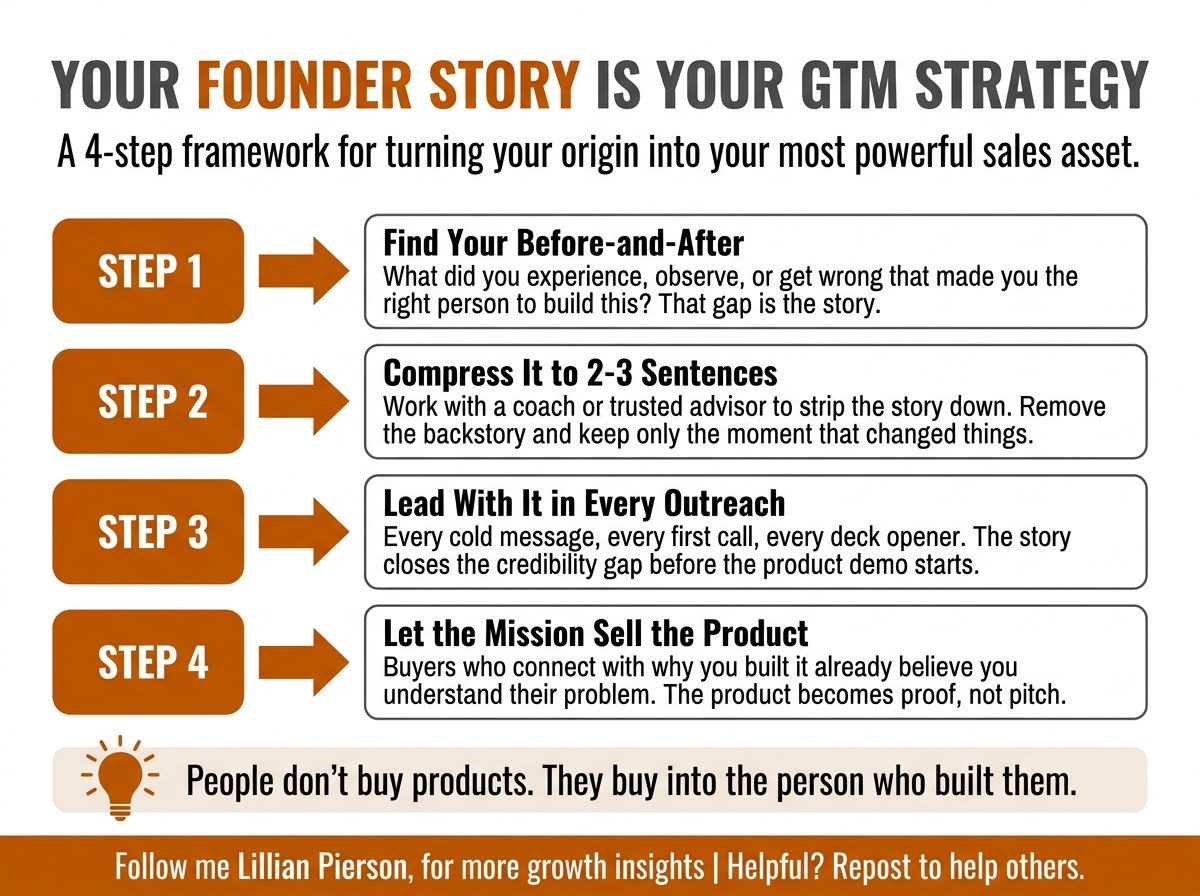
Every message, every piece of outreach, every early conversation with prospects anchored on the same idea. That idea: here’s a founder who lived this problem, rebuilt his life around solving it, and is now building the product he wishes had existed when he needed it. The personal narrative closed the credibility gap before the product demo even started.
His first institutional customers signed with Getmee because the mission was credible in a way that a typical pitch deck can’t manufacture. The logic goes like this…. If you built it for yourself, then you understand the people we’re trying to serve.
The good news is you don’t need to have arrived as a refugee to use this principle. All you really need is a genuine before-and-after. What did you experience, observe, or get wrong that made you the right person to build this specific thing? That’s your story – and if you’re not telling it, you’re making your prospects work harder to trust you.
In case you’re new to founder stories, I drew up the 4-step process below. You can use it to identify a strong origin story for your startup.
Bala did work with coaches early on to sharpen how he told it. “We all hold back,” he said. “We feel like we’re promoting ourselves. But that’s where the real connection is. Your story is powerful because people connect with people, not products.”
Company One: The Walk-In Close
Before Getmee, before the NASDAQ exit, before any of it, Bala built a point-of-sale system for small supermarkets out of his apartment. He was a fresh computer science graduate who’d gotten into university through an alternate pathway program for disadvantaged applicants because he had no secondary school certificates. He figured out that smaller supermarkets were using pen and paper for inventory and bookkeeping while larger chains had sophisticated systems costing $50,000 to $100,000 to implement.
So he built a version that did the same job for $6,000, and he sold it by walking into supermarkets with his laptop and scanner, finding the owner, and asking for five minutes.
“Five minutes into the conversation, he would shake my hand and go, ‘ Come and install it.”
In four months, he had 20 customers! No CRM, no email sequence, no funnel. Just a founder who saw a clear pain, built a direct solution, and walked it in the front door.
It might surprise you to hear that this approach still works. Mark Cuban has been saying it for years about brick-and-mortar businesses and AI. Bala was doing it in 2003 with retail software. The formula is the same: find a business where the pain is visible, show up with a working solution, and make the decision easy for the owner.
The lesson here is that the most effective startup go-to-market strategy often looks nothing like a strategy at all. It looks like a founder who saw a real problem, built a direct solution, and made it impossible for the buyer to say no.
The challenge, as Bala learned, is that closing 20 customers with a laptop isn’t a basis for a scalable business. He was getting 9 pm calls from supermarket owners because a database had run out of space. He’d fixed the problem for $6,000, no formal support contract, and now he was the IT department.
“After 18 months, I was like, no. I don’t have the skills to scale this. I need to find some people, or I’ve got to sell it.”
He sold it to a computer services company that was already supporting his customers, trained their team on the software, and got paid for the IP. That was his first exit: quick, practical, and clean.
What Bala Did Between Companies
This is where most founder origin stories skip ahead to the next win. Not Bala.
After exiting his first company, he went and worked inside established businesses, including telecom companies and a government agency in Canberra. He stayed two to three years specifically so he could learn how businesses actually operated, how teams were built, and how an idea moved from concept to commercial product. He wanted practical exposure, not theory.
“Practically, how do you take an idea from an idea to a commercial environment, validate it, and then scale? I didn’t know that. It was going to take me years to learn practically, so I thought I would go and learn from established businesses.”
Then he came back out.
He invested half a million dollars into building what he thought would be Australia’s local answer to eBay. He outsourced the development to a team overseas. Two years in, the product wasn’t what he’d envisioned and would need another $300,000 to fix. He didn’t have it. He walked away, half a million dollars lighter, with a lesson that still shapes how he builds today.
“You cannot outsource the entire product development and expect them to have the same level of passion and commitment as you. You can’t replicate the founder’s passion. Everyone else treats it as a project: pay me, and I’ll build you whatever you want. Founders put in the care and love.”
He didn’t mean this as a knock on agencies or dev shops… Rather, it’s simply a fundamental truth about what happens when you hand over the core of your product without maintaining enough oversight and ownership to catch when it’s going wrong.
He followed that loss with a lean, profitable consulting business, $50,000 to $60,000 a month, two people, focused on digitization for small-to-medium businesses that couldn’t afford the big consulting firms. Digital transformation, before that phrase meant anything. He built that up, then joined two other founders on the location services company that would eventually list on NASDAQ.
The NASDAQ Company: Building Toward a Known Exit
The location services business that Bala joined focused on automating toll road payments through a mobile app. Basically, it replaces the physical tag in your car with your phone. If you’ve used a toll road app in the U.S. (GoToll is one example), you’ve interacted with infrastructure this technology helped pioneer. Bala served as the founding CTO for six years before the company merged and listed.
What I want to underscore from this part of Bala’s journey is the philosophy he brought to it.
“Instead of looking at exit options at the end, I realized from my first business that I knew who I would be able to sell to. So if you think about that at the beginning, you start aligning your business with potential acquirers from day one.”
In other words, your channel partners, your key customers, and your distribution relationships are not just go-to-market levers. They’re your most likely acquirers. If you build those relationships intentionally, your eventual exit will be a natural next step for someone who’s already been working alongside you.
This is a different way of thinking about partnerships than most founders use. Most people treat partnerships as a sales channel. Bala treats them as a long-term optionality that can crystallize as an acquisition when the timing is right.
It won’t apply to every business. But if you’re building in a space where there are larger players who serve the same customers, it’s worth mapping out who those players are and thinking about whether the relationship you’re building could eventually become something more.
Market Signal Reading at Getmee: The B2C Pivot That Wasn’t
When Bala launched his current startup, Getmee, the initial product market fit hypothesis was B2C. People who needed communication and employability skills coaching would pay for it directly. He ran Facebook ads. In the first six months, he had about 300 paying customers.
Then he looked at the numbers.
“The CAC was so crazy. For us to get the volume, we’d have to spend so much money. And the churn rate wasn’t good. That was enough for us to go, ‘okay, this isn’t the right track for this train’.”
But there was a second signal, one that took longer to surface. When he went back into the B2B market, selling to employment services organizations and government-funded programs, some of those buyers pushed back. The product was solving a problem that their staff was already being paid to solve. The technology wasn’t seen as a tool for their team, but rather a threat to it.
“They’re getting paid for doing the things you’re trying to do through the technology. So they’ll go, yeah, this is really exciting in the sales call. And then they don’t buy it.”
Bala’s response was to pivot how the product was positioned without adjusting what it actually did. Instead of leading with automation and replacement, the framing shifted to augmentation. Getmee is now positioned as a platform that helps employment service organizations deliver better, more measurable outcomes for their clients while freeing up their staff to do higher-value work.
When you see resistance from a buyer that doesn’t track with the quality of your product or the size of the problem, you’re probably hitting a political or structural constraint. The question to ask in these situations is “who inside this organization loses something if we succeed, and how do we reframe the value so they don’t see it that way?”
Bala’s signal-reading shows up in a concrete habit: 60 to 70% of an early-stage founder’s time, in his view, should be spent talking to prospects. That’s because without that constant input from real buyers, you’re making product decisions based on your own assumptions instead of what the market is actually telling you.
“If you ignore the signals because you’re chasing blindly, you’ll get two customers and think you’re going to get 100 in six months.”
The Three-Vertical Sequencing Play
Getmee launched into employment services first, then expanded to universities and VET providers, then into recruitment.
Each vertical served the same core user (someone trying to improve their communication and employability skills) but through a different institutional buyer. Employment services agencies, funded largely by government contracts, needed to show measurable outcomes for their clients. Universities needed to differentiate their graduate outcomes. Recruitment firms needed to reduce the time-to-placement for candidates.
The product was the same. The buyer pain and proof points were different for each vertical.
When Bala decided it was time to move from one vertical to the next, he didn’t go on instinct. He read the data.
“We’re looking at revenue growth, customer acquisition cost, sales cycles, and the overall market size. When the previous six months of growth figures tell you that you’re going to need two more years to get another 20% in this market, or you can put those resources into a larger adjacent market, that’s a clear signal.”
The implication for any startup’s go-to-market strategy: vertical expansion isn’t something you plan once at the start and execute linearly. It’s a decision you return to periodically, using your actual pipeline data as the input. When your CAC starts rising, your sales cycles start lengthening, and your growth rate starts flattening, you’re probably close to the ceiling for that segment. The next question is which adjacent segment lets you build on what you’ve already built.
What Comes Next Week
Part 2 of this series goes deep on the operational playbook Bala actually runs at Getmee: the channel partner strategy that got him to 15+ countries in under two years, why he requires partners to pay a licensing fee upfront before Getmee commits to them, and how he built the white-label partner playbook that makes replication possible across markets.
We’ll also get into the founder skills mapping framework he uses to figure out exactly who to hire and when, and why most early-stage founders get the sequencing wrong.
If you’re building a B2B startup and wondering how to scale without building a massive in-house sales team, next week’s piece is for you.
Come talk to me before then if you want to pressure-test your own GTM before Part 2 drops.
Balendran Thavarajah is the Founder and CEO of Getmee, an AI-powered platform for communication and employability skills coaching, trusted in 15+ countries and recognized as a 2025 World Summit Award Global Winner. Connect with him here on LinkedIn.
Follow Getmee for all the exciting updates as the company scales aggressively. https://www.linkedin.com/company/get-mee/
P.S. One thing I keep coming back to from my conversation with Bala: he didn’t have a framework when he started. He had a problem he’d lived, the courage to walk into rooms without a script, and the discipline to watch what the market told him. The frameworks came later, from trying things and paying attention. That’s a story from which we can all be inspired.