


Here’s the bottom line: SaaS companies lose up to 70% of potential renewals when users fail to activate in the first two weeks. Lillian Pierson’s onboarding framework flips this script by focusing on customer outcomes – not internal processes. Her approach has driven over $7M in revenue and achieved results like 200x user growth in 90 days. Here’s how she does it:
- Early Wins Matter: Users who see value by Day 3 are far more likely to renew. Pierson’s methods prioritize fast activation through clear milestones and personalized support.
- Data-Driven Personalization: By tailoring onboarding to individual goals and behaviors, companies reduce friction and build trust.
- Retention = Revenue: Structured onboarding can boost lifetime value by 21% and reduce churn, turning early engagement into long-term loyalty.
- Upsells Start with Success: Early user wins pave the way for natural expansion – happy customers want more.
The hard part is: Aligning onboarding with what the customer needs, not just what the company wants. Pierson’s framework solves this with AI-powered systems, clear metrics, and continuous feedback loops. It’s all about helping users succeed faster while building scalable processes that grow with your business.
Customer Onboarding Impact on SaaS Revenue and Retention Statistics
SaaS Onboarding: How To Make Customers Fall In Love
sbb-itb-e8c8399
How Customer Onboarding Affects Retention and Revenue Growth
In the world of B2B SaaS, churn often starts on day one – when customers fail to see a meaningful result early on [4]. If users don’t achieve their first significant outcome within the initial weeks, their accounts may stay active but never deliver the value they hoped for. This disconnect often leads to cancellations when renewal time comes around. This silent drain on revenue highlights why every detail of onboarding matters from the very start.
How Onboarding Reduces Churn
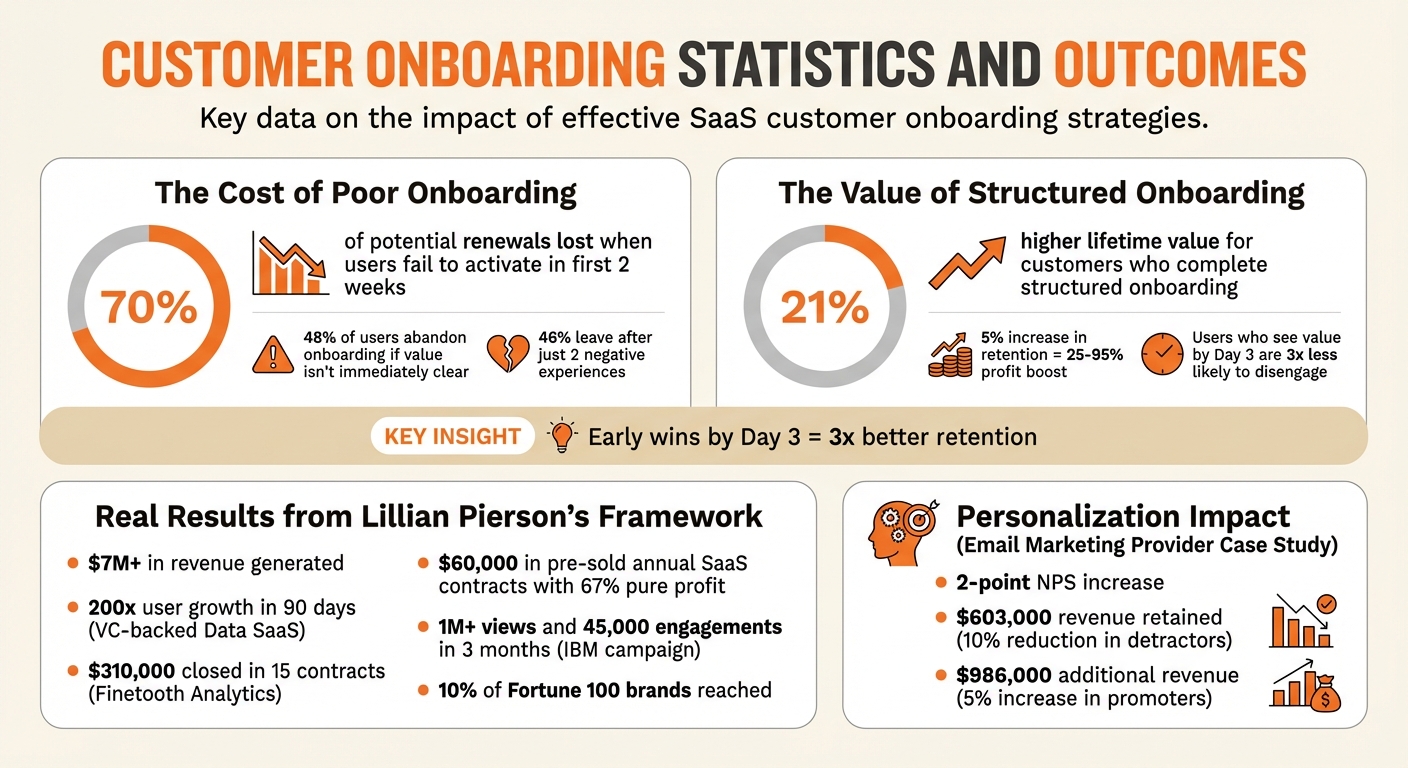
A well-structured onboarding process serves as an early warning system [4]. Data shows that customers who complete a structured onboarding process have, on average, a 21% higher lifetime value compared to those who don’t [4]. The difference lies in focusing on activation metrics – like workflows created, team members invited, or integrations completed – rather than just tracking logins.
"Onboarding isn’t a project… it’s the period that determines whether a customer will ever see enough value to renew and be a champion of your product!"
– Jay Levy, Onboard.io [4]
One major stumbling block is the handoff from sales to customer success. When critical context from the sales process gets lost, customers often find themselves repeating information they’ve already shared, which can erode trust before the relationship even begins [4]. Lillian Pierson at Data-Mania tackles this by ensuring all implementation-relevant data is captured in CRM fields before a deal closes [4].
Building Customer Trust Through Onboarding
Beyond reducing churn, structured onboarding fosters trust through proactive communication. Nearly 48% of users abandon onboarding if the product’s value isn’t immediately clear, and 46% leave after just two negative experiences [5]. Early and consistent communication reassures customers that they’ve made the right choice.
For instance, in March 2026, an email marketing provider in Europe and the Nordics revamped its onboarding process by tailoring experiences to individual customer goals and technical comfort levels. By improving pre-call preparation and personalizing interactions, they achieved a 2-point increase in NPS, retained $603,000 in revenue by reducing detractors by 10%, and generated an additional $986,000 from a 5% increase in promoters [5].
Proactive communication is key. By identifying potential pain points – like usage gaps – and addressing them before they become issues, companies position themselves as true partners in the customer’s success journey [5].
Using Onboarding to Drive Upsells and Expansion
Onboarding isn’t just about retention – it’s also a launchpad for growth. Customers who experience an early "win" within the first two weeks are three times less likely to disengage before renewal [6]. These early successes set the stage for expansion conversations.
"Your best expansion revenue does not come from a clever upsell pitch. It comes from a customer who has already won with your product and is ready to do more. Onboarding is what creates those wins."
– Sybill.ai [6]
A structured 90-day onboarding journey can pave the way for natural upsell opportunities. When Customer Success teams inherit detailed use cases and stakeholder maps from sales, they can design onboarding paths that uncover additional needs without forcing upsell conversations [6]. A success review at the three-month mark validates the ROI against the customer’s original goals, creating an ideal moment to discuss expanding seats, features, or integrations when satisfaction is at its highest [6].
Deep adoption during onboarding – where the product becomes an integral part of the customer’s workflows rather than being used superficially – drives loyalty and opens doors for expansion [4]. Even a 5% increase in customer retention can boost profits by 25% to 95% [4], making onboarding one of the most effective ways to fuel revenue growth.
Lillian Pierson’s Customer Onboarding Framework
Lillian Pierson’s onboarding framework is built around achieving customer outcomes rather than prioritizing internal convenience. Her approach reflects a customer-first mindset, where onboarding is seen as the cornerstone of predictable and scalable revenue growth [3].
The process starts with a Brand Assessment, which identifies friction points and opportunities in the customer journey [3]. This data-driven method ensures that onboarding strategies tackle genuine challenges, empowering companies to refine the customer experience before churn becomes an issue.
"I’ll dig deep to uncover your leaky buckets and untapped opportunities. Then I’ll build an evidenced-based strategy for unlocking next level growth."
– Lillian Pierson, Fractional CMO & GTM Engineer [3]
Pierson also emphasizes AI-powered growth systems to replace manual and inconsistent onboarding practices with structured, repeatable processes [3]. These systems leverage AI to personalize messaging and workflows in real time, tailoring the experience to individual customer behaviors and goals while maintaining scalability.
Aligning Onboarding with Customer Outcomes
Pierson’s strategies work backward from the customer’s desired outcomes. Instead of guiding users through a fixed sequence of product features, she identifies what success looks like for each customer segment and builds the onboarding journey around those goals [3].
Matt Brown, Head of Global Growth at Single Store, described her approach as driven by "a genuine curiosity and a commitment to understanding every facet of our brand", which allowed her to design strategies that resonated with their audience [3]. This curiosity fuels her framework, helping companies understand not only what customers purchase but why they make those decisions and what success means for them.
Her strategies are tailored to the company’s stage of growth. Early-stage startups refining their first offerings require different systems than established companies optimizing at scale. By aligning the framework with a company’s lifecycle and objectives, the onboarding process evolves alongside the business [3].
Building Systems for Scalability
Scalability is achieved by replacing manual effort with repeatable systems that deliver consistent results [3]. Key elements of Pierson’s framework include automation and team enablement. Her demand generation systems have reached 10% of Fortune 100 brands and generated over $7 million in direct revenue [3]. For instance, one VC-backed Data SaaS company achieved 200x user growth in just 90 days by implementing her systems [3].
Rather than testing isolated parts of the onboarding process, Pierson focuses on the entire customer journey to identify points of friction. These might include activation milestones, timing of human touchpoints, or the delivery of product education [1][3]. A critical aspect of scalability is training internal teams to manage and optimize these systems independently, enabling leadership to focus on broader revenue strategies.
Tony Garvan, Founder and CEO of SheetRocks, credited Pierson with bridging the gap between technical product development and customer acquisition. Her ability to translate technical capabilities into actionable customer outcomes is a defining feature of her approach [3].
Crafting Onboarding Messages That Resonate
Once scalable systems are in place, the next step is creating personalized messaging. Pierson excels at simplifying complex technical information into clear, engaging content [3]. This skill is especially valuable in onboarding, where customers often encounter unfamiliar terms and interfaces. Her framework customizes messages based on user actions, such as industry, goals, and engagement history [1].
Matt Carter, Global Program Director at IBM, praised Pierson for her ability to make highly technical topics approachable and relevant. In one IBM campaign, her strategies generated over 1 million views and 45,000 engagements in just three months [3]. This example highlights how targeted content that addresses customer pain points can deliver measurable results.
Effective onboarding messages in her framework focus on clarity and setting expectations. Customers are guided through each step, with clear timelines and outcomes, ensuring they know what to expect and what they stand to gain.
Eliminating Friction in Onboarding
A frictionless onboarding experience is built on clear milestones, automation, and well-defined success criteria. Pierson’s framework focuses on breaking down the process into manageable steps, reducing technical barriers, and aligning expectations from the start.
Kam Lee, Founder of Finetooth Analytics, reported impressive results after implementing Pierson’s strategies. The company closed 15 contracts worth $310,000 and pre-sold $60,000 in annual SaaS contracts, with 67% of that revenue being pure profit [3]. While this example spans broader go-to-market efforts, the principles of reducing friction and aligning with customer goals are integral to her onboarding methodology.
Continuous improvement is another cornerstone of her framework. By tracking customer feedback and using AI to analyze obstacles in real time, companies can refine their onboarding processes to enhance the overall experience [1][3].
"It’s time to implement a structured, repeatable system that scales beyond your personal efforts, and that drives consistent, efficient growth."
– Lillian Pierson, Fractional CMO & GTM Engineer [3]
Core Elements of a Data-Driven Onboarding Strategy
A data-driven onboarding strategy replaces guesswork with actionable insights. By tracking user behaviors, businesses can pinpoint what customers need, measure outcomes, and refine their approach based on real-world data. This approach turns onboarding into a retention driver rather than a churn risk.
Setting and Tracking Onboarding Metrics
Metrics act as a compass, showing whether customers are finding value or losing interest. For instance, the customer activation rate measures how many users complete key milestones like setting up a profile or connecting an account – steps that indicate active engagement rather than passive sign-ups [7][5]. Meanwhile, the onboarding completion rate tracks how many users finish the entire onboarding process, and the product adoption rate highlights whether users are engaging with core features within a specific timeframe [7].
With 48% of users abandoning onboarding if they don’t perceive value quickly [5], even small improvements in activation rates can directly boost revenue. Combining behavioral analytics – such as clicks, navigation paths, and time spent – with direct feedback from surveys and interviews provides a full understanding of user actions and where they drop off [5].
"If customers don’t quickly grasp the value of what they’ve bought, their interest fades fast. A shorter TTFV increases the likelihood of customer engagement and reduces churn." – Amarpreet Singh, Potion Blog [7]
These metrics form the groundwork for the personalized strategies explored in the next section.
Using Customer Data to Personalize Onboarding
Metrics alone aren’t enough; personalization transforms data into action. By mapping user behavior from sign-up onward, companies can identify where users face challenges or disengage [5]. This enables proactive solutions, such as guiding users toward meaningful actions before frustration sets in.
One email marketing provider found that a user’s technical comfort level – not their location – was the key factor in adoption. By tailoring onboarding interactions to match users’ tech proficiency, the company increased its NPS by two points, reduced detractors by 10%, retaining $603,000, and added $986,000 in revenue through a 5% rise in promoters [5].
Integrating tools like Agentic AI makes personalization even more effective. AI can suggest underused features, recommend dashboards based on user roles, or offer contextual tips when users seem stuck [5]. The secret lies in consolidating data from product logs, CRMs, and surveys into a single, actionable view of the user journey [5]. This unified approach eliminates silos, enabling real-time adjustments that align with customer behavior.
Improving Onboarding with Customer Feedback
While metrics and personalization create a structured framework, ongoing feedback ensures the process stays relevant. AI-driven tools can analyze onboarding calls and transcripts to uncover communication gaps or recurring issues that manual reviews might miss [5]. These insights help refine onboarding scripts, documentation, and support strategies [5].
Combining direct feedback with behavioral data provides the clearest picture. For example, in-app surveys collect user reactions at the exact moment they interact with a feature or encounter friction [5]. This real-time feedback, paired with usage logs, allows teams to update personas and adjust strategies based on actual evidence [5].
"Data-driven onboarding helps SaaS companies replace guesswork with insights from user behavior, feedback, and analytics." – Lindsay Joslin, Director of Global Analytics, Concentrix [5]
With 46% of customers leaving a brand after just two negative experiences [5], regular evaluations of the onboarding process are essential. By identifying drop-off points and addressing them head-on, businesses can turn early friction into lasting loyalty and drive recurring revenue [3]. This cycle of continuous improvement ensures onboarding evolves in step with customer expectations.
Conclusion
Customer onboarding lays the groundwork for activation, retention, and sustainable revenue growth. When businesses prioritize customer outcomes over internal processes, they create experiences that inspire trust, reduce churn, and open doors to expansion.
The success of this approach is evident in examples like Lillian Pierson and Data-Mania, who achieved a staggering 200x user growth in just 90 days and reached 10% of Fortune 100 brands through organic demand generation [1]. For startups earning between $1M and $4M annually, her framework transitions companies from scrappy, hustle-driven methods to scalable systems that deliver consistent growth [2].
In 2024, Kam Lee of Finetooth Analytics demonstrated the power of these strategies by closing 15 contracts worth $310,000 and locking in an additional $60,000 in annual contracts – resulting in 67% pure profit [2]. Similarly, Matt Brown, Head of Global Growth at SingleStore, credited Pierson’s partnership with helping them craft strategies that ensured their product resonated with the right audience during market entry [2].
To build scalable onboarding systems, businesses need a holistic approach that integrates data, personalization, and continuous feedback. By aligning with customer goals from the start and tracking meaningful metrics, companies can turn initial engagement into lasting loyalty. When onboarding becomes part of a larger growth strategy, early wins evolve into long-term advocacy, driving recurring revenue and organic growth.
FAQs
What counts as “activation” for my product?
Activation happens when a user takes a crucial action that indicates they’ve connected with your product and begun to recognize its value. While the specific action depends on the product, it generally involves steps that encourage retention, drive growth, and build early user confidence.
How do I identify a user’s desired outcome during onboarding?
Understanding a user’s goals during onboarding is all about figuring out what they want to accomplish with your product or service. By focusing on their objectives, tracking their progress, and customizing the onboarding experience to meet these needs, you create a more meaningful connection. This approach not only boosts their confidence but also encourages loyalty and ensures they see lasting benefits. The key is to align your onboarding steps with what matters most to them, rather than centering it around your internal workflows.
Which onboarding metrics should I track first?
Tracking user activity over time is key to understanding retention. A retention curve that flattens over time indicates you’re holding onto users effectively. Alongside this, keep an eye on Customer Acquisition Cost (CAC) to evaluate how efficiently you’re bringing in new users, and Net Revenue Retention (NRR) to measure the value existing customers continue to bring. Together, these metrics provide insight into how well your onboarding process delivers both immediate impact and lasting results.