

The SaaS Magic Number, long trusted to measure sales efficiency, is falling apart for AI companies in 2026. Here’s why:
- AI economics break the rules: AI companies face wildly unpredictable margins (from -50% to +80%) and steep infrastructure costs tied to usage, not seats.
- Usage-based revenue distorts reality: Revenue spikes from token consumption often inflate growth metrics without reflecting profitability.
- It ignores cash burn: The Magic Number overlooks the true cost of growth, including compute and infrastructure expenses that dominate AI operations.
The fix? The Burn Multiple. It calculates total cash burned per dollar of new ARR, offering a clearer picture of efficiency for AI-driven businesses. While the Magic Number still works for evaluating specific sales efforts, the Burn Multiple is better suited for tracking overall capital efficiency in the AI era. If your Magic Number looks great but cash is running out, it’s time to rethink your metrics.
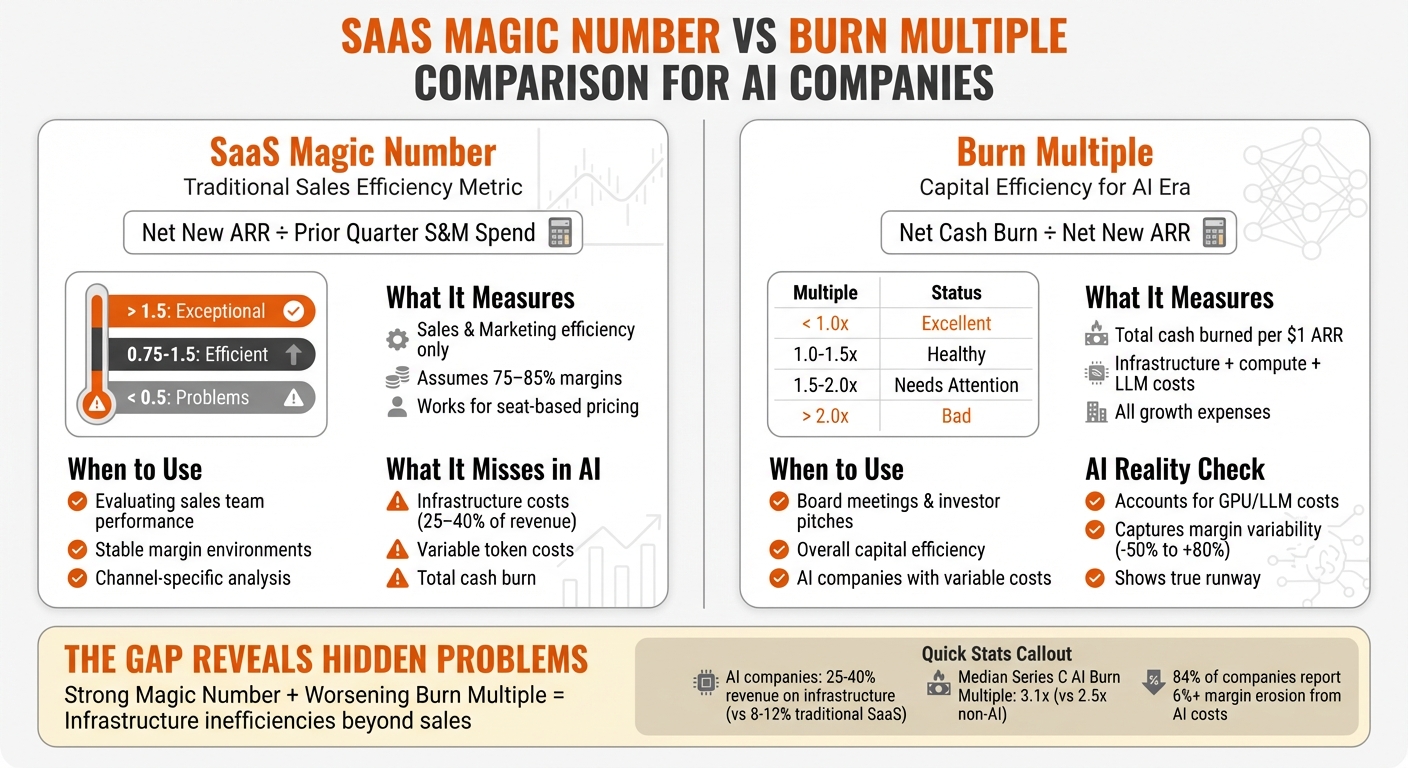
SaaS Magic Number vs Burn Multiple: Key Metrics for AI Companies
What the SaaS Magic Number Measures and Why It Worked
The Formula and Benchmarks
The Magic Number formula is straightforward: Net New ARR ÷ Prior Quarter S&M Spend. For instance, if a company generates $1 million in net new ARR while spending $800,000 on sales and marketing (S&M) in the previous quarter, the Magic Number would be 1.25. This metric, introduced by Scale Venture Partners, was designed to provide a standardized way to compare public SaaS companies using GAAP revenue figures [8][9].
The interpretation of the Magic Number is equally simple but revealing:
- Above 0.75: Indicates efficient growth.
- Above 1.5: Suggests an exceptionally effective sales engine primed for scaling.
- Below 0.5: Points to potential problems like poor product-market fit, high churn, or inefficiencies in the sales process [8][9][10][1].
A score of 1.0 reflects that the revenue generated over the next four quarters will fully repay the S&M spend from the previous quarter [8][1]. This level of clarity and predictability made the Magic Number an essential tool for evaluating traditional SaaS businesses.
Why It Worked for Traditional SaaS
The success of the Magic Number as a metric is rooted in the predictability of traditional SaaS economics. Gross margins for these companies typically ranged between 75% and 85%, with the best performers occasionally reaching 90% [2][4][5]. Additionally, fixed infrastructure costs meant that adding new customers came with almost no additional expense [2].
"The beauty of the model was near-zero marginal cost per additional user – infrastructure costs remained relatively fixed regardless of usage intensity." – Monetizely [2]
Revenue in traditional SaaS models was built on predictable, recurring streams, often through seat-based or flat subscription fees. These revenues were entirely disconnected from the cost of providing the service [4][6]. With a consistent cost structure for every dollar of ARR, the only variable was sales efficiency. This stability allowed the Magic Number to act as a reliable gauge of whether a company’s growth justified the resources being invested. It thrived because the underlying economics were steady enough to make top-line growth a dependable indicator of long-term profitability.
sbb-itb-e8c8399
3 Ways AI Companies Break the SaaS Magic Number
Margin Variability Distorts the Numbers
In SaaS, contracts with the same ARR (Annual Recurring Revenue) but different margins can produce identical Magic Numbers, even though their profitability tells a different story. For AI companies, this assumption falls apart entirely.
Margins in AI businesses can swing dramatically, from -50% to +80% across their customer base [5]. Why? Each interaction incurs variable token costs. A single heavy user can drive costs that are 10x to 100x higher than the average customer, making revenue cohorts appear healthier than they actually are [5][15].
Take Replit as an example. In March 2026, its gross margins plummeted from 36% to -14% in just two months after launching a more autonomous AI agent. The product, pricing, and team stayed the same – the only change was increased LLM (Large Language Model) consumption per customer [7]. Similarly, Anthropic operated with negative gross margins of -94% to -109% in 2024, spending more on infrastructure than it earned in revenue [5].
This isn’t an isolated issue. A staggering 84% of companies report at least a 6% erosion in gross margins due to AI infrastructure costs [5]. On top of that, only 15% of these businesses can predict their AI costs within a ±10% range [5]. The Magic Number doesn’t account for this volatility, often signaling efficiency even when each customer interaction results in a loss.
The problem becomes even more pronounced when revenue growth isn’t directly tied to sales efforts.
Usage-Based Revenue Masks True Sales Performance
In traditional SaaS, revenue growth is often a direct result of sales activity. But in AI, customer behavior – like increased usage – can drive revenue without any involvement from the sales team. For instance, if a customer doubles their token consumption, ARR grows, even though the sales team didn’t play a role [6].
This creates a blind spot for the Magic Number. It can’t differentiate between revenue generated by new sales efforts and revenue stemming from organic usage growth. A company might boast a Magic Number of 1.2, but that number could be inflated by surges in usage rather than efficient sales activity.
A real-world example: In July 2025, Cursor launched an "Unlimited" plan, only to rebrand it as "Extended" just 12 days later. Why? A single developer consumed 500 requests in one day, leading to an internal cost of $7,225 [7]. That usage spike was recorded as "growth" in the Magic Number, but it wasn’t tied to sales – and it certainly wasn’t profitable.
"Relying on traditional ARR to measure an AI business is like driving a Tesla using a road map from 1999." – Pedro Jannuzzi, SaaSholic [6]
Token-based revenue is inherently unpredictable, with monthly fluctuations that make quarterly efficiency metrics unreliable [6][11]. The Magic Number blends product stickiness with sales performance – two very different metrics in the AI world. This disconnect highlights the need for a better way to measure total growth costs.
The Metric Ignores Total Cash Burn
The final – and perhaps most critical – flaw in the Magic Number is its failure to account for the true cost of growth.
While the Magic Number focuses on sales and marketing efficiency, it overlooks the hefty infrastructure, compute, and support costs that are unavoidable in AI operations. These costs aren’t minor. AI-first SaaS companies allocate 25% to 40% of their revenue to infrastructure, compared to just 8% to 12% in traditional SaaS [2]. Similarly, their variable COGS (Cost of Goods Sold) can range from 20% to 40% of revenue, while traditional software businesses keep this below 5% [2]. Every LLM API call, GPU compute session, vector database query, and fine-tuning effort adds to these costs – and they scale with usage, not sales.
Now imagine two companies, each with a Magic Number of 1.0. On paper, they look equally efficient. But one might have healthy margins and manageable costs, while the other is burning cash on every customer interaction.
"The marginal cost of the next request is never zero. AI introduces variable COGS into businesses built for fixed-cost economics." – Midhun Krishna, tknOps [5]
The Magic Number assumes a world where the marginal cost per customer is close to zero. But in AI, every user interaction incurs a cost. Without factoring in these variable costs, the Magic Number can’t provide an accurate picture of cash runway – the metric investors care about most.
The Burn Multiple: A Better Metric for AI Companies
Why the Burn Multiple Works for AI
The Burn Multiple offers a more realistic way to measure efficiency for AI companies compared to the Magic Number, which overlooks significant infrastructure costs. AI businesses face unique economic pressures, and the Burn Multiple addresses these by asking: How much cash are you burning to generate each dollar of new ARR?
The formula is simple: Net Cash Burn ÷ Net New ARR. Unlike the Magic Number, which focuses solely on sales and marketing, the Burn Multiple takes into account all growth-related expenses – things like infrastructure, compute, LLM fees, R&D, support, and sales. This broader scope is crucial for AI companies, where infrastructure alone can eat up 25% to 40% of revenue, a stark contrast to the 8% to 12% typical in traditional SaaS companies[2].
David Sacks of Craft Ventures introduced the Burn Multiple as a "catch-all" metric for capital efficiency[17]. While it doesn’t pinpoint the exact inefficiencies – whether they stem from sales, pricing, or model-related costs – it highlights their existence. For investors, particularly in the AI space, this is often the key concern.
Take OpenAI as an example. By early 2026, leaked data revealed that the company was spending $1.69 for every dollar of revenue, largely driven by inference costs[18]. Despite reaching a $20 billion revenue run-rate by late 2025, OpenAI reported a staggering $13.5 billion net loss in just the first half of 2025[18]. The Burn Multiple brought these inefficiencies to light in a way that the Magic Number simply couldn’t.
Benchmarks and How to Use It
Understanding your Burn Multiple can help you gauge your company’s efficiency:
| Efficiency Level | Burn Multiple | What It Means |
|---|---|---|
| Excellent | < 1.0x | Spending less than $1 to generate $1 of ARR – rare and impressive |
| Healthy | 1.0x – 1.5x | Growth is sustainable with reasonable cash usage |
| Needs Attention | 1.5x – 2.0x | Costs are creeping up; time to reassess your spending |
| Bad | > 2.0x | Spending is out of control relative to growth – urgent action needed |
AI startups often show higher Burn Multiples, especially in the early stages. For example, in 2025, the median Series A AI company had a Burn Multiple of 5.0x – $1.40 higher than non-AI counterparts[19]. By Series C, the median dropped to 3.1x, still above the $2.50 median for non-AI companies[19]. What matters most is the trend over time, not just the number itself.
"The median Series C AI company is spending $3.10 to gain one dollar of new revenue compared to $2.50 for non-AI companies." – Silicon Valley Bank, State of the Market Report H2 2025[19]
Anysphere (Cursor) offers a great example. Midway through 2025, they had a negative 30% gross margin, spending $650 million annually with Anthropic while generating only $500 million in revenue[16]. By October 2025, they launched their proprietary model, "Composer", to slash costs. Just two months later, in December, they hit a $1 billion revenue run-rate with minimal monthly cash burn[16]. The Burn Multiple captured this shift, reflecting the infrastructure savings that the Magic Number would have overlooked.
While the Burn Multiple won’t solve inefficiencies on its own, it forces founders to confront them directly. For AI companies, it’s a tool that provides a clearer view of capital efficiency, addressing the blind spots left by traditional metrics like the Magic Number.
How to Use Both Metrics Together
When to Use the SaaS Magic Number
The Magic Number is still a valuable tool, but its best use lies in analyzing specific sales channels. It’s particularly effective for evaluating the performance of individual sales teams or marketing campaigns where margins remain steady over time [2]. By breaking it down by channel, representative, or campaign, you can assess the efficiency of sales or marketing efforts with consistent margins. For enterprise sales with predictable deal sizes and stable infrastructure costs, the Magic Number can highlight whether your sales reps are converting effectively.
Think of it as a focused tool for measuring micro-level efficiency.
When to Prioritize the Burn Multiple
While the Magic Number focuses on specific sales performance, the Burn Multiple takes a broader view of capital efficiency – ideal for high-level reporting.
For board meetings or investor pitches, the Burn Multiple should take center stage [6]. Investors in 2026 are laser-focused on overall capital efficiency, especially given the growing costs of AI operations. The "AI tax" – expenses like GPUs, LLM APIs, and vector databases – can eat up 20–40% of revenue [2]. The Burn Multiple is the only metric that fully accounts for these costs.
If you’re preparing a Series B or later pitch, the Burn Multiple should be the headline metric in your deck. The Magic Number can still appear as a supporting detail, but investors are primarily interested in one question: "How much cash are you burning to generate each dollar of ARR?"
What the Gap Between Metrics Tells You
The difference between these two metrics can uncover deeper cost structure issues.
A strong Magic Number alongside a worsening Burn Multiple often points to broader cost inefficiencies beyond sales [2][5]. This gap acts as a diagnostic tool, signaling that while your sales team is performing well, other areas – like infrastructure inefficiencies, poor LLM orchestration, or suboptimal model routing [4][5] – are dragging down profitability. It highlights how traditional metrics might overlook the full cost of scaling AI-driven operations.
For example, even a high Magic Number can obscure margin compression. In February 2026, Snowflake introduced its Cortex Code agent. While its core data warehouse maintained margins above 70%, industry insiders projected the AI agent’s gross margins to only hit 50% at best due to heavy token burn from multi-file refactoring and debugging cycles [14]. A strong Magic Number might have masked this margin pressure, but the Burn Multiple would have flagged it immediately.
If you see this gap widening, it’s time to check your Inference Efficiency Ratio. A ratio below 5:1 is a red flag [2]. Solutions might include implementing model routing – using cheaper models for simple tasks and reserving advanced models for complex queries [13][3] – or revisiting your pricing strategy. For instance, you could move from "unlimited" plans to hybrid models that combine a base subscription with consumption-based credits [4].
Why AI Companies Need a New Metrics Playbook
Why Traditional Metrics Fail in AI
The metrics that served SaaS companies well in the past are struggling to keep up with the complexities of AI-driven businesses.
Take Annual Recurring Revenue (ARR), for example. While it’s been the gold standard for measuring SaaS growth, it falls short in AI companies where revenue streams are more diverse. Seats, tokens, and professional services each come with their own margins, and lumping them together under a single ARR figure masks critical differences in profitability. This makes ARR less reliable as a measure of overall business health.
The same goes for LTV:CAC (Lifetime Value to Customer Acquisition Cost). This metric assumes a stable LTV, but AI disrupts that stability. Costs in AI aren’t static – they fluctuate based on usage. As Aleksei Maklakov explains:
"AI turns software costs from per customer into per action" [12].
In other words, when every user action has a variable cost, predicting LTV becomes more guesswork than science.
Then there’s the "P90 problem" – a challenge unique to AI. Your most loyal, engaged users often become your most expensive ones. In flat-rate subscription models, the top 10% of users can cost 10 to 40 times more than the average user, even though they pay the same price. This imbalance wrecks the unit economics that traditional SaaS metrics depend on.
With these traditional metrics breaking down, AI companies need a new way to measure success – one that reflects the real cost dynamics of their operations.
Building a New KPI Framework for AI
AI companies are rethinking their metrics to align with the unique economics of their business models.
One standout metric is gross profit per million tokens. This directly measures how efficiently a company operates at the model layer. Tomasz Tunguz has noted that this metric correlates strongly with AI company valuation multiples, signaling that investors are now paying attention to margin structures rather than just top-line growth [11].
Another key metric is the Inference Efficiency Ratio, which looks at revenue generated per dollar spent on inference. This offers a clear view of whether your pricing strategy can sustain your infrastructure costs. A healthy ratio is 8:1 or higher; if it dips below 5:1, it’s a red flag that your cost structure might be unsustainable [2].
For Lifetime Value, traditional predictive models are giving way to realized cohort analysis. By tracking cumulative gross profit for customer cohorts – after accounting for variable inference costs – you get a clearer picture of profitability over time [6]. While this approach takes longer than simple formulas, it’s far better at identifying which companies are thriving and which are merely surviving.
This shift toward metrics that reflect actual operational realities is essential for navigating the AI landscape.
Understanding the SaaS Magic Number – Benchmarks, Nuances & Investor Insights | SaaS Metrics School
Conclusion
The SaaS Magic Number was designed in a time when businesses enjoyed predictable 80% margins, negligible marginal costs, and revenue tied to seat-based pricing. AI companies, however, operate under an entirely different set of financial dynamics. Margins can fluctuate wildly, from -50% to +80%, depending on the customer. Revenue is often driven by token consumption rather than traditional sales activity, and infrastructure costs remain fixed, eating into cash flow regardless of sales team performance.
This mismatch between traditional metrics and AI economics creates a critical gap. A strong Magic Number combined with shrinking business resilience highlights a key issue: when the cash burned to generate new ARR surges due to rising inference and compute costs, the Magic Number loses its reliability.
Industry experts have succinctly captured this shift. Midhun Krishna stated:
"AI is not free marginal cost software anymore" [5].
This is where the Burn Multiple comes into play, exposing the hidden costs of growth that the Magic Number overlooks. While not flawless, it offers a more honest reflection of whether your growth is financially sustainable, particularly given the mounting pressures of AI infrastructure expenses [5].
For AI companies, the Magic Number still holds value for tracking sales efficiency in uniform-margin scenarios. However, the Burn Multiple should take center stage in discussions about capital efficiency, especially with investors. A strong Magic Number paired with a worsening Burn Multiple points to deeper cost structure issues rather than problems with sales performance.
For AI founders, aligning metrics with the true cost realities of the business isn’t optional – it’s essential. If your Magic Number paints a rosy picture, but your business still feels off-track, that disconnect is a signal worth exploring.
FAQs
How do I calculate Burn Multiple from my financials?
To figure out your Burn Multiple, take your net cash burned and divide it by your net new ARR. Here’s how to interpret the results: a ratio under 1x is outstanding, 1–1.5x is solid, but anything over 2x signals that there might be inefficiencies to address. This metric gives you a broader view of your growth efficiency since it factors in all expenses, not just sales and marketing.
What expenses should be included in net cash burn for AI companies?
AI companies need to factor in infrastructure expenses – such as GPU compute, LLM API fees, and vector database costs – when calculating net cash burn. These costs fluctuate based on AI inference and token usage, making them essential for accurately assessing the real cost of scaling.
What should I do if my Magic Number is strong but my Burn Multiple is worsening?
If your Magic Number looks solid but your Burn Multiple is trending in the wrong direction, it’s time to take a closer look at your infrastructure and compute expenses. A worsening Burn Multiple often points to higher capital burn compared to new ARR, which can frequently be tied to increasing AI-related costs – think token consumption or inference expenses. Tightening control over these areas can help you boost efficiency and get things back on track.
Related Blog Posts
- 5 Ways AI Can Optimize Marketing ROI for your Tech Startup
- GTM Engineering Benchmarks 2026: Time-to-First-Revenue, CAC Payback, and Pipeline Velocity for B2B SaaS
- B2B SaaS Benchmarks for 2026: Annual Report
- How AI Companies Are Monetizing in 2026: Seats, Tokens, and the Hybrid Models Winning Right Now